Our readers keep the lights on and my smoothie glass nicely filled. As an Amazon Associate, I earn from qualifying purchases.
A child’s first glimpse of the Moon’s craters through a clear lens can spark a lifelong passion for science. Yet most entry-level scopes deliver frustration, not fascination, with wobbly tripods and plastic optics that turn Jupiter into a fuzzy dot. The right pick balances real optical performance with the durability and simplicity a young astronomer needs to operate independently.
I’m Mohammad Maruf — the founder and writer behind WellFizz. I’ve spent hundreds of hours cross-referencing aperture sizes, focal lengths, eyepiece quality, and tripod stability to separate genuine beginner instruments from disappointing toys dressed up as telescopes.
This guide breaks down the seven strongest contenders on the market to help you find the very best children’s telescope for your aspiring stargazer’s age, patience level, and curiosity.
How To Choose The Best Children’s Telescope
A child’s telescope must survive bumps, be simple enough for small fingers to adjust, and still deliver a view that makes a young observer say “wow.” Three specifications separate the successful instruments from the frustrating ones.
Aperture and Light-Gathering Power
The aperture is the diameter of the main lens. A 70mm aperture collects enough light to show lunar craters, Jupiter’s cloud bands, and Saturn’s rings under dark skies. An 80mm aperture grabs about 30% more light, revealing fainter stars and more detail on planets. For a child’s first telescope, 70mm is the minimum for satisfying views — anything smaller risks disappointment.
Focal Length and Usable Magnification
Focal length determines the native magnification potential. A 400mm focal length with a 20mm eyepiece yields 20x magnification — wide enough to find targets easily. Switching to a 10mm eyepiece jumps to 40x for closer lunar inspection. A Barlow lens doubles or triples magnification, but exceeding 150x on an entry-level mount often introduces shakiness and dim images. The best children’s telescopes keep magnification in the 20x to 80x sweet spot where clarity remains high.
Mount Stability and Tripod Build
A wobbly tripod undermines every other spec. The finest optics are useless if a breeze or a bump sends the image dancing. Alt-azimuth mounts are the simplest for children to operate — just point up-down and left-right. Aluminum alloy legs with locking collars offer the best stability for the weight class. Adjustable leg height ensures the eyepiece reaches a child’s eye level comfortably without the user having to crouch.
Quick Comparison
On smaller screens, swipe sideways to see the full table.
| Model | Category | Best For | Key Spec | Amazon |
|---|---|---|---|---|
| HUGERSTAR 80mm | Premium | Best Overall — older kids/adults | 80mm aperture / 600mm focal length | Amazon |
| Dianfan 80mm | Premium | Portable stargazing with backpack | 80mm aperture / 500mm focal length | Amazon |
| Hawkko 80mm | Mid-Range | Brightest image in this price tier | 80mm aperture / 500mm focal length | Amazon |
| LeapFrog Magic Adventures | Premium | Digital learning for ages 5–8 | 2.4-inch LCD screen / 110x zoom | Amazon |
| ESAKO 70mm | Mid-Range | Budget-friendly with extras | 70mm aperture / 300mm focal length | Amazon |
| EACONN 70mm | Budget | Entry price point | 70mm aperture / 400mm focal length | Amazon |
| Wow in the World | Budget | Educational kit with podcast content | 25x / 50x magnification | Amazon |
In‑Depth Reviews
1. HUGERSTAR 80mm Telescope
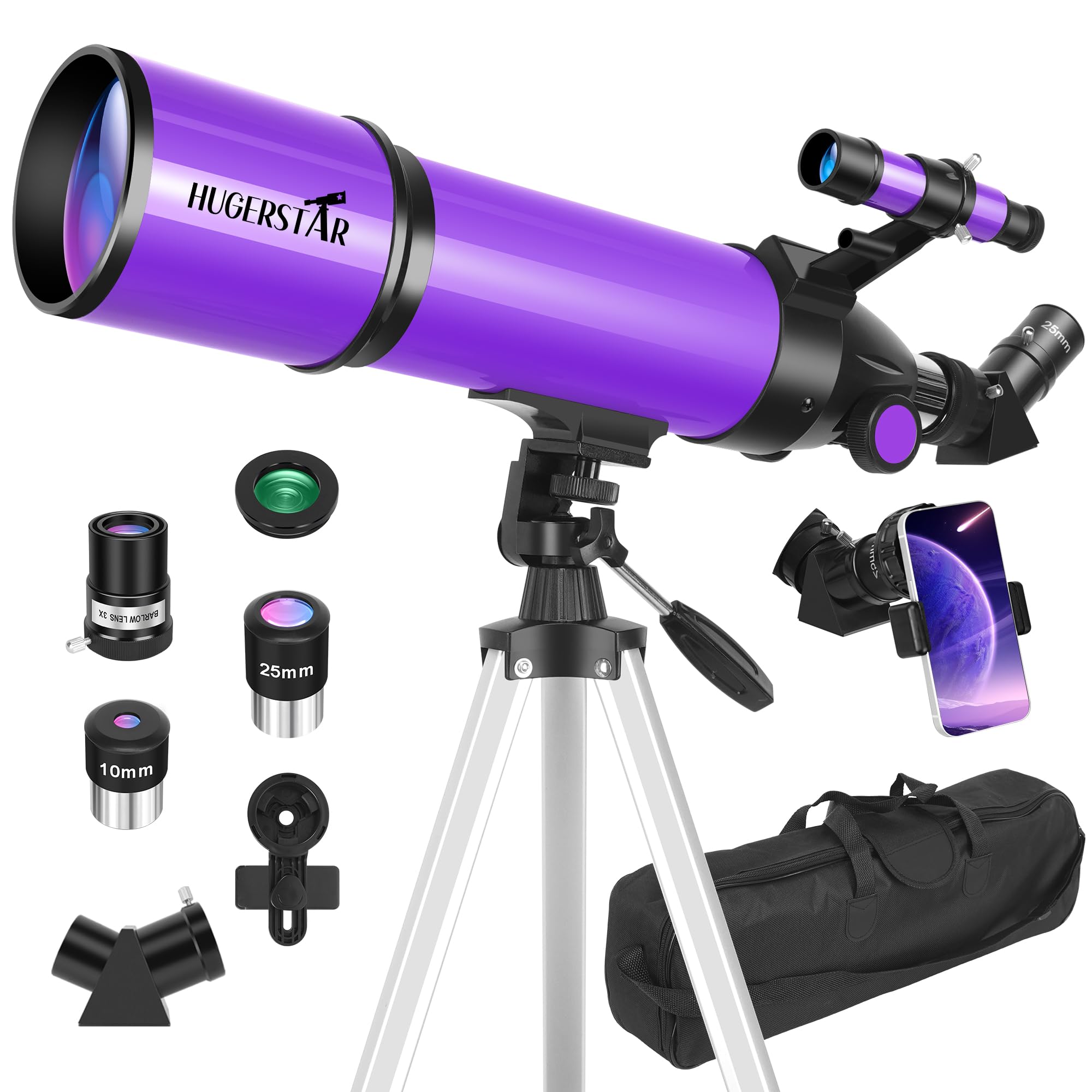
The HUGERSTAR 80mm delivers the largest aperture-to-focal-length ratio in this roundup. Its 600mm focal length paired with the 25mm eyepiece gives 24x magnification for finding targets, while the 10mm eyepiece jumps to 60x for detailed lunar cratering. The fully multi-coated lenses minimize glare and chromatic aberration, producing noticeably sharper contrast on Jupiter’s cloud bands compared to standard coated optics.
The alt-azimuth mount glides smoothly, and the aluminum tripod adjusts from 21 to 44 inches, accommodating both a seated child and a standing adult. A moon filter is included to reduce eye fatigue during bright lunar observation — a thoughtful addition that many competitors skip. The included phone adapter clips on securely, and the carry bag makes transport to a dark-sky site straightforward.
Setup takes about ten minutes without tools, and the finder scope’s straight-through design is intuitive for young users once aligned. The 3x Barlow lens pushes magnification to 180x, but image brightness drops noticeably beyond 120x under suburban skies. For a child ready to move past toy-grade optics, this is the most complete package at a mid-range investment.
Why it’s great
- 80mm aperture with fully multi-coated lenses delivers the brightest, sharpest images in its class
- Includes moon filter, phone adapter, and carry bag — everything needed to start observing immediately
- Sturdy tripod with wide leg span minimizes wobble even on uneven grass
Good to know
- Manual tracking at high magnification requires patience from younger users
- The 600mm focal length limits field of view for large deep-sky objects like the Andromeda Galaxy
2. Dianfan 80mm Telescope
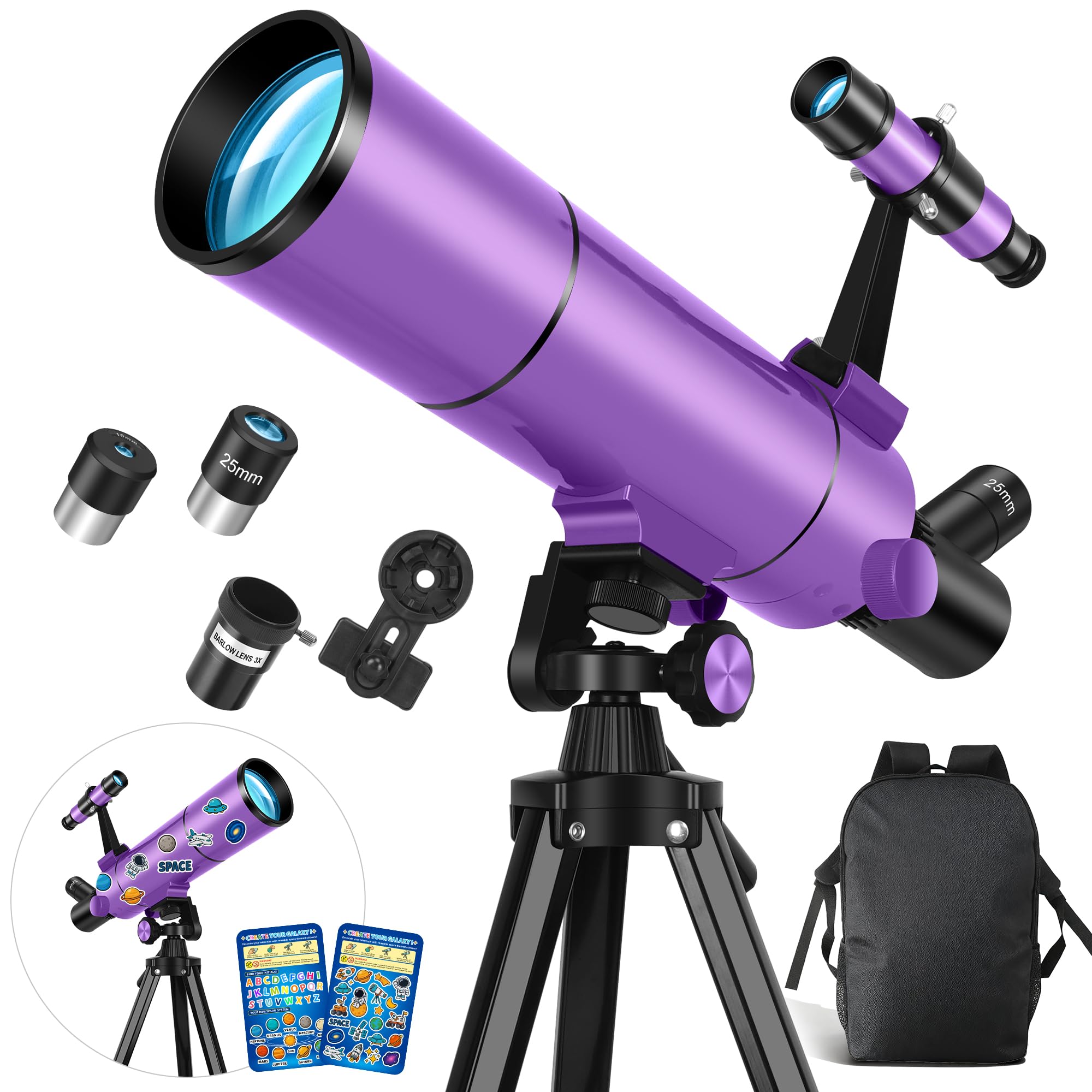
The Dianfan matches the Hawkko’s 80mm aperture and 500mm focal length but adds genuine portability with a custom-fit, water-resistant backpack. The purple finish and included reusable stickers let a child personalize the optical tube, turning the telescope into a personal project rather than just a gadget. Setup takes about 15 minutes, and the instruction manual uses clear illustrations that a motivated 8-year-old can follow.
Fully multi-coated optics gather 60% more light than a 70mm scope, translating to brighter views of Saturn’s rings at 50x magnification. The 3x Barlow lens combined with the 10mm eyepiece reaches 150x, though the image dims enough that most children will prefer the 25mm eyepiece at 20x or 10mm at 50x for everyday use. The smartphone adapter is easy to attach, and users report clear photo captures of the Moon on the first try.
The alt-azimuth mount has smooth vertical and horizontal movement, and the tripod locks at heights comfortable for kids ages 6 and up. The straight-through finder scope requires initial alignment but stays put once set. At this price point, the included backpack alone justifies the upgrade over cheaper models, making this ideal for families who camp, travel, or visit dark-sky parks.
Why it’s great
- Custom backpack makes this genuinely portable for camping and road trips
- Fun purple design with stickers encourages child engagement and ownership
- 80mm aperture with multi-coated optics provides bright planetary and lunar views
Good to know
- Focus dials require a few practice sessions before they feel smooth and natural
- Straight-through finder scope can be confusing for absolute beginners until properly aligned
3. Hawkko 80mm Telescope
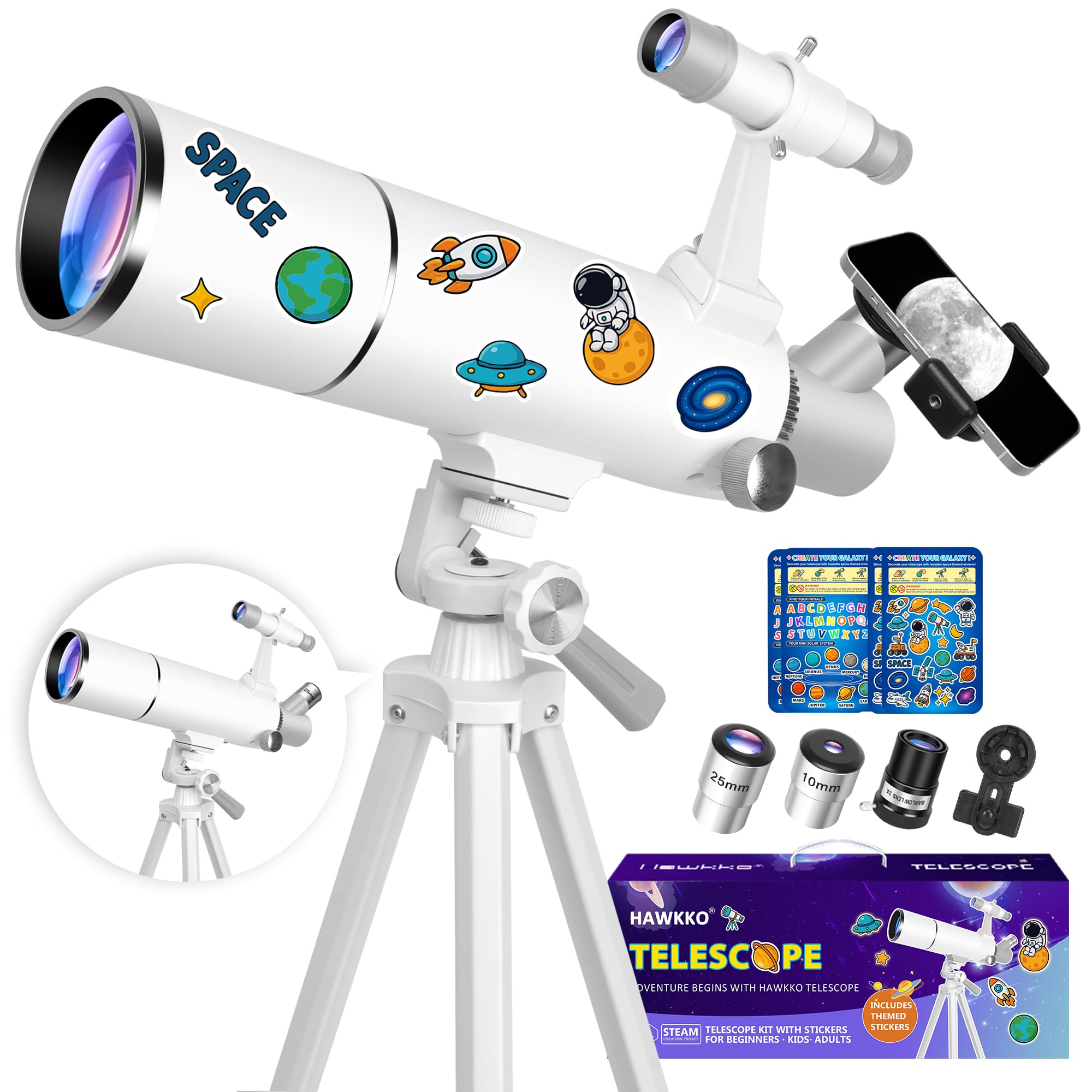
The Hawkko 80500 represents the best intersection of aperture size and price in this guide. Its 80mm objective lens with fully multi-coated coatings gathers roughly 30% more light than a 70mm scope, making a visible difference when viewing the Moon’s Terminator line or Jupiter’s four Galilean moons. Users under Utah’s dark skies reported crisp views of lunar craters and the ability to track Jupiter’s moons moving night to night.
Assembly is tool-free and takes under ten minutes. The aluminum alloy tripod is lighter than steel but still provides enough stability to minimize image shake at 50x magnification. The included space-themed stickers add a layer of personalization that children appreciate — and the white finish makes the stickers pop. The smartphone adapter requires a short learning curve to align the phone’s camera perfectly with the eyepiece, but once set, sharing photos is straightforward.
At 20x with the 25mm eyepiece, the field of view is wide enough for quick panning across star fields. Switching to the 10mm eyepiece at 50x brings lunar craters into sharp relief. The 3x Barlow pushes to 150x, but image brightness drops and the mount’s limits become apparent in windy conditions. The Hawkko is a strong choice for a child who has already shown interest and is ready for a scope that won’t become boring after one session.
Why it’s great
- 80mm aperture at an accessible price point delivers noticeably brighter images than 70mm rivals
- Tool-free assembly means a child can set it up independently after the first demonstration
- Compact and lightweight enough for easy backyard-to-park transport
Good to know
- The tripod, while adequate, is lightweight and can wobble in moderate wind at high magnification
- Basic Kellner eyepieces could be upgraded later for a wider apparent field of view
4. LeapFrog Magic Adventures Telescope

The LeapFrog Magic Adventures is not an optical telescope in the traditional sense. Instead of an eyepiece, it uses a 2.4-inch LCD screen to display a digital zoomed image of the Moon or daytime objects at up to 110x magnification. This eliminates the alignment and focusing frustration that young children experience with eyepieces, making it the most accessible option for ages 5 to 8.
The real value lies in the education content. The device includes 100+ NASA videos and images covering the solar system, star life cycles, constellations, and space discoveries. An interactive game lets children pilot a spacecraft to power satellites and reboot robots — turning passive observation into active problem-solving. The 20 cosmic cards trigger additional facts when inserted into the base. This multimedia approach keeps a short attention span engaged far longer than a traditional scope.
Battery life holds up well under daily use, though the screen image can appear grainy in bright daylight conditions. At night, the Moon view is clear enough to identify major craters. The detachable tripod provides stability, and the whole unit is durable enough to survive drops from a child’s hands — a critical feature that no glass-lens scope can claim. For parents who want a screen-based introduction to astronomy rather than a serious optical instrument, this is the clear winner.
Why it’s great
- LCD screen eliminates the frustration of aligning traditional eyepieces for young children
- NASA video content and interactive games teach space science beyond just looking at the sky
- Extremely durable construction survives drops and travel to the beach and mountains
Good to know
- Digital zoom image quality cannot match a glass-lens optical telescope for clarity
- Requires specific AA batteries for reliable function; daytime screen visibility is limited in bright sun
5. ESAKO 70mm Telescope

The ESAKO 70mm telescope uses a 300mm focal length, which is shorter than most competitors. This produces a wider field of view at the same magnification — ideal for a child learning to pan across the night sky and locate the Moon or bright planets without fighting a narrow tunnel. The 70mm fully coated aperture provides enough light for satisfying lunar views at 30x with the 10mm eyepiece.
The kit includes three eyepieces (20mm, 10mm, and 6mm) plus a 3x Barlow lens, enabling magnification from 15x up to 150x. In practice, the 150x setting exceeds the mount’s stability and the aperture’s resolving power, but the 15x to 75x range works well. The included moon filter reduces glare during full-Moon observations, and the smartphone adapter allows photo sharing without requiring a separate purchase.
Assembly is tool-free, and the aluminum tripod adjusts from a compact 12 inches to a full 38 inches. The 5×24 finder scope with crosshairs speeds up target acquisition once aligned. The tripod is lightweight and can feel flimsy on uneven ground, but on a flat backyard patio it holds steady enough for a child’s observing session. The ESAKO is a good entry-level option for a budget-conscious family wanting a full accessory set out of the box.
Why it’s great
- Short 300mm focal length provides a wide field of view that makes finding targets easier for beginners
- Comes with three eyepieces plus a Barlow lens and moon filter — no additional purchases needed
- Tool-free assembly is quick and intuitive for parents and children to set up together
Good to know
- The tripod is the weakest component and can wobble in a breeze or on soft ground
- Basic Huygens eyepieces offer a narrower apparent field than Kellner or Plössl designs
6. EACONN 70mm Telescope
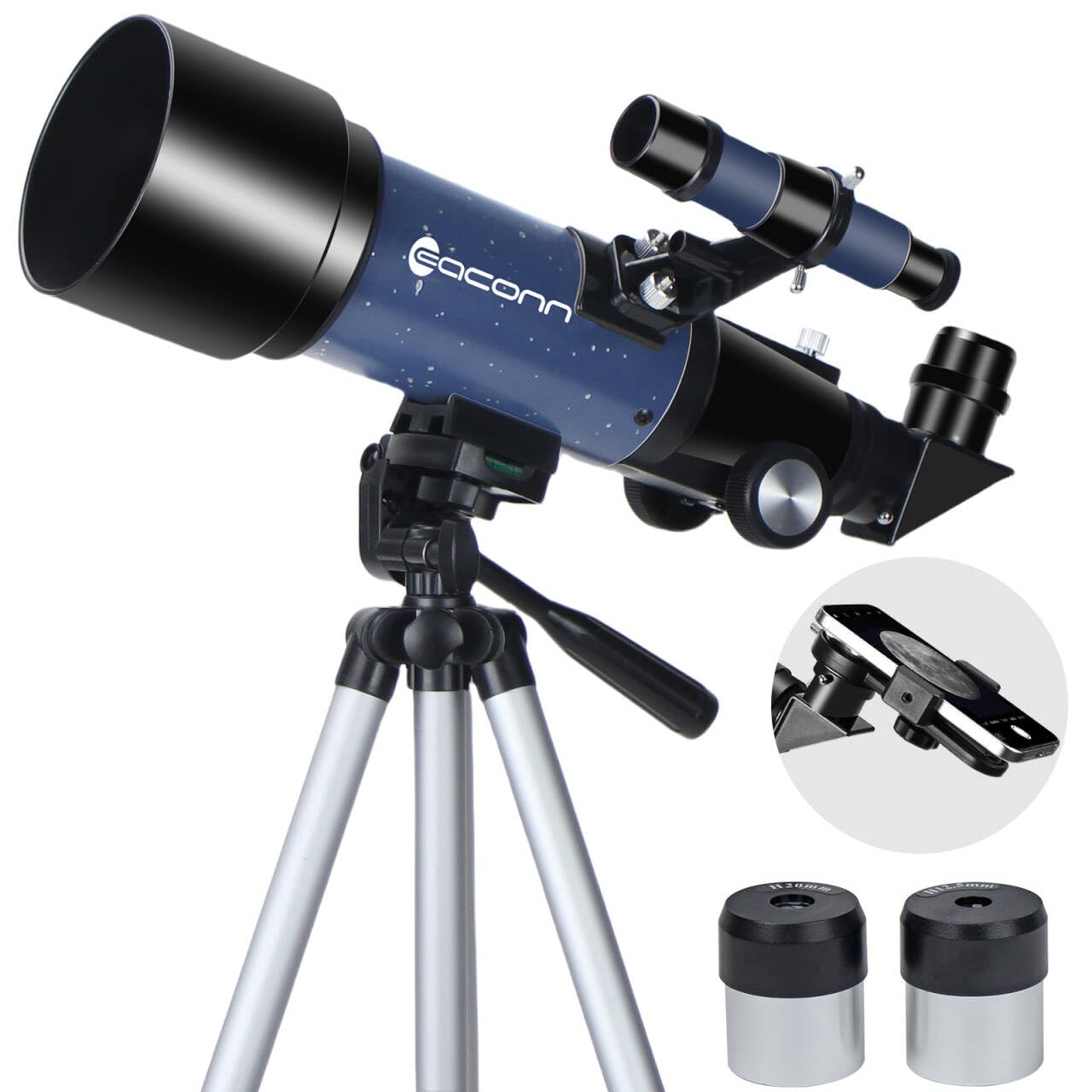
The EACONN 70mm is the most affordable telescope in this guide that still uses a proper 70mm glass objective lens rather than a plastic element. The 400mm focal length combined with the 20mm eyepiece produces 20x magnification — a forgiving starting point that lets a child find the Moon quickly without the image bouncing out of view. The 12.5mm eyepiece increases to 32x for a closer look at craters.
The aluminum alloy tripod adjusts from 12 to 38 inches, and assembly requires no tools. The crosshair finder scope helps with targeting, though aligning it with the main tube takes a few minutes of daylight practice. The phone adapter attaches securely to the eyepiece, allowing the child to capture their first Moon photos. The blue color and compact form factor appeal to younger users, and the overall weight of 1.9 kilograms is light enough for a child to carry to the backyard.
Customer reports are mixed at this price floor. Several users praise the clear moon views and ease of use, while one review notes that the unit could not achieve focus despite multiple attempts — a quality-control risk common at this tier. The tripod is best used on calm evenings, as wind vibration becomes noticeable. For the lowest possible investment, the EACONN offers a real 70mm scope, but you may need to adjust expectations for build consistency.
Why it’s great
- Genuine 70mm glass objective lens for the lowest investment available
- Lightweight and compact design makes it easy for a young child to carry and set up
- Includes phone adapter for capturing and sharing first Moon photos
Good to know
- Quality control is inconsistent — some units arrive with focus issues that cannot be resolved
- Lightweight tripod is easily destabilized by wind or accidental bumps during use
7. Wow in the World Kids’ Telescope
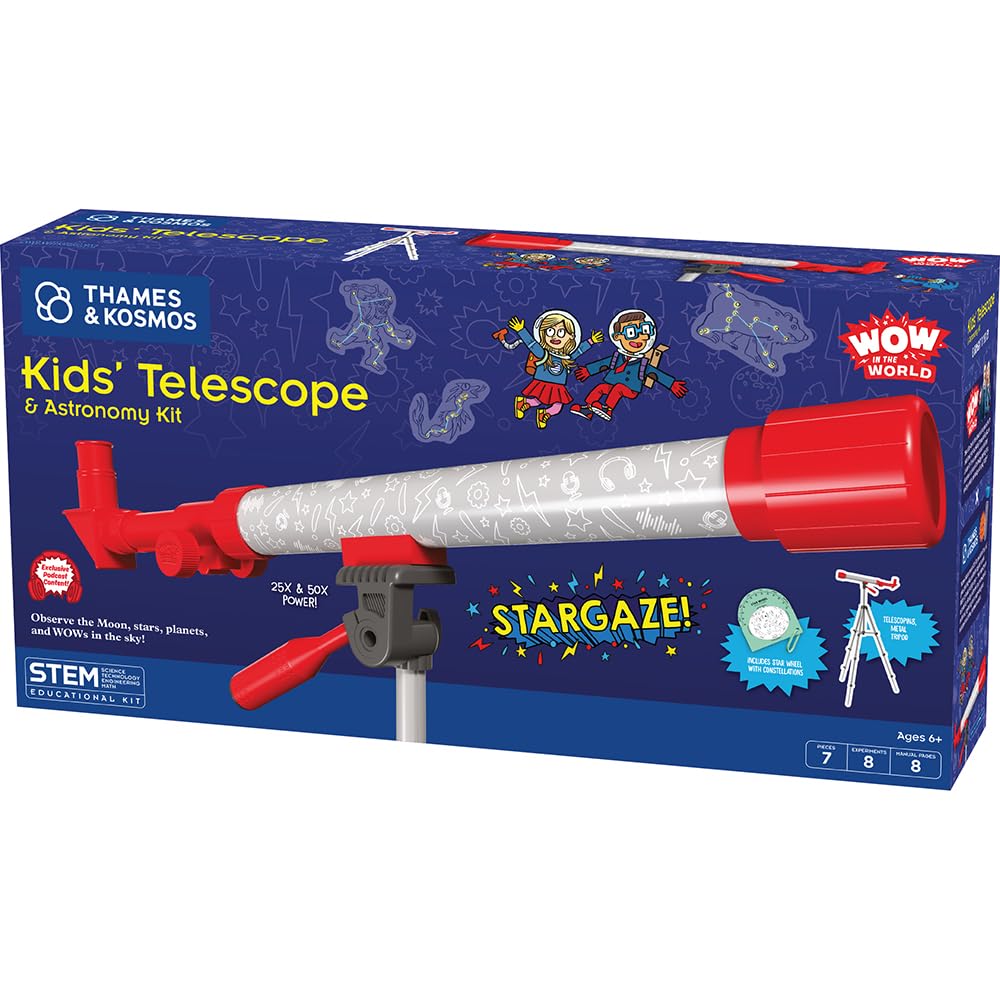
The Wow in the World telescope is a collaboration with the popular science podcast, and its design prioritizes educational context over raw optical power. The scope offers two fixed magnifications — 25x and 50x — using Kellner eyepieces that provide a wider apparent field than the Huygens lenses found on cheaper models. The 48-inch adjustable aluminum tripod is among the tallest in this guide, allowing a child to observe while standing comfortably rather than crouching.
The included “Wow-To Guide” explains how the telescope works and what to look for in the night sky, from lunar craters to specific constellations. The star wheel (planisphere) is a tangible tool that helps a child figure out which stars and constellations are visible on any given date and time in the Northern Hemisphere. Exclusive audio content from the podcast hosts Guy Raz and Mindy Thomas adds a multi-sensory layer that traditional scopes cannot match.
Optical performance is adequate for Moon viewing at 50x, but several users report that the focus is not sharp enough to resolve fine detail on planets or stars. The finder scope is basic, and the mount lacks the fine-adjustment controls needed for precise tracking at higher power. This scope is best viewed as an astronomy activity kit that happens to include a telescope — ideal for a child who loves the podcast and wants a hands-on supplement, but less suited for a kid obsessed with seeing Saturn’s rings clearly.
Why it’s great
- Includes a star wheel and educational guide that teach sky navigation skills beyond just looking through a lens
- Exclusive audio content from a popular science podcast adds engagement for young listeners
- Tall tripod adjusts to 48 inches, accommodating older children without back strain
Good to know
- Optical quality is limited — focus is often soft, and fine planetary detail is difficult to resolve
- Only two magnification options and no included phone adapter limit versatility and sharing
FAQ
What aperture is best for a child’s first telescope?
Why does my child’s telescope show blurry images even after focusing?
Is a digital telescope like the LeapFrog better than an optical one for a 5-year-old?
How high should the magnification be for a children’s telescope?
Final Thoughts: The Verdict
For most families, the best children’s telescope is the HUGERSTAR 80mm because its 600mm focal length, fully multi-coated optics, and included moon filter deliver genuinely impressive lunar and planetary views that will sustain a child’s interest across multiple seasons. If portability and personalization matter more, the Dianfan 80mm with its backpack and stickers turns stargazing into a personal adventure. And for the youngest explorers ages 5 to 7 who need a screen-based introduction, nothing beats the LeapFrog Magic Adventures for combining observation with interactive learning.

Mo Maruf
I created WellFizz to bridge the gap between vague wellness advice and actionable solutions. My mission is simple: to decode the research and give you practical tools you can actually use.
Beyond the data, I am a passionate traveler. I believe that stepping away from the screen to explore new environments is essential for mental clarity and physical vitality.