Our readers keep the lights on and my smoothie glass nicely filled. As an Amazon Associate, I earn from qualifying purchases.
Waking up shivering at 3 a.m. because the ground sucked every degree of warmth from your body is a camping experience no one repeats. A standard three-season pad lets the cold seep through the foam and fabric, turning your sleeping bag into a useless sack. The only fix is a pad built with enough insulation—measured by its R-value—to stop thermal bridging between you and the frozen earth.
I’m Mohammad Maruf — the founder and writer behind WellFizz. I’ve spent hundreds of hours cross-referencing ASTM insulation tests, real-user field reports, and material specs to separate the pads that actually hold warmth from those that merely claim to.
This guide breaks down seven of the most capable options on the market, from ultralight backpacking winners to car-camp behemoths, so you can confidently buy the best cold weather sleeping pad for your specific trip and budget.
How To Choose The Best Cold Weather Sleeping Pad
Buying a cold-weather sleeping pad is not the same as picking a generic camping mat. The ground in winter acts like a massive heat sink, and a pad with insufficient insulation will drain your core temperature all night, regardless of your sleeping bag’s rating. You need to evaluate three primary factors: R-value, insulation construction, and physical dimensions.
R-Value: The Cold-Weather Minimum
R-value measures thermal resistance—how well the pad stops heat from escaping into the ground. For three-season camping, an R-value of 2 to 4 is acceptable. For genuine cold-weather use at or below freezing, you should aim for an R-value of 5 or higher. Pads with an R-value above 7 are designed for deep winter and sub-zero expeditions. Always look for ASTM F3340-22 tested values, as unregulated “R-value” claims from generic brands can be wildly inflated.
Insulation Type: Reflective Film vs. Foam vs. Air
Ultralight pads often use metallized reflective films (like ThermaCapture or Thermal Mirror) that trap radiant body heat without adding weight or bulk. These are excellent for backpackers but can be crinkly. Self-inflating pads use an open-cell foam core that both insulates and provides structure—they are heavier but quieter and more durable. Pure air pads with no insulation layer are fine for summer but useless in the cold; avoid them for winter use.
Thickness, Width, and Packed Size
A thicker pad (3 inches or more) keeps your body farther from the cold ground and offers better comfort on uneven terrain. Wider pads (25 to 30 inches) prevent your arms and shoulders from sliding off onto the bare tent floor, which is a major heat-loss zone. However, thicker and wider pads weigh more and pack larger—car-campers can accept this, but backpackers must balance warmth against pack volume.
Quick Comparison
On smaller screens, swipe sideways to see the full table.
| Model | Category | Best For | Key Spec | Amazon |
|---|---|---|---|---|
| Therm-a-Rest NeoAir XTherm NXT | Air Pad | Ultralight Winter Backpacking | R-Value 7.3 | Amazon |
| NEMO Tensor All-Season | Air Pad | Quiet, Lightweight 4-Season Use | R-Value 4.8 | Amazon |
| Hikenture Self Inflating 4″ | Self-Inflating | Car Camping Comfort | R-Value 9.5 | Amazon |
| HEST Foamy | Memory Foam | Ultimate Car Camping Luxury | Thickness 8.8 in | Amazon |
| Big Agnes Rapide SL | Air Pad | Three-Season to Shoulder Season | R-Value 4.8 | Amazon |
| OGERY Self Inflating | Memory Foam | Value Winter Car Camping | R-Value 9.5 | Amazon |
| Hikenture Insulated 6.2 | Air Pad | Budget Winter Backpacking | R-Value 6.2 | Amazon |
In‑Depth Reviews
1. Therm-a-Rest NeoAir XTherm NXT Ultralight Camping and Backpacking Sleeping Pad

The NeoAir XTherm NXT is the benchmark that every cold-weather pad is measured against. With an ASTM-tested R-value of 7.3, it delivers genuine expedition-grade warmth while weighing only 15.5 ounces in the Regular size—a feat no foam-core pad can match. The reflective ThermaCapture technology traps radiant body heat, and the Triangular Core Matrix baffles minimize convective heat loss, so you stay warm even when the mercury drops well below zero.
At 3 inches thick, the pad provides enough loft to keep hips and shoulders off the ground, and the 70D ripstop nylon bottom resists punctures from rocky camp spots. The WingLock valve allows fast inflation and lightning-quick deflation, and it operates easily with gloved hands in freezing conditions. The included pump sack inflates the pad without introducing moisture, which prevents internal mold.
Several users report a crinkling noise when moving, a trade-off of the reflective film layers. Some have also experienced slow leaks, though Therm-a-Rest’s reputation for customer service and the included patch kit mitigate that risk. For anyone who needs the lightest, warmest pad for winter backpacking, this is the gold standard.
Why it’s great
- Exceptional warmth-to-weight ratio at 7.3 R-value and 15.5 oz
- Durable 70D bottom fabric resists punctures on rough terrain
- Fast, gloved-hand-friendly WingLock valve
Good to know
- Crinkly noise from reflective film can disturb light sleepers
- Narrow 20-inch width may cause arm spill-off for broader sleepers
2. NEMO Equipment Tensor All-Season Ultralight Insulated Sleeping Pad
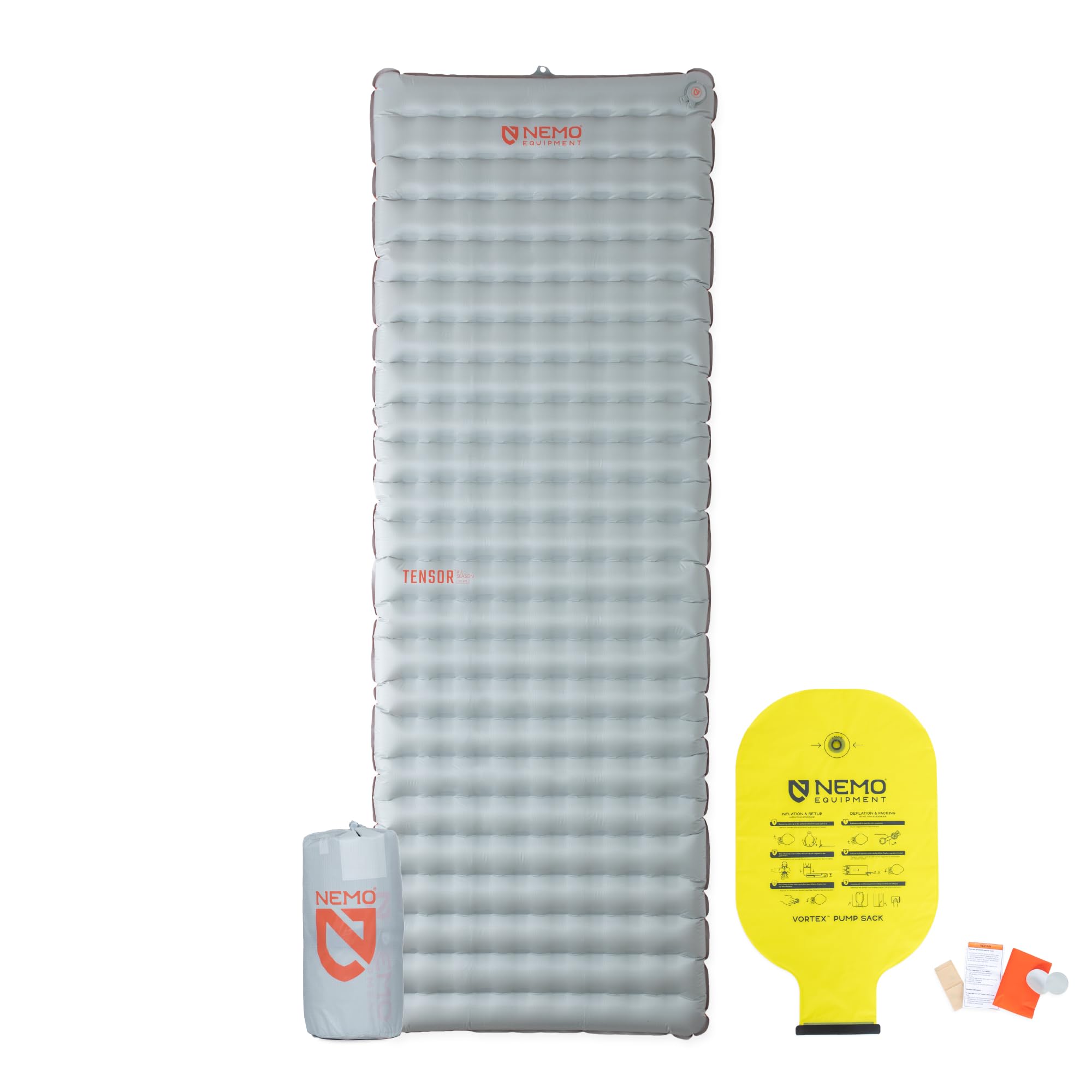
The Tensor All-Season is engineered for campers who refuse to sacrifice silence for warmth. NEMO’s floating Thermal Mirror metallized film provides insulation without the loud crinkling that plagues many reflective pads. The R-value of 4.8 makes it a capable three-season-plus pad, handling temperatures into the low 20s Fahrenheit, though it falls short of the extreme-winter insulation needed for deep sub-zero trips.
Spaceframe baffles use low-stretch, die-cut trusses that eliminate the springy, unstable feeling common on other air pads. At 3.5 inches thick, the pad offers generous cushioned loft, and the 25-inch wide version provides roomy comfort for side sleepers who tend to roll off narrower pads. The Vortex pump sack inflates the pad in two to three fills without using breath moisture.
The bluesign-approved 20D nylon fabric is light but not as puncture-resistant as the 70D bottom on the XTherm. Some users note the pad is slightly narrow in the shoulders for larger frames. It is a premium choice for hikers who want a quiet, stable, and warm pad for shoulder-season and mild-winter camping.
Why it’s great
- Remarkably quiet surface—no crinkling during movement
- Stable Spaceframe baffles eliminate springy bounce
- Wide 25-inch option provides better cold-ground coverage
Good to know
- R-value of 4.8 is not sufficient for deep winter expeditions
- Thin nylon fabric requires careful campsite selection
3. Hikenture 4 INCH Thick Self Inflating Sleeping Pad
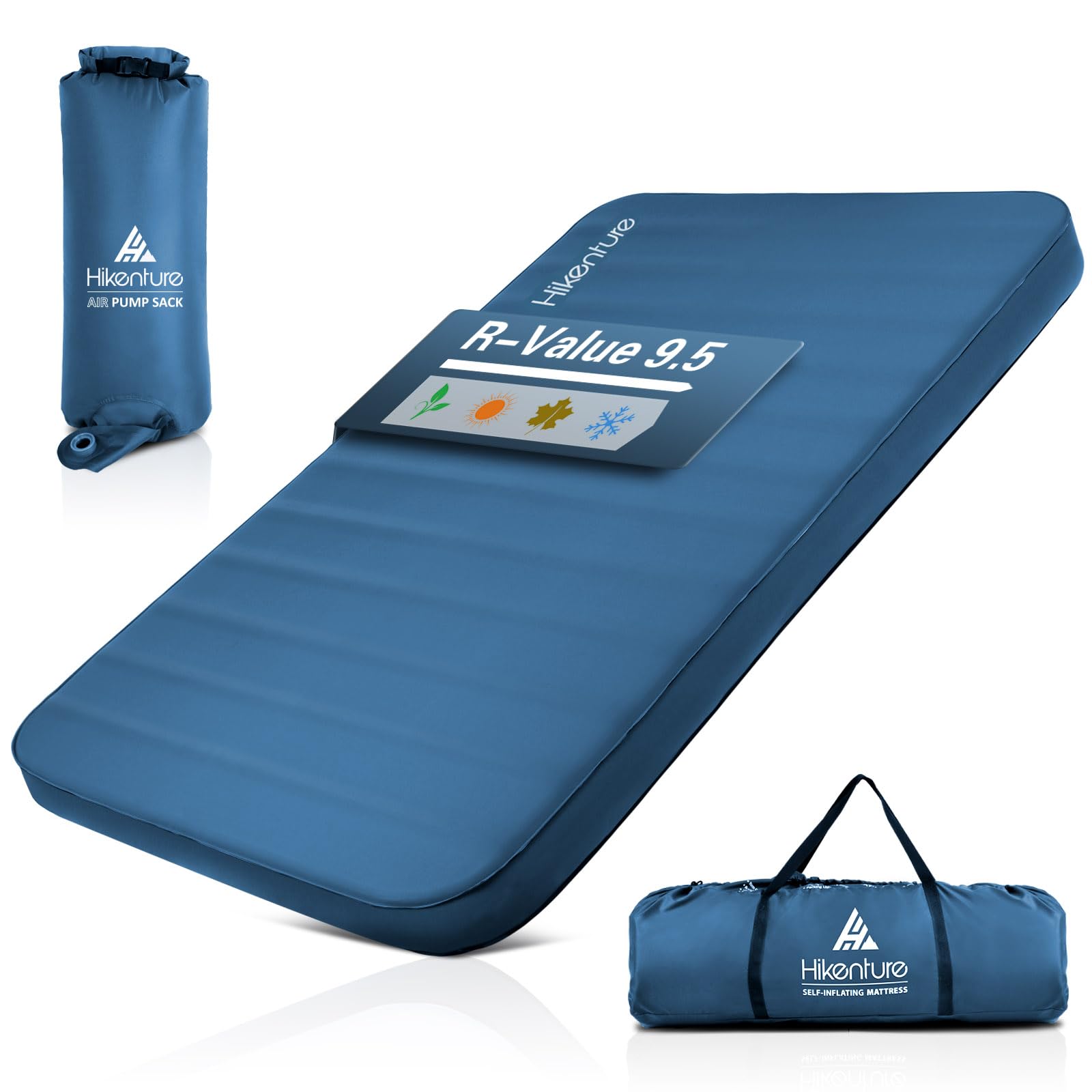
This Hikenture pad is the car camper’s dream: 4 inches of memory foam and air deliver a plush, quiet sleeping surface that rivals a home mattress. The R-value of 9.5 is among the highest on the market, meaning this pad will keep you warm even on frozen ground in a tent or truck bed. The self-inflating foam core takes the work out of setup—just open the patented two-way valve and let it expand.
At 80 x 28 inches, the pad is spacious enough for tall and broad sleepers, and the 4-inch thickness keeps hips from bottoming out against the cold earth. The included pump sack allows a few quick air bags to top off firmness after the foam self-inflates. Users consistently praise the durable build, quiet fabric, and lack of air loss over multiple nights.
The main drawback is weight: at 8 pounds, this pad is firmly in car-camp territory and not suitable for backpacking. The double-wide 52-inch version increases comfort for couples but adds even more bulk. Deflating and rolling the pad requires some effort due to the foam core. For vehicle-based winter camping, the warmth and comfort are unmatched.
Why it’s great
- R-value of 9.5 provides extreme cold-weather insulation
- 4-inch foam core offers luxurious cushioning and support
- Quiet polyester surface with no crinkling noise
Good to know
- 8-pound weight makes it impractical for backpacking
- Self-inflating foam can be tedious to fully pack down
4. HEST Foamy Camping Mattress Pad

The HEST Foamy redefines camping comfort by replacing air with a dense, dual-layer memory foam core that measures 8.8 inches thick—the tallest pad on this list. This sheer thickness lifts your body so far from the ground that cold-soak is virtually eliminated. It is a closed-cell foam construction, so there is no pump, no air valve, and no risk of a puncture deflating you at 2 a.m.
The 30-inch width provides a very spacious sleeping surface, and the integrated compression strap doubles as a welcome mat when unrolled. A top stash pocket keeps a phone or glasses handy. Users with back pain consistently report that this pad delivers the best sleep they have ever had while camping, with many saying it feels more comfortable than their home bed.
The trade-offs are significant weight (11 pounds) and bulk—this pad is for car camping, van life, or overlanding only. It is not packable for hiking. The foam can feel slightly warm in summer, and side sleepers over 200 pounds may experience some shoulder pressure. For pure, luxurious cold-weather car camping, nothing else on this list compares.
Why it’s great
- 8.8-inch memory foam eliminates ground cold completely
- No pump, no air valve, zero risk of deflation
- 30-inch wide surface offers exceptional sleeping room
Good to know
- 11-pound weight and large rolled size are car-camp only
- Side sleepers with heavy frames may find foam density too firm
5. Big Agnes Rapide SL Insulated Sleeping Pad

The Rapide SL bridges the gap between ultralight backpacking pads and cushy car-camp models. With an R-value of 4.8, it handles temperatures down to the mid-20s Fahrenheit, making it a strong choice for shoulder-season backpacking and early winter trips where extreme cold is not expected. The quilted top creates a pillowy sleeping surface, and the offset I-Beam construction reduces weight while delivering consistent stability.
At 4.25 inches thick with larger outer chambers, the pad cradles you comfortably and prevents the air-mattress bounce that can disturb sleep. The Pumphouse inflation sack fills the pad in about 4 minutes without moisture, and the high-volume valve allows micro-adjustments to fine-tune firmness. The 20×78-inch Regular size is light enough for bike packing and fits well inside most tents.
The main limitation is the 20-inch width—side sleepers or broad-shouldered users will likely want the 25-inch wide version. The pad is not warm enough for deep winter camping without a closed-cell foam layer underneath. For three-season backpackers who want a comfortable sleep without sacrificing packability, this is a top-tier pick.
Why it’s great
- Quilted top and offset beams provide stable, plush comfort
- High-volume valve allows easy micro-adjustments to firmness
- Lightweight enough for backpacking and bike packing
Good to know
- 20-inch width may cause arm spill-off for larger sleepers
- R-value of 4.8 is insufficient for sub-freezing winter nights
6. OGERY Self Inflating Sleeping Pad with Electric Pump
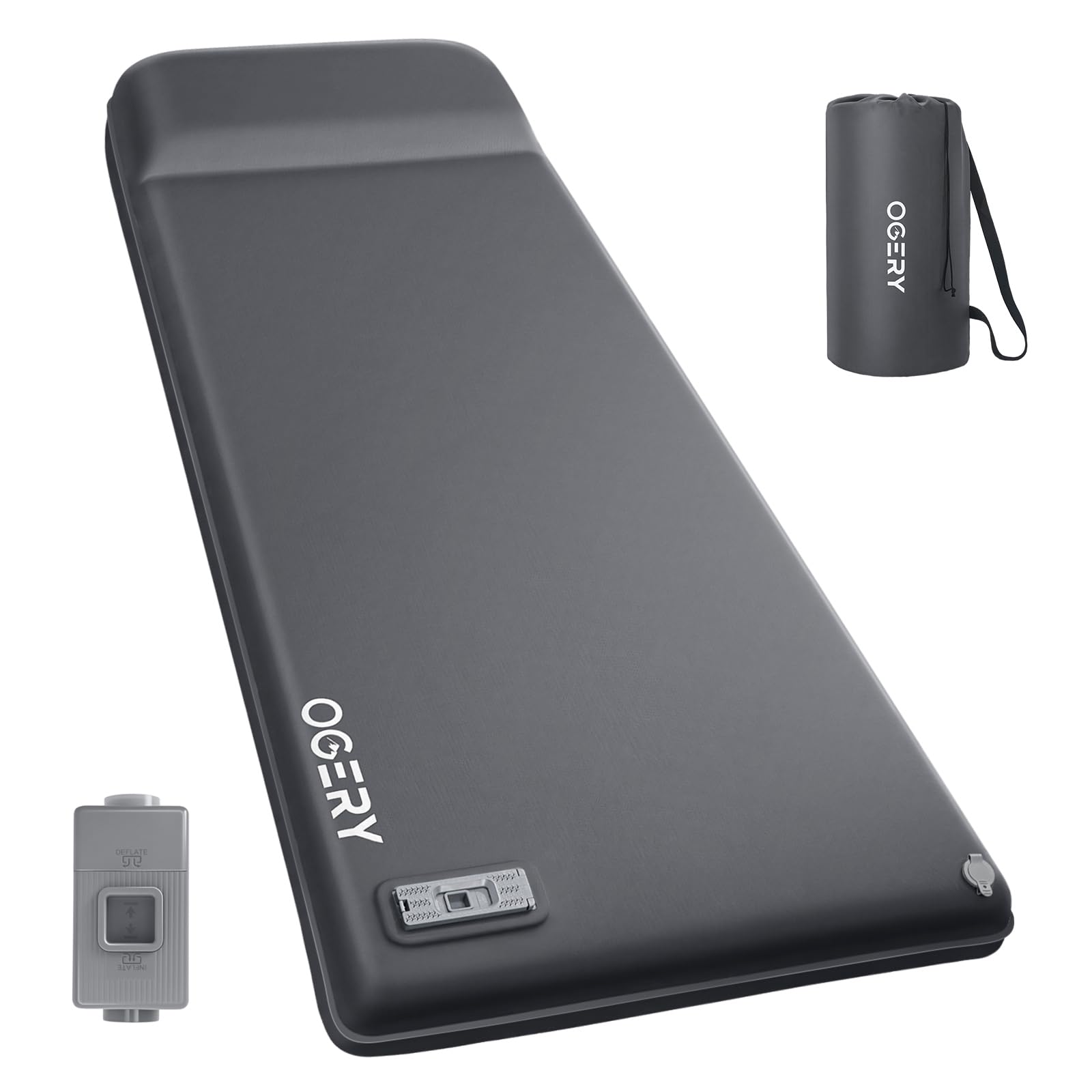
The OGERY pad delivers a massive R-value of 9.5 at an entry-level price point, making it one of the most affordable ways to stay warm in freezing conditions. The memory foam core combined with the detachable electric pump means you can set up a thick, insulated sleep surface in about 40 seconds without manual pumping. The 3.15-inch thickness provides good separation from the cold ground.
The built-in pillow adds head support, though many side sleepers may still prefer their own pillow for proper neck alignment. The 50D stretch knit fabric feels soft and quiet compared to crinkly air pads. The USB-C rechargeable pump charges from a car charger or power bank and supports up to 7 inflations per charge. The pad measures 76.77 x 26.38 inches, offering ample room for most sleepers.
At 5.95 pounds, this pad is best suited for car camping, RV travel, or guest-room duty—not backpacking. The foam core takes patience to fully roll and compress back into the carry bag. The electric pump is louder than manual pump sacks. For budget-conscious car campers who need serious cold-weather insulation, this pad delivers extraordinary value.
Why it’s great
- R-value of 9.5 rivals premium pads at a fraction of the cost
- Electric pump inflates in under a minute with no manual effort
- Soft knitted fabric surface is quiet and comfortable
Good to know
- 6-pound weight and foam bulk are car-camp only
- Electric pump is loud and relies on battery charge
7. Hikenture Camping Sleeping Pad with 6.2 R-Value
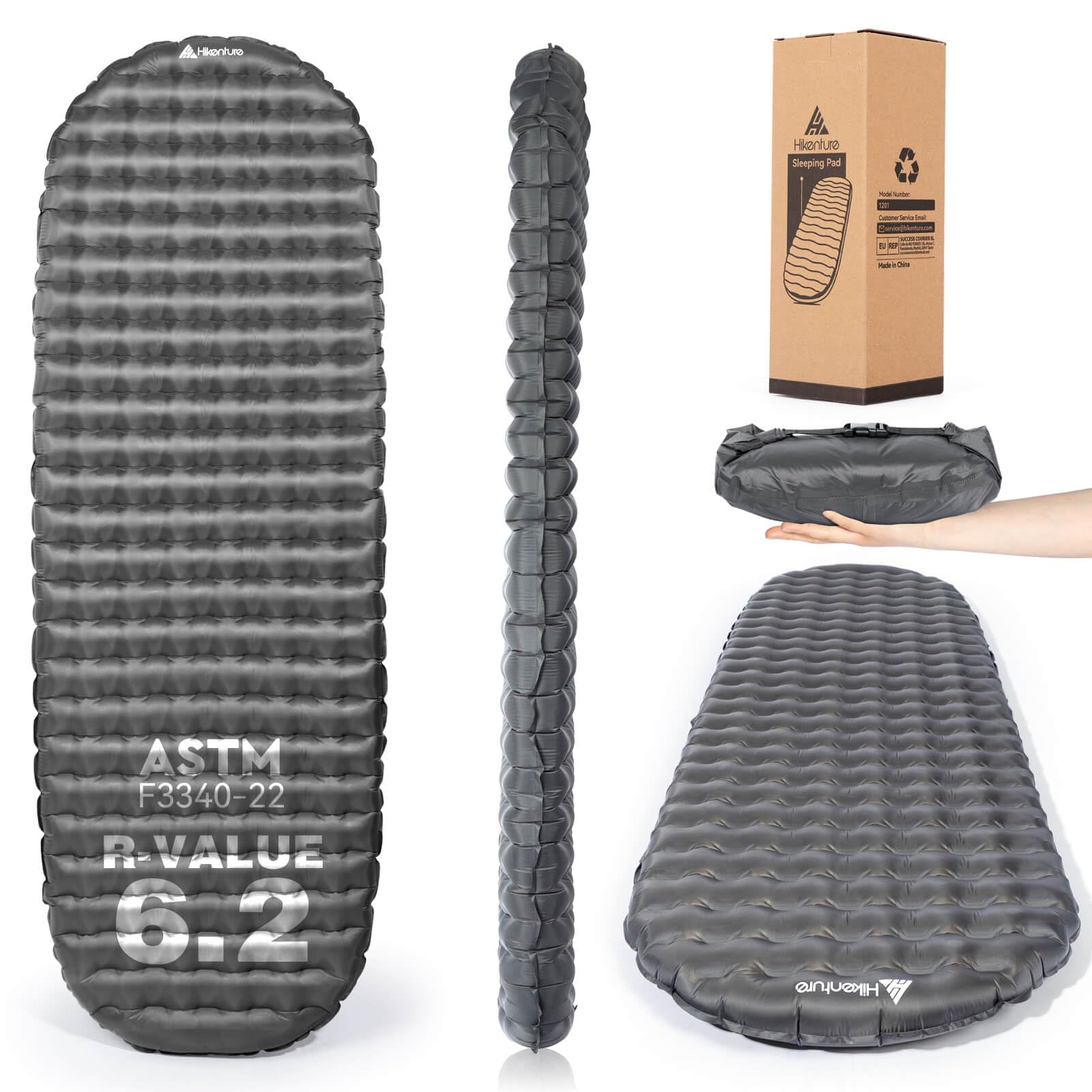
This Hikenture pad proves that you do not need to spend premium money for serious cold-weather insulation. With an ASTM-tested R-value of 6.2, it provides enough warmth for winter camping well below freezing, and the 3.2-inch thickness keeps your body off the cold floor. The reflective aluminum film inside traps body heat, and the airbag structure distributes pressure evenly to prevent bottoming out.
Weighing around 1.7 pounds (actual weight from users slightly higher than advertised), it is light enough for backpacking, and the included 40L pump sack inflates the pad with just three air bags. The 2-in-1 storage bag allows you to stuff extra clothing inside, saving pack space. Users report the pad survives heavy use, including kids jumping on it and dog nails, and the included repair patches handle any punctures.
The main complaint is crinkling noise from the reflective inner liner when shifting position. The valve at the foot end is hard to reach and open one-handed, and rapid deflation requires practice. Some users found the pad heavier than the listed 1.53 pounds. For budget-minded winter campers and backpackers, this pad offers an unbeatable warmth-to-dollar ratio.
Why it’s great
- R-value of 6.2 handles genuine winter conditions affordably
- Light enough for backpacking at under 2 pounds
- Pump sack doubles as storage bag for extra gear
Good to know
- Reflective liner creates crinkling noise during movement
- Foot-end valve is awkward to reach and operate with one hand
FAQ
What R-value do I need for winter camping?
Can I use a self-inflating pad in deep winter?
Why do some cold-weather pads make crinkling noises?
Should I get a wide pad for cold weather?
Final Thoughts: The Verdict
For most users, the best cold weather sleeping pad winner is the Therm-a-Rest NeoAir XTherm NXT because it combines an R-value of 7.3 with a sub-16-ounce weight, making it the most versatile winter pad for backpackers and mountaineers. If you want unmatched car-camping comfort with zero risk of deflation, grab the HEST Foamy. And for a budget-friendly option that still delivers serious insulation, the Hikenture 6.2 R-Value Pad offers exceptional warmth for the dollar.

Mo Maruf
I created WellFizz to bridge the gap between vague wellness advice and actionable solutions. My mission is simple: to decode the research and give you practical tools you can actually use.
Beyond the data, I am a passionate traveler. I believe that stepping away from the screen to explore new environments is essential for mental clarity and physical vitality.