Our readers keep the lights on and my smoothie glass nicely filled. As an Amazon Associate, I earn from qualifying purchases.
For a person living with dementia, a standard wall clock becomes a source of confusion—ambiguous hands, missing date information, and no clear indication of whether it’s morning or night. A specialized clock designed for this condition replaces guesswork with a bold, unambiguous display of the day, date, and time period, restoring a critical sense of orientation and reducing anxiety.
I’m Mohammad Maruf — the founder and writer behind WellFizz. This guide is built on hours of analyzing the specific display logic, alarm systems, dimming behavior, and ease-of-setup that define whether a clock actually helps someone with memory loss stay grounded in their daily routine.
After comparing seven models across multiple price tiers, these are the reviews you need to find the right clock for dementia patients that fits your family member’s specific living situation and cognitive needs.
How To Choose The Best Clock For Dementia Patients
The wrong clock adds frustration to an already disorienting experience. The right one becomes a silent caregiver. Here are the features that separate a helpful tool from a decorative object.
Screen Clarity and Display Logic
The most critical spec isn’t resolution—it’s how the clock labels the time of day. Look for models that spell out “Morning,” “Afternoon,” “Evening,” or “Night” instead of relying on AM/PM indicators. A large, non-abbreviated day of the week (Monday instead of MON) and full date (April 12 instead of 4/12) eliminate the cognitive load of decoding abbreviations.
Alarm and Reminder Systems
Multiple daily alarm slots let you set reminders for medication, meals, and appointments without overlap. The best models allow separate tones or visual icons for each type of reminder. A snooze function is useful, but be careful—unlimited snoozing can defeat the purpose of a scheduled medication prompt.
Brightness and Nighttime Behavior
A clock that glares at full brightness all night disrupts sleep. Auto-dimming that lowers the screen after 7 PM or 8 PM is a must-have. Some models also feature a completely blank screen option with voice-only time checks, which is ideal for those highly sensitive to light.
Battery Backup and Power
Dementia clocks often sit in bedrooms or nursing stations where power outages are a real risk. A built-in battery backup that retains the time and alarm settings after a blackout prevents the confusion of a flashing “12:00” that the user cannot reset themselves.
Quick Comparison
On smaller screens, swipe sideways to see the full table.
| Model | Category | Best For | Key Spec | Amazon |
|---|---|---|---|---|
| Pastigio 10.1″ | Premium | Full-featured home use | 10.1″ IPS, 6 alarms + 10 reminders | Amazon |
| American Lifetime | Premium | Durable wood-frame design | Wood frame, 5 alarms, auto-dimming | Amazon |
| Top Life Talking Clock | Premium | Visually & hearing impaired | 85 dB voice, one-button operation | Amazon |
| Mitoart 7″ | Mid-Range | Best overall balance | 7″ display, voice announcement, auto-DST | Amazon |
| AINFTIME 7″ | Mid-Range | Multi-display versatility | 3 display modes, 12 alarms, digital photo frame | Amazon |
| Aowasi 7″ | Mid-Range | Simple, proven reliability | 12 alarms, non-abbreviated text, battery backup | Amazon |
| WallarGe Atomic | Budget | Atomic self-setting accuracy | 14.5″ display, atomic sync, temperature display | Amazon |
In‑Depth Reviews
1. Pastigio 10.1″ Digital Clock With Date And Time
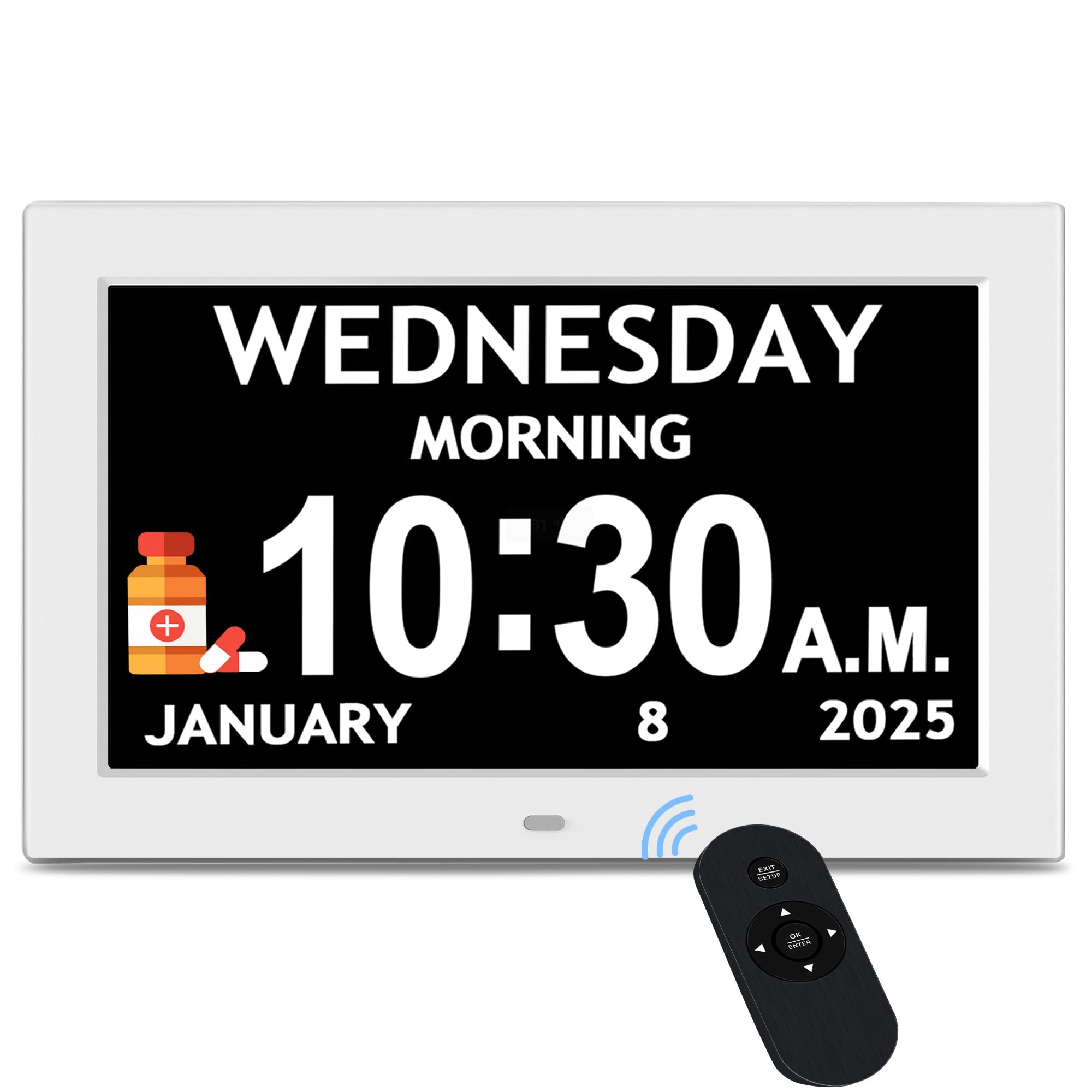
The Pastigio offers the largest screen in this roundup at 10.1 inches, with a crisp 1024×600 IPS panel that remains readable from any angle. It divides the day into five phases—Before Dawn, Morning, Afternoon, Evening, and Night—answering the disorientation question instantly. The visual icons for reminders (pill, water, sleep) reduce reliance on text comprehension.
With six custom alarms and ten daily reminders, this clock is effectively a scheduling hub. The five adjustable volume levels and five distinct tones mean you can match the alert to the user’s sensitivity. The included remote control is a genuine convenience for caregivers who need to adjust settings without bending over the unit or disturbing the user.
Auto-dimming adjusts to ambient room light, and the display offers five fixed brightness levels. The clock supports eight languages and four color themes, giving you visual customization that can prevent the screen from feeling sterile or unfamiliar. It runs on AC power with a backup battery included.
Why it’s great
- Largest and sharpest display of any model tested
- Five-phase day orientation removes AM/PM confusion
- Remote control for caregiver convenience
Good to know
- Must remain plugged in at all times
- Remote may interfere with other IR devices
2. American Lifetime Upgraded Version Day Clock
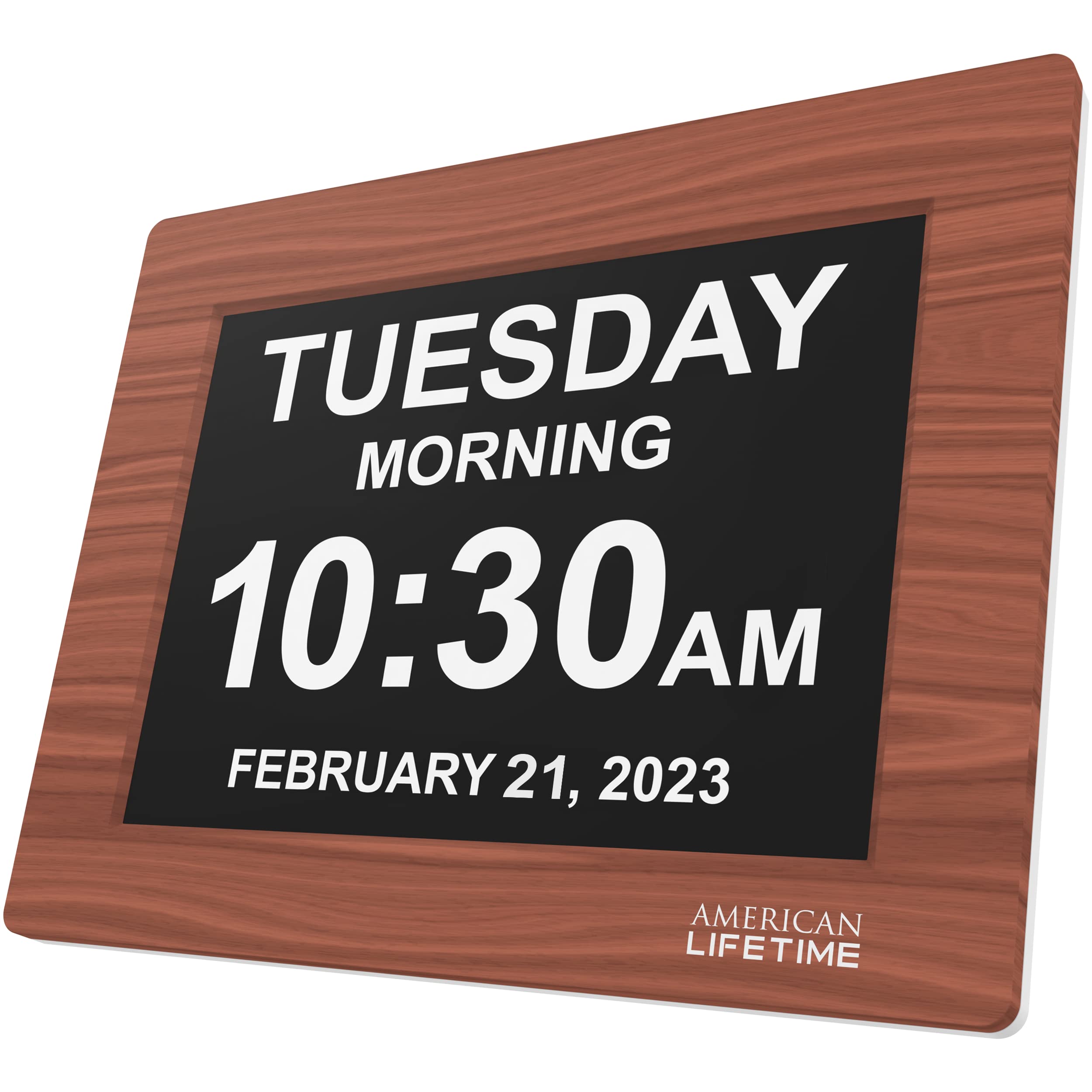
The American Lifetime clock stands apart with its brown wood frame, which blends into a home decor aesthetic rather than screaming “medical device.” The large digital display shows the day of the week, date, and a clear “Morning” or “Afternoon” label. The high contrast between the white text and dark background improves readability in low-light conditions.
Five customizable alarm slots cover the daily essentials—medication, meals, appointments, and personal care. The auto-dimming feature adjusts the screen brightness based on ambient room light, preventing sleep disruption while still being readable at a glance during the night. The user-reported feedback consistently mentions that the clock helps the user feel more independent.
The clock is built with a durable plastic core under the wood surface, designed to survive accidental drops or knocks. Setup is straightforward with an easy-to-follow manual. The included AC adapter powers the unit, and the backup battery ensures settings survive power interruptions.
Why it’s great
- Wood frame feels like furniture, not hospital equipment
- Morning/Afternoon labels are easy to interpret
- Durable build handles daily wear
Good to know
- Only five alarms—fewer than some competitors
- Limited color options (brown only)
3. Top Life Talking Clock

The Top Life Talking Clock is fundamentally different from the others: it prioritizes audible time announcements over visual display. A single press of the top button triggers a clear, neutral male voice that announces the time. A second press speaks the day, date, and year. This is invaluable for users with severe visual impairment or those who cannot interpret a digital display at all.
The voice volume reaches 85 dB, which is loud enough for users with moderate hearing loss. A normal volume setting is also available for quieter environments. The screen can be turned off completely while maintaining full functionality, eliminating any light disturbance in the bedroom at night—a feature that visual-only clocks cannot match.
The clock runs on AC power or three AA batteries, making it portable for travel or placement in rooms without accessible outlets. The large, high-contrast digital display serves as a secondary aid for those with partial vision. The snooze function and pleasant wake-up chime round out the user experience.
Why it’s great
- 85 dB voice announcement for hearing impaired
- Screen-off mode ensures total darkness at night
- One-button operation eliminates confusion
Good to know
- Voice announcements can feel verbose
- Only one button option—no remote control
4. Mitoart Digital Alarm Clock for Dementia Seniors
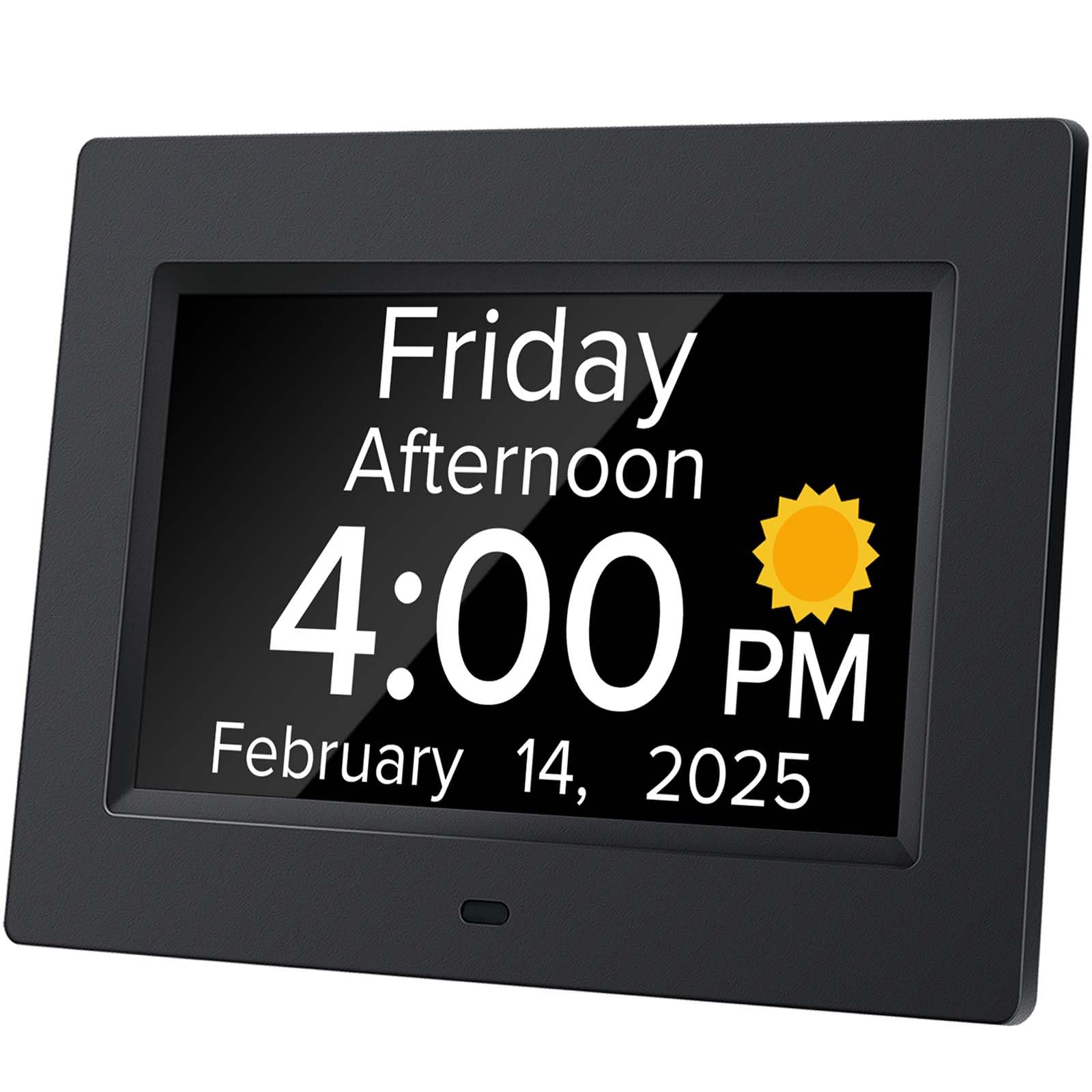
The Mitoart clock delivers a 7-inch display with large, non-abbreviated text for the week, month, and date. What sets it apart in the mid-range tier is the built-in voice announcement function: pressing the OK button on the clock or remote triggers automatic spoken time, supporting nine languages. This bridges the gap for users who need both visual and audible cues.
Multiple alarms allow reminders for medication and daily schedules. The auto-dimming feature switches to a softer brightness (50 cd/m²) at 7 PM and returns to full brightness (250 cd/m²) at 7 AM, with a gentle transition that avoids startling the user. The setup is intuitive enough that many caregivers report taking it out of the box and configuring it in minutes.
The clock body is made of durable plastic and weighs 0.44 kg, light enough to sit on a nightstand without feeling bulky. The remote control adds caregiver convenience for adjusting settings from across the room. The clock does not include batteries, but the included power adapter provides reliable operation.
Why it’s great
- Voice announcement in 9 languages suits diverse users
- Auto-dimming transitions are smooth and gentle
- Remote control for caregiver convenience
Good to know
- Batteries not included for backup
- Voice activation requires pressing a button
5. AINFTIME DST Digital Clock with Date and Day of Week
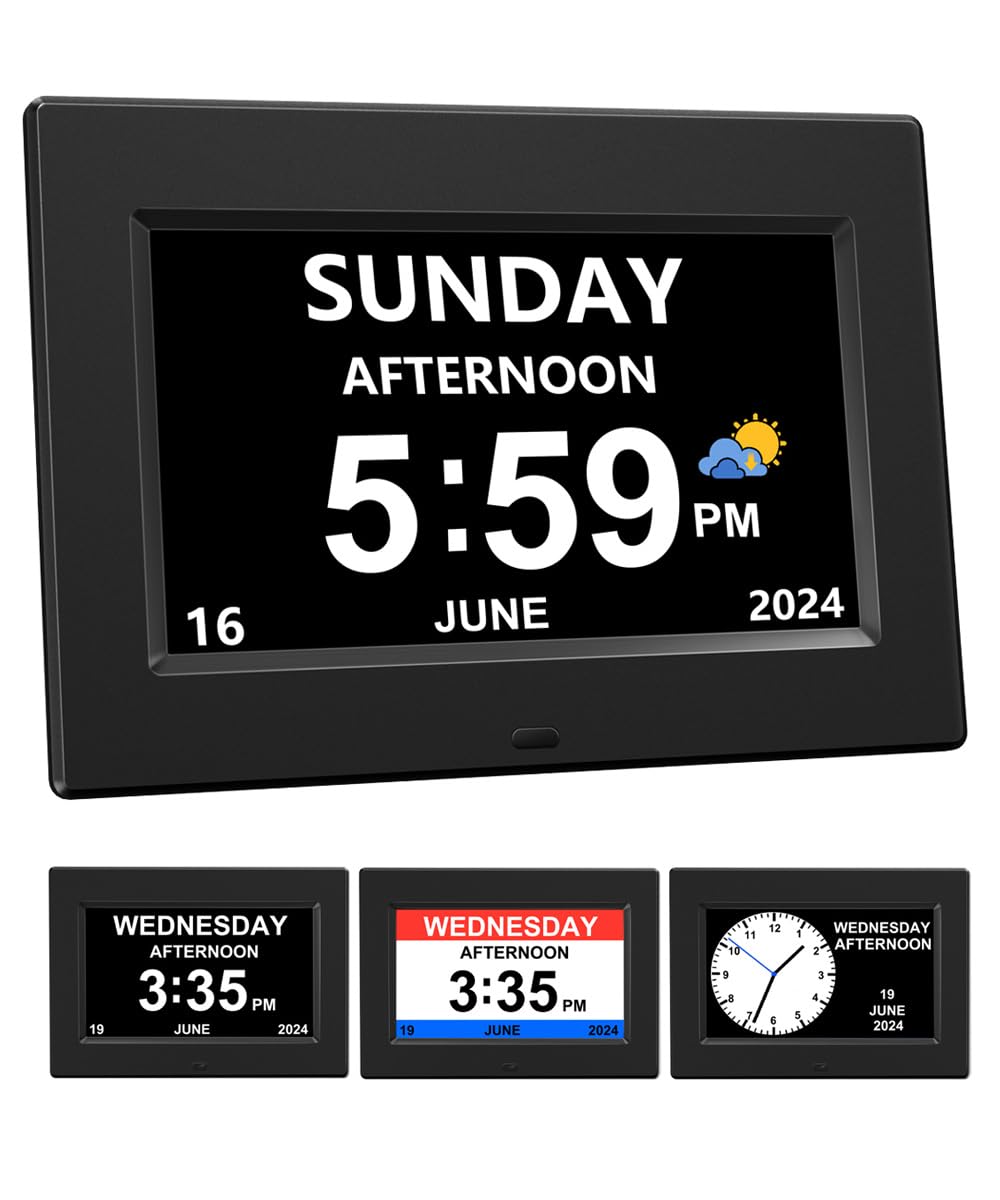
The AINFTIME clock offers three distinct display modes: an elderly-friendly mode with large non-abbreviated text showing the date, year, month, and time; a colorful digital mode; and a photo frame mode that cycles through cherished memories. The photo frame function serves as a subtle emotional anchor for dementia patients, keeping familiar faces visible throughout the day.
With 12 alarm reminders, this clock provides more scheduling slots than most competitors. The alarms can be set for medication, meals, appointments, and personal care tasks. The automatic DST adjustment adapts to North American, UK, and EU settings, eliminating the biannual confusion of manual time changes. The smart brightness feature dims the screen from 8 PM to 6:59 AM.
Note that the power adapter is not included in the box. The clock uses a standard USB power cord and works with any 5V/1A or 5V/2A adapter—such as an old phone charger. This keeps the purchase price lower but requires you to supply the adapter yourself. The clock is lightweight at 0.35 kg and can sit on a desk or mount on a wall.
Why it’s great
- Photo frame mode shows familiar faces for comfort
- 12 alarm slots cover every daily need
- Automatic DST for US, UK, and EU regions
Good to know
- No power adapter included—uses your own USB charger
- Wall mount has single hanger, may tilt from cord weight
6. Aowasi Digital Calendar Clock, 7-Inch

The Aowasi clock focuses on simplicity and reliability. The 7-inch display spells out the full day of the week, month, and year without abbreviations. It also labels the time of day into five phases—Before Dawn, Morning, Afternoon, Evening, and Night—reducing the cognitive load of interpreting AM/PM. Users consistently note that the high-contrast white-on-black display is easy to read from across the room.
Twelve alarm options cover a full daily schedule with dedicated reminders for medication, meals, clinic visits, showers, cleaning, appointments, and dog walks. The clock supports eight display languages including English, French, German, Dutch, Italian, Polish, Spanish, and Welsh. The auto-dimming function adjusts brightness between 7 PM and 7 AM, with five manual brightness levels for customization.
A battery backup preserves the date and time settings during power outages and automatically restores the correct time when power returns. The clock can stand on a desk or mount on a wall, and the packaging avoids the words dementia or Alzheimer’s, making it a more discreet gift. The included AC adapter and bracket simplify setup.
Why it’s great
- 12 alarms with specific reminder labels
- Battery backup retains settings during power loss
- Discreet packaging for gifting
Good to know
- No automatic DST—requires manual switch
- Display is not IPS; viewing angle is narrower
7. WallarGe Atomic Clock with Indoor Outdoor Temperature
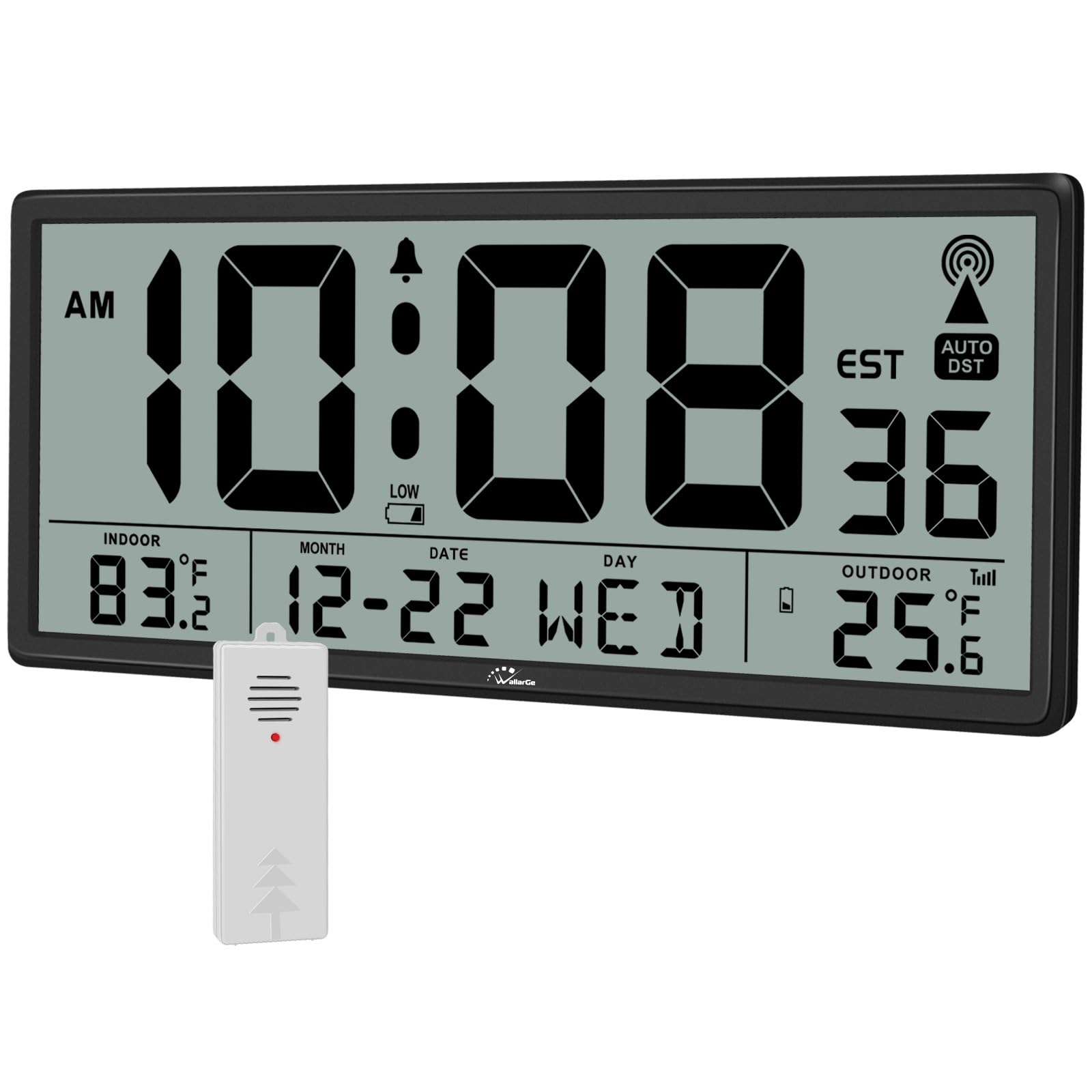
The WallarGe clock is fundamentally different from the dedicated dementia clocks above—it is an atomic clock first and a large-display clock second. The 14.5-inch screen shows jumbo time digits measuring 8.4 by 3.1 inches, making it the most physically readable numeric display in this roundup. The built-in atomic receiver syncs with the NIST WWVB broadcast, ensuring the time never drifts.
This clock displays indoor and outdoor temperatures via a wireless sensor that communicates up to 330 feet away. The date, day of the week, and seconds display are all shown on the screen. However, it does not label time of day phases (Morning/Afternoon) or provide multiple alarms—it has a single alarm function. For a dementia patient who primarily needs to know the date and time at a glance, this trade-off may be acceptable.
The clock runs on four AA batteries for the main unit and two AA batteries for the outdoor sensor. There is no AC adapter option, and there is no backlight—the display relies on reflective LCD technology, which means it is unreadable in complete darkness. The included mounting template simplifies wall installation.
Why it’s great
- Jumbo 14.5″ display with massive time digits
- Atomic sync means never needing to set the time
- Indoor/outdoor temperature provides weather awareness
Good to know
- No time-of-day phase labels (Morning/Afternoon)
- No backlight—cannot be read in dark rooms
FAQ
Will a clock with AM/PM confuse someone with dementia?
Can I use a standard large-display clock for a dementia patient?
How many alarms do I really need for medication reminders?
Final Thoughts: The Verdict
For most users, the clock for dementia patients winner is the Pastigio 10.1″ because its large IPS screen, five-phase day orientation, and comprehensive alarm/reminder system cover every key need. If you want a wood-frame design that blends into home decor, grab the American Lifetime. And for someone with combined vision and hearing loss, the Top Life Talking Clock provides a voice-based solution that no visual-only clock can match.

Mo Maruf
I created WellFizz to bridge the gap between vague wellness advice and actionable solutions. My mission is simple: to decode the research and give you practical tools you can actually use.
Beyond the data, I am a passionate traveler. I believe that stepping away from the screen to explore new environments is essential for mental clarity and physical vitality.