Our readers keep the lights on and my smoothie glass nicely filled. As an Amazon Associate, I earn from qualifying purchases.
Specs are compiled from manufacturer listings and verified buyer reviews and can change over time — please confirm the key details on the product page before buying.
A hangboard can turn weak fingers into crimp machines, but the wrong one leaves you sanding slippery wood or fighting loose hardware instead of training. This guide cuts through the clutter to match you with the exact board that fits your level, your doorway, and your skin.
I’m Mohammad Maruf — the founder and writer behind WellFizz. This guide is built by comparing the manufacturers’ published specifications and the patterns across verified customer reviews, so you get each pick’s real strengths and trade-offs instead of marketing spin.
Whether you are a weekend boulderer or a 5.12 aspirant, the right climbing hangboard is the one you actually hang from consistently — without blisters, wobbles, or guesswork.
Quick Picks
- TRANGO Rock Prodigy Hangboard — Best Overall
- Metolius Project Training Board CNC — Compact Power
- TWO STONES Climbing Hangboard (Large) — Depth Explorer
- Bellaroca Portable Hangboard — Travel Pick
- Yes4All Wooden Hang Board — Value Wall Board
- TWO STONES Portable Hangboard — Lightest Carry
How To Choose The Best Climbing Hangboard
A hangboard is a simple tool — a block of wood or resin with edges, pockets, and slopers — but picking the wrong one can stall your progress or mess up your skin. Focus on a few key decisions first.
Pocket Depth Range (Crimp Progression)
The single most important spec is how shallow the smallest pocket goes. A board that only offers 20mm pockets will feel easy after a few weeks; you want a board that lets you work down to 10mm or even 4mm crimps. The Bellaroca hits 4mm with its rubber inserts, making it a standout for long-term progression.
Mounting System: Doorway vs. Wall Studs
Not every board mounts the same way. Portable boards with ropes (like the TWO STONES portable at 0.7 kg) let you hang from a tree or pull-up bar in seconds. Fixed boards demand drilling into wooden studs or a plywood backer — the Metolius Project board, for example, requires a 3/4-inch plywood panel secured to two studs.
Material: Wood vs. Resin
Wood feels warmer on the skin and causes less friction than resin, which matters for 30-minute sessions. Resin boards offer sharper, more rock-like textures but shred skin faster. All six picks here are wood — a sign that the category has settled on wood as the skin-friendly standard.
Quick Comparison
| Model | Best For | Weight | Smallest Pocket | Grip Types | Amazon |
|---|---|---|---|---|---|
| TRANGO Rock Prodigy | Structured training (5.11/5.12) | 5.7 lbs | 10mm closed crimp | 12 grips + variable-depth rail | Amazon |
| Metolius Project | Compact wall-mounted training | 5.3 lbs | — | Slopers, edges, pockets | Amazon |
| TWO STONES (Large) | Full home gym board | 1.79 kg | 1/2/3/4 finger pockets | Slopes, pockets (10 depths), edges | Amazon |
| Bellaroca Portable | Travel & quick rope setup | 1.1 kg | 4mm (with insert) | 6 hold types + adjustable rubber plates | Amazon |
| Yes4All Wooden | Budget wall-mount with pinches | 2.05 kg | Mini crimps | Jugs, slopers, crimps, pinch holds | Amazon |
| TWO STONES Portable | Lightest rope-mount carry | 0.7 kg | 1-finger pocket | 1/2/3/4 finger pockets (4 depths) | Amazon |
In‑Depth Reviews
1. TRANGO Rock Prodigy Hangboard
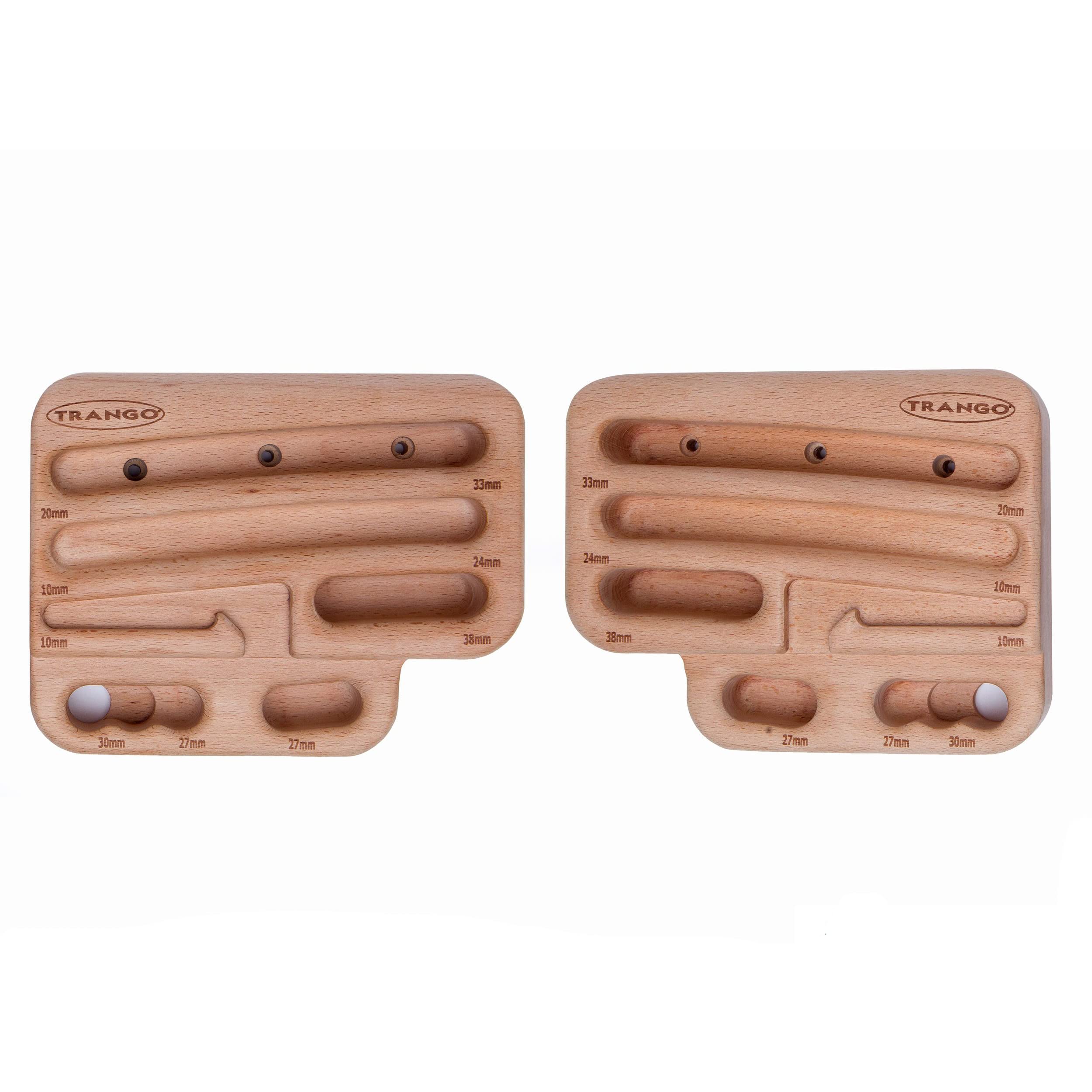
The structured training board that serious climbers trust for years of progression.
If you are working toward 5.11 or 5.12 and want a clear path forward, the Rock Prodigy gives you 12 distinct grips on FSC-certified beech wood — including two variable-depth rails that range from 10mm to 33mm — so one board covers open-hand jugs and razor crimps. The natural wood texture minimizes skin damage compared to plastic boards, which means you can hang three times a week without tearing up your fingers. Buyers consistently call it the gold standard, with one reviewer noting, “I’ve been using it regularly for over 4 years and am disappointed whenever I don’t have access to one.”
Unlike the TWO STONES Large board that offers 10 pocket depths but no training app, the Rock Prodigy pairs with a free iOS and Android app built around the methods from “The Rock Climber’s Training Manual.” That guided structure is a real advantage if you want more than just random hangs. The two-piece cleat-and-rail mounting system lets you adjust width to match your shoulder span and remove the board for storage — no tools required.
There is one installation hiccup: the board uses two different screw lengths, and buyers report figuring out which goes where is mildly irritating. But once mounted, it is a rock-solid training partner that outlasts cheaper boards. At 5.7 pounds, it is firmly in the wall-mount camp, but the included hardware makes it straightforward to hang.
Structured to Deliver
- Variable-depth rail (10-33mm) gives progressive crimp training without extra parts
- Free companion app guides sessions with proven rest intervals
- Tool-free width adjustment works for different shoulder widths
Installation Friction
- Two different screw lengths require a moment of head-scratching
- Heavier than portable rope boards (5.7 lbs vs 0.7 kg for the portable TWO STONES)
Reach for it when: you want a single board that guides you from intermediate to advanced with a proven training plan, and you are ready to mount it permanently on a wall.
Look elsewhere if: you need a portable board for travel or a rope-mount setup — the Rock Prodigy is a fixed-wall tool only.
2. Metolius Project Training Board CNC

A compact, textured board that hides above a door but works like a full gym.
The Project board packs slopers, edges, and pockets into a 26 x 9 x 7 inch frame that disappears above a doorway once mounted. Its CNC-milled construction gives a simulated rock texture that reviewers praise as “fantastic” — more like real stone than the smooth beech wood of the TRANGO Rock Prodigy. Owners mention that the texture helps build callus resilience without being overly abrasive, and several note that the compact size makes it an easy add to a home wall without dominating the room.
There is a catch with installation: unlike the Bellaroca that comes with ropes, the Metolius requires a 3/4-inch plywood panel mounted to at least two wall studs before you attach the board itself. Reviewers are upfront that you will need to buy, cut, and paint that plywood yourself. But once installed, it handles over 220 pounds without issue. One buyer called it a “great first hangboard” — affordable at this tier, but not ready to use from the start.
Unlike the Yes4All board which at 2.05 kg is nearly double the weight, the Metolius stays at 5.3 pounds while offering a higher-end build quality. It also ships with a training guide and comprehensive instructions, which is helpful if you are new to hangboard protocols. No mobile app here, but the Android “Project Hangboard Training PRO” app (a third-party tool) fills that gap.
Clean & Capable
- Realistic rock texture builds climbing-specific callus strength
- Compact footprint (26 by 9 by 7 inches) fits discreetly above any door
- Supports over 220 lbs once properly mounted
Setup Real Talk
- Requires buying and cutting a 3/4-inch plywood backer — not ready to mount from the start
- No official iOS training app; Android users pay for a third-party one
Choose it if: you want a low-profile board with aggressive texture that hides away, and you are comfortable with a weekend DIY mounting project.
Pass if: you need a tool-free rope setup or an app-guided training experience right from day one.
3. TWO STONES Climbing Hangboard (Large)
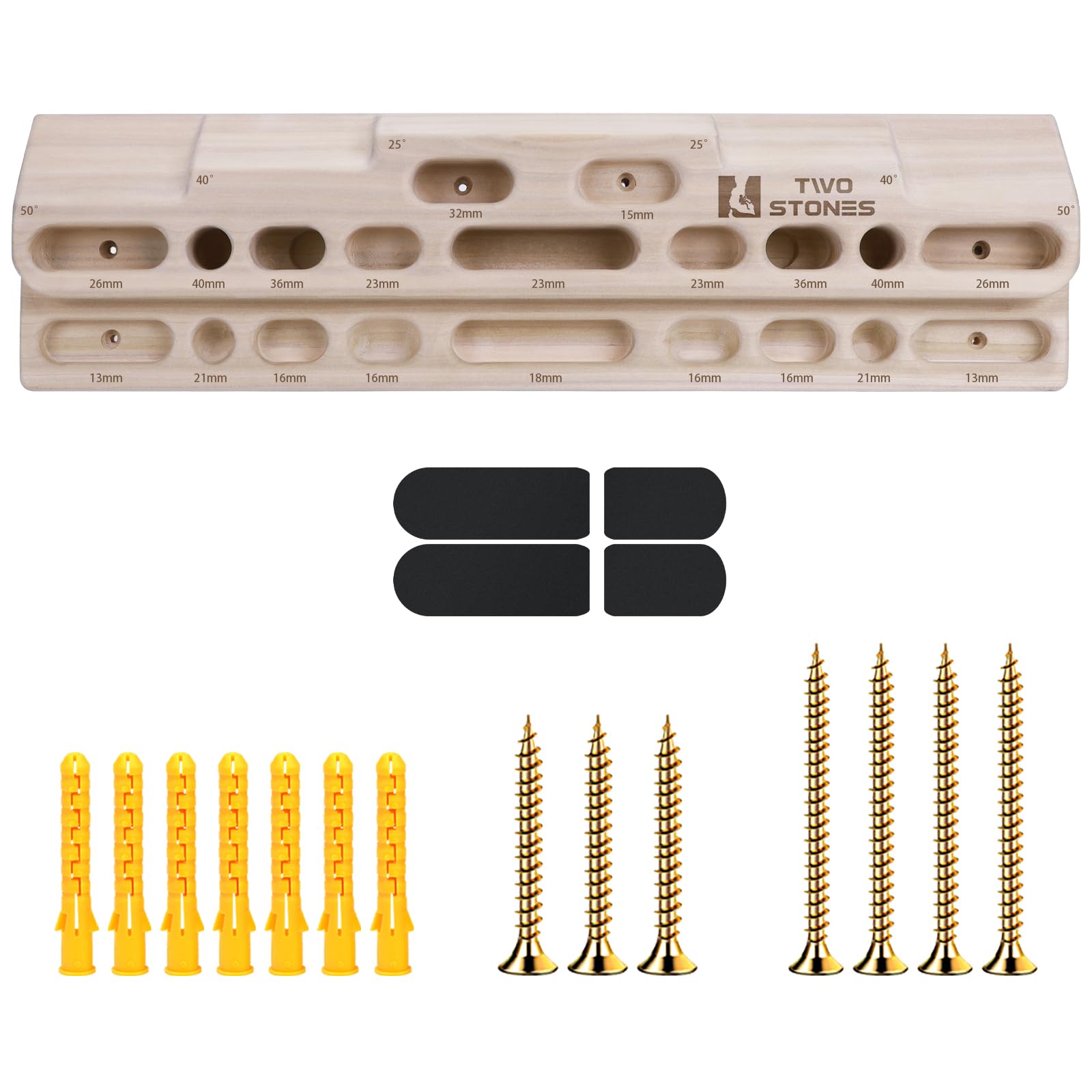
The board that lets you fine-tune difficulty with ten different pocket depths.
This TWO STONES board is all about variety: it features slopes at three different angles plus 1/2/3/4 finger pockets in ten distinct depths, giving you more fine-grained progression options than the 6 hold types on the Bellaroca. The CNC-milled natural wood block has no chips or splicing, and every pocket edge gets an R5 fillet — meaning a rounded, skin-friendly radius that allows long training sessions without hot spots. Buyers confirm it is “soft for the skin,” even on the smaller crimps.
The board tapers from 1.85 inches at the top to 1 inch at the bottom, which creates better forearm clearance during hangs — a detail the four other fixed boards here do not mention. At 22.83 by 6.3 by 1.89 inches, it is 20% larger than the portable TWO STONES board (which is 19.69 x 3.94 x 1.18 inches), so it fills a full doorway width. Mounting hardware includes 7 screws of two lengths plus expansion tubes, making it ready for both doorway and wall stud installation.
The trade-off is weight: at 1.79 kg, it is the heaviest of the wooden boards here, so if you plan to move it between homes, the Bellaroca at 1.1 kg is easier to carry. And while the 10 pocket depths give incredible variety, there is no rubber adjustment plate system like the Bellaroca offers to hit sub-10mm crimps without swapping boards.
Progression Depth
- Ten discrete pocket depths cover every finger-count from mono to full-hand
- Tapered profile (1.85 to 1 inch) improves forearm clearance during long hangs
- R5-radius edges keep skin comfortable across all hold types
Bulk & Adjustability
- Heavier than portable options (1.79 kg vs 1.1 kg on the Bellaroca)
- No adjustable inserts for micro-crimps below 10mm without buying another board
Get it for: structured home training where you want precise depth control across a wide range, and you plan to mount it permanently.
skip it if: you need ulta-light portability or adjustable crimp depth without swapping boards.
4. Bellaroca Portable Hangboard
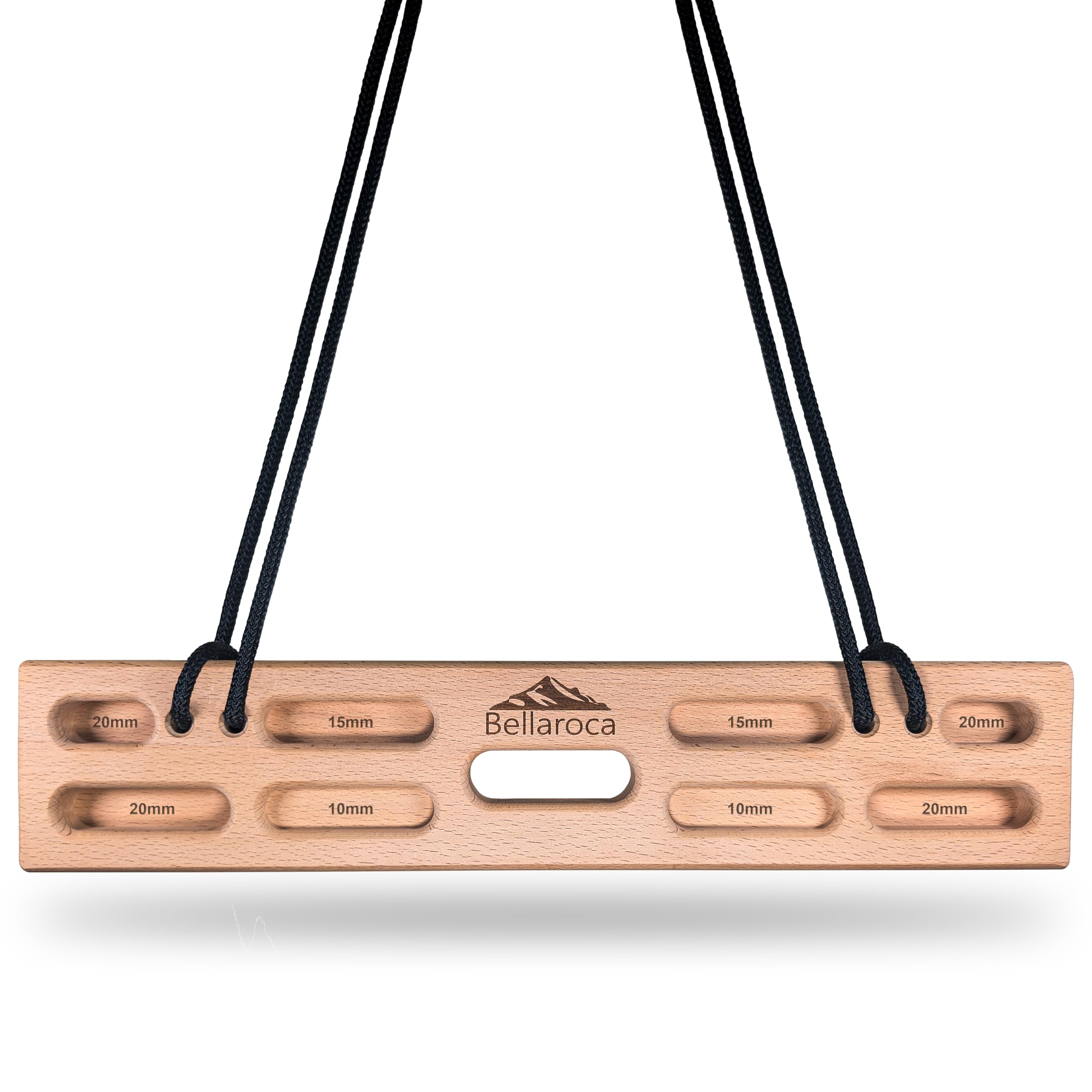
A rope-hung board that goes from pocket to pocket and crimp to micro-crimp.
The Bellaroca solves a real pain: you want a full training board but you travel or climb outside and cannot drill into walls. It weighs 1.1 kg and includes a 3-meter rope that you can loop over a tree branch, pull-up bar, or beam in under 60 seconds. Six hold types — including 20mm, 15mm, and 10mm four-finger pockets — cover the standard range, but the real differentiator is the four 3mm rubber plates that you slide into any pocket to shrink depth down to 4mm crimps. That gives you over 12 grip combinations in a single portable board.
Customers note the board is “well-made and comfortable to hang,” though one 6-foot-2 reviewer noted it feels “tight for large hands.” That is a genuine consideration if you have big hands — unlike the TRANGO Rock Prodigy which gives more rail width for open-hand hangs. The beech wood pockets have fully rounded edges that are gentle on skin, so repeated dead hangs do not cause irritation. Reviewers also call it “an absolute steal” and “definitely worth the money” for the variety packed into a portable form.
Compared to the TWO STONES portable board which weighs 0.7 kg but offers only 4 pocket depths, the Bellaroca gives you adjustable depth in a slightly heavier but much more versatile package. The included training plan also helps beginners structure sessions rather than just guessing hangs.
Pack-and-Go Versatility
- Four rubber adjustment plates reduce pockets to 4mm for micro-crimp training
- Rope setup in under 60 seconds — no mounting hardware needed
- 12+ grip combinations from a single board weighing only 1.1 kg
Hand Fit
- Narrow pockets feel cramped for climbers with larger hands (especially over 6-foot-2)
- Rope-mount limits max load compared to stud-mounted boards
Ideal for: climbers who train on the road, in the gym, or outdoors and want adjustable depth without permanent installation.
Not for: big-handed climbers who need wide jug rails or those who only train at a fixed wall.
5. Yes4All Wooden Hang Board
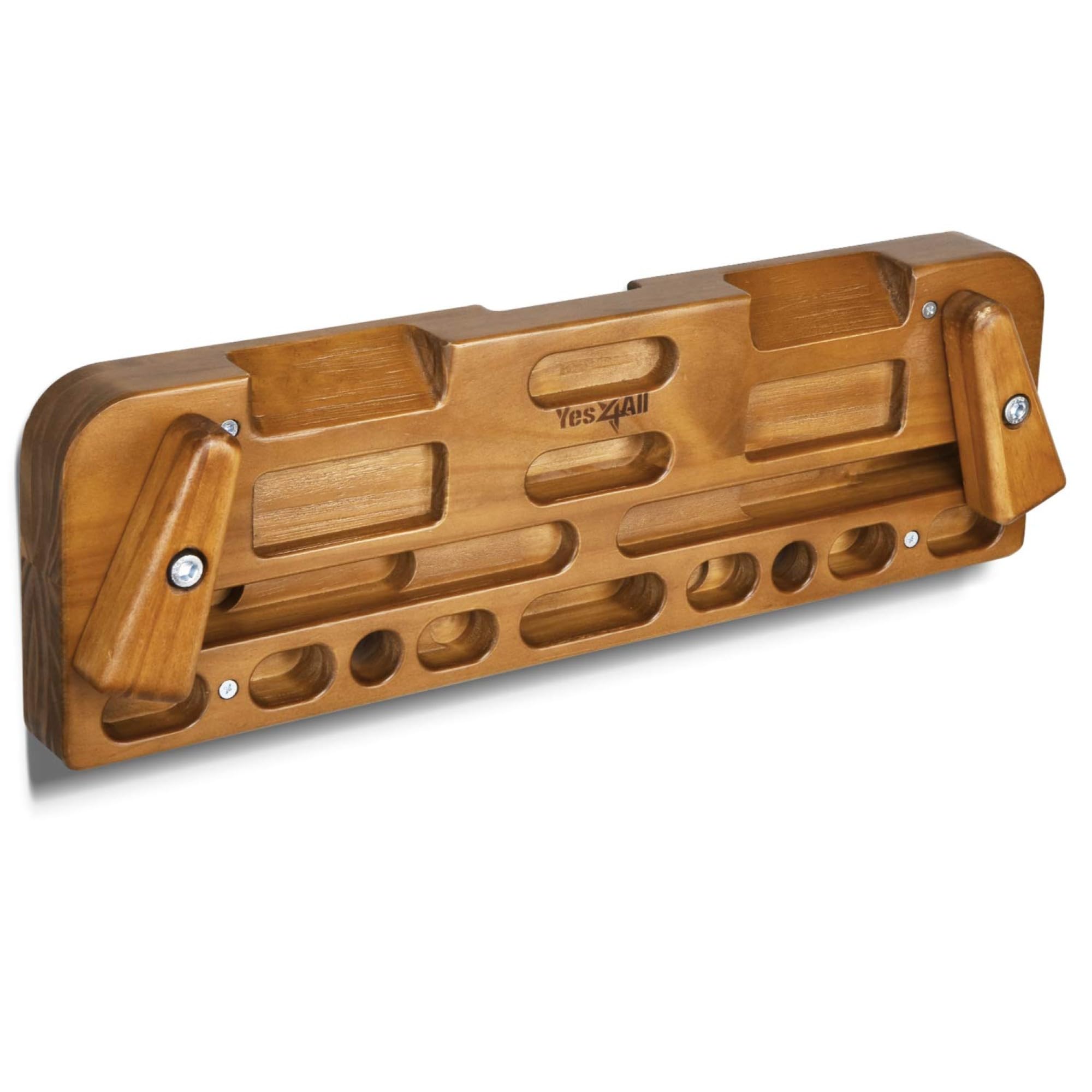
A budget board that packs jugs, slopers, crimps, and pinches onto one affordable slab.
The Yes4All comes with jugs, slopers, mini crimps, and two detachable pinch holds that you can angle before tightening — a feature none of the other boards here offer. At 2.05 kg, it is the heaviest board in this lineup (nearly 3x the 0.7 kg of the portable TWO STONES board), which signals solid wood but also limits portability. The design includes a phone holder at the top for timing rests, which is a simple but practical touch for self-coached sessions.
The honest catch is surface finish. Multiple reviewers point out that the board arrives with a lacquered coating that feels slippery and requires sanding before first use — one reviewer specifically mentioned spending 20 minutes sanding off the coating and smoothing rough finger holes. Another pointed out that pinch grip bolts “rotate or pull out under 170 lbs,” which is a real limit if you plan heavy loaded hangs. The glued three-layer construction also drew concern about durability at the low price point, with one buyer calling it “cheap price gets a cheap product.”
That said, once prepped, the hold variety genuinely rivals boards that cost to, according to buyers. The 300-pound maximum weight recommendation is the highest in this roundup, and the round corners below the jugs prevent wrist strain during extended hangs — a detail the TWO STONES boards do not call out.
Hold Variety on a Budget
- Detachable pinch holds adjust to any angle for custom pinch-width training
- Rated for 300 lbs — highest weight capacity in this comparison
- Phone holder built into the top for tracking rest intervals
Out-of-Box Quirks
- Lacquered coating is slippery and needs sanding before first session
- Pinch grip bolts rotate or pull out under 170 lbs — not load-rated for heavy hangs
Consider it if: you want the widest hold variety for the lowest cost and are willing to spend 20 minutes sanding to unlock it.
Avoid it if: you want a board that works perfectly from the start or you plan to do heavy loaded hangs on the pinch holds.
6. TWO STONES Portable Hangboard
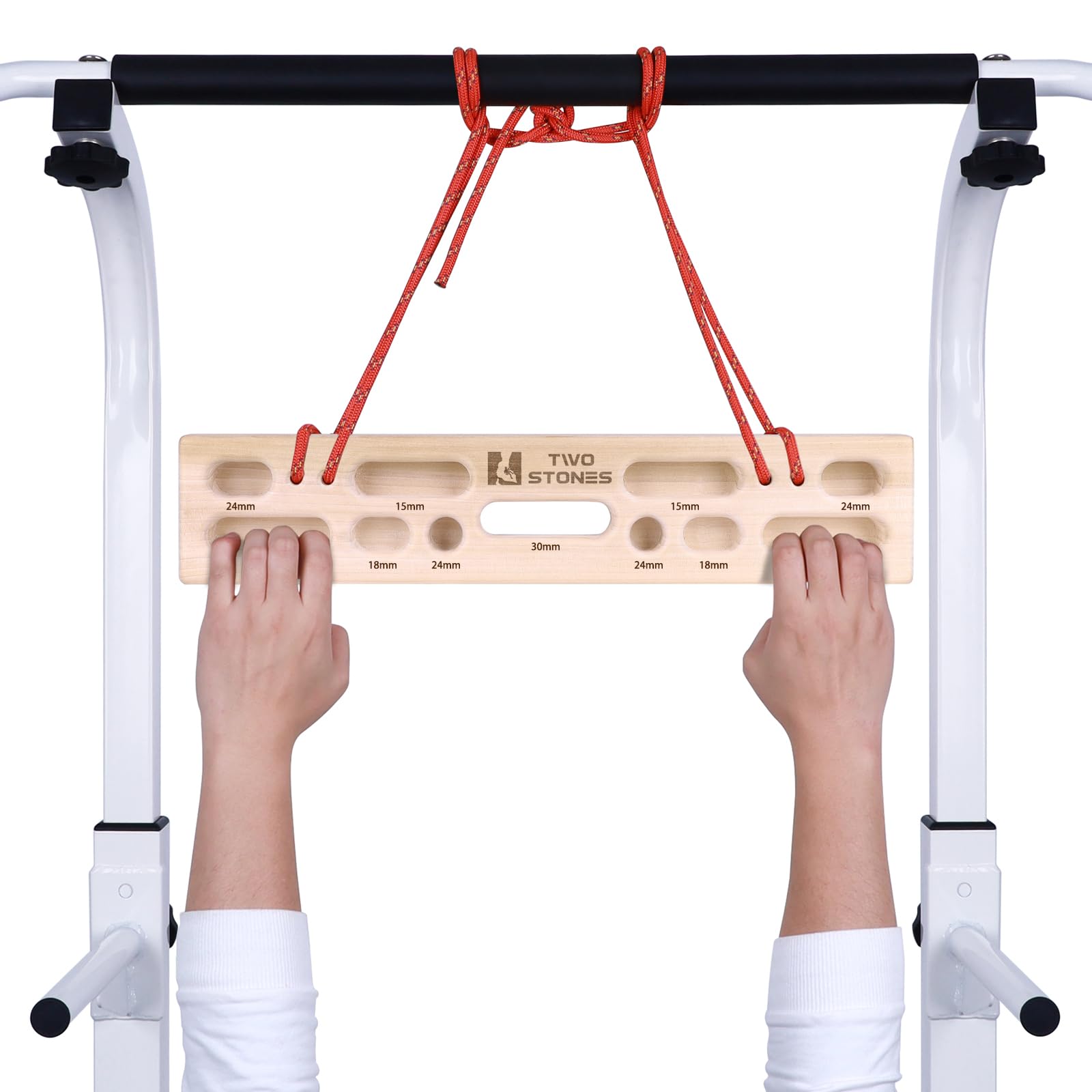
The featherweight rope board you can toss in a bag and still get a quality session.
At just 0.7 kg (about 1.65 pounds), this portable TWO STONES board is the lightest hangboard in this entire comparison — nearly 3x lighter than the Yes4All board at 2.05 kg. That weight difference matters when you are hiking to a crag or packing for a climbing trip. The board is CNC milled from a single natural rail wood block with no chips or splices, and all pocket edges have an R5 fillet radius for smooth, skin-friendly contact. Shoppers say the natural wood finish has no burrs or sharp edges, which makes it comfortable right out of the bag.
The outer dimensions are 19.69 by 3.94 by 1.18 inches — about the size of a small cutting board — with 1/2/3/4 finger pockets at four different depths. That gives you a solid range for beginners working up to intermediate hangs, but it falls short of the Bellaroca’s 12 grip combinations or the large TWO STONES board’s 10 pocket depths. There is no adjustable rubber plate system here, so the progression ceiling is lower. For the price, it is a clean, no-fuss entry point for climbers who want a quality wood board without paying for features they may not need.
If you compare it directly to the portable Bellaroca, the TWO STONES loses on depth adjustability (4 depths vs 6+ with rubber plates) but wins on weight (0.7 kg vs 1.1 kg). For a climber who prioritizes ultralight carry over hold variety, this is the better choice.
Ultralight Advantage
- Weighs only 0.7 kg — lightest board in this roundup by a wide margin
- Single-piece rail wood construction with no chips or glue seams
- R5-radius edges on all pockets are gentle on skin immediately
Limited Progression
- Only 4 pocket depths — no adjustable inserts for micro-crimps
- Hold variety is basic compared to the Bellaroca or TRANGO Prodigy
Best for: climbers who need a barely-there training tool for travel and are fine with basic progression.
Not for: anyone who wants to work sub-10mm crimps or needs a wide range of grip types from one board.
Understanding the Specs
Crimp Depth (mm)
This is the distance from the face of the board to the back of the pocket. A 20mm pocket is a jug — easy to hold. A 10mm pocket is a solid training edge. A 4mm pocket (only the Bellaroca hits this with its rubber inserts) is a micro-crimp that builds serious finger strength. The shallower the pocket, the harder the hang.
Mounting System
Rope-mount boards (Bellaroca, TWO STONES portable) use a cord that loops over any overhead anchor — a tree branch, pull-up bar, or beam. They set up in under 60 seconds but cannot hold heavy dynamic movements. Stud-mount boards (TRANGO, Metolius, Yes4All, TWO STONES large) screw into wooden wall studs or a plywood backer. They are rock solid but require drilling and permanent placement.
FAQ
How do I mount a hangboard without damaging my wall?
What does a 10mm pocket actually feel like?
Can I use a hangboard every day?
Is wood or resin better for a hangboard?
How do I know when to move to a shallower pocket depth?
Do I need a training app for a hangboard?
What is the difference between a jug and a sloper?
How long will a wooden hangboard last?
Can I use a hangboard if I am a beginner climber?
What is the maximum weight a hangboard can hold?
Final Thoughts: The Verdict
For most people, the climbing hangboard winner is the TRANGO Rock Prodigy because it combines FSC-certified beech wood, variable-depth rails from 10-33mm, and a free training app into one board that lasts for years of structured progression. If you want a portable board that fits in a bag and reaches 4mm micro-crimps, grab the Bellaroca Portable. And for a compact wall-mounted board with aggressive texture that hides above a doorway, the standout is the Metolius Project Training Board.
How We Picked
We do not accept paid placement. Every pick is matched to a real buyer and a real use-case; we do not hands-on test units.
Sources & Methodology
Specifications: manufacturer listings and product documentation. Review insights: verified customer reviews, as of July 2026. Pricing: not shown on this page (it changes often); check the current price via the retailer link.
As an Amazon Associate, WellFizz earns from qualifying purchases. This does not affect which products we feature.

Mo Maruf
I created WellFizz to bridge the gap between vague wellness advice and actionable solutions. My mission is simple: to decode the research and give you practical tools you can actually use.
Beyond the data, I am a passionate traveler. I believe that stepping away from the screen to explore new environments is essential for mental clarity and physical vitality.