Our readers keep the lights on and my smoothie glass nicely filled. As an Amazon Associate, I earn from qualifying purchases.
Getting clematis to produce those large, vibrant flowers instead of just scraggly leaves often comes down to one decision: the ratio of phosphorus and potassium in your feeding routine. A high-phosphorus, high-potassium formula is the difference between a few blooms and a wall of color.
I’m Mohammad Maruf — the founder and writer behind WellFizz. I’ve spent hundreds of hours analyzing fertilizer labels and customer reports to identify which granular and liquid formulations actually deliver measurable results for clematis growers.
Whether you are growing a jackmanii against a trellis or a montana along a fence, selecting the right clematis fertilizer requires understanding how NPK numbers translate to root strength and flower bud formation.
How To Choose The Best Clematis Fertilizer
Clematis is a heavy feeder, but it is picky about the balance between foliage growth and flower production. Too much nitrogen pushes leaves at the expense of buds. The right fertilizer focuses on phosphorus (the middle NPK number) and potassium (the last number) to trigger blooming and strengthen stems against mildew.
Look for a High Middle Number
Phosphorus (P) is the primary driver of flower initiation in clematis. A ratio like 12-24-12 provides double the phosphorus of nitrogen, signaling the plant to put energy into buds rather than vines. Avoid general-purpose lawn foods with high first numbers (30-0-0) as they encourage weak, leafy growth.
Potassium for Stem Strength and Winter Hardiness
Potassium (K) is crucial for clematis because it thickens cell walls, making vines less prone to wilt disease and improving the plant’s ability to survive cold winters. A fertilizer with a K value of 12 or higher, or a dedicated potash supplement (0-0-60), can be applied in late summer to harden off new growth before frost.
Granular vs. Liquid Application
Granular slow-release fertilizers provide a steady nutrient supply for several weeks with a single application around the root zone. Liquid concentrates deliver faster uptake and are useful for giving a mid-season boost to a clematis that has already set buds but needs an extra push to open them fully. Many experienced growers use both: granular in early spring and liquid during peak bloom.
Quick Comparison
On smaller screens, swipe sideways to see the full table.
| Model | Category | Best For | Key Spec | Amazon |
|---|---|---|---|---|
| Schultz 12-24-12 | Granular Slow-Release | General bloom stimulation | 12-24-12 NPK | Amazon |
| Great Big Roses Liquid | Liquid Concentrate | Fast-acting bloom booster | 70 trace minerals + humic acid | Amazon |
| Espoma Rose-Tone | Organic Granules | Organic feeding all season | 4-3-2 NPK + Bio-tone | Amazon |
| Espoma Potash | Potash Supplement | Late-season potassium boost | 0-0-60 NPK | Amazon |
| Cz Garden Muriate of Potash | Potash Supplement | Maximum bloom heavy feeding | 0-0-60 NPK | Amazon |
In‑Depth Reviews
1. Schultz 12-24-12 Slow-Release Bloom Fertilizer

The Schultz 12-24-12 delivers the exact phosphorus-heavy ratio clematis needs to shift energy into flower bud formation. Customer reports describe visible results within days, with more blooms that last longer and foliage that becomes markedly more vibrant. The slow-release granular form means a single application feeds the root zone for weeks without the risk of burning tender roots.
At 3.5 pounds, this bag covers a medium-sized planting area of several mature clematis vines. The granules are simple to broadcast around the base of the plant, followed by a thorough watering to activate the slow-release coating. Many users note that this fertilizer outperforms general-purpose options in producing a wall of continuous color rather than just green vines.
One reviewer mentioned that while it works very well, it is not quite as potent as some specialized bloom boosters for extremely heavy feeders. Still, for clematis specifically, the 12-24-12 ratio is difficult to beat at this price point for a quick, reliable result that even beginners can get right.
Why it’s great
- Phosphorus-heavy ratio specifically targets flower production
- Results visible in days according to verified buyers
- Easy to apply with no mixing required
Good to know
- Does not contain additional potassium boost for late-season hardening
- Some users preferred a more premium organic option
2. Great Big Roses and Flowers Liquid Fertilizer Booster
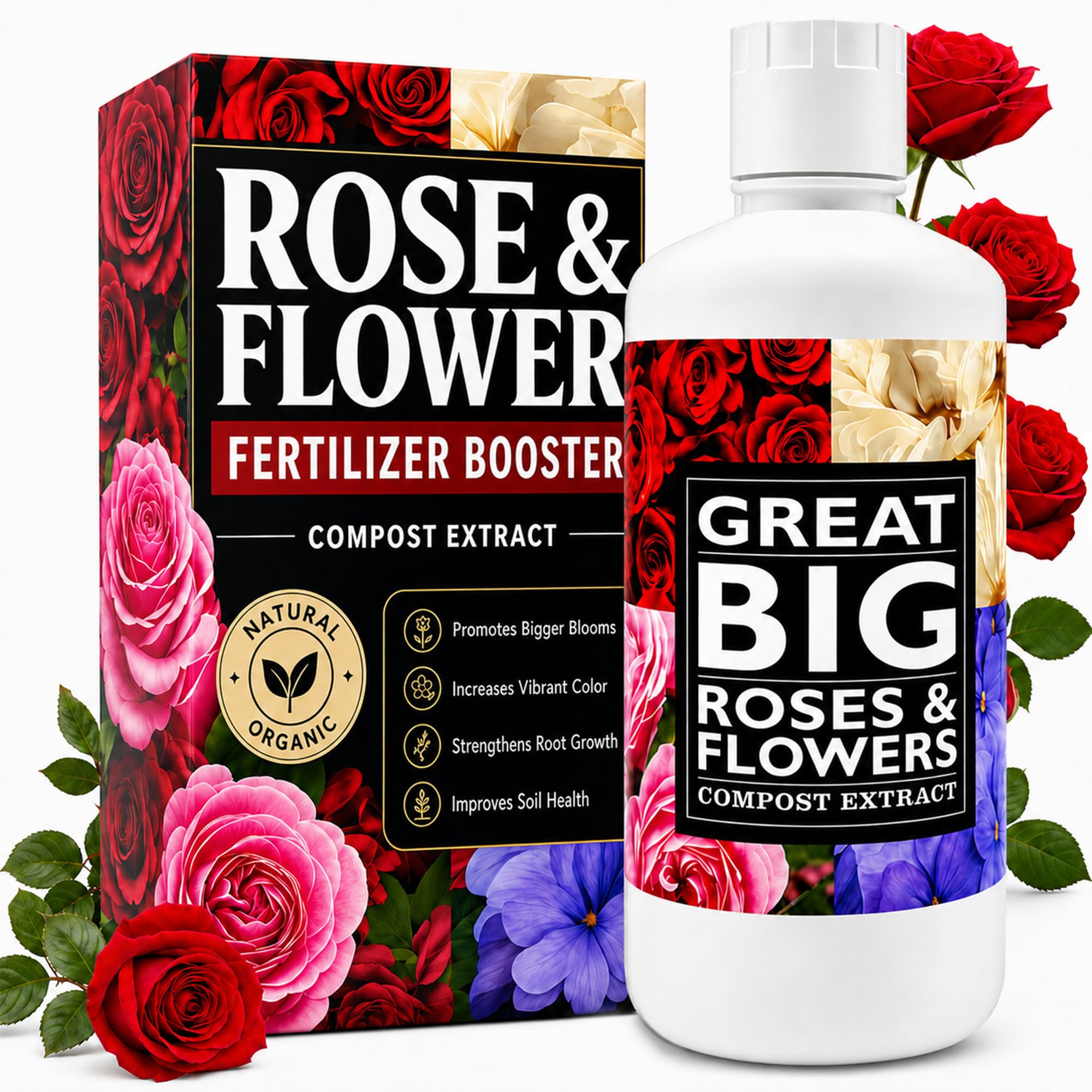
This liquid concentrate goes beyond a simple NPK scorecard by supplying over 70 chelated trace minerals, humic acid, and seaweed extract. For clematis, the humic acid improves nutrient uptake in the root zone, while the trace mineral complex helps convert soil-bound nutrients into plant-available forms. Customers report that roses that had not bloomed in years produced large flowers within weeks, and clematis responds similarly to this root-activation approach.
The 32-ounce bottle mixes at 4 ounces per gallon of water, yielding eight full applications that can cover an entire growing season. Users highlight that it works synergistically with existing organic fertilizers like fish emulsion or bone meal, making it a versatile additive rather than a standalone feed. The liquid form is ideal for mid-season feeding when clematis buds are swelling and need an immediate nutrient pulse.
The main drawback cited by multiple reviewers is the packaging: the wide-mouth jug makes it easy to over-pour and waste the expensive concentrate. The cost per bottle is higher than granular options, but mixing one gallon at a time stretches the value significantly if you are careful with measuring.
Why it’s great
- 70+ trace minerals unlock deeper root nutrition for clematis
- Humic acid helps break down compacted soil around the base
- Produces noticeable bloom increase even on stressed plants
Good to know
- Wide-mouth jug design makes measuring difficult
- Higher cost per ounce compared to granular options
3. Espoma Organic Rose-Tone 4-3-2

Espoma Rose-Tone is explicitly labeled for clematis on the packaging, making it one of the few fertilizers that directly address this plant’s needs. The 4-3-2 analysis is lower in phosphorus than synthetic bloom boosters, but the exclusive Bio-tone formula contains beneficial microbes that help clematis roots extract locked-up nutrients from the soil. This organic approach builds long-term soil health rather than delivering a synthetic jolt.
This pack of two gives 8 pounds total, which is enough to feed several clematis vines monthly from May through September. Users report that drift roses and clematis respond with vigorous green growth and a significant increase in flower bud density. The granular form is no-mix: just sprinkle around the drip line and water. One reviewer noted that it has a noticeable odor, typical of organic fertilizers, but that the bloom results justify the smell.
The main downside is the lower phosphorus content compared to synthetic bloom-specific fertilizers. If your clematis is already growing in rich organic soil, this product works beautifully as a maintenance feed. However, for a clematis planted in poor soil that needs a strong phosphorus signal, the 4-3-2 ratio may produce fewer first-year blooms than a synthetic alternative.
Why it’s great
- Approved for organic gardening with Bio-tone microbes
- Specifically includes clematis on the list of target plants
- Slow-release granules feed for a full month
Good to know
- Lower phosphorus ratio may not trigger maximum blooms in poor soil
- Strong odor during application
4. Espoma Potash 0-0-60

Potash is potassium in its most concentrated form, and the Espoma 0-0-60 supplies this critical element without any extra nitrogen or phosphorus. For clematis, a potassium boost in late summer is the key to hardening off new vine growth before winter and improving resistance to clematis wilt. This 6-pound bag provides a full season’s worth of maintenance for multiple plants.
Users report that applying this potash to vegetable gardens and flowering shrubs, including clematis, led to healthier foliage and noticeably heavier fruit or flower set. The granular formula is designed for direct soil application around the drip line, and it requires no mixing. Because it contains zero nitrogen, it is safe to use even when clematis vines are preparing for dormancy without encouraging fresh green growth that would be damaged by frost.
The primary limitation is that this is a single-element supplement rather than a complete feed. If your clematis also needs phosphorus for bloom initiation, you will need to pair it with a bloom-specific fertilizer like the Schultz 12-24-12. Some reviewers found it difficult to gauge effectiveness because they used it alongside other products, but the scientific role of potassium in clematis health is well established.
Why it’s great
- Pure potassium for targeted late-season hardening
- No nitrogen means safe for pre-dormancy application
- Major 6-pound bag covers a large garden
Good to know
- Not a complete fertilizer; must be combined with a phosphorus source
- Some users did not notice visible improvement alone
5. Cz Garden Muriate of Potash 0-0-60

This Muriate of Potash from Cz Garden Supply provides the maximum potassium concentration available for gardeners. The 0-0-60 analysis means every granule is pure potassium, making it ideal for custom-blending your own clematis feed or for giving a high-intensity potassium boost when your vines are setting heavy flower buds. Reviewers using it on fruit trees and flowers observed better fruit set and improved heat stress tolerance.
The resealable heavy-duty pouch is a practical improvement over paper bags, keeping the granules dry and free-flowing between uses. Being water-soluble, it can be dissolved and applied as a liquid drench around clematis roots for faster uptake than granular spreading. This flexibility is useful for container-grown clematis where you want precise control over nutrient delivery.
Like any single-element salt, this product requires careful measurement. Adding too much potassium without balancing calcium and magnesium in the soil can lead to nutrient lockout. It is best used as a supplement to a complete fertilizer rather than a standalone feeding program. The 5-pound pouch is a sensible size for gardeners who want to dial in their own NPK custom blend.
Why it’s great
- Highest potassium concentration at 0-0-60 for custom blending
- Resealable pouch keeps granules dry and fresh
- Water soluble for liquid feeding applications
Good to know
- Requires careful measuring to avoid nutrient imbalance
- Not a complete feed; must be paired with phosphorus and nitrogen
FAQ
Can I use a general rose fertilizer on clematis?
When should I stop feeding clematis for winter?
How often should I fertilize my clematis?
Does clematis need an acid fertilizer?
Final Thoughts: The Verdict
For most users, the clematis fertilizer winner is the Schultz 12-24-12 Slow-Release because its phosphorus-heavy ratio directly triggers maximum flower bud formation while the slow-release granules provide steady nutrition for weeks. If you want an organic feed that builds long-term soil health, grab the Espoma Rose-Tone. And for late-season potassium to harden off your clematis before winter, nothing beats the Espoma Potash 0-0-60.

Mo Maruf
I created WellFizz to bridge the gap between vague wellness advice and actionable solutions. My mission is simple: to decode the research and give you practical tools you can actually use.
Beyond the data, I am a passionate traveler. I believe that stepping away from the screen to explore new environments is essential for mental clarity and physical vitality.