Our readers keep the lights on and my smoothie glass nicely filled. As an Amazon Associate, I earn from qualifying purchases.
Specs are compiled from manufacturer listings and verified buyer reviews and can change over time — please confirm the key details on the product page before buying.
If your deck has turned into a patchy eyesore of black mold, green algae, and ground-in grime, you are not just looking for soap — you need a formula that kills the growth at the source and washes it away without turning the job into a weekend-long battle. The difference between a cleaner that merely wets the surface and one that lifts years of staining depends on whether it is concentrated, whether it uses bleach (sodium hypochlorite, a fast-acting chemical that kills organic stains) or an oxygen-based compound (chemicals that lift stains with tiny bubbles) to break down organic matter, and whether it is designed for your specific deck material — composite, cedar, or pressure-treated wood.
I’m Mohammad Maruf — the founder and writer behind WellFizz. This guide is built by comparing the manufacturers’ published specifications and the patterns across verified customer reviews, so you get each pick’s real strengths and trade-offs instead of marketing spin.
So the real question is: which one is worth buying? For most composite decks with deep black spots, the Wash Safe SPRAY & CLEAN delivers the best balance of coverage and power. But wood decks need something different. Here is an honest look at what a cleaner for decks can do for your next weekend project, without the hype.
Quick Picks
- Wash Safe™ SPRAY & CLEAN Commercial-Strength Composite Deck Cleaner — Top Performer
- DeckMax Premium Deck Cleaner Kit — All-in-One Kit
- TIMBERTECH Composite Deck Cleaner – 1 Gallon — Warranty Safe
- Wash Safe™ CEDAR WASH | Eco-Safe and Organic Wood Cleaner — Natural Cedar Pick
- MICROBAN Outdoor Surface Care Cleaner 1 Gal — Speedy Clean
- Spray & Forget Ready-to-Use House & Deck Outdoor Cleaner — Set-and-Forget
How To Choose The Best Cleaner For Decks
A deck cleaner needs to do more than just foam up — it has to kill the biological growth that makes wood or composite look dirty, and it has to do it without harming your plants or your deck’s surface. You can simplify this decision by focusing on a few key factors.
Match the Formula to Your Deck Material
Composite decking like Trex and TimberTech needs a cleaner with a mild bleach concentration — typically around 5% — or an oxygen-based alternative that won’t discolor the plastic cap. For raw cedar, bleach can dry and crack the wood fibers, so a hydrogen peroxide powder concentrate (a gentler chemical that uses oxygen to bleach stains) is better. Pressure-treated wood is more forgiving but still benefits from a biodegradable cleaner that rinses fully.
Concentrated vs. Ready-to-Use
A concentrated gallon of cleaner that you dilute with water costs less per square foot and lets you adjust the strength for tough stains. Ready-to-use trigger spray bottles are convenient for small jobs but run out fast on a full deck and often lack the chemical punch for deep-set black spots.
Scrubbing vs. No-Scrubbing Claims
Most “no scrubbing” cleaners rely on a soak time of 10 to 15 minutes and a pressure washer rinse. That works well for light mildew on smooth composite. On rough-cut cedar or old wood with several layers of dirt, even the best formula benefits from a stiff bristle brush to break the surface tension. Buyer reviews consistently show that a light scrub with a broom gives the best before-and-after results.
Quick Comparison
| Model | Best For | Coverage (sq. ft.) | Form | Deck Material | Amazon |
|---|---|---|---|---|---|
| Wash Safe Spray & Clean Composite | Black mold on composite | Up to 1,500 sq. ft. | Liquid concentrate | Composite (Trex, TimberTech, Fiberon) | Amazon |
| DeckMax Premium Deck Cleaner Kit | Versatile all-in-one kit | Up to 1,500 sq. ft. | Liquid concentrate | Composite & wood | Amazon |
| TimberTech Composite Deck Cleaner | TimberTech/AZEK deck warranty safety | ~1,000 sq. ft. (diluted) | Liquid concentrate | TimberTech capped composite | Amazon |
| Wash Safe Cedar Wash (Powder) | Natural cedar & wood surfaces | Up to 1,000 sq. ft. per lb | Powder concentrate | Raw wood, cedar, shakes | Amazon |
| Microban Outdoor Surface Care Cleaner | Quick foam-and-rinse on non-porous surfaces | — | Liquid spray | Vinyl, metal, painted wood | Amazon |
| Spray & Forget Ready-to-Use | Low-maintenance preventative spray | 150–200 sq. ft. | Ready-to-use liquid | Brick, walls, siding, stucco | Amazon |
In‑Depth Reviews
1. Wash Safe™ SPRAY & CLEAN Commercial-Strength Composite Deck Cleaner
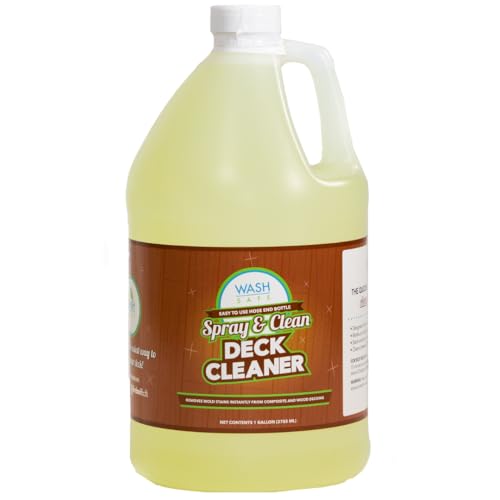
This cleaner targets black leopard spots so deep you thought they were permanent.
If you have a composite deck that has gone years without a deep clean, black mold, algae, and lichen can lock into the pores and create that spotted look known as “leoparding.” Wash Safe’s formula uses a small 5% chlorine bleach concentration combined with surfactant chemicals (agents that reduce surface tension so the liquid spreads into tiny crevices) that carry the cleaner into the pores — so you are not just rinsing the surface while the stain stays put. One gallon covers up to 1,500 square feet, which is more than enough for most standard decks. Buyers report restoring 8 to 15 years of built-up stains in a single application, often without needing to scrub.
One owner mentioned mixing at a ratio of one gallon of cleaner to one gallon of water, letting it soak for a couple of hours, then power washing — and the mold disappeared even in areas that needed a second full-strength spot treatment. It works on Trex, TimberTech, Fiberon, and Calibamboo, and the manufacturer markets it as non-hazardous with minimal bleach.
Why it stands out
- Covers 1,500 sq. ft. — more area per bottle than most competitors, giving you better value on a large deck.
- No scrubbing needed on normal mold; a pressure washer rinse does the job.
- Proven on Trex, TimberTech, Fiberon, and Calibamboo composite brands.
Know before you buy
- Does not include a sprayer; you will need your own pump sprayer (a handheld tank that sprays a mist).
- Best results call for a power washer, not just a garden hose.
- Heavy at 9 pounds per gallon — plan for lifting if you have a large deck.
Grab it if: you have a composite deck with deep-set black stains and want to avoid scrubbing.
One trade-off: you need a dedicated pump sprayer and access to a pressure washer to get the dramatic before-and-after look.
2. DeckMax Premium Deck Cleaner Kit

This kit bundles a concentrated cleaner and a scrub brush so you’re ready to work immediately.
If you prefer to scrub rather than rely on chemical soak alone, DeckMax is the better pick than Wash Safe because it includes a brush. The concentrated formula covers up to 1,500 square feet and is free of volatile organic compounds (VOCs — chemicals that produce fumes and can cause headaches or breathing irritation) — so you get no harsh solvent fumes while you scrub. It works on both wood and composite surfaces, making it among the most versatile single-bottle solutions on this list. One buyer with an eight-year-old Trex deck said they let the cleaner sit after scrubbing, scrubbed a second time, and saw a huge difference in the final look.
The catch — which several owners mention — is that the included brush does not come with a handle, so you will need to attach your own or buy a separate pole. Also, a few owners found it no more effective than dish soap on heavy mildew stains, so this is a product that rewards a bit of elbow grease.
What you get in the box
- Concentrated cleaner that covers up to 1,500 sq. ft. — best value on the list.
- Zero VOCs, no harsh solvents, safe for pets and plants once rinsed.
- Works on Trex, TimberTech, Fiberon, and wood decking.
What to expect
- Included brush has no handle — you will need to supply a broomstick or pole.
- Some customers note mildew stains need two scrubbing rounds to fully lift.
- Not as effective on deep-set black spots as the Wash Safe, which uses a 5% bleach formula.
Reach for this if: you prefer an all-in-one kit with a brush and want a low-fume, plant-safe cleaner.
Look elsewhere if: you want a spray-on-and-walk-away product — DeckMax needs scrubbing for best results.
3. TIMBERTECH Composite Deck Cleaner – 1 Gallon

The only cleaner on this list specifically formulated to protect a TimberTech capped-composite warranty.
If you paid a premium for a TimberTech AZEK, PRO, or EDGE deck, using the wrong cleaner could void the manufacturer warranty (the guarantee that covers cracking or fading). TimberTech made this formula for exactly that reason — the manufacturer states it is guaranteed not to damage capped composite, porch floors, or railing surfaces when used as directed. The concentrate is strong: one gallon bottle dilutes into four gallons of ready-to-use cleaner, covering about 1,000 square feet of surface area. A buyer who has used this product for 18 years on a TimberTech deck reports it removes mildew and algae effectively without causing any discoloration.
The formula is biodegradable (it breaks down naturally without leaving harmful residues), so runoff is less of a worry. But be realistic — reviewers point out scrubbing is required for the best results. One 76-year-old owner mentioned the cleaner removed stubborn spots from a light deck with minimal scrubbing, and a simple rinse left the deck looking new. It also works as a spot treatment for spills and tough stains.
Why choose this one
- Specially formulated for TimberTech capped composite — warranty-safe.
- One gallon makes four gallons of cleaner, covering ~1,000 sq. ft.
- Biodegradable and does not have an overpowering smell.
Heads up
- Scrubbing is needed for full cleaning — not a no-scrub product.
- Does not remove white oxidation from composite surfaces.
- Price per gallon is higher than multi-purpose alternatives like DeckMax.
Best for: owners of TimberTech capped-composite decks who want to keep their warranty valid.
Not for: cheap vinyl or painted wood surfaces — this cleaner is made for a specific material class.
4. Wash Safe™ CEDAR WASH | Eco-Safe and Organic Wood Cleaner
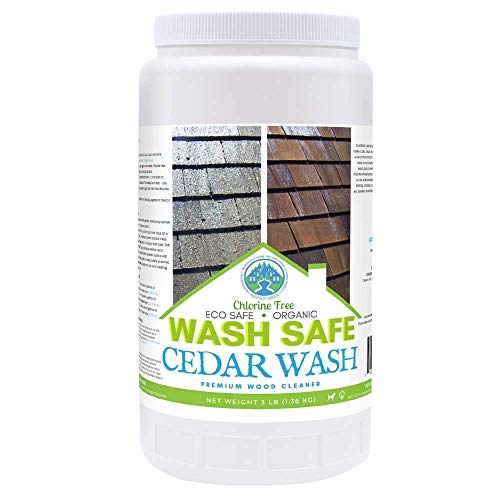
An oxygen-based powder that uses hydrogen peroxide to brighten cedar without drying it out.
Bleach-based cleaners can strip the natural oils out of cedar and make the wood brittle over time, which makes this powder concentrate a better choice for natural wood. Cedar Wash solves that by using a hydrogen peroxide powder (a chemical that releases oxygen to lift stains) that activates when mixed with water. The active life is only four to six hours, and after that it biodegrades completely — so you can use it around shrubs and gardens without worrying about chemical burns. One buyer used it on 20-year-old grey cedar shed siding: they mixed one cup of powder per gallon of water, let it sit for the recommended 13 minutes, and saw 90% improvement after a single scrub and rinse.
The trade-off is that this cleaner demands patience. The powder takes a while to dissolve fully — one reviewer noted they found drugstore 3% hydrogen peroxide worked faster on mold spots — and scrubbing is generally required, especially on rough-cut wood. Each pound of powder covers up to 1,000 square feet, and a 3-pound container gives you plenty for a full project.
The upside
- Zero bleach — safe for cedar, vegetation, and pets.
- Powder concentrate means less weight to carry; 3 lbs goes a long way.
- Brightens wood without making it dry or cracked.
The trade-off
- Requires a pressure washer for best results; hose rinsing may not be enough.
- Powder requires extended mixing time to dissolve fully.
- Some buyers found store-bought 3% hydrogen peroxide more convenient for spot treatments.
Choose this if: you have a cedar deck, shake roof, or fence that needs a chemical-free brightening.
skip it if: you want a quick spray-on solution — Cedar Wash is a multi-step soak, scrub, and rinse process.
5. MICROBAN Outdoor Surface Care Cleaner 1 Gal
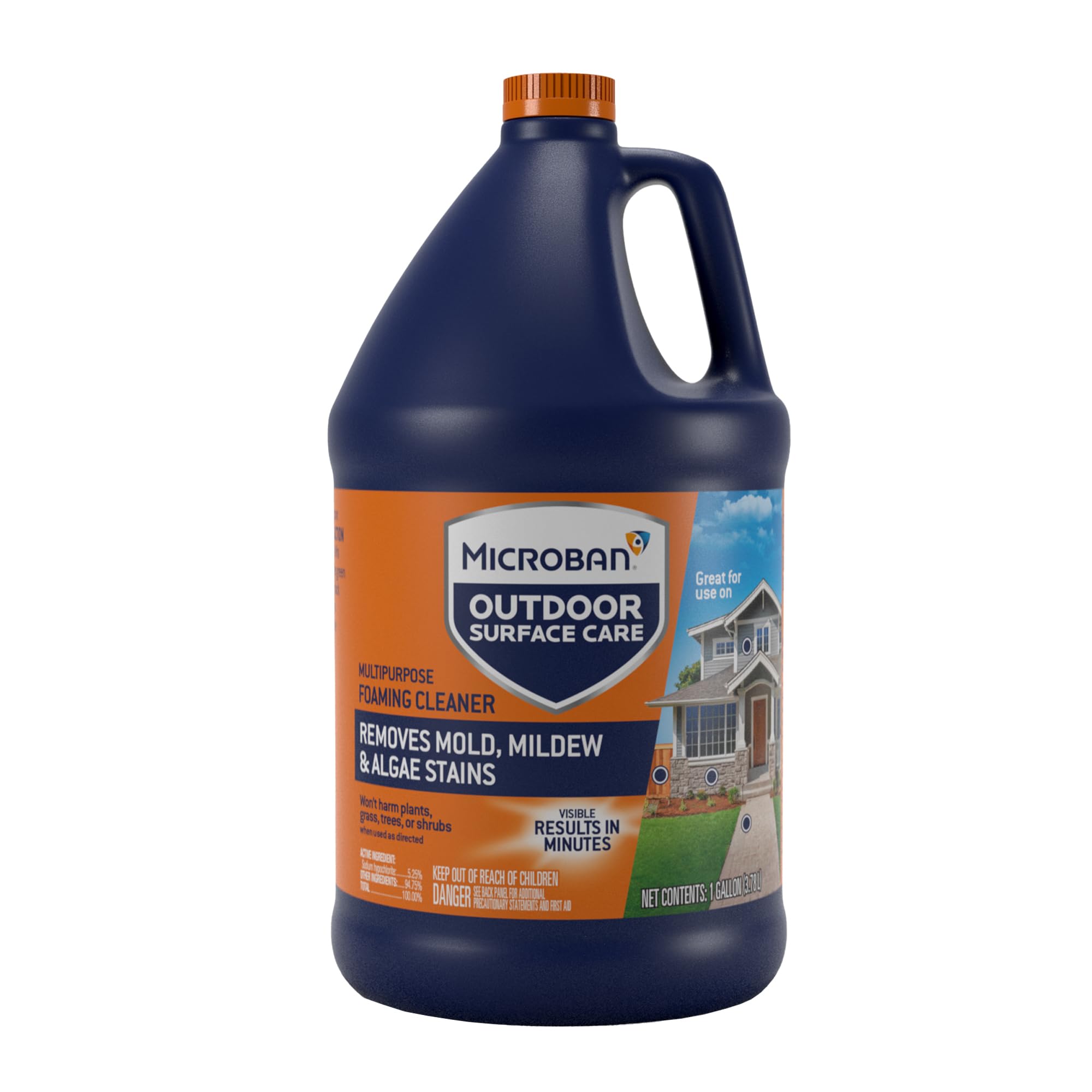
A foaming cleaner that kills mold in minutes and needs just a ten-minute soak before rinse.
Microban takes the simplest possible route to a clean deck: spray it on, wait ten minutes, and rinse off. The foaming action clings to vertical surfaces like fences and siding, and the formula is safe for plants when used as directed. One buyer used a 50/50 water dilution on a moldy white fence, let it sit, rinsed, and got perfect results with zero scrubbing. For a quick weekly or monthly touch-up, this is about as easy as it gets.
Where it falls short is on rough or old wood. One verified buyer sprayed a vinyl fence bottom-to-top, waited ten minutes, and found the rinse did nothing — they had to scrub to remove the growth. Another noted that concrete results were minimal. This is a surface-level cleaner that works brilliantly on smooth, non-porous materials but struggles with deep-set stains on wood.
The fast lane
- Foaming action clings to vertical surfaces — good for fences and siding.
- 10-minute soak time is the fastest on this list.
- Won’t harm grass, trees, or shrubs when used as directed.
The reality
- Ineffective on wood and vinyl without scrubbing — verified by buyers.
- Not a strong formula; heavy mold requires a separate brush session.
- Bottle size is 1 gallon with no dilution instructions for tough stains.
Reach for it if: you need a quick refresh on smooth surfaces like painted wood or vinyl siding.
Pass on it if: your deck has years of embedded black or green mold — you will end up scrubbing anyway.
6. Spray & Forget Ready-to-Use House & Deck Outdoor Cleaner

A ready-to-use spray that works slowly over time — you spray it once and forget about it.
This is the only product on the list that you do not rinse off. Spray & Forget uses a bio-based formula that sits on the surface and kills mold, mildew, and algae gradually over a period of weeks. Each gallon covers 150 to 200 square feet, and the manufacturer recommends respraying every 24 to 36 months. One long-time buyer says it works great for moss and algae prevention when used with patience — the active ingredient works slowly, but the moss dies and disappears naturally. The orange scent makes application less unpleasant than bleach-heavy alternatives.
The downside is speed and coverage. A verified buyer sprayed their awning and saw practically no change, calling it worthless. Another noted that the built-in sprayer is poor quality and you may need a separate sprayer. If you have a modest deck and want a low-effort preventative treatment, this fits. But for heavy, immediate stain removal, you will be disappointed. For the same price you could get the DeckMax concentrate, which covers up to 1,500 sq. ft. versus 150 to 200 sq. ft. here and works immediately.
What works
- No mixing, no rinsing — spray and walk away.
- Bio-based formula with an orange scent.
- Good for ongoing mildew prevention on brick, walls, and siding.
What does not
- Small coverage area (150–200 sq. ft. per gallon) for the price — DeckMax covers up to 1,500 sq. ft.
- Very slow results; no visible change for weeks.
- Sprayer quality is poor — many buyers switch to a separate unit.
Good for: maintenance cleaning on a small patio or driveway where you want to set a timer and forget.
Not for: anyone who needs a deck clean by the weekend — this product works on its own schedule, not yours.
Understanding the Specs
Bleach vs. Oxygen (Hydrogen Peroxide)
Bleach — usually listed as sodium hypochlorite — kills organic growth fast, often in 10 to 15 minutes, but it can dry out natural wood fibers and may harm grass and shrubs if not rinsed thoroughly. Oxygen-based cleaners use hydrogen peroxide to lift stains through tiny oxygen bubbles; they are gentler on wood and safer for plants, but they take longer to work and typically require a pressure washer to rinse off the lifted debris. Choose bleach if you want speed on composite; choose oxygen if you are cleaning raw cedar or have heavy vegetation around the deck.
Concentrate vs. Ready-to-Use (RTU)
A concentrated cleaner lets you adjust the dilution to match the stain — use full strength for deep-set black spots, dilute further for general maintenance. Concentrates also save storage space and cost less per square foot of coverage. Ready-to-use bottles are convenient for small touch-ups but run out fast; a 1-gallon RTU only covers about 150 to 200 square feet in most cases, making it impractical for a full-size deck. Always check the bottle’s coverage estimate in square feet before buying.
FAQ
Can I use a composite deck cleaner on a wood deck?
How long should I let the cleaner sit before rinsing?
Will a deck cleaner kill my grass and plants?
Which cleaner removes black mold spots from Trex decking?
Do I need a pressure washer or can I just use a hose?
Can I mix deck cleaner with other chemicals or soap?
How often should I clean my deck?
Can I apply a deck cleaner in direct sunlight?
Is there a difference between a deck cleaner and a deck brightener?
Will a deck cleaner remove old stain or sealer?
Final Thoughts: The Verdict
If you want one dependable pick, the cleaner for decks winner is the Wash Safe SPRAY & CLEAN Composite Deck Cleaner because it combines the highest coverage (1,500 sq. ft.), proven customer satisfaction on deep-set black spots, and a bleach formulation that works without scrubbing on normal composite mold. If you want a warranty-safe option and own a TimberTech composite deck, grab the TimberTech Composite Deck Cleaner. And for a natural cedar deck that needs a gentle, oxygen-based brightener, the Wash Safe Cedar Wash powder is the safest choice for your plants and the wood itself.
How We Picked
We do not accept paid placement. Every pick is matched to a real buyer and a real use-case; we do not hands-on test units.
Sources & Methodology
Specifications: manufacturer listings and product documentation. Review insights: verified customer reviews, as of July 2026. Pricing: not shown on this page (it changes often); check the current price via the retailer link.
As an Amazon Associate, WellFizz earns from qualifying purchases. This does not affect which products we feature.

Mo Maruf
I created WellFizz to bridge the gap between vague wellness advice and actionable solutions. My mission is simple: to decode the research and give you practical tools you can actually use.
Beyond the data, I am a passionate traveler. I believe that stepping away from the screen to explore new environments is essential for mental clarity and physical vitality.