Our readers keep the lights on and my smoothie glass nicely filled. As an Amazon Associate, I earn from qualifying purchases.
A damp, spalling cinder block wall isn’t just an eyesore; it’s a structural liability. Water infiltration through porous masonry leads to freeze-thaw damage, efflorescence, and crumbling surfaces that compromise your foundation, retaining wall, or garden shed. The right sealer stops moisture at the surface or deep within the pores, preserving the block’s integrity without trapping vapor that causes blistering.
I’m Mohammad Maruf — the founder and writer behind WellFizz. This guide comes from many hours of analyzing chemical formulations, application methods, and real-world customer reports on siloxane, silicone, acrylic, and liquid rubber sealers to find what truly works for cinder block and concrete masonry.
After evaluating seven leading products based on penetration depth, breathability, durability, and ease of application, you’ll have a clear picture of the best cinder block sealer for your specific project, whether it’s a vertical wall, horizontal slab, or moisture-prone basement.
How To Choose The Best Cinder Block Sealer
Selecting the right sealer depends entirely on the block’s location (above grade, below grade, interior, exterior) and the condition you care about most — stopping liquid water, resisting salt damage, or preventing dusting. Three factors separate the winners from the washouts.
Penetrating vs. Film-Forming Chemistry
Penetrating sealers, primarily silane siloxane blends, soak into the substrate and chemically bond to form a water-repellent barrier below the surface. They allow water vapor to escape (breathability), which is critical for vertical walls to prevent trapped moisture from causing spalling during freeze-thaw cycles. Film-forming sealers (acrylics, liquid rubber) sit on top, creating a physical barrier. These are better for horizontal slabs or surfaces where you want a wet look or slip resistance, but they risk peeling if moisture tries to escape from behind.
Coverage and Application Window
Cinder block is highly porous, which means it drinks up sealer. Low-coverage products (around 40 square feet per gallon) require more material for the same job than high-coverage options (150-225 square feet per gallon). Check the ambient temperature range: most sealers require 40-90°F and dry conditions for at least 6 hours. Water-based formulations offer easy soap-and-water cleanup but may require more coats, while solvent-based options penetrate deeper and cure faster but demand proper ventilation and respirator use.
Vapor Permeability and Substrate Compatibility
For painted or previously sealed blocks, a penetrating sealer may not bond — you must strip or grind to bare concrete. Unpainted, raw cinder block is ideal for silane siloxane treatments. If your block has existing moisture issues or you’re sealing a retaining wall, prioritize a breathable, non-film-forming formula that lets internal dampness evaporate while blocking liquid ingress.
Quick Comparison
On smaller screens, swipe sideways to see the full table.
| Model | Category | Best For | Key Spec | Amazon |
|---|---|---|---|---|
| Armor SX5000 WB | Silane Siloxane | Long-term zero-VOC protection | Reduces water absorption by up to 95% | Amazon |
| Armor AR350 | Solvent Acrylic | Wet-look color enhancement | Covers 175-225 sq. ft/gal | Amazon |
| AMES Blue Max | Liquid Rubber | Flood-level waterproofing | 900% elongation flexibility | Amazon |
| MasonryDefender All Purpose | Silane Siloxane | Vertical stone and brick walls | 1 gal covers 90-150 sq. ft | Amazon |
| MasonryDefender Concrete Sealer | Silane Siloxane | Driveway and patio slabs | Penetrates up to 1/4 inch | Amazon |
| Polar Dust Proof | Acrylic | Interior dust-proofing floors | Low viscosity for deep penetration | Amazon |
| ChimneyRx 300119 | Siloxane | Chimney and vertical masonry | Covers approximately 40 sq. ft/gal | Amazon |
In‑Depth Reviews
1. Foundation Armor SX5000 WB

The Armor SX5000 WB is a professional-grade water-based silane siloxane sealer that delivers deep, breathable protection without altering the look or feel of your cinder block. It reduces water absorption by up to 95% and forms a chemical bond below the surface, meaning there’s no film to peel or yellow over time. With a coverage rate of 175-225 square feet per gallon, it’s one of the most efficient options for large projects.
Customers consistently report that after application, water beads up and rolls off the surface for years — several reviews note effective performance lasting six to seven years on driveways and spalled slabs. The sealer dries quickly and allows a second coat within minutes, making it ideal for a fast DIY workflow. It works on concrete, brick, pavers, bluestone, flagstone, and natural stone.
The only real friction point is the price, which sits at the premium end of the market. But given the extended lifespan and the fact that it requires no stripping for reapplication, the cost per year of protection is among the lowest in this category. This is the set-and-forget solution for anyone serious about long-term cinder block preservation.
Why it’s great
- Zero VOCs and no odor, safe for occupied spaces
- Penetrates deep without altering color or texture
- Lasts 7-10 years on vertical surfaces
Good to know
- Higher per-gallon cost compared to film-forming sealers
- Requires clean, dry, absorbent surface for proper bonding
2. Armor AR350 Low Gloss Wet Look

If you want your cinder block wall or paver patio to look like it’s perpetually damp (in a good way), the Armor AR350 delivers that saturated, color-rich finish through a solvent-based acrylic formula. This is a film-forming sealer, so it sits on top of the concrete rather than penetrating, creating a low-gloss, non-yellowing membrane that resists UV rays, road salts, and light vehicle traffic.
Coverage is excellent at 175-225 square feet per gallon, and the self-priming nature simplifies recoat jobs. Reviews highlight that the dramatic color enhancement transforms dull gray surfaces into dark, rich tones, especially on stamped concrete and pool decks. The solvent-based chemistry requires a good respirator during application, but the trade-off is a tough, long-lasting layer that bonds aggressively to the substrate.
One key downside: because it creates a surface film, it’s not suitable for vertical walls where moisture might try to escape from behind. Use it on horizontal slabs, driveways, patios, and walkways where you want the enhanced look and can manage the strong initial odor. It’s available in multiple VOC formulations to comply with local regulations.
Why it’s great
- Dramatic color enhancement with a consistent low-gloss wet look
- Resists abrasion, vehicle traffic, and deicing salts
- Self-priming simplifies maintenance recoats
Good to know
- Strong solvent odor requires high-quality respirator
- Not breathable — avoid on vertical walls with moisture behind them
3. AMES Blue Max White Liquid Rubber

The AMES Blue Max takes a completely different approach from the penetrating sealers above. It’s a thick, elastomeric liquid rubber that forms a flexible, high-build membrane over the substrate. With 900% elongation, this product is designed for extreme waterproofing scenarios — below-grade foundations, basement walls, underlayment, and any location where standing water or hydrostatic pressure is a legitimate threat.
Users praise its adhesion to concrete, wood, and metal, and it’s non-toxic and VOC-compliant in all 50 states. Application is straightforward: brush, roll, or spray onto clean surfaces, and allow 24 hours between coats for full cure. Customers have successfully used it to seal shower window sills, pet-stained subfloors, and foundation walls. The white finish provides a visual indicator of coverage.
The trade-off is that Blue Max is a heavy-duty coating, not a penetrating sealer. It will change the appearance of your cinder block (white, rubbery finish), and it requires a top coat if exposed to direct sunlight, as UV degrades the rubber over time. This is the right tool when you need absolute water stoppage and flexibility rather than invisible, breathable protection.
Why it’s great
- Exceptionally flexible, resists cracking from structural movement
- Non-toxic and eco-friendly with low odor
- Creates a thick, durable waterproof membrane
Good to know
- White rubber finish changes block appearance significantly
- Requires UV-resistant top coat for outdoor sun exposure
4. MasonryDefender All Purpose Brick Stone & Concrete Sealer

The MasonryDefender All Purpose formula is another penetrating silane siloxane sealer, but it broadens its surface compatibility to include brick, limestone, granite, and cultured sandstone alongside concrete. This makes it an excellent choice if you’re sealing a mixed-masonry project — a cinder block wall with a stone facade, for instance. It remains invisible and breathable, allowing trapped vapor to escape while blocking liquid water.
Customers report that it solved persistent water seepage in basements and prevented freeze-thaw damage on terra cotta and statuary. The application is simple with a garden sprayer, and it dries clear quickly. Coverage ranges from 90-150 square feet per gallon, which is solid for a penetrating formula. The manufacturer recommends thorough shaking before use to prevent clogging in the spray nozzle.
The main caveat is that some users noted the water beading effect seems strong right after application, but its long-term longevity feels more like a routine maintenance step rather than a one-and-done decade solution. Still, for the price point, it delivers reliable protection for vertical walls and decorative masonry without altering the surface appearance at all.
Why it’s great
- Compatible with multiple stone types, not just concrete
- Clear and breathable — perfect for historic or decorative masonry
- Easy pump-sprayer application with quick drying time
Good to know
- May require annual reapplication for best long-term performance
- Can leave water spots if over-applied or applied in direct sun
5. MasonryDefender Concrete Sealer
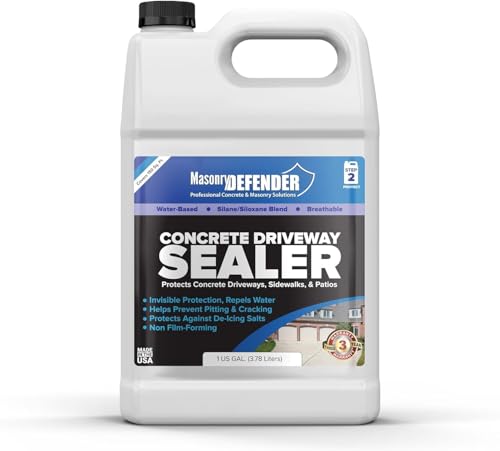
This specific MasonryDefender variant focuses on concrete slabs, driveways, sidewalks, and patios with a purely penetrating silane siloxane formula. It doesn’t change the concrete’s appearance at all — no gloss, no color shift — making it ideal for homeowners who want protection without turning their driveway into a skating rink or altering its natural tone.
Real-world reviews from the Pacific Northwest highlight that the sealer makes water bead up and roll off even in heavy rain, and after three years, treated driveway squares resisted dirt and mold growth noticeably better than untreated sections. The application is straightforward with a low-pressure garden sprayer, and cleanup is just soap and water. One gallon covers roughly 90-150 square feet, so plan accordingly for larger driveways.
The one limitation is that this formula is specifically for concrete — it doesn’t list the broad multi-stone compatibility of the All Purpose version. If your project is strictly concrete block or poured concrete, this is a focused, cost-effective choice. Users recommend annual reapplication as cheap insurance to extend the concrete’s lifespan against freeze-thaw cycles and efflorescence.
Why it’s great
- Zero visual change — no gloss, no residue
- Strong water beading that lasts through rain seasons
- Helps keep concrete whiter and cleaner by resisting mold and dirt
Good to know
- Coverage may require multiple gallons for full driveways
- Best for unsealed concrete; not for painted or coated surfaces
6. Polar Dust Proof Concrete Sealer

The Polar Dust Proof Sealer addresses a very specific cinder block pain point: concrete that sheds dust and fine particles onto floors and furniture. This 100% acrylic, low-viscosity formula penetrates the surface to bind loose particles and create a durable, satin-finished membrane that stops dusting at the source. It’s designed for interior use on garage floors, factory floors, warehouses, and workshop slabs.
Customer feedback confirms that two coats effectively reduce dust along with musty odors and surface moisture. The low viscosity allows excellent penetration into porous concrete and blockwork, creating superior adhesion. The 5-liter container covers up to 25 square meters, and each coat dries within 1-2 hours, allowing a same-day two-coat application. The satin finish adds a subtle sheen without being slippery when dry.
This is not a heavy waterproofing solution — it’s a dust-proofer and light sealer for interior horizontal surfaces. It should not be used with floor paint, and it won’t stop hydrostatic pressure or heavy standing water. If your main complaint is a dusty basement floor or garage slab that tracks particles everywhere, this is your fix. For outdoor walls or moisture intrusion, choose a penetrating silane siloxane instead.
Why it’s great
- Effectively eliminates concrete dust tracking on interior floors
- Fast drying time (1-2 hours per coat) enables same-day completion
- Low odor and eco-friendly acrylic formulation
Good to know
- Limited to interior horizontal surfaces — not for exterior walls
- Acrylic film may wear under heavy vehicle traffic over time
7. ChimneyRx 300119 Masonry Water Repellent

The ChimneyRx is a siloxane-based sealer purpose-built for vertical masonry surfaces, with a particular focus on chimneys. It penetrates up to 1/4 inch into the block, forming a strong chemical bond that repels water while remaining breathable. The non-film-forming nature means it won’t trap moisture inside the masonry, which is the leading cause of spalling on chimney stacks and retaining walls.
Users report that it effectively stopped chimney leaks after repairing cracked crowns and mortar, withstanding two-inch downpours without any water intrusion. The application temperature window is 40-90°F, and drying time ranges from 2-6 hours depending on humidity. Note that coverage is approximately 40 square feet per gallon, which is the lowest in this lineup — highly porous brick and cinder block may require two coats, so budget accordingly.
The main trade-off is the per-project cost due to the low coverage rate. For a single chimney or a small retaining wall, this is an affordable, effective option. For large foundation walls, you’ll go through multiple gallons. Some users reported that the water repellency needed reapplication after one year on roofs, but on vertical masonry, multiple reviews confirm five years of effective protection. The slight milky color dries clear on most substrates.
Why it’s great
- Deep penetration (up to 1/4 inch) for robust vertical protection
- Breathable — prevents spalling from trapped moisture
- Proven track record stopping chimney and wall leaks
Good to know
- Low coverage (40 sq. ft/gal) means more gallons for larger projects
- May require two coats on highly porous brick or cinder block
FAQ
Can I apply a cinder block sealer over paint or old sealer?
How long does a penetrating cinder block sealer last on a vertical wall?
Will a cinder block sealer stop efflorescence?
Final Thoughts: The Verdict
For most users, the best cinder block sealer winner is the Foundation Armor SX5000 WB because it offers invisible, breathable protection that lasts nearly a decade with zero VOC and no odor. If you want dramatic color enhancement and a wet-look finish for your patio or driveway pavers, grab the Armor AR350. And for absolute flood-level waterproofing where hydrostatic pressure is a concern, nothing beats the AMES Blue Max Liquid Rubber.

Mo Maruf
I created WellFizz to bridge the gap between vague wellness advice and actionable solutions. My mission is simple: to decode the research and give you practical tools you can actually use.
Beyond the data, I am a passionate traveler. I believe that stepping away from the screen to explore new environments is essential for mental clarity and physical vitality.