Our readers keep the lights on and my smoothie glass nicely filled. As an Amazon Associate, I earn from qualifying purchases.
Specs are compiled from manufacturer listings and verified buyer reviews and can change over time — please confirm the key details on the product page before buying.
A nesting box that hens refuse to use is worse than no box at all. Between broken eggs, dirty shells, and hens laying in random corners, the wrong setup creates a daily headache. This guide breaks down exactly which nesting boxes earn their keep — and which ones your flock will actually adopt.
I’m Mohammad Maruf — the founder and writer behind WellFizz. This guide is built by comparing the manufacturers’ published specifications and the patterns across verified customer reviews, so you get each pick’s real strengths and trade-offs instead of marketing spin.
The goal is simple: find the best chicken nesting boxes that keep eggs clean, safe, and easy to collect without a daily struggle.
Quick Picks
- Eggluuz Chicken Nesting Box, 3 Compartments Chickens Egg Laying Nest Boxes for Hens Green — Best Overall
- Homestead Essentials Compact Style 3 Compartment, Forward Rollout & Rollaway Nesting Box — Premium Pick
- Little Giant Single Plastic Nesting Box Chicken Nest Box with Perch — Best Value
- HOLOLIJO 10-Pack Chicken Nesting Boxes with Perch, Roll-Out Laying Boxes — Versatile Pick
- Touri 6-Pack Chicken Nesting Boxes for Laying Eggs for Hens Ducks and Poultry — Budget Champion
- Bavlesfuire 3-Compartment Wooden Chicken Nesting Box – Wall Mount — Compact Wood Option
How To Choose The Best Chicken Nesting Boxes
Picking the right nesting box depends on three things: what your hens will use, how much cleanup you can tolerate, and whether your coop has the mounting space. Miss on any of these and you will be cleaning eggs off the floor or scrubbing mite-infested wood.
Match the box size to your actual breed size
A nesting box that is too tight stresses the hen and leads to broken eggs. Full-size breeds like Orpingtons need a box at least 12 inches wide and 12 inches deep. Bantam breeds can squeeze into an 11-inch wide box. Check the internal depth — some boxes look large from the outside but have a shallow nest area that exposes the eggs.
Plastic vs. wood vs. metal: pick your trade-off
Plastic boxes are the easiest to clean and resist mites, but cheap thin plastic can crack in cold weather. Wood boxes look natural and insulate well, but they absorb moisture and harbor mites if not sealed. Metal boxes last the longest and keep eggs clean, but they get cold in winter and hot in summer unless insulated with bedding.
Roll-out trays vs. flat-bottom designs
A roll-out tray tilts forward so the egg rolls out of reach after the hen lays it. This prevents the hen from pecking or breaking the egg and keeps the egg clean. Flat-bottom boxes are simpler and cheaper but require you to reach in and collect the egg, which can startle the hen and lead to dirty or cracked shells.
Quick Comparison
| Model | Best For | Material | Dimensions (LxWxH) | Compartments | Amazon |
|---|---|---|---|---|---|
| Little Giant Single Plastic | Small flocks, easy cleaning | Polyethylene | 26.5″ x 15.88″ x 19.75″ | 1 | Amazon |
| Touri 6-Pack Plastic | Budget multi-pack, portable coops | PP plastic | 14.25″ x 12.5″ x 12.25″ | 6 | Amazon |
| Bavlesfuire 3-Compartment Wood | Small bantams, natural look | Pine | 14″ x 11.8″ x 11.4″ | 3 | Amazon |
| Eggluuz 3-Compartment Green | Exterior roll-out egg collection | ABS, Alloy Steel | 31.3″ x 20.5″ x 20″ | 3 | Amazon |
| Homestead Essentials 3-Compartment | Large hens, durable roll-out | Galvanized Steel | 31.5″ x 19.5″ x 19.5″ | 3 | Amazon |
| HOLOLIJO 10-Pack Plastic | Large flocks, automatic egg retrieval | ABS Plastic | — | 10 | Amazon |
In‑Depth Reviews
1. Eggluuz Chicken Nesting Box, 3 Compartments Chickens Egg Laying Nest Boxes for Hens Green
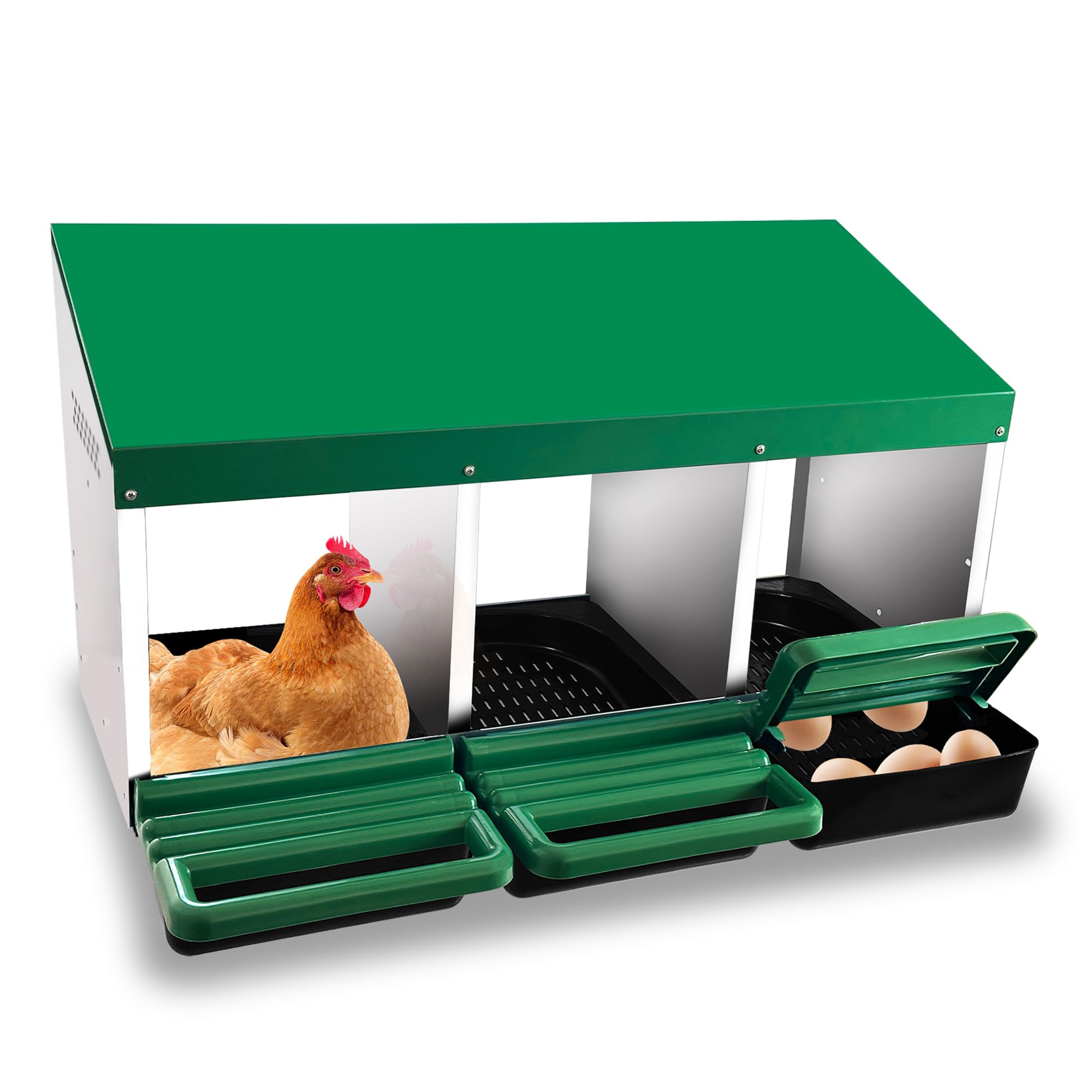
The roll-out tray champ that makes egg collecting a no-reach chore.
This box keeps eggs clean because a sloped floor (a roll-out tray) gently rolls each egg forward into a covered front tray. You never have to stick your hand into a dark box. The sides and roof are made from alloy steel with ventilation holes, and at 31.3 inches long by 20.5 inches wide by 20 inches high (9.78 kilograms), it is substantial. One reviewer says assembly via the YouTube video took about 15 minutes with a drill. The main drawback: the plastic trays snap in very snugly and are tough to remove once installed, so plan your cleaning routine before you lock them in. Some reviewers added a 2×4 mount to get the right forward angle so the eggs roll reliably.
Roll-Out Design Wins
- Unique sloped tray rolls eggs forward for zero-reach collection
- Galvanized steel roof and sides are durable and rust-resistant
- Ventilation holes keep the interior dry and cool
- Key-shaped hanging holes make mounting and disassembly simple
Assembly & Fit Gripes
- Plastic trays snap in permanently — nearly impossible to remove for cleaning
- Assembly instructions can be mildly confusing; YouTube video is easier
- Compartments are tight for extra-large breeds like Brahmas
- Needs a forward tilt (e.g., on a 2×4) to work properly for egg rolling
Reach for this if: you want a sturdy steel-constructed box that keeps eggs clean and makes collection a breeze — the roll-out tray is the standout feature here.
Consider the catch: you must get the mounting angle right for the roll-out mechanism to work, and those trays will not come out once snapped in, so plan weekly hosing rather than tray removal.
2. Homestead Essentials Compact Style 3 Compartment, Forward Rollout & Rollaway Nesting Box
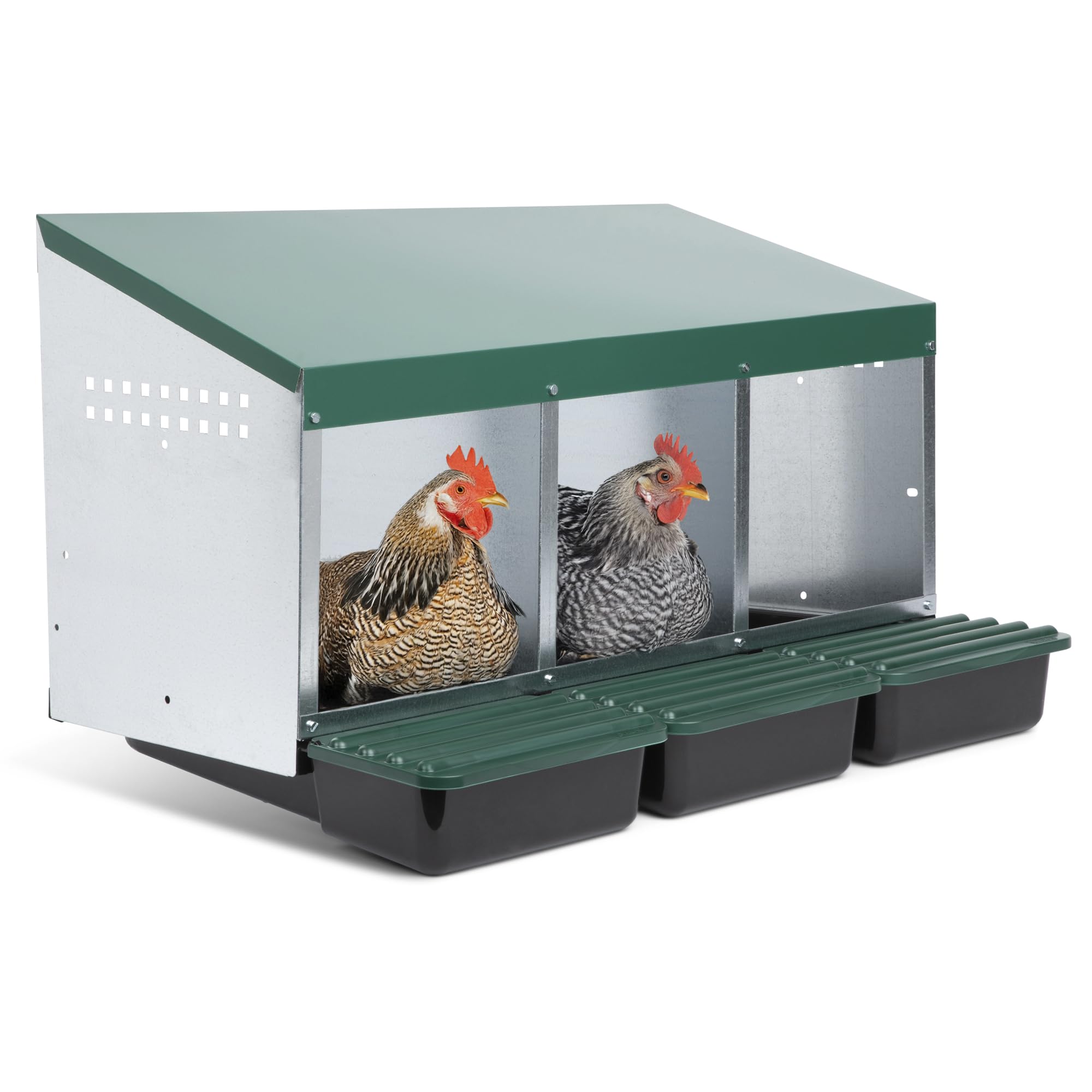
The metal fortress built for large hens and long-lasting outdoor life.
This steel box resists rust, rot, and corrosion far better than plastic or wood, so it lasts outdoors for years. Each of the three compartments fits up to five hens, and a roll-away tray with a protective lid gently rolls eggs forward after laying. The lid keeps eggs safe from pecking, breaks, and dirt. At 14 pounds (6.35 kilograms), it feels solid. One buyer with 19 hens says it works great once the chickens get used to it, with far fewer broken eggs than before. The steep roof keeps chickens from roosting on top, which prevents droppings buildup. The main catch: assembly requires careful wall anchoring, and some hens need training with fake eggs to adopt it.
Tough Build, Clean Eggs
- All-galvanized steel construction — lasts outdoors for years
- Roll-away tray with protective lid prevents pecking and breakage
- Each compartment fits up to 5 medium-to-large hens comfortably
- Easy to remove from wall for coop modifications when needed
Setup & Hen Adoption
- Assembly is not straightforward for everyone; instructions could be clearer
- Some hens refuse to use it initially and require training with fake eggs
- No metal hanger included — you need your own mounting hardware
- Galvanized steel gets cold in winter without deep bedding
Best suited for: anyone with a permanent coop who wants a one-time buy that shrugs off rain and sun for years. The steel build is the key durability advantage.
What to watch out for: if your hens are stubborn, you may need to place fake eggs in the nest and block access to their old spots for a week — they eventually switch over.
3. Little Giant Single Plastic Nesting Box Chicken Nest Box with Perch

The single-box workhorse that bantam owners and small-flock keepers swear by.
The smooth polyethylene surface on this box is easy to hose down, and it will not rust or rot. At just 3 pounds (1.36 kilograms), it is the lightest box here but still offers generous space — 26.5 inches long by 15.88 inches wide by 19.75 inches high, so even a 5-pound Brahma hen fits inside easily, according to buyers. A chicken sanctuary owner called it “the most perfect nesting box” they have seen, praising the dark, private interior and good ventilation. The sloped roof stops other chickens from roosting on top, and the fold-down perch gives hens a landing spot. The catch: it comes with no screws (you need #10 screws), there is no back panel (some owners add chicken wire), and eggs sit directly on the plastic floor without bedding. It does not have a roll-out tray like the Homestead Essentials, so you must reach in to collect eggs.
Practical & Hen-Approved
- Rust-proof, rot-proof polyethylene — easy to hose down
- Sloped roof stops chickens from roosting on top
- Includes fold-down perch and ventilation holes
- Weighs only 3 pounds for easy mounting
Missing Pieces & Depth
- No mounting screws included (requires #10 screws)
- No back panel — eggs can roll out the back without modification
- Shallow depth from hole to floor means straw gets kicked out easily
- Eggs sit directly on plastic floor — risk of breakage without bedding
Pick this for: small backyard flocks and bantam keepers who want a low-cost, lightweight, easy-to-clean plastic box that hens will actually use. The 3-pound weight is a real advantage for mounting on lighter coop walls.
Know before you buy: budget a few extra minutes and some #10 screws for installation, and consider adding a back panel or chicken wire if your coop setup leaves the back exposed.
4. HOLOLIJO 10-Pack Chicken Nesting Boxes with Perch, Roll-Out Laying Boxes
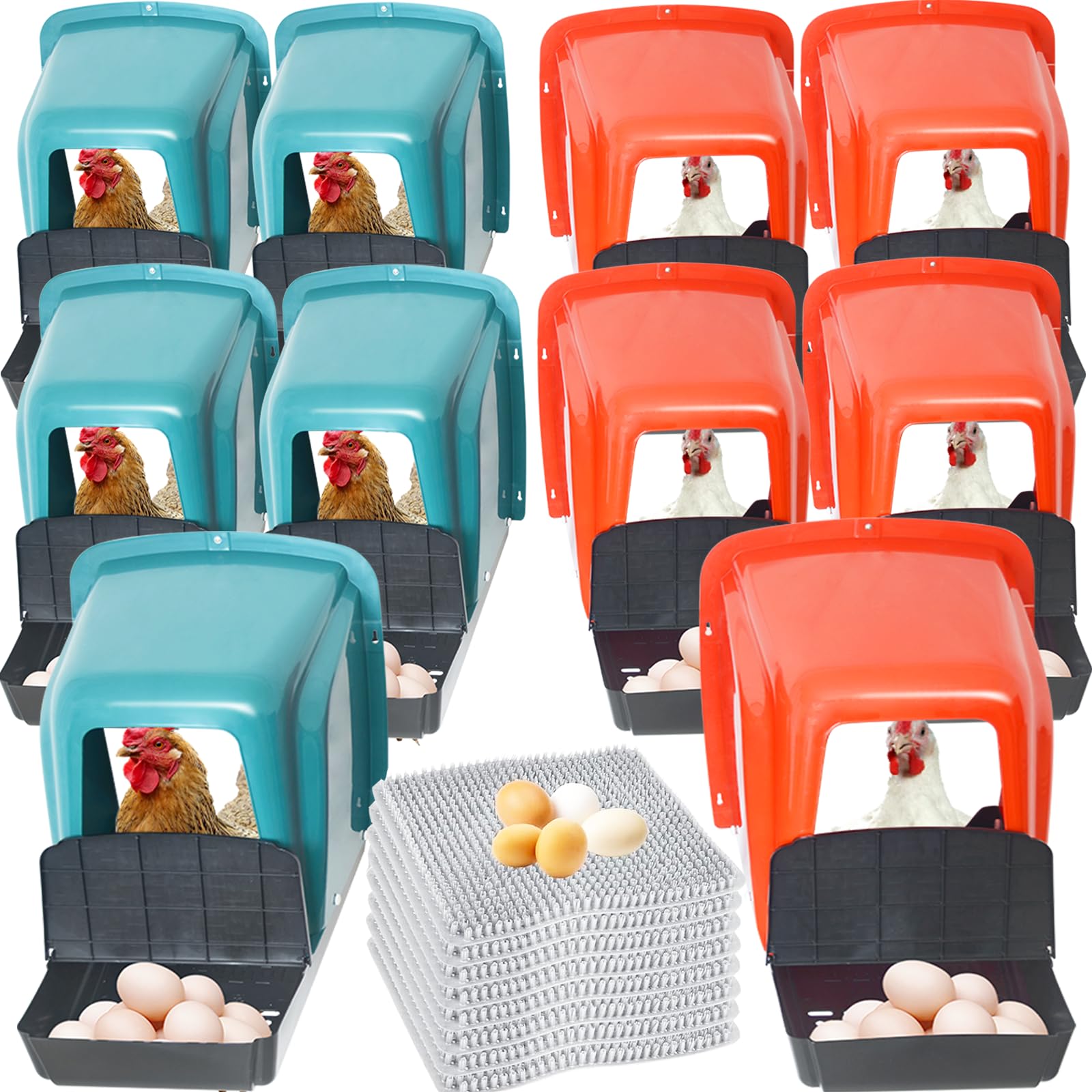
The 10-box bundle that solves egg-eating on a large-flock scale.
For a large flock, this pack delivers ten individual boxes, each with a built-in roll-away mechanism. The ABS plastic resists rust and rot. Each box includes a nest pad with small holes that filter dirt away from the egg. After the hen lays, a slight forward tilt rolls the egg under a front cover, keeping it clean and out of pecking range. Buyers report the chickens used them immediately and the roll-away design eliminated broken eggs overnight. The boxes feel a bit flimsy until fully assembled and screwed to a wall, but once mounted they are stable. Some owners mention the pads can slip and knock off the collection covers, and recommend replacing them with Astro turf for better long-term performance.
Massive Capacity, Clean Eggs
- 10 boxes in one package — ideal for flocks of 10+ hens
- Roll-away design prevents egg-eating and breakage
- sturdy ABS plastic — no rust, rot, or corrosion
- Comes with 10 nest pads as a bundled gift
Build & Pad Issues
- Feels flimsy before wall mounting; stability depends on secure screws
- Nest pads can slip over time and knock off the collection covers
- Mats require smooth-side-up positioning for proper egg rolling
- Some buyers replaced the included pads with Astro turf for better results
Ideal for: flock owners with 10 or more laying hens who need a complete egg-retrieval system in one box. The 10-pack value is tough to top on a cost-per-nest basis.
One thing to check: plan to replace the included nest pads with a sturdier alternative like Astro turf or Tractor Supply pads — reviewers report better long-term performance that way.
5. Touri 6-Pack Chicken Nesting Boxes for Laying Eggs for Hens Ducks and Poultry
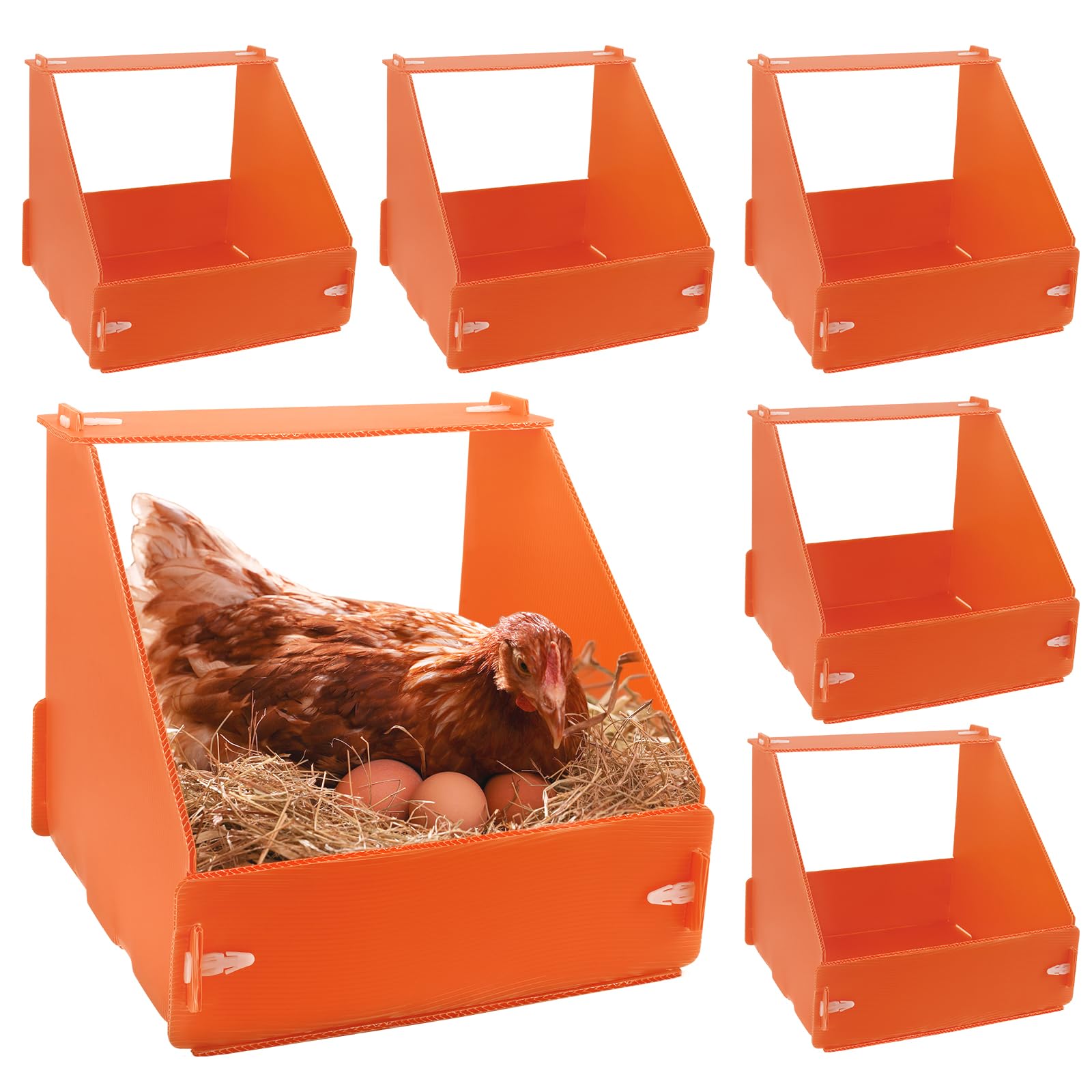
The no-tools, lightweight 6-pack that assembles in minutes for portable coops.
These boxes are cut from corrugated PP plastic and use Velcro attachments — you press the tabs together and the box is ready. Each box measures 14.25 inches long by 12.5 inches wide by 12.25 inches high, with a 0.2-inch wall thickness. One buyer says they put three together in less than 10 minutes with zero tools. The bright orange color is meant to help hens find the nests. Customers note that hens actually prefer these over more expensive options, and the boxes have held up for nearly a year. They are lightweight enough to move around in a chicken tractor (a portable coop). The corrugated plastic is not as durable as the Eggluuz’s steel, but for a quick, affordable solution, they work well. You also need a shelf or mounting surface — they have no built-in wall brackets like the Homestead Essentials.
Instant Setup & Mobility
- Velcro assembly — no tools, no screws needed
- Lightweight corrugated plastic — easy to move with a portable coop
- 6-pack covers a decent-sized flock in one purchase
- Bright orange color helps hens locate the nests
Not Built for Decades
- Corrugated plastic is not as durable as solid plastic or steel
- Reviewers point out they are not long-lasting, though they lasted nearly a year
- Material is thinner than expected by some first-time buyers
- Needs a shelf or mounting surface — no built-in wall brackets
Go with these if: you need an instant, portable, no-tools nesting solution for a chicken tractor or a small backyard flock where longevity is secondary to convenience. The 6-pack price is tough to top.
Skip them for: a permanent coop where you want a box that lasts for years. The corrugated plastic will need replacing after a season or two of outdoor exposure.
6. Bavlesfuire 3-Compartment Wooden Chicken Nesting Box – Wall Mount
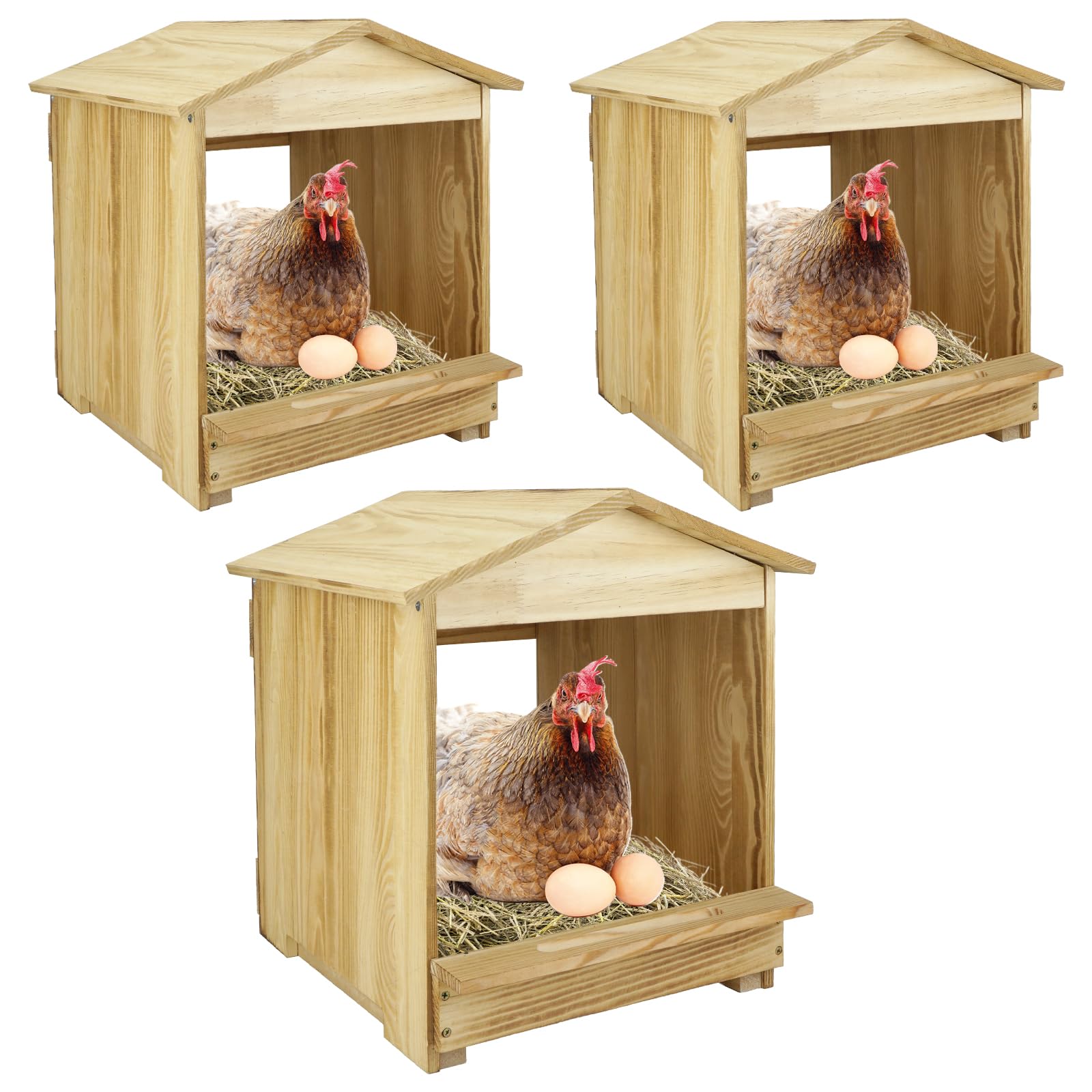
The natural-pine box that looks great in the coop but only fits bantam-sized hens.
This box is built from solid pine, giving it a natural look. The overall dimensions are 14 inches long by 11.8 inches wide by 11.4 inches high, and it weighs about 6.79 kilograms (roughly 15 pounds). It comes with pre-drilled holes and a screwdriver included. Shoppers say easy assembly. However, multiple buyers report this is suitable only for bantams. Standard-size hens like Orpingtons or Americaunas cannot fit in these compartments. One owner gave it 3 stars specifically for that size limitation. The wood has a light sealer, but several buyers recommend applying a heavy outdoor sealer if the box will face rain. It lacks the roll-out tray of the Eggluuz, so eggs stay in the nest until you collect them.
Charming & Easy Assembly
- Solid pine construction looks natural in any coop
- Pre-drilled holes make assembly straightforward with no instructions needed
- Flexible brackets allow single or grouped mounting
- Wood provides better insulation than metal in winter
Size Is the Dealbreaker
- Too small for standard-size breeds like Orpingtons or Americaunas
- Light sealer is not enough for outdoor exposure — needs additional sealing
- At 6.79 kg it is heavier than the 3-pound plastic alternative
- Wood can harbor mites if not regularly cleaned and sealed
Buy this for: bantam keepers who want a charming, easy-to-assemble wooden box that blends into a natural coop setting. The quick assembly and included hardware are real pluses.
Pass on it if: you own full-size laying hens. The compartments are simply too small, as confirmed by multiple buyer reports. A 3-star review sums it up: “nice boxes, suitable for bantams only.”
Understanding the Specs
Material: Plastic vs. Wood vs. Metal
Plastic nesting boxes (like polyethylene or ABS) are the easiest to clean — you just hose them down — and they resist mite infestations because mites cannot burrow into smooth plastic. Wood boxes (usually pine) insulate better against cold and look more natural, but they absorb moisture and need regular sealing to prevent rot and mites. Metal boxes (galvanized steel) last the longest outdoors and are the most durable against pecking and weather, but they get cold in winter and require thick bedding to keep hens comfortable.
Roll-Out vs. Flat-Bottom Design
A roll-out nesting box has a floor that tilts slightly forward so the laid egg rolls away from the hen into a covered collection tray. This prevents the hen from pecking or breaking the egg and keeps the shell clean. Flat-bottom boxes are simpler and cheaper — the egg stays where it is laid until you reach in to collect it. Roll-out designs cost more but eliminate the two biggest egg frustrations: cracked shells and dirty eggs.
FAQ
How many nesting boxes do I need per hen?
Will a wooden nesting box attract mites?
Can I mount a nesting box on a wall without studs?
What is the best height to mount a nesting box?
Are plastic nesting boxes safe in winter?
How do I get my hens to use a new nesting box?
What size nesting box does a large breed like an Orpington need?
Do roll-out nesting boxes really stop egg eating?
Final Thoughts: The Verdict
Across the board, the best chicken nesting boxes winner is the Eggluuz 3-Compartment because its roll-out tray and galvanized steel build offer the best mix of egg protection and durability. If you want a wall-mounted steel box that will last for years with larger hens, grab the Homestead Essentials 3-Compartment. And for a lightweight, easy-to-clean single-box solution at a great value, the standout is the Little Giant Single Plastic Nesting Box.
How We Picked
We do not accept paid placement. Every pick is matched to a real buyer and a real use-case; we do not hands-on test units.
Sources & Methodology
Specifications: manufacturer listings and product documentation. Review insights: verified customer reviews, as of July 2026. Pricing: not shown on this page (it changes often); check the current price via the retailer link.
As an Amazon Associate, WellFizz earns from qualifying purchases. This does not affect which products we feature.

Mo Maruf
I created WellFizz to bridge the gap between vague wellness advice and actionable solutions. My mission is simple: to decode the research and give you practical tools you can actually use.
Beyond the data, I am a passionate traveler. I believe that stepping away from the screen to explore new environments is essential for mental clarity and physical vitality.