Our readers keep the lights on and my smoothie glass nicely filled. As an Amazon Associate, I earn from qualifying purchases.
Crabgrass doesn’t just ruin the look of a lawn — it chokes out the good grass and spreads like a wildfire if you blink. You need a chemical that hits the weed where it lives, at the root, without torching the rest of your turf. This guide breaks down five serious herbicides so you know exactly what to pour into your sprayer.
I’m Mohammad Maruf — the founder and writer behind WellFizz. I’ve sorted through hundreds of user reports and label data to isolate which active ingredients actually terminate crabgrass instead of just making it wilt for a week.
The right chemical depends on whether you’re spot-treating, soaking a whole patch, or protecting an established lawn from reinfestation — and this guide to the best chemical to kill crabgrass gives you a targeted pick for every scenario.
How To Choose The Best Chemical To Kill Crabgrass
Crabgrass is a warm-season annual grass that germinates from seed every spring. A chemical that only burns the leaves will never stop the plant from regrowing from the crown or root system. You need an herbicide with systemic action — something the plant absorbs and translocates into its underground parts. The two main categories are selective (spray over the whole lawn without killing turf grass) and non-selective (exact spot treatment only).
Check the Active Ingredient First
Glyphosate is the heavy hitter for non-selective use — it kills anything green, including your lawn, so it belongs on cracks, driveways, and fence lines. For in-lawn crabgrass, look for ingredients like quinclorac or a combination of 2,4-D, dicamba, and mecoprop (MCPA). Products that list only glyphosate will destroy your turf grass too.
Match the Formulation to Your Job Size
Ready-to-use bottles with a spray wand are perfect for a few dozen spot treatments under an acre. Concentrate formulas require a tank sprayer but let you cover thousands of square feet at a lower cost per gallon. A quart of concentrate can yield 10 to 20 gallons of mixed solution.
Rainfast Timing
If you live in an area with afternoon thunderstorms or morning dew, check the rainfast window. Some chemicals need 15 minutes without rain; others need over an hour. A short rainfast time reduces the chance of washing the herbicide off before the plant absorbs it.
Quick Comparison
On smaller screens, swipe sideways to see the full table.
| Model | Category | Best For | Key Spec | Amazon |
|---|---|---|---|---|
| Roundup Weed & Grass Killer₄ | Non-Selective | Hard surfaces, patios, driveways | Rainfast in 30 minutes | Amazon |
| Ortho GroundClear Super Concentrate | Non-Selective | Fence lines, large bare-ground areas | Rainfast in 15 minutes | Amazon |
| Fertilome Weed-Out with Crabgrass Killer | Selective | In-lawn crabgrass control | Covers 5,000 sq ft | Amazon |
| Ortho WeedClear with Comfort Wand | Selective | Spot treatment in lawns | 1-gallon ready-to-use | Amazon |
| Control Solutions Eraser Concentrate | Non-Selective | Budget bulk spot-killing | 41% Glyphosate concentrate | Amazon |
In‑Depth Reviews
1. Roundup Weed & Grass Killer₄ with Comfort Wand
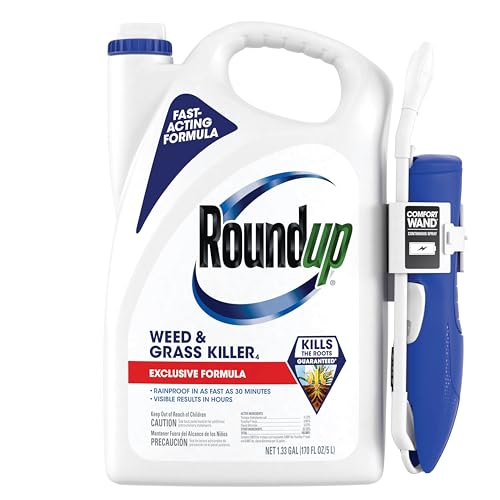
Roundup’s Weed & Grass Killer₄ is the benchmark for non-selective spot treatment. The formula penetrates leaf tissue fast and translocates to the root system, delivering visible wilting within hours and full kill in two to four days. It lists crabgrass right on the label alongside dandelion, poison ivy, and clover. The Comfort Wand delivers one-touch continuous spray, which makes treating cracks in driveways and walkways much less tedious than pumping a hand sprayer.
The product is rainproof in as little as 30 minutes, a practical feature for those who spray in the morning before fog or unexpected drizzle. The 1.33-gallon bottle covers 400 square feet, enough for most residential hardscape jobs. Users consistently report that the herbicide kills faster than generic concentrates, with many seeing browning by evening.
Keep in mind this is a non-selective formula — it kills any grass or plant it touches. Use it only on concrete, paver joints, gravel, and bare soil where you want nothing growing. The sensitivity of the spray wand means wind drift can damage nearby lawn grass, so apply on calm days.
Why it’s great
- Visible results in hours, full death in 2–4 days
- Rainproof within 30 minutes reduces washout risk
- Comfort Wand makes long-spray sessions painless
Good to know
- Non-selective — kills all vegetation it contacts
- Wind drift is a real risk for surrounding lawn grass
2. Ortho GroundClear Weed & Grass Killer Super Concentrate
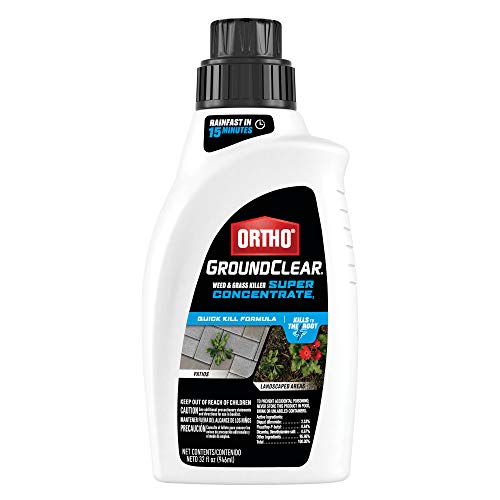
The Ortho GroundClear Super Concentrate stands out for its 15-minute rainfast claim — one of the tightest windows in the category. This matters when you’re spraying a large fence line or perimeter and can’t wait hours for the sky to clear. It kills crabgrass and other broadleaf weeds to the root, with users reporting visible dieback in three to four days. The concentrate is designed for tank sprayers; one 32-ounce bottle treats up to 1,120 square feet.
Buyers who used it on tough perennials like silverleaf nightshade found it effective at higher mix rates, suggesting the formula is flexible enough for stubborn weeds beyond crabgrass. The product also has a low odor compared to some other non-selective concentrates, which makes it more comfortable for large-area spraying. It works best when air temperature is above 60°F and weeds are actively growing.
Like all non-selective herbicides, it will kill lawn grass if overspray drifts. Because it’s a concentrate, you need a separate tank sprayer and proper mixing discipline. Overdiluting reduces efficacy; users sometimes double the recommended mix for tough woody weeds.
Why it’s great
- Fastest rainfast window at 15 minutes
- Covers up to 1,120 sq. ft. per bottle when mixed
- Low-odor formula for comfortable large-area spraying
Good to know
- Requires a tank sprayer for application
- Non-selective — kills any lawn grass on contact
3. Fertilome Weed-Out with Crabgrass Killer
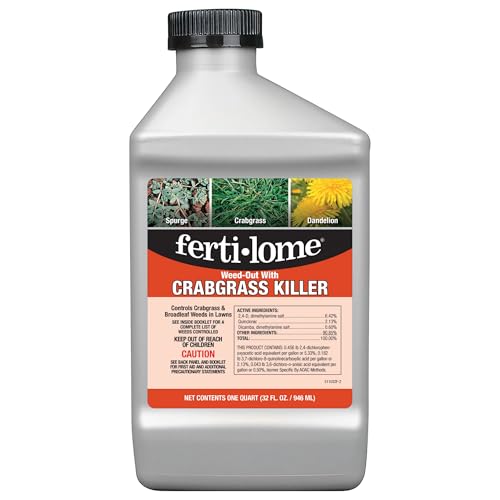
The Fertilome Weed-Out takes a selective approach, meaning you can spray it directly over established Bermuda, Buffalo, Kentucky Bluegrass, and other turf grasses without killing them while it takes down the crabgrass. It controls over 200 grassy and broadleaf weeds, including foxtail and spurge. The 32-ounce concentrate treats up to 5,000 square feet when mixed at the recommended rate — the highest coverage per bottle on this list.
User reports confirm it kills crabgrass effectively, though a small number of users claim it required a follow-up application for thick patches. The active ingredient formula includes quinclorac, which is specifically labeled for crabgrass control in lawns. Timing matters here; applying in spring or early summer when crabgrass is small and actively growing gives the best results. Bermuda grass may show temporary yellowing after application, but full recovery is expected within a few weeks.
Some users noted the price feels high for a 32-ounce bottle, but the per-square-foot cost is competitive given the coverage. It’s not the fastest killer — retreating after a few days can help ensure stubborn weeds don’t bounce back. The selective nature makes it the go-to choice if you have a lawn you want to keep green while attacking the crabgrass.
Why it’s great
- Selective formula — safe on many lawn grasses
- Covers up to 5,000 sq. ft. per bottle
- Specifically targets crabgrass and foxtail
Good to know
- May need a second application for heavy infestations
- Can temporarily yellow Bermuda grass
4. Ortho WeedClear Lawn Weed Killer with Comfort Wand
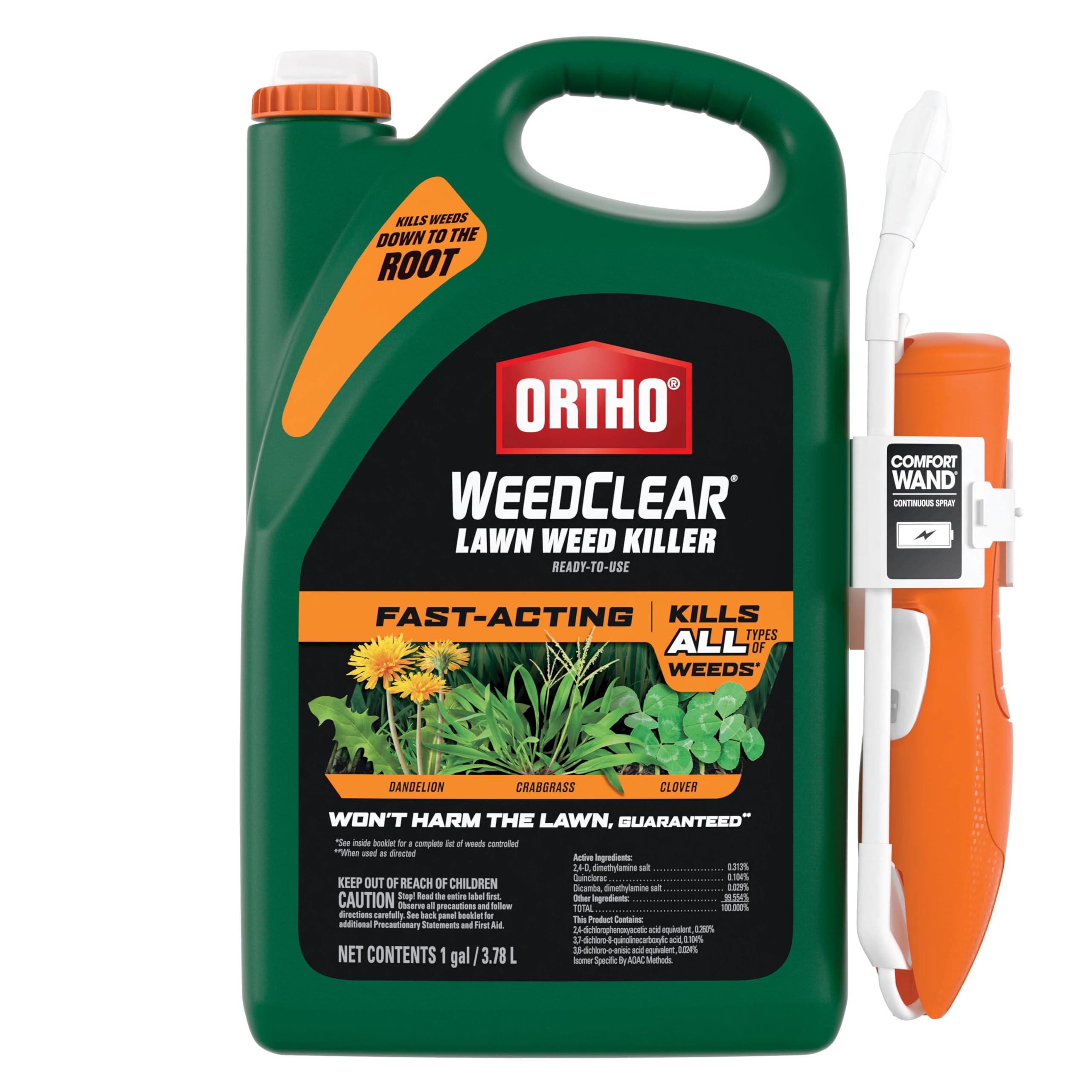
The Ortho WeedClear is a ready-to-use selective spray that treats crabgrass, dandelion, and clover without harming Fescues, Kentucky Bluegrass, Ryegrass, and Zoysiagrass. The battery-powered Comfort Wand makes spot treatment easy — just point and squeeze. Users report seeing dandelions melt within hours and full weed elimination in about two weeks. One reviewer who had no landscaping experience described it as a “life saver” after their backyard was overtaken by field weeds.
This product covers up to 20,480 square feet per gallon, an enormous value for a ready-to-use format. It works best when applied to young, actively growing weeds in spring or fall. The formula kills down to the root in a single application for most common broadleaf weeds, though some tough crabgrass patches may require a follow-up.
On the downside, it does not touch Bermuda grass if that invades your turf, and a small number of users reported slow results or needed a second spray. The ready-to-use format is convenient for small lawns but runs out fast if you have a large infestation. Do not use this on edible garden beds — it’s strictly for ornamental lawns.
Why it’s great
- Selective — won’t kill common turf grasses
- Massive 20,480 sq. ft. coverage per gallon
- Battery-powered wand reduces hand fatigue
Good to know
- Ineffective on Bermuda grass in the lawn
- Some users needed a second spray for stubborn weeds
5. Control Solutions Eraser Weed & Grass Killer Concentrate
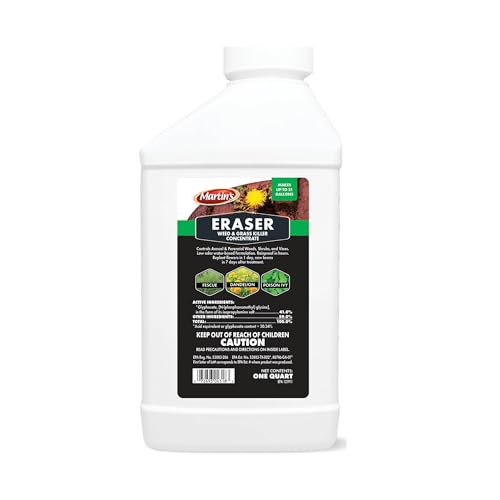
The Control Solutions Eraser Concentrate packs 41% glyphosate — the same active ingredient found in name-brand non-selective herbicides — at a per-ounce cost that beats most retail options. It’s a water-based, low-odor formula with no residual soil activity, meaning you can plant in treated areas after the chemical breaks down. Users have been buying this product for over 17 years, a testament to its consistency. It kills a broad spectrum of weeds including crabgrass, poison ivy, and woody vines.
The recommended mix rate is 8 ounces per gallon of water for general weed control, though heavier mixes work on tough roots. Users report visible yellowing in four to seven days, with complete death in one to two weeks. Adding a surfactant like Castille soap improves adhesion on waxy weed leaves. The quart bottle produces several gallons of mixed solution, making it economical for large properties.
The main drawback is speed — it works more slowly than consumer-grade Roundup, with some users noting it takes patience. The instructions on the bottle are sparse, so first-time users should research proper mixing ratios. Non-selective means it will kill your lawn if overspray drifts.
Why it’s great
- High 41% glyphosate concentration for low cost
- Low-odor, water-based formula
- No residual soil activity — safe for replanting
Good to know
- Slower systemic action than premium brands
- Label instructions are minimal — research mix ratios
FAQ
Will a selective crabgrass killer hurt my Kentucky Bluegrass lawn?
Why does my crabgrass look dead after a week but then grows back?
Can I mix crabgrass killer with fertilizer and apply them together?
Final Thoughts: The Verdict
For most users, the best chemical to kill crabgrass winner is the Roundup Weed & Grass Killer₄ with Comfort Wand because it combines fast visible results, a practical rainfast window, and an easy spray wand for spot-treating hard surfaces. If you want selective, lawn-safe control, grab the Fertilome Weed-Out with Crabgrass Killer for in-lawn application. And for covering cheap, large-area bare ground, nothing beats the Control Solutions Eraser Concentrate for its raw glyphosate value.

Mo Maruf
I created WellFizz to bridge the gap between vague wellness advice and actionable solutions. My mission is simple: to decode the research and give you practical tools you can actually use.
Beyond the data, I am a passionate traveler. I believe that stepping away from the screen to explore new environments is essential for mental clarity and physical vitality.