Our readers keep the lights on and my smoothie glass nicely filled. As an Amazon Associate, I earn from qualifying purchases.
Staring at your handlebars, you don’t need a color map or turn-by-turn directions — you just need speed, distance, and a few ride metrics that don’t cost more than your front tire. The cheap bike computer market has quietly evolved: GPS chips that lock within seconds, displays that actually work in direct sunlight, and battery runtimes that outlast your legs. The catch is separating the plastic toys from the real tools.
I’m Mohammad Maruf — the founder and writer behind WellFizz. I’ve spent hundreds of hours cross-referencing specs, customer ride logs, and firmware update histories to find the budget bike computers that deliver genuine utility without draining your wallet.
Whether you need basic ride logging without fiddling with spoke magnets or a full ANT+ sensor hub for heart rate and cadence, this guide to the best cheap bike computer breaks down five models that earn their place on your stem for under forty dollars.
How To Choose The Best Cheap Bike Computer
A budget GPS bike computer doesn’t mean you accept flaky data or a dim screen. The key is knowing which corners can be cut (no touchscreen, no maps) and which corners cannot (accurate satellite lock, decent battery, usable display). This section walks you through the three specs that separate a good cheap unit from a frustrating one.
Satellite lock and positioning accuracy
The cheapest bike computers still need a GPS chip that can find you in under a minute. Older-gen chips struggle under tree cover or near tall buildings, giving you quarter-mile gaps in your track. Look for units supporting at least GPS plus one additional constellation (GLONASS, BeiDou, or Galileo). Multi-constellation support means faster lock times and better accuracy when trail dips into a wooded ravine.
Battery life that matches your longest ride
A cheap bike computer with a 25-hour rated battery often delivers 18–22 hours in real use with the backlight on. That’s fine for weekend warriors, but if you’re planning multi-day brevets or bikepacking trips, target models with 40-hour or 60-hour claims. Also check the charging port: USB-C is faster and more common now than micro-USB. Avoid units that use proprietary charging cables — losing that cable kills your device.
Sensor ecosystem and data sharing
Even a budget-friendly bike computer should talk to a heart rate strap or cadence sensor if you plan to train with power data. ANT+ is the standard for sports sensors; Bluetooth is mostly for phone syncing. Check whether the unit syncs to Strava, TrainingPeaks, or Komoot without needing to manually export a .fit file. If the companion app looks abandoned (no updates in 18 months), the unit may stop syncing after a phone OS update.
Quick Comparison
On smaller screens, swipe sideways to see the full table.
| Model | Category | Best For | Key Spec | Amazon |
|---|---|---|---|---|
| iGPSPORT BSC100S | GPS + Sensors | Long-distance riders who want 40-hour battery and ANT+ sensor support | 40-hour battery, 2.6-inch anti-glare display | Amazon |
| CYCPLUS M1 | GPS + Large Screen | Riders wanting the biggest display and longest battery (60h) at a budget price | 60-hour battery, 2.9-inch FSTN display | Amazon |
| COOSPO BC107 | GPS + Compact | Minimalists who want a precise GPS with ANT+ in the smallest package | IP67 waterproof, GPS/BeiDou dual-mode | Amazon |
| XOSS G+ | GPS + App | Commuters and social riders who want seamless Strava auto-sync | ANT+/Bluetooth, direct Strava sync | Amazon |
| Bikevee BKV-310 | GPS Only | Budget-first buyers who need basic speed/distance without any sensor pairing | 28-hour battery, 2.4-inch LCD with auto backlight | Amazon |
In‑Depth Reviews
1. iGPSPORT BSC100S
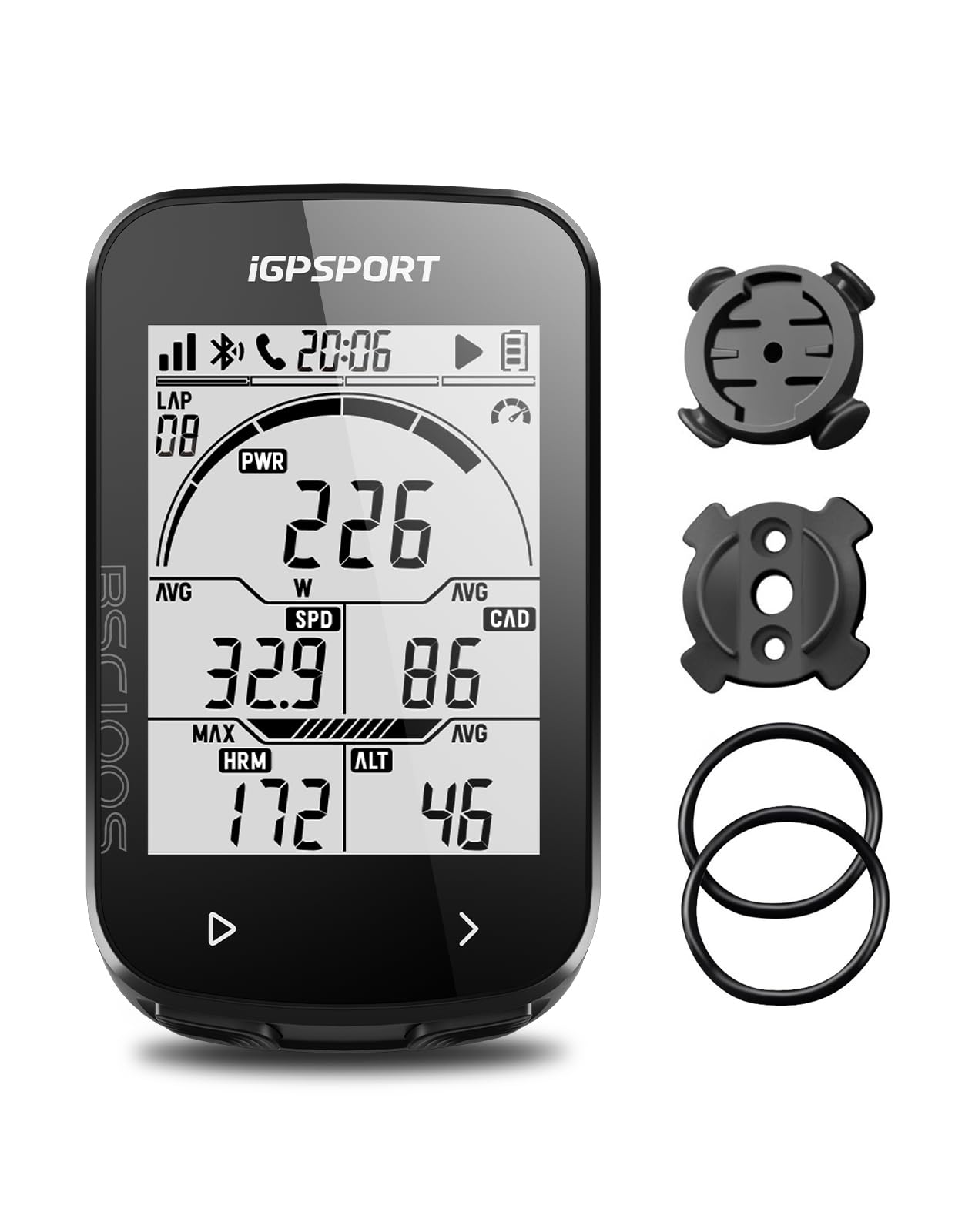
The iGPSPORT BSC100S nails the sweet spot where battery life, screen quality, and sensor support converge under forty dollars. Its 2.6-inch anti-glare LCD is readable even with polarized sunglasses, and the 40-hour battery claim holds up reasonably well in real-world riding — one reviewer logged 25+ miles per battery bar without needing a charge. The unit locks onto five satellite constellations simultaneously (GPS, BeiDou, GLONASS, Galileo, QZSS), so tree cover on winding MTB trails rarely causes dropouts.
ANT+ and Bluetooth 5.0 dual protocol means you can pair a power meter, heart rate strap, and speed/cadence sensor simultaneously without pairing headaches. The iGPSPORT app exports .FIT, .GPX, and .TCX files and syncs directly to Strava and Komoot. A few riders noted that the default activity privacy is set to public — you’ll want to toggle that in app settings before your first ride upload. The included rubber-band mount feels basic, but the unit uses a standard Garmin-style quarter-turn mount, making aftermarket upgrades easy.
Drawbacks are minor but real: no turn-by-turn navigation, limited page customization, and the printed quick-start guide has comical Chinglish errors (it defines “diameter” when it means “circumference”). The companion app shows ads, and one rider experienced a mid-ride freeze that required a reset. Still, for a unit that costs a fraction of a Wahoo ELEMNT Bolt while delivering 90% of the core GPS and sensor functionality, the BSC100S is hard to beat.
Why it’s great
- Five-constellation GPS locks on fast in open or wooded terrain
- 40-hour battery covers multi-day touring without charging
- ANT+ and Bluetooth 5.0 pair with power meters, HR straps, and cadence sensors
- USB-C charging and standard Garmin mount for easy upgrades
Good to know
- App has ads and tracks default to public — change privacy setting manually
- Rubber-band mount feels less secure than a quarter-turn lock
- Occasional firmware freeze has been reported, requiring a hard reset
2. CYCPLUS M1

The CYCPLUS M1 is built for riders who refuse to stop for a charge mid-week. Its 1200mAh battery delivers an advertised 60 hours — the longest runtime in this lineup — making it the go-to for randonneuring, bikepacking, or anyone who forgets to plug in between commutes. The 2.9-inch FSTN display is the largest of the group, with glare-free readability that stays crisp under direct summer sun. Tempered glass over the screen resists scratches from pocket carry or accidental drops against a frame.
Under the hood, the M1 uses a Swiss-made GPS chipset that provides accurate positioning with a solid signal lock, though a few reviewers noted that wooded canopy can degrade altitude accuracy by several percent. The unit supports ANT+ for speed, cadence, heart rate, and power meters, and it syncs through the CYCPLUS FIT app to Strava and TrainingPeaks. The three-button interface is intuitive — one reviewer with a defective unit received prompt customer support and a replacement without hassle, which speaks to the two-year warranty backing.
The M1’s weaknesses are its app performance and GPS altitude quirks. Phone sync is slow compared to competitors, and instantaneous speed can fluctuate by 1–2 mph even on steady terrain. One power user flagged that the device shows UTC time until you manually set the time zone through the app — and if you skip that step, all ride start times are wrong. The mount is basic rubber-band style, and the unit does not offer turn-by-turn navigation or calorie tracking.
Why it’s great
- Industry-leading 60-hour battery with 1200mAh cell covers ultra-long days
- Large 2.9-inch FSTN display with tempered glass is readable in all light
- ANT+ pairs with power meters and HR straps for structured training
- Two-year warranty and responsive customer support
Good to know
- Speed data can fluctuate 1–2 mph on flat, open roads
- Altitude readings drift under heavy tree cover
- Must manually set time zone; otherwise clock defaults to UTC
3. COOSPO BC107

The COOSPO BC107 proves that budget-friendly doesn’t have to mean bulky. With a 2.4-inch LCD squeezed into a glass-filled ABS and TPU chassis, this unit weighs just 140 grams and leaves no wasted handlebar space. Its standout feature is dual-mode global positioning (GPS only or GPS + BeiDou), which helps it lock onto satellites faster in obstructed areas than single-constellation units. One reviewer clocked 500 miles over 10 days and still had 75% battery remaining — quiet testimony that the battery life exceeds typical weekend expectations.
ANT+ connectivity is the BC107’s strongest suit: it pairs seamlessly with heart rate monitors, speed/cadence sensors, and power meters. Importantly, the unit does NOT support Bluetooth for sensor pairing — Bluetooth is reserved solely for syncing with the CoospoRide app. This means if you own Bluetooth-only sensors, you’ll need an ANT+ adapter or a different computer. The app syncs .fit files to Strava, though some users reported recent app updates causing auto-sync hiccups that require manual logout/login.
The downsides center on app stability and mount design. The CoospoRide app, while functional, has had intermittent auto-sync issues with Strava, forcing you to manually upload your .fit file on occasion. The included standard mount uses rubber rings that can shift under hard pedaling, and COOSPO notes that an extension front mount is sold separately — so taller stems or aero bars may need an accessory purchase. For the price, the BC107 delivers reliable GPS tracking and ANT+ compatibility in a compact, weather-sealed (IP67) package that survives heavy rain.
Why it’s great
- Dual-mode GPS/BeiDou positioning for faster lock and better tree-cover performance
- Compact glass-filled ABS/TPU body is robust yet lightweight
- ANT+ supports power meters, HR, speed, and cadence sensors
- IP67 waterproof rating protects against heavy rain and hose splashes
Good to know
- No Bluetooth sensor pairing — only ANT+ sensors will connect
- App auto-sync to Strava can falter; manual upload may be needed occasionally
- Separate extension mount required for aero bars or oversized stems
4. XOSS G+

The XOSS G+ has carved out a loyal following among riders who want their ride data to appear on Strava without manual file transfers. The XOSS app binds directly to your Strava account, so after a ride, data syncs automatically over Bluetooth without touching a cable. With a 1.8-inch HD LCD screen and automatic backlight that adjusts based on ambient light, the display is crisp enough for quick glances mid-pedal. The 500mAh battery delivers around 25 hours of runtime, and real-world reports from commuters and MTB riders suggest GPS lock often happens in under 10 seconds.
ANT+ support enables pairing with heart rate monitors and cadence sensors — both sold separately — and the G+ tracks speed, distance, altitude, and gradient. One reviewer noted excellent performance under tree cover on technical MTB trails, with consistent reads even on twisty singletrack. The double-tap-the-screen trick to initiate GPS lock is a handy shortcut that avoids navigating menus mid-ride. The unit also supports posting to social networks through the app, making it a good choice for group ride enthusiasts who share stats.
The G+ stumbles on indoor training and app reliability. GPS is required for distance and time logging, so stationary trainer rides will record nothing unless you have an external speed sensor. A small percentage of users reported Bluetooth pairing failures with Pixel phones and a buggy “Contact Us” link inside the app that loops back to the home screen instead of opening support. The display is on the smaller side at 1.8 inches, and the unit defaults to metric — you must change units through the app, which may frustrate riders who want to set it up without a phone.
Why it’s great
- Seamless Strava auto-sync via XOSS app — no cable needed
- Fast GPS lock (<10 seconds) works reliably under tree cover
- ANT+ support for HR and cadence sensor pairing
- Double-tap gesture for quick GPS fix initiation
Good to know
- Does not record distance or time for stationary trainer rides without a speed sensor
- App has Bluetooth pairing issues with some Android phones
- Smaller 1.8-inch display compared to other budget competitors
5. Bikevee BKV-310
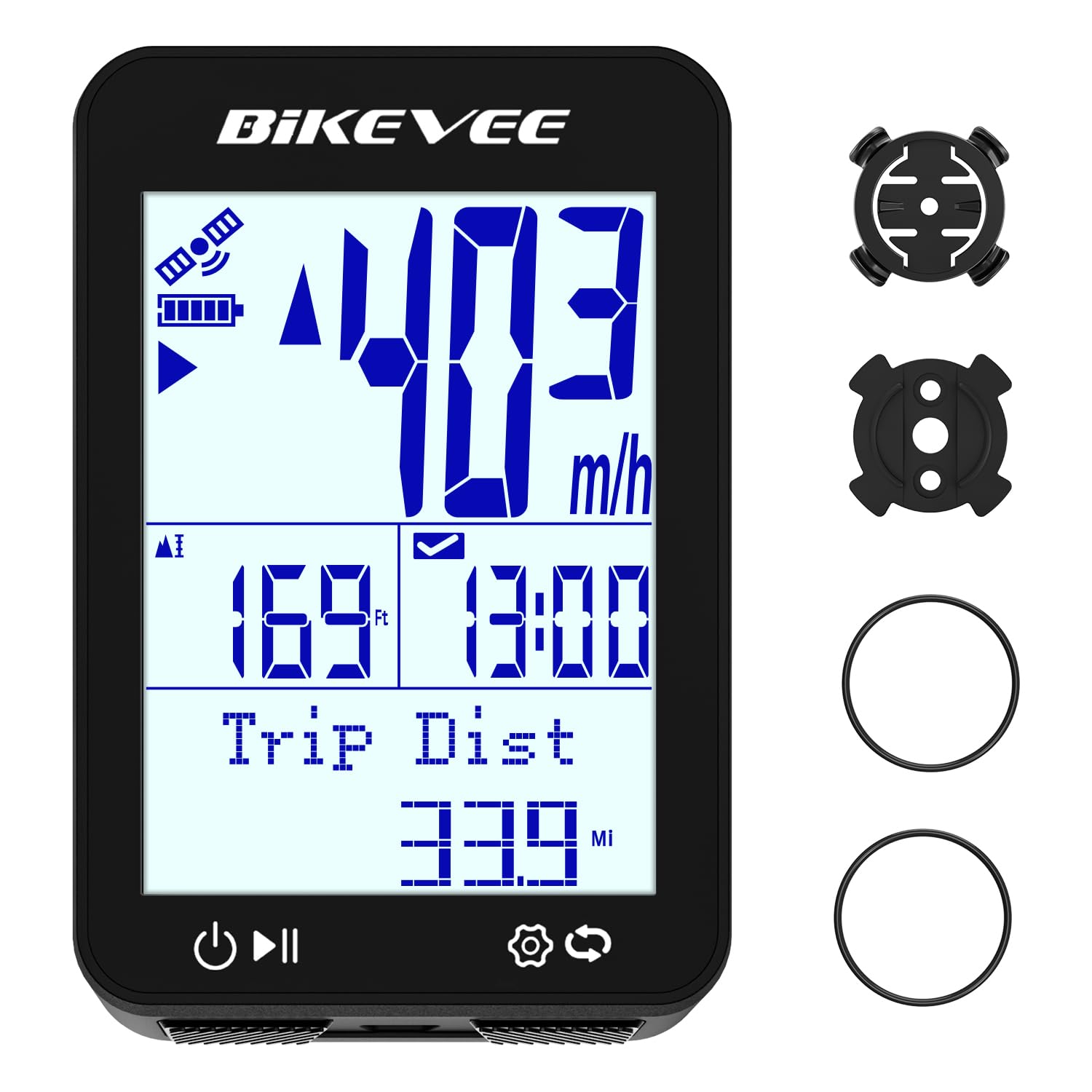
The Bikevee BKV-310 is the no-frills entry point into GPS bike computers — no ANT+ sensors, no app, no Bluetooth — just clean GPS tracking for speed, distance, ride time, average and max speed, temperature, altitude, and gradient. The 2.4-inch LCD screen with auto backlight provides solid readability day or night, and the IPX7 waterproof rating means it can handle sustained downpours without shutting down. Setup is genuinely magnet-free and wire-free: mount the unit, press a button, and wait for the GPS lock.
Battery life hits a claimed 28 hours from its 650mAh cell, and real-world MTB users report that it easily outlasts a full day on the trail — one reviewer noted that after 7 hours of riding, the battery indicator had barely dropped from full. The 9-language interface (English, Deutsch, Français, Italiano, Español, and more) makes it a versatile choice for international buyers or bilingual households. Several customers have repurposed the unit on golf carts and utility vehicles to track mileage, proving its simplicity has cross-functional appeal.
However, the BKV-310’s simplicity also defines its limits. There is no support for heart rate, cadence, or power meter sensors — it records only what the GPS chip sees. GPS acquisition can be slow, taking up to half a mile of riding before it locks, which will frustrate riders who want to start recording from their driveway. The display always shows altitude and military time, and you cannot configure which data fields appear on the main screen. For riders who just want a clean odometer and speed readout at the lowest possible cost, this unit delivers — but if you plan to grow into structured training, you’ll quickly outgrow it.
Why it’s great
- True magnet-free, wire-free GPS installation in under two minutes
- Excellent 28-hour battery life for day-long adventures
- Auto backlight and high-contrast 2.4-inch LCD readable in all conditions
- IPX7 waterproof rating handles sustained heavy rain
Good to know
- No ANT+ or Bluetooth sensor pairing — GPS data only
- GPS lock can take up to 0.5 miles of riding on cold starts
- Display fields are not configurable; always shows altitude and 24h time
FAQ
Do I need a magnetic wheel sensor with a GPS bike computer?
Will a budget bike computer work with my power meter?
How does IPX7 compare to IPX6 for a bike computer?
Final Thoughts: The Verdict
For most users, the best cheap bike computer winner is the iGPSPORT BSC100S because it bundles multi-constellation GPS, 40-hour battery, ANT+ sensor support, and a large readable screen at a price that leaves room for a sensor upgrade later. If you want ultra-long battery life with the biggest display, grab the CYCPLUS M1. And for minimalist riders who want a compact, weather-sealed unit with reliable GPS and ANT+ sensor pairing, nothing beats the COOSPO BC107.

Mo Maruf
I created WellFizz to bridge the gap between vague wellness advice and actionable solutions. My mission is simple: to decode the research and give you practical tools you can actually use.
Beyond the data, I am a passionate traveler. I believe that stepping away from the screen to explore new environments is essential for mental clarity and physical vitality.