Our readers keep the lights on and my smoothie glass nicely filled. As an Amazon Associate, I earn from qualifying purchases.
The right charger changes that, turning a dead cell into a reliable start without the guesswork of traditional trickle chargers that can cook a battery overnight. This category has moved past simple current delivery into intelligent voltage management, pulse repair, and multi-chemistry compatibility that respects the sensitive electronics on modern bikes.
I’m Mohammad Maruf — the founder and writer behind WellFizz. I’ve spent countless hours dissecting the spec sheets, customer feedback, and real-world performance data on these chargers to separate the units that quietly sulfation your battery from those that actively restore it.
Here you’ll find the detailed breakdown of the top contenders on the market, designed to help you choose a reliable charger for motorcycle battery that matches your bike’s chemistry and your riding habits.
How To Choose The Best Charger For Motorcycle Battery
Selecting the right charger comes down to understanding your battery’s chemistry, the amperage your bike can safely accept, and whether you need a simple top-up or a full maintenance solution for long-term storage. Here are the critical factors to weigh before committing to a purchase.
Chemistry Compatibility: Lead-Acid vs. LiFePO4
Not all chargers work with lithium-iron-phosphate (LiFePO4) batteries. If you’ve upgraded your bike to a lightweight lithium battery, you need a charger with a dedicated lithium mode that uses a different voltage curve and charge profile. Using a standard lead-acid charger on a lithium battery can cause damage or trigger the battery’s internal BMS to shut down charging entirely.
Amp Rating and Battery Capacity
Motorcycle batteries typically range from 5 Ah to 30 Ah. A good rule is to charge at 1/10th of the battery’s capacity—so a 10 Ah battery is best served by a 1-amp charger. High-amp chargers (5A or more) can charge faster but risk overheating small batteries if they lack intelligent current limiting. For maintenance, a low-amp unit (under 1A) is ideal for long-term float charging.
Desulfation and Pulse Repair
Sulfation is the leading cause of lead-acid battery failure. A charger with a pulse repair mode sends high-frequency electrical pulses to break down lead sulfate crystals that form on the battery plates during discharge. This feature can recover batteries that seem dead and significantly extend the service life of a battery that is still functional. Look for automatic desulfation that triggers without manual intervention.
Temperature Compensation
Charging a battery in a cold garage versus a warm workshop requires different voltage targets. Chargers with thermal sensors dynamically adjust the output voltage based on ambient temperature, preventing overcharging in hot weather and undercharging in cold conditions. This feature is critical for riders who store their motorcycles seasonally in unheated spaces.
Quick Comparison
On smaller screens, swipe sideways to see the full table.
| Model | Category | Best For | Key Spec | Amazon |
|---|---|---|---|---|
| NOCO GENIUS5 | Smart Charger | Multi-chemistry & dead battery recovery | 5A, charges from 1V, thermal sensor | Amazon |
| OptiMate3 | Maintainer | Long-term motorcycle storage | 0.8A, tests battery health | Amazon |
| VEVOR 20-Amp Smart | Multi-Mode Charger | High-amp recovery & desulfation | 20A adjustable, 3.6″ LCD | Amazon |
| ECO-WORTHY 12V 5A | Smart Charger | Versatility across vehicle types | 5A, SAE connector, LiFePO4 | Amazon |
| Battery Tender Junior | Maintainer | Entry-level maintenance | 0.75A, 4-step charging | Amazon |
| YONHAN 15A | Smart Charger | Fast charging & pulse repair | 15A, temp compensation, 9-stage | Amazon |
| NEXPEAK 15A | Smart Charger | Large color display & trickle mode | 15A, 1.75A trickle, 8.9ft cord | Amazon |
In‑Depth Reviews
1. NOCO GENIUS5

The NOCO GENIUS5 is the benchmark for intelligent charging, offering 5 amps of clean power that works across both 6V and 12V systems, as well as lithium and lead-acid chemistries. Its standout feature is the ability to charge batteries from as low as 1 volt, which means it can often resurrect a battery that other chargers refuse to recognize. The built-in thermal sensor dynamically adjusts the voltage curve based on ambient temperature, making it a safe choice for unheated garages where winter storage can drop below freezing.
Real-world feedback highlights the GENIUS5’s ability to recover deeply discharged batteries that have been neglected for months. Users consistently report that the desulfation mode effectively reverses sulfation on lead-acid batteries, restoring capacity that seemed permanently lost. The unit is compact—34% smaller than the previous generation—yet delivers more power, which makes it easy to mount on a wall or store in a saddlebag for trips. The included eyelet terminals with an integrated fuse simplify permanent connection to a motorcycle battery, allowing quick plug-and-play access without removing the seat.
Some users note that the charger runs slightly warm during bulk charging, a normal behavior for a 5-amp unit in this form factor. The plastic housing feels robust but could crack if dropped on concrete, so a soft storage bag (not included) would be a welcome addition. The instruction manual is dense and the small print can be difficult to read, but the operational logic is intuitive once you understand that the button has a short delay before responding. Overall, the GENIUS5 is the most versatile and reliable charger in its class, justifying its premium price with feature density that lower-cost units cannot match.
Why it’s great
- Charges batteries from 1V, recovering deeply discharged units
- Integrated thermal sensor adjusts voltage for hot and cold ambient temps
- Includes both battery clamps and eyelet terminals with a fuse
Good to know
- Plastic case can feel fragile if dropped on hard surfaces
- Button has a slight delay before it registers input
- Does not include a storage bag for the unit or cables
2. OptiMate3

The OptiMate3 is a purpose-built device for the powersport world, designed specifically for the small-capacity lead-acid batteries found in motorcycles, ATVs, and personal watercraft. It delivers a gentle 0.8-amp charge, which is perfectly matched to a typical 9–15 Ah motorcycle battery, preventing the risk of overcharging that can occur with higher-amp units. What sets it apart is its automatic battery health test—after charging, the unit evaluates whether the battery can hold a load and illuminates a warning if it detects a faulty cell, saving you from chasing a dead battery with a fresh charge.
Long-term users report that the OptiMate3 is essentially a “connect and forget” device. Over six years of continuous use, the unit maintains a steady float voltage without drifting, and the fully sealed case protects against accidental spills and light rain, making it suitable for damp garage environments. It is the only charger on this list recommended by major OEMs including Honda, Yamaha, Kawasaki, KTM, and Husqvarna, which speaks to its reliability in harsh riding conditions. The integrated SAE connector with a weatherproof cap allows for a semi-permanent installation on the bike, so you can plug in without removing the seat.
The downside is that the OptiMate3 is exclusively a lead-acid charger. If your bike has a lithium battery, this unit will not work safely, and you will need a multi-chemistry alternative. The charging speed is also slow by modern standards—0.8A means it can take 12–15 hours to recharge a fully depleted battery. It also lacks a desulfation mode, meaning it will maintain a healthy battery but cannot repair one that has already sulfated. For riders who only need a dependable maintainer for seasonal storage, however, the OptiMate3 is as close to bulletproof as it gets.
Why it’s great
- Automatic health test detects faulty batteries after charging
- Sealed case resists moisture and garage spills
- Endorsed by major motorcycle manufacturers globally
Good to know
- Not compatible with lithium (LiFePO4) batteries
- Charges very slowly at 0.8A for large batteries
- No pulse repair or desulfation features
3. VEVOR 20-Amp Smart Battery Charger

While 20 amps might seem excessive for a motorcycle battery, the VEVOR is designed for versatility across multiple vehicle types, with an adjustable current that can be dialed down to a safe level for small batteries. It works with 6V, 12V, and 24V systems, covering lead-acid and lithium chemistries, and includes a dedicated desulfation mode that uses pulse repair to break down sulfation on aging batteries. The large 3.6-inch LCD screen provides real-time voltage, current, and charge percentage, making it easy to monitor progress without squinting at small LEDs.
Users who own both a motorcycle and a car or boat will appreciate that this single charger covers all bases. The desulfation mode has been effective at recovering batteries that were on the verge of being replaced, and the forced charge mode can wake up batteries with voltages as low as 1V. The figure-eight power cable is a standard 9.8 feet, which offers decent reach in a garage, and the included copper wire terminals are more robust than the nickel-plated clips found on cheaper units. Temperature compensation ensures safe charging across seasonal temperature swings.
The VEVOR lacks the premium build finish of the NOCO or the OEM pedigree of the OptiMate. The buttons have a slightly plasticky feel, and the LCD backlight could be brighter for outdoor use. Some users have noted that the unit does not automatically resume charging after a power cut—it requires a manual button press to restart the cycle. Additionally, at 20A max output, it is overkill for a standard bike battery unless you explicitly adjust the current down. For the rider who wants one charger for everything in the garage, the VEVOR is a powerful and affordable option, but purists may prefer a more bike-specific solution.
Why it’s great
- High max amperage (20A) with adjustable current for small batteries
- Large, easy-to-read LCD screen with detailed charging data
- Desulfation mode successfully revives sulfated batteries
Good to know
- Does not automatically resume after a power interruption
- Plastic housing and buttons feel less durable than premium alternatives
- Overkill for small motorcycle batteries unless actively dialed down
4. ECO-WORTHY 12V 5A Smart Charger

The ECO-WORTHY 5A charger bridges the gap between a basic maintainer and a full-featured smart charger, offering compatibility with both lead-acid and lithium (LiFePO4) batteries at a price that undercuts most multi-chemistry alternatives. It includes three sets of output leads—battery clips, screw-down ring terminals, and an SAE connector with a 10-amp inline fuse—which cover nearly every installation scenario right out of the box. The intelligent detection system constantly monitors battery voltage and will alert you if it detects sulfation or a battery that is too degraded to charge, saving you from wasting time on a dead cell.
Buyers who have installed this on motorcycles report that it works flawlessly as a trickle charger through the winter, keeping the battery topped off without any manual intervention. The desulfation feature is automatic, meaning you do not need to select a separate mode—it triggers when the charger senses sulfation buildup. The LCD display shows charging status clearly, and the unit is compact enough to be mounted permanently in a small space. It has also been confirmed to work with smart generators and solar setups, making it a useful tool beyond just motorcycle maintenance.
The main limitation is the 5-amp charge rate, which, while safe for most motorcycle batteries, is slower than the 15-amp units for deeply depleted batteries. A few users have noted that the charger runs warm during bulk charging, so it should be placed in a well-ventilated area. The build quality is decent for the price, but the plastic case could be more impact-resistant. Some customers have experienced issues with the charger failing to recognize a very deeply discharged battery below 3V, but this is common across many chargers in this price range. For the rider who needs a single unit that handles both lead-acid and lithium without breaking the bank, the ECO-WORTHY is a top contender.
Why it’s great
- Works with both lead-acid and LiFePO4 batteries
- Includes three different output cable types for flexible installation
- Automatic desulfation without manual mode selection
Good to know
- 5A charge rate is slower than higher-amp competitors
- May not detect batteries below 3V without manual intervention
- Plastic case can get warm during bulk charging
5. Battery Tender Junior

The Battery Tender Junior is the quintessential entry-level maintainer that has been keeping motorcycle batteries alive for decades. Its 0.75-amp output is perfectly calibrated for the small batteries used in bikes, ATVs, and lawn equipment, and the four-step charging program (Initialization, Bulk, Absorption, Float) ensures that the battery receives the right voltage at each stage of the charge cycle. The spark-proof circuitry is a meaningful safety feature—it eliminates the risk of a spark when connecting to a battery, which is important when working around hydrogen gas that batteries can emit.
Users consistently praise the Junior for its simplicity: plug it in, connect the clips, and walk away. The two-color LED indicator shows red while charging and green when the battery is fully charged and in float mode, making the status clear at a glance. Many reviewers note that this unit has extended their battery’s life to 6–8 years, compared to the typical 3–4 years when left unmaintained. The included fused ring-terminal harness allows for a permanent connection, so you can plug the quick-disconnect into the charger without removing the seat each time. The 12-foot output cord provides good reach in a standard garage.
The Junior’s main drawbacks are its low amperage and lack of advanced features. It will take 36–48 hours to fully charge a depleted motorcycle battery from 11V, which feels slow compared to modern smart chargers. It does not have a desulfation mode, so it cannot repair batteries that have already sulfated—it is strictly a maintainer for healthy batteries. The plastic case is functional but feels basic, and the 5-year warranty is standard rather than exceptional. For a rider who just needs to keep a battery topped off between rides, however, the Battery Tender Junior is a proven, no-frills solution that has earned its reputation through decades of reliable service.
Why it’s great
- Simple four-step charging program, no programming required
- Spark-proof circuitry for safe connections
- Includes ring terminals and clips for versatile mounting
Good to know
- 0.75A charge rate is very slow for depleted batteries
- No desulfation or pulse repair functionality
- Plastic housing feels basic compared to newer smart chargers
6. YONHAN 15A Battery Charger

The YONHAN 15A charger packs significant power into a surprisingly small chassis, making it one of the most compact high-amp chargers on the market. Its 9-stage charging algorithm includes a pulse repair function that automatically detects sulfation and acid stratification, sending high-frequency pulses to break down crystal buildup and restore battery capacity. The unit works with both 12V and 24V systems and covers multiple chemistries including LiFePO4, AGM, GEL, and flooded lead-acid, which makes it a versatile tool for a multi-vehicle garage. Temperature compensation automatically adjusts voltage based on ambient conditions, preventing overcharging in summer heat or undercharging in winter cold.
Customer experiences highlight the YONHAN’s ability to revive batteries that seemed beyond saving. One user reported that the restore mode improved a battery’s state of health from approximately 50% to 84% across two different vehicles, which is a meaningful performance gain for a sub- charger. The digital display shows voltage when unplugged and amperage when charging, providing clarity on the charging process. The unit includes a dedicated motorcycle mode that switches to a 1.75A trickle charge after the battery reaches full capacity, making it effective for long-term winter storage.
The primary caveat is that while the unit functions as a charger and desulfator, it is not recommended as a long-term maintainer for unattended periods exceeding 12 hours, according to some users. The touch button for mode selection can be finicky and may require multiple presses to register input. The alligator clips are sturdy but lack a storage solution on the housing, which can lead to them dangling awkwardly when not in use. Additionally, the desulfation cycle on a battery that is still connected to a vehicle’s electronics could potentially risk sensitive modules—a reality with any pulse repair charger. For riders who want a fast, affordable charger with real restorative potential, the YONHAN delivers strong value despite its minor interface quirks.
Why it’s great
- 15-amp output in a compact, lightweight form factor
- Pulse repair mode actively restores sulfated batteries
- Temperature compensation for safe charging in all climates
Good to know
- Not recommended for long-term unattended maintenance over 12 hours
- Touch button can be unresponsive or hard to press accurately
- No storage slot for the battery clamps when not in use
7. NEXPEAK 15A Battery Charger
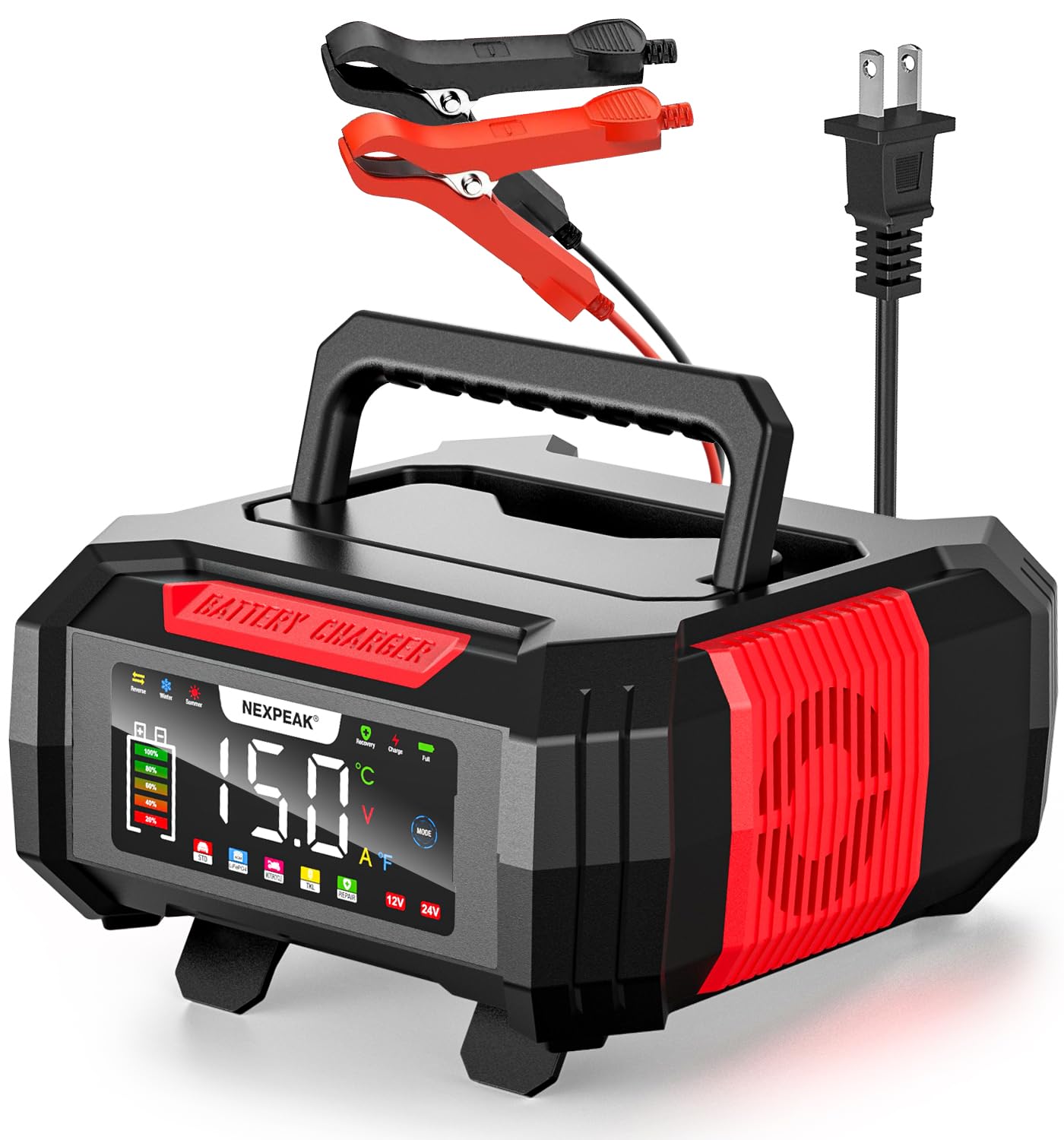
The NEXPEAK 15A charger distinguishes itself with an extra-large color LCD screen that clearly displays charging voltage, current, internal temperature in Fahrenheit, and charge percentage—all legible even in direct sunlight. It delivers 15 amps for fast 12V charging and 8 amps for 24V, and includes a dedicated 1.75-amp trickle charge mode that is specifically engineered for long-term battery maintenance. The 9-stage charging process covers initialization, bulk, absorption, and float stages, while pulse repair technology automatically detects and reverses sulfation. The lengthened 8.9-foot power cord provides more reach than most competitors, reducing the need for an extension cord in a typical garage setup.
Users who own older muscle cars or RVs appreciate the NEXPEAK’s ability to handle larger batteries without overheating. The fan is reported to be quieter than expected, and the unit stays cool even during extended bulk charging cycles. The cord compartment is a thoughtful design touch that makes storage cleaner and prevents the cables from tangling. The summer and winter modes automatically adjust the charging voltage profile based on the season, which is particularly useful for riders who store bikes in unheated spaces. The inclusion of fireproof materials in the casing provides an extra layer of safety for leaving the unit plugged in.
The NEXPEAK’s main weakness is its physical durability. While functional, the housing feels less robust than the NOCO or OptiMate units, and several users caution that it could crack if dropped on concrete. The power cord is shorter than some premium units that include extension-ready connectors, despite being longer than average. Some customers have noted that the unit does not always automatically restart charging after a power cut, requiring manual re-selection of the mode. For the price, the NEXPEAK offers an impressive feature set with the best display on this list, but those who prioritize rugged construction may want to spend more.
Why it’s great
- Large color LCD readable in direct sunlight
- Dedicated 1.75A trickle mode for long-term maintenance
- Long 8.9-foot power cord and integrated cable storage
Good to know
- Housing is less impact-resistant than premium units
- May not auto-restart after a power interruption
- Fan, though quiet, is audible in a silent garage
FAQ
Can I leave a charger connected to my motorcycle battery all winter?
Will a 15-amp charger damage my small motorcycle battery?
What is the difference between a battery charger and a battery maintainer?
Do I need a charger with lithium battery compatibility for my motorcycle?
Final Thoughts: The Verdict
For most users, the charger for motorcycle battery winner is the NOCO GENIUS5 because it combines a 5-amp fast charge rate with the ability to recover deeply discharged batteries down to 1 volt, and its thermal sensor ensures safe operation across all seasons. If you want a purpose-built device recommended by the biggest motorcycle manufacturers, grab the OptiMate3. And for a budget-friendly option that still offers pulse repair and multi-chemistry support, the ECO-WORTHY 12V 5A is the best value on this list.

Mo Maruf
I created WellFizz to bridge the gap between vague wellness advice and actionable solutions. My mission is simple: to decode the research and give you practical tools you can actually use.
Beyond the data, I am a passionate traveler. I believe that stepping away from the screen to explore new environments is essential for mental clarity and physical vitality.