Our readers keep the lights on and my smoothie glass nicely filled. As an Amazon Associate, I earn from qualifying purchases.
Tap water arrives laced with chlorine, sediment, and dissolved solids that no standard pitcher catches. A carbon water filter targets those specific contaminants using activated carbon’s natural adsorptive properties, stripping away the chemical tastes and visible particulates that ruin a glass of water.
I’m Mohammad Maruf — the founder and writer behind WellFizz. I analyze filtration media densities, micron ratings, and third-party certifications to separate real reduction claims from marketing fluff.
After sifting through gallons of test data and actual customer water reports, the best carbon water filter picks here balance micron precision with long filter life and proven certification against lead, chromium, and chlorine.
How To Choose The Best Carbon Water Filter
Every carbon filter is not the same. A block of compressed activated carbon traps different particle sizes than loose granular carbon media. The micron rating — the size of the smallest particle the filter can capture — determines whether you get clear water or something still carrying fine sediment.
Micron Rating and Media Density
Standard carbon water filters use granular activated carbon (GAC), which leaves larger channels that sediment can slip through. A solid carbon block pressed at 1 micron forces water through a dense matrix that catches particles and adsorbs chlorine by holding the molecules to the carbon surface. Lower micron numbers mean tighter filtration — 1 micron catches cysts and fine sand that a 5 or 10 micron sieve lets pass.
Certification and Contaminant Claims
Third-party certification from NSF, IAPMO, or WQA matters more than the list of chemicals printed on the box. A certified filter has been tested to reduce specific contaminants to safe levels under controlled flow rates. Unc certified filters may claim similar reductions but lack verified lab data. Check that the certification matches your target contaminant — NSF 42 covers chlorine taste and odor, while NSF 53 covers heavy metals like lead and mercury.
Flow Rate and Filter Life
Tighter filtration slows water flow. A 1 micron carbon block delivers slower but cleaner water than a GAC filter. Filter life is measured in gallons — a standard pitcher filter lasts about 40 gallons, while whole-house 10-inch cartridges can reach 13,000 gallons before needing replacement. Match the rated capacity to your household consumption to avoid premature clogging or under-filtration.
Quick Comparison
On smaller screens, swipe sideways to see the full table.
| Model | Category | Best For | Key Spec | Amazon |
|---|---|---|---|---|
| EXCELPURE 1 Micron 10″ x 2.5″ | Carbon Block Cartridge | Whole-house chlorine reduction | 1 Micron CTO Carbon Block | Amazon |
| ZeroWater 23-Cup Dispenser | 5-Stage Pitcher | Zero dissolved solids removal | 5-Stage Ion Exchange + Carbon | Amazon |
| Brita Large 10-Cup Pitcher | Pitcher System | Everyday chlorine taste reduction | Granular Activated Carbon | Amazon |
| Brita Standard Filter 6-Pack | Pitcher Refills | Replacement for Brita pitchers | 40 Gal Life / 2 Months | Amazon |
| Aquabliss SF100 Shower Filter | Shower Inline Filter | Chlorine reduction for skin/hair | Multi-Stage + Coconut Carbon | Amazon |
In‑Depth Reviews
1. EXCELPURE 1 Micron 10″ x 2.5″ Carbon Filter Cartridge

The EXCELPURE 1 Micron CTO carbon block uses compressed activated carbon to capture sand, rust, sediment, and up to 99 percent of chlorine from incoming tap water. At a 1 micron nominal rating, this cartridge catches fine particulates that standard 5-10 micron GAC filters let through, making it suitable for whole-house countertop and inline RO systems with standard 10-inch housings.
Each of the four cartridges delivers a rated capacity of about 13,000 gallons under average tap water conditions. The food-grade carbon media holds European EC1935-2004 compliance and BPA-free certification, and it fits DuPont, Whirlpool, GE, Culligan, and other 10×2.5 models. Users on well water should note that heavy sediment loads may clog these cartridges faster than they would with city water — a pre-filter is recommended upstream for well applications.
Customer reports confirm that after adding a spin-down sediment filter and a 20-micron pre-filter, the EXCELPURE block produced crystal-clear water with no chlorine taste. The micron precision means slower flow than a GAC filter, but the clarity and taste improvement justify the trade-off for users who want particulate-free water without a costly RO upgrade.
Why it’s great
- 1 micron carbon block captures sediment and chlorine more effectively than loose GAC media
- Four-pack provides roughly 52,000 gallons of filtration capacity total
- Fits dozens of standard 10-inch housing models from major brands
Good to know
- Not suitable as a standalone filter for well water with heavy silt loads
- Carbon block construction reduces water flow rate compared to GAC filters
2. ZeroWater 23-Cup Ready-Pour Dispenser

The ZeroWater 23-Cup Dispenser uses a 5-stage ion exchange filter that wraps carbon filtration around a resin bed designed to reduce total dissolved solids to 0 ppm. Unlike standard carbon pitchers that leave minerals and salts in the water, this system removes virtually everything — including lead, chromium, mercury, and PFOA/PFOS — verified through IAPMO certification.
The built-in TDS meter lets you measure dissolved solids before each pour, taking the guesswork out of filter replacement. The 5.4-liter capacity dispenser holds enough water for a household without needing constant refills. Customers report that initial filtered water may taste slightly flat due to the complete mineral removal, and that a short adjustment period of a few days resolves any aftertaste from the new filter media.
Real-world testing shows that with tap TDS readings between 110 and 567 ppm, the ZeroWater filter dropped readings to 0 ppm while also reducing pH from around 7.8 to a slightly acidic 5.8-6.3. The pitcher body is BPA-free, and the removable spigot simplifies dispensing without lifting the full container. Filter life depends heavily on incoming TDS — higher solids mean shorter intervals between replacements.
Why it’s great
- Ion exchange + carbon combination reduces dissolved solids to 0 ppm for the purest taste
- Included TDS meter takes the guesswork out of filter change timing
- Large 23-cup capacity dispenser reduces refill frequency
Good to know
- High TDS water reduces filter life significantly, requiring more frequent changes
- Removes beneficial minerals, leaving water that some describe as tasting flat
3. Brita Large 10-Cup Water Filter Pitcher
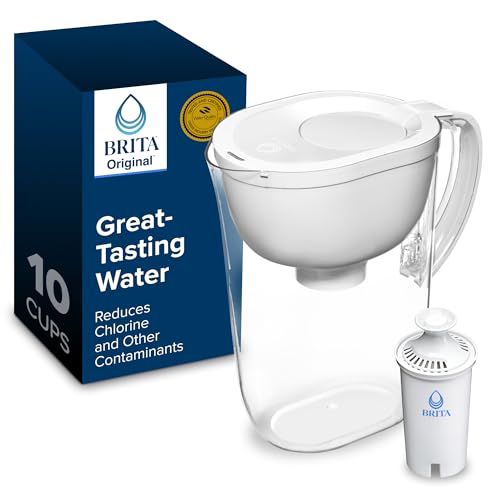
The Brita Large 10-Cup Pitcher uses granular activated carbon media to cut chlorine taste and odor while reducing zinc, copper, cadmium, and mercury. The 10-cup capacity fills a standard coffee carafe in one pour, making it the ideal companion for coffee and tea drinkers who want to remove chloramine off-flavors from their brew water.
The space-efficient design fits on most refrigerator door shelves at 10.7 inches long and 5.4 inches wide. The easy-fill locking lid opens without detaching, and the BPA-free plastic construction is dishwasher-safe on the top rack. The standard filter lasts 40 gallons or roughly two months, while optional Longlast+ filters extend that to 120 gallons or six months for users who want fewer replacements.
Customer feedback highlights that the water tastes noticeably cleaner than tap, and that coffee brewed with Brita-filtered water loses the metallic aftertaste that can come from chlorinated supply. The improved reservoir cap design on the current model prevents the leaks reported on earlier iterations. A minor complaint: the indicator stickers are small and can be difficult to reposition after the first wash.
Why it’s great
- 10-cup capacity fills a coffee maker in one pour without needing a secondary container
- Fits standard refrigerator door shelves for cold storage
- Compatible with both Standard and Longlast+ filter options for flexibility
Good to know
- Granular activated carbon does not remove dissolved solids or heavy metals beyond listed contaminants
- Pitcher can be heavy when full, and replacement reminder stickers are difficult to remove
4. Brita Standard Water Filter 6-Pack
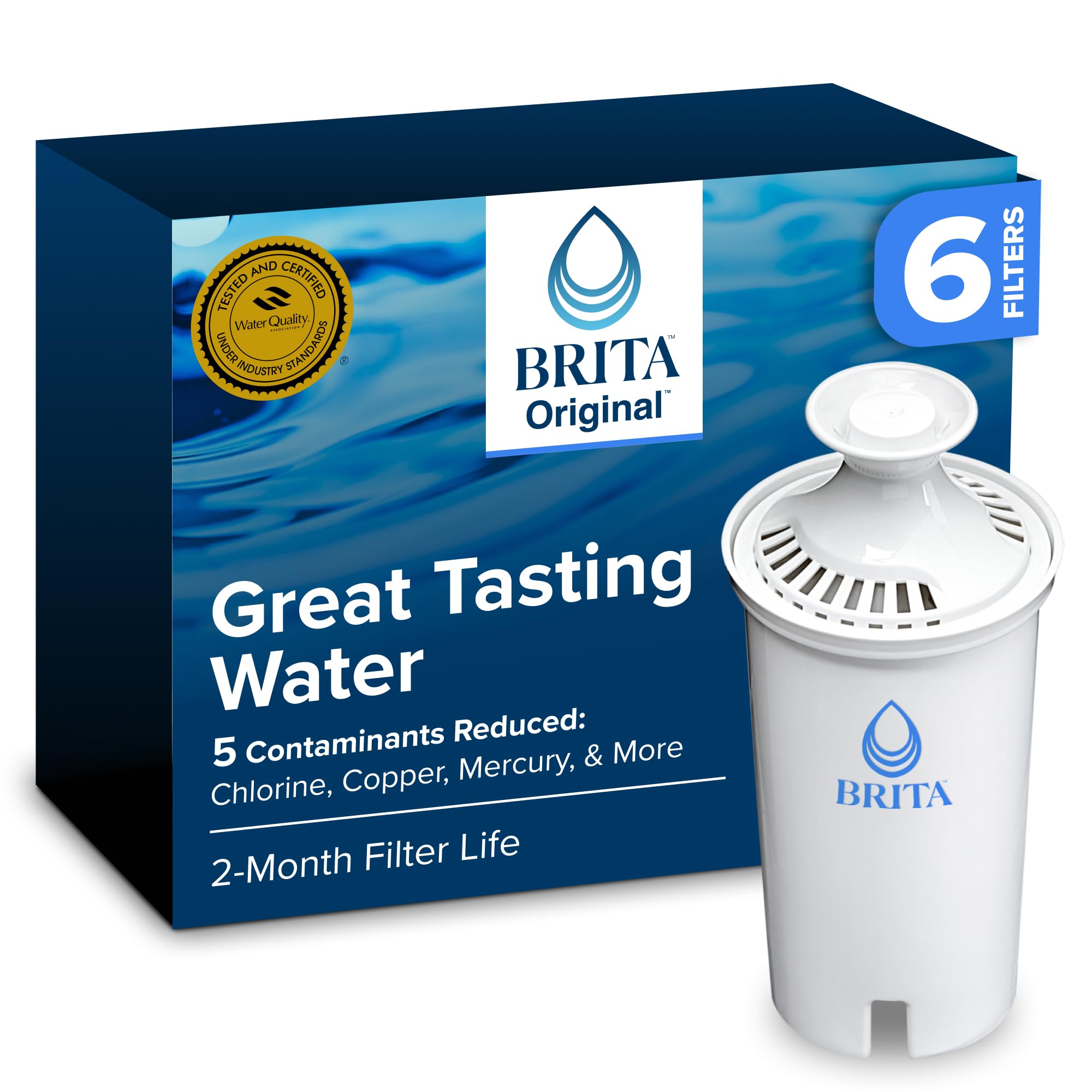
The Brita Standard Filter 6-Pack delivers six individual GAC filters designed to replace existing cartridges in all Brita pitchers and dispensers except the Stream line. Each filter removes chlorine taste and odor and reduces copper, cadmium, and mercury impurities, lasting two months or 40 gallons per filter before needing a swap.
Installation requires no presoak — simply rinse the filter under cold water for 15 seconds, insert it into the reservoir, and run two full pitchers through before drinking. The polypropylene housing contains activated carbon and a non-woven membrane that catches larger particles. The six-pack covers a full year of replacements for a single pitcher, reducing single-use plastic bottle consumption by an estimated 1,800 bottles per year per filter.
Users consistently report quick installation, an immediate improvement in chlorine taste, and reliable performance across multiple Brita pitcher generations. The flow rate can be slightly inconsistent — some filters seem to restrict water more than others — but the overall value and certification under NSF/ANSI standards make this a consistent pick for households already invested in the Brita ecosystem.
Why it’s great
- Six-pack provides roughly 12 months of filter replacements for a single pitcher
- No special soaking or priming required before installation
- NSF-certified reduction of chlorine, copper, cadmium, and mercury
Good to know
- Flow rate can vary between individual filters, with some running slower than others
- Granular activated carbon media does not capture sediment or particles smaller than about 20 microns
5. Aquabliss SF100 Revitalizing Shower Filter
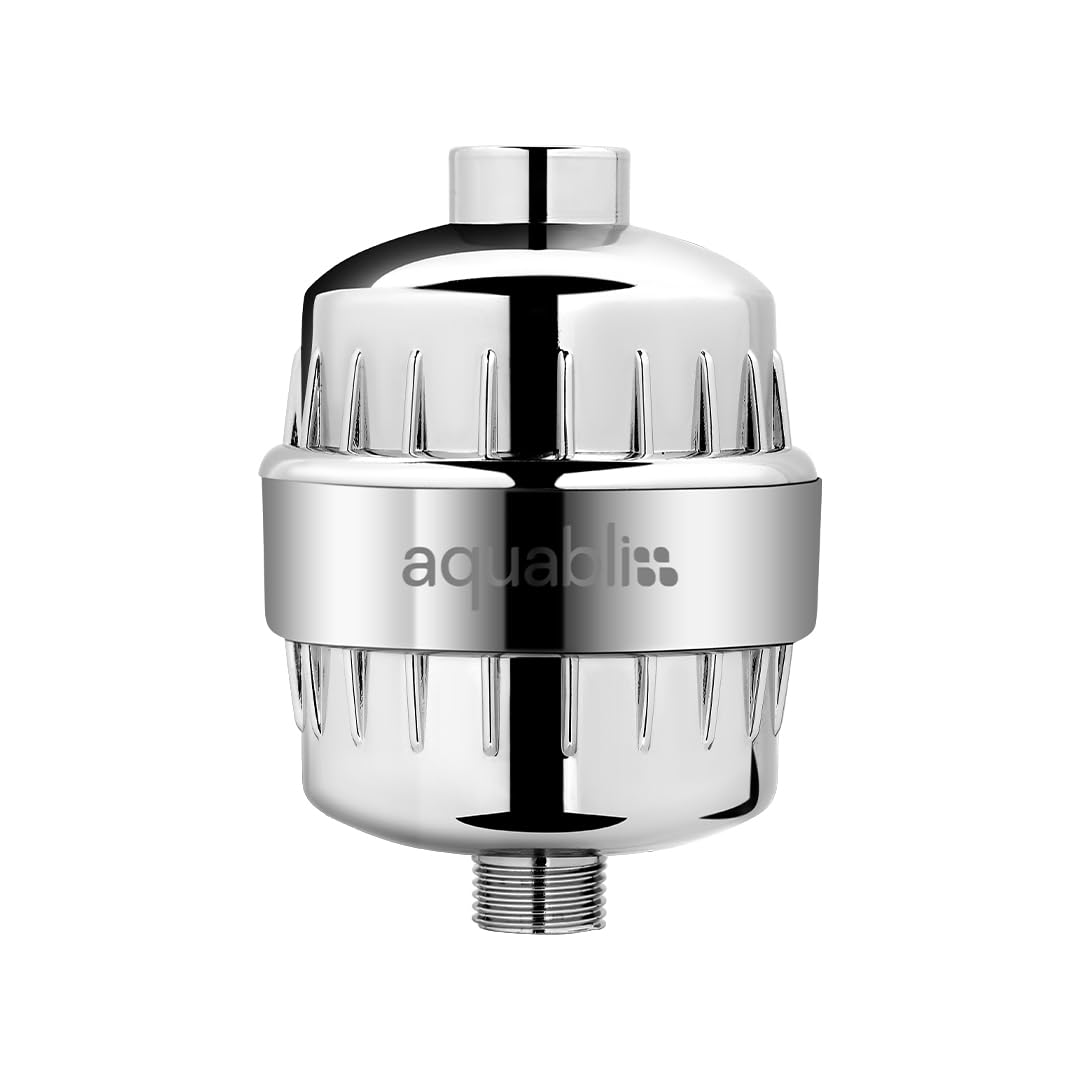
The Aquabliss SF100 installs inline on any standard 1/2-inch shower arm using a hand-tighten connection that requires no tools. Inside the chrome housing, a multi-stage cartridge combines sediment filter padding, redox media, calcium sulfite, coconut activated carbon, and ceramic beads to reduce chlorine, pesticides, pharmaceuticals, dirt, and odor while controlling scale buildup in the shower head.
The coconut carbon stage targets chlorine specifically, using its high surface area to adsorb the chemical compound responsible for dry skin, brittle hair, and scalp irritation. Redox media also helps neutralize chloramines and balance pH toward a more skin-friendly range. The cartridge lasts up to six months, and replacement cartridges cost about nine cents per day — significantly less than bottled water for skin rinsing.
Users with hard water and high chlorine levels report visible reduction in dry, scaly skin within two to four weeks, and improvements in scalp itchiness and dandruff after the first shampoo. Water pressure remains strong after installation because the filter media is designed to maintain flow rather than restrict it. A potential issue: the plastic housing can crack if overtightened with a wrench, so the manufacturer advises hand-tightening only.
Why it’s great
- Coconut activated carbon targets chlorine that dries out skin and damages hair cuticles
- Multi-stage cartridge also reduces pharmaceuticals and balances pH for gentler washing
- Tool-free hand-tighten installation works with most standard shower arms
Good to know
- Plastic housing can crack if overtightened with tools — hand-tighten only
- Not compatible with shower arms that use non-standard thread sizes
FAQ
Does a carbon water filter remove fluoride?
How often should I replace a carbon water filter?
Can a carbon water filter handle well water with high sediment?
Final Thoughts: The Verdict
For most users, the best carbon water filter winner is the EXCELPURE 1 Micron because its 1 micron carbon block captures sediment and chlorine at a level that standard GAC filters cannot match, and its compatibility with dozens of standard 10-inch housings makes it the most versatile option for whole-house and under-sink systems. If you want zero dissolved solids and the purest water possible for drinking, grab the ZeroWater 23-Cup Dispenser with its 5-stage ion exchange filter. And for skin and hair that feels dry and itchy from showering in chlorinated water, nothing beats the Aquabliss SF100 Shower Filter for targeted chlorine reduction at the showerhead.

Mo Maruf
I created WellFizz to bridge the gap between vague wellness advice and actionable solutions. My mission is simple: to decode the research and give you practical tools you can actually use.
Beyond the data, I am a passionate traveler. I believe that stepping away from the screen to explore new environments is essential for mental clarity and physical vitality.