Our readers keep the lights on and my smoothie glass nicely filled. As an Amazon Associate, I earn from qualifying purchases.
Dragging a heavy, underperforming solar panel to a campsite only to watch your power station trickle-charge all afternoon is a painful waste of daylight. The difference between a panel that saves your weekend and one that frustrates you comes down to cell technology, real-world wattage delivery, and the quality of its connectors — not the wattage printed on the box.
I’m Mohammad Maruf — the founder and writer behind WellFizz. My research into portable solar involves combing through thousands of verified buyer reports, cross-referencing efficiency claims with real-world output data, and breaking down which specs actually matter for off-grid charging scenarios.
After comparing nine leading models across output, weight, and connectivity, this guide isolates the camping solar panels that consistently deliver their rated power in the field without forcing you to compromise on packability or build quality.
How To Choose The Best Camping Solar Panels
Choosing a portable solar panel for camping is not about grabbing the highest wattage number you can afford. Three factors — cell efficiency, connector compatibility, and physical weight versus output — determine whether a panel earns its place in your pack. Overlooking any one of them can leave you with a heavy brick that barely talks to your power station.
Cell Technology: Monocrystalline vs. N-Type
Standard polycrystalline panels convert roughly 18-20% of sunlight into electricity. Entry-level monocrystalline panels push that to 22-23%. N-Type monocrystalline cells with 16-busbar designs reach 25% efficiency and resist light-induced degradation over time. For camping, where cloud cover and angled sunlight are common, the extra efficiency directly translates to more usable watt-hours during a shorter charging window. A panel with 25% efficiency can generate meaningful power even when the sun is low or hazy, whereas a cheaper poly panel may stall entirely.
Connector and Voltage Compatibility
Not all power stations accept the same input voltage or connector type. Some portable panels output 18V (standard 12V system voltage), while higher-wattage panels push 40V or 48V to charge larger stations faster. Jackery units often use an 8mm DC7909 or DC8020 barrel connector. EcoFlow stations prefer XT60. Many Bluetti and Anker models accept Anderson or MC4 connections. The best camping solar panels include a multi-connector cable — ideally a 5-in-1 or 4-in-1 — so you do not need to buy a separate adapter before your trip.
Weight, Folded Size, and Deployment Speed
A 200W panel that weighs 14 lbs and folds to 23 x 23 x 2 inches is reasonable for car camping. A 100W panel under 8 lbs works for short hikes or base-camp setups. Above 30 lbs, you are looking at RV or overlanding gear — not something you carry more than 50 feet from your vehicle. Also consider how the panel deploys: magnetic closures and rigid kickstands allow setup in under 30 seconds, whereas Velcro straps and flimsy legs add fumbling time and may collapse in a breeze.
Quick Comparison
On smaller screens, swipe sideways to see the full table.
| Model | Category | Best For | Key Spec | Amazon |
|---|---|---|---|---|
| Renogy 200W E.Flex | Premium | Versatile off-grid power with USB devices | 25% N-Type efficiency, 13.9 lbs | Amazon |
| ZOUPW 100W | Mid-Range | First-time buyers & universal compatibility | 23.5% efficiency, 5-in-1 cable | Amazon |
| Renogy 100W E.Flex | Mid-Range | Weight-conscious solo campers | 25% N-Type efficiency, 7.3 lbs | Amazon |
| HQST 200W N-Type | Mid-Range | High output without premium pricing | 25% efficiency, 11 lbs, IP67 | Amazon |
| SOKIOVOLA 200W | Mid-Range | Integrated storage bag & durable build | 25% N-Type, 16.3 lbs, IP68 | Amazon |
| MHPOWOS 220W | Mid-Range | High-voltage compatibility for big stations | 23.5% efficiency, 40V output, 17.8 lbs | Amazon |
| ZOUPW 450W | Premium | Large power station owners (40-60V input) | 25% N-Type, 29.5 lbs, IP68 | Amazon |
| EF ECOFLOW 400W | Premium | EcoFlow ecosystem pairing | 22.4% efficiency, 35.3 lbs, IP68 | Amazon |
| EBL 100W | Budget | Entry-level short trips | 23% efficiency, 45° kickstands | Amazon |
In‑Depth Reviews
1. Renogy 200W Portable Solar Panel
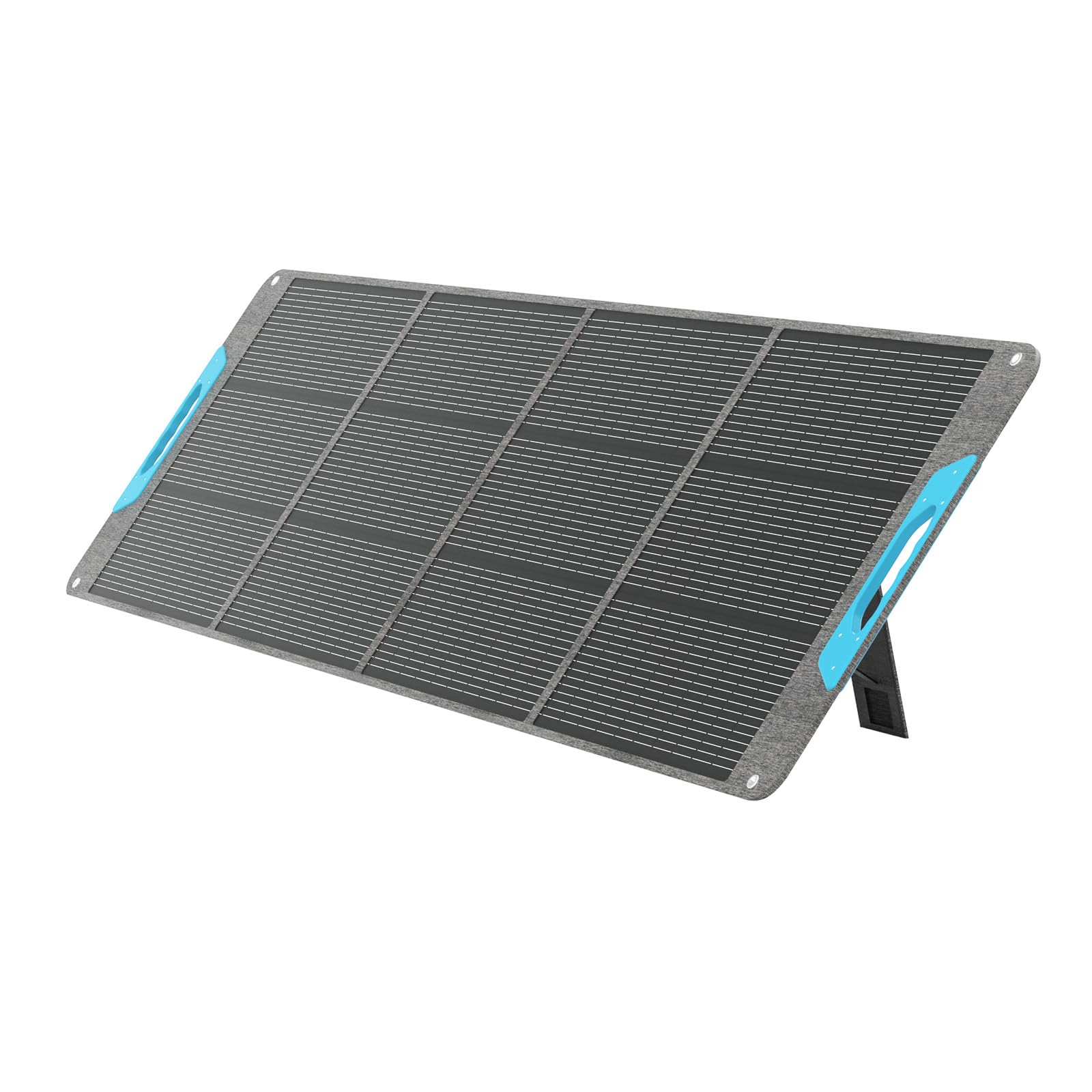
The Renogy 200W E.Flex uses 16BB N-Type cells that hit 25% efficiency, meaning it pulls more wattage from the same patch of sunlight than panels using older 9BB designs. Owners report sustained output above 200W in bright Florida sun, and the 13.9 lb weight is the lightest in the 200W foldable class — realistic for car camping and RV tailgate setups without requiring a dolly.
Three-angle kickstands (40°, 50°, 60°) keep the panel stable on uneven ground, and the magnetic closure speeds up deployment compared to Velcro-wrap designs. The built-in USB-C PD port delivers 45W, enough to fast-charge a laptop or tablet directly from the panel without a power station in the loop. The MC4 output pairs cleanly with EcoFlow, Anker, and Bluetti generators.
Battery SOC recovery tests show that this panel can recoup the drain from a CPAP machine or a 60W laptop workload within two hours of direct sunlight. The IP65 rating handles rain splashes, though the USB ports are not fully sealed — keeping the pouch zipped during wet weather prevents moisture ingress into the connector bay.
Why it’s great
- Industry-leading 25% N-Type cell efficiency for faster charging
- Lightest 200W foldable panel at 13.9 lbs
- 45W USB-C PD for direct device charging
Good to know
- No storage bag included for travel protection
- Legs can feel janky in sustained high wind
2. ZOUPW 100W Portable Solar Panel

The ZOUPW 100W panel uses Grade A+ monocrystalline cells with a 23.5% conversion rate — right at the top of the 100W category for efficiency. The standout feature is the 5-in-1 solar connector cable that includes DC8020, XT60, Anderson, DC7909, and DC5521 tips, covering nearly every power station brand without requiring separate adapters.
Weighing 9.5 lbs with a folded size of 24.1 x 21.1 x 1.8 inches, it is best suited for car camping and RV use rather than backpacking. The IP67 ETFE coating protects against rain and splashes, and the built-in USB-C port can deliver up to 45W for direct-device charging. The two adjustable kickstands allow a 45° tilt that captures up to 25% more sunlight than a flat-laid panel.
Verified buyers pairing this panel with a Jackery Explorer 300 saw a charge jump from 84% to 100% in roughly 20 minutes on a cloudy day — a strong indicator that the smart IC controller handles voltage management well. The 12-month warranty and lifetime technical support add peace of mind for first-time solar buyers.
Why it’s great
- True 5-in-1 connector cable eliminates adapter hunting
- High 23.5% efficiency from A+ monocrystalline cells
- IP67 waterproof ETFE coating handles rain and marine spray
Good to know
- Heavier than some competitors at 9.5 lbs
- Kickstands lack fine angle adjustment increments
3. Renogy 100W Portable Solar Panel

At 7.3 lbs, the Renogy 100W E.Flex is the lightest 100W folding panel on the market, making it a legitimate option for hikers and kayakers who need to shave every ounce. The 16BB N-Type cells deliver 25% efficiency — two to three percentage points higher than the typical 100W panel — which directly improves charging speed during morning and late-afternoon low-light windows.
The quad-fold design packs to backpack size (22.99 x 22.54 x 1.57 inches) with a magnetic closure that snaps shut for quick stowage. Three kickstand angles (40°, 50°, 60°) allow fine-tuned positioning. The panel also includes a USB-C PD port (45W max) and two USB-A ports, plus an MC4 output for connecting to power stations. The built-in accessory pouch stores cables neatly.
One-year continuous-use reports from owners show the panel reliably keeping a Jackery 600 topped off for security cameras and internet gear. Real-world output maxes around 87W in full sun due to thermal losses — typical for a 100W panel — but the combination of light weight and high efficiency makes this the top choice for anyone who moves camp frequently.
Why it’s great
- Lightest 100W folding panel at 7.3 lbs
- 25% N-Type efficiency for better low-light performance
- Magnetic closure and quad-fold for fast pack/unpack
Good to know
- No power station adapters included — MC4 cable only
- USB-C PD maxes at 40W rather than the advertised 45W
4. HQST 200W Ultra-Light Portable Solar Panel
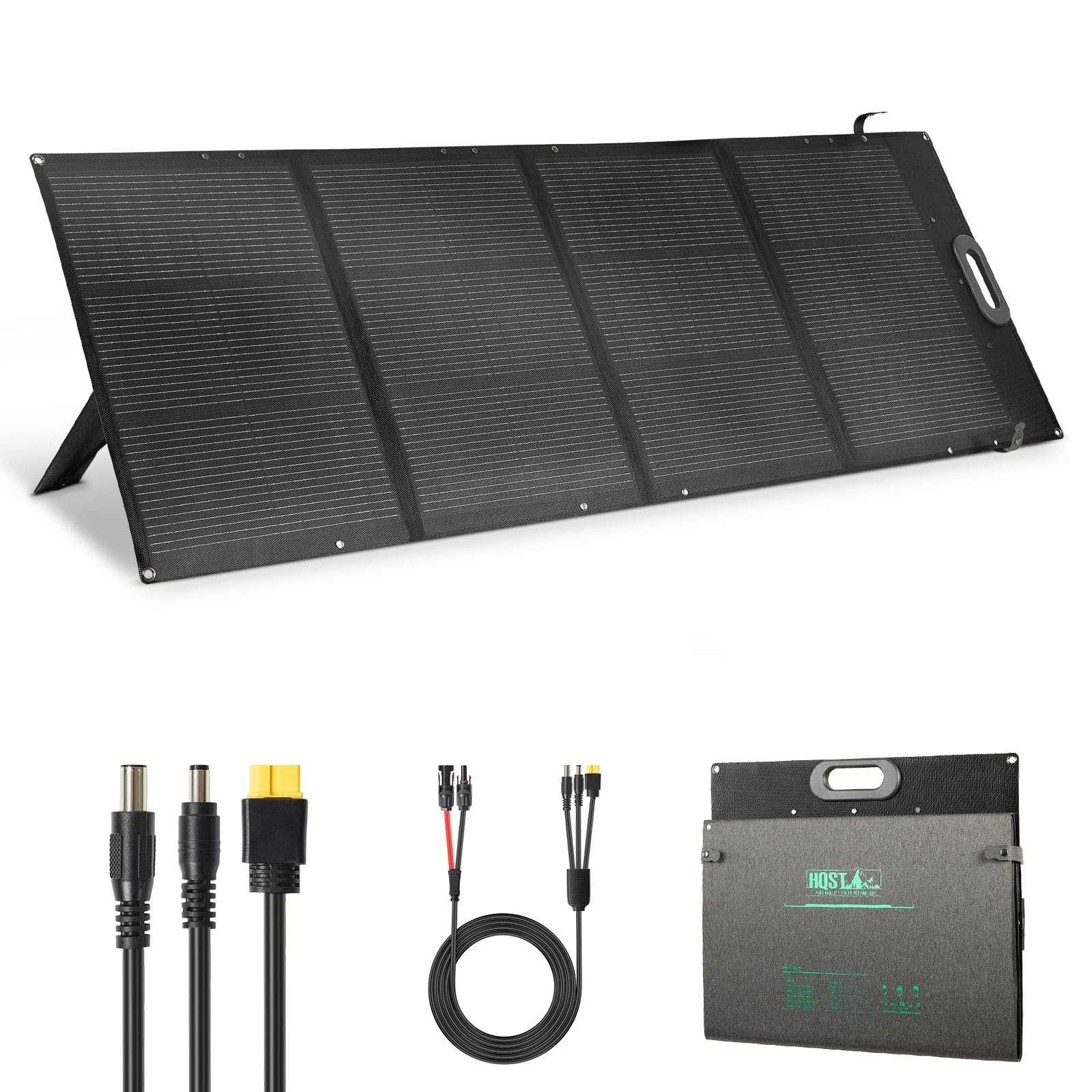
HQST’s 200W N-Type panel undercuts most 200W competitors on price while keeping a 25% efficiency rating and an ultra-light 11 lb frame — 37% lighter than typical 200W rigid panels. The built-in rubberized handle makes one-handed carry easy, and the quad-fold with buckle closure packs down to a thin 1.97-inch profile for trunk storage.
The panel uses a fully laminated ETFE construction with no stitched seams, preventing water ingress and earning an IP67 rating. Two adjustable kickstands support 40° to 60° tilt angles. The included 4.9 ft 3-in-1 adapter cable covers XT60, DC7909, and DC5521 connections — compatible with Jackery, EcoFlow, BLUETTI, Goal Zero, and Anker stations.
Owners report pairing this panel in series for higher-voltage charging on MPPT controllers, with one user seeing about 2A at 35V on overcast days. The bypass diodes help maintain output when partial shade hits one panel section. The 12-month warranty and lifetime technical support provide solid backup for a panel in this price tier.
Why it’s great
- Exceptional value for a 200W N-Type panel at 25% efficiency
- Ultra-light 11 lb build for easy transport
- Fully laminated IP67 construction resists rain and dust
Good to know
- Adapters only 4.9 ft — may need extension for flexible placement
- Shipping packaging can leave cosmetic dents on the frame
5. SOKIOVOLA 200W Portable Solar Panel
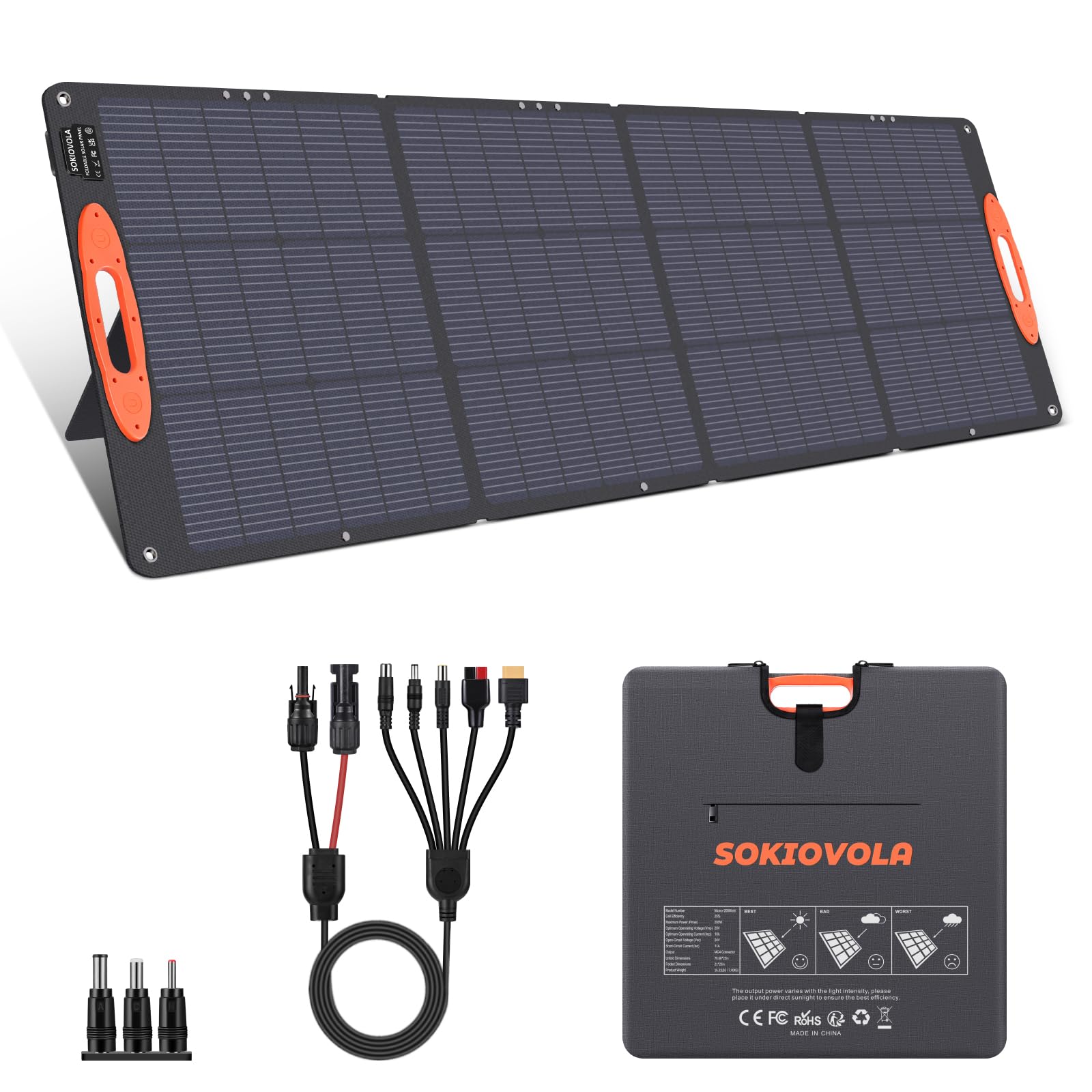
The SOKIOVOLA 200W panel uses the same 16BB N-Type cell architecture found in premium brands, achieving 25% efficiency. Its folded size of 21 x 23 inches is compact for a 200W panel, and the included padded carrying bag with room for cables and adapters adds real-world convenience that many competitors skip. Owners note that the bag itself feels overbuilt compared to the panel’s substrate.
A 10.5 ft 5-in-1 extension cable ships with the panel, covering XT60, DC5521, DC7909, DC8020, and Anderson connectors — maximum compatibility without adapter shopping. The IP68-rated ETFE coating means the main panel body is both dust-tight and submersible, though the junction box and connectors should not be immersed.
Real-world output in Southern California sun reached 177W (88-89% efficiency relative to rating), while a separate test in 95°F conditions saw 170-180W — consistent with thermal derating. The 12-month warranty and 30-day refund period reduce purchase risk. The flimsy plastic substrate is a minor durability concern for UV-exposed long-term use.
Why it’s great
- Padded carry bag included — rare in this price tier
- 10.5 ft 5-in-1 cable for broad compatibility
- IP68 waterproof rating for wet-weather camping
Good to know
- Substrate feels thin — long-term UV durability is unproven
- Leg retraction force is strong; requires care when folding
6. MHPOWOS 220W Portable Solar Panel

The MHPOWOS 220W panel stands apart with a 40V output voltage — significantly higher than the typical 18-23V of most foldable panels. This higher voltage pairs well with EcoFlow Delta series and Bluetti Elite units that accept up to 60V input, reducing cable losses and enabling faster charging through MPPT controllers. A 7-in-1 connector kit ensures broad power station compatibility.
Weighing 17.8 lbs with a folded size of 23.5 x 21.25 x 2.3 inches, it is heavier than the HQST or Renogy options but still manageable for vehicle-adjacent camping. The four kickstands keep the panel stable, though the Velcro attachments can be aggressive when re-securing the panel legs. The monocrystalline cells deliver a 23.5% conversion rate.
Winter testing in Northern Illinois recorded 185W at 10:30 AM, while Texas users saw peaks of 190-207W at 17° tilt. The panel charged an EcoFlow Delta 2 (1024Wh) efficiently from a 73% starting SOC while simultaneously running a fridge. The key caveat: this panel will not work with low-voltage power stations (under 30V input like Jackery 500/1000), so verify your station’s voltage ceiling before buying.
Why it’s great
- 40V output for fast charging on compatible high-voltage stations
- Real-world peaks above 200W in good sun conditions
- 7-in-1 connector kit covers most stations out of the box
Good to know
- Not compatible with power stations under 30V input
- Leg Velcro can be difficult to re-attach cleanly
7. ZOUPW 450W Portable Solar Panel
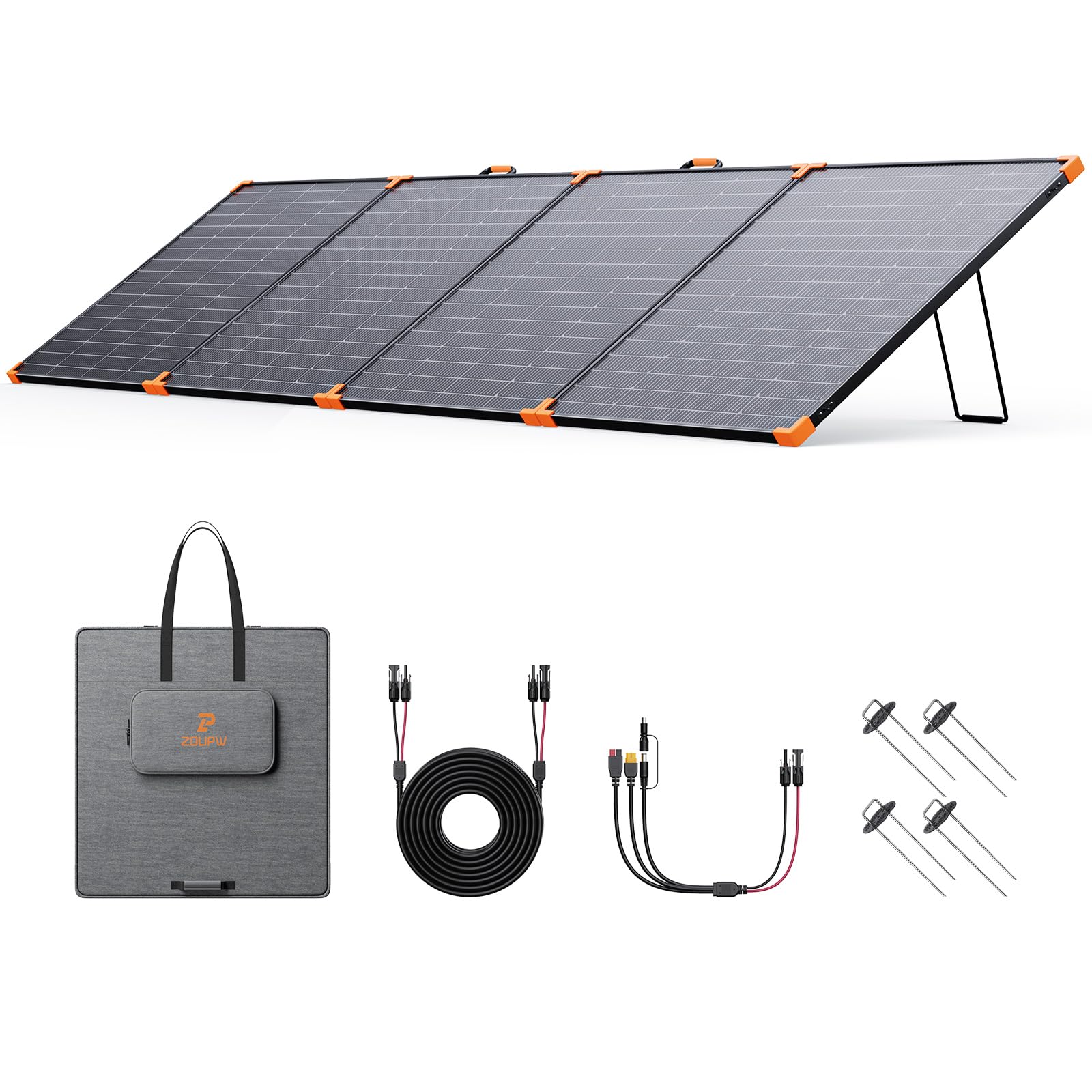
The ZOUPW 450W panel uses aerospace-grade fiberglass to achieve a remarkably light 29.5 lb frame for its output class — about 30% lighter than comparable 400W rigid panels. The 16BB N-Type cells maintain 25% efficiency and produce a 45.9V open-circuit voltage, making this panel suitable for large power stations in the 40-60V input range such as the EcoFlow Delta series, Anker C1000, and Bluetti Elite 100.
Four reinforced kickstands adjustable to 45° handle positioning on uneven ground, and the IP68 rating means the panel body is fully dust-tight and protected against water immersion — though connectors should not be submerged. The included 4-in-1 adapter cable covers XT60, Anderson, DC7909, and DC8020 ports. Ground stakes and a storage bag are included in the package.
Winter testing at 43°N latitude recorded an open-circuit voltage of 51.2V and amperage of 12.48A — above the rated spec. Owners report consistent output above 450W in hot climates, occasionally peaking at 500W. The 36-month warranty is the longest in this roundup. The primary downside: even an inch of shade on one panel section can drop voltage by over 50%, so careful placement is critical.
Why it’s great
- Output consistently exceeds 450W, peaking over 500W
- Aerospace-grade fiberglass saves 30% weight vs. rigid 400W panels
- 36-month warranty — best in class for portable panels
Good to know
- Shade on any section causes steep voltage drop (>50%)
- Not compatible with power stations under 30V input
8. EF ECOFLOW 400W Portable Solar Panel

The EcoFlow 400W Solar Panel is the purpose-built companion for EcoFlow Delta Pro and Delta Pro Ultra power stations, leveraging the MPPT algorithm for optimal efficiency in variable sun. With 22.4% monocrystalline cell efficiency, it is not the most efficient panel on this list, but its integration with the EcoFlow ecosystem means voltage and connector pairing are seamless — no adapter guesswork.
The panel folds into an adjustable carry case that doubles as a kickstand, propping the panel at the ideal angle without separate legs. The construction uses flexible EVA layers over tough fiberglass for impact resistance.
Post-hurricane testing in Southeast Texas with two 400W panels feeding a Delta Pro saw a peak combined input of 695W (86.9% efficiency relative to 800W rated). Owners who lean the panels against a wall instead of using the case hooks report simpler daily setup and similar output. The IP68 rating on the main body provides peace of mind in sudden downpours, though the junction box and connectors are not waterproof-rated for immersion.
Why it’s great
- Seamless MPPT optimization with EcoFlow Delta stations
- Adjustable carry case doubles as built-in kickstand
- IP68 waterproof main body handles heavy rain
Good to know
- Heavy at 35.3 lbs — vehicle-only portability
- Short included cable may require extension for sunny placement
9. EBL Solar Panel 100W
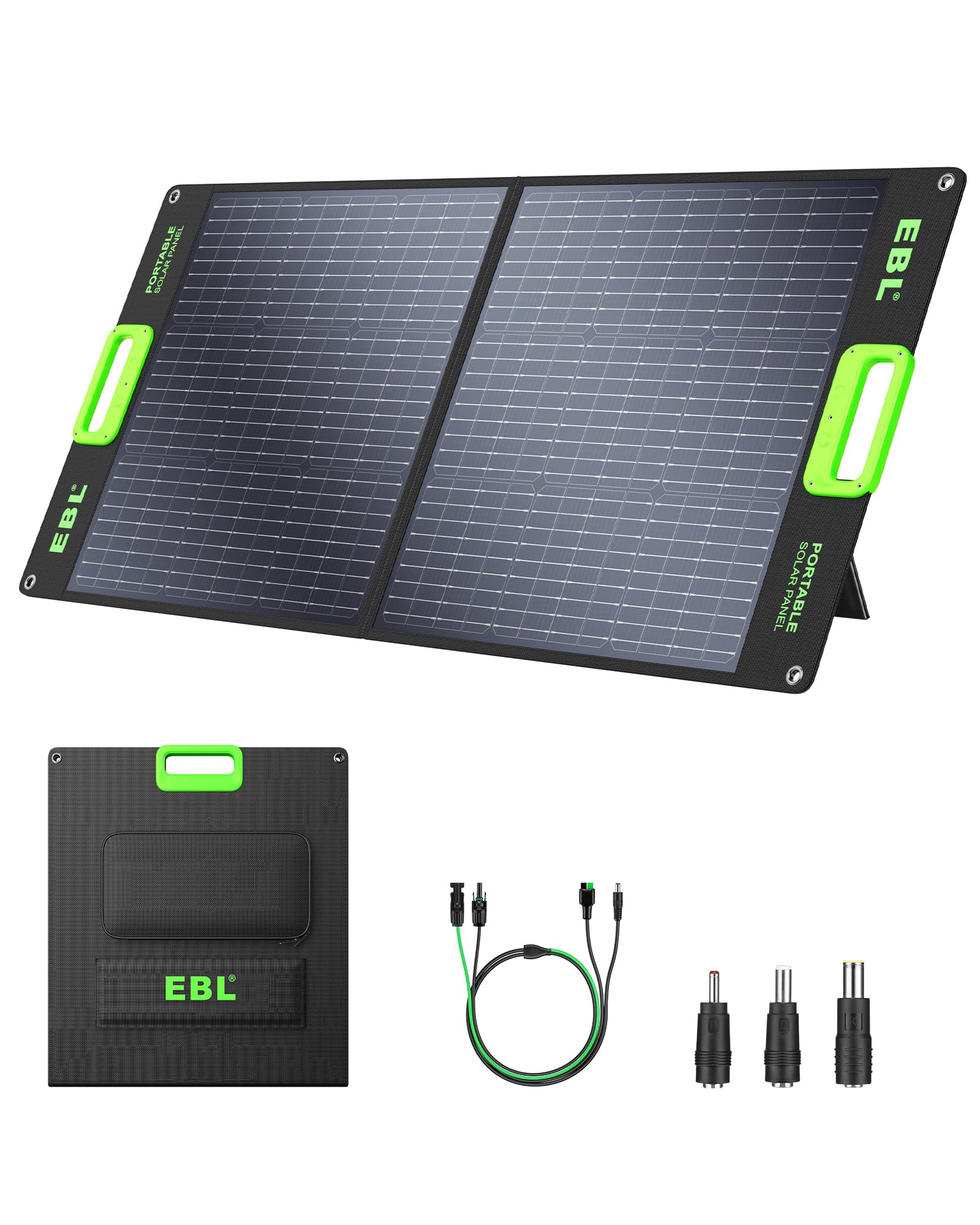
The EBL 100W Solar Panel is the budget entry point in this roundup, using upgraded monocrystalline cells with a 23% conversion rate. The panel includes two kickstands that tilt to 45° — a 20% improvement in sunlight capture over flat laying, per the manufacturer. The magnetic handle simplifies folding and storage, and the ETFE laminate provides IP65 splashing resistance.
The kit includes MC4-to-Anderson, MC4-to-DC5521 cables, plus adapters for 5.5×2.1mm to 5.5×2.5mm, 7.9×0.9mm, and 3.5×1.5mm connections — a workable set for budget power stations. A parallel cable is included, allowing multiple panels to combine output. The 6 ft cable length limits positioning flexibility for sun chasing.
Owners report 191W peak output when testing in good sun, with the panel still pulling 157W at 5 PM. Another user averaged 131-145W in April sun and charged a 448Wh battery from 7% to 100% in three hours. The 45° kickstands are fixed — no angle adjustment — and the IP65 rating means this panel should not be left in sustained rain. The customer service response on compatibility issues has been notably responsive per buyer reports.
Why it’s great
- Strong real-world output for its price tier
- Parallel cable included for future expansion
- Responsive customer support on compatibility issues
Good to know
- IP65 only — not designed for sustained rain exposure
- 6 ft cable can limit placement options
FAQ
Can I charge a power station and devices at the same time from one panel?
What does the IP rating mean for a camping solar panel?
Why does my 100W panel only show 85W on my power station?
Final Thoughts: The Verdict
For most users, the best camping solar panels winner is the Renogy 200W E.Flex because its 25% N-Type efficiency, 13.9 lb weight, and built-in USB-C PD make it the most versatile all-around panel for vehicle-based camping and RV trips. If you want a lightweight option for solo trips, grab the Renogy 100W E.Flex. And for large power station owners who need maximum wattage in a portable format, nothing beats the ZOUPW 450W for its output-to-weight ratio and market-leading warranty.

Mo Maruf
I created WellFizz to bridge the gap between vague wellness advice and actionable solutions. My mission is simple: to decode the research and give you practical tools you can actually use.
Beyond the data, I am a passionate traveler. I believe that stepping away from the screen to explore new environments is essential for mental clarity and physical vitality.