Our readers keep the lights on and my smoothie glass nicely filled. As an Amazon Associate, I earn from qualifying purchases.
That sulfur smell every time you turn on the hot water isn’t a plumbing mystery—it’s a clear signal your sacrificial anode rod has reached the end of its useful life. Left unchecked, corrosion attacks the tank lining, turning a simple replacement into a water heater swap.
I’m Mohammad Maruf — the founder and writer behind WellFizz. I’ve spent hundreds of hours dissecting user repair logs, cross-referencing threaded connection standards, and breaking down the electrochemistry of galvanic protection to help you pick the exact anode rod for water heater tank you need, the first time.
This guide cuts through the brand noise to compare aluminum, magnesium, zinc-alloy, and titanium powered rods, so you can confidently choose the best anode rod for water heater based on your water chemistry, ceiling clearance, and odor tolerance.
How To Choose The Best Anode Rod For Water Heater
Sacrificial anode rods are the only line of defense between your water heater tank and electrolytic corrosion. Pick the wrong material or length, and you’ll either still smell sulfur or struggle to fit the rod into a tight mechanical room. Focus on three variables: material chemistry, physical length and flexibility, and the thread interface with your heater.
Material Chemistry Matches Your Water
Magnesium offers the highest electrochemical potential, making it the most aggressive at protecting the tank—but it also reacts strongly with sulfate-reducing bacteria, often causing that rotten egg odor. Aluminum rods provide a middle ground with less odor production and a longer service life in hard water. Zinc-aluminum blends neutralize sulfur compounds best, making them ideal for well water systems where hydrogen sulfide is present. Titanium powered rods don’t sacrifice themselves at all; they use a low-voltage electrical current to prevent corrosion, eliminating both the sacrificial core and the odor problem permanently.
Physical Length and Flexibility
Standard residential tanks accept a 42-inch rod (Product 2) if you have at least 4 feet of overhead clearance. In basements with low joists or mechanical closets, you need a segmented flexible rod (Product 3 and Product 4) that breaks into 12-inch sections for in-place installation. Measure your available height above the water heater port before ordering—you cannot bend or compress a solid rod.
Thread Size and Hex Bushing
Every rod in this guide uses a standard 3/4″ NPT thread. The hex head on top is 1-1/16″ (27mm). A 27mm deep socket and a breaker bar or impact wrench are essential for removal because factory-installed rods are often overtightened and seized by mineral deposits. Avoid 12-point sockets—they slip on the hex bushing and round the corners.
Quick Comparison
On smaller screens, swipe sideways to see the full table.
| Model | Category | Best For | Key Spec | Amazon |
|---|---|---|---|---|
| Kelaro Aluminum Zinc (Flexible) | Aluminum-Zinc | Rotten egg smell on well water | 44-inch flexible segmented rod | Amazon |
| Camco 11582 Aluminum | Aluminum | Standard residential replacement | 42-inch solid aluminum rod | Amazon |
| Eau Flexible Magnesium | Magnesium | Hard water with space constraints | 44-inch flexible 4-segment design | Amazon |
| Podoy Powered Titanium | Titanium Electric | Odor-free long-term protection | 9.4-inch titanium, AC/DC power | Amazon |
| 5-Pack RV Kit (jixsloft) | Aluminum Kit | RV/camper water heater cleaning | 9.25-inch rod + flush wand | Amazon |
In‑Depth Reviews
1. Kelaro Aluminum Zinc Water Heater Anode Rod (44-inch Flexible)

The Kelaro rod is the only aluminum-zinc blend in this roundup, and that alloy choice is what makes it the top pick for anyone dealing with well water sulfur smell. The zinc content actively neutralizes hydrogen sulfide bacteria, which is why multiple verified reviewers report the rotten egg odor vanished within 24 hours of installation. At 44 inches with a flexible segmented core, it fits into spaces where a solid rod simply cannot go—you only need about 12 inches of overhead clearance to guide it into the tank port.
Installation is straightforward with standard tools, though the package does not include a 1-1/16″ deep socket or impact wrench. Reviewers consistently note that removal of the old rod required an impact gun and a breaker bar because factory rods are often overtightened and calcified. Once the old rod is out, the Kelaro threads directly into the 3/4″ NPT port with a wrap of Teflon tape. One review mentioned cutting the flexible rod shorter with a sawzall to fit a 40-gallon tank, confirming the rod is user-adjustable in length.
The price lands in the mid-range tier, offering better long-term value than a pure aluminum rod because the zinc additive extends both odor control and corrosion protection for 2–3 years under normal residential use. If you are replacing a depleted rod in a tight basement closet and you want the sulfur smell gone for good, this is the first rod to reach for.
Why it’s great
- Zinc alloy eliminates hydrogen sulfide odor at the source, not just masks it.
- Flexible segmented design installs without overhead clearance requirements.
- Compatible with AO Smith, Rheem, Kenmore, GE, Reliance, Richmond, State, and most 3/4″ NPT heaters.
Good to know
- Socket and impact wrench not included—borrow or buy a 1-1/16″ deep socket separately.
- You may need to cut the rod if your tank is smaller than 40 gallons or shorter than 44 inches inside.
2. Camco 11582 Aluminum Anode Rod

Camco’s 11582 is the industry standard for a reason: it is a no-frills, 42-inch solid aluminum rod that has been in continuous production since 2011 and carries thousands of verified reviews. The aluminum composition offers a slower consumption rate than magnesium in hard water, making this rod a better fit for homes with city water or moderately hard well water where odor is not the primary complaint.
The physical dimensions are straightforward—3/4″ OD with a 1-1/16″ hex bushing and 3/4″‑14 NPT thread. You need at least 4 feet of vertical clearance above the water heater port to install this rod without cutting. If your basement utility closet has tight overhead joists, you will have to cut the rod with a hacksaw (reviewers confirm this is easy with aluminum). A critical detail: the 42-inch length is designed for standard 50‑gallon tanks; if you have a 30‑ or 40‑gallon tank, measure your tank height from the port downward and cut accordingly.
Users report this rod lasts between 4 and 6 years before significant depletion, depending on water chemistry. The hex head is robust enough for an impact wrench at medium torque, though you should always use a 6-point deep socket to avoid stripping the bushing. At an entry-level price, the Camco 11582 delivers dependable protection without any gimmicks, making it the default choice for DIY homeowners who have overhead clearance and want the simplest possible swap.
Why it’s great
- Proven aluminum formula lasts 4–6 years in moderate water conditions.
- Universal 3/4″ NPT thread fits virtually all residential water heaters.
- Priced at the entry-level tier with massive consumer confidence from over a decade of sales.
Good to know
- Cannot be installed without overhead clearance—requires 4+ feet above the port.
- Does not address sulfur odor as effectively as zinc-alloy or powered rods.
3. Eau 44 Inch Flexible Magnesium Anode Rod

When your water heater is wedged into a closet or tucked under low ductwork, the Eau flexible magnesium rod is your only realistic path to replacement without pulling the whole heater. The rod is articulated into four segments with a hinge, letting you feed the 44-inch rod through the port with as little as 12 inches of vertical clearance. Magnesium provides the highest galvanic potential of all sacrificial materials, which means it offers superior protection in soft water or water with high chloride content—common in many municipal supplies.
The kit includes a 27mm chrome-finished socket and a roll of Teflon sealing tape, both of which users found functional if not premium. The socket is a 6-point design and worked fine with a breaker bar and impact wrench in multiple verified reviews. One reviewer noted that the paint on the threads was thick enough to potentially interfere with the electrical ground path, but they verified continuity with a multimeter and reported near-zero resistance. If you are replacing an anode in a gas water heater, that ground path matters for the flame rectification circuit, so check continuity if you see heavy paint.
The downsides are typical of magnesium: it can produce more hydrogen sulfide gas (rotten egg smell) when sulfate-reducing bacteria are present in the water. If you already have sulfur odor, consider the Kelaro zinc-alloy rod instead. But for hard water tanks where odor is not an issue and overhead clearance is tight, the Eau rod offers a complete replacement kit at a fair mid-range price point with no extra trips to the hardware store for tools.
Why it’s great
- Segmented flexible design fits in extremely low-clearance utility closets.
- Socket and Teflon tape included—everything you need in one box.
- Magnesium provides aggressive corrosion protection for soft and high-chloride water.
Good to know
- Magnesium can worsen or cause rotten egg odor in sulfate-heavy water.
- May require an impact wrench for removal if factory rod is seized; hand tools alone often fail.
4. Podoy Powered Titanium Anode Rod
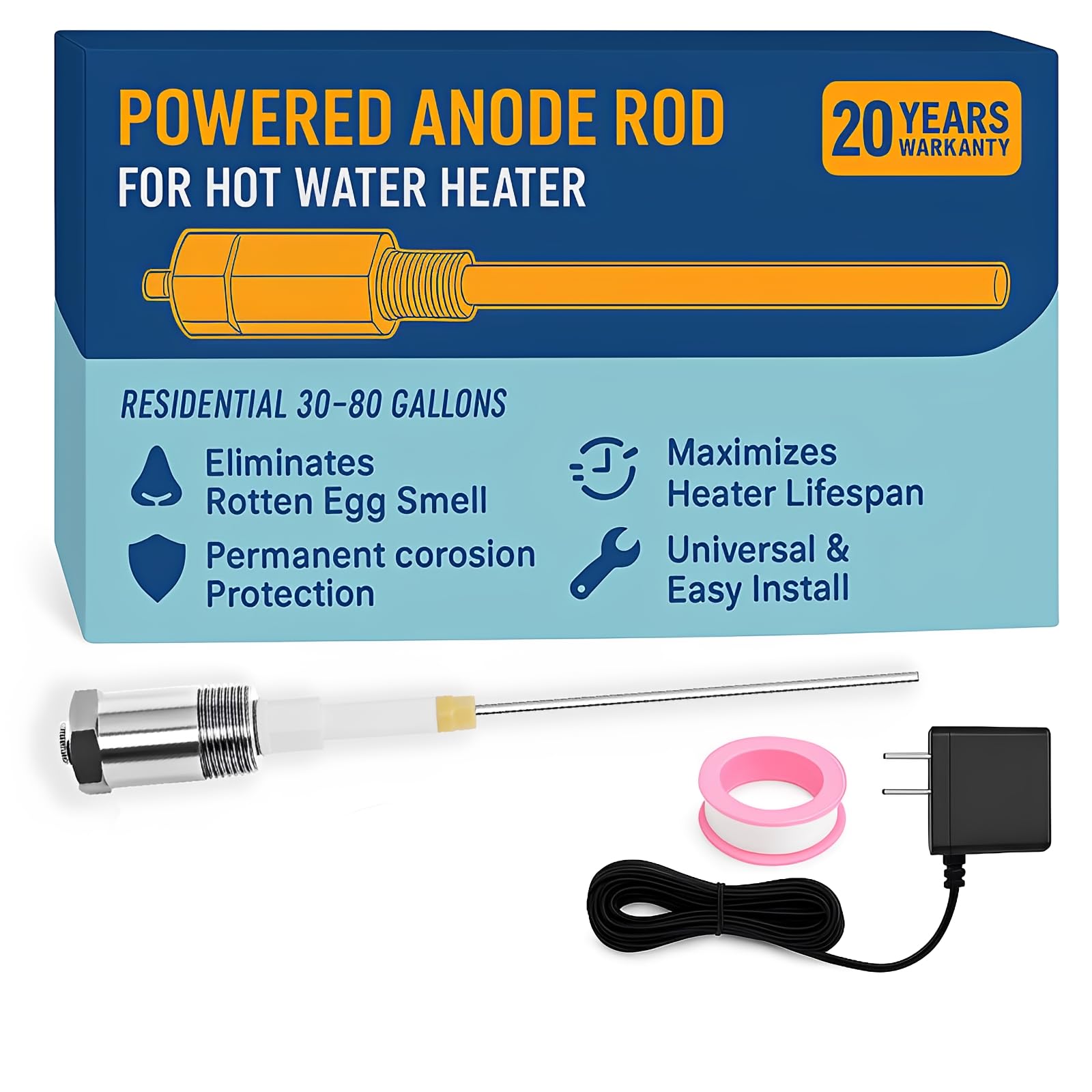
The Podoy powered anode rod is a fundamentally different technology: instead of a sacrificial core that corrodes away, it uses a titanium electrode connected to a low-voltage AC-to-DC power supply (100–240V input, DC 3V output at 1A). The electrical current prevents electrolytic corrosion without consuming any material, which means the rod never needs replacing for the life of the water heater. It also directly eliminates the rotten egg smell within 24 hours by disrupting the sulfate-reducing bacteria cycle, rather than merely competing with it as sacrificial rods do.
Installation is simpler than a conventional rod because the 9.4-inch titanium section is much shorter, so overhead clearance is never an issue. The 3/4″ NPT thread screws directly into the heater port, and the power cord plugs into any standard wall outlet. You need to leave the unit powered continuously to maintain the protective current. The package includes Teflon tape, but you must supply your own 1-1/16″ deep socket and a ratchet or wrench—these are common tools, but the omission may catch first-time buyers off guard.
At a premium price, the Podoy is significantly more expensive upfront than any sacrificial rod. However, because it never decays, you completely eliminate the recurring purchase and the physical labor of replacing a rod every 2–4 years. For homeowners who plan to stay in their house for 10+ years or who have persistent sulfur odor that sacrificial rods only partially mask, the Podoy powered rod is cheaper over the long run and delivers consistent, odor-free hot water from day one.
Why it’s great
- Zero corrosion wear—titanium rod lasts the full lifespan of the water heater.
- Eliminates sulfur odor within 24 hours through active electrical treatment.
- Short 9.4-inch design fits any space with zero clearance restrictions.
Good to know
- Higher upfront cost than sacrificial rods, though cost recoups over many years.
- Requires continuous AC power near the water heater, which may need outlet proximity.
5. 5 Pack RV Water Heater Anode Rod & Flush Wand Kit
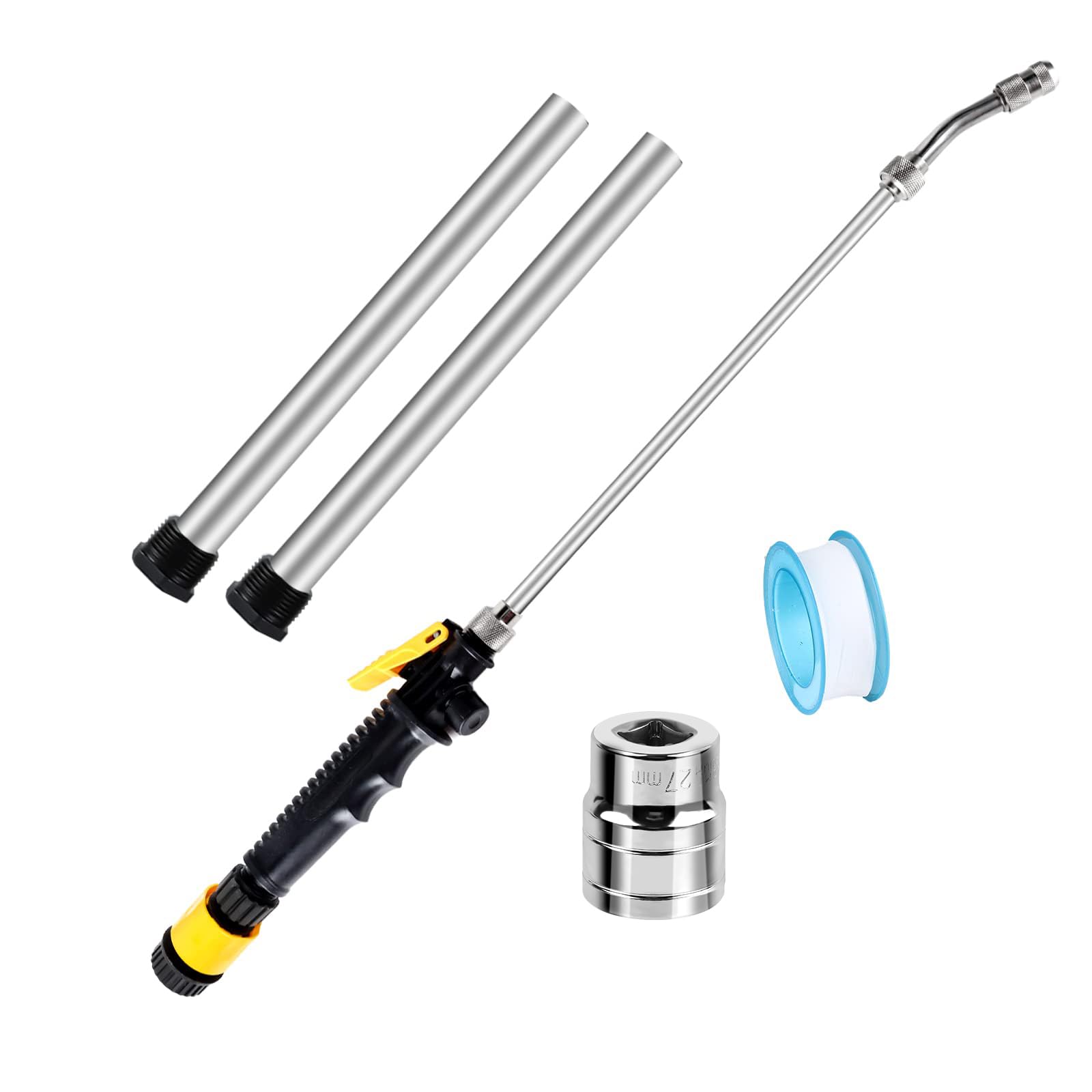
If you maintain an RV, camper, or mobile home water heater, this kit from jixsloft is designed specifically for the geometry of Suburban and Mor-Flo RV tanks. The 9.25-inch aluminum rods with 3/4″ NPT threads fit the short dip-tube ports found in RV water heaters, and the kit bundles two rods, a stainless-steel flush wand, a hex wrench socket, and Teflon tape. The flush wand is the standout feature: its curved stainless tip and adjustable nozzle pattern let you blast sediment from the bottom of the small RV tank without damaging the lining.
RV water heaters accumulate calcium and rust scale much faster than residential units because they see intermittent use and frequent temperature swings. The included flush wand connects to a standard garden hose via a 1/2″ quick-connect adapter, and the 13.7-inch metal rod reaches deep enough to scour dead spots. One reviewer noted that the socket in the kit was too short to reach a recessed hex bushing on some heaters, requiring an extension bar or a torque wrench with a longer reach.
The bundle is priced at the entry-level tier, making it the most cost-effective option for RV owners who need both replacement rods and a cleaning tool. The aluminum rods are sacrificial and should be replaced annually if you use the RV regularly. The biggest limitation is that this kit is not sized for standard 40- or 50-gallon residential water heaters—the rods are too short. Reserve this kit for travel trailers, fifth wheels, and motorhomes exclusively.
Why it’s great
- All-in-one kit includes rods, flush wand, socket, and tape for a complete RV maintenance session.
- Flush wand reaches deep into RV tanks with an adjustable spray pattern for effective sediment removal.
- Two aluminum rods let you plan a spare for the next season at no extra cost.
Good to know
- Rods are 9.25-inch—too short for residential water heater tanks.
- Socket included may be too short to reach a recessed hex bushing on some models.
FAQ
How often should I replace my water heater anode rod?
What is the difference between aluminum and magnesium anode rods?
Can a flexible anode rod be cut to a shorter length?
Do I need an impact wrench to remove an old anode rod?
Will a powered anode rod work in a Bradford White water heater?
Final Thoughts: The Verdict
For most users, the best anode rod for water heater winner is the Kelaro Aluminum Zinc flexible rod because it combines the sulfur-neutralizing benefits of zinc with a flexible segmented design that fits any installation space at a reasonable mid-range price. If you want a classic, no-fuss replacement and have overhead clearance, grab the Camco 11582 solid aluminum rod. And for total long-term elimination of both odor and recurring replacement labor, nothing beats the Podoy powered titanium rod.

Mo Maruf
I created WellFizz to bridge the gap between vague wellness advice and actionable solutions. My mission is simple: to decode the research and give you practical tools you can actually use.
Beyond the data, I am a passionate traveler. I believe that stepping away from the screen to explore new environments is essential for mental clarity and physical vitality.