Our readers keep the lights on and my smoothie glass nicely filled. As an Amazon Associate, I earn from qualifying purchases.
Finding a generator that delivers reliable power without drowning out the sounds of nature is the single biggest challenge camper owners face. You need enough wattage for your air conditioner and microwave, but you also need a unit that won’t disturb neighboring campsites or violate park noise ordinances. Balancing output, decibel levels, and portability requires a deep understanding of inverter generator specs.
I’m Mohammad Maruf — the founder and writer behind WellFizz. I’ve spent years analyzing portable power equipment, comparing engine displacements, total harmonic distortion ratings, and real-world runtimes to separate marketing claims from genuine performance.
This in-depth guide breaks down the top contenders, from budget-friendly workhorses to premium silent runners, so you can confidently choose your next best camper generator.
How To Choose The Best Camper Generator
Selecting the right generator for your camper isn’t just about the biggest number on the box. You must match the generator’s electrical output to your RV’s specific power demands, weight constraints, and noise tolerance.
Wattage Demands of RV Air Conditioning
A 13,500 BTU RV air conditioner typically draws 1,500 to 1,800 running watts but can require up to 2,800 surge watts for compressor startup. A 15,000 BTU unit pushes closer to 2,000 running watts and 3,500 surge watts. Always check the nameplate LRA (Locked Rotor Amps) on your AC unit and ensure your generator’s surge capacity exceeds that figure.
Noise Levels and Campsite Regulations
Most public campgrounds enforce a 60 dBA daytime limit and stricter levels after quiet hours. Inverter generators with advanced mufflers, like those rated at 52 to 59 dBA from 23 feet, generally pass these checks. Open-frame conventional generators often run at 70 to 80 dBA, which can result in citations.
Fuel Type and Runtime Considerations
Gasoline is the most common and energy-dense fuel, but it degrades over time. Propane burns cleaner, extends engine life, and is easier to store, though it delivers slightly less peak wattage. Pure battery power stations offer zero emissions and silent operation, but they require recharging infrastructure and have limited high-draw runtimes.
Quick Comparison
On smaller screens, swipe sideways to see the full table.
| Model | Category | Best For | Key Spec | Amazon |
|---|---|---|---|---|
| PowerSmart 3800W | Inverter | Budget-friendly 3200W power | 59 dBA at 23 feet | Amazon |
| AIVOLT 4300W | Inverter | CO safety and LCD display | 3450 running watts | Amazon |
| Pulsar PGD40ISCO | Inverter | Ultra-light 47.3 lb build | 4000 peak watts | Amazon |
| Westinghouse 2550W | Dual Fuel | Whisper-quiet dual fuel runs | 52 dBA noise output | Amazon |
| Champion 4000W | Inverter | Ultra-light 4000W class | 48.1 pounds total weight | Amazon |
| WEN 4800W | Inverter | High-output 4000W rated power | 224cc 4-stroke engine | Amazon |
| WEN DF360iX | Dual Fuel | Flexible gas or propane use | 3600 surge watts | Amazon |
| Jackery 2000 v2 | Battery | Silent zero-emission camping | 2042Wh LiFePO4 battery | Amazon |
| Yamaha EF2200iS | Inverter | Reliable compact power | 79cc Yamaha engine | Amazon |
| Honda EU2200ITAN1 | Inverter | Legendary Honda reliability | 50 dBA quiet operation | Amazon |
| Cummins Onan P4500I | Inverter | Remote start convenience | 7.3 HP 224cc engine | Amazon |
In‑Depth Reviews
1. Champion Power Equipment 4000-Watt RV Ready Portable Inverter Generator

Champion delivers an exceptional power-to-weight ratio with this 48.1-pound inverter generator, producing 4000 starting watts and 3000 running watts from a 149cc 4-stroke OHV engine. The 64 dBA noise level at 23 feet is quieter than many open-frame rivals, and the CO Shield carbon monoxide auto shutoff system adds critical safety margin for RV use. Real-world reports show it runs a 15,000 BTU RV air conditioner plus lights and fridge continuously, consuming roughly 5 gallons of gasoline per 24 hours under heavy AC load.
The optional parallel kit lets you pair two Champion inverters for double the power at your campsite. The control panel includes a 120V 25A TT-30R outlet plus a 120V 20A household duplex outlet, delivering clean electricity with less than 3% total harmonic distortion. Several owners report first-pull starts after break-in and smooth operation even at higher altitudes when using the provided high-altitude kit.
While the 64 dBA rating is slightly louder than premium ultra-quiet models, the lightweight frame and strong output make it the most balanced choice for full-size camper owners. The 3-year limited warranty with free lifetime technical support provides peace of mind for a multi-season investment.
Why it’s great
- Exceptional 48.1-pound weight for a 3000-watt rated inverter
- CO Shield auto shutoff enhances campsite safety
- Reliable first-pull starts even after 50+ hours
Good to know
- Cannot run microwave and AC simultaneously
- 64 dBA is louder than premium 52-59 dBA units
2. Westinghouse 2550 Peak Watt Portable Inverter Generator

Westinghouse targets campers who prioritize silence with this 2550 peak watt inverter generator operating at just 52 dBA — quieter than a normal conversation. The 1.16-gallon fuel tank delivers up to 12 hours of runtime at 25% load, and the Economy Mode automatically adjusts engine speed to match the connected load for maximum efficiency. It weighs only 43.2 pounds, making it one of the lightest dual-fuel inverter generators in its class.
The dual-fuel capability allows switching between gasoline and propane without any manual conversion, providing 1900 rated watts on gasoline and slightly less on propane. The TT-30R RV outlet, two 120V 20A outlets, and two USB ports cover typical camper needs. Owners consistently praise the plug-and-play setup with included oil, funnel, and propane hose, though several note the included oil bottle is insufficient for the full crankcase fill.
Some users with RV air conditioners report the need for a soft start device, as the 1900 rated watts can struggle with the compressor surge of larger AC units. The 3-year limited service, labor, and parts coverage backs the investment, but a few customers experienced defective units. Stick to this model if your load profile stays under 1900 watts and silence is your top priority.
Why it’s great
- Remarkable 52 dBA noise floor for undisturbed camping
- Dual-fuel flexibility out of the box
- Up to 12 hours runtime on gasoline
Good to know
- 1900 rated watts may require soft start for RV AC
- No hour meter for tracking maintenance intervals
3. WEN Quiet 4800-Watt Portable Inverter Generator (56477i)

WEN packs serious power into this inverter generator with a 224cc engine generating 4800 surge watts and 4000 rated watts — enough to run the largest RV air conditioners, microwaves, and multiple appliances simultaneously. The fully enclosed design keeps noise manageable, and the telescoping pull handle with onboard wheels makes the 72.7-pound unit roll like a piece of luggage rather than a deadlift. Over a year of user reports confirm reliable starting on the first or second pull even after seasonal storage.
The fuel shutoff feature is a standout maintenance tool, draining the carburetor before shutdown to prevent gumming from ethanol-blended gasoline. The WEN Watchdog CO Shutdown Sensor automatically cuts the engine if carbon monoxide reaches unsafe levels. The outlet complement includes four three-prong 120V receptacles, one TT-30R RV receptacle, one 12V DC outlet, and two 5V USB ports, providing extensive device compatibility.
At 72.7 pounds, it is the heaviest inverter in this mid-range group, but the rolling frame largely negates the weight penalty. Owners running ethanol-free gasoline report whisper-quiet operation and fuel economy that stretches 8 hours per tank at moderate loads. One minor complaint involves the fuel cap vent, which can vapor-lock in extreme heat, requiring periodic cracking to relieve pressure.
Why it’s great
- 4000 rated watts handles large RV AC and appliances
- Fuel shutoff extends carburetor life significantly
- Telescoping handle and wheels for easy transport
Good to know
- 72.7 pounds is heavy for manual loading
- Fuel cap may vapor-lock in hot conditions
4. Pulsar PGD40ISCO 4000W Portable Gas Inverter Generator

Pulsar strips away unnecessary bulk with this 47.3-pound inverter generator rated at 4000 peak watts and 3200 running watts — one of the lightest 4000-watt-class units available. The 145cc 4-stroke engine runs at 59 dBA from 23 feet, and the 1-gallon fuel tank provides approximately 4 hours of runtime at half load. The compact white body with dimensions of 18.9 x 11.4 x 17.3 inches stows easily in truck beds and camper storage compartments.
Several owners have accumulated over 300 hours of use, reporting reliable first-pull starts from sea level up to 8,000 feet. The clean sine wave output with less than 3% total harmonic distortion makes it safe for sensitive electronics. Users running 13,500 BTU camper air conditioners with a soft start report consistent performance even during summer peak temperatures.
The lack of wheels means you will need to carry or cart it across rough terrain, which can be a chore at gravel campsites. Some users note the fuel cap may vapor-lock in high heat, requiring occasional venting. For campers who prioritize weight savings and have modest AC demands, this is a compelling entry-level inverter generator that outperforms its price tier in reliability.
Why it’s great
- Extremely lightweight at 47.3 pounds for 4000W peak
- Proven 300+ hour reliability from owner reports
- Quiet operation at 59 dBA for campground compliance
Good to know
- No wheels included for transport
- Prone to fuel cap vapor lock in extreme heat
5. PowerSmart 3800W Portable Inverter Generator
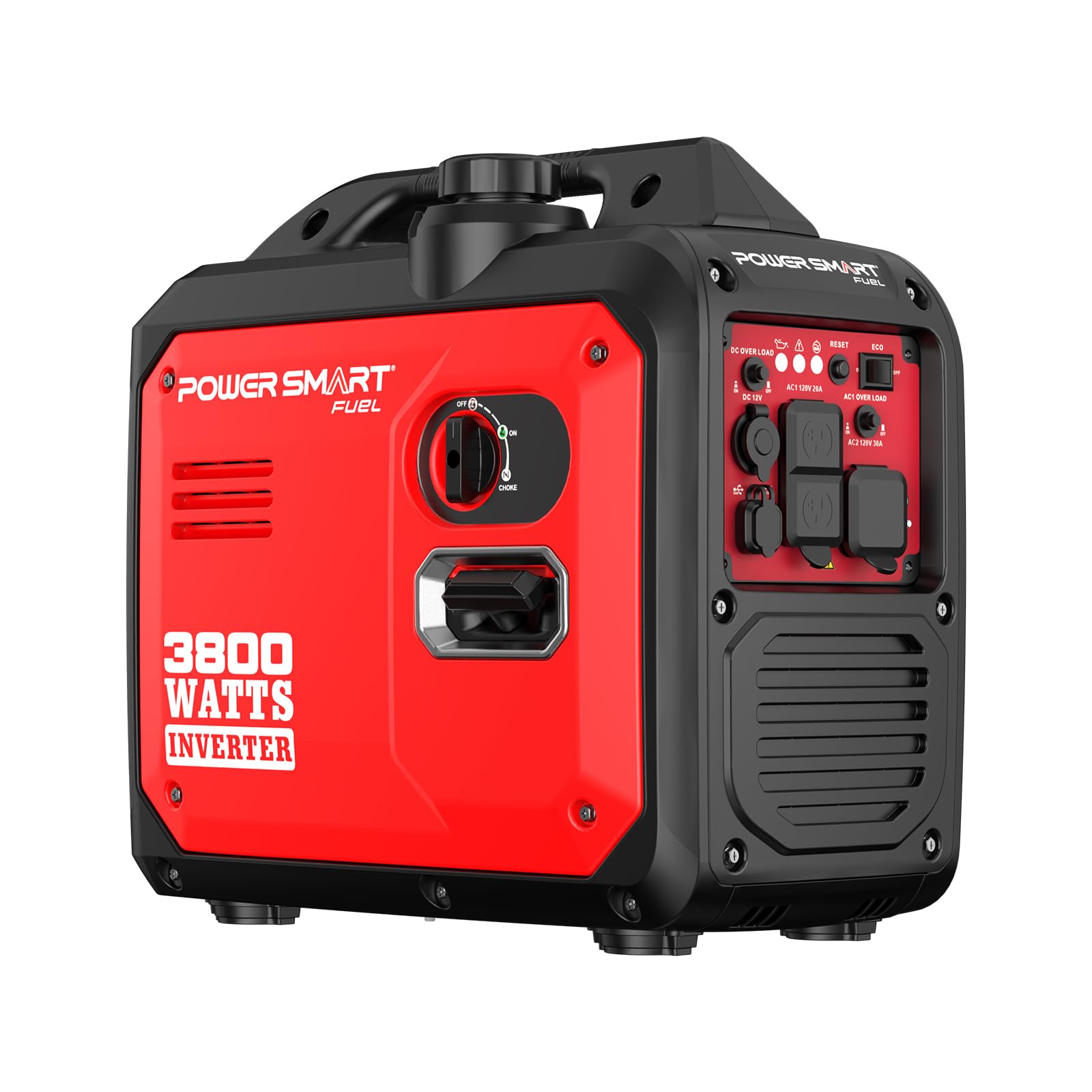
PowerSmart delivers a strong value proposition with 3800 starting watts and 3200 rated watts from a 143cc 4-stroke OHV engine, all at a weight of just 52 pounds. The 59 dBA noise rating keeps campsite neighbors happy, and the 1.19-gallon fuel tank provides up to 4.5 hours of runtime at 50% load. The red chassis features an ergonomic handle that makes carrying this unit to and from the truck bed straightforward.
Real-world owners living off-grid report this generator as their sole power source, running lights, TVs, and even air conditioners with stable sine wave output under 3% total harmonic distortion. The parallel-ready capability allows pairing two units for double the output, though the parallel kit is sold separately. Outlet configuration includes two 120V 26.7A AC receptacles and a 5V USB port.
Several users note the generator started on the first pull straight out of the box with no break-in fuss. The included wheels and handle kit simplify movement across flat terrain. For campers who need reliable 3200-watt output without paying a premium for a name brand, the PowerSmart offers an excellent cost-to-performance ratio backed by a 2-year warranty.
Why it’s great
- Strong 3200W rated output from a lightweight 52-pound frame
- First-pull start reported by multiple owners
- Parallel-ready for future power expansion
Good to know
- Only 4.5 hours runtime at 50% load
- USB port limited to 5V output
6. AIVOLT 4300W Inverter Generator
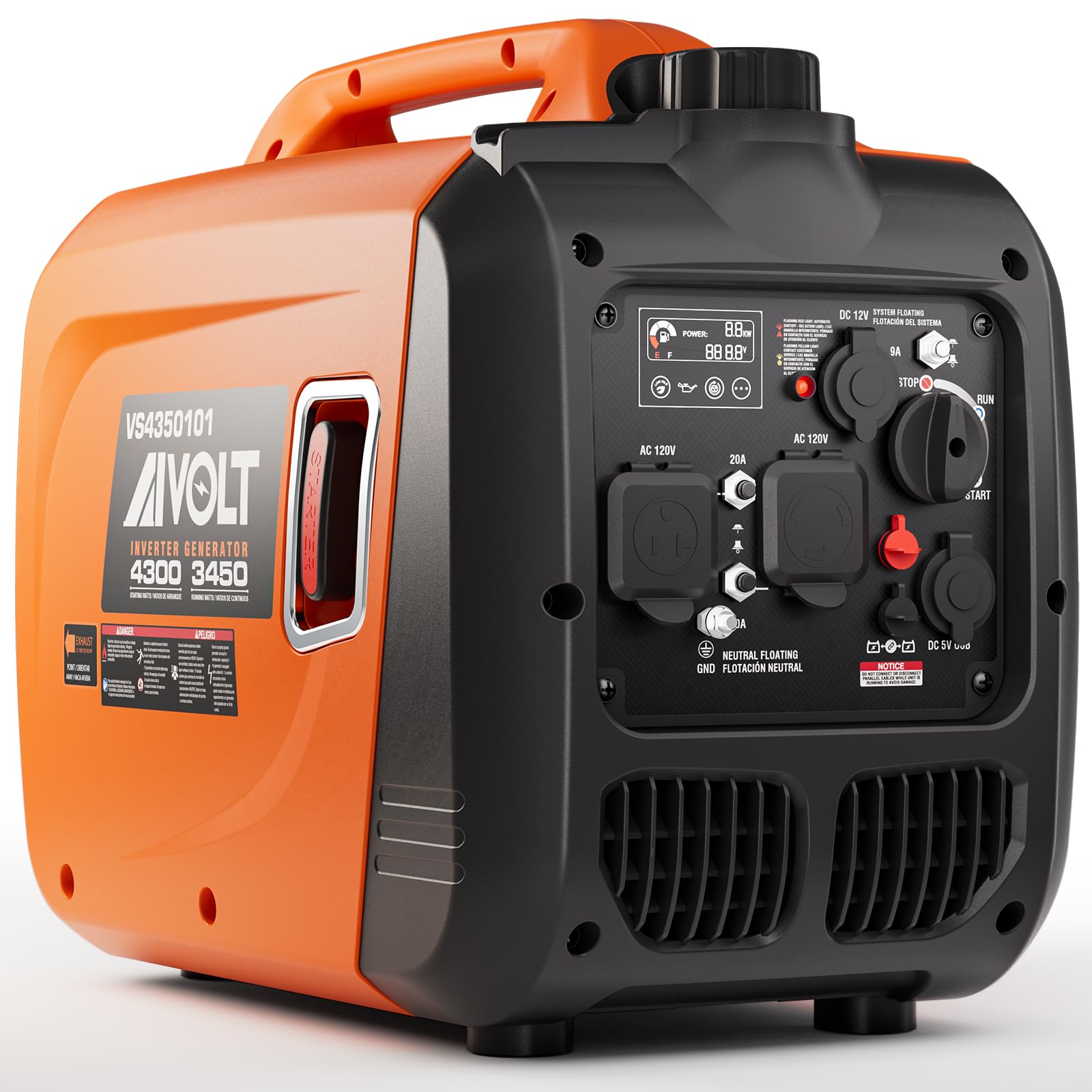
AIVOLT integrates advanced safety and monitoring features into a 50.7-pound inverter generator delivering 4300 starting watts and 3450 running watts from a 149cc copper winding engine. The 5-in-1 LCD display shows oil level, fuel level, overload warnings, and current operating status, while the CO Alert technology automatically shuts the generator down if carbon monoxide reaches dangerous levels. The eco switch extends runtime to over 5.5 hours at 25% load.
Quiet operation at 60 dBA from 23 feet makes this unit suitable for campgrounds with noise restrictions. The control panel includes a 120V 20A outlet, a 120V 30A locking outlet, a 12V DC outlet, and both Type-A and Type-C 5V USB ports. Owners running 400W portable air conditioners in tents report smooth operation, though some note the generator requires a cool-down period of up to an hour before restarting if shut down hot.
The 149cc engine features an electric start ignition system for push-button convenience, with a recoil backup. Dimensions of 21.45 x 13.78 x 18.7 inches make it roughly 10% smaller than comparable models. A small but notable fraction of users experienced failures within the first few hours, and customer support is based overseas, which may complicate warranty claims for some buyers.
Why it’s great
- Comprehensive LCD display for real-time monitoring
- CO Alert auto shutoff for enhanced safety
- Electric start with recoil backup
Good to know
- Some units require long cool-down restart times
- International customer support may delay warranty service
7. WEN Quiet 3600W Dual Fuel Inverter Generator (DF360iX)

WEN offers the flexibility of both gasoline and propane operation in this 49-pound inverter generator, delivering 3600 surge watts and 2900 rated watts on gasoline, or 3500 surge watts and 2600 rated watts on propane. The 149cc engine runs exceptionally quiet — owners consistently compare the noise to a normal conversation. The built-in fuel shutoff drains the carburetor before shutdown to prevent varnish buildup from ethanol gas, a common cause of small-engine failures.
The control panel displays volts, frequency, runtime, load percentage, and fuel level, giving you full situational awareness at a glance. The tool-free LPG quick-connector makes switching between fuel sources effortless at the campsite. Included are two three-prong 120V receptacles, one TT-30R RV receptacle, one 12V DC outlet, and two USB ports. The CO Watchdog sensor automatically shuts the engine down if dangerous carbon monoxide levels are detected.
Owners praise the competitive price point for a dual-fuel inverter with a 3-year warranty. One user noted that the box arrived damaged with a broken propane regulator, but WEN replaced the part promptly — a positive sign of customer support responsiveness. The only recurring complaint involves the 120V outlets holding plugs somewhat loosely, which can be an annoyance when running heavy loads that tend to pull on cords.
Why it’s great
- Instant dual-fuel switching without conversion kits
- Informative digital display with runtime feedback
- 49-pound weight is very manageable for campground setup
Good to know
- 120V outlets may hold plugs loosely
- Propane output drops to 2600 rated watts
8. Jackery Explorer 2000 v2 Portable Power Station

The Jackery Explorer 2000 v2 is a pure battery power station that produces zero emissions and operates at near-silent levels under 30 dB — perfect for campers who cannot tolerate any engine noise. With 2042Wh of LiFePO4 battery capacity and 2200W of AC output, it can run a medium-sized RV refrigerator for over 21 hours or power CPAP machines, medical devices, and electronics for multiple nights without recharging.
The Cell-to-Body (CTB) technology, borrowed from electric vehicle manufacturing, makes this unit 41% lighter and 34% smaller than typical 2kWh LiFePO4 power stations at just 39.5 pounds. AC fast charging brings the unit from 0 to 80% in 66 minutes, and solar charging with 400W panels achieves full charge in approximately 6 hours. The 20ms uninterruptible power supply (UPS) switching ensures critical devices never lose power when the grid flickers.
Owners report excellent build quality and reliable Bluetooth connectivity through the Jackery app for remote monitoring. The three AC ports, two USB-C PD 100W ports, and multiple DC outlets handle most camper electronics. The primary limitation is the total capacity: high-draw appliances like air conditioners will drain the battery quickly. For campers who already own solar panels or primarily need clean silent power for electronics and refrigeration, this is an ideal companion or sole power source.
Why it’s great
- Utterly silent operation with no exhaust fumes
- 39.5-pound weight with CTB EV technology
- UPS backup switching under 20ms
Good to know
- Limited runtime for high-wattage AC loads
- Solar charging requires separate panel purchase
9. Yamaha EF2200iS Inverter Generator
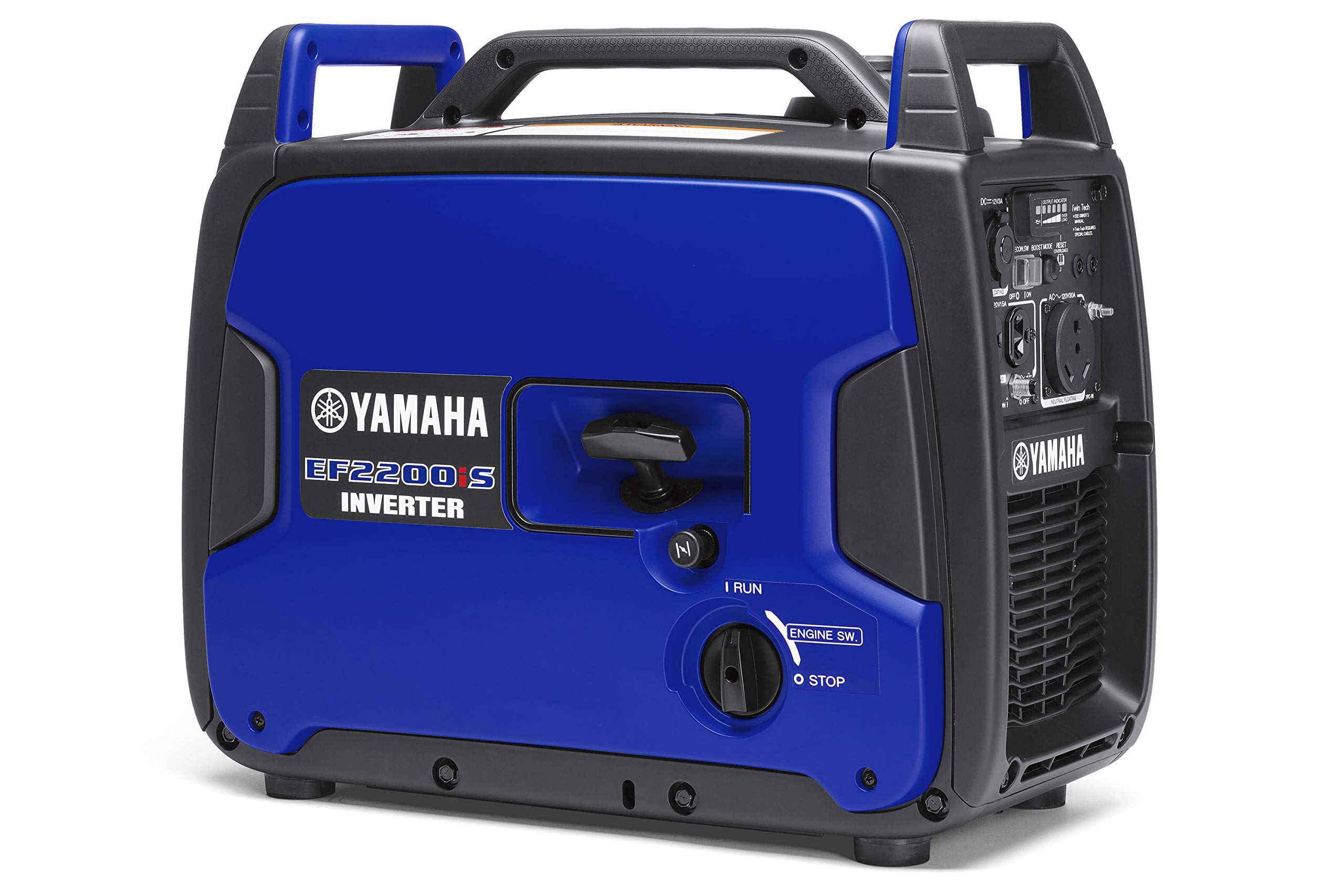
The Yamaha EF2200iS pairs a proven 79cc 4-stroke engine with Yamaha Quiet Technology to deliver 2200 peak watts and 1800 rated watts at a measured noise level that stays unobtrusive throughout the day. The Smart Dial knob simplifies startup to a single intuitive motion, and the Smart Throttle automatically adjusts engine speed to match the connected load, improving fuel economy during light use. The illuminated multi-function LED display shows output status and maintenance reminders in both daylight and darkness.
Owners report this unit powers RV essentials — including 110V water heaters, small TVs, CPAP machines, and refrigerators — on roughly 1 gallon of gasoline per day. The cast iron cylinder liner improves longevity compared to aluminum-sleeved engines, and the built-in fuel pump allows gravity-independent operation for flexible fuel container placement. The standard 30A RV outlet eliminates the need for adapters, and a DC outlet provides battery charging flexibility.
At 55.2 pounds, it is slightly heavier than some competitors in its wattage class, but the built-in handle and balanced frame make it manageable for one person. Some owners note it runs well with a 9,200 BTU RV air conditioner without stalling. For campers who prioritize a strong dealer network and decades of engine expertise over absolute peak wattage, the Yamaha offers proven reliability that retains resale value exceptionally well.
Why it’s great
- Cast iron cylinder liner for extended engine life
- Smart Dial and Smart Throttle for intuitive control
- Excellent fuel economy at 1 gallon per day
Good to know
- 55.2 pounds is heavier than some 2200W rivals
- Limited to 1800 rated watts for high-draw appliances
10. Honda EU2200ITAN1 2200-Watt Companion Inverter Generator
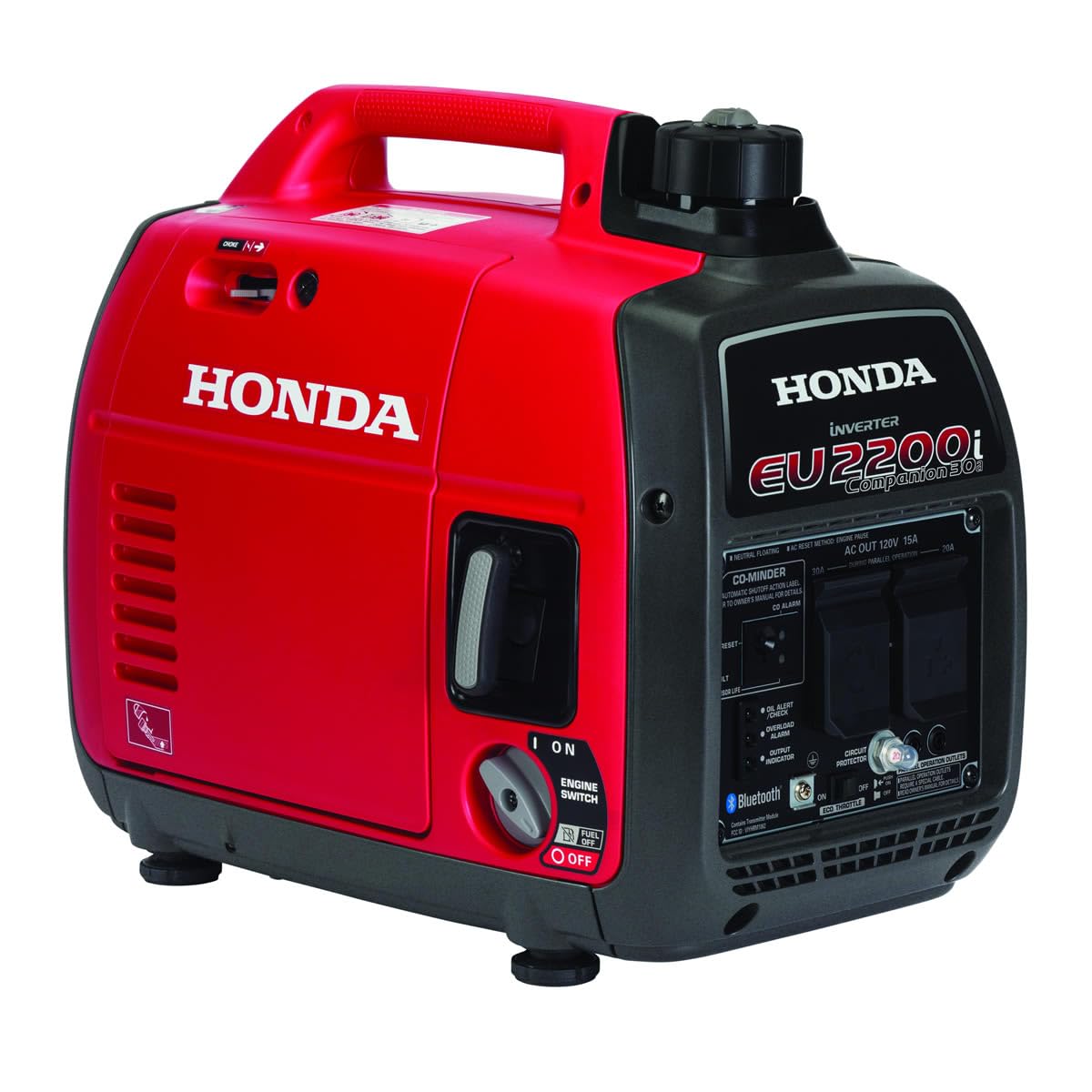
The Honda EU2200ITAN1 represents the gold standard for portable inverter generators, operating at an industry-leading 50 dBA noise level while producing 2200 maximum watts and 1800 rated watts. The 208cc Honda GX-series engine is renowned for starting instantly even after months of storage and running for days on end without hesitation. The CO-Minder system continuously monitors carbon monoxide buildup and automatically shuts down the generator if levels become dangerous.
Owners consistently describe the build quality as exceptional, with tight panel gaps, robust switches, and a metal frame that withstands years of camping abuse. The 1.1-gallon fuel tank provides up to 8.8 hours of runtime at 25% load, making it one of the most fuel-efficient options in its class. The companion model features a streamlined control panel with a single 120V 20A outlet and a 120V 30A TT-30R RV outlet, plus a DC receptacle for battery charging.
The 51-pound dry weight is manageable for most campers, and the recessed handles provide multiple lifting options. The primary tradeoff is price — the Honda commands a significant premium over competitors with similar wattage ratings. For campers who run critical medical equipment or who demand absolute reliability in remote locations, the Honda EU2200ITAN1 is an investment that typically lasts for a decade or more of regular use.
Why it’s great
- Industry-best 50 dBA operation for silent camping
- Honda GX engine legendary for long-term reliability
- 8.8 hours runtime at 25% load on 1.1 gallons
Good to know
- Premium price point is significantly above competitors
- Only 1800 rated watts limits high-draw appliances
11. Cummins Onan P4500I Portable Inverter Generator
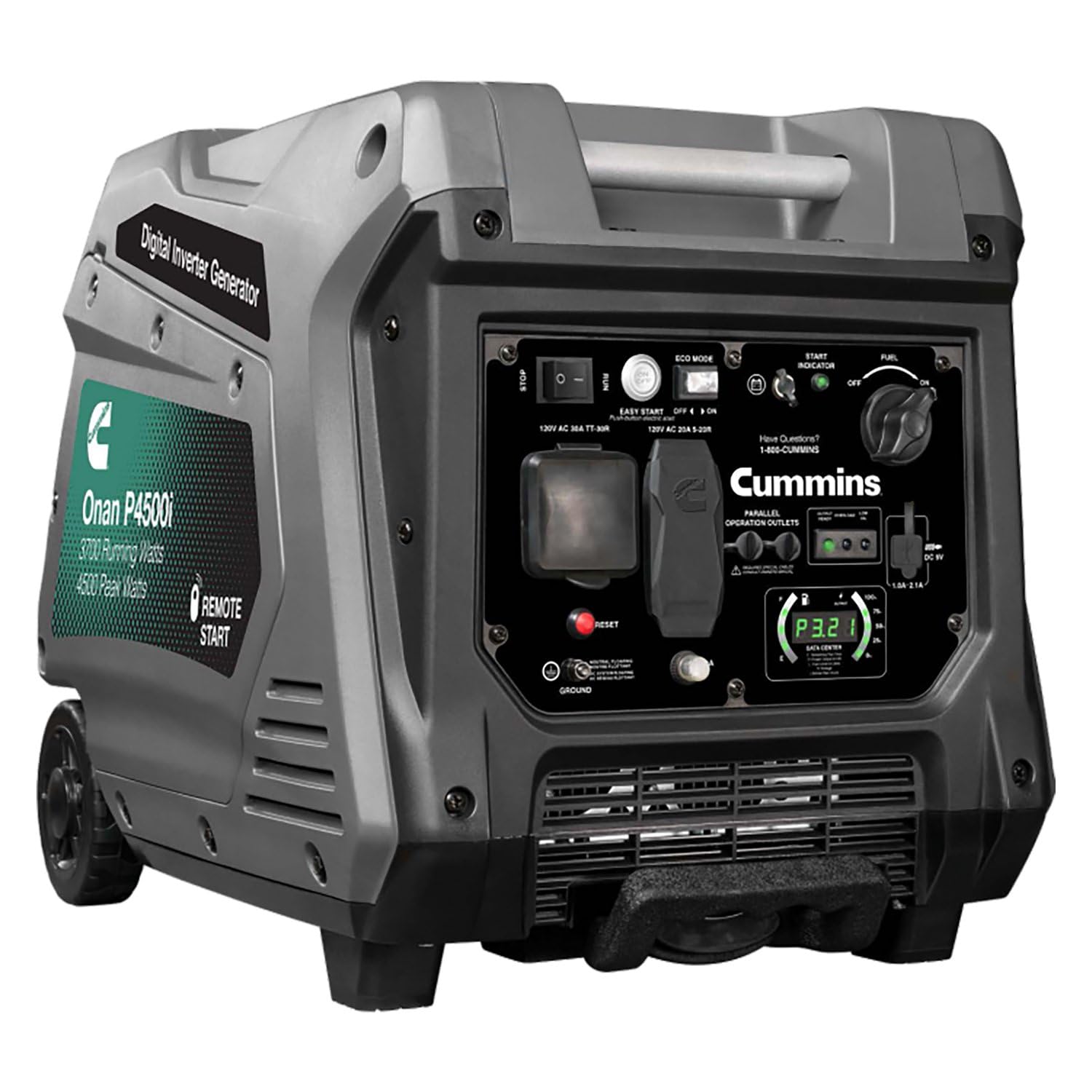
The Cummins Onan P4500I combines a robust 224cc OHV 4-stroke engine with remote start capability, generating 4500 peak watts and 3700 rated watts for serious RV power demands. The remote start feature lets you turn the generator on from inside your camper — a major convenience on cold mornings or during rain. The push button start on the unit itself complements the remote with a backup recoil cord, ensuring you can always get the engine running.
Owners consistently praise the quiet operation at campsites, noting the generator doesn’t disturb neighboring campers even during extended overnight use. The 30A TT-30R outlet connects directly to most RV power inlets, while dual 5V USB ports keep mobile devices charged. The parallel capability allows connecting a second P4500I for up to 50A output. The luggage-style handle makes the 98-pound unit manageable on gravel terrain, though it is the heaviest generator in this review.
Voltage stability under load is excellent, with multiple users reporting a steady 120V output even when running air conditioners and microwaves simultaneously. The oil change requires some dexterity due to the panel alignment with the drain plug, but routine maintenance is otherwise straightforward. For RV owners who want the convenience of remote starting and the power to run any camper appliance without compromise, the Cummins Onan P4500I delivers in a class of its own.
Why it’s great
- Remote start for effortless activation from inside the RV
- 4500 peak watts handles the largest RV loads
- Parallel capable for 50A output
Good to know
- 98-pound weight requires careful lifting and rolling
- Oil drain plug access is tight for maintenance
FAQ
How do I calculate the right generator wattage for my camper?
What is the quietest generator for campgrounds with strict noise limits?
Can I run my RV air conditioner on a dual-fuel generator using propane?
Is a battery power station like the Jackery enough for a weekend camping trip?
What does parallel capability mean for camper generators?
Final Thoughts: The Verdict
For most campers, the best camper generator is the Champion 4000-Watt because it delivers class-leading power-to-weight ratio, reliable CO safety features, and proven real-world performance running RV air conditioners. If you want whisper-quiet operation and dual-fuel flexibility for easy fuel storage, grab the Westinghouse 2550W. And for zero-emission silent camping with no fuel to haul, nothing beats the Jackery Explorer 2000 v2 battery station paired with solar panels.

Mo Maruf
I created WellFizz to bridge the gap between vague wellness advice and actionable solutions. My mission is simple: to decode the research and give you practical tools you can actually use.
Beyond the data, I am a passionate traveler. I believe that stepping away from the screen to explore new environments is essential for mental clarity and physical vitality.