Our readers keep the lights on and my smoothie glass nicely filled. As an Amazon Associate, I earn from qualifying purchases.
Wood veneer is beautiful precisely because it is thin — and that thinness creates a unique bonding challenge. Too much clamp pressure and the veneer cracks. The wrong glue seeps through and stains the face. A weak adhesive lets the edge lift after a season of humidity shifts. The adhesive you choose must grab fast enough to hold the sheet flat, yet remain flexible enough to accommodate the natural movement of the substrate beneath it. That balance separates a flawless lamination from a frustrating delamination.
I’m Mohammad Maruf — the founder and writer behind WellFizz. I’ve spent years analyzing the adhesive chemistry that matters most for veneer work: open time, viscosity, heat resistance, and bond strength relative to wood fiber failure, so you can pick the glue that eliminates clamp time without sacrificing durability.
Whether you are a professional cabinetmaker laying sheets on MDF or a hobbyist repairing a chipped edge on an heirloom piece, this guide to the best adhesive for wood veneer will help you match the right formula to your specific project and workspace.
How To Choose The Best Adhesive For Wood Veneer
Veneer adhesives are not interchangeable. The best glue for a bentwood project is the worst glue for a flat desktop lamination. You need to match three variables: the size of the surface, the time you have before the bond locks, and whether you want a rigid or slightly flexible joint.
Set Time vs. Open Time
Set time is how fast the bond becomes immovable; open time is how long you can slide the veneer into position before the glue grabs. Cyanoacrylate (CA) glues set in 2–18 seconds, which is ideal for small edge repairs but brutally unforgiving for a full 24-inch-wide sheet. Contact cements and spray adhesives offer 10–60 minutes of open time, giving you the window to align and roller the veneer flat without panic.
Viscosity and Wickability
Thin CA glue (water-like consistency) wicks into microfractures in the substrate and soaked-in veneer fibers, creating a bond that is stronger than the wood itself. Thicker gel or thick CA fills gaps in uneven substrates but can leave a visible line if too much is applied. For veneer delaminating from a solid core, thin glue is the only option that will penetrate the gap without bulging.
Heat and Moisture Resistance
Contact cements rated for 250°F won’t soften under hot coffee cups or summer attic heat. Standard super glues break down around 180°F — fine for trim, risky for a kitchen island. Moisture resistance matters if the veneer is near a sink. Look for waterproof-rated contact cement or a CA glue labeled as water-resistant for those applications.
Quick Comparison
On smaller screens, swipe sideways to see the full table.
| Model | Category | Best For | Key Spec | Amazon |
|---|---|---|---|---|
| Titebond Instant Bond Wood Adhesive Thick | CA Glue (Gel) | No-clamp edge repairs, small parts | 18-second full cure, bonds stronger than wood | Amazon |
| Clear-Tite Contact Cement | Contact Cement | Countertops, tabletops, medium laminations | 250°F heat resistant, waterproof, 24hr full cure | Amazon |
| Starbond Super Fast Thin CA Glue Pro Kit | CA Glue (Thin) | Wicking into cracks, stabilizing veneer flaws | 2-3 second set, thin viscosity wicks into joints | Amazon |
| DAP Weldwood Instant Adhesive | CA Glue (Gel) | Repositionable bond for quick wood joints | 30-minute cure, 3-minute reposition window | Amazon |
| 3M Hi-Strength 94 ET Spray Adhesive | Spray Adhesive | Full-sheet large surface laminations | 60-minute open time, low VOC, GREENGUARD certified | Amazon |
In‑Depth Reviews
1. Titebond Instant Bond Wood Adhesive Thick, 2 oz

The Titebond Instant Bond is a thick cyanoacrylate gel engineered specifically to eliminate clamping on wood repairs. The gel formula stays where you put it without dripping down vertical surfaces, making it ideal for edge banding and corner repairs on veneer panels.
With a full cure time of only 18 seconds, this glue demands precise alignment before application — there is zero forgiveness. The attached applicator nozzle dispenses controlled drops and reduces waste, a notable advantage over tube-style super glues that polymerize inside the cap. Customers note that it swells slightly as it dries, which fills hairline gaps but also means you cannot slide the piece after contact.
The bond strength exceeds the tensile strength of the wood itself, meaning the joint will break before the glue line fails. This is the adhesive to grab when you need a permanent, heat- and solvent-resistant fix on a broken corner or loose veneer edge and you do not want to wait for PVA glue to cure overnight.
Why it’s great
- Bonds stronger than wood fiber; joint will not fail before the wood
- Thick gel does not run or drip on vertical applications
- Excellent heat and solvent resistance for long-term durability
Good to know
- 18-second set time leaves no room for repositioning — align perfectly the first time
- Gap-filling thickness means it will not wick into hairline cracks below the surface
2. Clear-Tite Contact Cement, 4 oz can

Clear-Tite is a neoprene-based contact cement that maintains its bond at temperatures up to 250°F, making it the go-to formula for veneer on kitchen countertops or desktops exposed to heat. Apply it to both surfaces, let it dry to the touch (roughly 10 minutes), and then press the veneer down — the bond grabs immediately and permanently.
The 4-ounce can includes a brush in the cap, which is convenient for small jobs like a tabletop edge or a cabinet face. The liquid formula is low-viscosity, so it soaks into porous substrates like particle board and MDF, creating a mechanical lock rather than just a surface stick. Professional cabinet shops have relied on this exact formula for decades because the bond does not creep under load.
Note that the dried adhesive is a transparent yellow, not completely water-clear as the name implies. It is fully waterproof once cured, so it will not fail if the veneer edge is exposed to splashes. For any veneer project that will see daily use, heat, or moisture, this contact cement is the reliable workhorse.
Why it’s great
- Withstands 250°F without softening — safe for countertops near appliances
- Bonds to a wide variety of substrates including metal, glass, and ceramics
- Waterproof after full 24-hour cure
Good to know
- Dries translucent yellow rather than clear — may show on very light veneers
- Requires application to both surfaces before pressing, adding a step to the workflow
3. Starbond Super Fast Thin CA Glue Pro Kit, 2 oz
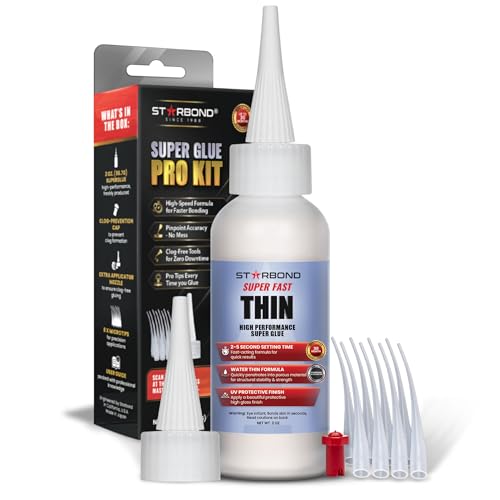
The Starbond Thin CA glue has the consistency of alcohol — it wicks into the tiniest hairline gaps and capillary-action into microfractures that thicker glues cannot reach. Woodturners and furniture restorers use it to stabilize soft spots in veneer or to bond delaminated layers where the glue has to flow into the gap, not sit on top of it.
The Pro Kit includes precision microtips and a pin cap that prevents the nozzle from clogging after repeated use — a common failure point on cheaper CA glues. The 2-3 second set time is genuinely fast, but the thin viscosity means you need a very tight joint for the bond to hold its full strength; it will not fill a 1/16-inch gap without being absorbed. Customers specifically praise its ability to stabilize soft stone and wood for carving, validating its penetration power.
For veneer repair, this is the glue you use when a section has lifted and you need to inject adhesive under the sheet without disturbing the surrounding finish. The microtips let you place drops exactly where needed, and the thin formula spreads under the veneer rather than pooling on the surface.
Why it’s great
- Water-thin viscosity wicks into microfractures and under lifted veneer
- Kit includes anti-clog pin cap and precision microtips for controlled application
- 2-3 second set time eliminates need for clamping on tight joints
Good to know
- Not a gap filler — joint must be tight for maximum bond strength
- Thin consistency runs easily; use sparingly or risk glue bleed-through on porous veneer
4. DAP Weldwood Instant Adhesive, 4 oz

The DAP Weldwood offers a unique middle ground in the CA glue category: the bond is repositionable for up to 3 minutes before it locks permanently. That 180-second window is a lifesaver when you are aligning a long strip of veneer edge banding and need to shift it slightly before the glue commits. Most CA glues lock in under 30 seconds, making this a distinct advantage for precision work.
Full cure takes 30 minutes — slower than typical super glues, but still dramatically faster than PVA or contact cement. The ethyl cyanoacrylate formula bonds to ABS, melamine, particle board, and steel in addition to wood, which matters if your veneer is backed with a synthetic substrate. Users consistently note the joint ends up stronger than the wood itself for interior applications.
The 4-ounce bottle delivers significantly more adhesive per application than the 2-ounce competitors, though the bottle cap and applicator tip can degrade with repeated use over several months. For the price per ounce, this is a budget-friendly option that does not compromise on bond strength for general veneer repairs and quick wood joints.
Why it’s great
- 3-minute repositionable window prevents alignment mistakes
- Bonds wood, melamine, particle board, PVC, rubber, and stone
- Larger 4-ounce bottle provides better value per application
Good to know
- Not rated for exterior use or continuous moisture exposure
- Applicator tip and cap may degrade over time with frequent opening/closing
5. 3M Hi-Strength 94 ET Spray Adhesive, 19.75 oz
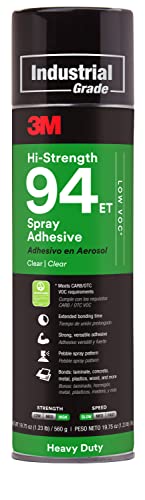
The 3M 94 ET is the only spray adhesive on this list, and it exists for a simple reason: nothing else covers a 4×8-foot sheet of veneer evenly and quickly. The fan spray pattern lays down a consistent layer of epoxy-based adhesive that has 60 minutes of open time, giving you an entire hour to position large sheets, roll them flat, and trim overhang without the glue flashing off.
The aggressive tack grabs immediately on contact, yet remains repositionable during the open window — a balance that contact cement in a can cannot match because it grabs the moment the two coated surfaces touch. The spray is low-VOC and GREENGUARD certified, so it contributes to LEED credits and is safer for indoor use than traditional spray adhesives (though ventilation is still required).
This is the premium choice for laminating full panels, reupholstering veneer-backed foam, or bonding metal-backed veneer to cabinetry. One can typically lasts a hobbyist about 18 months. The strong solvent smell demands a mask and open windows, but the bond durability and the flexible joint it creates make it the undisputed choice for large-surface veneer work.
Why it’s great
- 60-minute open time allows precise positioning on large sheets
- Aggressive tack with flexible bond that handles substrate movement
- Low-VOC and GREENGUARD certified for safer indoor application
Good to know
- Strong solvent odor requires ventilation and respiratory protection
- Not ideal for small spot repairs — overspray wastes product on tiny jobs
FAQ
Can I use standard super glue on wood veneer?
Does contact cement work for thin paper-backed veneer?
Final Thoughts: The Verdict
For most users, the best adhesive for wood veneer winner is the Titebond Instant Bond Wood Adhesive Thick because it eliminates clamp time, bonds stronger than the wood, and handles both edge repairs and small laminations with no mess. If you need to lay a full sheet of veneer on a desktop, grab the 3M Hi-Strength 94 ET Spray Adhesive for its unmatched 60-minute open time and uniform coverage. And for precision wicking into lifted veneer edges or stabilizing hairline cracks, nothing beats the Starbond Super Fast Thin CA Glue Pro Kit.

Mo Maruf
I created WellFizz to bridge the gap between vague wellness advice and actionable solutions. My mission is simple: to decode the research and give you practical tools you can actually use.
Beyond the data, I am a passionate traveler. I believe that stepping away from the screen to explore new environments is essential for mental clarity and physical vitality.