Our readers keep the lights on and my smoothie glass nicely filled. As an Amazon Associate, I earn from qualifying purchases.
A dead camper battery doesn’t just mean the lights go out—it means the water pump stops, the fridge warms up, and your entire off-grid setup becomes a box of metal and plastic. The chemistry you choose for your power bank dictates not only how many nights you can stay out but also how much weight your suspension carries and whether you need to babysit a charge controller every morning.
I’m Mohammad Maruf — the founder and writer behind WellFizz. I’ve spent years analyzing battery chemistry, BMS topologies, and real-world capacity data from camper owners who push their systems to the limit every season.
Whether you’re outfitting a tiny teardrop trailer or a full-size fifth wheel, this guide breaks down the exact trade-offs between lithium iron phosphate and sealed lead-acid batteries to help you find the right best camper battery for your rig and your budget.
How To Choose The Best Camper Battery
Selecting a camper battery is not about picking the highest amp-hour number on a spec sheet. The chemistry determines weight, lifespan, depth of discharge, and how much solar energy you can actually store. Three main factors separate a good fit from a constant headache.
Chemistry and usable capacity
Lead-acid batteries (flooded or AGM) only allow a 50 percent depth of discharge without damaging the cells. A 100Ah AGM battery gives you roughly 50Ah of usable energy. LiFePO4 lithium batteries allow 80 to 100 percent depth of discharge, meaning a 100Ah lithium battery delivers two to three times more usable power than the same rated amp-hours in lead-acid. If you run a 12V fridge, LED lights, and a water pump overnight, that difference decides whether you wake up to a warm cooler or a fully functional kitchen.
Weight and physical fitment
A standard 100Ah AGM battery weighs around 60 pounds. A similar-capacity LiFePO4 unit weighs about 20 to 24 pounds. If your camper has a tongue weight limit or a slide-out tray, every pound matters. Terminal location also varies between Group 24, Group 27, and Group 31 case sizes. Measure your existing tray depth and terminal clearance before ordering — a battery that fits the spec sheet but not the compartment is useless.
BMS features and charging compatibility
Lithium batteries rely on an internal Battery Management System (BMS) to prevent overcharge, over-discharge, and thermal runaway. Some BMS units include Bluetooth monitoring so you can check state of charge from your phone. Others offer low-temperature charging cutoff to protect cells below freezing. Make sure your converter or solar charge controller has a lithium profile — lead-acid chargers may never fully charge a LiFePO4 battery or could trigger the BMS protection prematurely.
Quick comparison
On smaller screens, swipe sideways to see the full table.
| Model | Category | Best For | Key Spec | Amazon |
|---|---|---|---|---|
| Battle Born BB10012 | LiFePO4 | Long-term full-time RV living | 31 lbs, 100Ah, 10-year warranty | Amazon |
| ECO-WORTHY 280Ah | LiFePO4 | High-capacity off-grid solar systems | 68.5 lbs, 280Ah, metal case | Amazon |
| Renogy Core Mini 100Ah | LiFePO4 | Tight compartments and teardrop trailers | 22.7 lbs, 9.02 x 5.43 x 8.39 in | Amazon |
| Litime 12V 100Ah TM | LiFePO4 | Trolling motor and marine camper use | 22.16 lbs, ABYC E-13 compliant | Amazon |
| GOLDENMATE 12V 400Ah | LiFePO4 | Massive single-battery energy storage | 88.18 lbs, 5120Wh, 200A charge | Amazon |
| Power Queen 12V 100Ah | LiFePO4 | Budget-conscious lithium upgrade | 24.25 lbs, Group 31, 15000 cycles | Amazon |
| CYCLENBATT 100Ah Mini BT | LiFePO4 | Bluetooth monitoring in a small footprint | 20.83 lbs, 46% smaller than G31 | Amazon |
| DUMFUME 12V 150Ah | LiFePO4 | High amp-hours on a budget | 22.05 lbs, 1920Wh, 5-year warranty | Amazon |
| WEIZE 12V 100Ah AGM | AGM | Entry-level camper or backup power | 63 lbs, maintenance-free, spill-proof | Amazon |
In‑depth reviews
1. Battle Born Batteries 100Ah LiFePO4
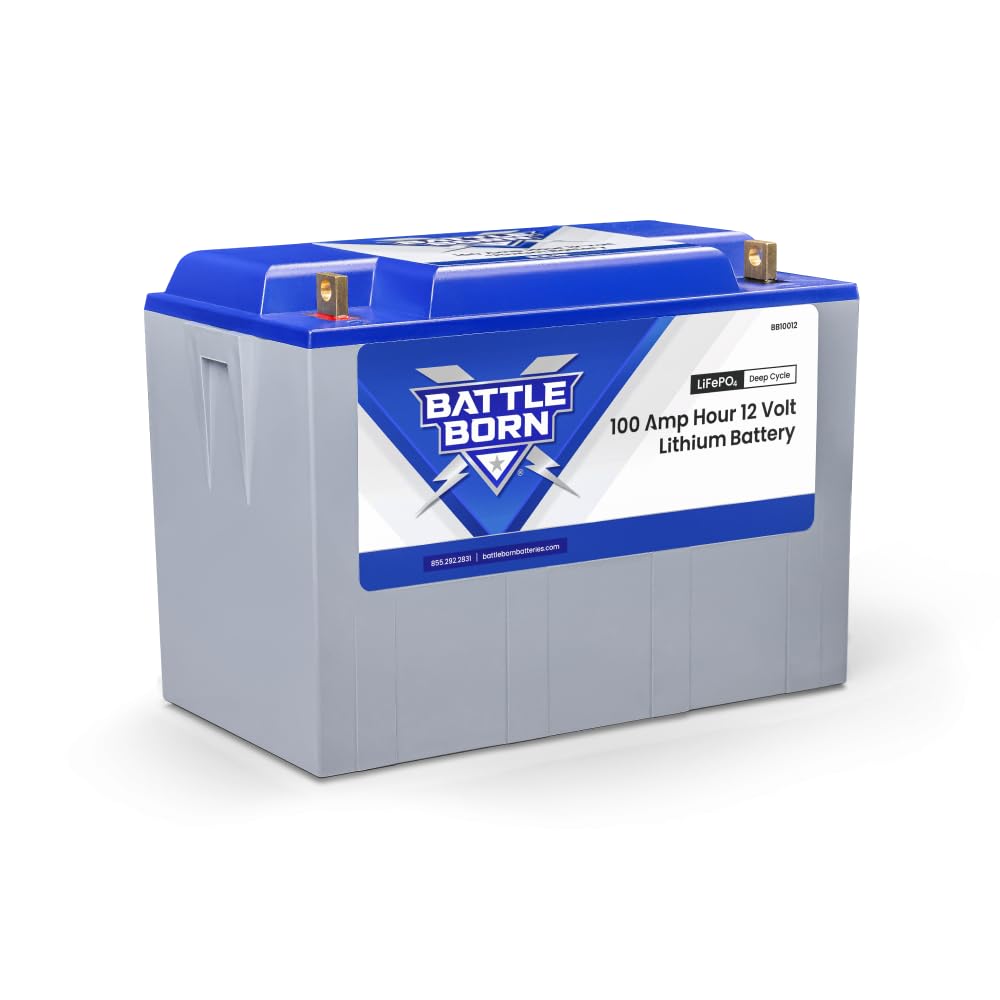
Battle Born’s BB10012 has been the benchmark for drop-in lithium camper batteries for years. At 31 pounds, it saves roughly 60 to 70 pounds compared to an equivalent AGM setup, which directly reduces tongue weight and improves fuel economy on long hauls. The internal BMS includes low-temperature charging cutoff, preventing damage when you store the camper through a winter freeze.
The 3,000 to 5,000 cycle rating means that a full-timer can expect a decade or more of service before capacity degradation becomes noticeable. The side-post terminals match standard Group 27 and 31 trays, so no adapter plates are needed.
Customer reviews highlight the responsive support team — one user received a free replacement after a minor BMS issue at the one-year mark. The main drawback is the upfront cost, which is roughly double that of comparable 100Ah lithium batteries from newer brands. For owners who plan to keep their rig for years and want US-based support, the price premium buys peace of mind.
Why it’s great
- 10-year warranty with proven support track record
- Weighs only 31 lbs, saves significant payload
- Reliable low-temp charging protection included
Good to know
- Premium price well above budget lithium options
- Requires lithium-compatible converter or solar controller
2. ECO-WORTHY 12V 280Ah Metal Case LiFePO4
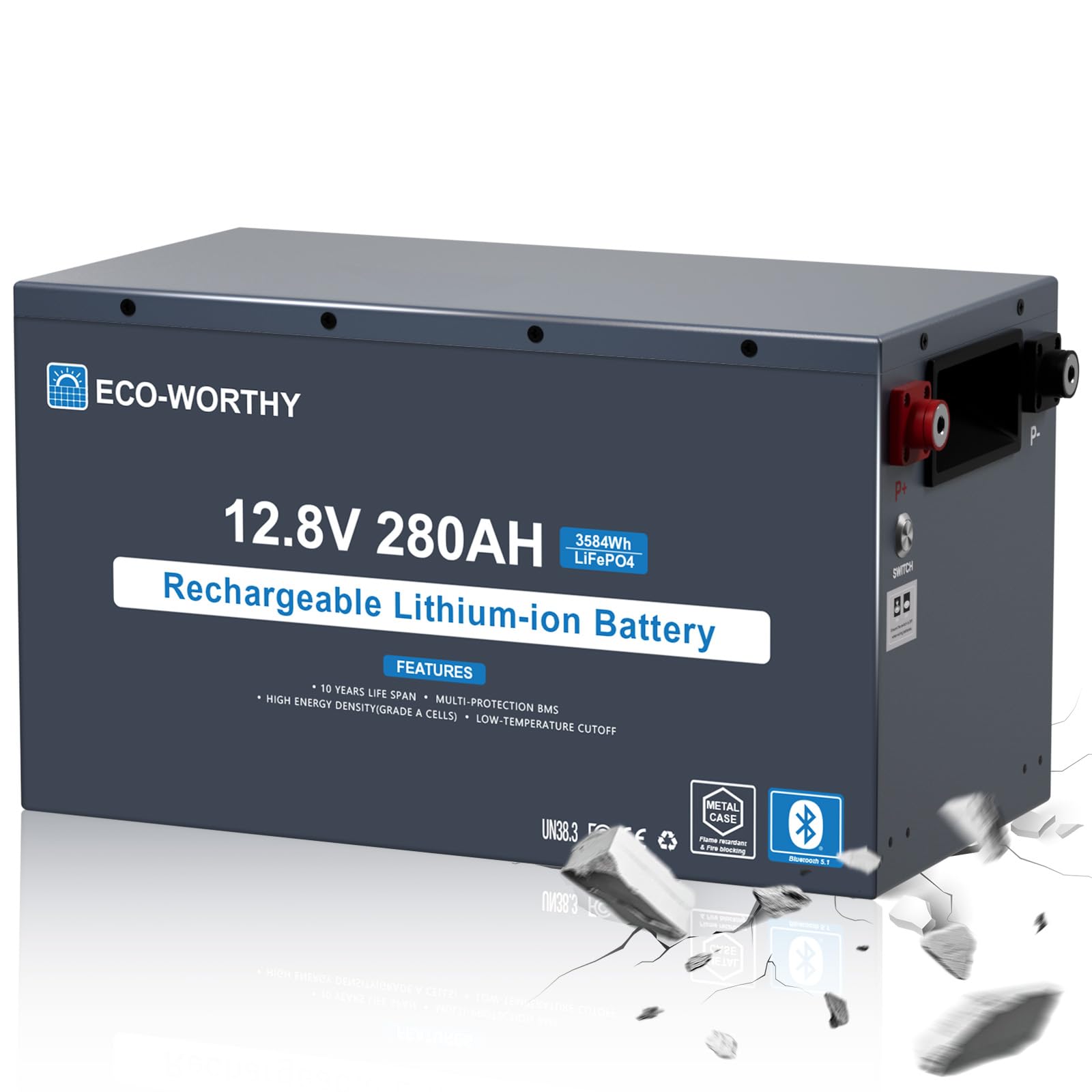
The ECO-WORTHY 280Ah battery delivers 3,584 watt-hours of usable energy in a single unit — enough to run a medium-sized camper’s fridge, lights, water pump, and a 2,000W inverter for several days. The heavy-duty metal enclosure provides fire protection and eliminates the need for a separate battery box, and the four mounting feet bolt directly into the camper floor for a secure fit during rough-road travel.
Built-in Bluetooth monitoring lets you check voltage, state of charge, and temperature from a smartphone app. The 200A BMS can handle high-draw appliances like induction cooktops and microwaves on a 2,000W inverter. Customers report that the battery exceeds its rated capacity when tested with a capacity discharge meter, and the JBD-brand BMS is compatible with third-party monitoring apps for users who want more granular data.
At 68.5 pounds, this battery is not lightweight — it weighs about the same as a 100Ah AGM. But in terms of usable capacity per pound, it outperforms almost any lead-acid configuration. The on-off switch on the front panel simplifies maintenance and isolation during storage. A few users noted that the battery arrived with a partial charge around 25 percent, which is normal for lithium cells but requires an initial full charge before putting it into service.
Why it’s great
- Massive 280Ah capacity in one metal-cased unit
- Bluetooth monitoring with smartphone app
- 200A BMS handles heavy inverter loads
Good to know
- Heavier than multiple smaller lithium batteries
- Mounting bolts included but may need longer hardware for thick floors
3. Renogy 12V 100Ah Core Mini LiFePO4
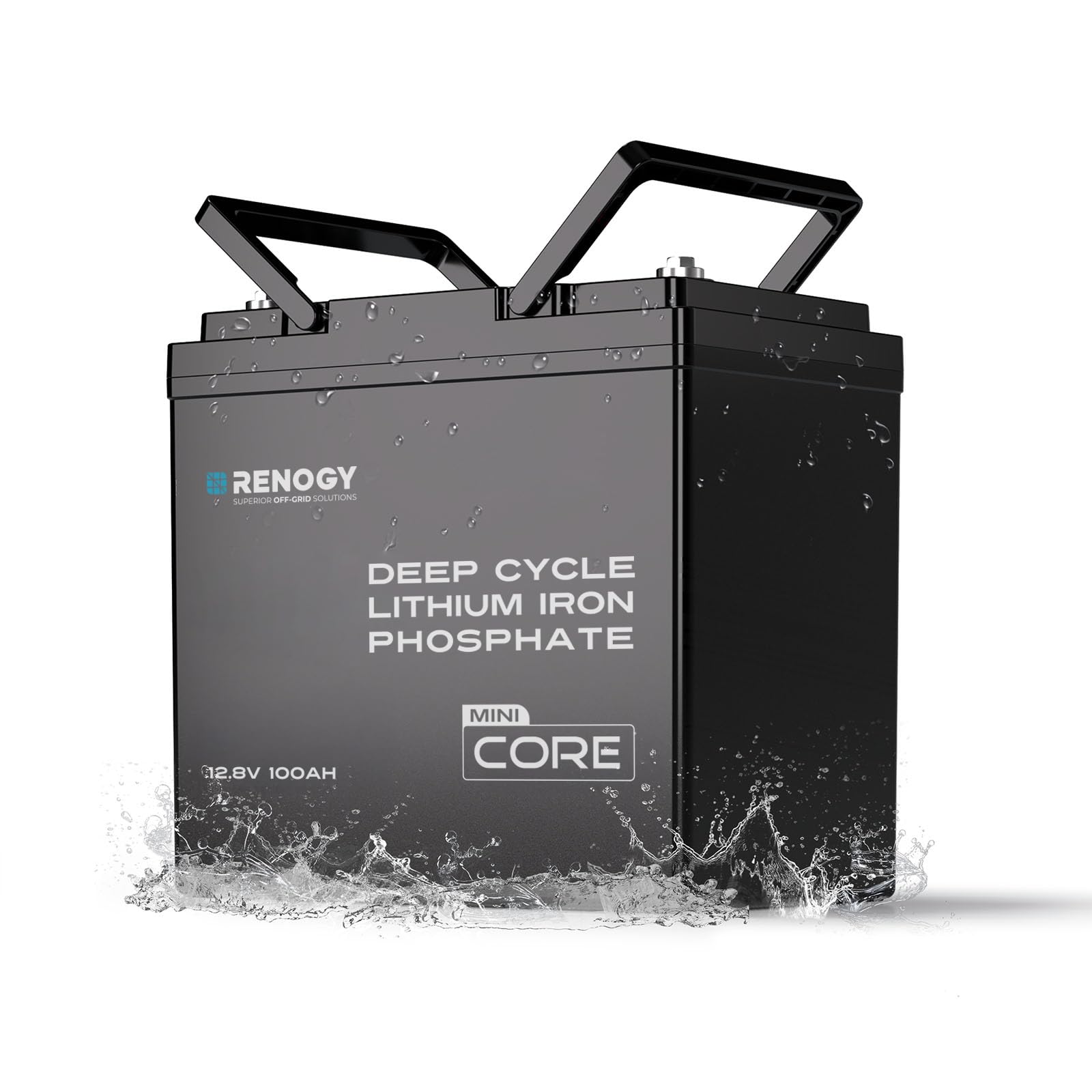
Renogy’s Core Mini series shrinks a 100Ah LiFePO4 battery down to 9.02 x 5.43 x 8.39 inches — roughly 50 percent smaller than a standard Group 31 case. This size fits into teardrop trailers, kayak compartments, and camper van cabinets where every inch of floor space is already claimed. The weight of 22.7 pounds makes it easy to carry one-handed during installation or seasonal removal.
The IP65-rated casing resists splashes and dust, which matters if the battery lives near a leaky window or a vent fan opening. Metallic cell spacers inside the case keep the prismatic cells locked in place during off-road bouncing, preventing internal damage that can lead to premature capacity loss. The 100A BMS covers over-voltage, under-voltage, over-current, and short-circuit protection.
Renogy offers an optional 300A battery shunt that enables Bluetooth monitoring through the DC Home app, so you can check state of charge remotely. Users who already own Renogy solar charge controllers and monitors report seamless integration — the battery communicates with the Renogy ONE display without extra adapters. The trade-off is that the mini size means slightly less capacity than a full-size Group 31 lithium battery, but for space-constrained campers, this is often the only 100Ah option that fits.
Why it’s great
- Extremely compact footprint for tight compartments
- IP65 water and dust resistance rating
- Works with Renogy DC Home monitoring ecosystem
Good to know
- Bluetooth shunt sold separately
- Not compatible with lead-acid chargers without lithium profile
4. Litime 12V 100Ah Trolling Motor LiFePO4

Litime engineered this 100Ah battery specifically for trolling motor applications, but its features translate directly to camper life. The ABYC E-13 standard compliance means it passed marine industry tests for resistance to salt spray, vibration, and water intrusion — all factors that kill standard car batteries in a damp camper battery compartment. The built-in TVS diode absorbs voltage spikes from trolling motor controllers, which also protects sensitive electronics like an RV inverter or a DC-DC charger.
The low-temperature charging protection stops charging below 32°F and discharging below -4°F, which is critical for campers stored in cold climates. At 22.16 pounds, this battery cuts two-thirds of the weight versus a comparably rated lead-acid group 31. Owners of smaller boats and teardrop campers report that the weight savings noticeably improved handling and fuel efficiency. Real-world tests show the battery running a 45-pound thrust trolling motor for eight hours with minimal discharge.
Customer reviews consistently note that the battery arrives at 12.8V or higher, indicating the cells were well-balanced before shipping. The 4,000-cycle rating at 100 percent depth of discharge gives an expected lifespan of about ten years for seasonal use, vastly outlasting the two-to-three-year replacement cycle of typical AGM camper batteries.
Why it’s great
- ABYC E-13 certified for marine and damp environments
- TVS protection against voltage spikes
- Only 22.16 lbs for easy transport and installation
Good to know
- Designed for deep cycle, not starting engine duty
- Flat discharge curve requires a multimeter for accurate state of charge
5. GOLDENMATE 12V 400Ah LiFePO4
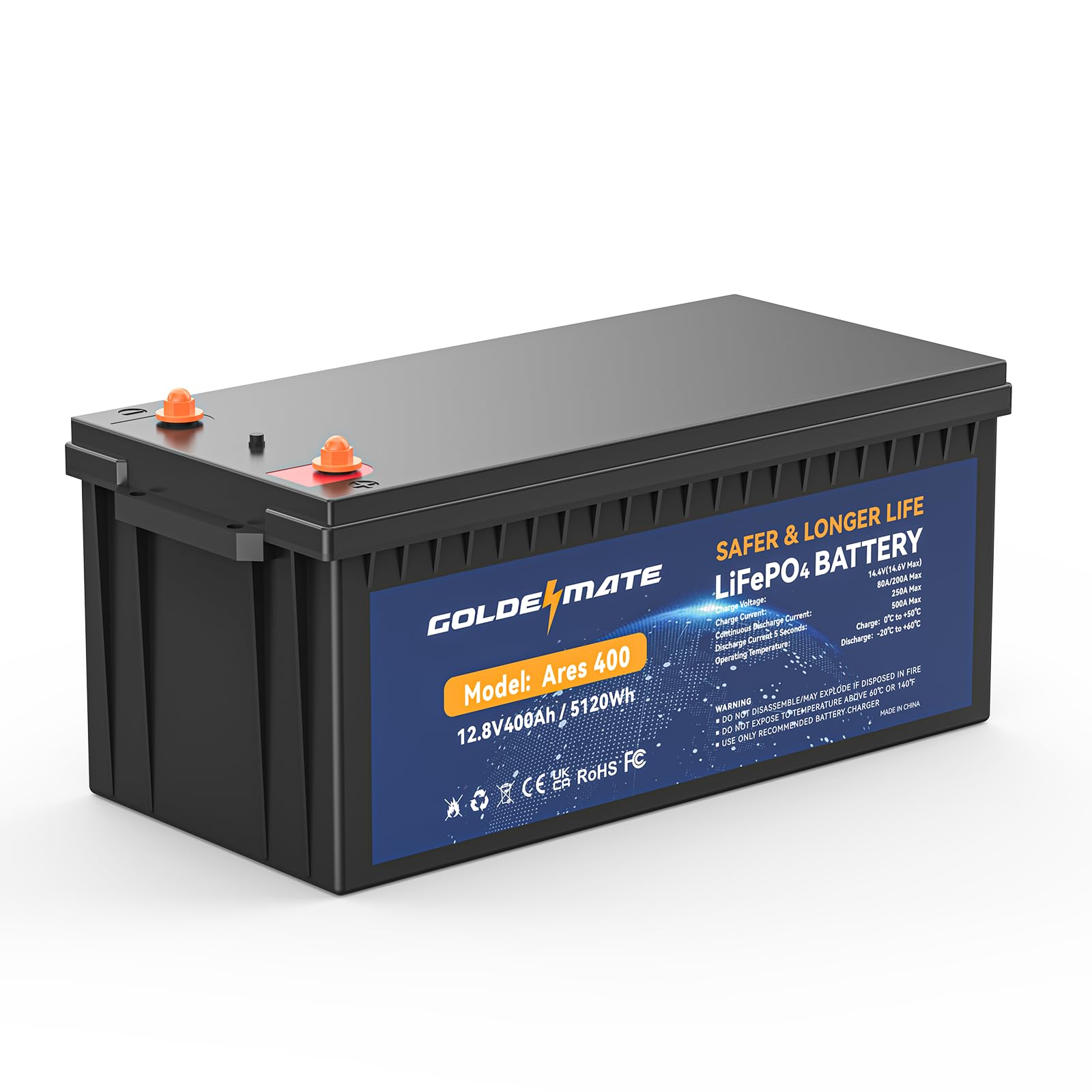
When you need a single-battery solution that eliminates the complexity of parallel wiring, the GOLDENMATE 400Ah delivers 5,120 watt-hours in one box. That is enough energy to power a 12V fridge for about 10 days, or a 1,500W space heater for around three hours. The 200A continuous discharge rating supports high-load appliances like an electric kettle or a hair dryer without tripping the BMS, and the burst capability of 500A for five seconds covers surge loads from induction cooktops or water pumps.
The battery supports series and parallel connections up to 51.2V 1600Ah, meaning you can build a massive system later without replacing the core unit. The BMS provides full protection against overcharge, over-discharge, over-temperature, and short circuits, and the self-discharge rate is low enough that a fully charged battery can sit for up to a year without maintenance. At 88.18 pounds, this is the heaviest battery on the list, so plan for two-person installation and reinforced mounting hardware.
Customer feedback highlights the Bluetooth app which shows runtime and charge time, though the percentage display is reported to be oversized and not as granular as some competing apps. Users with Toyota Prius conversions and sailboat installations confirm the battery works well as a house battery when paired with proper charging equipment. The one-year warranty is shorter than typical lithium warranties, so factor that into your long-term cost calculation.
Why it’s great
- Massive 400Ah capacity in a single unit
- 200A continuous discharge for high-power appliances
- Expandable to 1600Ah with series/parallel wiring
Good to know
- Heavy at 88 lbs, requires secure mounting
- One-year warranty is less generous than competitors
6. Power Queen 12V 100Ah LiFePO4
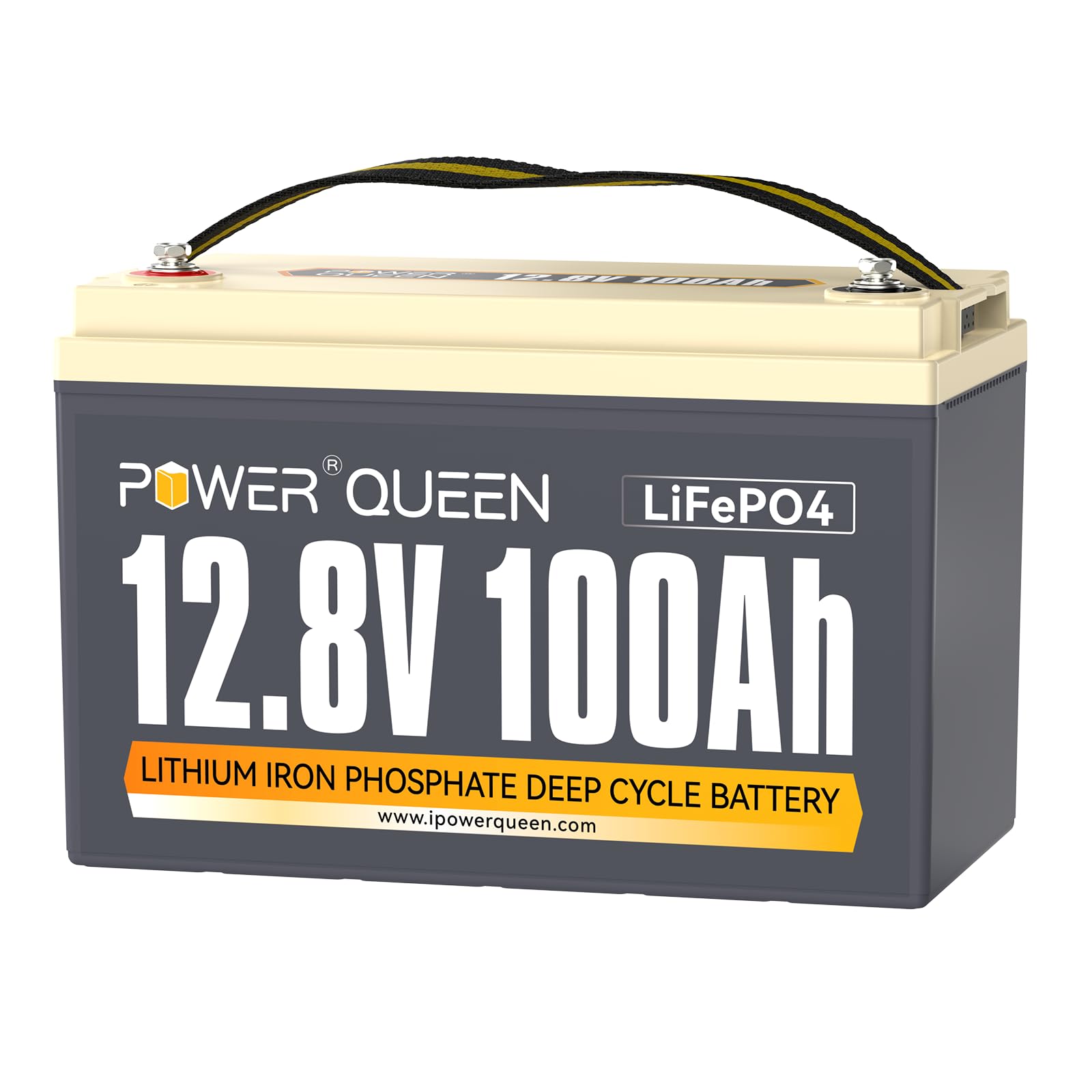
Power Queen’s 100Ah Group 31 lithium battery hits a sweet spot between price and performance for campers making their first jump from lead-acid. At 24.25 pounds, it weighs less than half of a comparable AGM, freeing up payload for water tanks or extra gear. The 100A BMS covers standard protection circuits, and the cells are Grade A LiFePO4 rated for up to 15,000 cycles — though real-world lifespan will depend on depth of discharge and charging habits.
The battery supports series and parallel expansion up to 4S4P, allowing you to build a 51.2V 400Ah system with 20.48 kWh of total storage. Owners of sailboats and golf carts report that the consistent voltage output under load gives better performance than lead-acid, especially for electric trolling motors that draw sustained current. The self-discharge rate of 3 percent per month means you can store the battery through winter without connecting a trickle charger.
Customer reviews consistently mention that the battery tests above its rated 100Ah capacity, with one user measuring 102Ah from a full charge. The packaging includes all necessary mounting hardware and terminal bolts. The only common complaint is the lack of an integrated Bluetooth monitor — you will need to add a separate shunt or battery monitor if you want to check state of charge from your phone.
Why it’s great
- Excellent value for a proven 100Ah lithium pack
- Lightweight at 24.25 lbs for easy handling
- Expandable to 4S4P for large systems
Good to know
- No built-in Bluetooth monitoring
- Requires lithium-compatible charging setup
7. CYCLENBATT 12V 100Ah Mini Bluetooth LiFePO4
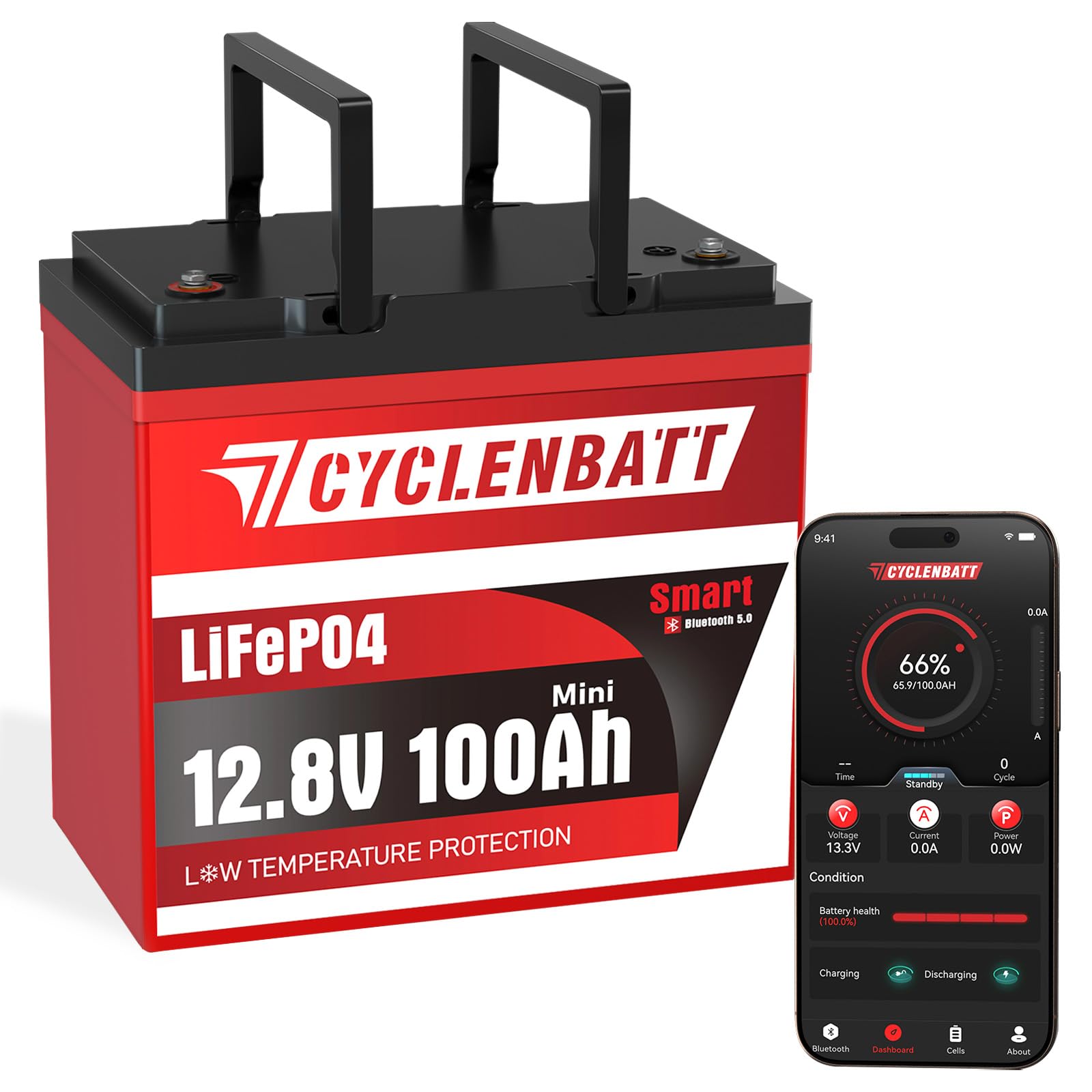
The CYCLENBATT Mini measures just 9.02 x 5.44 x 8.19 inches, making it one of the smallest 100Ah lithium batteries on the market. The footprint is 46 percent smaller than a standard Group 31 case, which opens up installation options in kayak compartments, under-dinette seating, and small camper van cabinets where every cubic inch is accounted for. At 20.83 pounds, you can lift and position it with one hand.
Built-in Bluetooth 5.0 connects to the CYCLENBATT app, showing state of charge, voltage, current draw, and individual cell balance. You can also toggle charging and discharging functions from the app, which is useful when you want to isolate the battery from solar input during storage. The smart BMS includes low-temperature charging cutoff at 32°F and discharging cutoff at -4°F, protecting the cells during cold-weather camping.
Customer reviews verified the battery delivers around 104Ah to 105Ah when tested with a capacity discharge meter, slightly exceeding the rated spec. The JBD-brand BMS is recognized by third-party monitoring tools, so tech-oriented owners can pull detailed data via Python scripts. The non-standard case size means it fits inside a Type 27 battery box rather than a standard Group 31 tray, so measure your compartment before ordering.
Why it’s great
- Extremely compact footprint fits tight spaces
- Integrated Bluetooth 5.0 with smartphone app
- Verified capacity slightly exceeds 100Ah rating
Good to know
- Non-standard size may not fit standard Group 31 trays
- App interface is basic compared to premium brands
8. DUMFUME 12V 150Ah LiFePO4
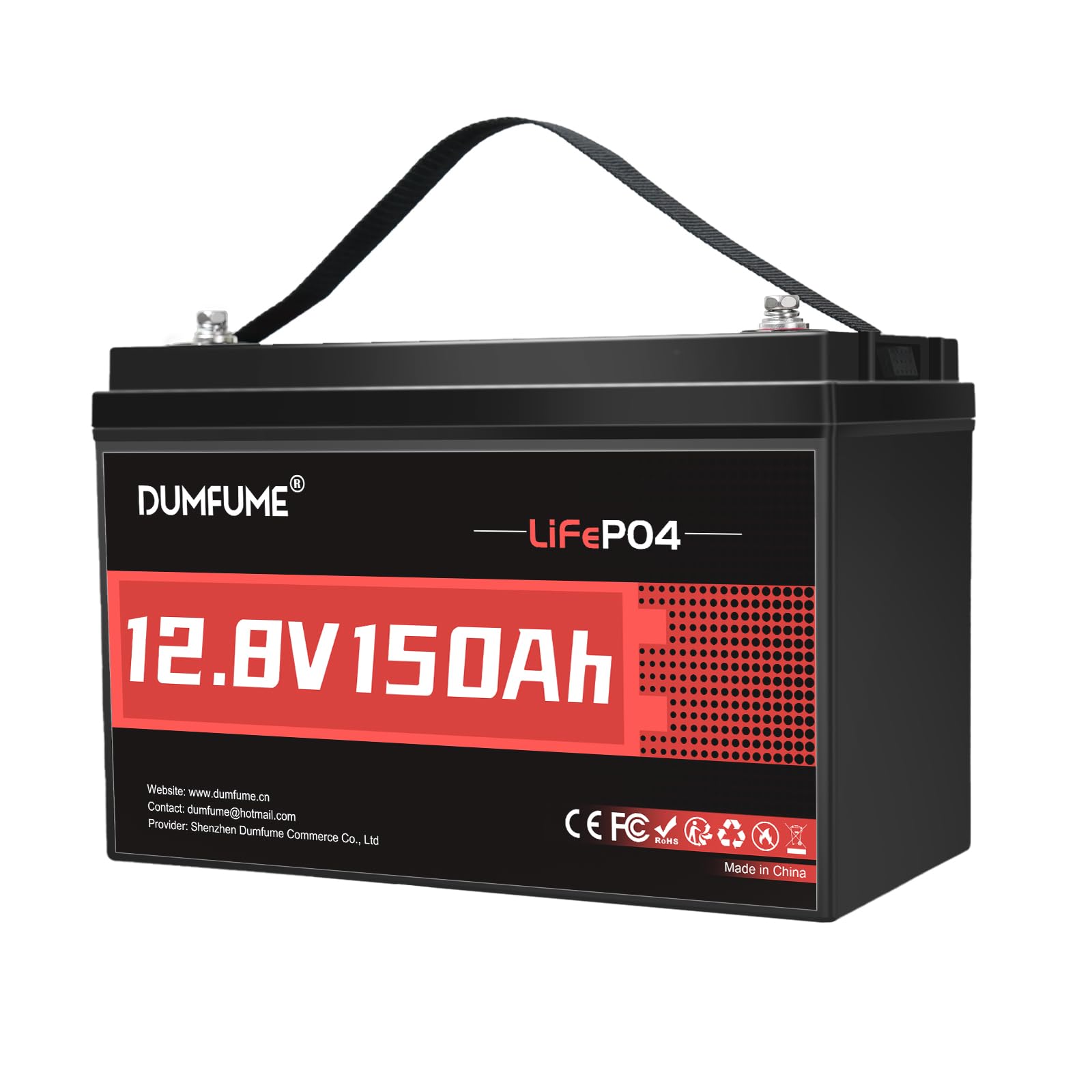
The DUMFUME 150Ah lithium battery provides 1,920 watt-hours of energy in a package that weighs just 22.05 pounds — about the same as a 100Ah lithium unit from other brands. That weight-to-capacity ratio makes it a compelling option for campers who need extended runtime without exceeding a weight limit on a trailer tongue or a roof-mounted solar tray. The compact dimensions of 13.05 x 6.78 x 8.66 inches fit into most standard Group 31 trays.
The 100A BMS handles typical camper loads — a 12V fridge, LED lights, a water pump, and phone charging — without issues. The battery supports series and parallel connections up to 4S4P, allowing you to scale to 51.2V 600Ah if your power needs grow. DUMFUME backs the battery with a five-year warranty, which is longer than many competitors at this price tier. The low-temperature protection stops charging below about 41°F to prevent cell damage.
Customer reviews from solar and RV owners confirm that the batteries often exceed their rated capacity by about 7Ah when new. However, some users reported that units shipped from Amazon arrived at a low voltage around 12.2V, requiring a parallel jump charge with a charged battery to wake the BMS. The company’s customer service responded to warranty claims within a few days, replacing a unit that arrived with a dented box from shipping damage.
Why it’s great
- High 150Ah capacity at a very competitive price
- Only 22.05 lbs for easy handling
- Five-year warranty provides long-term coverage
Good to know
- Some units arrive in low-voltage sleep mode
- Low-temperature charging cutoff requires temps above 41°F
9. WEIZE 12V 100Ah Deep Cycle AGM

The WEIZE 100Ah AGM battery represents the traditional lead-acid approach to camper power. At 63 pounds, it is heavy — more than double the weight of a comparable lithium battery — but it also costs a fraction of what you would pay for a LiFePO4 unit. The sealed, spill-proof design means you can mount it in any orientation except upside down, and you never need to check water levels or clean corrosion off terminals.
Real-world performance from campers shows that a single 100Ah AGM battery provides around 50Ah of usable capacity before the voltage drops below a safe cutoff point. With a 300W solar panel and a 700W inverter, owners report running a small crock pot, a TV, and lights for an evening without draining the battery below 50 percent. The self-discharge rate is only 3 percent per month, so you can store the battery over winter without a trickle charger if you fully charge it first.
Customer reviews highlight the value proposition: this AGM lasts about two to three years in seasonal RV service, and when it degrades, the replacement cost is low enough that it does not sting. Multiple users run two of these in parallel to get a total of 100Ah usable (from 200Ah rated), which is a common configuration for weekend campers who do not need lithium’s weight savings. The main limitation is the 50 percent depth of discharge rule — exceed it regularly, and the battery’s cycle life drops sharply.
Why it’s great
- Low upfront cost for budget-conscious campers
- Maintenance-free and spill-proof design
- Low self-discharge rate for seasonal storage
Good to know
- Only 50Ah usable capacity from the 100Ah rated capacity
- Heavy at 63 lbs, consumes significant payload
- Lasts only 2-3 years in seasonal use
FAQ
Can I replace my camper’s lead-acid battery with a LiFePO4 battery without changing anything else?
How many amp-hours do I actually need for a weekend camper trip?
Does low-temperature charging protection affect me if I camp in winter?
Can I wire a new lithium battery in parallel with my existing AGM battery?
Final thoughts: The verdict
For most campers, the best camper battery winner is the Battle Born BB10012 because it combines a 10-year warranty, proven reliability in full-time RV use, and a drop-in form factor that fits standard trays without modification. If you want the highest capacity-per-dollar ratio and plan to run heavy inverter loads, grab the ECO-WORTHY 280Ah. And for a compact, budget-conscious lithium upgrade with Bluetooth monitoring, nothing beats the CYCLENBATT 100Ah Mini for tight camper compartments.

Mo Maruf
I created WellFizz to bridge the gap between vague wellness advice and actionable solutions. My mission is simple: to decode the research and give you practical tools you can actually use.
Beyond the data, I am a passionate traveler. I believe that stepping away from the screen to explore new environments is essential for mental clarity and physical vitality.