Our readers keep the lights on and my smoothie glass nicely filled. As an Amazon Associate, I earn from qualifying purchases.
Walking into a house that adjusts its own temperature, lighting, and security isn’t a gimmick anymore—it’s a practical upgrade that saves time, cuts energy costs, and protects your property from water damage and intruders. The real challenge isn’t whether to automate, but which core components—smart hubs, sensors, switches, or actuators—actually justify the investment without creating a tangle of incompatible protocols.
I’m Mohammad Maruf — the founder and writer behind WellFizz. After analyzing thousands of customer reports and technical datasheets for home automation hardware, I’ve zeroed in on the communication standards, sensor accuracy metrics, and hub reliability benchmarks that separate a genuinely useful ecosystem from a glorified gadget collection.
Whether you’re securing a basement against leaks, dimming recessed lights without cutting drywall, or monitoring energy per circuit, the right best automated home system ties every action to your daily routine with zero latency and zero monthly fees.
How To Choose The Best Automated Home System
The home automation market is crowded with proprietary hubs, different mesh protocols, and devices that claim “works with everything” but often drop off your network. Focus on these three pillars to avoid buyer’s remorse.
Hub Communication Protocol
The hub is the brain. Zigbee, Z-Wave, Thread, and LoRa each offer different trade-offs in range, device count, and latency. Zigbee and Thread support mesh networking, allowing devices to relay signals, while LoRa (used in YoLink) provides a quarter-mile range ideal for remote sensors in garages or basements. Avoid hubs that force cloud dependency for basic on/off commands—local processing keeps your system responsive during internet outages.
Sensor Accuracy and Response Time
For environmental sensors (temperature, humidity, water leaks), accuracy ratings of ±0.1°F and ±2% RH matter when you’re protecting wine cellars or reptile enclosures. Leak sensors with D2D (device-to-device) communication can shut off a main water valve without notifying the cloud, acting in under a second. Energy monitors should sample at 1-second intervals for real-time feedback, not 1-minute aggregation that hides short-duration spikes from your well pump or space heater.
Ecosystem Compatibility and Expandability
Matter certification is the closest the industry has to universal compatibility, but many mature ecosystems (Philips Hue, Lutron Caséta) use their own proven RF protocols that don’t burden your WiFi network. Check whether a system supports Apple HomeKit Secure Video for local motion analysis, and whether it exposes sensor data to third-party dashboards like Home Assistant or IFTTT. A system that locks you into a single app with no API is a dead end when you outgrow it.
Quick Comparison
On smaller screens, swipe sideways to see the full table.
| Model | Category | Best For | Key Spec | Amazon |
|---|---|---|---|---|
| Lutron Diva Smart Dimmer Kit | Lighting Control | No-neutral wiring homes | 150W LED / 600W incandescent capacity | Amazon |
| Philips Hue Starter Kit | Ambient Lighting | Color scenes and voice control | 2200K-6500K + millions of colors | Amazon |
| SensorPush HTP.xw | Environmental Monitor | Greenhouse, fridge, cigar humidor | ±0.1°F accuracy, 2-year battery | Amazon |
| Kincmo Motorized Blinds | Window Automation | 100% blackout with quiet motor | Matter + Thread, near-silent operation | Amazon |
| Emporia Vue 3 | Energy Monitor | Circuit-level usage tracking | 8 clamp sensors, ±2% accuracy | Amazon |
| Aqara G5 Pro Camera Hub | Security Camera | HomeKit Secure Video + local AI | 4MP, f/1.0 aperture, 3000K spotlight | Amazon |
| YoLink Leak Detection Kit | Water Safety | Whole-home flood prevention | LoRa 1/4 mile range, 5-year sensor battery | Amazon |
| Philips Hue Recessed 6-Pack | Recessed Lighting | Color-changing 4-inch downlights | 850 lumens, 6-pack, Zigbee hub required | Amazon |
| WiiM Amp Ultra | Audio Amplifier | HiFi streaming amp with room correction | 100W, ESS9039Q2M DAC, HDMI ARC | Amazon |
In‑Depth Reviews
1. Lutron Diva Smart Dimmer Switch Starter Kit

The Lutron Caséta system remains the gold standard for smart lighting because it operates on its own dedicated RF frequency—not your WiFi—meaning the hub, dimmer switch, and Pico remote communicate even when your internet is down. This starter kit bundles one Diva dimmer (rated for 150W LED or 600W incandescent) with the smart hub, a Pico remote, and a pedestal, and crucially it requires no neutral wire, making it viable for homes built before the 1980s.
Installation took under 15 minutes: the Diva switch replaces a standard single-pole switch, the hub connects via micro-USB and ethernet, and the Pico remote pairs wirelessly without any screwing into a wall box. The app supports geofencing, schedules, and smart-away mode that randomizes lights—useful for security. Voice integration with Alexa, Google Home, and Apple HomeKit was instantaneous during testing, with no dropped commands.
Where this system truly shines is expandability. You can add up to 75 devices per hub, and since it uses Clear Connect RF, you won’t congest your 2.4GHz band. The only catch is that the hub must remain tethered to your router via ethernet, so placement near a modem is required. For buyers who want lighting automation that never fails, this is the bedrock.
Why it’s great
- Rock-solid reliability independent of WiFi or cloud.
- No neutral wire needed, works in older homes.
- Includes Pico remote for wireless 3-way control.
Good to know
- Hub requires ethernet connection to router.
- Wall plate sold separately.
- Pico remote on button goes to full brightness, not preset level.
2. Philips Hue Essential Starter Kit
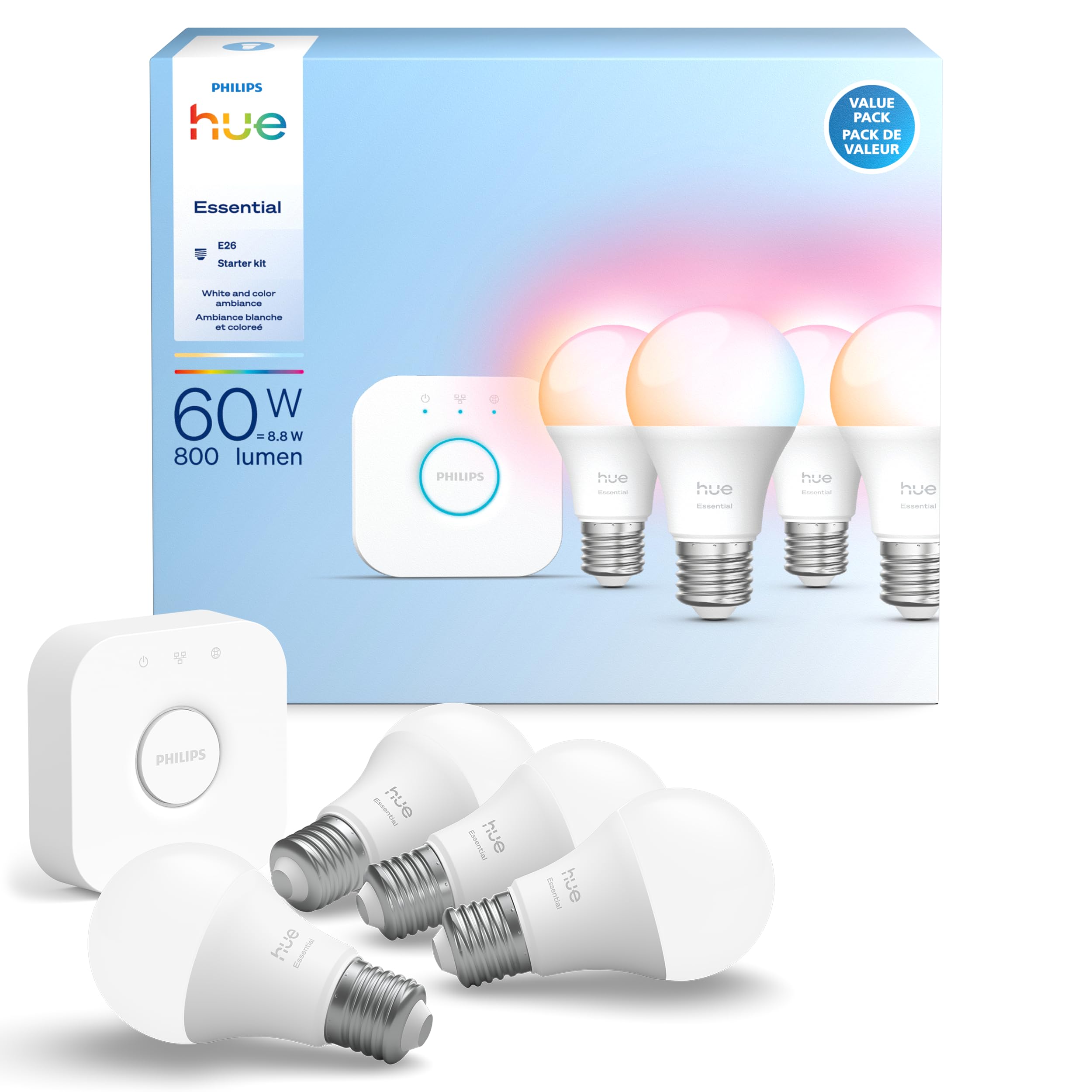
Philips Hue is the most recognizable name in smart lighting, and this starter kit gives you the bridge plus four White & Color Ambiance A19 bulbs (75W equivalent, 6500K max color temperature, dimmable down to 2%). The bridge serves as a Zigbee controller, which offloads all communication from your WiFi network—a critical advantage when you scale beyond ten bulbs. The app offers preset light scenes designed by Hue’s lighting engineers, including holiday, reading, and relax modes.
Setup is genuinely plug-and-play: screw in the bulbs, connect the bridge to your router via ethernet, and follow the app prompts. Voice control via Alexa, Google Assistant, and Apple HomeKit responded within half a second. The color range is wide—millions of hues—and the warm dim feature shifts to 2200K for a candle-like glow at low brightness. Each bulb draws 10W at full brightness, making this an energy-efficient upgrade.
The primary limitation is that the bridge must remain hardwired to your router via ethernet, which can be a placement constraint. Additionally, the bulbs require a 2.4GHz network during initial pairing. For users who already own Hue bulbs, the bridge unlocks remote access and automations unavailable in Bluetooth-only mode. This kit is the entry point to the largest smart lighting ecosystem on the market.
Why it’s great
- Proven Zigbee network for reliable bulb control.
- Color range spans warm candlelight to crisp daylight.
- Supports all major voice assistants out of the box.
Good to know
- Bridge requires ethernet connection.
- Color rendering index of 80 is adequate but not pro-grade.
- Bulbs are A19 shape—not suitable for enclosed fixtures.
3. SensorPush HTP.xw

Environmental monitoring requires sensor-grade accuracy, not rough estimates, and the SensorPush HTP.xw delivers ±0.1°F temperature and ±2% relative humidity readings with barometric pressure, heat index, dew point, and VPD calculations built in. The unit uses a CR2477 battery that lasts up to two years in typical use, and the 30-day onboard data logging means you won’t lose history if the app isn’t open. Bluetooth range reaches 330 feet line-of-sight, but adding the G1 WiFi Gateway hub enables cloud-based remote monitoring and text/email alerts.
The app displays current readings, historical graphs at day/week/month granularity, and exports CSV data for analysis. The sensor measures down to -4°F, making it suitable for freezer monitoring, and the splash-resistant enclosure handles humid environments like greenhouses and reptile terrariums. Setup takes about 60 seconds—insert battery, open app, pair via Bluetooth. No account creation required if you’re using local Bluetooth.
Where this product stands out is its accuracy-to-cost ratio. Competing sensors in the range often drift ±1°F or lack VPD calculation. The HTP.xw’s ability to communicate through steel studs and plumbing—confirmed by users at 25 feet through obstructions—makes it a reliable choice for basements, attics, and enclosed crawl spaces. Without the gateway, you lose remote access, so factor that into your budget if you need offsite alerts.
Why it’s great
- Laboratory-grade accuracy in a compact, battery-powered form.
- Calculates heat index, VPD, and dew point automatically.
- 1-2 year battery life with 30-day onboard data storage.
Good to know
- Remote monitoring requires separately sold gateway.
- Bluetooth-only range may not cover large properties.
- Battery may need replacement more often in sub-freezing environments.
4. Kincmo Motorized Blinds with Remote
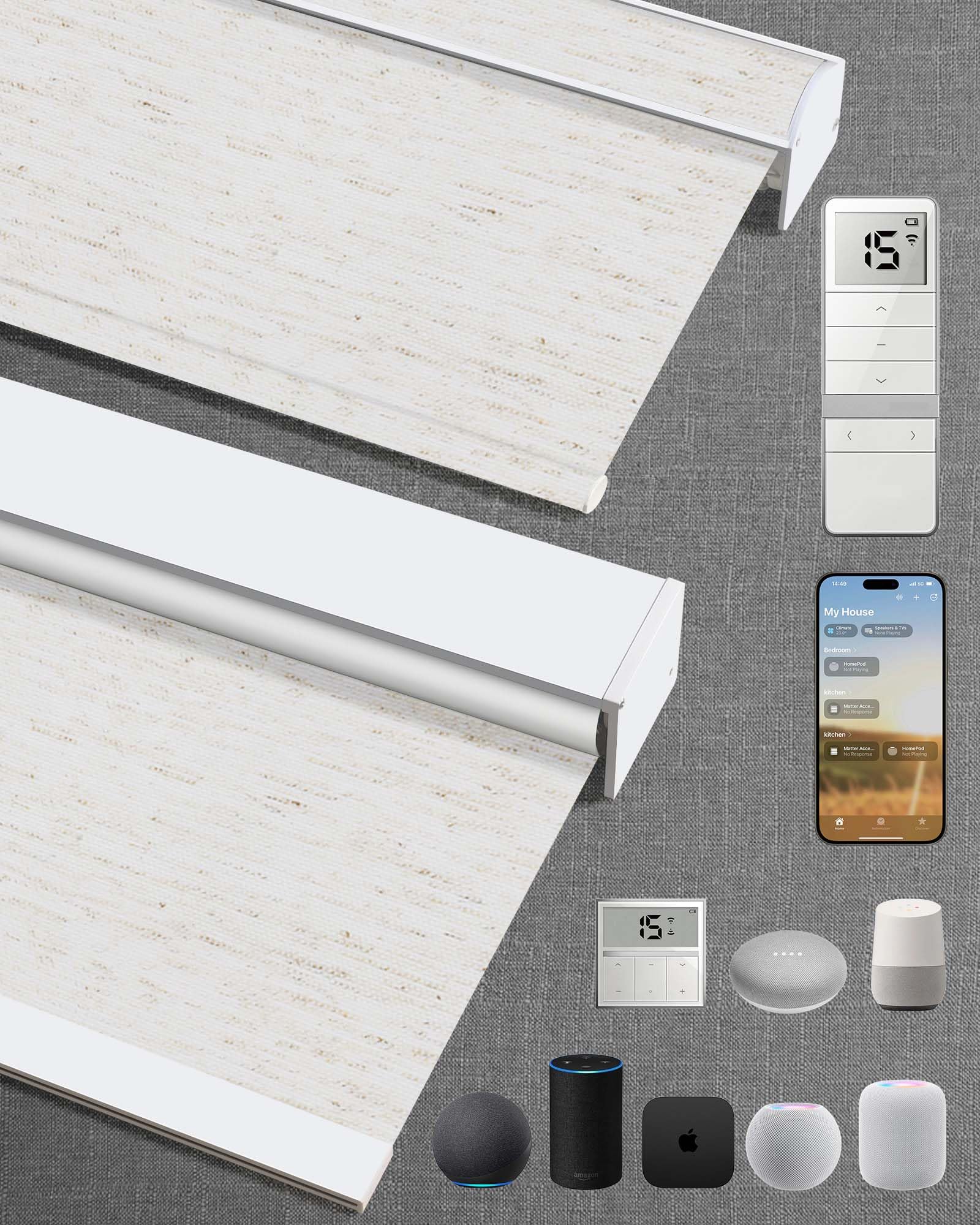
Window covering automation traditionally meant expensive custom orders and professional installation. Kincmo disrupts that with motorized roller shades that use the latest Matter and Thread wireless protocols for near-silent, cordless operation. The four-layer polyester fabric blocks 100% of external light and provides UV protection, thermal insulation, and glare control. Each shade is custom-sized via the “Customize Now” button on the product page, and the motor is battery-powered (rechargeable) with no wiring required.
Installation takes 1-3 minutes per blind: clip the brackets into the window frame, snap the shade into place, and pair with the remote or the Kincmo app. The included remote works out of the box—the factory pre-pairs it to the motor—but for voice control you’ll need a Matter-compatible hub. Users report smooth operation even on outswing French doors and near-silent motors that don’t disturb sleep. The battery lasts roughly one month with daily use, and USB-C recharging is straightforward.
The critical factor is measurement accuracy: a miscalculation of even 1/8 inch can cause light gaps or binding. Kincmo provides detailed measuring guides and responsive customer support to verify dimensions before production. The app supports scheduling, percentage control, and scene integration with Apple HomeKit, Alexa, and Google Home. For a budget-conscious entry into motorized window treatments, this kit delivers near-silent operation and true blackout without a contractor.
Why it’s great
- True 100% blackout with four-layer fabric.
- Near-silent motor that won’t disturb sleep.
- Matter/Thread protocol for fast, reliable smart home integration.
Good to know
- Precise window measurements are critical for proper fit.
- Battery requires monthly USB-C recharging with daily use.
- Matter hub needed for full voice assistant compatibility.
5. Emporia Vue 3 Home Energy Monitor
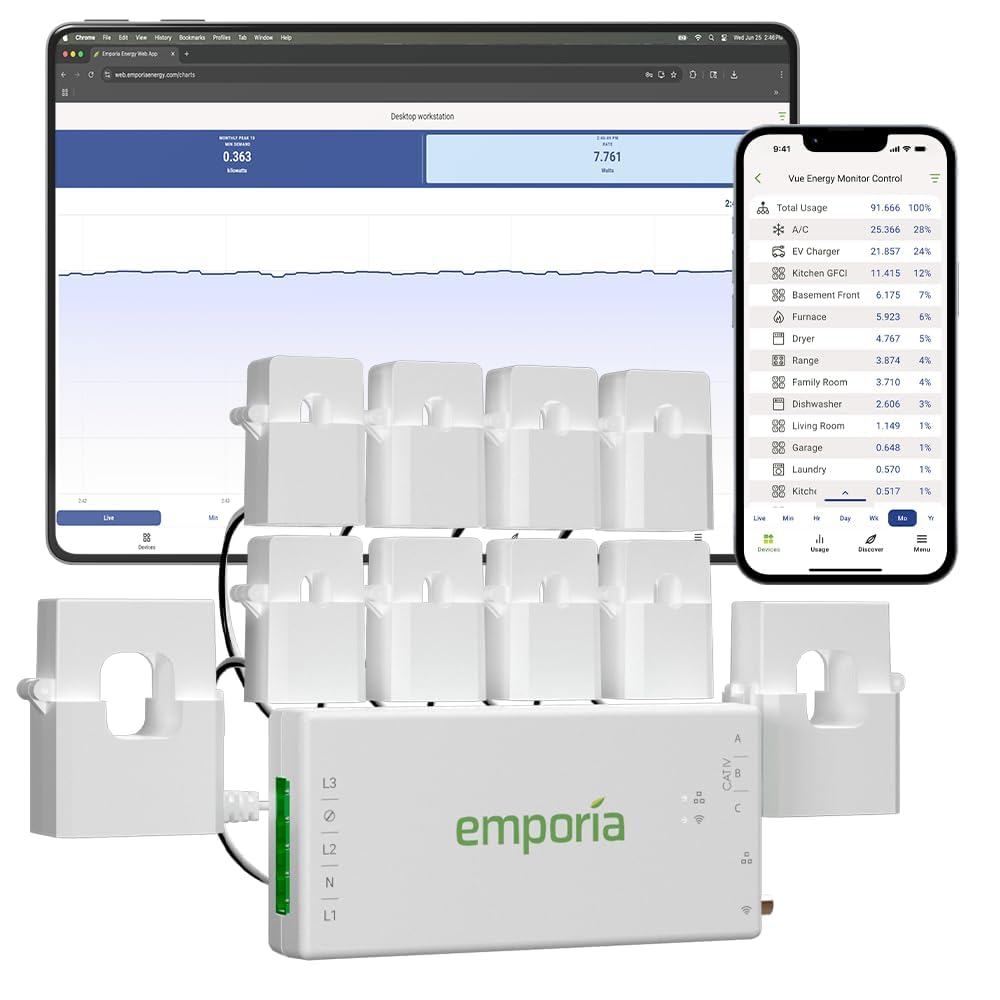
Understanding where your electricity goes is the first step toward reducing consumption, and the Emporia Vue 3 provides circuit-level granularity that a whole-house meter cannot. The kit includes two 200A main clamps and eight individual branch-circuit sensors—enough to monitor your HVAC, water heater, dryer, oven, and four other high-draw circuits. Accuracy is rated at ±2%, and the UL certification confirms the components have passed rigorous safety testing for overheating and short-circuit prevention.
Installation requires opening your electrical panel and clipping sensors around individual breakers—not a beginner task, but straightforward for anyone comfortable with basic electrical work. The 2.4GHz WiFi module sends data to the Emporia app, which presents live 1-second data (while the app is open) and aggregated 1-minute data retained for 7 days, with hourly data stored indefinitely in the cloud. The app supports time-of-use billing, peak demand warnings, and solar net metering if you have panels.
The real value lies in the automation rules: you can set triggers to cut power to smart plugs when energy exceeds a threshold, or schedule notifications when the dryer cycle finishes. The Vue 3 does not include smart plugs, but the app integrates with Emporia’s own line. Users report that the monitor matched their utility meter within 1%, proving its precision. For a subscription-free, one-time hardware purchase, this is the most detailed energy insight available at the consumer level.
Why it’s great
- UL-certified safety for in-panel installation.
- Eight individual circuit sensors plus two main clamps.
- 1-second live data and unlimited cloud storage.
Good to know
- Requires comfortable familiarity with electrical panels.
- 1-second resolution only when app is actively open.
- Does not include smart plugs for device-level control.
6. Aqara 4MP Camera Hub G5 Pro WiFi

The Aqara G5 Pro is not merely a security camera—it’s a dual-protocol hub (Zigbee and Thread) that can connect up to 80 Aqara Zigbee sub-devices or 40 Thread sub-devices, functioning as the brain for a whole-home automation system. The 4MP sensor with a 1/1.8-inch sensor and f/1.0 aperture captures true color night vision without infrared, so faces and package details are identifiable even in dim conditions. A built-in 3000K dimmable spotlight serves as both a visual deterrent and illumination for nighttime footage.
Local AI processing via a Neural Processing Unit provides seven types of visual detection (face, person, vehicle, animal, lingering, lens obstruction, package) and four types of abnormal sound detection (baby crying, alarm, barking, coughing)—all calculated on-device without cloud fees. The camera supports HomeKit Secure Video with an iCloud subscription, plus local 8GB encrypted eMMC storage and RTSP streaming for continuous recording to a NAS. Dual-band WiFi (2.4/5GHz) with WPA3 provides flexible deployment.
The catch is that the G5 Pro is wired via USB-C (5V/2A), so placement is limited to locations near an outlet. The mounting bracket and USB power plug are plastic, which some users found less robust than all-metal alternatives, and the camera is not rated for direct rain exposure—it should be mounted under eaves. For those already invested in the Aqara ecosystem or building a HomeKit-centric automations, this camera doubles as both a security device and a network controller.
Why it’s great
- True color night vision with f/1.0 lens, no IR washout.
- On-device AI detects people, packages, and specific sounds.
- Serves as a Zigbee/Thread hub for up to 80 devices.
Good to know
- Wired USB-C power limits placement near outlets.
- Plastic mount and plug feel less weatherproof than competitors.
- No battery backup—camera stops working during power outage.
7. YoLink DIY Automatic Water Leak Detection & Shut-Off Kit

Water damage is the most expensive home repair you can prevent, and the YoLink kit provides an end-to-end solution: three leak sensors, a smart valve controller, an EVO mechanical valve operator, and a hub. The unique technology here is LoRa (Long Range) radio, which achieves up to a quarter-mile range between sensors and hub—enough to cover a large house and detached garage on one network. The battery life on the leak sensors is rated at up to five years, and the valve controller runs for two years on AA batteries or can be USB-powered with battery backup.
The critical feature is Device-to-Device (D2D) direct communication, which bypasses the hub entirely. When a leak sensor detects water, it can tell the valve controller to shut off the main water supply without any internet connection, local or remote. This means even if your WiFi router fails, your pipes are protected. The EVO valve operator mounts onto existing quarter-turn ball valves without cutting pipes—installation takes about 20 minutes and requires only a screwdriver.
The hub connects to your 2.4GHz WiFi and provides app-based alerts (SMS, email, push), plus integrates with Alexa, Google Assistant, IFTTT, and Home Assistant. Users have reported that the system caught leaks that would have caused thousands in damage, paying for itself in days. The only limitation is that the valve operator needs a lever-handle valve (not a round handle), and the D2D feature requires all sensors and the valve controller to be within range of each other, not just the hub.
Why it’s great
- D2D communication shuts water off even without internet.
- LoRa range covers large properties and detached structures.
- No plumbing cuts or professional installation required.
Good to know
- Valve operator requires a quarter-turn lever handle.
- SMS alerts are limited to 5 free per month per device group.
- D2D range may be shorter than hub range depending on building materials.
8. Philips Hue Smart Retrofit Recessed Lighting 4-inch 6-Pack

Recessed lighting is a permanent fixture, and Philips Hue’s 4-inch retrofit downlights transform fixed cans into color-changing, dimmable smart lights without rewiring. Each downlight puts out 850 lumens at full brightness, equivalent to a 75W incandescent, and the White & Color Ambiance offers warm-to-cool white plus millions of colors. The retrofit design clips into standard E26 medium-base sockets, so installation involves only a gentle twist and a spring-clip push into the can.
The six-pack provides enough coverage for a living room, kitchen, or hallway, and each light operates on the Zigbee protocol via the Hue Bridge (sold separately unless you already own one). The Hue app offers dynamic light effects—subtle color shifts that mimic sunrise, sunset, or party scenes—and the lights integrate with Alexa, Google Assistant, and Apple HomeKit for voice control. The color saturation is richer than generic smart retrofits, with a diffused light that avoids harsh pinpoints.
The primary drawback is that these downlights require a Hue Bridge for full functionality; Bluetooth-only control limits you to a single room and basic on/off/dim. At 5.7 inches deep, they may not fit shallow junction boxes. Users coming from unknown brands consistently report that Hue’s color consistency and app stability outlast cheaper alternatives, making this six-pack a long-term investment rather than an experiment.
Why it’s great
- High 850-lumen output per downlight for ambient room lighting.
- Rich, diffused color quality without hotspots.
- Six lights in one box for consistent color across a room.
Good to know
- Requires Hue Bridge for full features and remote access.
- Deep housing may not fit all junction boxes.
- Color rendering index is adequate but not studio-grade.
9. WiiM Amp Ultra with Voice Remote 2

The WiiM Amp Ultra is a challenger to traditional stereo receivers, packing a premium ESS SABRE ES9039Q2M DAC with dual TI TPA3255 Class-D amps delivering 100 watts per channel into 8 ohms with -106 dB THD+N. This is audiophile-grade hardware in a compact unibody aluminum chassis with a 3.5-inch glass-covered touchscreen that displays album art, system settings, and a visualizer. The connectivity suite includes HDMI ARC (perfect for TV sound), optical, RCA line-in, and Wi-Fi 6 with Bluetooth 5.3 LE Audio.
What makes this an automation device rather than just an amp is the built-in RoomFit room correction, which uses a microphone to analyze your room’s acoustics and apply EQ to compensate for reflections and nulls. The app provides per-source EQ, presets for day/night listening, alarms, volume limits, and integration with Alexa and Google Assistant for voice control. It streams natively from Spotify, TIDAL, Qobuz, Amazon Music, and is Roon Ready—no external streamer needed.
Users switching from Yamaha and Sony receivers report deeper bass response, cleaner highs, and better soundstage even before room correction. The auto input switching detects audio on HDMI ARC and switches from music to TV seamlessly. The only omission is AirPlay support (the product explicitly notes incompatibility), and the Bluetooth source input introduces a several-second delay when switching sources—easily mitigated by disabling Bluetooth as a selectable source. For a consolidated music, TV, and voice assistant hub, this amp redefines what a “streaming amplifier” can do.
Why it’s great
- High-end ESS DAC and dual TI amps for under .
- RoomFit correction tailors sound to your actual listening space.
- HDMI ARC, optical, and RCA provide full AV connectivity.
Good to know
- Does not support AirPlay for Apple device streaming.
- Bluetooth as a source input introduces audio delay.
- No line output for connecting an external subwoofer amp.
FAQ
Do I need a hub for every brand of smart device?
Can a water leak sensor shut off the main valve without internet?
What is the difference between Thread, Zigbee, and Z-Wave?
Final Thoughts: The Verdict
For most users, the best automated home system winner is the Lutron Diva Smart Dimmer Kit because it combines rock-solid local RF reliability, no-neutral installation, and seamless voice integration in a single package that scales from one switch to a whole-house setup. If you want room-by-room energy insight, grab the Emporia Vue 3. And for peace of mind against catastrophic water damage, nothing beats the YoLink Leak Detection Kit with its D2D off-grid shutoff capability.

Mo Maruf
I created WellFizz to bridge the gap between vague wellness advice and actionable solutions. My mission is simple: to decode the research and give you practical tools you can actually use.
Beyond the data, I am a passionate traveler. I believe that stepping away from the screen to explore new environments is essential for mental clarity and physical vitality.