Our readers keep the lights on and my smoothie glass nicely filled. As an Amazon Associate, I earn from qualifying purchases.
A cold, lumpy night on hard ground can turn a weekend adventure into a miserable test of patience. The difference between tossing until dawn and waking refreshed comes down to one piece of gear: the pad beneath your sleeping bag. Good camp sleeping mats do more than cushion—they trap body heat, block moisture from the soil, and provide the stable foundation your spine needs after a long day on the trail.
I’m Mohammad Maruf — the founder and writer behind WellFizz. I’ve spent years analyzing outdoor gear specifications, comparing foam densities, R-value test results, and packed dimensions to find the models that actually deliver on their promises without wasting your money on marketing hype.
When you shop for camp sleeping mats, the critical factors are R-value for warmth, thickness for comfort, packed size for portability, and material durability for rocky terrain—get any of these wrong and your sleep system fails completely.
How To Choose The Best Camp Sleeping Mats
Picking the right pad means matching its construction style, insulation rating, and packed size to how you actually camp. Weight-conscious thru-hikers need different gear than families car-camping at a state park. Focus on four core specs: R-value, thickness, weight, and material build quality.
R-Value and Insulation
R-value measures how well a sleeping pad resists heat loss to the ground. A rating of 1.0 to 2.0 works for summer use above 50°F, while 3.0 to 5.0 handles three-season camping down to freezing. Ratings above 5.0 are built for winter expeditions. Closed-cell foam pads typically sit around 2.0, while high-end self-inflating models reach 9.5. If you sleep cold or camp in shoulder seasons, do not compromise here.
Thickness and Comfort
Thinner pads under 1 inch are ultralight and pack tiny but transfer every root and pebble through to your hips. Pads between 2 and 3 inches suit most side sleepers and provide real pressure relief. Ultra-thick models at 4 inches rival a home mattress but weigh over 6 pounds and take up significant trunk space. Side sleepers should prioritize 2.5 inches minimum to avoid hip pain.
Packed Size and Carry Weight
Backpackers need pads that roll down to water-bottle size and weigh under 1.5 pounds. Car campers can prioritize comfort over portability. Foam pads are lighter per inch of thickness but bulkier externally, while inflatable pads pack smaller but add pump weight. Self-inflating pads split the difference—decent packed size with built-in insulation.
Quick Comparison
On smaller screens, swipe sideways to see the full table.
| Model | Category | Best For | Key Spec | Amazon |
|---|---|---|---|---|
| Hikenture 4 Inch Self Inflating | Self-Inflating Foam | Four-season car camping | 9.5 R-Value, 4 inches thick | Amazon |
| Wevelel Memory Sleeping Pad | Self-Inflating Memory Foam | Family car camping comfort | 9.5 R-Value, 3.1 inches thick | Amazon |
| CYMULA 3 Inch Memory Foam | Roll-Up Memory Foam | Tent and cot use | 3 inches thick, 6.4 pounds | Amazon |
| VALEHOWL Ultralight Inflatable | Inflatable Air Pad | Three-season backpacking | 3.0 R-Value, 1.8 pounds | Amazon |
| NEMO Equipment Switchback | Closed-Cell Foam | Ultralight backpacking | 2.0 R-Value, 14.8 ounces | Amazon |
| AceCamp Accordion Foam Pad | Closed-Cell Foam | Budget ultralight hiking | 2.0 R-Value, 11 ounces | Amazon |
| THINTON Foldable Foam Pad | Closed-Cell Foam | Ultralight thru-hiking | 2.1 R-Value, 1 pound | Amazon |
In‑Depth Reviews
1. Hikenture 4 Inch Thick Self Inflating Sleeping Pad

This is the pad that forces you to reconsider what a camp mattress can be. At 4 inches thick with a 9.5 R-value, the Hikenture delivers warmth and pressure relief that rivals a home bed. The self-inflating foam core requires just a few puffs from the included pump sack after the initial expansion, and the patented two-way valve makes deflation one-way to avoid backflow frustration. At 6.5 pounds, this is strictly car-camping territory, but the width—28 inches—accommodates broad-shouldered side sleepers who typically hang off narrower pads.
The soft polyester top fabric feels quiet against sleeping bags, eliminating the crinkle noise that plagues many inflatable pads. Owner reports confirm no air loss over months of use, and the integrated foam insulation means you never wake up cold from ground conduction, even in sub-freezing temperatures. The 80-inch length fits users up to 6-foot-3 without feet hanging off the edge.
One buyer received a pad with a manufacturing tear, and the company replaced it immediately without requiring a return—an uncommon warranty experience at this price point. Packed size is roughly the volume of a small duffel, which is manageably compact for trunk storage. The self-inflating action takes roughly 3-5 minutes to reach full thickness, so plan setup time accordingly.
Why it’s great
- 40D nylon bottom fabric resists punctures from rough tent floors
- Memory foam and air hybrid design packs smaller than pure foam pads of equal thickness
- Valve design allows single-handed deflation without struggling to re-seal
Good to know
- At 6.5 pounds, it is too heavy for backpacking trips
- Self-inflation is not instant; allow a few minutes for the foam to expand fully
2. Wevelel Memory Sleeping Pad

The Wevelel uses high-density 50D memory foam—significantly denser than the 19D foam found in budget self-inflating pads. That density translates directly to better weight distribution and reduced pressure on hips and shoulders. At 3.1 inches thick and 77 inches long, it supports sleepers up to 800 pounds without bottoming out, making it one of the most load-capable foam pads on the market.
The self-inflation process is fast: open the three valves, let the foam expand for 10 seconds, close the rear two valves, then use the front valve to top off with 20 seconds of foot-pumping. The dual-use valve system allows air to exit while preventing re-entry during deflation, which is a genuinely helpful engineering detail that reduces packing frustration. At 6.59 pounds and a bulky packed size, this is firmly a car-camping or guest-bedroom pad—not backpacking gear.
The 50D stretch knit cover fabric is breathable, sweat-wicking, and most importantly silent—no crinkling when you shift positions. The R-value of 9.5 after ASTM testing means this pad handles winter camping comfortably. Some side sleepers note that the measured width is 26 inches rather than the advertised 30, which may feel narrow for larger users. The built-in pillow is shallow; many owners add a separate camp pillow anyway.
Why it’s great
- High 50D memory foam density provides luxurious pressure relief compared to standard polyurethane foam
- R-value of 9.5 blocks ground cold even in winter conditions
- Dual-use valve simplifies deflation by preventing air from re-entering the pad
Good to know
- Actual width is narrower than listed—measure your tent space before ordering
- Bulk when deflated requires a full car trunk to transport effectively
3. CYMULA 3 Inch Memory Foam Camping Pad
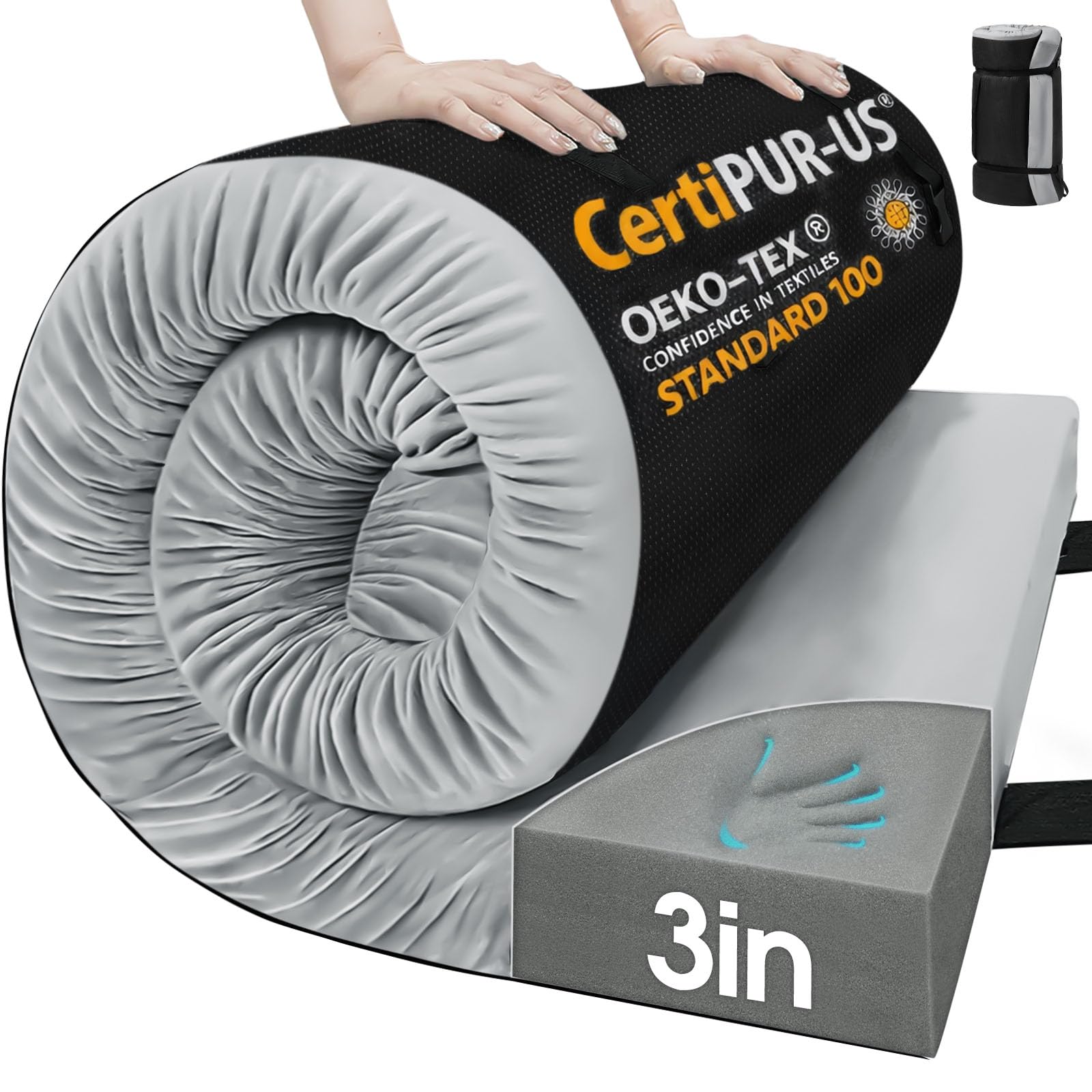
This is a roll-up memory foam pad with a removable, machine-washable cover—a rare combination in a market dominated by sealed foam blocks. The dual-layer construction uses carbon-fiber-infused memory foam on top and high-density base foam underneath, which gives it a plush feel without sacrificing structural support. At 3 inches thick, it provides real cushioning on hard tent floors, cots, or truck beds.
The waterproof bottom with rubberized anti-slip dots keeps the pad from sliding on slick surfaces, and the built-in straps hold it in place on a cot frame. Reviewers consistently report excellent comfort on cots in sub-30°F conditions, with the memory foam molding to body contours while the base layer insulates from cold air circulating underneath the cot. The initial chemical smell upon unboxing is strong—airing it out for 24 hours before first use is essential.
At 6.4 pounds and rolling down to roughly the size of a compact sleeping bag, this pad is best suited for car camping, RV use, or guest bedroom floor lounging. The included carrying straps are functional but not heavy-duty; several owners replaced them with better-quality webbing straps. The 72-inch length fits most adults well, but users over 6 feet tall may find their feet hanging off the end.
Why it’s great
- Zip-off cover is machine-washable, keeping the pad clean after muddy trips
- Carbon-fiber memory foam layer resists permanent compression over repeated use
- Non-slip rubberized bottom stays put on cot fabric and tent floors
Good to know
- Strong initial chemical odor requires airing out before first use
- Rolled size is too bulky for backpacking or even large hiking packs
4. VALEHOWL Ultralight Camping Sleeping Pad
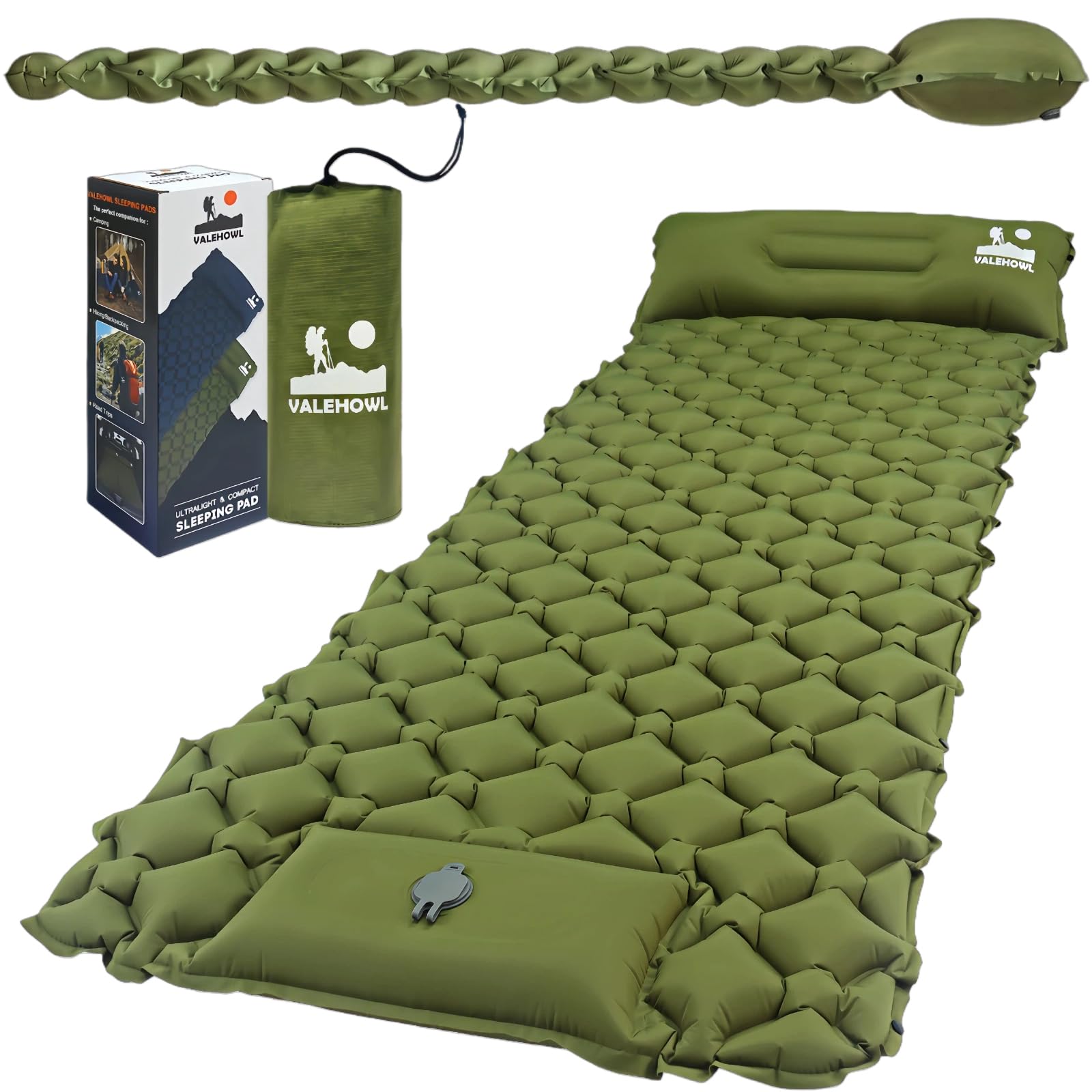
The VALEHOWL bridges the gap between ultralight closed-cell foam pads and heavy self-inflating models. It weighs just 1.8 pounds and packs down to 10 x 5 inches—small enough to fit into a backpack side pocket. The 2.7-inch thickness, achieved through an air chamber design rather than solid foam, provides genuine side-sleeping comfort without the bulk. The integrated foot pump eliminates the need for a separate inflation sack: 40 seconds of steady pedaling and the pad is fully inflated.
The 40D nylon outer fabric resists tears from sharp rocks and branches, and the TPU inner coating creates a waterproof barrier that prevents moisture from wicking through. The 3.0 R-value handles spring-through-fall temperatures down to about 35°F comfortably. The integrated pillow is present but shallow—some users find its position awkward and prefer a separate inflatable pillow. Side snap buttons allow you to connect two pads together for a double-wide setup, which is a nice touch for couples.
The two-stage deflation system lets you adjust firmness by releasing air gradually, then open the main valve for rapid deflation. Owner feedback highlights that the valve plugs must be seated firmly—hand-tighten both caps after inflation to prevent slow overnight air loss. The pad supports up to 400 pounds, and its 75-inch length accommodates users up to 6-foot-3. The honeycomb internal chamber distributes pressure well, making it a solid mid-range pick for three-season backpacking.
Why it’s great
- Built-in foot pump saves the hassle of carrying a separate inflation bag
- 40D nylon shell withstands rough terrain without developing pinhole leaks
- Compact 10×5-inch packed size fits standard backpack side pockets
Good to know
- Integrated pillow is too low for most side sleepers and may need supplementation
- Manual pressure-check and valve tightening necessary to avoid overnight deflation
5. NEMO Equipment Switchback Foam Sleeping Pad
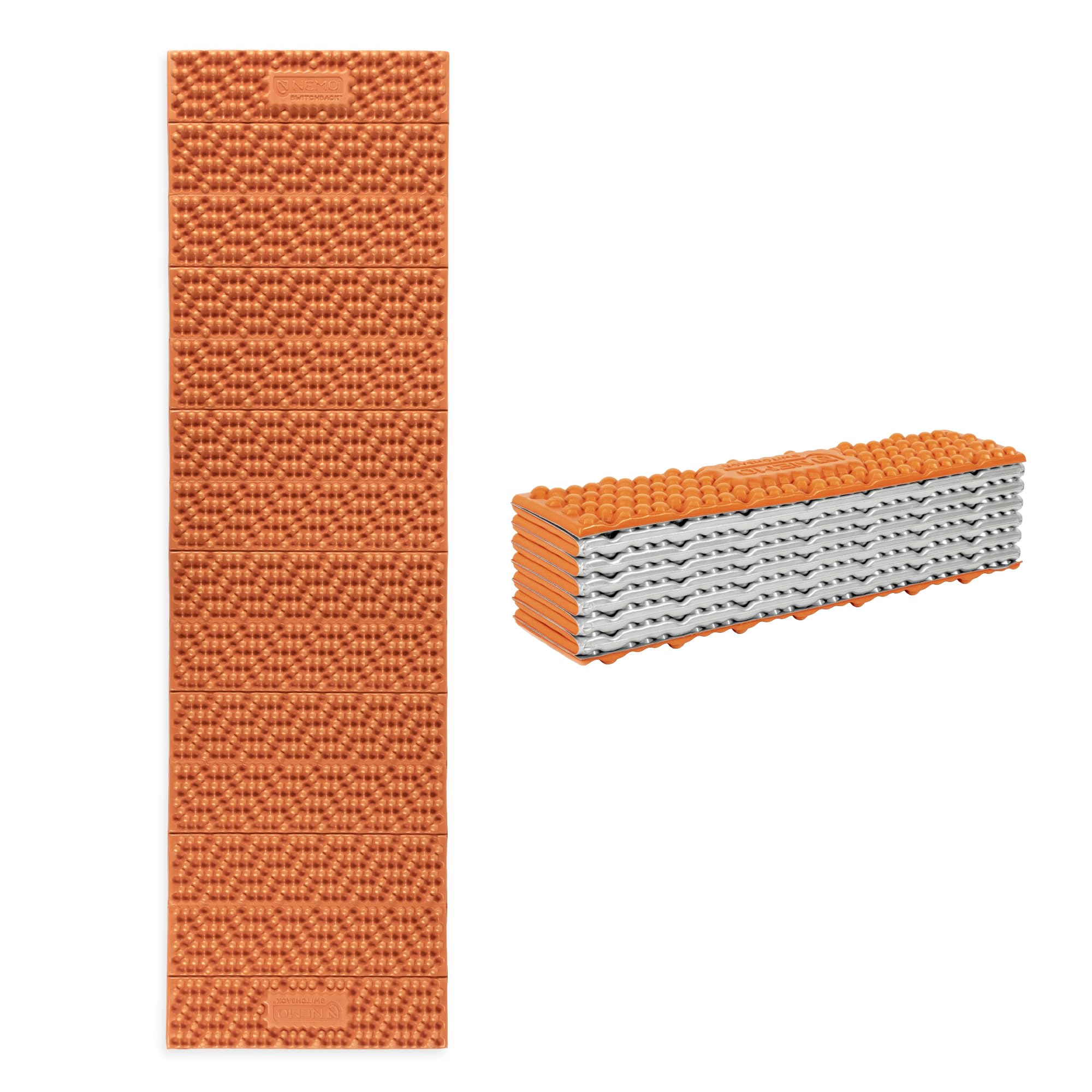
The NEMO Switchback is a closed-cell foam pad that uses a hexagonal nesting pattern to increase plushness without adding weight. The nodes are taller and wider than typical egg-crate foam, allocating more space for the foam to compress under your body weight while trapping dead air for insulation. The result is a pad that feels significantly softer than traditional blue foam mats while still weighing only 14.8 ounces for the full-length version.
The dual-density Axiotomic foam construction sandwiches a softer comfort layer over a firmer support layer, so the pad cushions pressure points without collapsing completely under your hips. A metallized thermal reflective film on the underside bounces body heat back toward you, and the film is laminated between durable protective layers so it won’t peel or delaminate over time. At a 2.0 R-value, this pad is intended for summer and mild three-season use, though many users pair it under an inflatable pad in winter for extra insulation.
One of the Switchback’s strongest assets is its reliability—closed-cell foam never leaks, never punctures, and never requires inflation. The pad folds into an accordion shape and secures with attached straps, creating a compact bundle that straps to the outside of a backpack. NEMO backs it with a lifetime warranty against defects. The trade-off is the inherent limitation of foam pads: at 0.9 inches thick, it protects against sharp rocks and roots far better than bare ground but still transmits more texture than a 3-inch inflatable. Cutting the pad down to torso length saves additional weight for ultralight hikers.
Why it’s great
- Dual-density Axiotomic foam combines comfort and support in a single non-inflatable pad
- Lifetime warranty from NEMO provides long-term purchase confidence
- Hexagonal nesting design delivers noticeably better cushioning than standard closed-cell foam
Good to know
- At 0.9 inches thick, it offers less cushion than air pads—side sleepers may need a second layer
- R-value of 2.0 limits cold-weather performance unless paired with an insulating under-pad
6. AceCamp Portable Foam Sleeping Pad

The AceCamp is a closed-cell accordion-fold pad that competes directly with pricier name-brand foam mats at roughly half the cost. Weighing just 11 ounces, it is one of the lightest full-length foam pads available, making it an obvious choice for ultralight hikers who need a reliable sleeping surface without the weight penalty of inflatable systems. The polyethylene foam is less dense than premium competitors but still provides decent cushioning and an R-value of 2.0 for summer and shoulder-season use.
The pad measures 69.2 inches long, which covers most users from head to mid-calves—taller hikers can use the excess folded portion as a seat pad. Two compression straps secure the folded accordion stack into a compact brick that straps easily to the bottom or back of a pack. Owner feedback from a 12-day hiking trip reported the pad held up well with only minor surface wear, which is impressive for an entry-level price point. Several buyers use it as a protective layer beneath an expensive inflatable pad to prevent punctures and add a combined R-value boost.
At 0.5 inches thick despite the claimed 0.8-inch spec, the AceCamp is thinner than its listing suggests. This is the one spec caveat to be aware of: sleeping directly on this pad on rocky ground will transmit texture through to your sleeping bag. As a standalone pad on soft forest duff or as a supplementary layer under a thicker inflatable pad, it works excellently. The included elastic bands are functional for storage but not designed to survive years of heavy use.
Why it’s great
- Extremely lightweight at 11 ounces for a full-length pad—competitive with ultralight inflatables
- Can be cut to torso length for additional weight savings without compromising structural integrity
- Functions as both a primary summer pad and a protective under-layer for inflatable pads
Good to know
- Actual measured thickness is roughly 0.5 inches—thinner than the advertised 0.8 inches
- Bulk when folded is larger than a packed inflatable pad of similar weight
7. THINTON Foldable Closed Cell Foam Camping Pad

The THINTON pad is a budget-friendly closed-cell foam mat built around IXPE foam with an aluminum film backer that reflects body heat upward. At 1 pound for the 72.8 x 23.6-inch pad, it is impressively light for its coverage area. The 2.1 R-value comes from the heat-reflective aluminum layer combined with the insulating closed-cell foam, making it marginally warmer than standard polyethylene foam pads of similar thickness.
The aluminum film backing also makes this pad completely waterproof and moisture-proof, which is critical when camping on damp ground. The foam folds rather than rolls, packing down to 23.6 x 5.5 x 5.5 inches—small enough to fit inside larger backpack frames or strap to the outside. The material is odor-free out of the box, which is a common complaint with cheaper foam pads that off-gas volatile compounds. Users report it is wider than many pricier name-brand options, providing better coverage for broader shoulders.
The closed-cell foam is less dense than premium competitors, so it compresses more under body weight and provides less cushion than denser foams. At 0.7 inches thick, this pad is best used as a supplementary layer under an inflatable pad or as a primary pad on forgiving surfaces like pine duff or grassy fields. Rocky terrain will transmit through to the sleeper. Several owners use two pads stacked for added comfort, which still keeps the total weight and cost well below a single premium self-inflating pad. The included extra storage straps are a welcome touch that budget pads often omit.
Why it’s great
- Aluminum film backing adds meaningful warmth at no weight penalty compared to plain foam pads
- Wider than many competing closed-cell pads—23.6 inches fits broad-shouldered users
- Completely waterproof construction prevents moisture wicking from wet ground
Good to know
- Foam density is lower than premium alternatives, leading to faster compression under body weight
- At 0.7 inches thin, it transmits rocky terrain texture to the sleeper without a topper layer
FAQ
What R-value do I need for winter car camping below freezing?
Can I use a closed-cell foam pad alone for backpacking?
How do I clean a self-inflating camping pad that got muddy?
Why does my inflatable sleeping pad lose air overnight?
Final Thoughts: The Verdict
For most users, the camp sleeping mats winner is the Hikenture 4 Inch Self Inflating Pad because its 9.5 R-value, 4-inch thickness, and easy valve system make it the most car-camp-friendly luxury option that still packs into a manageable carry bag. If you want the lightest reliable foam pad for ultralight backpacking, grab the NEMO Equipment Switchback. And for a budget closed-cell pad that pairs perfectly under an inflatable mattress for extra warmth and puncture protection, nothing beats the THINTON Foldable Foam Pad.

Mo Maruf
I created WellFizz to bridge the gap between vague wellness advice and actionable solutions. My mission is simple: to decode the research and give you practical tools you can actually use.
Beyond the data, I am a passionate traveler. I believe that stepping away from the screen to explore new environments is essential for mental clarity and physical vitality.