Our readers keep the lights on and my smoothie glass nicely filled. As an Amazon Associate, I earn from qualifying purchases.
Choosing the right tool for filmmaking comes down to a critical fork in the road: do you prioritize a flat, color-gradable log profile with high dynamic range, or do you need a stabilized, point-and-shoot rig with reliable autofocus? The market currently splits cleanly between cinema-style bodies that demand manual rigging and hybrid mirrorless cameras that aim for all-in-one versatility. Your shooting environment—controlled studio, run-and-gun event, or solo vlog—determines which side of that fork you land on.
I’m Mohammad Maruf — the founder and writer behind WellFizz. I’ve spent years analyzing sensor readout speeds, rolling shutter performance, bit depth specifications, and codec support across the full spectrum of videography cameras to separate genuine professional tools from marketing-heavy compromises.
After evaluating sensor sizes, stabilization systems, recording formats, and autofocus reliability across eleven distinct models, this guide to the best cameras for videography breaks down which bodies justify their price tags for real-world production workflows.
How To Choose The Best Cameras For Videography
Video-focused camera selection is fundamentally different from stills photography. You are optimizing for data throughput, overheating resistance, and codec flexibility—not just megapixels or burst rate. Three core decisions define your purchase.
Sensor Size and Dynamic Range
Super 35 (APS-C) and full-frame sensors dominate videography. Full-frame gives shallower depth of field and better high-ISO performance, but Super 35 bodies like the Sony FX30 or Blackmagic Pocket 6K Pro often offer higher frame rates and less rolling shutter for the same sensor cost. Dynamic range measured in stops—13 stops or more—is the number that matters for preserving highlight and shadow detail in log profiles.
Recording Codecs and Bit Rates
Internal 10-bit 4:2:2 recording at 4K is the baseline for serious color work. Cameras that only do 8-bit 4:2:0 introduce banding and grading limitations quickly. Codec choice also dictates storage: ProRes and Blackmagic RAW eat cards fast but edit smoothly, while H.265 saves space but requires a powerful computer. Bodies with dual card slots or USB-C SSD recording offer the most flexible workflow.
Stabilization and Autofocus Priority
In-body stabilization (IBIS) saves rig weight for handheld shooting, but it cannot replace a gimbal for walking shots. Phase-detect autofocus with eye-tracking is essential for solo run-and-gun or vlogging; contrast-detect systems typical of cinema cameras require manual pulling. Decide if you need a hybrid camera that balances both or a dedicated cinema body that prioritizes image quality over ease of use.
Quick Comparison
On smaller screens, swipe sideways to see the full table.
| Model | Category | Best For | Key Spec | Amazon |
|---|---|---|---|---|
| Sony FX30 | APS-C Cinema | Solo indie filmmaking | 14+ stops dynamic range | Amazon |
| DJI Osmo Pocket 3 | Compact Gimbal | Vlogging & travel | 1-inch CMOS, 4K/120fps | Amazon |
| Canon EOS R5 | Full-Frame Hybrid | High-res hybrid work | 8K RAW internal recording | Amazon |
| Blackmagic Pocket 6K Pro | Super 35 Cinema | Studio narrative shoots | 6K BRAW, 13 stops DR | Amazon |
| Nikon Z 8 | Full-Frame Hybrid | High-speed hybrid | 8K/60p N-RAW internal | Amazon |
| Sony A7 IV | Full-Frame Hybrid | Hybrid photo/video | 4K 60p 10-bit 4:2:2 | Amazon |
| Fujifilm X-H2 | APS-C High-Res | Detail-heavy videography | 8K/30p 10-bit internal | Amazon |
| Blackmagic Pocket 4K | MFT Cinema | Budget cinema starter | 4096×2160 BRAW 12-bit | Amazon |
| Canon EOS 5D Mark IV | Full-Frame DSLR | Reliable event work | 4K Motion JPEG 30fps | Amazon |
| Nikon D7500 | APS-C DSLR | Entry-level learning | 4K UHD 30fps stereo | Amazon |
| Panasonic LUMIX FZ80D | Superzoom Bridge | Outdoor long-reach | 4K Photo & 60x zoom | Amazon |
In‑Depth Reviews
1. Sony FX30

The FX30 delivers 90 percent of the FX3’s video capability at roughly half the outlay, making it the clearest value proposition in the current cinema camera landscape. Its 20.1 MP Exmor R APS-C sensor oversamples 6K to produce 4K footage with exceptional color depth and low noise, while dual base ISO (640 and 2500) ensures clean images across varied lighting. S-Cinetone straight out of the box gives a pleasing filmic look without requiring extensive grading.
The body includes professional connectors such as full-size HDMI, dual CFexpress Type A / SD card slots, and an active cooling fan that prevents overheating during long recordings. Cine EI Quick and Cine EI Log modes allow experienced shooters to expose for a log profile using native ISO while beginners can rely on Flexible ISO for simpler exposure control. User LUTs can be applied to both the LCD preview and the HDMI output.
Battery life with the NP-FZ100 runs about 90 minutes of continuous recording, but USB-C power delivery keeps the camera alive via a power bank. Autofocus performance is class-leading with reliable 495-point phase detection, eye tracking, and solid subject recognition. The main tradeoff is the APS-C crop compared to full-frame—you get a 1.5x field-of-view factor when using E-mount lenses.
Why it’s great
- Dual base ISO delivers clean low-light footage
- S-Cinetone provides ready-to-use cinematic color
- Active cooling prevents thermal shutdown
Good to know
- APS-C crop factor on all lenses
- No built-in mechanical ND filter
- Battery life requires external power for all-day shoots
2. DJI Osmo Pocket 3 Creator Combo

The Pocket 3 redefines compact videography with a 1-inch CMOS sensor that records 4K resolution at 120 frames per second—a spec normally reserved for much larger bodies. The 3-axis mechanical stabilization is genuinely gimbal-grade, eliminating the need for post-production warp stabilizer on walking shots. Its 2-inch rotatable touch screen flips 90 degrees for vertical content capture, making it ideal for hybrid social media workflows.
ActiveTrack 6.0 keeps subjects centered even during fast movement, and the included DJI Mic 2 transmitter pairs wirelessly for clean audio up to 250 meters. The Creator Combo bundles a wide-angle lens, battery handle extending runtime to 166 minutes, mini tripod, and carrying bag—everything needed for a complete mobile studio. D-Log M with 10-bit color depth captures one billion colors for grading flexibility.
The gimbal mechanism is the most fragile part—impacts or sand can damage the motors. Low-light performance, while improved over previous generations, still falls short of larger sensor cameras. The fixed lens means no interchangeable glass, limiting creative options for depth-of-field control. For travel vloggers and solo creators, however, the combination of pocketable size and gimbal stabilization is unmatched at this level.
Why it’s great
- Built-in 3-axis gimbal eliminates rigging
- 4K/120fps from a 1-inch sensor
- Included DJI Mic 2 for pro audio
Good to know
- Gimbal is delicate—not rugged
- Fixed lens limits creative DOF control
- Low-light performance is adequate but not outstanding
3. Canon EOS R5

The R5 remains Canon’s most ambitious hybrid body, pairing a stacked 45MP full-frame sensor with internal 8K RAW recording at 30fps and 4K up to 120fps. DIGIC X processing drives 12 fps mechanical and 20 fps electronic continuous shooting, while Dual Pixel CMOS AF II covers 100 percent of the frame with 1,053 phase-detection points. Eye Control AF—where the camera reads your eye to select focus points—is a genuine differentiator for fast-paced single-operator shooting.
The IBIS unit provides up to 8 stops of correction, enabling handheld gimbal-like shots with adapted EF lenses via the Canon mount adapter. 4K HQ mode oversamples from 8K to produce exceptionally detailed 4K footage with minimal moiré. Overheating concerns from the initial firmware have been largely resolved through later updates and a factory-overheat threshold adjustment, though prolonged 8K recording in warm environments still triggers the thermal limiter.
Battery life from the LP-E6NH is reasonable at about 320 shots per CIPA rating, but video recording drains it faster, making external power advisable for long interviews or events. The body features dual card slots—one CFexpress Type B for high-bitrate video and one UHS-II SD for backup. The RF mount ecosystem continues to expand with high-quality cinema glass from Canon and third-party manufacturers.
Why it’s great
- 8K RAW internal with outstanding detail
- Eye Control AF for fast subject switching
- 8-stop IBIS for handheld video
Good to know
- 8K recording can trigger thermal limits in hot conditions
- CFexpress Type B cards are expensive
- Battery life is average for video work
4. Blackmagic Pocket Cinema Camera 6K Pro

The Pocket 6K Pro is purpose-built for narrative and commercial work where image quality matters more than portability. The Super 35 sensor captures 6144 x 3456 resolution with 13 stops of dynamic range, and the built-in 2, 4, and 6-stop ND filters eliminate the need for matte boxes in exterior shoots. Dual gain ISO up to 25,600 keeps noise manageable in dimly lit interiors.
Recording options are extensive: 12-bit Blackmagic RAW internally to CFast 2.0 cards or external SSDs via USB-C, plus Apple ProRes up to 4K. The included DaVinci Resolve Studio activation key is a substantial value add, providing a full color grading and editing suite. The 5-inch tilting HDR LCD is bright enough for outdoor use, reducing reliance on external monitors for framing and focus.
The EF lens mount gives access to a vast library of Canon and third-party glass, though the body lacks any form of in-body stabilization—you must rig it with a gimbal or tripod for smooth footage. Auto exposure only adjusts iris and shutter speed, not ISO, causing sudden brightness jumps during scene changes. Battery life with the included NP-F570 is roughly 45 minutes, so extra packs or a V-mount plate are necessary for extended shoots.
Why it’s great
- Built-in ND filters for controlled exposure outdoors
- 12-bit BRAW with DaVinci Resolve included
- 5-inch tilting HDR LCD for accurate monitoring
Good to know
- No IBIS—requires gimbal or tripod
- Short battery life, needs extra packs
- Auto exposure lacks ISO control for smooth transitions
5. Nikon Z 8

The Z 8 brings essentially the same stacked 45.7MP sensor and EXPEED 7 processor found in the flagship Z9 into a body that is 30 percent smaller. Internal 8K/60p recording in 12-bit N-RAW and ProRes RAW gives filmmakers an extraordinary level of post-production latitude, while 4K/120p with no crop provides slow-motion versatility without changing composition. The 493-point hybrid AF system, developed through deep learning, detects people, animals, and vehicles down to -9 EV.
The shutterless design uses a sensor shield to protect the imaging plane during lens changes and can shoot 20 fps RAW or 120 fps JPEG bursts. The body is weather-sealed to the same standard as the D850, with a magnesium alloy chassis that withstands demanding field conditions. Dual card slots accept one CFexpress Type B for high-bitrate video and one SD UHS-II for overflow or backup.
Heat management is a concern: the smaller body lacks the Z9’s heat sink mass, so prolonged 8K/60p recording in warm environments can trigger thermal shutdown. Using low-voltage CFexpress cards helps maintain longer run times. The menu system is deep—expect a real learning curve when configuring custom shooting banks and video profiles. For existing Nikon users with F-mount glass, the FTZ II adapter retains full compatibility.
Why it’s great
- Internal 8K/60p N-RAW for maximum grading flexibility
- 4K/120p with no crop
- Advanced subject-detection AF down to -9 EV
Good to know
- Thermal limits under heavy 8K load
- Steep learning curve for complex settings
- CFexpress Type B media is premium-priced
6. Sony A7 IV

The A7 IV strikes a compelling balance between stills and video performance. Its 33MP back-illuminated Exmor R sensor paired with BIONZ XR processing delivers 4K 60p in 10-bit 4:2:2 with full pixel readout—upgraded from the A7 III’s 8-bit limit. The 7K oversampling in 4K 30p mode produces exceptionally sharp footage with no pixel binning artifacts. S-Cinetone color profile provides a pleasing starting point for filmic skin tones.
The 693-point phase-detect AF covers 94 percent of the frame with real-time Eye AF for both humans and animals, reliable enough for one-person documentary work. The body includes a fully articulating 3-inch touchscreen for vlogging, 5-axis IBIS rated at 5.5 stops, and dual card slots (one CFexpress Type A, one UHS-II SD). The 14-bit RAW output gives stills shooters latitude for high-end photo work alongside video.
The 60p video mode uses a Super 35 crop (1.5x), so wide-angle lenses lose their field of view. The A7 IV lacks the dual base ISO architecture of the FX30/FX3 line, so low-light noise is more present at higher ISOs. Battery life is strong for a mirrorless body—CIPA-rated at 580 shots—but video recording will still demand a spare NP-FZ100 for all-day shoots.
Why it’s great
- 7K oversampled 4K 30p with no pixel binning
- S-Cinetone for pleasing out-of-camera color
- Strong 5.5-stop IBIS for handheld work
Good to know
- 4K 60p uses a 1.5x crop
- No dual native ISO for low-light
- CFexpress Type A cards are less common
7. Fujifilm X-H2

The X-H2 stands alone as the only APS-C camera with a 40MP sensor, and its video specs are equally distinctive: internal 8K/30p recording in Apple ProRes 10-bit 4:2:2 to a CFexpress Type B card, plus F-Log2 that extends dynamic range to 13+ stops—a one-stop improvement over the X-T5. The back-side illuminated X-Trans CMOS 5 HR sensor optimizes pixel layout for both high detail and accurate color reproduction.
The 7-stop IBIS system uses an improved motion detection algorithm that reduces shake during walking shots and pans, making it more useful for video than previous Fujifilm implementations. Pixel Shift Multi-Shot produces 160MP stills for archival work. The 425-point hybrid AF system is responsive, though continuous tracking for fast-moving subjects doesn’t match Sony’s phase-detection speed. In-body image stabilization and the large grip make handling comfortable with heavier zoom lenses.
8K recording generates massive data throughput, and the X-H2 can overheat after 20 minutes of continuous 8K capture. The CFexpress Type B card requirement adds cost compared to the SD-only X-H2S. Film simulations (ETERNA, Velvia, Classic Chrome) reduce post-processing time for projects that don’t require a flat log grade, but the 40MP sensor demands high-quality Fujifilm XF lenses to resolve full detail in video mode.
Why it’s great
- 40MP sensor with 8K internal recording
- F-Log2 for 13+ stops dynamic range
- Pixel Shift Multi-Shot for 160MP stills
Good to know
- 8K recording limited to ~20 minutes before thermal warning
- Requires CFexpress Type B for high-bitrate 8K
- Autofocus tracking lags behind Sony’s best
8. Blackmagic Pocket Cinema Camera 4K

The Pocket 4K remains the most affordable entry point into true cinema-style recording. Its 4/3-inch sensor captures a native 4096 x 2160 resolution with 13 stops of dynamic range and dual gain ISO up to 25,600. The active MFT lens mount supports native Micro Four Thirds glass as well as adapted lenses via speed boosters, giving budget-conscious filmmakers flexibility across multiple ecosystems.
Recording options include 12-bit Blackmagic RAW to CFast 2.0 or SD UHS-II cards, as well as external SSD storage via USB-C. The included DaVinci Resolve Studio license is worth a significant portion of the camera’s total cost. The 5-inch LCD touchscreen eliminates the need for an external monitor for framing and focus, though it is only 250 nits and becomes hard to read in direct sunlight.
Battery life is the biggest liability: an LP-E6 battery lasts roughly 30 minutes of recording, making V-mount plates or external power mandatory for any serious shoot. The camera has no continuous autofocus, no IBIS, and no flip screen—it is fundamentally a manual cinema tool. For narrative, interview, and documentary work where you control the environment, the image quality per dollar is unmatched.
Why it’s great
- 13 stops dynamic range for class
- DaVinci Resolve Studio included
- Active MFT lens mount with adapter flexibility
Good to know
- ~30-minute battery life—needs external power
- No IBIS or continuous autofocus
- Screen is dim outdoors
9. Canon EOS 5D Mark IV
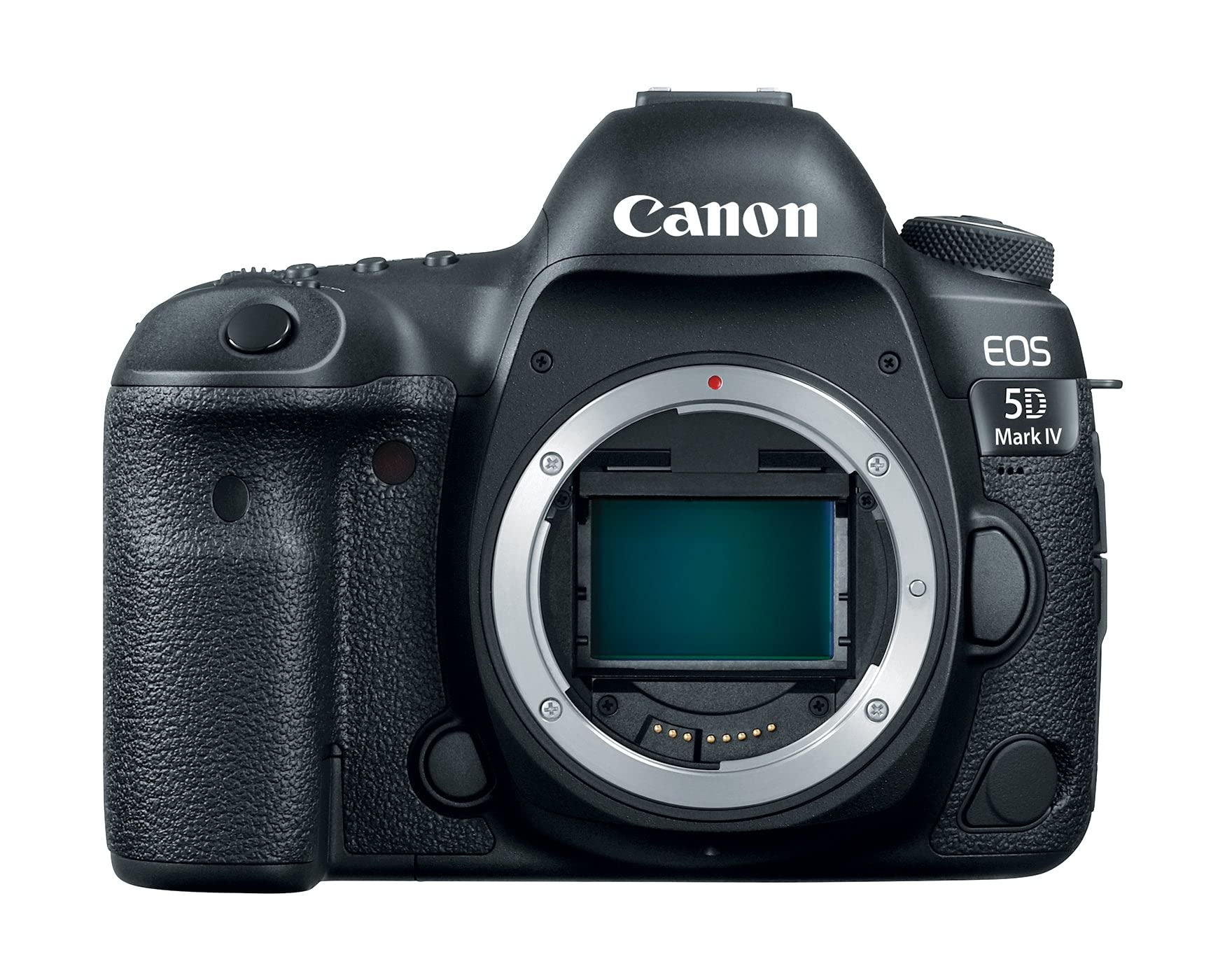
Released in 2016, the 5D Mark IV remains a viable option for videographers who need a reliable, full-frame DSLR with proven Dual Pixel CMOS AF. The 30.4MP sensor and DIGIC 6+ processor capture 4K Motion JPEG at 30fps—not the most efficient codec, but the footage is usable for broadcast and commercial projects. The 61-point phase-detect AF system with 21 cross-type sensors is fast and accurate for both stills and video.
The optical viewfinder is a significant advantage for photographers who prefer optical over electronic, and the body is built like a tank with magnesium alloy construction and weather sealing. Wi-Fi and NFC enable quick file transfer to mobile devices via the Canon Camera Connect app. The touchscreen interface is responsive and intuitive for AF area selection during video recording.
The 4K Motion JPEG codec produces massive file sizes—roughly 800 MB per minute—that fill cards quickly and require fast card writing speeds. The 4K crop factor is 1.74x, significantly narrowing wide-angle field of view. Dynamic range at 13.6 stops is competitive for its generation, but the 5D Mark IV lacks modern video features like 10-bit internal recording, IBIS, or log profiles beyond a flat picture style. For hybrid shooters who prioritize durability and Canon’s lens ecosystem over bleeding-edge video specs, it still delivers professional-grade reliability.
Why it’s great
- Proven Dual Pixel CMOS AF for smooth video focus
- Rugged magnesium-alloy weather-sealed build
- Excellent high-ISO and dynamic range
Good to know
- 4K Motion JPEG files are extremely large
- 1.74x 4K crop narrows wide-angle coverage
- No 10-bit internal or IBIS
10. Nikon D7500

The D7500 is a capable APS-C DSLR for beginners learning videography fundamentals. The 20.9MP sensor and EXPEED 5 processor handle 4K UHD at 30fps with stereo sound and power aperture control—rare in the entry-level segment. The 51-point AF system with 15 cross-type sensors and group-area AF delivers reliable focus tracking for slow-moving subjects. The 3.2-inch tilting touchscreen aids composition from high and low angles.
The 4K recording does not use the full sensor width; it applies a 1.5x crop that makes the included 18-140mm VR lens behave like a 27-210mm equivalent, limiting wide-angle coverage. No headphone jack is present for monitoring audio, and the video bit rate is capped at 144 Mbps, resulting in lower overall quality than mirrorless competitors. The optical viewfinder is excellent for stills photography, and battery life is class-leading at CIPA-rated 950 shots per charge—a major advantage on long shoot days.
The D7500 lacks in-body stabilization; you depend entirely on lens-based VR for handheld video. The 8 fps continuous shooting is sufficient for action stills, and the pentaprism viewfinder is bright and clear. For a student or hobbyist moving from smartphone video to a dedicated camera, the D7500 offers a gentle learning curve with immediate improvements in dynamic range and lens control, but the video feature set is clearly dated.
Why it’s great
- Excellent battery life for all-day shooting
- 4K UHD with power aperture control
- Reliable 51-point AF system
Good to know
- 1.5x crop in 4K mode
- No headphone jack for audio monitoring
- No IBIS—relies on lens VR only
11. Panasonic LUMIX FZ80D

The FZ80D is a superzoom bridge camera that provides an accessible entry into 4K video without requiring interchangeable lenses or complex setup. The 60x optical zoom (20-1200mm equivalent) reaches subjects that would otherwise demand thousands of dollars in telephoto glass, making it a practical tool for wildlife, sports, and inspection work. POWER OIS suppresses hand-shake vibration at the tele end, and the 2,360K-dot electronic viewfinder keeps framing visible in bright sunlight.
4K Photo mode extracts 8-megapixel stills from the 4K video stream, while Post Focus lets the user select the focus point after capture—both helpful for stationary subjects. The contrast-detect AF with 39 focus points is adequate for static or slow-moving subjects but hunts excessively for fast action. Video resolution tops out at 4K 30fps, and the small 1/2.3-inch sensor produces noticeable noise at moderate ISO levels, limiting indoor and low-light applications.
Built-in Wi-Fi enables remote control and file transfer via the Panasonic app. The FZ80D shoots 1920×1080 at 60fps for smooth slow-motion playback. Battery life is average—about 350 shots per charge—and drains quicker with active zoom operation. For a budget-conscious user who needs extreme reach in daylight conditions and wants to learn 4K video basics, the FZ80D offers tremendous value, but the image quality gap compared to larger-sensor cameras is significant.
Why it’s great
- 60x optical zoom covers 20-1200mm effectively
- POWER OIS stabilizes the long tele end
- Post Focus and 4K Photo for creative flexibility
Good to know
- Small sensor limits dynamic range and low-light performance
- Contrast-detect AF hunts in fast motion
- No headphone jack for live audio monitoring
FAQ
What is the minimum bit depth I should accept for professional video?
Why do some cameras overheat when recording 8K video?
What is the practical difference between IBIS and gimbal stabilization?
Is a full-frame sensor always better than Super 35 for video?
What recording format should I choose for post-production flexibility?
Final Thoughts: The Verdict
For most users, the best cameras for videography winner is the Sony FX30 because it delivers cinema-grade image quality, professional codecs, and reliable autofocus at a price that undercuts full-frame competitors while outperforming every other APS-C body. If you need gimbal-stabilized footage in a pocketable form factor for solo vlogging, grab the DJI Osmo Pocket 3 Creator Combo. And for controlled narrative and commercial shoots where raw dynamic range and grading flexibility are paramount, nothing beats the Blackmagic Pocket 6K Pro.

Mo Maruf
I created WellFizz to bridge the gap between vague wellness advice and actionable solutions. My mission is simple: to decode the research and give you practical tools you can actually use.
Beyond the data, I am a passionate traveler. I believe that stepping away from the screen to explore new environments is essential for mental clarity and physical vitality.