Our readers keep the lights on and my smoothie glass nicely filled. As an Amazon Associate, I earn from qualifying purchases.
The pursuit of vintage photos isn’t just about nostalgia—it’s about capturing a specific texture, color response, and light sensitivity that modern digital sensors often smooth away. Whether you crave the grain of 35mm film, the chemical warmth of an instant print, or the deliberate pace of a fully manual shutter, the right camera body and lens pairing defines the entire outcome.
I’m Mohammad Maruf — the founder and writer behind WellFizz. My research dives into the mechanical tolerances, film formats, and lens ecosystems that separate a true vintage-feeling camera from one that merely looks old.
After analyzing hundreds of customer reviews and technical specs across nine distinct models, I’ve built this guide to help you find the best camera for vintage photos that matches your shooting style and desired film aesthetic.
How To Choose The Best Camera For Vintage Photos
Selecting the right camera for vintage-style photography means balancing film format, lens compatibility, and the level of manual control you want. Each element directly affects the grain, color, and sharpness of the final image.
Film Format: The Foundation of the Vintage Look
The film format determines frame size, grain structure, and how many shots you get per roll. Full-frame 35mm (36x24mm) offers the classic field of view and wide lens selection, while half-frame (17x24mm) doubles your shot count—great for storytelling sequences. Instant film formats like Instax Mini or Square produce tangible prints with a distinct, soft aesthetic.
Lens Mount and Optical Character
Old lenses have unique coatings and glass formulations that produce lower contrast, softer corners, and warmer color casts compared to modern designs. Cameras with a native FD, EF, or M42 mount let you attach vintage glass directly. Digital mirrorless bodies with Micro Four Thirds or Z mounts can adapt nearly any legacy lens, opening up decades of optical history.
Manual vs. Automatic Control
Chasing a vintage feel often means wanting aperture rings, shutter speed dials, and film-wind levers. Fully manual or semi-automatic bodies (aperture-priority or shutter-priority) force you to meter by eye, which many photographers find integral to the slow, intentional workflow that produces character-rich images.
Quick Comparison
On smaller screens, swipe sideways to see the full table.
| Model | Category | Best For | Key Spec | Amazon |
|---|---|---|---|---|
| Fujifilm X100VI | Premium Digital | Film simulations & everyday carry | 40.2MP X-Trans Sensor, 20 Film Sims | Amazon |
| OM SYSTEM OM-3 | Premium Digital | Weather-sealed vintage body | 20MP Stacked BSI Sensor, IP53 Rating | Amazon |
| Nikon Z f | Premium Digital | Full-frame retro mirrorless | 24.5MP BSI Sensor, EXPEED 7 | Amazon |
| Leica Q3 | Premium Digital | Ultra-high resolution compact | 60MP BSI CMOS, Summilux 28mm f/1.7 | Amazon |
| Pentax 17 | Mid-Range Film | Half-frame film efficiency | 72 images per roll, 25mm F3.5 lens | Amazon |
| NONS SL660 | Mid-Range Instant | Interchangeable lens instant camera | Instax Square Film, EF Mount | Amazon |
| Fujifilm Instax Mini EVO | Mid-Range Hybrid | Hybrid digital & instant prints | 100 creative combos, 10 lens effects | Amazon |
| Canon AE-1 | Mid-Range Film | Classic SLR with FD lens system | Shutter speeds 1/1000 to 2 sec, TTL Metering | Amazon |
| Canon Rebel 2000 | Budget Film | Budget-friendly autofocus film body | 7-Point AF, Program AE modes | Amazon |
In‑Depth Reviews
1. Fujifilm X100VI Digital Camera

The Fujifilm X100VI is the most deliberate digital alternative to a film rangefinder on the market. Its 40.2MP X-Trans CMOS 5 HR sensor pairs with 20 film simulation modes, including the newly added REALA ACE, to produce out-of-camera JPEGs that mimic the color science of classic emulsions. The fixed 23mm f/2 lens (35mm full-frame equivalent) forces compositional discipline, while the hybrid optical/electronic viewfinder lets you frame shots without the lag of a pure EVF.
In-body image stabilization rated up to 6 stops gives you handheld confidence in dim interiors, and the built-in 4-stop ND filter lets you shoot wide open in bright sunlight—a feature film shooters appreciate for controlling depth of field. The tactile aperture ring and shutter speed dials make you slow down, meter by eye, and engage with light the way you would with an AE-1 or FM2.
The main trade-off is the fixed focal length—you cannot zoom. For photographers who want a single, sharp lens that covers street, travel, and environmental portraits, the X100VI is a near-perfect everyday carry that delivers vintage color and contrast straight from the sensor.
Why it’s great
- Industry-leading film simulations produce authentic vintage color profiles (Velvia, Classic Chrome, Nostalgic Neg.)
- Hybrid viewfinder gives you optical framing without battery drain
- 40MP sensor with IBIS handles high-ISO handheld shooting impressively
Good to know
- Fixed 23mm lens limits versatility for close-ups or telephoto
- Autofocus can hunt in low contrast scenes compared to competitors
- Battery life is shorter than mirrorless rivals—carry a spare
2. OM SYSTEM Olympus OM-3 Silver

The OM-3 resurrects the iconic OM series design language in a premium metal body sealed to IP53 standards. Its 20MP Stacked BSI Live MOS sensor may seem modest next to full-frame sensors, but the stacked architecture delivers blazing readout speeds and zero rolling shutter. The Creative Dial gives direct access to Monochrome Profile Control, Color Creator, and Art Filters—allowing you to dial in a vintage black-and-white look that rivals Tri-X pushed to 1600.
Computational photography features like Live ND, High Res Shot (up to 80MP), and Focus Stacking are accessible via a dedicated lever, letting you simulate long exposures without a tripod or capture depth-of-field effects impossible with a single exposure. The 5-axis IBIS is class-leading, keeping handheld shots sharp at shutter speeds as slow as 1/8 second.
The flatter front panel lacks a pronounced grip, which purists appreciate for its heritage feel, but some users may need a thumb grip for secure handling. The Micro Four Thirds mount opens up a vast library of adapted vintage lenses, perfect for achieving that soft, glowy character from old glass.
Why it’s great
- Full weather sealing lets you shoot in rain, dust, and freezing conditions
- Computational features (Live ND, High Res) emulate vintage techniques digitally
- Fits easily into a sling bag with multiple adapted lenses
Good to know
- 20MP resolution is lower than full-frame rivals for large prints
- No built-in flash; relies on hot-shoe strobes
- Sensor size means shallower depth of field requires fast adapted glass
3. Nikon Z f Full-Frame Mirrorless

The Nikon Z f nails the tactile experience of the classic FM/FM2 series with a full-frame 24.5MP BSI sensor and the EXPEED 7 processing engine. The mechanical shutter and top-plate dials for ISO, shutter speed, and exposure compensation reward hand-metering habits, while the 3D Tracking autofocus with subject recognition locks onto faces, eyes, and animals with exceptional accuracy. For vintage black-and-white shooters, the Z f’s monochrome profiles produce tonality that mirrors Plus-X and Tri-X, straight out of camera.
4K UHD video oversampled from 6K, 10-bit internal recording, and 1080/120p slow motion make this equally capable for hybrid creators. The vari-angle touchscreen includes Touch Fn for simultaneous EVF shooting, and the Pixel Shift mode creates 96MP stills for archival-quality detail. The Nikon Z mount supports native lenses and adapts nearly every F-mount lens ever made, preserving the optical character of vintage Nikkors.
The ergonomics divide opinion—the flat front and small grip feel authentic to the 1980s SLR shape, but many users add an aftermarket grip for all-day comfort. The PSAM dial system can be unintuitive for rapid mode switching, and the menu layout is denser than Fuji’s offering.
Why it’s great
- Full-frame sensor with industry-leading AF and subject tracking
- Monochrome profiles produce convincing Tri-X and Plus-X tonality
- Massive lens compatibility via native Z, adapted F, and third-party mounts
Good to know
- Ergonomics feel small—most users need an add-on grip
- PSAM dial layout is slower than dedicated aperture rings
- EVF refresh rate could be faster for action tracking
4. Leica Q3 Compact Digital Camera
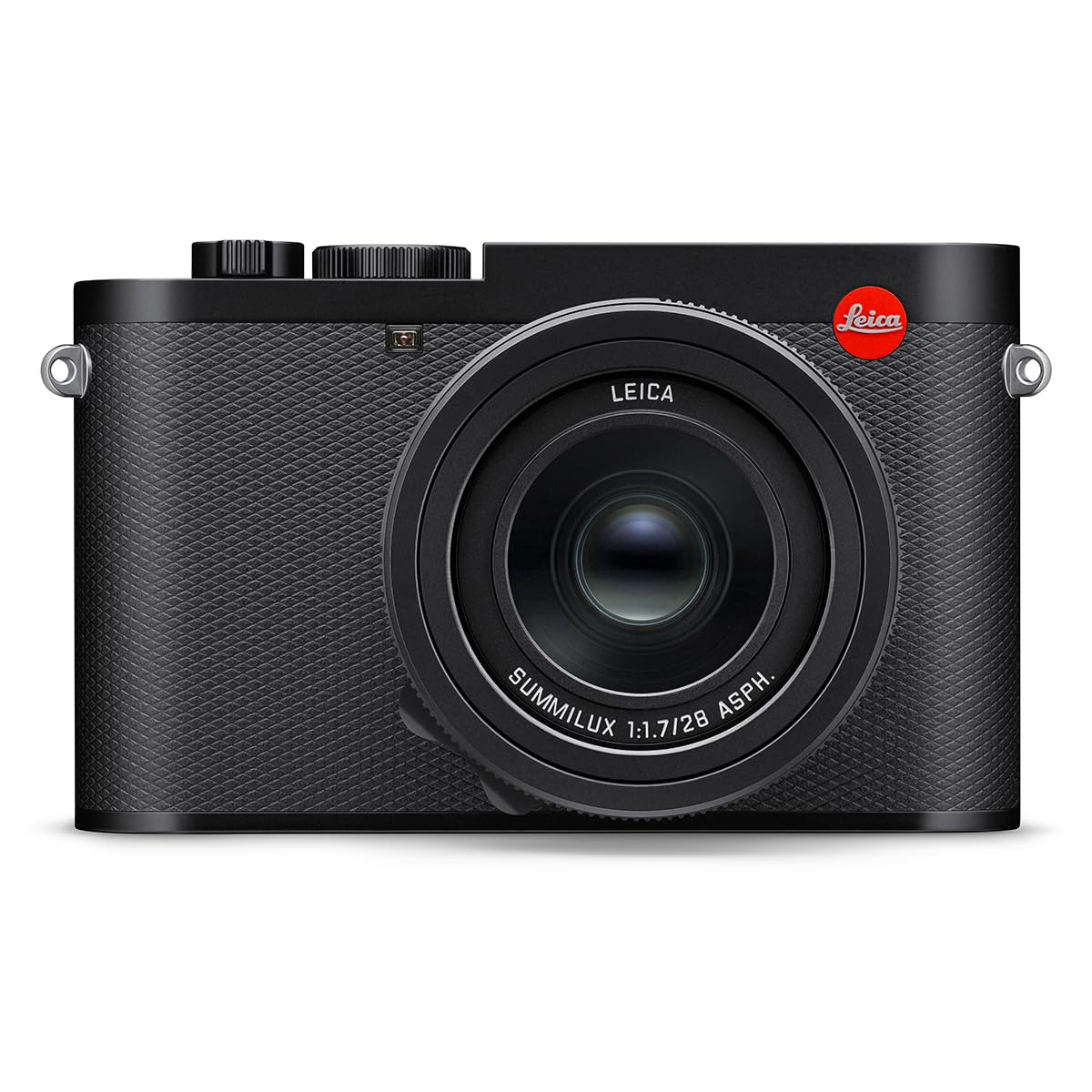
The Leica Q3 marries a 60MP BSI CMOS sensor with Triple Resolution Technology (choose 60, 36, or 18MP) to a fixed Summilux 28mm f/1.7 ASPH lens—one of the sharpest wide-angle lenses ever made. The Maestro IV processor with 8GB buffer enables high-speed continuous shooting and instant image playback. Digital zoom options push the effective focal length up to 90mm while maintaining decent resolution, and the hybrid autofocus (contrast + phase detection) locks focus in near darkness.
Build quality is unmatched: the all-metal body, leather-like trim, and smooth focus ring feel like a precision instrument. The optical image stabilization in the lens allows handheld shooting at shutter speeds below 1/10 second. Straight-out-of-camera JPEGs from the Q3 have a distinct Leica character—micro-contrast, subtle color rendering, and a three-dimensional pop that is hard to replicate. For photographers who prize portability without sacrificing sensor performance, the Q3 is the ultimate everyday camera.
The fixed 28mm lens limits composition flexibility compared to an interchangeable system. Supply scarcity often drives prices well above MSRP, and warranty support requires authorized Leica dealers.
Why it’s great
- 60MP sensor with Triple Resolution gives flexibility for large prints
- Summilux 28mm f/1.7 lens produces unmatched sharpness and micro-contrast
- Compact body fits in a jacket pocket with full-frame quality
Good to know
- Fixed lens limits wide-angle and telephoto options
- Supply shortage inflates prices—buy from authorized dealers
- No built-in flash; requires hot-shoe accessory
5. Pentax 17 Half-Frame 35mm Film Camera

The Pentax 17 revives the half-frame format in a modern, semi-automatic body. By cramming two vertical 17x24mm images into each standard 35mm frame, a single 36-exposure roll yields 72 shots—perfect for storytelling, travel diaries, or daily documentation without burning through film costs. The 25mm F3.5 lens (37mm equivalent) is treated with Pentax’s HD coating for reduced flare and improved contrast in half-frame images.
The zone-focus system divides distances into six zones (close-up, portrait, group, landscape, infinity, and macro), replaced by a simple icon-based selector—fast and intuitive for street photography. The retro-inspired magnesium alloy top and bottom plates feel solid and lightweight, while the manual film advance lever recreates the tactile ritual of film winding. ISO range from 50 to 3200 covers most consumer and professional films.
Some reviewers note the price feels steep for a point-and-shoot with zone focus and a fixed lens. The half-frame orientation requires careful composition since each image is tall and narrow, and there are no programmed auto modes—it’s entirely aperture-priority or manual.
Why it’s great
- 72 shots per roll doubles your shooting capacity without extra film cost
- Magnesium alloy body delivers premium feel and durability
- Simple zone-focus system is fast and intuitive for street shooting
Good to know
- Price is higher than many vintage film cameras with similar features
- Fixed lens limits compositional flexibility
- Half-frame orientation requires different framing habits
6. NONS SL660 Instant Camera

The NONS SL660 is a full manual SLR instant camera built around a native Canon EF mount—letting you attach decades of Canon glass or vintage lenses via adapters for M42, Nikon F, PK, CY, and medium format. It uses Instax Square Film for a classic 1:1 aspect ratio that mirrors Polaroid’s iconic square format. The CNC-machined aluminum alloy body and stainless steel dials rival premium film cameras in build quality, and the wooden hand holder adds a comfortable grip.
Shutter speeds range from bulb to 1/250 with a hot shoe for external flash and multiple exposure capability. The 50/1.8 lens bundle gives a standard field of view, but the real draw is using your favorite vintage glass—a 28mm f/2.8 or 58mm Helios—to imprint its optical character directly onto instant film. The manual-only controls demand an external light meter, as the built-in meter can be inconsistent.
Viewfinder coverage is approximately 50%, requiring guesswork or a separate optical finder. The optical field expander eats two stops of light, and the metering tends to overexpose by one to two stops—compensate accordingly. This camera is for experienced photographers who want ultimate control over instant prints, not casual shooters.
Why it’s great
- EF mount accepts hundreds of vintage and modern lenses for instant film
- Full manual control (aperture, shutter, bulb, multiple exposure)
- Tank-like aluminum alloy build feels like a premium film camera
Good to know
- Built-in meter is unreliable—an external light meter is essential
- Viewfinder covers roughly half the frame—composition requires practice
- Metering tends to overexpose; set compensation manually
7. Fujifilm Instax Mini EVO Hybrid Instant Camera Bundle
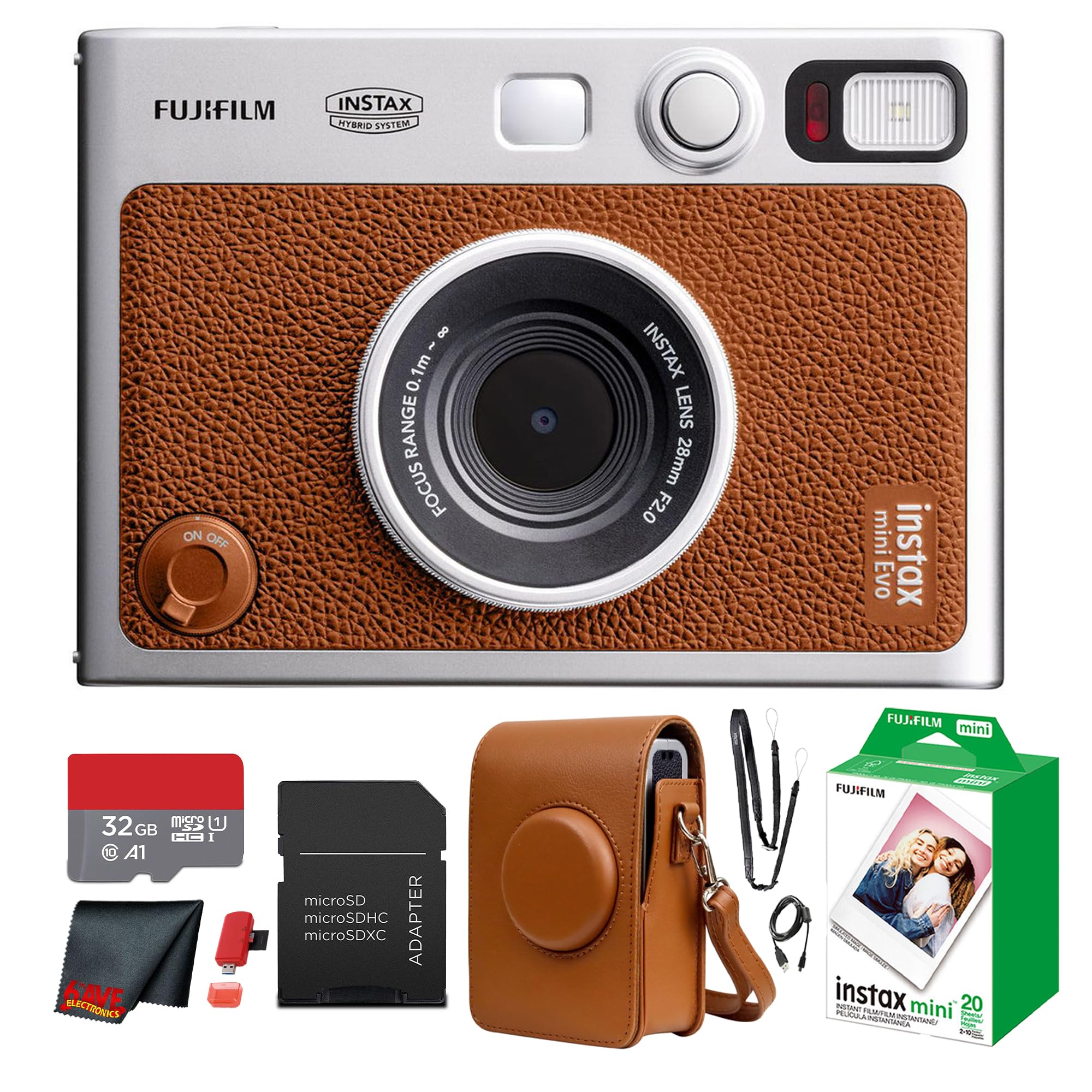
The Instax Mini EVO bridges digital capture with instant film output, storing every shot digitally on an internal memory or microSD card while letting you choose which frames to print. Its 100 creative combinations (10 lens effects × 10 film effects) mimic vintage looks like soft focus, vignetting, and toy camera aesthetics without the chemical guesswork. The 28mm-equivalent f/2 lens performs well in low light, and the dual shutter buttons support portrait and landscape shooting.
The bundle includes 20 sheets of Instax Mini film, a 32GB memory card, a brown vintage case, and cleaning cloth—everything needed to start shooting immediately. The Instax Mini EVO app adds remote shooting, smartphone printing, and advanced editing (crop, rotate, brightness, contrast, saturation) before committing to print. USB-C charging eliminates battery swaps, and the built-in selfie mirror and 3.0-inch LCD screen make composition easy.
The digital sensor resolution is limited compared to dedicated cameras—printed images top out at 600 DPI. The fixed lens means no optical zoom, and the film cost per print adds up over time. For social sharing, family events, and creative experimentation, the EVO delivers an undeniably fun, vintage-inspired instant printing experience.
Why it’s great
- Hybrid design lets you print selectively, saving film and money
- 100 creative combinations offer endless vintage-style effects
- USB-C charging and smartphone connectivity streamline the workflow
Good to know
- Digital image quality is lower than dedicated cameras—prints at 600 DPI
- Fixed 28mm lens limits composition options
- Ongoing film cost makes it more expensive than pure digital
8. Canon AE-1 35mm SLR Film Camera (Renewed)

The Canon AE-1 is one of the most beloved 35mm SLRs ever made, and this renewed example from Amazon comes with a Canon 50mm f/1.8 FD lens. Its shutter-priority automatic mode lets you choose the shutter speed while the camera sets the aperture via TTL metering—a fast, intuitive system for capturing decisive moments. The shutter range from 1/1000 to 2 seconds plus bulb covers nearly every situation, and the interchangeable FD lens mount opens up a huge ecosystem of affordable vintage glass.
The metal-body construction feels solid in hand, and the split-image rangefinder makes manual focusing precise. The AE-1’s program mode is simple enough for beginners, while the full manual mode gives experienced photographers complete control. The self-timer and multiple-exposure capability add creative flexibility. Early reviews note the renewed condition is often like-new, with all functions working properly.
Some units arrive with minor cosmetic wear or require a light seal replacement after a few months of heavy use. The 50mm f/1.8 lens is sharp but produces lower contrast than modern coatings—ideal for that soft, nostalgic look. The AE-1 is a gateway camera into film photography that holds its value well.
Why it’s great
- Shutter-priority auto makes it easy for beginners to get accurate exposures
- FD lens mount offers hundreds of affordable vintage lenses
- Rangefinder focusing is precise and tactile
Good to know
- Renewed units may have minor cosmetic wear or require light seal replacement
- 50mm f/1.8 lens has lower contrast than modern glass—perfect for vintage look
- Manual focusing is slower than modern AF systems
9. Canon Rebel 2000 SLR Film Camera (Renewed)
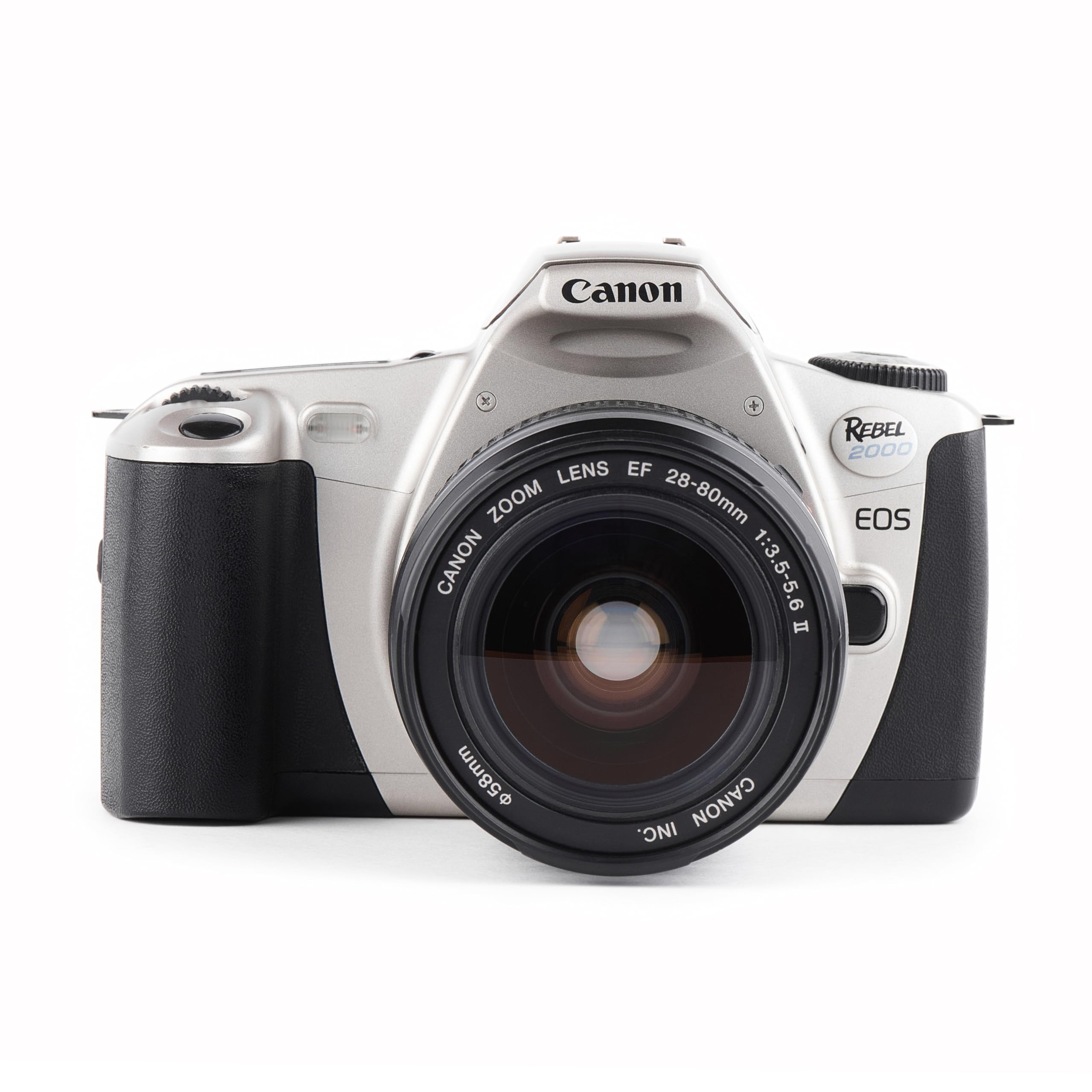
The Canon Rebel 2000 is an autofocus 35mm film SLR that offers Program AE, Aperture Priority, Shutter Priority, and full Manual modes, making it one of the most versatile budget-friendly film cameras available. Its 7-point autofocus system locks onto subjects quickly, and the built-in pop-up flash provides fill lighting when needed. Automatic film loading, advancing, and rewinding eliminate the learning curve of manual film handling—ideal for beginners exploring film photography.
The renewed unit comes with a Canon 28-80mm EF zoom lens, covering wide-angle to short telephoto. The ISO range of 100-400 is standard for consumer films, and the 16:9 aspect ratio option offers a cinematic frame. Many reviewers report the camera arrives in near-mint condition, functioning perfectly for college photography courses or casual daily shooting. The included 28-80mm lens is sharp enough for general use but lacks the character of a prime lens.
Some units may arrive with missing cables or slower-than-expected shipping. The plastic body feels less substantial than metal-bodied competitors, and the kit zoom lens won’t produce the same optical quality as a 50mm f/1.8 prime. For the price, the Rebel 2000 is an unbeatable entry point into 35mm film photography with modern autofocus convenience.
Why it’s great
- 7-point autofocus makes film shooting fast and accurate for beginners
- Four exposure modes (Program, Aperture Priority, Shutter Priority, Manual) for learning
- Automatic film transport simplifies the entire workflow
Good to know
- Plastic body doesn’t feel as premium as metal SLRs
- 28-80mm kit zoom lens lacks the sharpness and character of a prime
- Some units may show cosmetic wear or missing accessories
FAQ
What film format produces the most authentic vintage look?
Can I use vintage lenses on a modern digital camera?
How do film simulations compare to real film?
Final Thoughts: The Verdict
For most users seeking the best camera for vintage photos, the winner is the Fujifilm X100VI because its 20 film simulations, 40MP sensor, and hybrid viewfinder deliver authentic vintage color science and a deliberate shooting experience in a carry-everywhere body. If you want full-frame depth of field with classic retro dials, grab the Nikon Z f. And for true film purists who want 72 shots per roll and magnesium-alloy build, nothing beats the Pentax 17 half-frame camera.

Mo Maruf
I created WellFizz to bridge the gap between vague wellness advice and actionable solutions. My mission is simple: to decode the research and give you practical tools you can actually use.
Beyond the data, I am a passionate traveler. I believe that stepping away from the screen to explore new environments is essential for mental clarity and physical vitality.