Our readers keep the lights on and my smoothie glass nicely filled. As an Amazon Associate, I earn from qualifying purchases.
Accurately tracking your daily calorie intake is the foundation of weight loss, muscle gain, and sustained energy, but manually logging every bite quickly becomes a chore that derails even the most motivated dieters. A dedicated calorie counter device eliminates the guesswork by weighing your food and instantly calculating the nutritional data you need to stay on target. Whether you are managing macros for a ketogenic diet, portioning for diabetes management, or simply trying to build better eating habits, the right device transforms meal prep from a hassle into a seamless part of your routine.
I’m Mohammad Maruf — the founder and writer behind WellFizz. I specialize in analyzing health-tech hardware specifications and app ecosystems to help consumers choose the tool that fits their lifestyle rather than blindly following hype.
After evaluating seven top models based on accuracy, food database depth, app integration, and build quality, I have identified the clear leader for best calorie counter device shopping decisions.
How To Choose The Best Calorie Counter Device
Choosing the right device depends on whether you prefer an all-day wearable tracker that estimates calories through heart rate and activity, or a dedicated kitchen scale that measures the actual weight and nutritional content of your food. Both approaches have merit, but they serve very different use cases, so understanding your own habits is the first step.
Food Database Depth and Update Cadence
A device is only as useful as its food library. Standalone scales like the Greater Goods type come pre-loaded with 2,000 codes, which is excellent for common ingredients but frustrating for branded packaged goods. Smart scales that sync with databases like Nutritionix (over 1 million entries) offer far broader coverage. Wearable fitness trackers like the Fitbit Charge 6 estimate calories based on heart rate and activity data rather than food input, so they pair best with a separate food-logging app. If you eat many specific name-brand products, prioritize a device with an actively maintained, searchable database rather than a fixed code book.
Form Factor and Logging Friction
The single biggest reason people abandon calorie counting is logging friction — the number of steps between preparing food and recording it. A kitchen scale that requires you to input a food code every meal adds friction compared to a smart scale that pairs with a smartphone app and auto-populates the weight into a log. Screenless wearable trackers like the Google Fitbit Air remove friction entirely for activity-based calorie estimates but require a separate app for food logging. The best choice is the form factor that fits your least-busy moments: if you meal prep in batch, a scale wins; if you graze throughout the day, a wearable tracker is more practical.
Sensor Accuracy and Measurement Units
For kitchen scales, accuracy means 1g increments and a tare function that zeroes out bowls. Look for platforms with at least 11 lb capacity (roughly 5,000g) so you can weigh large mixing bowls. For wearable trackers, sensor accuracy revolves around optical heart rate monitoring and step counting — check reviews for real-world distance and calorie deviation. Wearables that require a seven-day calibration period (like the Fitbit Air) may show inaccurate calorie burn during the first week. For medical or clinical use, a standalone food scale with multi-nutrient display (protein, carbs, fat, sodium) is more reliable than any wearable estimate.
Quick Comparison
On smaller screens, swipe sideways to see the full table.
| Model | Category | Best For | Key Spec | Amazon |
|---|---|---|---|---|
| Fitbit Charge 6 | Wearable | All-day tracking with built-in GPS | 40+ exercise modes, 7-day battery | Amazon |
| Etekcity Smart Scale | Smart Scale | App-connected macro tracking | 19 nutrients, 1 million food database | Amazon |
| EILISON Smart Scale | Smart Scale | Offline nutrition display | 50 built-in foods, TFT color screen | Amazon |
| KUAIVO Smart Scale | Smart Scale | Daily intake goal tracking | 1g increments, 5000g capacity | Amazon |
| Fitbit Inspire 3 | Wearable | Stress and sleep tracking | 10-day battery, SpO2 sensor | Amazon |
| Google Fitbit Air | Screenless Wearable | Distraction-free activity tracking | 7-day battery, AI coaching | Amazon |
| Greater Goods Food Scale | Standalone Scale | No-app nutrition tracking | 2,000 pre-loaded food codes | Amazon |
In‑Depth Reviews
1. Fitbit Charge 6

The Fitbit Charge 6 is the most complete wearable calorie management tool on this list, combining a built-in GPS for outdoor run distance, a 24/7 heart rate monitor that links to compatible gym equipment, and automatic exercise detection across 40+ modes. Its real-time calorie burn estimate during workouts gives you immediate feedback on effort intensity, which is essential for adjusting your daily energy deficit or surplus targets. The integration with Google Maps for turn-by-turn directions and Google Wallet for contactless payments adds convenience without requiring you to carry a phone.
The companion app tracks Active Zone Minutes, Daily Readiness Score, and sleep stages, and the 3-month Google Health Premium membership (included) unlocks personalized coaching and advanced analytics. The stainless steel case and silicone band feel durable enough for daily wear through sweat and water exposure up to 50 meters. Battery life averages 7 days with typical use, though GPS-heavy workouts drain faster — expect 5 to 6 days if you track runs daily.
Some users have reported significant distance inaccuracy when comparing GPS data to known route lengths, and the calorie burn figures can appear inflated for short-duration activities. The app requires a Google login, which may frustrate users outside the Google ecosystem, and the YouTube Music controls are hit-or-miss in real-world testing. If you want a unified daily calorie picture that combines food logging with exercise burn, this is the premium choice — but be prepared for occasional sensor quirks.
Why it’s great
- Real-time heart rate on gym equipment for precise calorie estimates
- Built-in GPS for accurate distance tracking on outdoor runs
- 7-day battery life with fast charging for low-maintenance wear
Good to know
- GPS distance can be off by significant margins compared to known routes
- Google login requirement blocks syncing with Apple Health
- YouTube Music controls are unreliable in real-world use
2. Etekcity Smart Food Kitchen Scale

The Etekcity Smart Kitchen Scale delivers the best balance of accuracy, food database depth, and price in the kitchen-scale category. It uses the Nutritionix database, which holds roughly 1 million food entries, and the free VeSync app tracks up to 19 nutrients per item including calories, protein, carbs, fat, fiber, and sodium. The scale itself is built with a food-grade 304 stainless steel platform that resists staining and wipes clean instantly, and the 11 lb / 5,000g capacity handles everything from a single tablespoon of peanut butter to a full mixing bowl of dough.
Weighing is accurate to 1g increments thanks to four high-precision sensors, and the tare function zeroes out any container with a single button press. The LCD display is bright enough to read under kitchen lights but can appear dim in direct sunlight. The scale connects via Bluetooth to the VeSync app, which also logs data to Apple Health and Fitbit, so your meal entries appear in your wearable ecosystem automatically. Battery life on three AAA batteries is decent, though heavy Bluetooth users report swapping batteries every 4 to 6 weeks.
The biggest limitation is the absence of a sub-gram setting — the scale rounds to the nearest gram, which is fine for solid foods but less precise for small quantities of yeast, salt, or supplements. The food database search within the app can be slow to return results for uncommon items, and the lack of a barcode scanner means you must manually search or log brand-name foods. For someone who cooks whole foods and wants a straightforward, reliable smart scale, this is the best entry point.
Why it’s great
- Nutritionix database with 1 million food entries for broad brand coverage
- Food-grade 304 stainless steel platform for durability and easy cleaning
- Syncs with Apple Health and Fitbit for unified daily tracking
Good to know
- No sub-gram precision — rounds to nearest gram for small quantities
- App search for uncommon items can be slow
- Battery life suffers with heavy Bluetooth usage
3. EILISON Smart Kitchen Scale
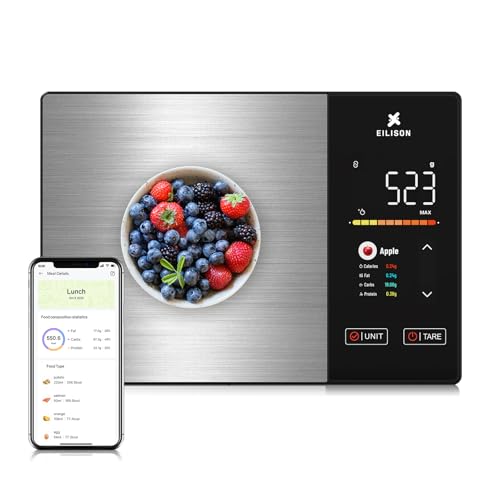
The EILISON Smart Kitchen Scale stands out for its vivid TFT color screen that displays calories, protein, fat, and carbs directly on the device without requiring a smartphone connection. You can program up to 50 user-customizable foods into the scale’s memory and select them via on-screen buttons, making this an excellent choice for people who want to track nutrition without pulling out a phone at every meal. The 5,000g capacity and 2g accuracy are slightly less precise than the competition, but the convenience of offline nutrition display is a genuine workflow advantage for meal prep sessions.
When you do want to sync data, the companion app unlocks a database of 999+ foods and analyzes 24 nutrients per item, which is more granular than most competitors. The stainless steel platform and compact footprint make it easy to store, and the Bluetooth connection is stable enough for daily use. The scale weighs in g, ml (water), ml (milk), oz, and lb:oz, so you can use it for both dry and liquid ingredients without mental conversion.
The app’s food database lags behind major competitors — several users reported difficulty finding common packaged brands, forcing manual entry for items like protein powders. The tare button placement on the app rather than the device can feel unintuitive, and the 3-star average for app usability suggests the software is not quite polished. If offline operation is your priority and you eat a limited set of repeat foods, this scale is a clever choice; if you rely on an extensive searchable library, look elsewhere.
Why it’s great
- Offline nutrition display with 50 programmable food slots for phone-free tracking
- 24-nutrient analysis when synced with companion app
- Multiple unit types including ml for milk and water
Good to know
- App food database is sparse compared to Nutritionix or MyFitnessPal
- Tare function is more intuitive via app than on-device
- 2g accuracy is less precise than 1g alternatives
4. KUAIVO Smart Nutrition Food Scale
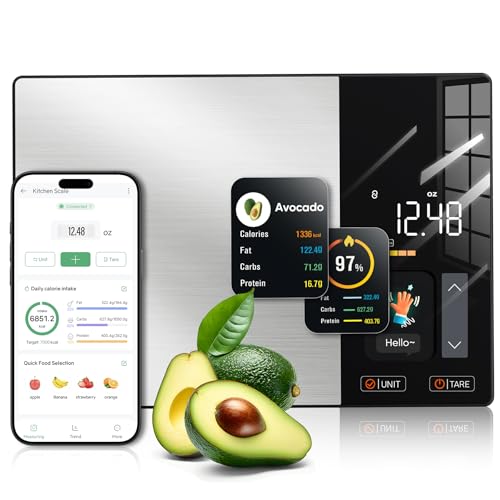
The KUAIVO Smart Nutrition Food Scale integrates daily intake target tracking directly into its companion app, letting you set custom goals for calories, protein, carbs, and fat and see your progress update in real time as you log food. The full-color TFT display shows weight and nutrition info instantly, with 50 pre-loaded food presets for quick access to common ingredients like chicken breast, rice, and apples. The scale measures in 1g increments up to 5,000g, and the tare function works reliably for removing bowl weight.
The companion app records data by day, week, and month, offering trend analysis and personalized guidance based on your logged intake. Bluetooth pairing is straightforward, and the scale runs on standard batteries so there is no built-in rechargeable pack to degrade over time. Users on strict macro-counting diets appreciate the ability to customize daily targets and see at a glance whether they are on track for each nutrient.
The 50 built-in foods are limited to basics — you will need to use the app for most packaged items. Some users question the calorie accuracy for fruits and vegetables, since the device relies on estimated averages rather than barcode scans. The instruction manual is minimal, and the unit does not support sub-gram measurements, so precision-weighing small amounts of seasoning or leavening agents is not possible. For someone who follows a structured meal plan with consistent whole foods, this is a solid mid-range tool.
Why it’s great
- Customizable daily intake goals updated in real time as you log
- Color TFT display for quick calorie and macro viewing at the counter
- Accurate to 1g for consistent measuring of whole foods
Good to know
- Only 50 built-in foods — app required for broader database
- No barcode scanning for packaged ingredient lookup
- Calorie estimates for produce may vary from actual values
5. Fitbit Inspire 3

The Fitbit Inspire 3 is the most comfortable wearable on this list, with a super lightweight silicone body that you barely notice on your wrist — a crucial feature for users who want 24/7 heart rate and sleep tracking without the bulk of a smartwatch. Its 10-day battery life is the best in its class, charging only twice a month under typical use, and the color touchscreen with customizable clock faces makes glanceable data effortless. The stress management score, relaxation breathing sessions, and SpO2 monitoring add wellness context beyond simple calorie counting.
For calorie tracking, the Inspire 3 estimates energy expenditure based on heart rate, step count, and personal metrics entered in the app. The 40+ exercise modes auto-detect common activities and log Active Zone Minutes, which correlate more closely with calorie burn than simple step totals. The device pairs with the Fitbit app for food logging, though you must manually enter meals rather than scan barcodes — pairing with a smart scale like the Etekcity fills this gap effectively.
The band’s hinge mechanism is a known failure point — several users report the strap detaching after 8 to 12 months of daily wear. The screen, while clear, can be hard to read in direct sunlight, and the auto-wake gesture (turning the wrist to see stats) is inconsistent. The calorie burn estimates lean generous compared to chest-strap heart rate monitors, so use the numbers as directional guidance rather than medical-grade data. For someone prioritizing comfort and sleep tracking over precise nutrition logging, this is a strong entry-level wearable.
Why it’s great
- Ultra-lightweight design comfortable for 24/7 wear including sleep
- 10-day battery life requires minimal charging attention
- Stress management and SpO2 features add wellness context to calorie data
Good to know
- Band hinge is a common durability issue within the first year
- Auto-wake gesture is unreliable — screen may not activate on wrist turn
- Calorie burn estimates are optimistic compared to lab-grade measurements
6. Google Fitbit Air
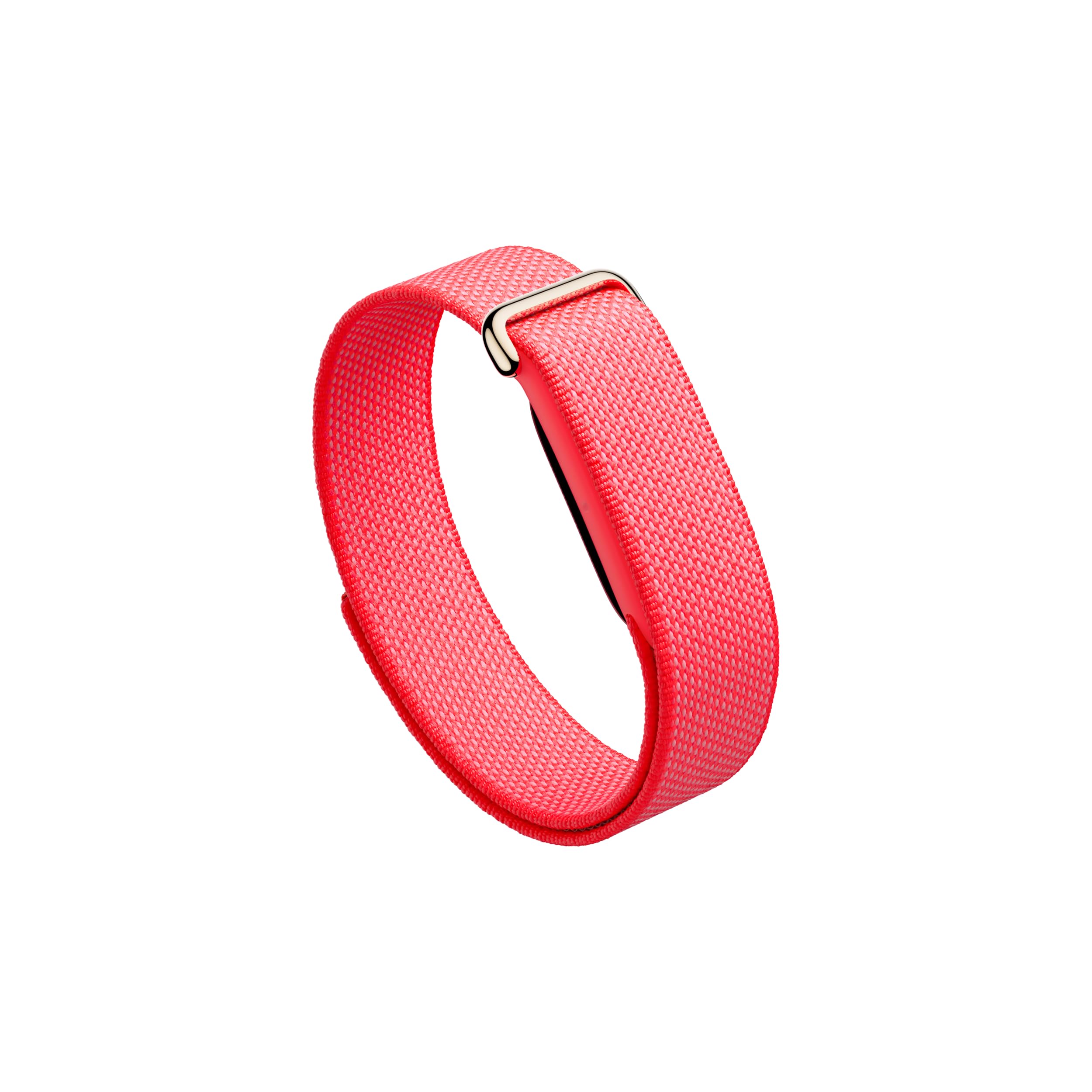
The Google Fitbit Air takes the radical step of removing the screen entirely, fitting into a micro-adjustable silicone band that is lighter and more discrete than any display-based wearable. This screenless approach eliminates the distraction of notifications and the bulk of a touchscreen, making it ideal for people who want calorie tracking and health monitoring without a visible device. Advanced sensors track 24/7 heart rate, SpO2, HRV, skin temperature, and sleep stages, and the embedded pebble-style controller lets you toggle modes or reject calls by pressing it.
The accompanying Google Health Premium membership (3-month trial included) leverages Gemini AI to offer personalized coaching, fitness plans, and sleep guidance based on your real-time metrics. The 7-day battery life with 5-minute fast charging for a full day of power makes it the most convenient wearable to maintain. The band is water resistant to 50 meters, so you can wear it swimming, showering, and through high-sweat workouts without concern.
The AI coaching feature has drawn significant criticism for generating prescriptive commentary that some users find unhelpful or even counterproductive — a personal trainer reviewer noted that the AI insisted on a constant rehab plan for an old ACL injury without nuance. Distance tracking for running is notably inaccurate, as the device lacks GPS and relies on step-count estimation. The lack of any screen means you cannot glance at real-time calorie burn during a workout; you must check the app later. For data-hungry users who want the most unobtrusive health tracker and are willing to ignore or override the AI, this is a fascinating option, but the average dieter will find the screenless workflow disorienting.
Why it’s great
- Incredibly lightweight and comfortable — easy to forget you are wearing it
- 5-minute fast charge gives a full day of battery for minimal downtime
- Advanced 24/7 sensor suite for HR, SpO2, HRV, and sleep tracking
Good to know
- No screen means no real-time calorie display during workouts
- Distance tracking is inaccurate without GPS — not for serious runners
- AI coaching can produce unhelpful or psychologically prescriptive advice
7. Greater Goods Food Scale
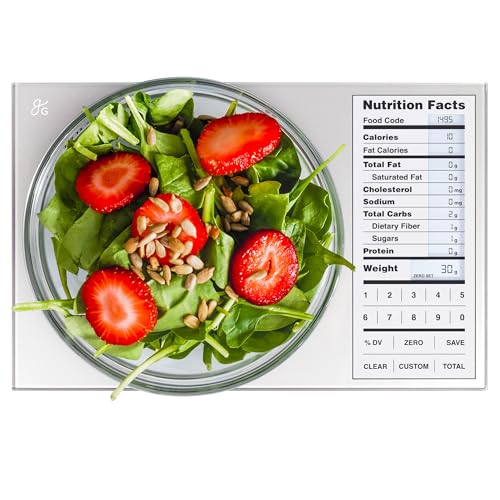
The Greater Goods Food Scale is the best choice for users who want calorie tracking without any smartphone dependency, featuring a built-in database of 2,000 pre-loaded food codes that you can access directly from the device. The LCD screen mimics a packaged food label, displaying calories, protein, carbs, fat, and sodium for each selection, and you can save up to 99 custom foods for your frequently eaten meals. The scale is battery-operated with three AAA batteries and includes an auto-shutoff feature to preserve power, and the compact glass platform (9.3 by 6 inches) fits easily into a drawer when not in use.
The tare function zeroes out bowls and automatically totals nutrition as you add ingredients, making it excellent for building recipes with cumulative macro counts. The matte finish resists fingerprints, and the glass wipes clean instantly after handling raw meat or sticky ingredients. The 5-year warranty and responsive customer service from the St. Louis-based team are genuinely reassuring for a budget-tier device — multiple users report getting a replacement unit after accidental breakage.
The pre-loaded database is limited to whole foods and common ingredients — you will not find brand-name frozen dinners or specialty protein powders. The lack of decimal places for nutrients means a food with 1.5g of saturated fat will round either up or down, which matters over a full day of tracking. There is no Bluetooth or barcode scanning, so you cannot export your data to an app or fitness platform. If you are a privacy-conscious user who wants to log calories without ever touching a phone, this is a reliable, thoughtfully-built tool; if you need a linked ecosystem, look at the Etekcity or EILISON instead.
Why it’s great
- Completely phone-free — all nutrition data accessible on-device
- 5-year warranty with reliable US-based customer support
- Automatic recipe totaling for multi-ingredient meal prep
Good to know
- Database does not include branded packaged goods
- No decimal precision for nutrients — rounding affects daily totals
- No app connectivity for exporting data or syncing with wearables
FAQ
How does a wearable calorie counter differ from a food scale for calorie tracking?
Can I trust the calorie data from a built-in food code book on a scale like the Greater Goods?
Why does sub-gram accuracy matter for calorie counting?
Final Thoughts: The Verdict
For most users, the best calorie counter device winner is the Fitbit Charge 6 because it combines all-day calorie burn estimation through continuous heart rate monitoring, built-in GPS for accurate distance tracking, and a broad app ecosystem that pairs with food scales for the most complete daily picture. If you want a dedicated kitchen scale with the deepest food database and seamless app connectivity, grab the Etekcity Smart Scale for its nutritionix-backed library and 304 stainless steel build. And for the privacy-focused user who wants to track calories without ever touching a smartphone, nothing beats the Greater Goods Food Scale with its 5-year warranty and phone-free workflow.

Mo Maruf
I created WellFizz to bridge the gap between vague wellness advice and actionable solutions. My mission is simple: to decode the research and give you practical tools you can actually use.
Beyond the data, I am a passionate traveler. I believe that stepping away from the screen to explore new environments is essential for mental clarity and physical vitality.