Our readers keep the lights on and my smoothie glass nicely filled. As an Amazon Associate, I earn from qualifying purchases.
The promise of WiFi 6 is real: lower latency, better multi-device handling, and faster throughput. But the leap from WiFi 5 to WiFi 6 doesn’t require a premium price tag. The real challenge for budget-minded buyers is sorting through the spec sheets to find a router that delivers the actual AX performance gains—OFDMA, MU-MIMO, and 1024-QAM—without cutting corners on range or stability.
I’m Mohammad Maruf — the founder and writer behind WellFizz. I’ve analyzed the hardware specifications, customer feedback, and real-world throughput data of every entry-level and mid-range WiFi 6 router on the market to separate the genuine value plays from the marketing traps.
This guide cuts through the noise to find the best budget wifi 6 router for your home, focusing on measurable specs like gigabit port counts, dual-band throughput ceilings, and security feature depth rather than sticker appeal.
How To Choose The Best Budget WiFi 6 Router
Every budget WiFi 6 router operates on the same core standard, but how they implement it determines whether you actually see the speed and stability benefits. Three decisions will define your experience: the speed tier you buy into, the security model you accept, and the physical port layout you need. Skip the wrong one and you’ll be swapping hardware within a year.
Speed Tier vs. ISP Plan: The Throughput Match
A router’s AX rating—AX1800, AX3000, AX5400—represents the theoretical combined bandwidth of both bands. That number is irrelevant if your internet plan caps at 300 Mbps. What matters is the real-world 5 GHz throughput. Budget AX1800 routers typically deliver 600–800 Mbps of usable 5 GHz speed, which is plenty for plans up to 500 Mbps. AX3000 models add 160 MHz channel support on the 5 GHz band, pushing real throughput past 900 Mbps. Match the tier to your plan: paying for AX3000 on a 200 Mbps connection is wasted headroom.
Security: Subscription Trap vs. Built-in Protection
Several budget routers arrive with robust security features locked behind a paid subscription after a trial period—Netgear Armor and TP-Link HomeShield Pro are the most common examples. Others, like ASUS with AiProtection Classic, offer subscription-free network security powered by Trend Micro. If ongoing costs matter, prioritize routers that include core security features (IPS, malicious site blocking, quarantine) at no extra charge rather than assuming the free trial will last.
Ports, Mesh, and Expandability
All budget WiFi 6 routers include four gigabit LAN ports, but not all support Wi-Fi EasyMesh, AiMesh, or eero’s TrueMesh for adding nodes later. If you plan to cover a two-story home or a space with signal-blocking construction, choose a router that supports the same-brand mesh protocol. Also check for a USB 3.0 port—it enables network-attached storage sharing and printer serving, which can replace a dedicated NAS for light home use.
Quick Comparison
On smaller screens, swipe sideways to see the full table.
| Model | Category | Best For | Key Spec | Amazon |
|---|---|---|---|---|
| ASUS RT-AX58U (Renewed) | AX3000 | AiMesh + Subscription-Free Security | 160 MHz channel / AiProtection Pro | Amazon |
| Netgear Nighthawk RAX50 (Renewed) | AX5400 | Highest Raw Bandwidth | 5.4 Gbps total / 2,500 sq ft | Amazon |
| TP-Link Archer AX55 | AX3000 | Strong AX Value | 2402 Mbps 5GHz / USB 3.0 | Amazon |
| Amazon eero 6 | Mesh Node | Dead-Simple Mesh Setup | Built-in Zigbee / TrueMesh | Amazon |
| Netgear R6700AX | AX1800 | Smallest Premium Footprint | Internal antennas / 1,500 sq ft | Amazon |
| ASUS RT-AX1800S | AX1800 | Entry-Level ASUS Ecosystem | AiProtection Classic / AiMesh | Amazon |
| TP-Link Archer AX21 | AX1800 | Rock-Bottom Budget Entry | 1.8 Gbps total / EasyMesh | Amazon |
In‑Depth Reviews
1. ASUS RT-AX58U Dual Band WIFI Router (RT-AX3000) (Renewed)

The RT-AX58U (sold as RT-AX3000) punches well above its price tier by combining 160 MHz channel width support on the 5 GHz band with AiProtection Pro—security software that never asks for a subscription fee. In real use, the 5 GHz throughput reaches 700–900 Mbps with compatible clients, which saturates gigabit ISP plans and makes it the fastest option here for single-device throughput. The dual-core processor and OFDMA stack handle 20+ simultaneous devices without the latency spikes common on entry-level AX1800 chipsets.
AiMesh compatibility is the strategic advantage: you can add another ASUS router later to create a seamless mesh network without buying a proprietary satellite kit. The external antennas are permanent but provide consistent signal across a 2,000 sq ft home, including through multiple interior walls. Renewed units from Amazon typically arrive in like-new condition, though some buyers report needing a firmware update before adding the router to an existing mesh setup—a one-time inconvenience for the price savings.
The only notable omission is WiFi 6E—this is a dual-band router, so the 6 GHz band is unavailable. For most homes on sub-gigabit plans, that’s irrelevant. What matters is that you get professional-grade network security, robust VPN server support, and a mesh-ready platform at a price that undercuts nearly every new AX3000 competitor.
Why it’s great
- 160 MHz channel for 700+ Mbps real-world 5 GHz throughput
- AiProtection Pro security at no ongoing cost
- AiMesh compatible for future whole-home expansion
Good to know
- Renewed units may ship with outdated firmware requiring manual update
- No 6 GHz band support (WiFi 6E)
2. Netgear Nighthawk RAX50 6-Stream AX5400 (Renewed)

The RAX50 delivers the highest theoretical bandwidth in this roundup—5.4 Gbps across its six streams—and translates that into real coverage for larger homes. Netgear rates it for 2,500 sq ft and up to 25 devices, and the 5 GHz stream handles 4K streaming, video conferences, and multi-device gaming without stuttering. The four external antennas and beamforming focus signal through walls better than internal-antenna designs in the same budget tier.
USB 3.0 is included, so you can attach a drive for media streaming across the network, effectively turning the router into a basic NAS. Setup requires the Nighthawk app—there is no browser-based setup option—which is a minor friction point for power users who prefer a web interface. More importantly, the Netgear Armor security features require a paid subscription (roughly – per year) after a trial, which adds a recurring cost that the ASUS and TP-Link alternatives avoid.
Renewed units vary in cosmetic condition, and the unit is physically larger than most budget routers. The tradeoff is worth it if coverage and raw bandwidth are the primary concerns, but the subscription security model makes this a tougher recommendation for cost-conscious buyers who want a zero-ongoing-fee setup.
Why it’s great
- Highest total bandwidth (5.4 Gbps) in this price class
- Rated coverage of 2,500 sq ft with beamforming
- USB 3.0 port for network storage sharing
Good to know
- Netgear Armor security requires subscription after trial
- App-only setup; no browser configuration available
3. TP-Link Archer AX55 AX3000

The Archer AX55 occupies the sweet spot of the budget AX3000 category: it delivers 2402 Mbps on the 5 GHz band through 160 MHz channel support, includes a USB 3.0 port for storage, and features an improved cooling design with a larger heat sink that prevents thermal throttling during sustained use. Real-world testing shows 5 GHz throughput of 475 Mbps at close range and 355 Mbps one room away, representing a 73% improvement over the outgoing Archer C7 (WiFi 5) in the same location.
TP-Link’s HomeShield provides basic security features—network scan, IoT device identification, parental controls—at no cost, though advanced features like real-time threat prevention require a subscription. The router supports EasyMesh, so you can add compatible TP-Link nodes later for extended coverage. The four high-gain antennas deliver consistent signal across a typical 1,800 sq ft home, and the dim green LEDs are unobtrusive in a bedroom or living room environment.
Owners report occasional quirks with Smart Connect band steering pushing mobile devices between 2.4 GHz and 5 GHz too aggressively, but the fix is straightforward: disable Smart Connect and assign separate SSIDs for each band. For wired performance, the gigabit LAN ports deliver 475+ Mbps consistently, and the VPN client/server support is a rare find at this price point.
Why it’s great
- 160 MHz channel support for near-gigabit 5 GHz speeds
- USB 3.0 for network storage without a dedicated NAS
- Improved thermal design prevents heat-related throttling
Good to know
- Smart Connect band steering may require manual separation
- Advanced HomeShield features require subscription
4. Amazon eero 6 Mesh WiFi Router

The eero 6 is not a traditional router—it’s a mesh node that starts as your primary router and expands as needed. For homes that need dead-zone elimination more than raw bandwidth, the eero 6’s TrueMesh technology intelligently routes traffic to maintain signal strength across 1,500 sq ft per node, supporting up to 75 connected devices. The real-world performance ceiling is 900 Mbps, which covers most broadband plans in the 300–800 Mbps range.
Two features differentiate the eero 6 from traditional routers: an integrated Zigbee smart home hub eliminates the need for a separate hub for compatible lights, locks, and sensors; and the setup via the eero app is genuinely fast, taking under 10 minutes for users who aren’t network specialists. The system updates automatically, and the security features (firewall, content filtering) are included without a subscription—a notable advantage over Netgear’s Armor model.
The tradeoff for this simplicity is granular control: the eero app offers fewer advanced settings than the ASUS or TP-Link web interfaces. VPN passthrough is limited, and there’s no built-in VPN server for remote access. If you need advanced QoS prioritization, custom DNS on a per-band basis, or VLAN tagging, the eero 6 will feel restrictive. For everyone else who just wants reliable WiFi everywhere without tinkering, this is the most frictionless option.
Why it’s great
- TrueMesh technology extends coverage without manual configuration
- Built-in Zigbee hub eliminates separate smart home hub
- Setup takes under 10 minutes via the eero app
Good to know
- Limited advanced settings for power users
- No built-in VPN server or VLAN support
5. Netgear R6700AX AX1800
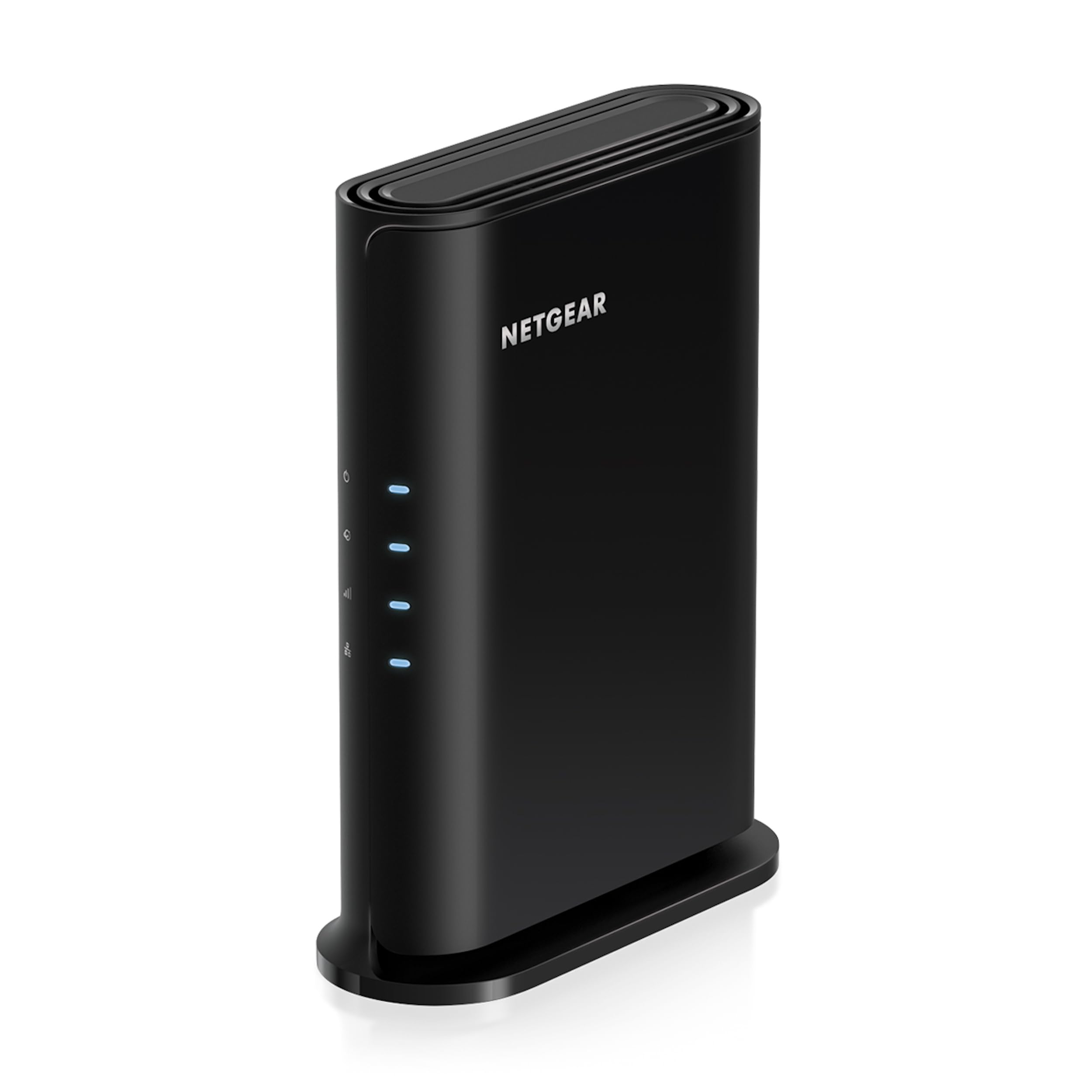
The R6700AX is Netgear’s smallest and most discreet AX1800 router, using internal antennas to maintain a footprint that fits easily on a desk or shelf without protruding elements. For apartments and condos under 1,500 sq ft, the coverage is reliable across 20 devices, and the 5 GHz stream handles 4K streaming and video calls without buffer drops. Setup is available through the Nighthawk app or a web browser, accommodating both casual users and those who prefer a traditional interface.
The security model is cleaner than the premium RAX50: WPA3 encryption and automatic firmware updates are included at no cost, while the Netgear Armor subscription remains optional rather than aggressively upsold. The R6700AX also supports the same Nighthawk app ecosystem, which provides real-time traffic monitoring and device prioritization. The four gigabit LAN ports are enough for a gaming console, PC, streaming box, and a smart TV.
The limitation is clear: this is a standalone router with no mesh expansion path. If you later need to extend coverage to a second floor or a detached garage, the R6700AX cannot pair with another Netgear router to form a mesh. The 1,500 sq ft coverage rating assumes an open layout; homes with concrete or brick walls will hit dead zones sooner. It is a solid, focused device for a single-level space, not a scalable solution.
Why it’s great
- Compact internal-antenna design fits tight spaces
- Setup via app or web browser for flexibility
- WPA3 and automatic updates at no extra cost
Good to know
- No mesh expansion capability for future coverage needs
- Optimal range limited to 1,500 sq ft open layout
6. ASUS RT-AX1800S

The RT-AX1800S is the most affordable way to enter the ASUS router ecosystem while retaining AiProtection Classic—Trend Micro’s free, subscription-free network security suite. For homes with 15–20 devices on a mid-range internet plan (200–400 Mbps), the AX1800 bandwidth ceiling (up to 1200 Mbps on 5 GHz, 574 Mbps on 2.4 GHz) is sufficient for simultaneous streaming, online gaming, and video calls. The dual-core processor and OFDMA handle concurrent traffic without the queuing delays common on older WiFi 5 routers.
AiMesh compatibility remains intact on this entry-level model, so it can serve as a mesh node or primary router in a larger ASUS mesh network later. The four retractable external antennas provide strong 2.4 GHz range—reviewers report stable connections 20–30 feet outside the home—and the 5 GHz band delivers reliable throughput for gaming consoles and streaming sticks. The web-based UI offers granular control over band steering, QoS prioritization, and device management.
The physical design is utilitarian, with a matte black housing and retractable antennas that fold down for transport. The RT-AX1800S lacks a USB port, so there is no option for network-attached storage or printer sharing. If you need that functionality, stepping up to the AX3000 tier (like the RT-AX58U) is necessary. For pure router duties with free security, this is the baseline that sets the standard for the category.
Why it’s great
- AiProtection Classic security at no ongoing cost
- AiMesh compatible for future whole-home expansion
- Strong 2.4 GHz range for devices far from the router
Good to know
- No USB port for storage or printer sharing
- AX1800 ceiling limits throughput for gigabit plans
7. TP-Link Archer AX21 (AX1800)

The Archer AX21 is the router that defines the budget AX1800 category. At a price point that undercuts most competitors, it delivers the core WiFi 6 technologies—OFDMA, MU-MIMO, and 1024-QAM—that reduce congestion and improve throughput for homes with multiple devices. Real-world speed improvements are measurable: users upgrading from ISP-provided gateways or WiFi 5 routers report 15–20% higher throughput and more stable connections, especially on the 5 GHz band. The four external antennas and FEM chipset provide signal coverage that matches or exceeds the range of much more expensive routers in a typical 1,500 sq ft home.
Setup flexibility is a highlight: the Tether app works for quick configuration, but power users can access the full web-based admin interface for manual band steering, IP whitelisting/blacklisting, and VPN server configuration. The Archer AX21 supports OpenVPN and PPTP VPN servers, a rare feature at this entry-level price. It also supports EasyMesh, allowing future add-ons for coverage expansion—though the mesh feature is limited to TP-Link EasyMesh-compatible devices.
Customer support from TP-Link is responsive and US-based, with a dedicated phone line for troubleshooting. The primary compromise is the absence of a USB port: there is no way to share a drive or printer over the network directly from the router. Additionally, the 1.8 Gbps total bandwidth is shared between bands, so heavy simultaneous upload and download traffic on both bands can hit the ceiling. For the price, however, the AX21 offers more useful features per dollar spent than nearly any other budget WiFi 6 router on the market.
Why it’s great
- Core WiFi 6 features (OFDMA, MU-MIMO) at a very accessible price
- VPN server support (OpenVPN and PPTP) included
- EasyMesh compatible for future coverage expansion
Good to know
- No USB port for network storage or printer sharing
- 1.8 Gbps total bandwidth ceiling limits heavy multi-band traffic
FAQ
What is the actual speed difference between AX1800 and AX3000 for budget buyers?
Do budget WiFi 6 routers support WPA3 security?
Can I use a budget WiFi 6 router with a mesh system later?
Is it worth buying a renewed budget WiFi 6 router?
Final Thoughts: The Verdict
For most users, the best budget wifi 6 router winner is the ASUS RT-AX58U (Renewed) because it combines AX3000 speed with subscription-free AiProtection security and AiMesh expandability at a price that undercuts new AX1800 models. If you want the highest raw bandwidth for a larger home, grab the Netgear Nighthawk RAX50 (Renewed). And for a dead-simple mesh setup with a built-in Zigbee hub, nothing beats the Amazon eero 6.

Mo Maruf
I created WellFizz to bridge the gap between vague wellness advice and actionable solutions. My mission is simple: to decode the research and give you practical tools you can actually use.
Beyond the data, I am a passionate traveler. I believe that stepping away from the screen to explore new environments is essential for mental clarity and physical vitality.