Our readers keep the lights on and my smoothie glass nicely filled. As an Amazon Associate, I earn from qualifying purchases.
A telescope with a shaky tripod or a plastic lens can kill a beginner’s interest in astronomy before the first night is over. The real challenge in this category is separating the few optically sound refractors and Maksutov-Cassegrain designs from the countless toys that promise 200x magnification but deliver blurry blobs of light.
I’m Mohammad Maruf — the founder and writer behind WellFizz. I’ve pored over hundreds of product specs, customer reviews, and optical performance data to identify which telescopes actually deliver usable views without forcing beginners to spend a fortune.
Whether you’re buying for a curious eight-year-old or starting your own journey into amateur astronomy, finding the right budget telescope for beginners means ignoring marketing hype and focusing on aperture size and mount stability instead.
How To Choose The Best Budget Telescope For Beginners
Choosing a first telescope involves more than picking the cheapest option. Beginners should prioritize a stable mount, a large enough aperture to gather light, and fully-coated optics that enhance contrast. Avoid models that brag about magnification—high zoom on a shaky tripod and a small lens produces unusable views.
Aperture Is Everything
The aperture (the diameter of the main lens or mirror) determines how much light the telescope collects. A 70mm aperture is the minimum for seeing details on the Moon, Jupiter’s moons, and Saturn’s rings. Scopes with a 50mm or 60mm aperture will show the Moon clearly but struggle with planets and deep-sky objects. Look for at least 70mm in the budget tier; 80mm or 90mm offers noticeably brighter, sharper views.
Mount Stability Over Magnification Numbers
An altitude-azimuth (AZ) mount that moves smoothly in two directions is ideal for beginners. Cheap tripods with plastic legs or thin aluminum tubes vibrate with every touch, turning high magnification into a frustrating, shaky mess. A sturdy tripod with a central hook to hang weight (like a bag or water bottle) adds stability at no extra cost. Avoid any telescope sold as a “tabletop” unless you already have a solid surface to place it on.
Optical Coatings and Eyepiece Quality
Fully-coated optics increase light transmission and reduce internal reflections, giving you brighter, higher-contrast images. Avoid telescopes labeled “coated” (just one surface) or those that don’t specify coating at all. The eyepieces included with budget telescopes are often basic Kellner or Huygens designs — upgrading to a Plössl eyepiece later can dramatically improve view quality. A 3x Barlow lens doubles or triples your eyepiece options without buying more eyepieces.
Quick Comparison
On smaller screens, swipe sideways to see the full table.
| Model | Category | Best For | Key Spec | Amazon |
|---|---|---|---|---|
| Koolpte 90mm | Refractor | Best Overall | 90mm aperture, 700mm FL | Amazon |
| SOLOMARK 80mm | Refractor | Large Aperture Value | 80mm aperture, 900mm FL | Amazon |
| Gskyer 70mm | Refractor | Popular Choice | 70mm aperture, fully coated | Amazon |
| Sarblue Mak60 | Catadioptric | Ultra-Portable | 60mm aperture, 750mm FL | Amazon |
| Celestron Travel Scope 70 | Refractor | Travel & Backpack | 70mm aperture, 400mm FL | Amazon |
| Amazon Basics 70mm | Refractor | Budget Pick | 70mm aperture, multi-coated | Amazon |
| Koolpte 70mm | Refractor | Entry-Level | 70mm aperture, 400mm FL | Amazon |
In‑Depth Reviews
1. Koolpte 90mm Aperture 700mm Professional Telescope
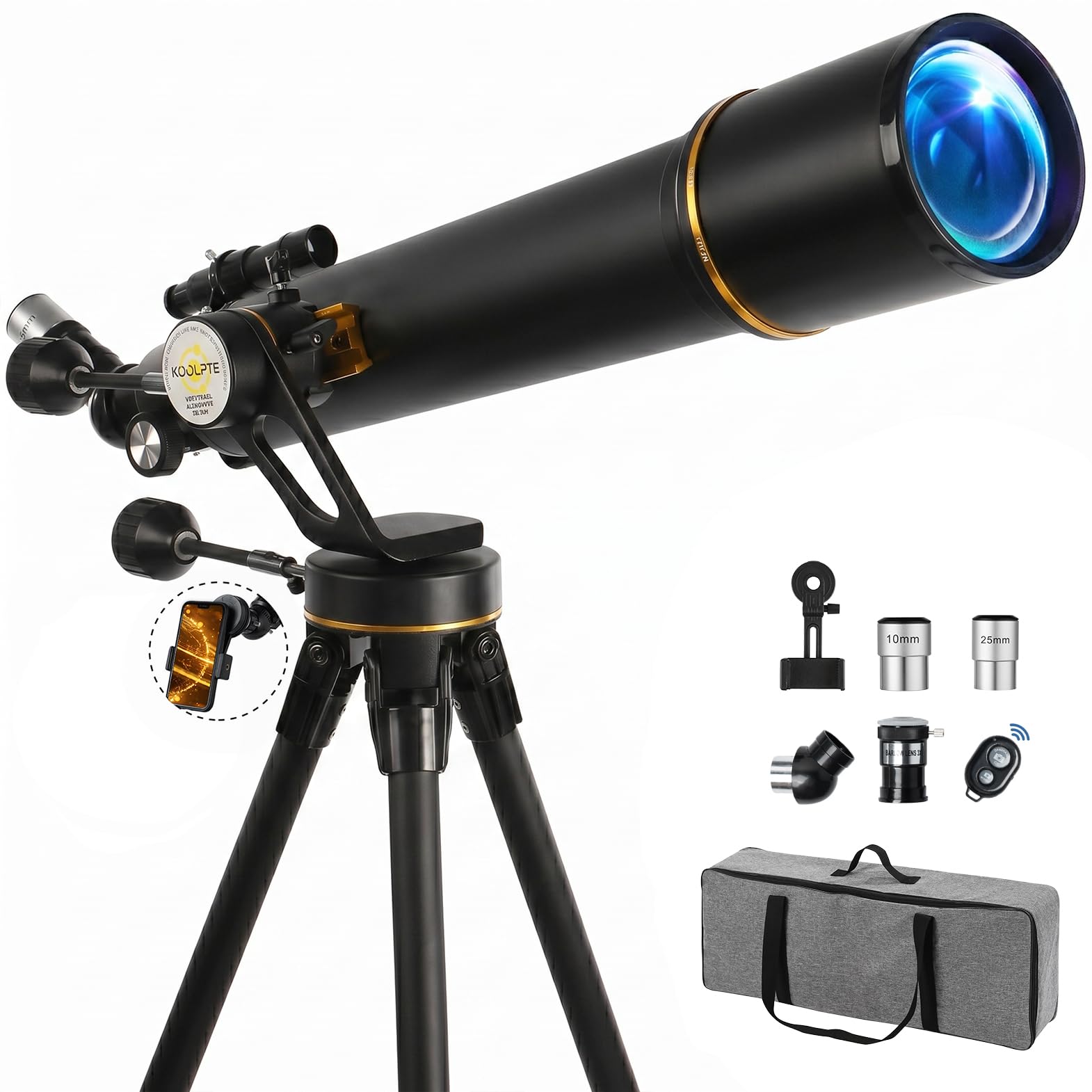
The Koolpte 90mm telescope punches well above its price bracket with a 90mm aperture that captures significantly more light than the standard 70mm entry-level scopes. Its 700mm focal length combined with fully multi-coated optics delivers 99% light transmission, producing bright, high-contrast views of lunar craters, Saturn’s rings, and Jupiter’s moons. The Vertisteel AZ slow-motion mount is a standout feature — it provides smooth, precise tracking without the overshooting or wobble that plagues cheaper designs.
This model includes K10mm and K25mm eyepieces plus a 3x Barlow lens, giving a versatile magnification range from 28x to 210x. The stainless steel tripod is noticeably more rigid than aluminum alternatives, and the included carrying bag makes transport simple. Assembly takes under ten minutes with no tools required, and the phone adapter with wireless remote lets you capture and share your observations easily.
The only downside reported by taller users (over six feet) is that viewing near the zenith requires crouching. The thin metal leg tubes, while adequate, could be thicker for ultimate stability. However, for a mid-range price, you get premium-level aperture and mount performance that will keep a beginner engaged for months rather than weeks.
Why it’s great
- 90mm aperture gathers far more light than typical 70mm beginner scopes
- Vertisteel AZ mount with slow-motion controls enables smooth planetary tracking
- Full multi-coated optics deliver 99% light transmission for high-contrast images
- Tool-free assembly in under ten minutes with included carry bag
Good to know
- Reduced eyepiece height near zenith may be uncomfortable for users over six feet tall
- Stainless steel legs are sturdy but could be thicker for absolute rigidity
2. SOLOMARK 80mm Aperture 900mm Refractor Telescope

SOLOMARK’s 80mm refractor with a 900mm focal length offers a longer focal ratio (f/11.25) that naturally reduces chromatic aberration, making it a strong choice for planetary observation. The fully multi-coated green optics lens improves light transmission and contrast, and the large 80mm aperture captures enough light to reveal Jupiter’s cloud bands and Saturn’s rings with reasonable clarity. The included Super Plössl eyepieces (10mm and 20mm) are a step above the standard Kellner designs found on cheaper models, providing 45x and 90x magnification right out of the box.
The adjustable aluminum tripod features a gimbal with clear altitude and azimuth scales, allowing you to dial in positions more precisely than a basic AZ mount. The 5×24 finderscope with crosshair makes locating objects straightforward for a beginner. All accessories, including the erect-image diagonal and phone adapter, pack into the included carrying bag for easy transport.
A few users note that the instructions for the phone adapter could be clearer, and the tripod, while adequate, benefits from hanging a weight on the center hook for added stability in windy conditions. But for a mid-range price, this telescope delivers professional-level focal length and a larger aperture that will serve a beginner well into intermediate stargazing.
Why it’s great
- 80mm aperture with 900mm focal length reduces chromatic aberration for sharper planetary views
- Super Plössl eyepieces provide better image quality than standard Kellner designs
- AZ mount with altitude and azimuth scales enables precise positioning
- Carrying bag included for easy storage and portability
Good to know
- Phone adapter instructions could be more detailed for first-time users
- Tripod stability improves significantly when a weight is hung from the center hook
3. Gskyer 70mm Aperture 400mm AZ Mount Refractor Telescope

Gskyer’s 70mm refractor is one of the most popular budget telescopes for beginners for good reason. The 400mm focal length (f/5.7) with fully coated glass optics delivers bright, crisp views of the Moon’s craters, Jupiter’s four largest moons, and a faint but recognizable view of Saturn’s rings. The included 10mm and 20mm eyepieces plus a 3x Barlow lens provide a magnification range from 20x to 200x, though the upper end is best reserved for the Moon on steady nights.
The adjustable aluminum alloy tripod is sturdy enough for a 70mm scope, and the carry bag makes travel and storage convenient. The smartphone adapter and wireless remote work well for capturing lunar images and sharing them with friends. Assembly is straightforward, and the 5×24 finderscope with crosshair helps beginners locate targets without frustration.
Customer feedback consistently praises the value proposition — this telescope outperforms toy-level scopes by a wide margin. However, like all short-focal-length refractors, chromatic aberration (purple fringing) appears around bright objects. The standard Kellner eyepieces are functional but upgrading to Plössl eyepieces later will noticeably sharpen the view. For the price, this is a reliable gateway into astronomy that won’t disappoint.
Why it’s great
- Fully coated optics deliver bright, clear views of the Moon and bright planets
- Included smartphone adapter and wireless remote enable easy astrophotography
- Carry bag and adjustable aluminum tripod make it highly portable
- Proven popularity with thousands of positive customer reviews
Good to know
- Some chromatic aberration visible around bright objects at higher magnifications
- Standard Kellner eyepieces benefit from upgrading to Plössl for sharper images
4. Sarblue Mak60 Maksutov-Cassegrain Telescope
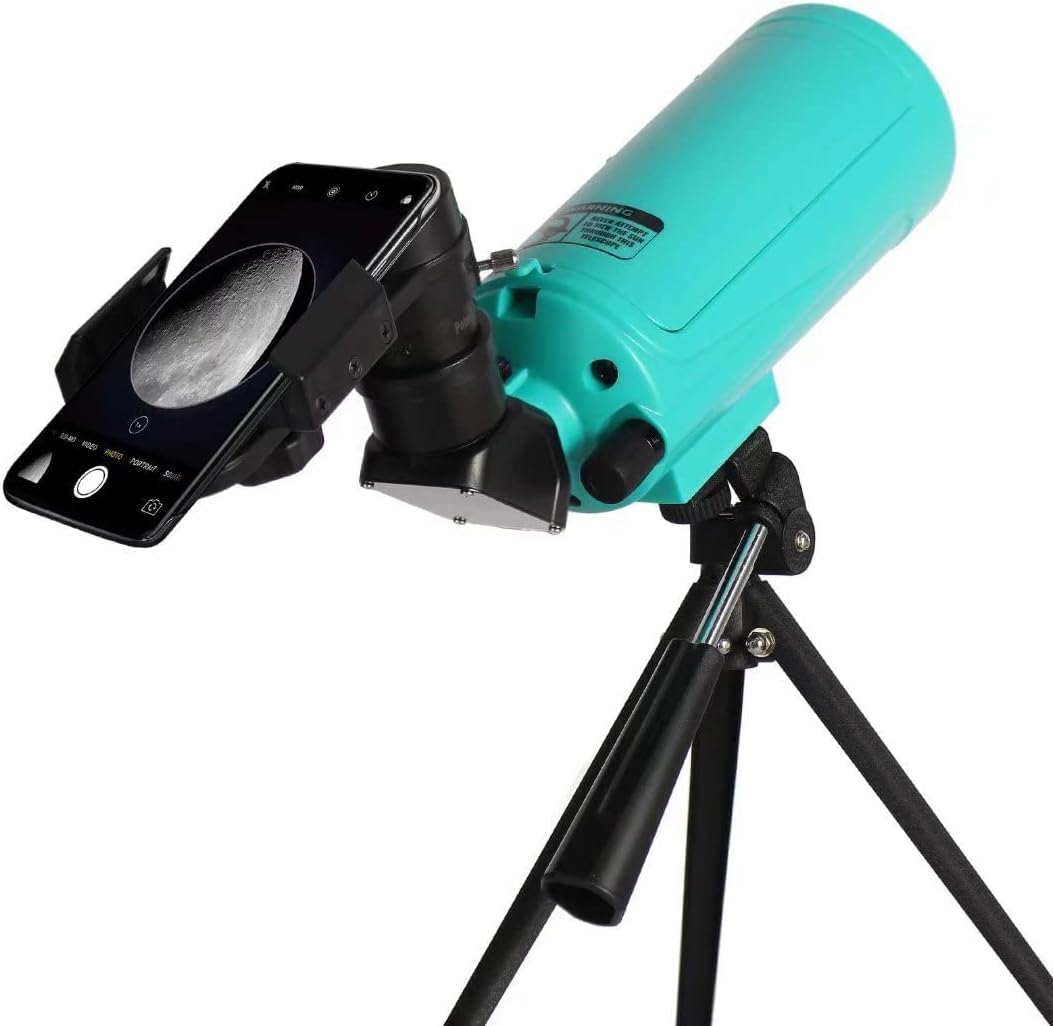
The Sarblue Mak60 is a Maksutov-Cassegrain catadioptric telescope that packs a 750mm focal length into a tube just 200mm long. This design minimizes spherical and chromatic aberrations, producing sharp, high-contrast images that rival much larger refractors. With a 60mm aperture and fully multi-coated optics, it delivers excellent lunar detail, clear views of Jupiter’s moons, and a recognizable Saturn ring even at modest 37.5x magnification with the included 20mm eyepiece.
Portability is this telescope’s superpower — it fits easily into a small backpack, making it ideal for camping trips, balcony stargazing, or travel astronomy. The tabletop tripod is basic but workable on any flat surface. The detachable lid reveals the internal mirror design, which doubles as an educational tool for curious kids. The smartphone adapter attaches securely to the included eyepiece, enabling easy photo capture of your observations.
The short tabletop tripod is the weakest link — upgrading to a standard photo tripod with a 1/4-20 screw mount transforms the stability and viewing height. There’s no finderscope, so beginners should use the included green laser pointer or a star-hopping technique. The narrow field of view (1.7 degrees) makes locating deep-sky objects challenging, but for lunar and planetary observation on a budget, this compact Mak offers outstanding optical quality.
Why it’s great
- Maksutov-Cassegrain design virtually eliminates chromatic aberration for sharp views
- Ultra-compact 200mm tube length fits in any backpack for true portability
- Fully multi-coated optics deliver excellent lunar and planetary contrast
- Educational detachable lid helps beginners understand the optical design
Good to know
- Tabletop tripod is functional but best replaced with a standard photo tripod
- Narrow 1.7-degree field of view makes deep-sky object location challenging
- No included finderscope — expect to use a green laser pointer or star charts
5. Celestron Travel Scope 70 Portable Refractor
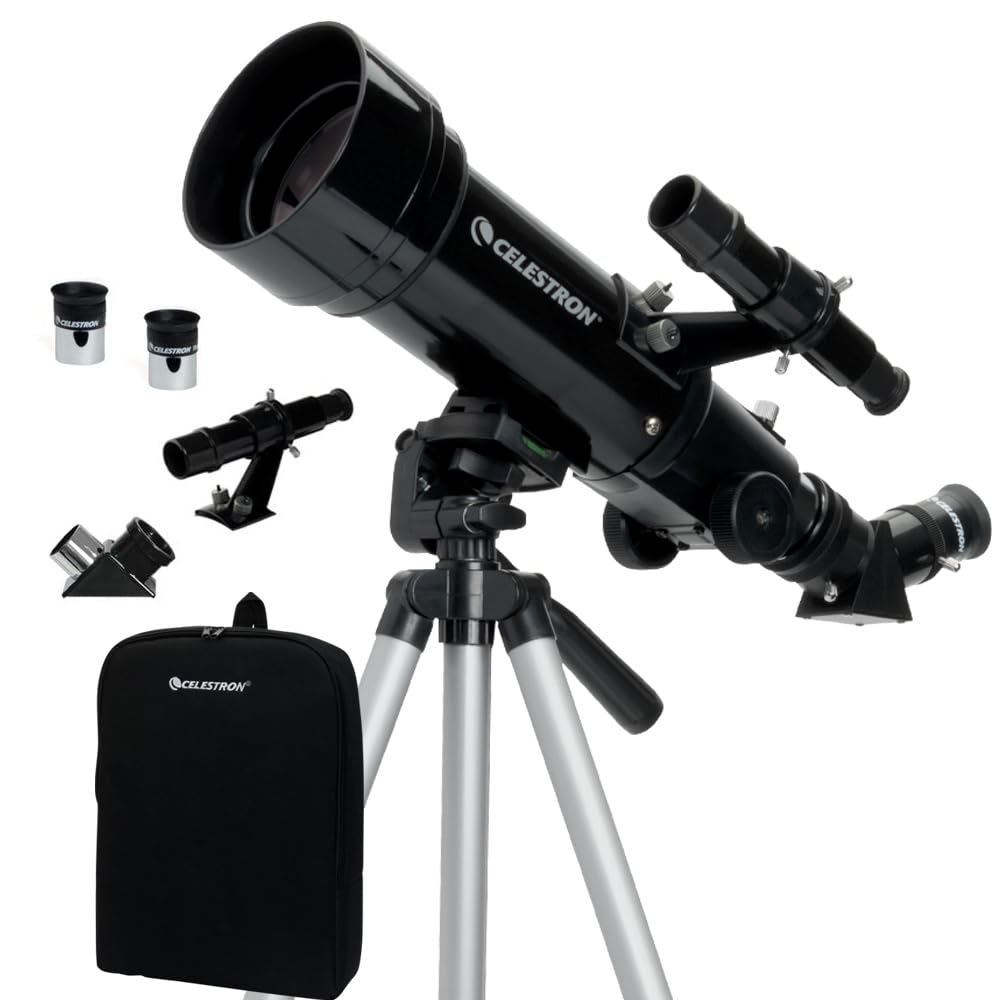
Celestron is a trusted name in amateur astronomy, and the Travel Scope 70 lives up to that reputation with a 70mm fully-coated refractor that sets up in seconds. The 400mm focal length (f/5.7) provides wide-field views ideal for scanning star fields, the Moon, and terrestrial scenery during daylight. The included 20mm eyepiece (20x) gives pleasing low-power sweeps, while the 10mm eyepiece (40x) pulls in lunar craters and Jupiter’s moons with decent clarity.
The standout feature is the padded backpack that holds the entire kit — telescope tube, tripod, eyepieces, finderscope, and star diagonal — making this the most grab-and-go option in this review. The no-tool setup is genuinely fast, and the included Starry Night software helps newcomers learn the night sky from their computer. The 45-degree erect-image diagonal makes this scope equally useful for bird watching and daytime landscape viewing.
The tripod is the weakest area — many users report wobbliness, especially when extended to full height. A light touch is required for focusing at higher magnifications. The 45-degree diagonal is convenient for terrestrial use but forces an awkward neck angle for astronomical viewing above 60 degrees altitude. Despite these ergonomic compromises, the optical quality from Celestron’s fully-coated glass is reliable, and the combination of brand trust, backpack portability, and software makes this a solid beginner package.
Why it’s great
- Celestron’s fully-coated 70mm optics deliver reliable, crisp views of the Moon and planets
- Padded backpack includes all components for maximum portability
- No-tool setup takes seconds — genuinely beginner-friendly
- Included Starry Night software helps beginners learn celestial navigation
Good to know
- Tripod wobbles when fully extended; requires a light touch for focusing
- 45-degree diagonal is uncomfortable for overhead astronomical viewing
- Basic eyepieces benefit from upgrading to Celestron’s accessory kit
6. Amazon Basics 70mm Aperture 400mm AZ Mount Telescope
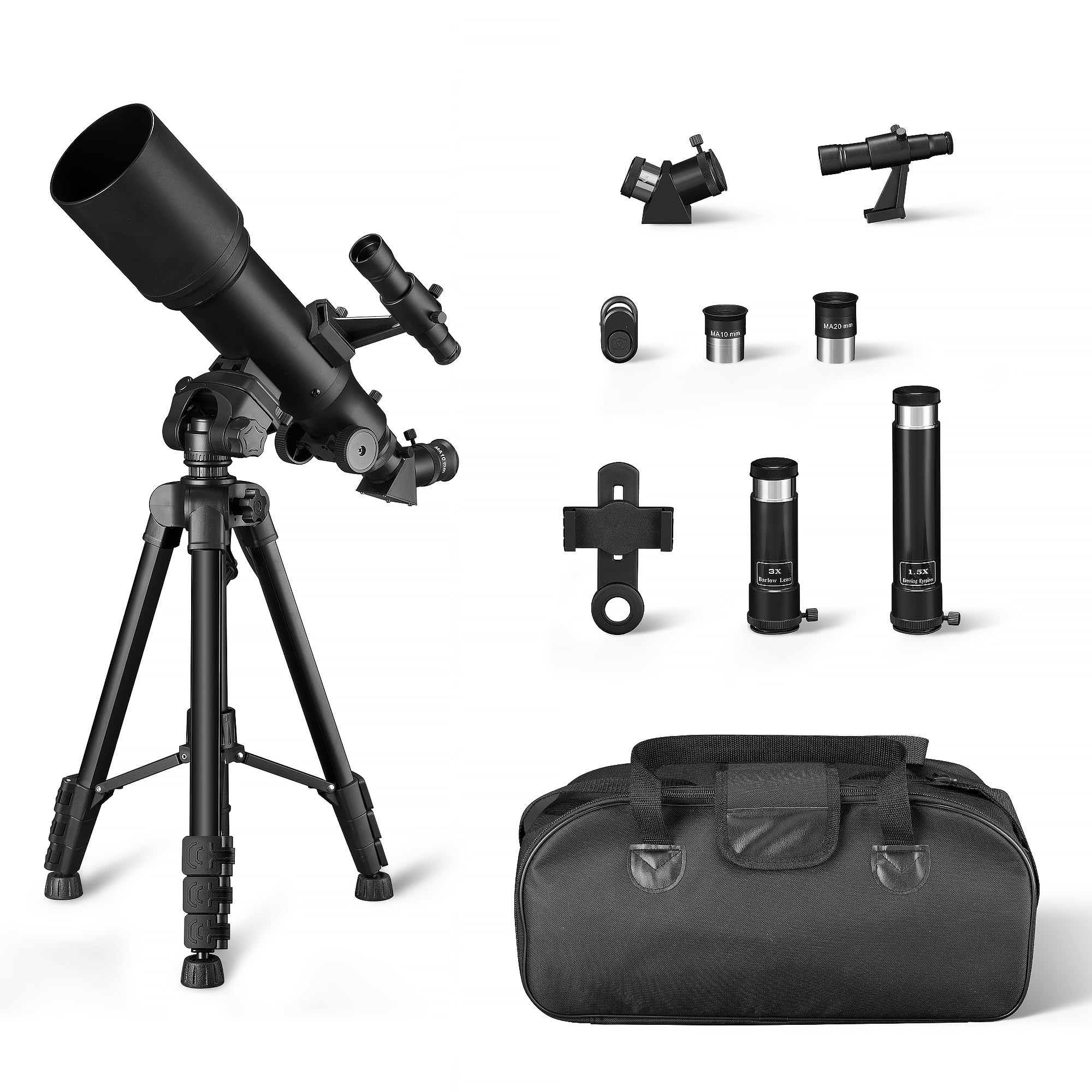
Amazon Basics enters the telescope market with a 70mm refractor that includes everything a beginner needs at a very appealing price. The multi-coated optics and 400mm focal length produce sharp lunar views and recognizable planetary images. The AZ mount moves smoothly in altitude and azimuth, and the lightweight aluminum tripod adjusts from 23.6 inches to 63.2 inches, accommodating both seated and standing observers. The erect-image design means it works well for terrestrial viewing during the day too.
The accessory bundle is generous: MA 10mm and 20mm eyepieces, a 3x Barlow lens, a 1.5x erecting eyepiece, a finderscope, a smartphone adapter, a wireless remote, and a carry bag are all included. The 18x to 120x magnification range is realistic and usable. The carry bag also doubles as a weight that can be hung from the tripod’s center hook to improve stability — a smart design touch that compensates for the lightweight tripod.
Some customers have reported packaging issues where accessories arrived loose, and the manual could be more detailed for absolute beginners. The Kellner-type eyepieces are functional but not premium. However, considering the complete kit price, this Amazon Basics telescope offers excellent value and a low barrier to entry. It’s a genuine astronomical instrument, not a toy, and will show a beginner enough detail to decide if they want to invest further in the hobby.
Why it’s great
- Multi-coated optics deliver sharp lunar and planetary views at an entry-level price
- Complete accessory bundle includes Barlow lens, smartphone adapter, remote, and bag
- Erect-image design allows daytime terrestrial and nighttime astronomical use
- Carry bag doubles as a tripod weight to improve stability
Good to know
- Packaging quality control issues reported by some customers
- Manual could be more detailed for first-time assemblers
- Kellner eyepieces are functional but upgrading to Plössl is recommended
7. Koolpte 70mm Aperture 400mm AZ Mount Refractor Telescope
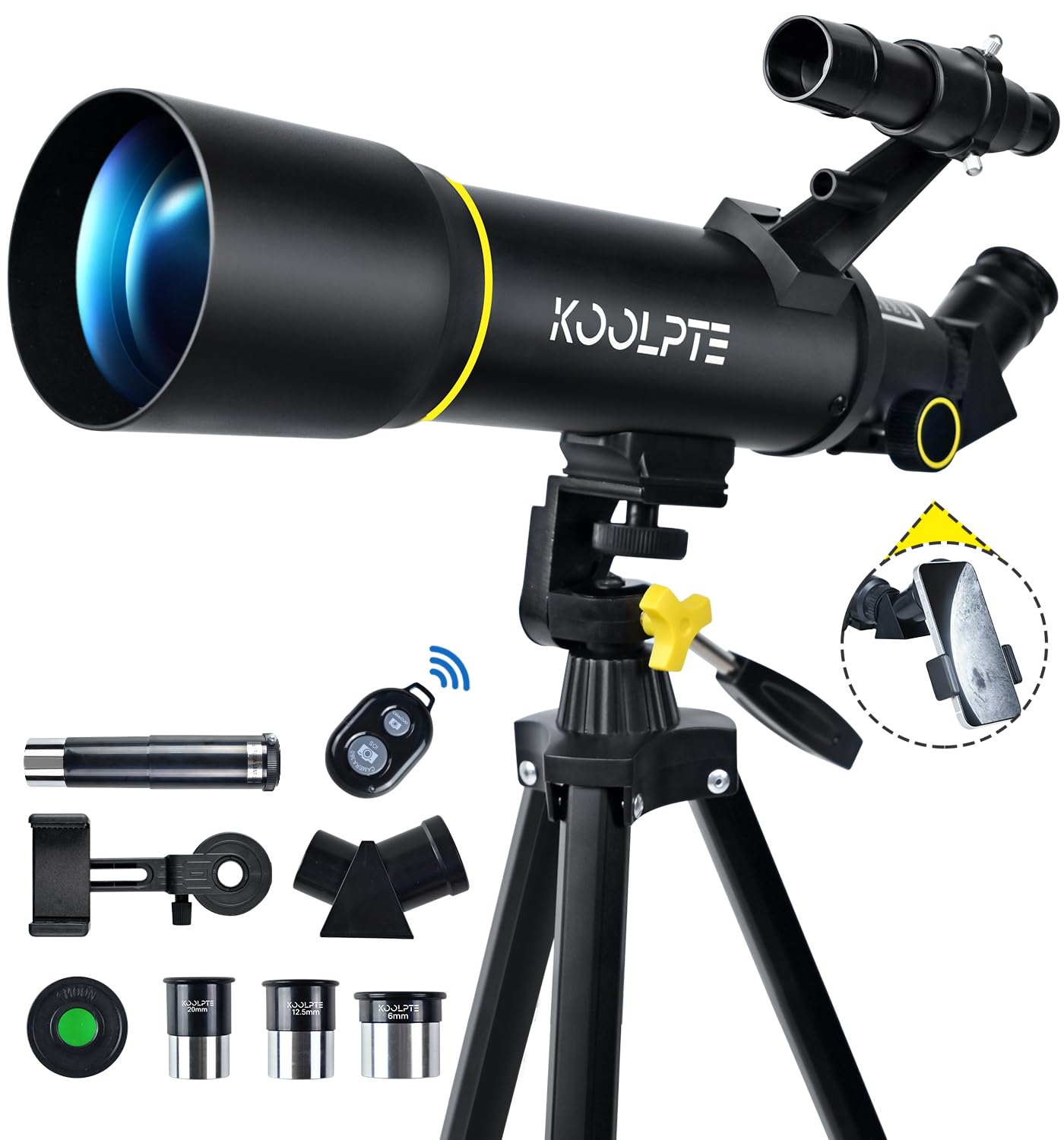
Koolpte’s entry-level 70mm refractor offers a 400mm focal length with anti-reflection coated optics that produce bright, serviceable views of the Moon and brighter deep-sky objects. The AZ mount is simple and intuitive, and the lightweight aluminum tripod is easy to set up in any backyard. The included 6mm, 10mm, and 25mm eyepieces plus a 3x Barlow lens provide magnification from 16x to 200x, though 200x is only usable on very steady nights and with perfect focus.
This telescope ships with a smartphone adapter and wireless remote, allowing beginners to capture their first lunar images without additional purchases. The 5×24 finderscope with crosshair helps locate objects, and the tripod includes a central tray for holding eyepieces. Assembly is quick, and the scope is light enough for a child to carry outside.
Customer feedback mentions that the phone adapter can scratch larger phone lenses if not handled carefully. The tripod is functional but feels less robust than the aluminum tripods on slightly pricier models. The 6mm eyepiece at 200x is frustratingly dim and shaky — stick to the 25mm and 10mm for the best experience. For the lowest price point in this review, you get a genuine telescope that shows the moon beautifully and introduces the basics of aiming and focusing without a huge financial commitment.
Why it’s great
- Anti-reflection coated optics deliver bright lunar views at the lowest entry price
- Three eyepieces plus a 3x Barlow provide versatile magnification options
- Smartphone adapter and wireless remote included for basic astrophotography
- Lightweight and quick to assemble, suitable for children and teens
Good to know
- Phone adapter can scratch sensitive phone lens surfaces
- 6mm eyepiece at 200x produces dim, shaky images on the lightweight tripod
- Tripod stability is adequate but not as solid as mid-range options
FAQ
Can I see Saturn’s rings with a budget beginner telescope?
What magnification should I actually use for the Moon and planets?
Do I really need a smartphone adapter and wireless remote?
Why does my telescope show everything upside down?
What accessories should a beginner buy first?
Final Thoughts: The Verdict
For most users, the budget telescope for beginners winner is the Koolpte 90mm because it offers an unusually large 90mm aperture and a smooth Vertisteel AZ mount at a price that undercuts what you’d expect for this level of light-gathering ability. If you want true portability without sacrificing optical quality, grab the Sarblue Mak60 — its Maksutov-Cassegrain design fits in a backpack and delivers aberration-free lunar and planetary views. And for the lowest barrier to entry, nothing beats the Amazon Basics 70mm, which includes a comprehensive accessory kit and a solid 70mm aperture at a price that makes astronomy accessible to anyone.

Mo Maruf
I created WellFizz to bridge the gap between vague wellness advice and actionable solutions. My mission is simple: to decode the research and give you practical tools you can actually use.
Beyond the data, I am a passionate traveler. I believe that stepping away from the screen to explore new environments is essential for mental clarity and physical vitality.