Our readers keep the lights on and my smoothie glass nicely filled. As an Amazon Associate, I earn from qualifying purchases.
A cold, hard, or deflated sleeping pad is the fastest way to ruin a night on the trail. The wrong choice means sleepless hours spent shivering on frozen ground or waking up sore from every root and rock beneath your tent. For backpackers, the trade-off between weight, comfort, and cost is the real puzzle — and getting it right determines whether you wake up ready to hike or ready to go home.
I’m Mohammad Maruf — the founder and writer behind WellFizz. I’ve spent years analyzing backpacking gear specifications, from foam densities and R-values to fabric denier ratings and inflation mechanisms, to separate genuinely capable budget designs from those that fail in the backcountry.
Whether you prioritize a closed-cell foam mat for absolute reliability or a lightweight inflatable with a built-in pump for comfort, knowing which specs matter helps you land on the best budget backpacking sleeping pad for your specific trip style.
How To Choose The Best Budget Backpacking Sleeping Pad
Selecting a budget-friendly sleeping pad is not simply about finding the cheapest option. The goal is to maximize three variables — weight, insulation, and comfort — without exceeding your spending limit. Here is what to check before buying.
R-Value and Temperature Rating
R-value measures how well a pad resists heat loss through the ground. For three-season backpacking (spring to fall), a pad with an R-value of 2.0 to 4.0 is typically sufficient. If you plan to camp below freezing, look for a pad with an R-value of 4.5 or higher. Closed-cell foam pads often have lower R-values but are more predictable because they cannot deflate and lose insulation value.
Construction Type: Foam vs. Inflatable
Closed-cell foam pads are durable, puncture-proof, and require no setup time. They are bulkier on the outside of a pack but weigh very little. Inflatable pads offer superior comfort and a much smaller packed size, but they carry a risk of punctures and require manual or pump inflation. Many backpackers carry both — a thin foam pad for sit breaks and a lightweight inflatable for sleeping.
Weight and Packed Volume
Every ounce matters on a multi-day hike. A full-length foam pad typically weighs between 10 and 16 ounces. Inflatable pads range from 13 ounces to over 2 pounds depending on thickness and insulation layers. Check the rolled or folded dimensions — some inflatables compress to the size of a water bottle, while foam pads remain strapped to the outside of a pack.
Thickness and Sleeping Position
Side sleepers generally need more cushion to prevent hips and shoulders from pressing into the ground. A foam pad under 1 inch thick may not be enough on its own. Inflatable pads between 2.5 and 4 inches thick offer the most relief for side sleepers. Back sleepers can often get away with a thinner pad if the ground is not too uneven.
Quick Comparison
On smaller screens, swipe sideways to see the full table.
| Model | Category | Best For | Key Spec | Amazon |
|---|---|---|---|---|
| Hikenture Sleeping Pad | Inflatable | Cold-weather camping | R-Value 6.2 / 1.53 lb | Amazon |
| NEMO Switchback | Closed Cell Foam | Ultralight reliability | R-Value 2.0 / 14.8 oz | Amazon |
| Featherstone El Cordion | Closed Cell Foam | Insulated foam pad | R-Value 2.1 / 16 oz | Amazon |
| VALEHOWL Ultralight Pad | Inflatable | Built-in pump comfort | Thickness: 2.7″ / 1.8 lb | Amazon |
| GDREAMT Inflatable Pad | Inflatable | Extra wide cushion | Thickness: 4″ / 2.44 lb | Amazon |
| FOCHIER F Foam Pad | Closed Cell Foam | Lightweight durability | Weight: 0.86 lb / IXPE Foam | Amazon |
| AceCamp Accordion Pad | Closed Cell Foam | Ultralight entry-level | Weight: 11 oz / R-Value 2.0 | Amazon |
In‑Depth Reviews
1. Hikenture Camping Sleeping Pad
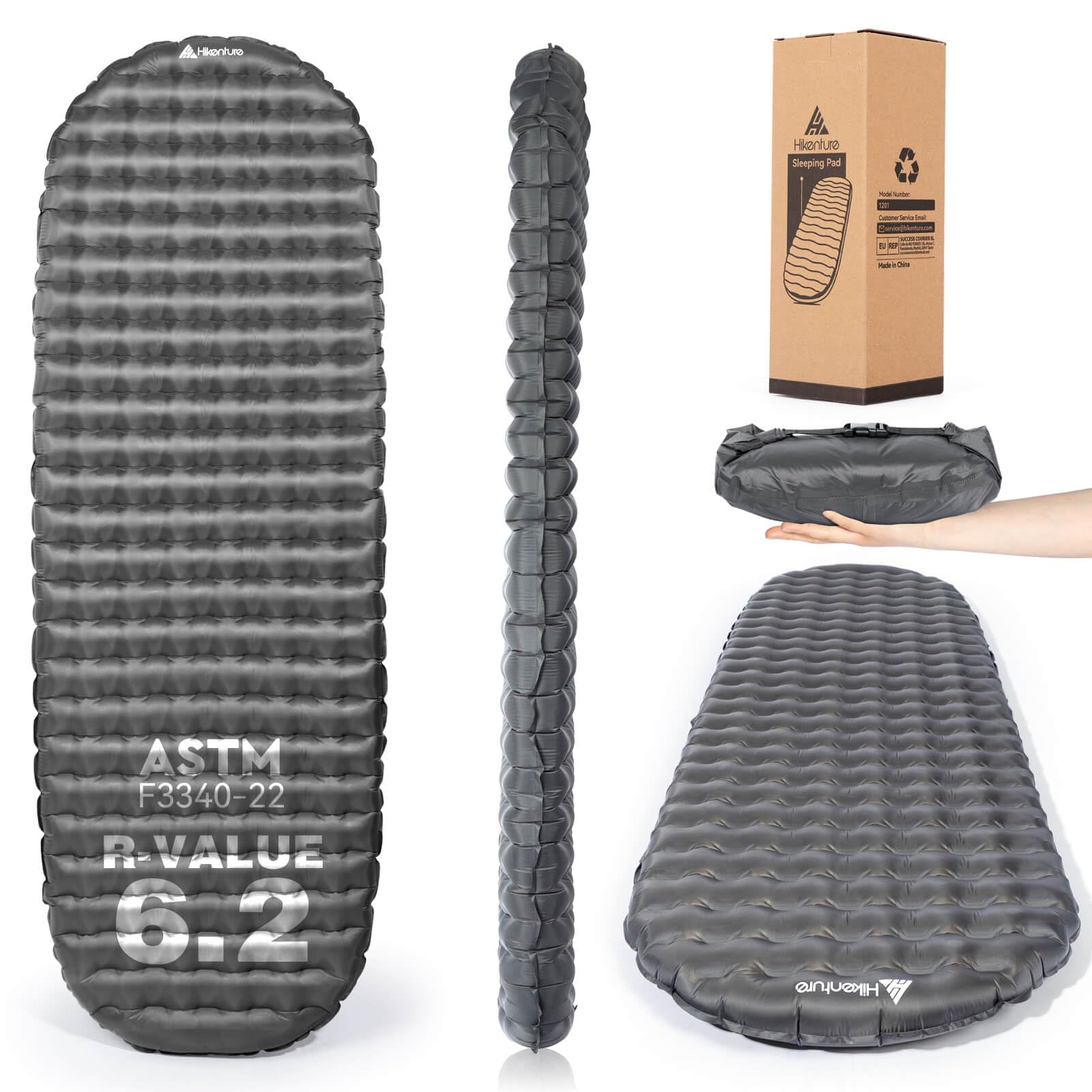
This inflatable pad delivers an R-value of 6.2, tested under ASTM F3340-22, making it the strongest winter-rated pad in this lineup. The 3.2-inch thickness provides cushion deep enough for side sleepers without bottoming out on uneven tent floors. Its internal airbag structure distributes weight evenly, and the aluminum film lining reflects body heat effectively in sub-freezing conditions.
At just 1.53 pounds, it packs down to 12 x 3.5 inches, fitting easily into a backpack or side pocket. The included storage bag doubles as a 40-liter pump sack, allowing full inflation in three quick presses. The TPU liner is environmentally friendly and resists moisture penetration, and the nylon outer shell holds up against rough ground contact.
Users consistently report comfort in snowstorms and around 0°F conditions when paired with an appropriate sleeping bag. The only trade-off is a slight crinkle noise from the reflective liner, which most campers find minor compared to the warmth and packability this pad offers for the price point.
Why it’s great
- Exceptional R-value 6.2 for four-season use
- Lightweight and packs extremely small
- Pump sack inflation is fast and reliable
Good to know
- Reflective liner produces some crinkle noise
- Deflation nozzle located at foot end can be awkward
2. NEMO Equipment Switchback Foam Sleeping Pad
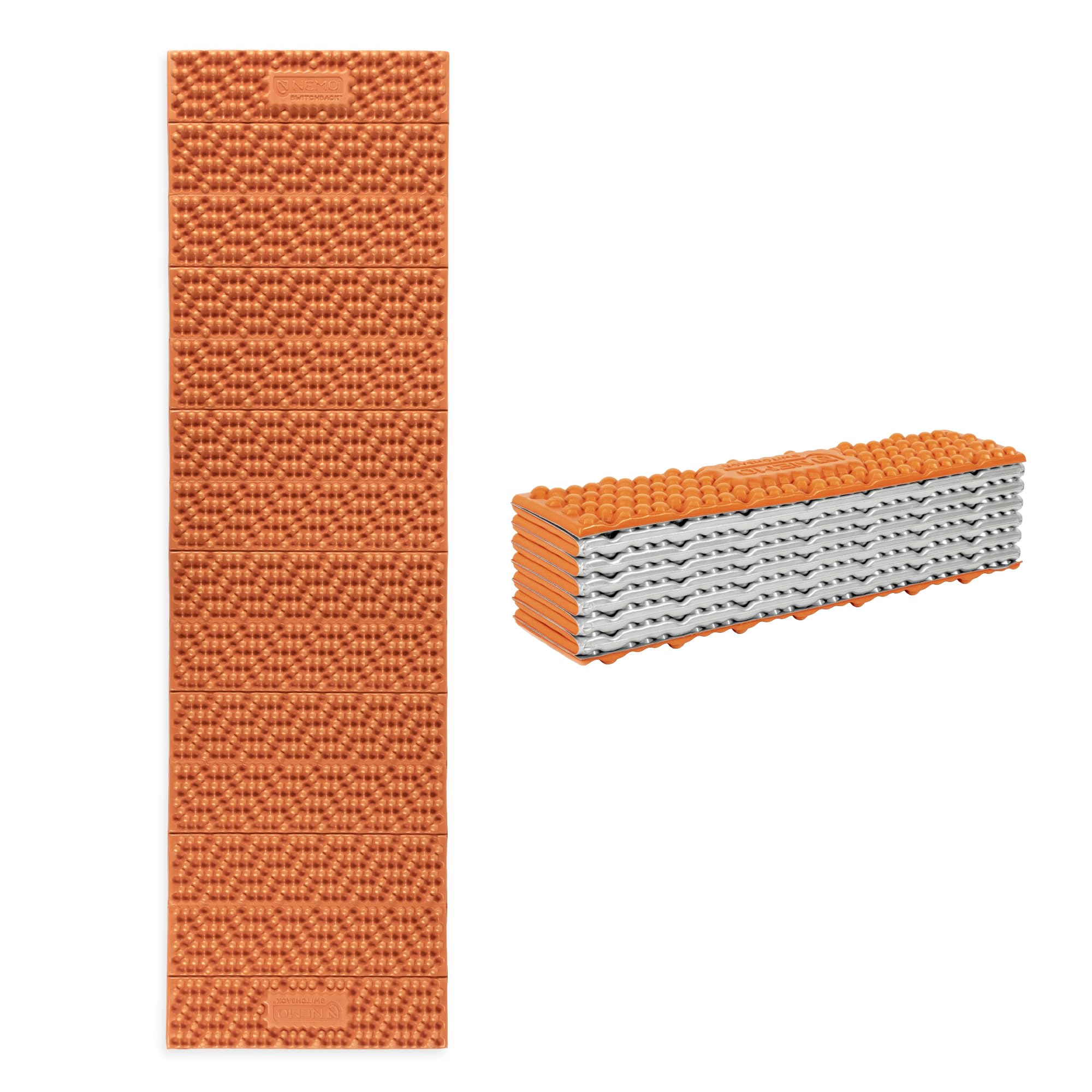
The NEMO Switchback is the gold standard for closed-cell foam pads in the ultralight community. Its hexagonal nesting pattern creates taller, wider nodes compared to traditional egg-crate designs, delivering noticeably more cushion without adding weight. The dual-density Axiotomic foam uses a soft layer against the body and a firm layer underneath for structural support.
Weighing just 14.8 ounces, the Switchback folds into a compact 20 x 5 x 5.5-inch block that straps neatly to the outside of any backpack. The metallized thermal reflective film on the bottom traps heat, giving it an R-value of 2.0 — adequate for spring through fall conditions. It doubles as a sit pad around camp or a gear insulator under an inflatable mattress.
Reviewers praise its reliability for thru-hiking and rough terrain use, with many using it solo or layering it beneath an inflatable for extra warmth in winter. The foam is durable enough for years of use, though some users note it is less plush than air pads. The lifetime warranty from NEMO adds long-term confidence.
Why it’s great
- Proven hexagonal node design for extra comfort
- Extremely durable and never punctures
- Versatile as stand-alone pad or insulation layer
Good to know
- Less cushioned than comparable inflatable pads
- Bulkier packed volume than inflatable options
3. Featherstone Outdoor El Cordion Insulated Sleeping Pad

The Featherstone El Cordion uses irradiation cross-linked polyethylene foam combined with a dual-density heat reflective film to achieve an R-value of 2.1. This is the highest insulation rating among all closed-cell foam pads in this review, making it a strong choice for three-season backpackers who want dependable ground insulation without the risk of punctures.
The hexagonal node pattern provides 40% more coverage and elevation above the ground than standard egg-crate foam designs. Each node supports the body while trapped air between nodes retains warmth. At 16 ounces, it is only slightly heavier than the NEMO Switchback but offers a wider surface area that keeps elbows and hips off the ground during restless sleep.
Backpackers consistently note that this pad rivals more expensive options from Therm-a-Rest and NEMO at a lower cost. The elastic band keeps it tightly folded for pack strapping, and the pad can be cut down to torso length without losing structural integrity. The limited lifetime warranty from a US-based company removes the risk of early failure.
Why it’s great
- Highest R-value in its foam category
- Wider profile reduces edge pressure points
- Backed by limited lifetime warranty
Good to know
- Foam feels stiffer than NEMO Switchback
- Packed size is similar to other full-length foam pads
4. VALEHOWL Ultralight Camping Sleeping Pad
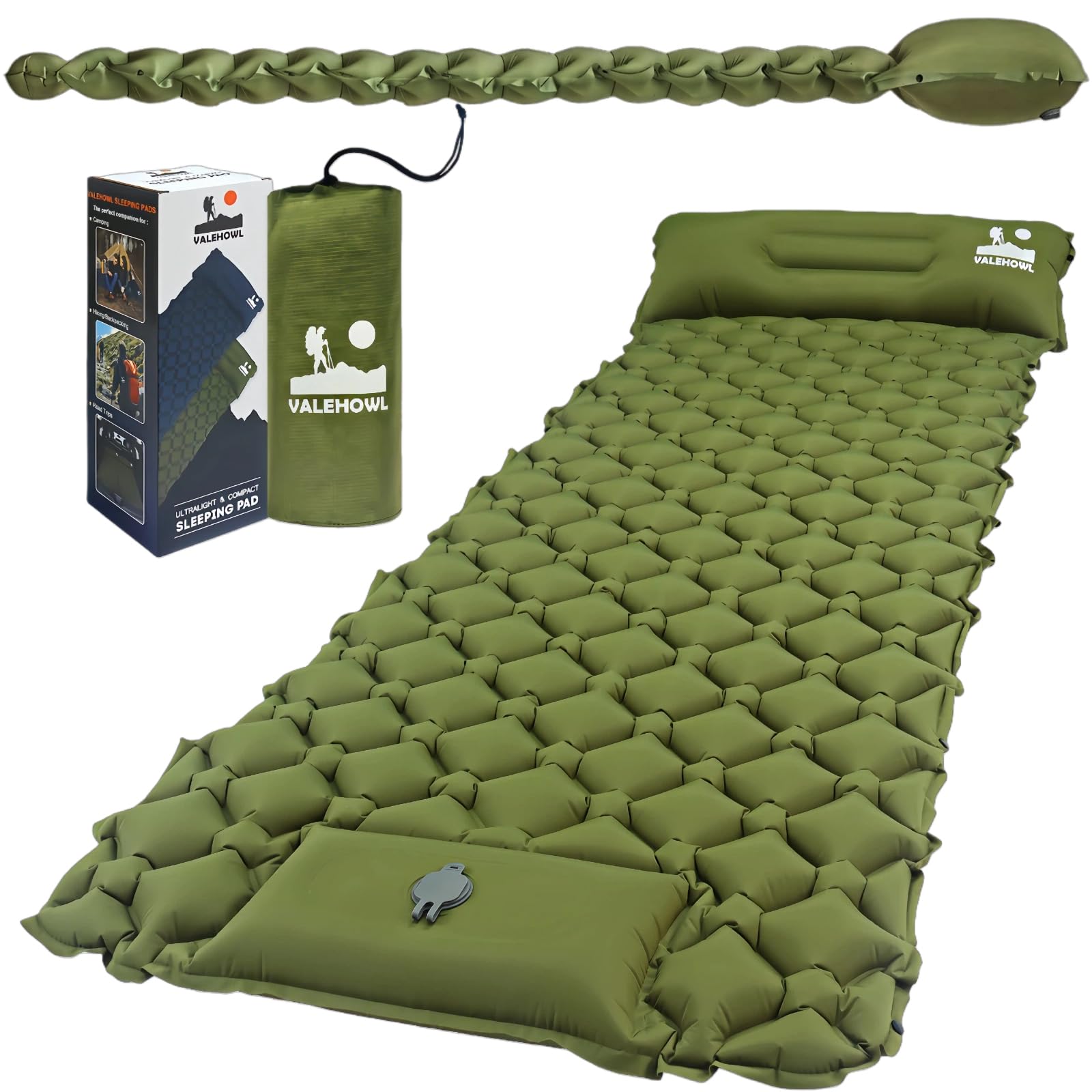
The VALEHOWL pad offers a 2.7-inch thick honeycomb air chamber design that evenly distributes pressure across the body. It integrates a built-in foot pump that inflates the pad in roughly 40 seconds — no separate pump or breath inflation required. The 40D nylon outer layer resists abrasion from rocks and branches, while the TPU coating seals against moisture.
With an R-value of 3.0, this pad is optimized for three-season use in temperatures between 35°F and 95°F. It measures 75 x 25 inches, accommodating users up to 6 feet 3 inches tall, and includes a built-in pillow contour for neck and spinal alignment. The side snap buttons allow two pads to connect for a double sleeping surface.
At 1.8 pounds, it is heavier than ultra-minimalist options, but the built-in pump and integrated pillow reduce the need for additional gear. Reviewers highlight the ease of inflation and the sturdy feel when fully pressurized. The valve system requires careful sealing to prevent slow air loss, but most users find it reliable after a few uses.
Why it’s great
- Built-in foot pump inflates in under a minute
- Integrated ergonomic pillow reduces pack weight
- Connectable design for paired camping
Good to know
- Heavier than foam pads of similar price
- Pillow position may not suit all sleepers
5. GDREAMT Inflatable Camping Sleeping Pad with Pillow

The GDREAMT pad prioritizes cushion above all else with a full 4-inch thickness when fully inflated. The hexagon air cell structure ergonomically supports pressure points across the hips, shoulders, and lower back. A built-in pillow at the head end relieves neck strain without requiring a separate camping pillow, saving both weight and pack space.
Constructed from 50D nylon with a waterproof TPU coating, this pad feels thicker and sturdier than many budget inflatables. The thermoform-sealed edges reduce the risk of air leaks along the seams. It measures 74.8 x 26.77 inches — notably wider than standard pads, providing extra room for restless sleepers who roll side to side during the night.
Weighing 2.44 pounds, this is the heaviest pad in the review, but the trade-off is a bed-like sleeping experience on rough ground. The built-in foot pump takes about three minutes to achieve full inflation. Users report excellent results for car camping and basecamp use, though some note that it is too heavy for fast-and-light backpacking trips.
Why it’s great
- Thickest pad at 4 inches for maximum comfort
- Extra-wide surface accommodates side sleepers
- Built-in pillow eliminates separate gear item
Good to know
- Heavier than other inflatable and foam options
- Pump can create suction against tent floor
6. FOCHIER F Foam Camping Pad

The FOCHIER F pad uses an IXPE closed-cell foam construction with a peanut-shaped node design that nests together when folded for minimal packed volume. It weighs only 0.86 pounds, making it one of the lightest full-length pads available at this price point. The accordion-style folding pattern with built-in compression straps keeps it tidy for external pack attachment.
The closed-cell structure ensures it will never deflate or lose insulation value, even if punctured by thorns or sharp rocks. It works well as a stand-alone pad for summer camping or as a protective underlayer beneath an inflatable mattress for cold-weather trips. The moisture-proof foam prevents ground dampness from seeping into the sleeping bag.
Military users and long-distance hikers praise this pad for its reliability in rough field conditions. It provides enough cushion for most back sleepers, though side sleepers may find it too thin for hard ground. The pad can be easily cut to torso length for weight savings, and the versatile shape also works as a picnic seat or yoga mat around camp.
Why it’s great
- Extremely lightweight at under one pound
- Never punctures or deflates
- Compact folded size with compression straps
Good to know
- Thin profile is less comfortable for side sleepers
- Foam pad pairs best with inflatable for winter use
7. AceCamp Portable Foam Sleeping Pad

The AceCamp foam pad delivers the lightest carry weight in this lineup at just 11 ounces, making it a true ultralight option for fast-moving backpackers. The full-length accordion design unfolds to 69.2 x 21.6 inches and folds down to a compact 5 x 6 x 21.6-inch block with two attached compression straps. The polyethylene foam construction provides an R-value of 2.0.
This pad is best suited as a budget-friendly entry point for new backpackers or as a supplemental layer under a thicker inflatable pad. Its thin 0.5-inch profile means it does little to soften large rocks or roots, but it reliably blocks ground moisture and cold transfer. Many users cut it down to torso length for significant weight savings without losing core insulation.
Reviewers compare it favorably to more expensive closed-cell pads at a fraction of the cost. The foam holds up well through multiple trips, though wear signs appear after extended use on jagged terrain. The pad doubles as a sit pad around camp, and the elastic bands keep the folded pad secure when strapped to the outside of a backpack.
Why it’s great
- Lightest pad at only 11 ounces
- Comes with two secure compression straps
- Affordable entry into closed-cell sleeping pads
Good to know
- Thinner than competing closed-cell pads
- Limited cushion for rough or rocky ground
FAQ
Is a closed-cell foam pad warm enough for winter camping?
How much does a budget sleeping pad typically weigh for backpacking?
Can I use a budget sleeping pad as a permanent guest bed or for car camping?
How do I repair a puncture in a budget inflatable sleeping pad?
What does R-value 2.0 mean for sleeping pad temperature rating?
Final Thoughts: The Verdict
For most users, the budget backpacking sleeping pad winner is the Hikenture Sleeping Pad because it offers an ASTM-tested R-value of 6.2, a lightweight 1.53-pound design, and fast pump sack inflation — all at a price that undercuts premium winter pads. If you want the reliability of closed-cell foam with zero chance of deflation, grab the Featherstone El Cordion for its superior R-value of 2.1 in a puncture-proof format. And for maximum comfort on rough terrain or car camping trips, nothing beats the GDREAMT Inflatable Pad with its 4-inch thickness and built-in pillow.

Mo Maruf
I created WellFizz to bridge the gap between vague wellness advice and actionable solutions. My mission is simple: to decode the research and give you practical tools you can actually use.
Beyond the data, I am a passionate traveler. I believe that stepping away from the screen to explore new environments is essential for mental clarity and physical vitality.