Our readers keep the lights on and my smoothie glass nicely filled. As an Amazon Associate, I earn from qualifying purchases.
Finding a budget audiophile receiver that actually delivers on its promise of high-fidelity sound without the high-end price tag is one of the most rewarding challenges in home audio. The market is flooded with options that claim audiophile-grade performance, but only a handful truly balance warmth, clarity, and build quality at an accessible price point.
I’m Mohammad Maruf — the founder and writer behind WellFizz. I’ve spent hundreds of hours analyzing specifications, cross-referencing user experiences, and studying the engineering trade-offs that define this category to separate genuine value from marketing hype.
After deep analysis, the best budget audiophile receiver delivers surprising warmth and detail when you focus on amplifier quality over extra features.
How To Choose The Best Budget Audiophile Receiver
The term “budget audiophile” might sound like a contradiction, but it describes a very real sweet spot in the receiver market. You’re looking for gear that prioritizes sound quality and build integrity over superfluous features, all while staying within a reasonable budget. The key is knowing where to compromise and where to hold the line.
Amplifier Topology: Class D vs. Class A/B vs. Hybrid Tube
The amplifier circuit design fundamentally shapes your listening experience. Class D amplifiers are highly efficient and run cool, making them ideal for compact, modern setups — many budget-friendly options now use advanced Class D chips like the TPA3255 that deliver surprisingly clean power. Class A/B amplifiers are heavier and less efficient but are beloved for their natural, musical warmth and linear response. Hybrid tube amplifiers combine a vacuum tube preamp stage with a solid-state power section, giving you that sought-after tube “glow” and harmonic richness without the cost and heat of a full tube design. Your choice here should match your speaker sensitivity and your personal taste for warmth versus transparency.
Power Ratings: What Wattage Actually Means
Don’t get fixated on peak power numbers. A receiver that delivers 50 clean watts per channel into 8 ohms will drive most bookshelf speakers to satisfying levels in a medium-sized room. What matters more is how the amplifier behaves under load — look for sustained RMS power ratings rather than inflated maximum figures. Also pay attention to the impedance rating: a receiver that can handle 4-ohm loads is generally built with a more robust power supply and will be more stable with demanding speakers. Sensitivity is your friend; pairing a modestly powered receiver with high-sensitivity speakers (90 dB and above) is a proven strategy for budget audiophile success.
Connectivity: What You Need vs. What’s Extra
A budget audiophile receiver should have the inputs you actually use without forcing you to pay for features you don’t need. Bluetooth is now standard and essential for streaming from your phone. A phono input is a huge plus if you own a turntable — it saves you the cost of an external preamp. Optical and coaxial inputs let you connect a TV or CD transport for higher-quality digital audio. HDMI is less critical for a pure stereo-focused receiver, though it becomes relevant if you’re building a hybrid home theater setup. Subwoofer output is another valuable addition that extends your system’s bass capability without requiring a separate amplifier.
Build Quality and Reliability
On a budget, build quality is where corners are most often cut. Look for a metal chassis rather than all-plastic construction — it provides better shielding and durability. Binding posts for speaker connections are preferable to spring clips; they accommodate banana plugs and thicker cables. A well-implemented volume pot with smooth resistance and no channel imbalance is a sign of thoughtful engineering. Read user reviews carefully for patterns of failure, especially around heat management and long-term reliability. A receiver that runs excessively hot may have a shortened lifespan, particularly in enclosed spaces.
Quick Comparison
On smaller screens, swipe sideways to see the full table.
| Model | Type | Best For | Key Feature | Amazon |
|---|---|---|---|---|
| Dayton Audio HTA100 | Hybrid Tube | Overall audiophile value | 50W RMS + tube preamp + VU meters | Amazon |
| AIYIMA A80 | Class D | Tech-forward desktop rigs | ES9038Q2M DAC + TPA3255 + digital VU | Amazon |
| Rockville BluTube WD | Hybrid Tube | Vintage aesthetics on a budget | Tube preamp + HDMI + sub output | Amazon |
| Sony STRDH190 | Class A/B | All-around reliability | Phono input + Bluetooth + Hi-Res Audio | Amazon |
| Yamaha R-S202BL (Renewed) | Class A/B | Budget-friendly Yamaha quality | 100W/ch + Bluetooth + FM/AM tuner | Amazon |
| Pyle 5.2 Channel | Class A/B | Budget surround sound | 5.2 channels + 4K HDMI + Bluetooth | Amazon |
| Yamaha R-S202BL (New) | Class A/B | Simple, powerful stereo | 100W/ch + Bluetooth + dual speaker zones | Amazon |
| WiiM Ultra | Streamer/DAC | Multiroom streaming | ESS DAC + touchscreen + Wi-Fi 6 + phono | Amazon |
| Denon AVR-S570BT | AV Receiver | Home theater + music | 5.2 channels + 8K HDMI + eARC | Amazon |
| Denon PMA-600NE | Integrated Amp | Pure stereo performance | 70W/ch + DAC + phono + Analog Mode | Amazon |
| Cambridge Audio AXR100 | Class A/B | Premium stereo refinement | 100W/ch + DAC + dual speaker zones | Amazon |
In-Depth Reviews
1. Dayton Audio HTA100

The Dayton Audio HTA100 is the sweet spot for anyone wanting genuine tube warmth without the complexity or cost of a full tube amplifier. Its hybrid design pairs a vacuum tube preamp section with a Class A/B power stage, delivering 50 watts per channel of clean, musical power. The front-panel VU meters and exposed tubes give it a classic vintage look that feels substantial, while the build quality inspires confidence at this price point.
Connectivity is generous for a stereo-focused unit: Bluetooth 5.0, a USB DAC input, RCA inputs, and a built-in phono preamp for turntables. The headphone output is surprisingly capable, driving high-impedance models like the DT 880 Pro with authority. Users consistently report a warm, engaging sound signature with strong bass presence, smooth mids, and relaxed highs — a presentation that flatters a wide range of music without sounding overly analytical.
Customer feedback highlights the HTA100’s ability to drive demanding speakers like Focal Aria and Klipsch Reference series with ease. The remote control is a noted weak point, feeling cheap compared to the receiver itself, and the Bluetooth range is average. But for the price, the combination of tube-infused sound, useful features, and robust power makes this the most well-rounded budget audiophile receiver available today.
Why it’s great
- Genuine tube warmth with solid-state reliability
- Powerful 50W RMS drives most bookshelf speakers
- Built-in phono preamp for turntable users
- Excellent headphone amplifier section
Good to know
- Remote control feels cheap and lacks a power button
- Bluetooth range is limited compared to newer standards
2. AIYIMA A80
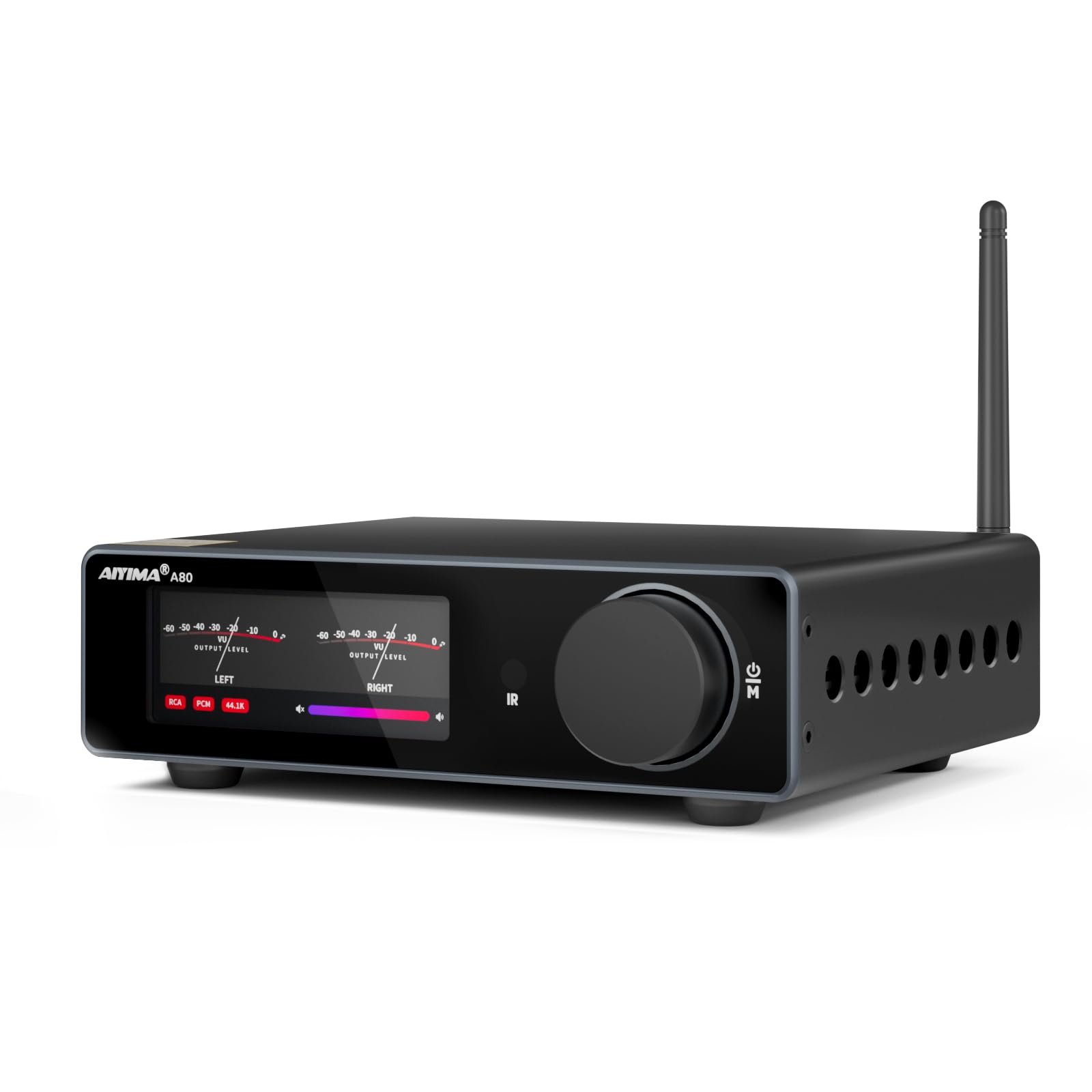
The AIYIMA A80 is a technological powerhouse packed into a compact chassis, making it an ideal centerpiece for a modern desktop or small-room system. It combines a high-performance ES9038Q2M DAC chip with the TPA3255 Class D amplifier, delivering up to 120 watts per channel into 4 ohms. The digital VU meter display is both functional and visually striking, offering multiple modes including a spectrum analyzer.
Input options are remarkably extensive: Bluetooth 5.0, USB (PC-USB), optical, coaxial, and even TRS balanced inputs — a rare find at this price. The pre-out and subwoofer output allow for flexible system expansion. Users consistently praise the clarity and detail, noting that the built-in DAC rivals external units costing significantly more. The tone controls (bass/treble) are genuinely useful for tailoring the sound to different speakers or room acoustics.
Customer feedback confirms that the A80 works exceptionally well with sensitive speakers like Sony SSCS5 and Pioneer BS22-LR, producing crisp highs, clear vocals, and punchy bass. Some users note that it runs warm, especially with the display and EQ engaged, but this hasn’t been a reliability concern. The remote control is basic but functional. For anyone building a space-efficient, high-resolution system without sacrificing connectivity, the AIYIMA A80 is a standout choice.
Why it’s great
- Exceptional DAC performance with ES9038Q2M chip
- Compact size with rich feature set (USB, optical, balanced)
- Digital VU meter adds style and functionality
- Powerful enough for most bookshelf speakers
Good to know
- Runs warm during extended use
- Not ideal for low-sensitivity, power-hungry speakers
- Remote is basic with limited range
3. Rockville BluTube WD

The Rockville BluTube WD brings the classic tube amplifier experience to a very accessible price point, complete with a two-tone silver and wood accent finish that looks right at home in any vintage-inspired setup. It delivers 25 watts per channel RMS at 8 ohms, which is modest but sufficient for efficient speakers in a small to medium room. The tube preamp stage provides the warm, slightly compressed character that many audiophiles love.
Connectivity is surprisingly versatile for a tube hybrid: Bluetooth 2.1+EDR, HDMI (ARC), optical, coaxial, USB, and RCA inputs, plus a subwoofer output. The front-panel VU meter and bass/treble controls offer hands-on tuning. Customer reviews consistently highlight the excellent value proposition, with many users praising the clean, solid sound and attractive design. Some note a low-level tube hum that becomes audible in quiet listening environments.
Reliability is a mixed bag in user feedback. While many report long-term satisfaction, a few units have experienced issues such as channel cutouts after extended use or electrical problems. The lack of a ground on the phono input is a notable omission for turntable users. Overall, if you prioritize aesthetics and a warm tube sound over ultimate power and bulletproof reliability, the BluTube WD delivers a compelling package at an entry-level price.
Why it’s great
- Authentic tube warmth at a very low price
- Vintage design with wood accents and VU meter
- HDMI input for easy TV connection
- Includes subwoofer output for bass extension
Good to know
- Modest power output (25W/ch) limits speaker choices
- Audible tube hum in quiet environments
- Some reliability concerns reported
- No ground on phono input
4. Sony STRDH190
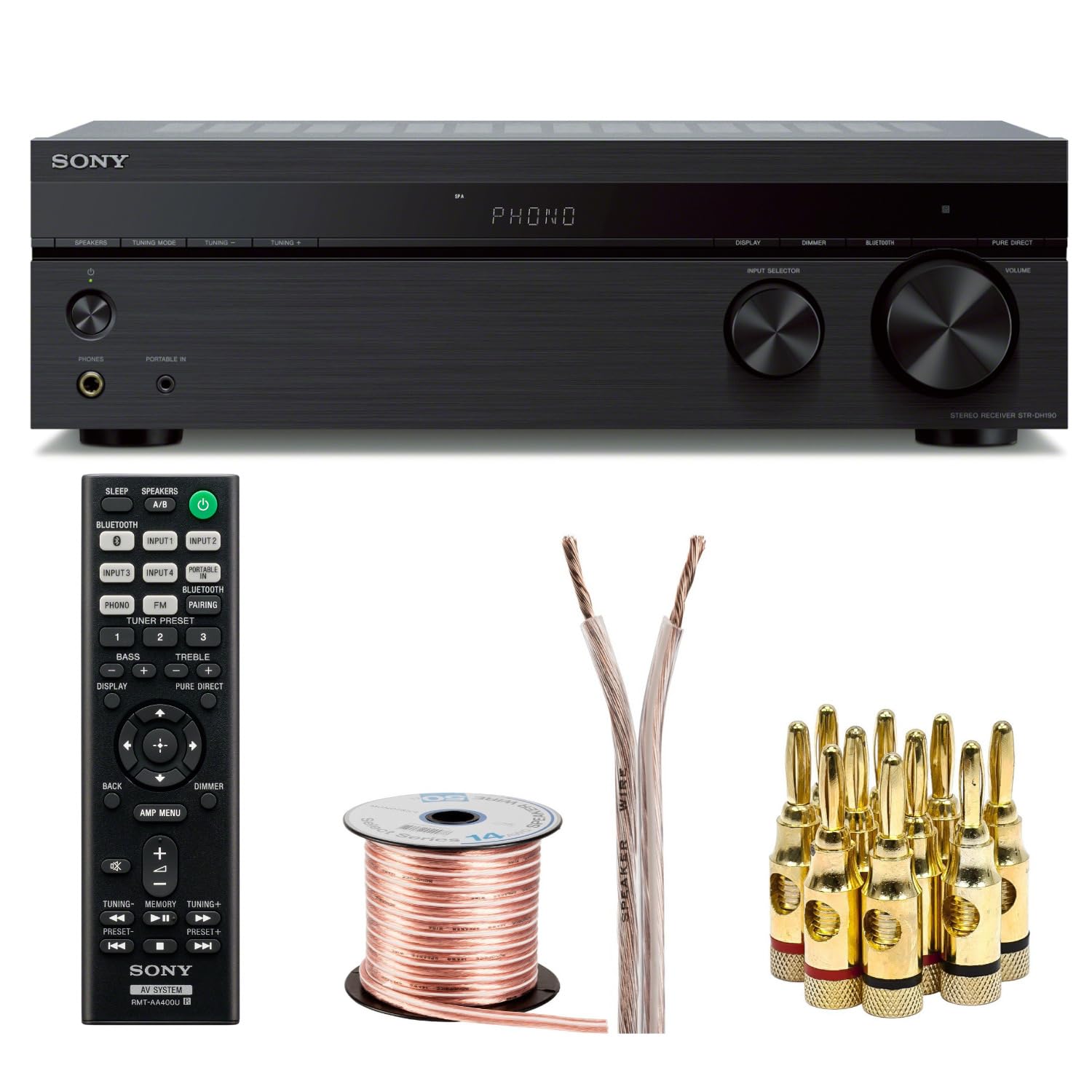
The Sony STRDH190 is a straightforward, no-nonsense stereo receiver that has become a staple in budget hi-fi setups. It delivers 100 watts per channel into 8 ohms, providing ample headroom for a wide range of speakers. The built-in Bluetooth with standby mode allows you to turn on the receiver from your phone, a thoughtful convenience. The phono input is a key feature for vinyl enthusiasts, saving the cost of an external preamp.
Build quality is typical of Sony: functional and reliable, though not luxurious. The front panel is clean with large knobs for volume, bass, and treble. The speaker terminals are spring clips rather than binding posts, which is a minor compromise at this price. Customer feedback is overwhelmingly positive, with users praising the clear, powerful sound and easy setup. Many pair it with Klipsch or Polk speakers for a classic budget audiophile combination.
User reviews note that the FM tuner is acceptable but not exceptional, and the spring clips can be finicky with thicker speaker wire. Some users wish for a subwoofer output, which is absent. However, for its core mission — delivering clean, high-resolution audio from multiple sources — the Sony STRDH190 is a reliable and proven performer that consistently exceeds expectations for its price bracket.
Why it’s great
- High power output (100W/ch) drives many speakers
- Built-in phono input for turntables
- Bluetooth with standby mode is convenient
- Proven reliability from a major brand
Good to know
- Spring clip speaker terminals instead of binding posts
- No subwoofer output
- FM tuner is basic with limited antenna options
5. Yamaha R-S202BL (Renewed)

The Yamaha R-S202BL in its renewed form offers an incredible entry point into serious stereo listening. It delivers 100 watts per channel into 8 ohms with Yamaha’s characteristic clean, detailed sound. The built-in Bluetooth 4.1 + EDR provides reliable wireless streaming, and the 40-station FM/AM tuner is a nice bonus for radio lovers. The brushed aluminum finish and simple layout give it a timeless look.
Customer reviews consistently highlight the excellent value, with many stating the receiver looks and performs like new. The sound is described as robust and clear, with good bass control. Users appreciate the A/B speaker switching, allowing connection to two pairs of speakers. The remote control is basic but functional. Some note that the volume knob requires multiple rotations to change levels, but this is a minor quibble.
The renewed status means careful inspection is recommended, but most buyers report receiving units in factory-sealed condition with no visible wear. The lack of a subwoofer output is a common point of feedback, and the FM antenna wire is basic. However, for someone building their first budget audiophile system, the Yamaha R-S202BL renewed offers unbeatable value and proven performance from a trusted brand.
Why it’s great
- Yamaha reliability at a very low price
- Powerful 100W/channel output
- A/B speaker switching for multi-room setups
- Bluetooth and FM tuner included
Good to know
- No subwoofer output
- Volume knob is slow to adjust
- Renewed condition varies by seller
6. Pyle 5.2 Channel Receiver

The Pyle 5.2 Channel Receiver offers a budget-friendly pathway into surround sound for those who want more than stereo without spending a fortune. It delivers 1000 watts peak power across 5 channels, with four HDMI 2.0 inputs supporting 4K Ultra HD pass-through. The built-in Bluetooth allows wireless streaming, and the digital audio (DAC) interface connects to computers for improved sound quality.
User reviews are mixed but trend positive for the price. Many users are delighted with the performance when paired with older speakers, praising the simple setup and reliable Bluetooth connectivity. The remote control is functional and easy to use. The protection circuitry (overcurrent, short circuit, overvoltage) is a welcome safety feature. Some users report excellent results with vintage speaker systems.
However, there are notable quality concerns. Some users report optical audio desync issues, and a few have experienced remote failure within weeks. The Bluetooth range is limited, and the build quality feels budget-tier. This receiver is best suited for casual listeners or secondary systems where absolute fidelity is not the primary goal. For the price, it offers a lot of features, but patience with potential quirks is advised.
Why it’s great
- Affordable 5.2 surround sound with 4K HDMI
- Bluetooth streaming and DAC input
- Protection circuitry for safe operation
- Easy setup with remote control
Good to know
- Some users report optical audio desync
- Remote reliability concerns
- Bluetooth range is limited
- Build quality is not premium
7. Yamaha R-S202BL (New)

The brand-new Yamaha R-S202BL is the same core product as the renewed version but with the peace of mind of full factory warranty and untouched condition. It offers 100 watts per channel into 8 ohms with Yamaha’s advanced circuitry design, delivering clean, detailed sound with excellent dynamics. The Bluetooth 4.1 + EDR is reliable for streaming, and the 40-station FM/AM tuner is a nice inclusion.
Customer reviews consistently praise the simplicity and reliability. Users appreciate the dual speaker zone capability (A/B switching), allowing connection to two pairs of speakers. The sound is described as powerful and clear, with good bass response. Many users pair it with efficient speakers like Cerwin Vega or Klipsch for impressive results. The brushed aluminum finish looks clean and modern.
The main drawbacks are the lack of a subwoofer output and the basic FM antenna. Some users note that the volume control is slow to respond. However, for a pure stereo receiver that does its core job exceptionally well, the Yamaha R-S202BL is a classic choice that will serve reliably for years. It’s the go-to option for anyone who wants a straightforward, powerful, and well-built stereo receiver without any unnecessary complexity.
Why it’s great
- Full factory warranty and new condition
- Powerful 100W/channel with clean sound
- Dual speaker zones (A/B switching)
- Yamaha reliability and build quality
Good to know
- No subwoofer output
- Volume knob is slow to adjust
- FM antenna is basic
8. WiiM Ultra

The WiiM Ultra is a revolutionary device that redefines what a budget-friendly streamer can be. It functions as a music streamer, digital preamp, and DAC all in one, with a gorgeous 3.5-inch touchscreen and premium aluminum chassis. At its heart is the ESS ES9038 Q2M DAC, offering exceptional clarity with a THD+N of -116dB and SNR of 121dB. Wi-Fi 6 and Bluetooth 5.3 ensure fast, stable connectivity.
Connectivity is incredibly versatile: HDMI ARC, phono input, USB, optical, coaxial, RCA, and a dedicated headphone output. It supports multiroom audio with Amazon Echo and Google Home devices. Users consistently praise the sound quality, ease of setup, and the intuitive app. The room correction and EQ features allow fine-tuning to your space. Many use it as a hub to upgrade older amplifiers with modern streaming capabilities.
Customer feedback is overwhelmingly positive, with many calling it a game-changer for the price. The only notable omission is AirPlay compatibility. Some users recommend using Ethernet for the best high-resolution streaming. For anyone looking to modernize their system with high-quality streaming, the WiiM Ultra is an exceptional value that rivals products costing several times more.
Why it’s great
- Reference-grade ESS DAC performance
- Versatile inputs including HDMI ARC and phono
- Beautiful touchscreen and premium build
- Multiroom audio with app control
Good to know
- No AirPlay support
- Ethernet recommended for best stability
- Requires an amplifier to power speakers
9. Denon AVR-S570BT

The Denon AVR-S570BT bridges the gap between home theater and stereo music, offering 5.2 channels with 70 watts per channel. It features four HDMI 2.1 inputs supporting 8K video, eARC, and advanced gaming features like VRR and QFT. The built-in Bluetooth allows wireless streaming, and the on-screen Setup Assistant makes configuration straightforward even for beginners.
Customer reviews highlight the excellent sound quality for both movies and music, with Denon’s signature clarity and dynamic range. The remote app control adds convenience. Many users appreciate the ability to connect a turntable via the phono input (though some models may not include it; check specs). The room calibration feature helps optimize sound for your space. Build quality is solid, as expected from Denon.
Some users note that the Bluetooth is input-only (no Bluetooth output to headphones), and the setup process requires a TV connection. A few have experienced remote quirks or volume lag. However, for someone who wants a versatile receiver that can handle both immersive surround sound and decent stereo music playback, the Denon AVR-S570BT offers excellent value and future-proofing with its 8K HDMI capabilities.
Why it’s great
- 8K HDMI inputs with eARC and VRR
- Denon sound quality for movies and music
- Easy setup with on-screen assistant
- Bluetooth streaming and app control
Good to know
- Bluetooth is input-only (no output)
- Setup requires TV connection
- Some users report remote quirks
10. Denon PMA-600NE

The Denon PMA-600NE is a dedicated integrated amplifier that prioritizes pure stereo performance above all else. It delivers 70 watts per channel into 4 ohms with Denon’s Advanced High Current (AHC) circuitry, providing clean, detailed sound with excellent dynamic control. The built-in DAC supports optical and coaxial inputs, and the phono preamp is a standout feature for vinyl lovers.
Customer reviews are effusive about the sound quality, describing it as warm, tube-like, and highly engaging. The Analog Mode disables the digital circuitry and Bluetooth, offering a purer analog path for critical listening. The build quality is exceptional for the price, with a solid metal chassis and a clean, minimalist design. Users praise the subwoofer output and headphone amplifier as well.
Some users note that the remote control volume is laggy and coarse, and the input relays are audible. The unit only supports one pair of speakers. However, for dedicated stereo listening, the Denon PMA-600NE competes with amplifiers costing significantly more. It’s a serious component for anyone building a high-quality two-channel system on a budget, offering a level of refinement that few integrated amps at this price can match.
Why it’s great
- Warm, tube-like sound with excellent detail
- Built-in DAC and phono preamp
- Analog Mode for purist listening
- Solid build quality and subwoofer output
Good to know
- Remote volume is laggy and coarse
- Audible input relay clicks
- Only one pair of speaker outputs
11. Cambridge Audio AXR100

The Cambridge Audio AXR100 is a premium stereo receiver that brings British hi-fi engineering to a more accessible price point. It delivers 100 watts per channel into 8 ohms with a clean, neutral sound that reveals detail without harshness. The built-in DAC with optical and coaxial inputs ensures high-quality digital playback. The phono stage is decent for moving magnet cartridges.
Build quality is excellent: a solid metal chassis, well-ventilated design, and no fan noise. Dual speaker outputs (A/B) allow for flexible setups. Customer reviews consistently praise the powerful, clear sound that works beautifully with a wide range of speakers, including Klipsch and Bowers & Wilkins. The Bluetooth is functional but has limited range compared to newer standards.
Some users note that the Bluetooth range is disappointing for the price, and the remote control is basic. The phono stage, while acceptable, doesn’t match the performance of dedicated external preamps. However, for its core mission of delivering high-fidelity stereo sound with ample power and refined clarity, the Cambridge Audio AXR100 is a serious contender that justifies its position at the top of the budget audiophile spectrum.
Why it’s great
- Refined, neutral British sound quality
- Powerful 100W/channel with clean headroom
- Excellent build quality with no fan noise
- Dual speaker zones and DAC inputs
Good to know
- Bluetooth range is limited
- Remote control is basic
- Phono stage is decent but not exceptional
Understanding the Specs
RMS Power vs. Peak Power
RMS (Root Mean Square) power is the continuous, sustainable output an amplifier can deliver. This is the number that matters for real-world listening. Peak power is a marketing figure that represents a brief maximum burst. Always compare RMS ratings at the same impedance (usually 8 ohms). A receiver with 50W RMS per channel is typically sufficient for moderate listening volumes with efficient speakers, while 100W RMS provides more headroom for dynamic peaks and less efficient speakers.
Signal-to-Noise Ratio (SNR)
SNR measures how much background noise the amplifier introduces relative to the music signal. A higher SNR means a cleaner, quieter background, allowing subtle details to emerge. Look for an SNR of at least 90 dB for a budget audiophile receiver; 100 dB or higher is excellent. This spec is particularly important if you listen at low volumes or have efficient speakers that reveal noise more readily.
Total Harmonic Distortion (THD)
THD indicates how much the amplifier distorts the original signal. Lower is better. A THD of 0.05% or less is generally inaudible for most listeners. High-quality budget receivers can achieve 0.01% or lower. However, some listeners prefer the slight harmonic distortion from tube preamps, which adds warmth and character. The key is understanding your preference: clean transparency vs. subtle coloration.
Impedance Compatibility
Speakers have an impedance rating (typically 4, 6, or 8 ohms). A receiver’s power output varies with impedance. A receiver that can handle 4-ohm loads generally has a more robust power supply and is better suited for demanding speakers. Pairing a low-power receiver with 4-ohm speakers can lead to overheating or distortion. Always check the receiver’s minimum impedance rating and match it with your speakers for safe, optimal performance.
FAQ
Do I need a separate DAC with a budget audiophile receiver?
Can I use a budget audiophile receiver for home theater?
What speaker sensitivity should I look for with a budget receiver?
Is a tube amp better than a solid-state for budget audiophile?
How important is Bluetooth in a budget audiophile receiver?
Final Thoughts: The Verdict
For most people, the budget audiophile receiver winner is the Dayton Audio HTA100 because it offers a genuine tube-infused sound, robust power, and useful features like a phono preamp and headphone output at a price that doesn’t break the bank. If you want modern connectivity and a compact design, grab the AIYIMA A80. And for pure stereo performance with a classic approach, nothing beats the Denon PMA-600NE.

Mo Maruf
I created WellFizz to bridge the gap between vague wellness advice and actionable solutions. My mission is simple: to decode the research and give you practical tools you can actually use.
Beyond the data, I am a passionate traveler. I believe that stepping away from the screen to explore new environments is essential for mental clarity and physical vitality.