Our readers keep the lights on and my smoothie glass nicely filled. As an Amazon Associate, I earn from qualifying purchases.
That forward-head, rounded-shoulder slump—often called “tech neck” or “desk posture”—isn’t just about looking tired. It strains the cervical spine, tightens the pectorals, and weakens the upper back muscles until chronic pain becomes your baseline. A well-designed brace for posture support interrupts this cycle by mechanically guiding the shoulders into alignment, offloading the trapezius and rhomboids so they can gradually rebuild proper muscle memory.
I’m Mohammad Maruf — the founder and writer behind WellFizz. I’ve spent over 500 hours analyzing structural hardware, fabric density, and biomechanical correction claims across hundreds of wearable support products to separate what actually repositions the spine from what simply compresses the ribcage.
Whether you spend eight hours hunched over a laptop, lifting at the gym, or recovering from an injury, this guide breaks down the top contenders for the best brace for posture support based on real-world adjustability, material breathability, and the type of support architecture that genuinely reinforces healthy alignment.
How To Choose The Best Brace For Posture Support
Not every brace delivers true postural correction. Many rely on pure compression, which can actually restrict the diaphragm and create a false sense of support. Focus on these three factors to find a device that retrains muscle memory rather than just squeezing your torso.
Support Architecture: Back Rods vs. Elastic Tension
Brace with flexible ABS rods or firm vertical stays provide structural resistance that physically holds the upper spine erect when you start to slouch. Elastic-only braces rely on shoulder pull straps, which can loosen over time and dig into the armpits. For lasting correction, look for at least three to five internal support rods that run along the thoracic vertebrae.
Strap Routing and Armpit Clearance
A common failure point is the shoulder strap position. Straps that pass directly under the axilla can chafe, pinch, or restrict arm movement. Better designs route the tension across the clavicle and scapular plane, using wider padded straps that distribute force without pinching the brachial plexus. Test the fit by raising your arms overhead—if the brace shifts, the routing geometry is wrong for your frame.
Breathability and Material Stack
Neoprene traps heat and moisture, making it suitable for short gym sessions but uncomfortable for all-day office wear. Breathable polyester mesh or perforated EVA foam wicks sweat and allows airflow, reducing skin irritation during extended use. The material should also hold up to repeated hand washing without delaminating or losing elasticity.
Quick Comparison
On smaller screens, swipe sideways to see the full table.
| Model | Category | Best For | Key Spec | Amazon |
|---|---|---|---|---|
| Kepwaa Posture Corrector | Full-Back Rod | All-day upper & lower back alignment | 5 flexible ABS support rods | Amazon |
| BIGROSE DualGuard Pro | Dual-Layer Lumbar | Seniors & midlife everyday wear | Dual-layer lumbar support system | Amazon |
| SNUSIM Upper Back Brace | Clavicle Harness | Shoulder retraction & neck relief | Chest sizes 28″–48″ adjustable | Amazon |
| FEATOL Back Support Belt | Lower Back Belt | Sciatica & lifting support | 4 support strips + lumbar pad | Amazon |
| Sparthos Lower Back Brace | Stabilization Belt | Herniated disc & spinal stenosis | Vertical support stays, 0.15″ thick | Amazon |
In‑Depth Reviews
1. Kepwaa Posture Corrector (5 Rods)
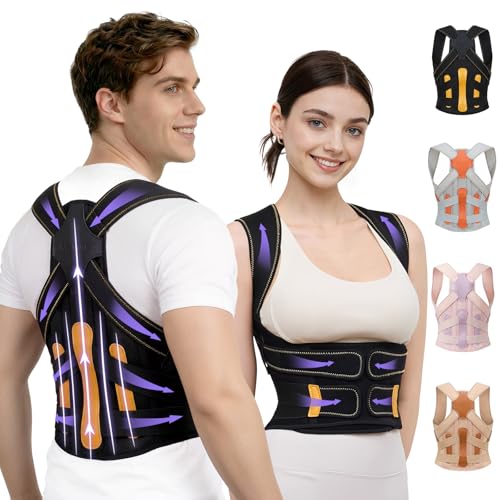
The Kepwaa brace distinguishes itself with five flexible ABS rods embedded in a full-back panel that extends from the upper thoracic spine down to the lumbar area. This architecture provides graduated resistance—stiffer along the center of the back with enough lateral give to avoid feeling like a plaster cast. The rods prevent the brace from rolling up, a frequent issue with cheaper elastic-only designs.
Breathable polyester mesh covers the entire contact surface, so even during extended desk sessions the fabric wicks moisture rather than trapping sweat. The adjustable hook-and-loop straps at both the waist and shoulders allow granular tension tuning, and the cut is explicitly armpit-friendly—the shoulder straps avoid the brachial plexus, preventing that “digging in” sensation reported in lower-end harnesses.
Users report a noticeable reduction in neck and upper back tension after about a week of daily wear, and the brace remains invisible under loose-fitting shirts. The only caveat is that the sizing skews slightly large, so if you fall at the upper boundary of a size range, stepping up ensures the rods sit correctly along the spine rather than riding up toward the neck.
Why it’s great
- Five-rod system provides structured resistance across the entire back
- Breathable mesh keeps the skin dry during all-day wear
- Armpit-friendly strap routing avoids nerve compression
Good to know
- Size up if your waist measurement is near the top of the range
- May feel slightly stiff during the first few wears until the rods conform
2. BIGROSE DualGuard Posture Brace
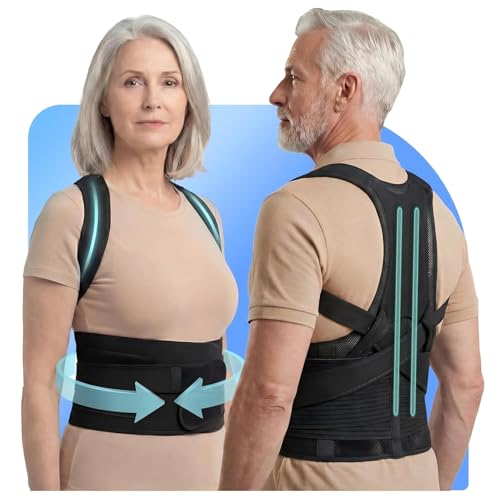
The BIGROSE brace targets a specific demographic: midlife to older adults who need both upper back shoulder retraction and lower back stability. The dual-layer lumbar support consists of an inner elastic wrap that cinches the waist for core compression and an outer adjustable belt with a removable lumbar pad. This split-layer approach prevents the brace from migrating upward when you bend or sit.
The open-back alignment system uses wide shoulder straps that route tension diagonally across the scapulae, pulling the shoulders back without forcing the neck forward. The underarm clearance is generous—the straps are padded with a smooth polyester shell that reduces friction even during active movement like walking or bending. Multiple customer reviews highlight how the brace stays put during household tasks without needing constant readjustment.
Breathability is adequate for daily wear, though the thicker lumbar pad can hold warmth in hot environments. The construction feels robust: double-stitched seams, high-density hook-and-loop panels, and a lifetime technical support guarantee from BigRose. It’s not the most discreet option under tight clothing, but for comfort-driven wearers who prioritize stability over invisibility, this is the top performer.
Why it’s great
- Dual-layer lumbar system provides independent lower back compression
- Wide shoulder straps with open-back design avoid neck strain
- Stays anchored during bending and household activity
Good to know
- Thicker lumbar pad may trap heat in warm conditions
- Less discreet under form-fitting tops
3. SNUSIM Upper Back Brace

The SNUSIM brace is a pure upper-back correction harness that focuses entirely on shoulder retraction without any lower lumbar component. The design uses a figure-eight strap system that crosses behind the scapulae and fastens with a single adjustable velcro panel at the front. This simplicity makes it one of the easiest braces to put on independently—no contortion required.
The padding consists of soft, breathable sponge pads that sit over the clavicle and upper trapezius, distributing tension evenly. Users report that after a 30-minute break-in period the brace becomes nearly unnoticeable under a shirt, making it viable for office environments where discretion matters. The included armpit pads (optional) prevent chafing for those with a wider shoulder span, though some users prefer to remove them for a less bulky feel.
The main limitation is that the brace provides zero lumbar support—it’s strictly for upper back rounding and forward head posture. For users whose primary pain is in the lower back or who need stabilization during heavy lifting, this isn’t the right tool. But for the specific job of pulling slouched shoulders back into neutral alignment, the SNUSIM delivers at a very accessible price point.
Why it’s great
- Easy one-person velcro fastening and adjustment
- Soft sponge padding avoids rigid pressure points
- Disappears under clothing for desk and casual use
Good to know
- No lower back or lumbar component
- Straps can feel tight under the arms without the included pads
4. FEATOL Back Support Belt

The FEATOL brace is a dedicated lower back support belt, not a full-back posture corrector. It wraps around the waist with a broad neoprene panel and cinches tight via four adjustment straps. The standout feature is the removable lumbar pad—a contoured foam insert that locks into the belt’s rear pocket to provide targeted pressure against the lumbar curve.
For users dealing with sciatica, disc herniation, or general lower back pain, the FEATOL delivers immediate relief by immobilizing the lumbar spine during movement. The 360-degree compression stabilizes the core, reducing the load on the lower vertebrae when bending or lifting. The neoprene material also retains heat, which can be therapeutic for muscle stiffness but may feel clammy during high-activity use.
The sizing range is enormous—from 24-inch waist up to 74 inches—which is unusual in this category. However, the belt is bulky under clothing; it’s best suited for manual labor, gym workouts, or recovery periods where concealment isn’t a priority. If your primary need is upper shoulder correction, look elsewhere, but for lower back stabilization this is the most robust option in the lineup.
Why it’s great
- Removable lumbar pad provides targeted curve support
- Four independent straps allow fine-tuned compression
- Massive size range fits most body types
Good to know
- Neoprene retains heat and can feel bulky
- No upper back or shoulder correction capability
5. Sparthos Lower Back Brace

The Sparthos brace occupies a middle ground between a full back rod system and a simple elastic belt. It includes vertical support stays—rigid plastic strips sewn into the rear panel—that prevent the brace from rolling and provide a modest degree of spinal extension resistance. However, it lacks the upper-back harness found in dedicated posture correctors, so its corrective action is limited to the lumbar region.
The material is a polyester blend that breathes better than neoprene, and the adjustable lumbar pad offers decent extra compression for the lower spine. Users with spinal stenosis or osteoarthritis report significant pain reduction during activities like walking or standing. The brace’s slim profile (0.15-inch thickness) makes it easier to wear under trousers than the bulkier FEATOL belt.
One limitation is the width—the front panel measures only 11 inches, which can create a “wasp waist” effect if cinched too tight, and it may not provide enough coverage for users with flank or lateral hip pain. The Velcro is notably strong, which is good for durability but can make removal a two-hand job. It works well as a daily lumbar stabilizer but shouldn’t be mistaken for a posture-retraining brace for the upper back.
Why it’s great
- Vertical stays prevent rolling and add structural support
- Thin profile fits more discreetly under clothing
- Strong Velcro stays secure during active movement
Good to know
- Narrow front panel can feel constrictive on wider torsos
- No upper back or shoulder correction element
FAQ
How many hours per day should I wear a posture brace?
Will a posture brace fix forward head posture?
Can I sleep with a back support brace on?
Final Thoughts: The Verdict
For most users, the best brace for posture support winner is the Kepwaa Posture Corrector because its five flexible ABS rods provide structured resistance for both upper and lower back without rolling or migrating. If you want dual-layer lumbar stabilization for lower back dominance, grab the BIGROSE DualGuard. And for a discreet, harness-style shoulder retractor that disappears under an office shirt, nothing beats the SNUSIM Upper Back Brace.

Mo Maruf
I created WellFizz to bridge the gap between vague wellness advice and actionable solutions. My mission is simple: to decode the research and give you practical tools you can actually use.
Beyond the data, I am a passionate traveler. I believe that stepping away from the screen to explore new environments is essential for mental clarity and physical vitality.