Our readers keep the lights on and my smoothie glass nicely filled. As an Amazon Associate, I earn from qualifying purchases.
A board game collection often suffers from one problem: too many boxes that look good on a shelf but rarely get opened. The issue isn’t a lack of options — it’s finding titles with the right depth-to-fun ratio that match your group’s real habits. Whether the goal is a 20-minute filler or a 90-minute engine-builder, the decision comes down to playtime, player count, and how much chaos your group can handle.
I’m Mohammad Maruf — the founder and writer behind WellFizz. I’ve spent years analyzing board game mechanics, component quality, and the hidden rules that separate a five-time repeat play from a one-and-done dust collector.
This guide breaks down seven carefully selected titles across party, strategy, cooperative, and solo modes to help you find the right board games for your next game night.
How To Choose The Best Board Games
Picking a game that gets played repeatedly means ignoring hype and looking at three things: how many people actually show up, how long they can sit still, and whether the rules match the group’s collective patience. A brilliant game for four strategy lovers can be a total dud at a table of eight casual players. Start with the real usage scenario.
Match the Player Count and Playtime
A 2-player game like Sky Team delivers tight cooperative tension, but it can’t accommodate a family of five. Telestrations thrives with six to eight players but feels overkill for a couple. Similarly, a 90-minute game like Wyrmspan demands dedicated table time, while Fire Tower wraps up in under 30 minutes. Check the box for the recommended player range and average playtime — they are the most reliable predictors of whether a game fits your schedule.
Mechanics Matter More Than Theme
Tile-laying (Harmonies), engine-building (Wyrmspan), and cooperative dice placement (Sky Team) reward different kinds of thinking. A group that enjoys quiet puzzle-solving will prefer pattern-matching, while a chaotic group will get more mileage from drawing-and-guessing or competitive fire-spreading. The theme — dragons, landscapes, or airports — is a bonus, but the mechanical loop determines whether the game stays fun on the tenth play.
Component Quality and Replayability
Wooden tokens, thick card stock, and engraved dice increase tactile satisfaction and longevity. Games with modular boards (CATAN), randomized tile draws (The Night Cage), or multiple scenarios (Sky Team) offer high replay value without requiring expansions. Check whether the game includes a solo mode if you plan to play alone — Wyrmspan and Harmonies both offer solid Automa or single-player variants.
Quick Comparison
On smaller screens, swipe sideways to see the full table.
| Model | Category | Best For | Key Spec | Amazon |
|---|---|---|---|---|
| Cathedral (CATAN) | Strategy | Classic negotiation & resource trade | 60-90 min, 3-4 players, modular hex board | Amazon |
| Wyrmspan | Engine Builder | Deep strategic depth for gamers | 90 min, 1-5 players, 183 dragon cards | Amazon |
| Sky Team | Cooperative | Intense 2-player teamwork | 20 min, 2 players, silent dice placement | Amazon |
| Fire Tower | Competitive | Fast, tactical firefighting duels | 15-30 min, 2-4 players, wind die | Amazon |
| Harmonies | Tile Laying | Calm, strategic pattern building | 30 min, 1-4 players, 120 wooden tokens | Amazon |
| Telestrations | Party Game | Large groups, loud laughter | 30-45 min, 4-8 players, 2000+ prompts | Amazon |
| The Night Cage | Cooperative | Atmospheric horror escape | 30-45 min, 1-5 players, tile maze | Amazon |
In‑Depth Reviews
1. CATAN Board Game (6th Edition)

CATAN remains the benchmark for accessible strategy because it makes resource management feel like a negotiation game, not a spreadsheet. The 6th Edition upgrades the component heft — chunkier wooden settlements, card trays that actually hold the deck, and a rulebook that clarifies the renamed resources (Wood for Lumber, Wheat for Grain). The modular hex board ensures no two layouts are identical, and the 10-victory-point race forces constant trading and occasional betrayal.
At 60 to 90 minutes, it lands in the sweet spot for a family game night: long enough to develop a strategy, short enough to play twice. The dice-driven resource generation introduces luck, but savvy players mitigate bad rolls through ports and smart trade deals. The 6th Edition also includes two bonus victory point tiles and updated card backs, which matter if you plan to add expansions later.
For groups of 3 to 4 players ages 10 and up, this is the safest bet in the list. It teaches negotiation, probability assessment, and long-term planning without overwhelming new players. The only real catch is that it does not scale to 2 players out of the box — you will need the CATAN base game plus an expansion for that.
Why it’s great
- Proven replay value with modular hex board
- Chunkier components and improved rulebook in 6th Ed
- Teaches negotiation and resource management beautifully
Good to know
- 2-player play requires separate expansion
- Dice-based resource system can swing games heavily
2. Stonemaier Games Wyrmspan (Base Game)

Wyrmspan is the heavier sibling of Wingspan that trades birds for dragons without losing the elegant engine-building loop. The core mechanic — excavating caves to chain dragon abilities via your adventurer meeple — creates satisfying combos without needing a rulebook the size of a novel. The 183 dragon cards each feature unique powers that interact differently each game, and the hatchling system adds a one-time bonus when a juvenile dragon matures.
Setup takes about 5 minutes, but the playtime runs closer to 90 minutes with 4 or 5 players. The wood speckled eggs, shiny cardboard coins, and watercolor illustration by Clémentine Campardou make the table presence exceptional. Solo players benefit from the Automa system that simulates a fair opponent without adding fiddly upkeep.
This is a mid-weight strategy game best suited for ages 14 and up who enjoy card drafting, hand management, and multiple scoring paths. The Dragon Guild tiles and objective tiles keep each game distinct. It is a premium purchase that rewards repeat plays, but expect a steeper learning curve than party games or tile-layers.
Why it’s great
- 183 unique dragon cards with high replayability
- Smooth Automa for solo play
- Gorgeous watercolor art and premium components
Good to know
- 90-minute playtime requires dedicated table time
- Expansion sold separately for additional content
3. Scorpion Masqué Sky Team

Sky Team earned the Spiel des Jahres 2024 for good reason — it distills cooperative tension into a 20-minute silent dice-placement puzzle. Each player takes a role (pilot or co-pilot) and places dice on a cockpit board without discussing exact moves. The limited communication mimics real cockpit pressure: you can discuss plans between rounds, but once the dice roll, trust takes over.
The game includes 20 scenarios representing different airports, each with unique landing conditions like ice on the tarmac or a rookie intern. The coffee re-roll mechanic softens bad luck, but strategic placement matters more than dice face values. The compact box (7.4 x 10 x 2 inches) makes it travel-friendly, and the cardboard cockpit components feel satisfyingly thick.
This is a pure 2-player experience — no solo mode, no 4-player variant. It shines for couples or friends who want a quick, brain-burning session after work. The campaign mode escalates difficulty gradually, giving it more longevity than many small-box games.
Why it’s great
- Award-winning silent cooperation mechanic
- 20 unique scenarios with escalating difficulty
- Quick playtime fits tight schedules
Good to know
- Strictly 2-player only
- Dice luck can occasionally override strategy
4. Runaway Parade Games Fire Tower Deluxe Edition

Fire Tower flips the typical firefighting game by letting you spread flames toward opponents while defending your own lookout. The wind direction die determines how fire propagates each round, adding a spatial puzzle that changes every turn. The Deluxe Edition upgrades the components with 135 shimmering fire gems, a printed cloth bag for drawing tiles, custom meeples, and an engraved wind die that feels substantial in hand.
Rounds finish in 15 to 30 minutes, making it ideal for a warm-up game or a quick finale. The rulebook fits on two pages — intuitive enough that you can teach it while setting up. The “Shadow of the Wood” mechanic keeps eliminated players engaged by giving them special vengeance powers, which solves the common problem of dead players waiting around.
Competitive players who enjoy Risk-like area control but want faster games will appreciate the tactical depth. The watercolor art by Kevin Ruelle and the tactile fire gems create a board presence that draws in casual observers. Best with 2 or 3 players; 4-player team mode is fun but can slow down slightly.
Why it’s great
- Unique competitive firefighting mechanic with wind die
- Deluxe components feel premium and satisfying
- Shadow of the Wood keeps eliminated players engaged
Good to know
- Can feel chaotic at 4-player count
- Not for groups that dislike direct conflict
5. Asmodee Harmonies Board Game

Harmonies delivers a peaceful tile-laying experience where players stack wooden tokens to build 3D landscapes that match animal card patterns. The tactile quality — 120 wooden tokens, thick card stock, and a central board with recessed spaces — makes every placement feel deliberate. The rules take 2 minutes to explain, but the puzzle depth grows as you chase higher-scoring combinations.
Playtime sits around 30 minutes, perfect for a lunch break or a calming reset after a heavy strategy game. The solo mode works well for solo gamers looking for a low-stress puzzle. The Nature’s Spirit cards add variety by offering bonus scoring conditions, and the 42 illustrated cards feature Libellud’s signature dreamlike art style.
The main tradeoff is low player interaction — each player builds their own tableau with minimal direct interference. This makes it ideal for introverted groups or families who prefer parallel problem-solving over negotiation. If your group thrives on trash talk and sabotage, look elsewhere. For everyone else, it is one of the most relaxing and visually satisfying games on this list.
Why it’s great
- Highly tactile 3D tile-building with wooden tokens
- Very easy to learn, suitable for ages 6+
- Relaxing solo and multiplayer puzzle
Good to know
- Minimal player interaction (multiplayer solitaire)
- Can feel repetitive after many plays without expansion
6. Telestrations 8 Player 2nd Edition
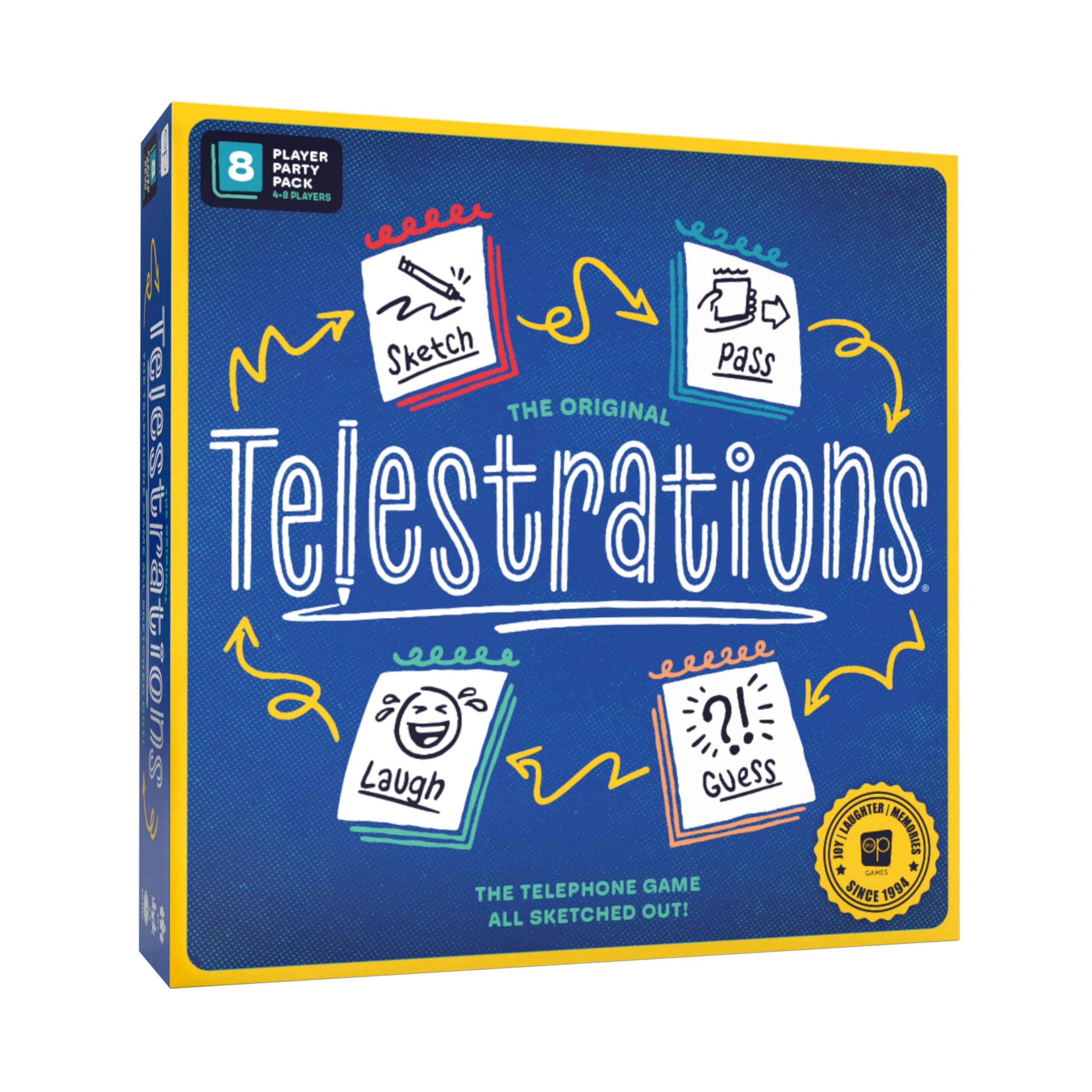
Telestrations combines Pictionary and Telephone into a guaranteed chaos generator. Each player draws a prompt, passes the sketchbook to the next player who guesses what they saw, then passes again for another drawing — and the chain continues. The 2nd Edition updates the art style and includes over 2,000 prompts, mixing fresh phrases with classic ones to keep even veteran players guessing.
The dry-erase sketchbooks and markers are reusable indefinitely, and the box size (10 x 10 x 2.5 inches) is compact enough for a party bag. The rules take 30 seconds to explain, and the fun scales directly with the participants’ drawing ability — or lack thereof. The worst artists create the funniest results.
This game supports 4 to 8 players ages 10 and up, but younger kids may struggle with reading the prompts. It is not a game for quiet concentration or strategic depth — it is pure social lubricant for family reunions, holiday gatherings, or any group that wants to laugh until they cry. Avoid if your group prefers quiet puzzles or hates drawing in front of others.
Why it’s great
- Instant setup and 30-second rule explanation
- 2000+ prompts provide massive replayability
- Works for ages 10 to 75 with no skill required
Good to know
- Requires minimum 4 players for best experience
- Not suitable for quiet or strategy-focused groups
7. Smirk and Dagger The Night Cage

The Night Cage builds tension by literally keeping players in the dark — each tile is placed face-down on the board, and you can only see what your candle token illuminates. The cooperative goal is to collect keys and escape through a gate before the Wax Eaters catch you, but the shifting tile maze means your path is never clear. The candlelight mechanic creates genuine suspense: every new tile could be a safe corridor or a dead end.
Setup is fast, and games finish in 30 to 45 minutes even with 5 players. The difficulty is adjustable, and the Advanced Game mode adds monsters and obstacles that force the team to adapt mid-game. Playing with the lights off and a thematic soundtrack amplifies the horror atmosphere, but the game works fine in normal lighting. The tile components are sturdy, and the art fits the eerie theme without being gory.
This is a pure cooperative experience — no player elimination, no hidden traitor. It works best with 2 to 4 players; 5 players can feel crowded but still playable. The rulebook could be clearer on edge cases, but a quick YouTube tutorial resolves any confusion within minutes. Great for groups who enjoy survival horror and shared puzzles over direct competition.
Why it’s great
- Candlelit visibility mechanic creates real tension
- High replayability with randomized tile maze
- Adjustable difficulty and advanced game mode
Good to know
- Rulebook clarity could be improved
- 5-player count can feel slightly crowded
FAQ
What is the best board game for 2 players specifically?
Which game works for large groups of 6 to 8 people?
How do I know if a game has good replay value?
What is the difficulty difference between Harmonies and Wyrmspan?
Can I play any of these games solo?
Final Thoughts: The Verdict
For most users, the board games winner is the CATAN 6th Edition because its blend of negotiation, resource management, and modular board creates the highest ratio of replay value to teach time. If you want deep engine-building for dedicated gamers, grab the Wyrmspan. And for quick 2-player cooperative tension, nothing beats the Sky Team.

Mo Maruf
I created WellFizz to bridge the gap between vague wellness advice and actionable solutions. My mission is simple: to decode the research and give you practical tools you can actually use.
Beyond the data, I am a passionate traveler. I believe that stepping away from the screen to explore new environments is essential for mental clarity and physical vitality.