Our readers keep the lights on and my smoothie glass nicely filled. As an Amazon Associate, I earn from qualifying purchases.
The best board games for kids don’t just pass the time — they sneak in skill-building while your child is too busy giggling to notice. Whether it’s a classic buzzer-driven surgery or a T-Rex trying to eat a taco, the right game turns family night into a genuine bonding experience rather than a screen-time substitute. The challenge is finding one that holds attention spans, survives spills, and still feels fresh on the tenth playthrough.
I’m Mohammad Maruf — the founder and writer behind WellFizz. I spend my time analyzing the construction, replayability, and educational design of children’s tabletop games to separate the plastic junk from the lasting keepsakes.
After combing through dozens of candidates across skill-based action, educational wordplay, and pure chaotic fun, I’ve settled on five that earn their shelf space. This is the definitive guide to the best board games for kids.
How To Choose The Best Board Games For Kids
Kids’ board games have a surprisingly high failure rate — not because they are poorly designed, but because they are often purchased for the wrong age or skill target. A game that demands complex reading will frustrate a kindergartener, while a simple luck-based roll-and-move will bore a second grader within minutes. Matching the mechanical depth of the game to the child’s developmental stage is the single most important decision you will make.
Age Range vs. Actual Content Complexity
The number on the box is a safety and choking-hazard baseline, not a guarantee of cognitive fit. A game rated for ages 5+ might still contain dense instruction text or sequential logic that exceeds a five-year-old’s patience. Look at the core mechanism: does the child need to read cards, count spaces, use strategy, or simply react to a physical stimulus? The best picks offer layered difficulty so the game grows with the child rather than becoming obsolete in under a year.
Component Durability and Storage
Cardboard that delaminates after two plays, tokens that slide off the board, and game boxes that cannot close properly are the fastest way to turn a investment into landfill fodder. Prioritize games with built-in storage trays, thick board stock, and pieces that can survive being knocked off the table. A portable carrying case is a strong bonus for families who travel or take games to grandparents’ houses.
Replayability and Skill Progression
The best kids’ games deliver a different experience each time, not a fixed sequence of moves. Variable setups, multiple play modes, or luck elements that create emergent chaos keep the game feeling fresh. Educational games should feel like play first and learning second — if the child grumbles at the sight of the box, the mechanical layer is too thin. A genuinely replayable game gets pulled off the shelf weekly, not annually.
Quick Comparison
On smaller screens, swipe sideways to see the full table.
| Model | Category | Best For | Key Spec | Amazon |
|---|---|---|---|---|
| Operation Electronic Board Game | Action/Party | Fine motor skill practice & portable fun | 12 ailments, handled carrying case | Amazon |
| Spin Master Snack-O-Saurus Rex | Action/Party | High-energy group play for ages 5+ | Magnetic dino tongue, 20 snacks | Amazon |
| Cows in Space | Action/Party | Silly physical dexterity & family laughs | 2 UFO headbands, electronic spinning base | Amazon |
| Skillmatics Sentence Search | Educational | Grammar & reading for ages 5–8 | 120+ color-coded word tiles | Amazon |
| Mathemagical World | Educational | Arithmetic drills disguised as adventure | 8 themed worlds, 2 difficulty levels | Amazon |
In‑Depth Reviews
1. Operation Electronic Board Game w/ Carrying Case

The updated Operation does more than modernize a classic — it fixes the biggest pain point of the original: lost pieces. The integrated drawer in the foldable handled case stores all 12 ailments, cards, and the tweezers securely, so the game actually survives trips to the car or coffee table clear-outs. The slightly larger board and squiggly-shaped cavities add enough challenge to keep repeat players honest without making the game feel unfair to younger kids.
Two distinct modes provide real replay value. Hospital mode follows the classic card-drawn instructions with the iconic buzzing penalty and the patient’s light-up nose. Emergency mode strips the cards and turns the game into a race against a 90-second timer, with Cavity Sam reacting with funny sounds whenever the metal tweezers touch the sides. That second mode transforms the experience from careful surgery into frantic speed-play, which appeals to a wider age band.
The age floor of 6+ is accurate because the fine motor requirement is genuine — the cavities are tight, and the tongs require a steady grip. Younger siblings can watch or use their fingers (unofficially) for a gentler introduction. Thematically, the modern ailments like “Glued to His Phone” and “Frog in His Throat” land well with today’s kids, bridging the gap between nostalgic parents and digital-native children.
Why it’s great
- All-in-one carrying case prevents lost tokens
- Two distinct modes double replay value
- Updated ailments feel fresh and funny
- Light-up nose and sound effects add sensory fun
Good to know
- Requires 3x AA batteries (not included)
- Tongs can be tricky for very small hands
- Battery compartment screw reported as tight on some units
2. Spin Master Snack-O-Saurus Rex

Snack-O-Saurus Rex delivers the kind of chaotic joy that turns a quiet evening into a table-pounding laugh riot. The centerpiece is a plastic T-Rex with a spring-loaded magnetic tongue — players rotate the dino on a rock base, pull the tongue back, and release it to snatch one of 20 food-shaped tokens from the board. Hit a snack and keep it; knock an opponent and send them back toward the start. It’s pure cause-and-effect physics with a generous layer of luck, making it ideal for ages 5 and up.
The game board is sturdy cardboard illustrated with a colorful prehistoric landscape, and the cavepeople tokens are thick enough to survive aggressive play. The four snack types — taco-dactyl, prehistoric pizza, and two others — are made from dense plastic that holds up well. Setup is under two minutes, and the rules fit on a single sheet, which means zero rules-lawyering from younger players. Each round runs about 20 minutes, short enough to maintain attention but long enough to feel like a real game.
One minor mechanical quirk: the tongue sometimes does not retract fully if a child pulls it too hard, which can affect aim on subsequent shots. Checking and resetting the tongue between turns solves the issue. Speech-language pathologists have noted its value for targeting fine motor skills, turn-taking, and even vocabulary through snack-naming. The magnetic action is genuinely satisfying, and the dino’s face is expressive enough to draw kids in before the first turn.
Why it’s great
- Magnetic tongue mechanic is unusually satisfying
- Sturdy tokens and board survive repeated play
- No batteries required
- Therapist-approved for fine motor and social skills
Good to know
- Tongue can stick if pulled too aggressively
- Best with 3–4 players; 2-player feels less chaotic
- No finish line — player elimination via tongue knockback
3. Cows in Space by Relatable
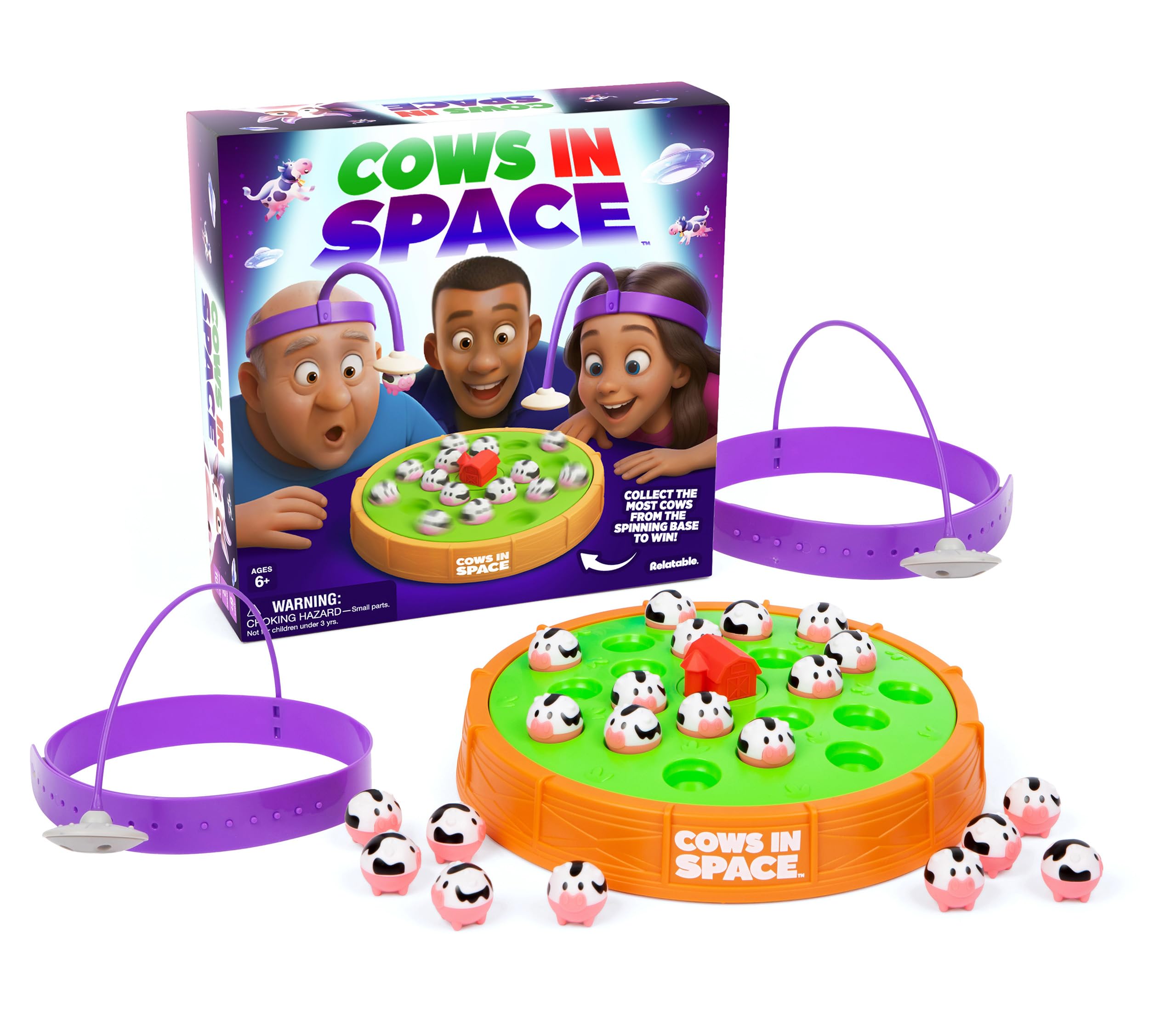
If you have ever wanted to abduct plastic cows with a magnetic UFO strapped to your forehead, Cows in Space is your game. The premise is gloriously ridiculous: two players wear UFO headbands that hover over a spinning electronic base littered with 21 small cow tokens. The challenge is to angle your head to make the magnetic saucer on your headband snap onto the cows without using your hands. The spinning base scatters cows unpredictably, creating frantic head-tilting that looks absurd and feels hilarious.
The production quality is solid for the price point. The base spins at a moderate speed that is challenging without being frustrating, and the magnet strength is calibrated so cows snap on cleanly but detach easily for reset. The 2026 Toy of The Year Finalist designation is not marketing fluff — the novelty factor is genuinely high, and the game supports ages 6+ without feeling babyish. Even adults find themselves leaning and twisting to line up the magnet, and the round-based play (whoever collects the most cows in a set time wins) keeps matches short enough for repeat rounds.
The headbands are the weakest link — they are functional but feel a bit plasticky, and the elastic straps could be more durable for heavy use. Some users noted the saucers detach if dropped, though reattachment is simple. The game is strictly two-player, so larger families will need to rotate turns. Despite that, the laughter-to-cost ratio is exceptional, and the tactile, screen-free physics make it stand out in a field dominated by card- and token-based mechanics.
Why it’s great
- Unique magnetic headband mechanic creates genuine laughs
- Electronic spinning base adds variable chaos each round
- Round-based format keeps play time manageable
- Strong replay value thanks to physical skill curve
Good to know
- Strictly 2-player; larger groups must rotate
- Headband build quality feels mid-range
- Small loose cows could pose a choking hazard if lost
4. Skillmatics Sentence Search
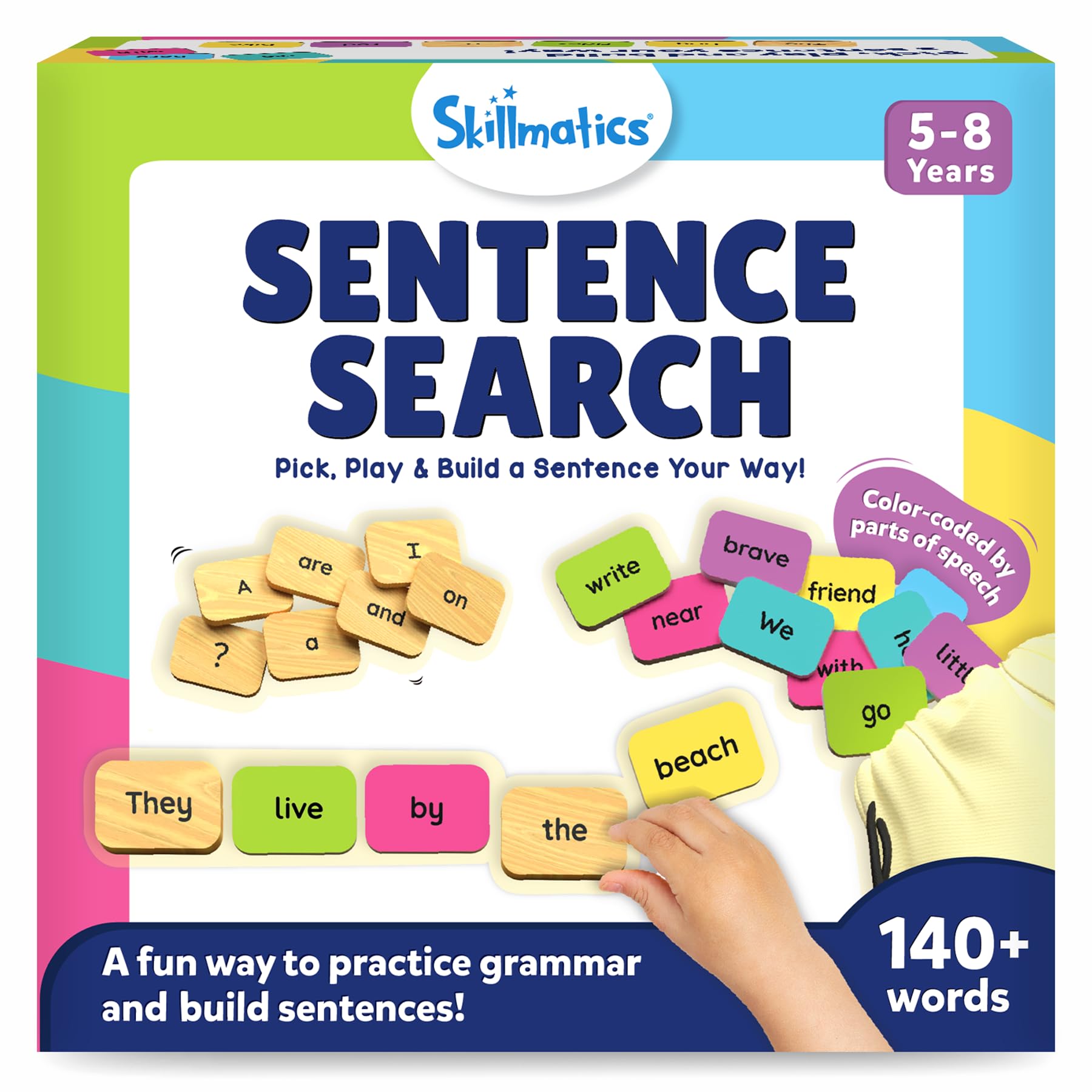
Sentence Search solves a common problem for parents of early readers: grammar practice feels like homework when it comes from a workbook, but it feels like a puzzle when it comes from a box of tiles. The kit includes over 120 color-coded word tiles organized by part of speech — nouns, verbs, adjectives, and connectors — plus 20 wooden sentence builder tiles that act as physical frames. The recommended age of 5–8 is accurate: a five-year-old can physically arrange three-word sentences, while an eight-year-old can create compound structures using the included connectors.
The teaching design is smartly layered. The instruction manual provides a step-by-step progression from simple subject-verb-object sentences to more complex structures with adjectives and conjunctions. Because the tiles are color-coded, children subconsciously learn grammatical categories while hunting for the right tile. The two cloth bags separate active tiles from used ones, preventing the chaos of 120+ pieces spilling everywhere. The wooden sentence builder tiles are thick enough to survive drops and small enough for a child’s hand to manipulate comfortably.
Homeschool parents and speech therapists will appreciate the open-ended nature of the activity — there is no fixed board or winning condition, so the game adapts to the child’s pace. The main criticism is tile legibility: some words could be printed slightly larger to reduce squinting, especially for children still learning letter shapes. Overall, this is a rare educational game that feels like play first and drills second, making it a strong pick for reluctant readers who resist traditional worksheets.
Why it’s great
- Color-coded tiles teach parts of speech intuitively
- Open-ended design adapts to skill level
- Durable wooden components survive heavy use
- Screen-free grammar practice that feels like a puzzle
Good to know
- Word tile font size is small for some early readers
- Adult guidance recommended for initial sessions
- Tile bag could be sturdier for frequent travel
5. Mathemagical World

Mathemagical World disguises arithmetic drills as a themed board game where players travel across eight unique worlds — Dinosaur Island, Pirate Island, Zombie Island, Unicorn Island, and others — solving addition and subtraction equations to advance. The two-tiered difficulty system allows a single game to serve both kindergarteners (single-digit sums) and first graders (double-digit and half/double concepts). The board itself is large and vibrant, with colorful illustrations that make each world feel distinct and worth exploring.
The educational scaffolding is well-executed: the laminated rules page and durable box have held up through repeated use in homeschool and classroom settings. The game cleverly integrates “double” and “half” mechanics, pushing children beyond rote memorization into conceptual math thinking. For gifted and talented prep, the higher difficulty level aligns well with OLSAT and COGAT readiness, making it a dual-purpose purchase for families targeting academic enrichment alongside family fun.
The biggest caveat is the narrow age sweet spot — roughly 4.5 to 5.5 years. Children at the younger end may find the math too challenging without constant adult help, while kids over 7 often find the gameplay (essentially roll-and-move with math stops) too simple. Some reviewers noted that with four players the game can drag, and the “shark attack” spaces can create frustrating loops that slow progress. For its intended age window, however, it delivers more educational density than Candy Land while staying simpler than Monopoly.
Why it’s great
- Two difficulty levels extend usable age range
- Double/half mechanic builds conceptual math skills
- Durable board and components for classroom use
- Eight themed worlds maintain visual interest
Good to know
- Best for ages 4.5–5.5; older kids may find it simple
- Longer play times with 4 players
- Shark attack spaces can create frustrating loops
FAQ
What is the best board game for a 5-year-old who cannot read yet?
How do I know if a board game has enough replay value for my child?
Are educational board games actually effective for learning math or reading?
What is the ideal player count for kids’ board games?
Final Thoughts: The Verdict
For most families, the best board games for kids winner is the Hasbro Gaming Operation because it combines fine motor skill practice, two distinct play modes, and a carrying case that solves the eternal “where are the pieces” problem. If you want a high-energy group game that generates belly laughs without requiring batteries, grab the Spin Master Snack-O-Saurus Rex. And for a screen-free literacy tool that feels more like play than work, nothing beats the Skillmatics Sentence Search.

Mo Maruf
I created WellFizz to bridge the gap between vague wellness advice and actionable solutions. My mission is simple: to decode the research and give you practical tools you can actually use.
Beyond the data, I am a passionate traveler. I believe that stepping away from the screen to explore new environments is essential for mental clarity and physical vitality.