Our readers keep the lights on and my smoothie glass nicely filled. As an Amazon Associate, I earn from qualifying purchases.
A backpacking solar panel needs to earn every gram of space in your pack. You are trading weight for the ability to recharge a phone, a GPS unit, or an inReach without hunting for a wall outlet. The wrong panel delivers nothing but dead weight on a cloudy day. The right one turns a day of hiking into a consistent trickle of power that keeps your essential devices alive for the duration of your trip.
I’m Mohammad Maruf — the founder and writer behind WellFizz. I’ve spent years analyzing portable power hardware, comparing monocrystalline cell efficiency ratings, real-world wattage output, foldability, and IP ratings across dozens of panels designed specifically for the trail rather than the campsite.
A smart purchase depends on understanding the panel’s actual wattage capacity, the type of connectors you need for your power bank, and the weight you are willing to haul. This guide breaks down the best options available today to help you identify the right backpacking solar panel for your next adventure.
How To Choose The Best Backpacking Solar Panel
Selecting the right panel for the trail is different from buying one for a van or a cabin. Weight, packability, and real-world efficiency in partial shade are the deciding factors. Here is what matters most.
Real Wattage vs Advertised Wattage
Most portable panels only reach their rated wattage under ideal lab conditions — direct sun at perpendicular angles, cool temperatures, and a clean surface. In the field, expect roughly 60–75% of the advertised number on a clear day. A panel labeled 25W may deliver 15W to your phone. Pay attention to the USB-C PD wattage rating, as that port handles the fastest charging for modern power banks and phones.
Weight and Folded Size
Every ounce counts on a multi-day hike. A panel under 1 pound with a folded size similar to a tablet fits neatly against your pack’s hydration sleeve or lashes to the outside. Panels above 4 pounds are better suited for base camp setups or short carries rather than true backpacking. Look for ETFE coating rather than standard PET — it shaves weight while improving light transmission and durability.
Connector Compatibility
Check what your power bank or phone accepts. Many modern panels include USB-C PD outputs for direct device charging, while higher-wattage panels use 8mm, DC5521, or MC4 connectors for power stations. If you plan to charge a phone and a battery pack simultaneously, ensure the panel has at least two independent output ports.
Durability and Weather Resistance
A panel that cannot survive a sudden downpour is useless on the trail. IP65 rating handles splashes and light rain. IP67 and IP68 ratings offer full dust protection and immersion protection. Also check whether the fabric and stitching around the fold seams are reinforced — that is where most failures happen after repeated packing and unpacking.
Quick Comparison
On smaller screens, swipe sideways to see the full table.
| Model | Category | Best For | Key Spec | Amazon |
|---|---|---|---|---|
| [Upgraded] BigBlue 25W | Ultra-Light | Ultralight backpacking & thru-hikes | 0.84 lb / 25W rated / IP68 | Amazon |
| FlexSolar 100W | Mid-Range Power | Long trips with a power station | 4.1 lb / 100W rated / IP67 | Amazon |
| ZOUPW 100W | High Efficiency | Universal power station charging | 9.48 lb / 100W rated / 23.5% efficiency | Amazon |
| EBL Solar 100W | Value Performer | Budget-friendly base camp setup | 9.48 lb / 100W rated / IP65 | Amazon |
| Goal Zero Nomad 20 | Compact Premium | Day hikes & emergency kits | 2.25 lb / 20W rated / 180° kickstand | Amazon |
| Renogy 200W E.Flex | High Output | Group trips & CPAP backup | 13.89 lb / 200W rated / 25% efficiency | Amazon |
| EcoFlow 220W NextGen | Flagship Performance | Extended off-grid base camps | 15.9 lb / 220W rated / IP68 | Amazon |
In‑Depth Reviews
1. [Upgraded] BigBlue 25W Portable Solar Panel

The BigBlue 25W is the lightest fully-featured panel in this roundup at just 0.84 pounds, folding down to the size of an iPad. That weight-to-wattage ratio makes it the obvious choice for thru-hikers and ultralight backpackers who still want to keep a phone and a small power bank topped off during town stops or lunch breaks. The N-type monocrystalline cells with a 25.4% conversion efficiency are genuinely high for this size class.
Real-world testing shows the panel outputs roughly 15W via the USB-C port in direct sun, which is enough to charge a 10,000mAh power bank in about six hours. The IP68 rating means you do not have to panic during an afternoon thunderstorm. The built-in USB-A port at 2.4A and USB-C at 3A allow simultaneous charging of two small devices.
Some users noted that Amazon fulfillment occasionally sends returned units missing accessories — the included carabiners and USB-C cable are essential for hanging the panel on your pack. The maximum output per USB-C port is 15W rather than the full 25W the panel name suggests, so manage expectations on charging speed. Still, for pure hiking portability, this panel is hard to beat.
Why it’s great
- Incredibly lightweight at under one pound.
- IP68 waterproof rating for all-weather durability.
- High 25.4% cell efficiency for its size.
Good to know
- Real-world USB-C output caps around 15W on one port.
- Best for topping off power banks and phones, not large power stations.
- Amazon returns may be missing carabiners or USB-C cable.
2. FlexSolar 100W Portable Solar Panel
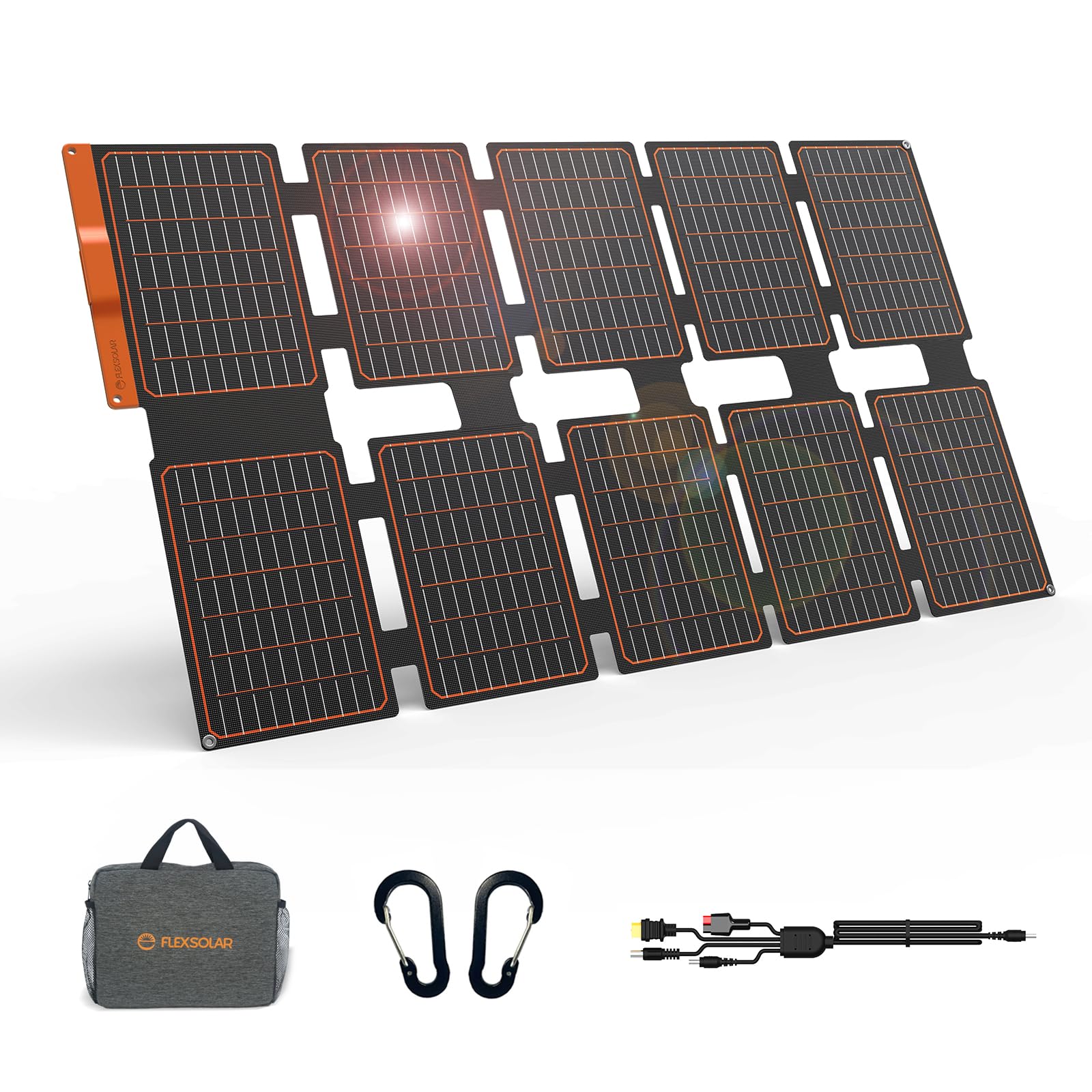
The FlexSolar 100W hits a sweet spot for backpackers who carry a small power station like a Jackery 300 or EcoFlow River. Weighing 4.1 pounds and folding to notebook size, it is manageable for a pack lash or a canoe portage. The PD 3.0 USB-C port delivers up to 45W, which can charge a laptop or a power station much faster than typical 18W USB-A ports.
Build quality feels solid with E-Film laminated monocrystalline cells and an IP67 dust and water resistance rating. The included 4-in-1 charging cable covers DC5521, DC7909, Anderson, and XT60 connectors — useful for pairing with a wide range of power stations. Users report real-world DC output near 90W and USB-C output around 56W, which is impressive for a sub- panel.
The DC and USB circuitry can get hot under sustained loads above 60W, so ventilate the panel if you are pushing it hard. The USB connector pins are also prone to corrosion after exposure to rain. Cleaning the pins restores function, but it is an extra maintenance step that heavier-usage buyers should keep in mind.
Why it’s great
- Excellent value with near 100W real-world output.
- 45W USB-C PD for fast laptop and power station charging.
- Includes 4-in-1 cable for multiple connector types.
Good to know
- USB connector pins can corrode if exposed to rain.
- DC and USB circuitry runs hot at high loads.
- No MC4 connector included for some permanent installations.
3. ZOUPW 100W Portable Solar Panel

The ZOUPW 100W is built for compatibility first. The 5-in-1 cable includes a DC8020 connector specifically for newer Jackery Explorer models, alongside XT60, Anderson, DC7909, and DC5521. If you own a power station from Jackery, EcoFlow, Anker, or Bluetti, odds are this panel connects without an adapter. The 23.5% efficiency grade A+ monocrystalline cells perform well even in overcast conditions.
The panel includes two adjustable kickstands that lock at a 45-degree angle to capture more sunlight than flat laying. The ETFE coating is tough and resists heat better than PET-laminated panels. A built-in smart controller offers three direct device ports — one USB-C PD 15V/3A and two USB-A ports including QC3.0 — so you can charge phones and a power bank simultaneously.
The 10-foot solar extension cable gives you flexibility in positioning the panel in the sun while keeping your electronics shaded. At 9.48 pounds, this panel is heavier than the FlexSolar and better suited for base camp or car camping than ultralight backpacking. The kickstand legs lack adjustable tilt beyond the 45-degree preset, so you cannot fine-tune for early morning or late afternoon sun angles.
Why it’s great
- 5-in-1 cable connects to 99% of popular power stations.
- High 23.5% efficiency in low-light conditions.
- ETFE coating adds durability and heat resistance.
Good to know
- At 9.48 lb it is more of a base camp panel.
- Kickstand legs only adjust to 45 degrees.
- USB-C PD limited to 45W instead of the stated 60W.
4. EBL Solar 100W Portable Solar Panel
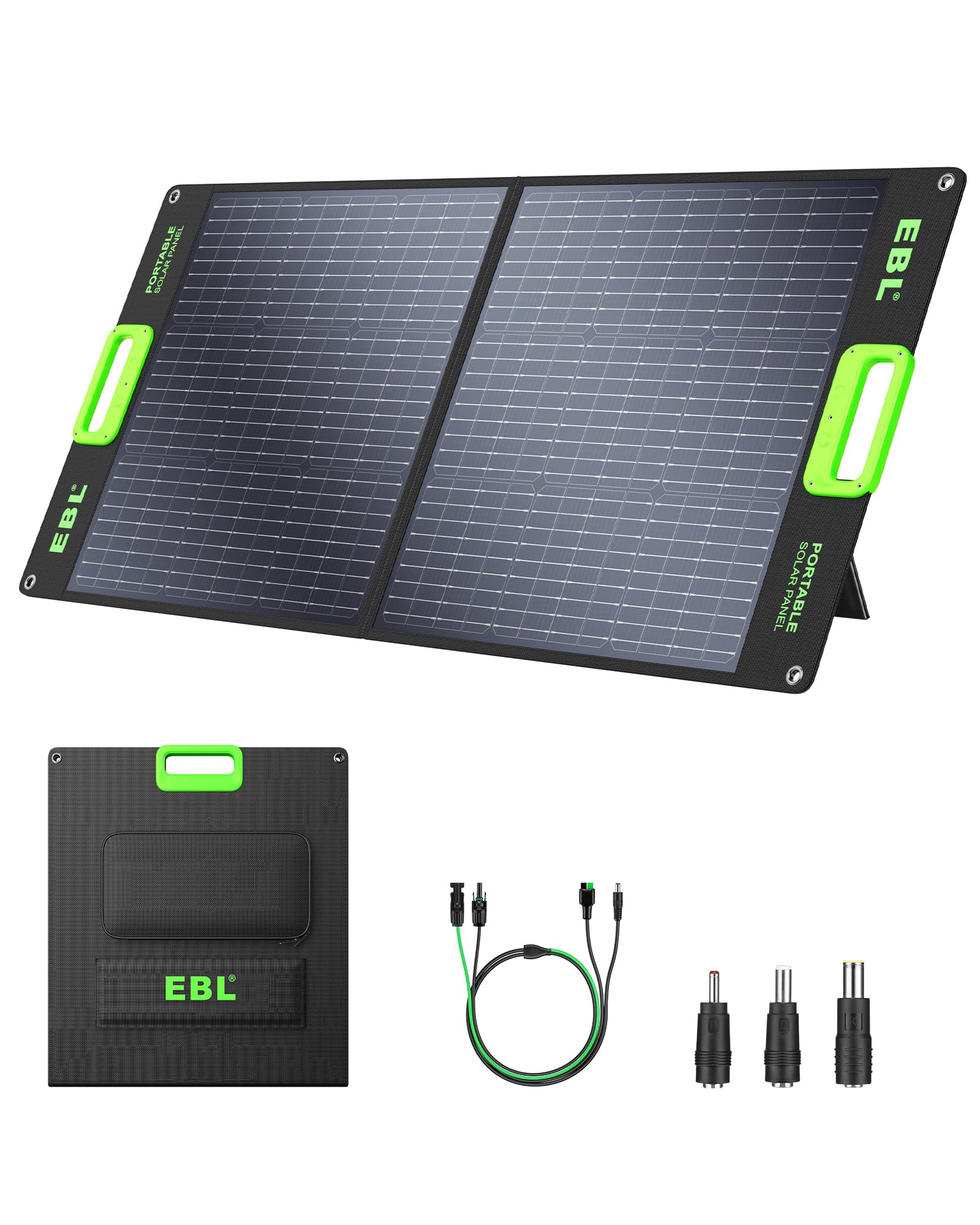
The EBL Solar 100W panel offers a budget-friendly entry into 100W portable charging without cutting corners on basic build quality. The monocrystalline cells are rated at 23% efficiency, and the panel comes with two kickstands that angle it at 45 degrees for improved solar capture. The magnetic handle makes folding and carrying straightforward.
In the field, users report real-world output around 65-80W on sunny days, though some have recorded peaks over 130W under ideal conditions. The IP65 water resistance is sufficient for light splashes, but this panel should not sit out in heavy rain. The kit includes multiple adapters for DC5521, Anderson, and 5.5mm barrel connectors, giving you compatibility with a variety of power stations and batteries.
The 6-foot cable is shorter than some competitors, which can make positioning the panel in the sun while keeping your gear shaded more difficult. The build quality is solid for the price, but panel-to-panel consistency varies — some customers report needing a replacement to get a fully functional unit with all adapters. Given the price, it is a strong option for car camping or short trips where weight is less critical.
Why it’s great
- Very competitive price for a 100W portable panel.
- 45-degree kickstand improves sunlight capture.
- Includes multiple adapter cables for various power stations.
Good to know
- IP65 rating means it cannot handle heavy rain.
- Short 6-foot cable limits positioning flexibility.
- Some customers report needing replacement units.
5. Goal Zero Nomad 20 Portable Solar Panel

The Goal Zero Nomad 20 is a purpose-built panel for day hikers, emergency kits, and minimalist travelers. At 2.25 pounds with a folded size of 11.5 x 7.4 x 1.25 inches, it is slightly heavier than the BigBlue but offers a 180-degree adjustable kickstand that makes propping it up against a rock or a pack much easier. The 20-watt monocrystalline panel outputs 18-22 volts, which is ideal for charging Goal Zero’s own power banks via the built-in 8mm cable.
The USB port delivers up to 2.4A, which is enough to charge an iPhone or a small battery bank at a reasonable pace. In real-world use, the Nomad 20 brings a phone from near-empty to about 60% in two hours of direct sun. The US-based engineering and support team gives this panel a quality assurance edge over cheaper imports. The included 8mm cable can also daisy chain to a larger Nomad panel for increased charging capacity.
The Nomad 20 is not meant for powering a laptop or a large power station — its output is strictly for small devices. At this price point, you are paying for the brand’s reliability and the 180-degree kickstand design rather than raw wattage. If your goal is to keep a phone and a small USB battery charged on day trips, this panel delivers consistent, simple performance.
Why it’s great
- 180-degree adjustable kickstand for easy positioning.
- Built-in 8mm cable works with Goal Zero power banks.
- Compact folded size fits easily in a day pack.
Good to know
- Only 20W output — not for laptops or power stations.
- Higher cost per watt than larger panels.
- USB port may stop charging in light cloud cover.
6. Renogy 200W E.Flex Portable Solar Panel
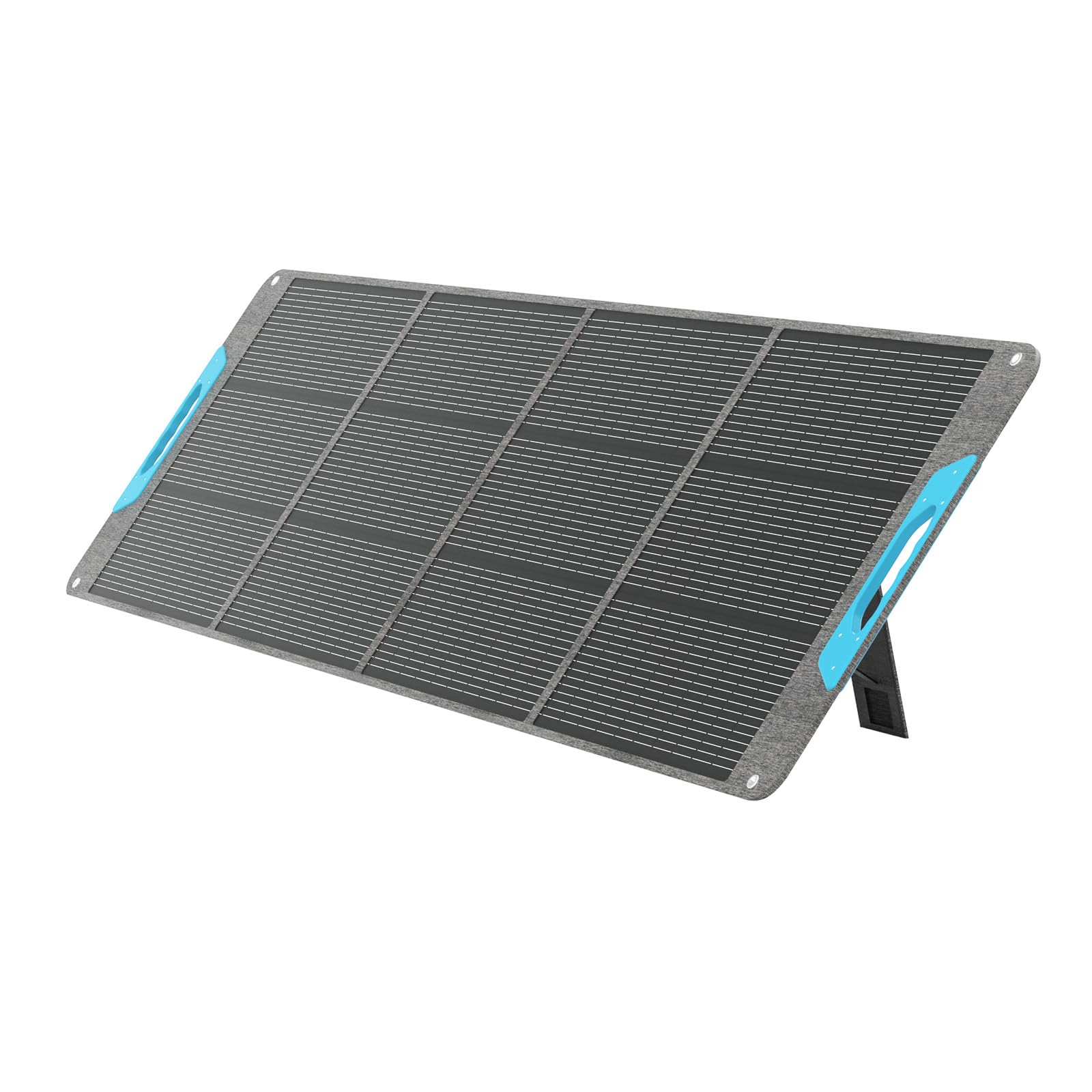
The Renogy 200W E.Flex is for the backpacking group or the solo adventurer who needs to recharge a CPAP battery or a small power station daily. At 13.89 pounds with a quadfold design, it is not a panel you toss in a day pack, but it packs down to 23.72 x 22.99 x 1.97 inches — manageable for a canoe strap or a dedicated dry bag on a longer trip. The 16BB N-type cell technology delivers 25% conversion efficiency, which is industry-leading for a portable panel.
The E.Flex includes three USB outputs (one USB-C PD at 45W, two USB-A at 18W and 15W) plus an MC4 output for connecting to a 12V battery system or a power station. The magnetic closure makes setup and breakdown much faster than traditional snap or Velcro designs. Four kickstands with three angle adjustments (40, 50, and 60 degrees) let you optimize the panel’s tilt throughout the day.
Real-world tests show the panel averaging around 133-154W in direct summer sun, occasionally exceeding 200W under ideal conditions. The IP65 rating handles dust and light splashes but is not waterproof, so this panel needs to be packed away during heavy rain. The included travel bag is functional but basic — some users upgrade to a padded bag for better protection during transport.
Why it’s great
- 25% N-type cell efficiency — top in its class.
- Magnetic closure and three-angle kickstands for easy setup.
- Three USB outputs plus MC4 for power station charging.
Good to know
- 13.89 lb is heavy for true backpacking.
- IP65 rating does not protect against heavy rain.
- No charging cable included for some power stations.
7. EF ECOFLOW 220W NextGen Portable Solar Panel

The EcoFlow 220W NextGen is the most powerful panel on this list, designed for serious off-grid power needs. It uses N-type solar cells with 25% conversion efficiency — the same technology used in high-end residential panels. The IP68 rating means it is fully dust-tight and can withstand immersion in water, making it the most weather-resistant option for extended base camps in unpredictable environments.
The adjustable angle bracket ranges from 30 to 60 degrees, paired with an integrated solar angle guide that helps you find the optimal tilt based on your latitude and time of year. This panel is built to handle sustained high-output charging for EcoFlow’s Delta 2 Max and similar large power stations. In tests, it achieved 206W peak output on a sunny day — roughly 93.6% of its rated capacity, which is excellent real-world performance.
At 15.9 pounds, this panel is strictly for vehicle-supported camping, base camps, or overlanding. The ETFE coating and robust frame are built for years of rough use. The one-year warranty is shorter than some competitors, and the elastic straps on the stands are tight enough that solo setup can feel awkward. For the hiker who arrives at camp with a fully loaded power station and needs to replenish daily, this panel is the undisputed performance leader.
Why it’s great
- IP68 waterproof — fully protected against dust and immersion.
- 93.6% real-world output efficiency versus rated 220W.
- N-type cells with 25% conversion efficiency.
Good to know
- 15.9 lb is the heaviest panel — not for backpacking.
- One-year warranty is shorter than some competitors.
- Stand straps make solo setup somewhat awkward.
FAQ
Can a backpacking solar panel charge a laptop directly?
How should I position my solar panel while hiking?
What size panel do I need for a weekend backpacking trip?
Final Thoughts: The Verdict
For most backpackers, the best backpacking solar panel winner is the BigBlue 25W because it weighs less than a pound, folds to tablet size, and delivers reliable charging for phones and power banks without bogging down your pack. If your trips involve a small power station and you want maximum power per ounce, grab the FlexSolar 100W. And for serious off-grid base camps where you need enough solar to recharge CPAP batteries or run a laptop daily, nothing beats the Renogy 200W E.Flex.

Mo Maruf
I created WellFizz to bridge the gap between vague wellness advice and actionable solutions. My mission is simple: to decode the research and give you practical tools you can actually use.
Beyond the data, I am a passionate traveler. I believe that stepping away from the screen to explore new environments is essential for mental clarity and physical vitality.