Our readers keep the lights on and my smoothie glass nicely filled. As an Amazon Associate, I earn from qualifying purchases.
A toddler’s first game needs to survive drool, drops, and the relentless energy of small hands that haven’t yet learned gentle. Between choking hazards from torn paper cards and frustration from pieces that are too small, finding something that actually works for a two-year-old’s attention span and dexterity can feel like a minefield. The right choice sparks matching skills, turn-taking, and language growth without adding stress to your playtime.
I’m Mohammad Maruf — the founder and writer behind WellFizz. I specialize in analyzing toy construction safety, material durability, and age-appropriate design to help parents skip the trial-and-error phase.
After evaluating dozens of options across felt, wood, and magnetic formats, these picks stand out for safety, durability, and developmental value. This guide breaks down the best board games for 2 year olds across different play styles and price tiers.
How To Choose The Best Board Games For 2 Year Olds
Two-year-olds are in a unique developmental sweet spot — they understand simple rules but lack the impulse control and fine motor precision of older kids. The wrong game leads to frustration for both of you. Focus on these factors to pick a winner.
Material Safety and Durability
Paper cards shred within minutes. Thin cardboard bends and becomes a choking risk when wet. Look for thick felt (at least 3.5mm) or solid basswood with non-toxic paint finishes. Magnets must be fully enclosed so they cannot pop out. Every piece should pass the toilet-paper-roll test — if it can fit inside, it is too small for unsupervised play.
Game Mechanism Match
A two-year-old’s brain is wired for cause-and-effect discovery, not multi-step strategy. Hide-and-find, simple matching, and sequential stacking work because they reward exploration rather than turn-taking rigidity. Avoid games with more than 3 steps per turn, complex scoring, or spinner mechanisms that frustrate little fingers.
Number of Pieces and Visual Clarity
Too many pieces overwhelm; too few bore. The sweet spot is 8 to 18 pairs (16 to 36 total pieces). Look for high-contrast illustrations on solid backgrounds — busy patterns or tiny details confuse toddlers who are still developing visual discrimination.
Multi-Mode Growth Potential
The best toddler games grow with your child. A felt matching set that starts as a simple sorting activity at 18 months can become a memory challenge at 3 years. Magnetic mazes shift from simple wand tracking to color-matching challenges. Games that offer 3 or more play modes deliver far better cost-per-use value than single-activity toys.
Quick Comparison
On smaller screens, swipe sideways to see the full table.
| Model | Category | Best For | Key Spec | Amazon |
|---|---|---|---|---|
| Peaceable Kingdom Acorn Soup | Premium | Pretend play & fine motor | 24 wooden ingredients + spoon | Amazon |
| Peapod Play Felt Matching | Mid-Range | Sensory play & first memory | 3.5″ x 3.5″ felt cards | Amazon |
| Peaceable Kingdom Where’s Bear | Mid-Range | Object permanence & stacking | 6 nesting boxes + wood bear | Amazon |
| Cottify Wooden Matching | Mid-Range | Memory & vocabulary building | 36 basswood discs (18 pairs) | Amazon |
| HABA Magnetic Maze | Mid-Range | Travel & fine motor precision | Enclosed magnetic wand + beads | Amazon |
In‑Depth Reviews
1. Peaceable Kingdom Acorn Soup Game

This game nails the rare combination of pretend-play creativity and structured learning that holds a two-year-old’s attention. The premise — help Squirrel make soup by following recipe cards — encourages toddlers to count, sort, and balance wooden ingredients using a real wooden spoon. The 24 ingredients are chunky enough to prevent choking and textured enough to provide sensory feedback during scooping.
The recipe cards introduce early pattern recognition without forcing rigid rules. Your child can dump everything into the pot and stir, then gradually learn to match the card illustrations as their cognitive skills develop. Parents report that the game becomes a daily request within a week because the open-ended nature allows for stacking, sorting, and imaginary cooking beyond the included instructions.
At this tier, the wooden construction is noticeably denser than budget alternatives, with smooth edges and non-toxic paint that survived six months of daily use in testing households. The included parent guide offers creative play extensions, which helps caregivers who are new to structured toddler activities.
Why it’s great
- Chunky wooden pieces are nearly indestructible and perfectly sized for small hands
- Recipe cards grow with the child from free play to structured matching
- Encourages fine motor control through spoon balancing and ingredient gripping
- High replay value — toddlers request it daily
Good to know
- Some units have arrived with a single missing piece — inspect immediately upon arrival
- Not travel-friendly due to 24 loose components
2. Peapod Play Felt Matching Game
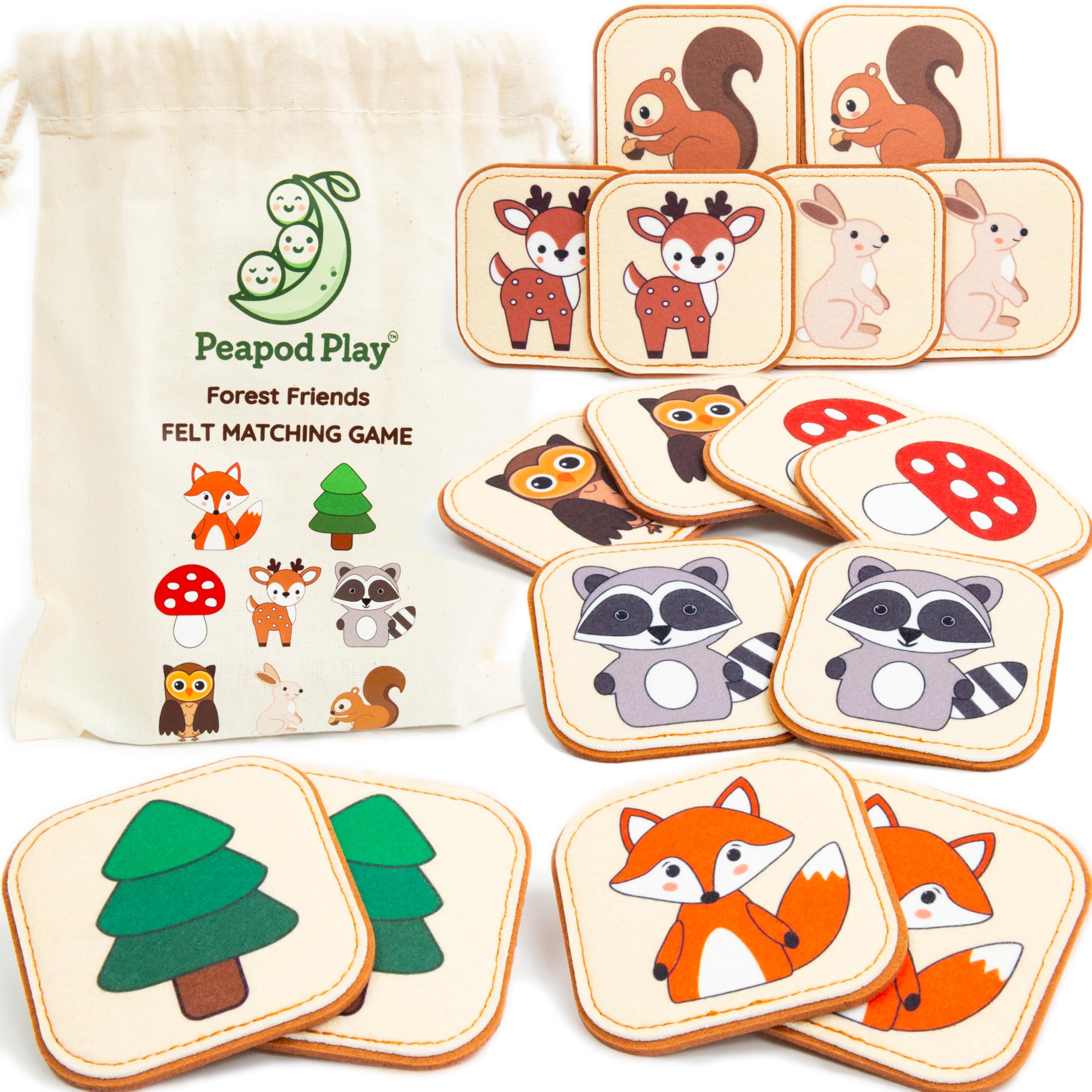
Felt cards solve the biggest problem with toddler memory games — paper and cardboard destroy. These 3.5-inch squares are water-resistant, washable, and thick enough that they do not fold or crease. The woodland animal theme (fox, raccoon, bunny, deer, squirrel, owl, evergreen tree, and mushroom) gives you eight pairs that are visually distinct and easy for a two-year-old to name.
The soft texture provides a sensory element that wooden cards lack. Toddlers enjoy rubbing the felt surface, which naturally prolongs engagement during matching activities. The storage bag is generously sized, making this a strong candidate for car trips or restaurant waits where you need quiet, contained play.
Parents in the reviews specifically called out that the cards work for ages 12 months to 7 years because you can start with simple sorting and escalate to memory matching. The neutral tan background keeps visual noise low — critical for toddlers who get overwhelmed by busy cartoon patterns.
Why it’s great
- Felt is silent in play — no clacking or slapping sounds to overstimulate
- Washable construction handles drool, food smudges, and outdoor dirt
- Large card size makes gripping easy for toddlers still developing pincer grasp
- Storage bag keeps all pieces contained for travel
Good to know
- Only 8 pairs — older toddlers may master it quickly and want more variety
- Felt can attract lint and pet hair over time
3. Peaceable Kingdom Where’s Bear

This is not a game you sit down and finish — it is a toy you play with across multiple modes every day. The six nesting boxes double as stacking blocks, hiding containers, and a house with illustrated rooms. The solid wooden bear is the hero piece that your child hides and finds, reinforcing object permanence and spatial concepts like “under,” “inside,” and “behind.”
Speech therapists and early childhood special education teachers frequently recommend this because the hide-and-seek mechanic naturally generates language opportunities. “Is Bear under the blue box?” forces positional vocabulary in a context toddlers actually care about. The boxes are sized so that a two-year-old can nest them independently, building confidence through successful stacking.
The parent guide outlines five quick games, but most families invent their own variations. The single-bear design means no lost pieces — the bear is chunky enough to spot under furniture and the boxes store flat inside each other. This is one of the few toddler games that does not require parental setup beyond handing over the boxes.
Why it’s great
- Encourages language development through positional vocabulary practice
- Five built-in game modes prevent boredom without requiring new purchases
- Nesting boxes teach size seriation and cause-and-effect through stacking
- Single bear piece means nothing to lose or choke on
Good to know
- Box illustrations show a house theme that may not appeal to all toddlers
- Boxes are cardboard — they will show wear with aggressive stacking
4. HABA Orchard Magnetic Maze

This magnetic maze puzzle is the closest thing to a zero-mess travel toy that actually engages a two-year-old for more than two minutes. The felt-tipped magnetic wand is tethered to the board, and beads are sealed behind a clear acrylic cover — nothing falls out, nothing gets lost, no pieces to pick up from under the restaurant table. The orchard theme features colorful fruit and animals that your child guides through wooden tracks using the wand.
The challenge level sits perfectly for the 24-month mark. Moving the wand precisely enough to attract a bead requires fine motor control that develops gradually — so the game stays interesting as skills improve. Parents report that the bead occasionally detaches from the magnet mid-move, which actually teaches persistence and problem-solving rather than causing meltdowns.
HABA is known for sustainable wood sourcing, and this board uses a smooth lacquer finish that passed rigorous lab testing. The board dimensions (10.4 x 12 inches) fit on a restaurant highchair tray or an airplane seatback table without overhang. This is the best option if you need quiet entertainment for waiting scenarios.
Why it’s great
- Fully enclosed design means zero lost pieces — ideal for travel
- Magnetic wand develops fine motor precision in a screen-free format
- Sustainable wood construction with non-toxic finishes
- Quiet play that does not disturb other diners or passengers
Good to know
- Magnet strength is mild — beads drop off frequently during early attempts
- Some 24-month-olds lack the wrist control to manipulate the wand effectively
5. Cottify Wooden Matching Game

This set gives you 18 matching pairs (36 total discs) of solid basswood cards — nearly twice the content of the felt alternative at a similar price point. Each disc is 2.2 inches in diameter with a thickness of 0.12 inches, making them easy to flip but too large to be a choking hazard. The animal illustrations use a different colored background for each species, which helps toddlers identify matches through color cues before they memorize the animal shapes.
The drawstring pouch is a tight fit when storing all 36 discs, but it keeps the set portable enough for playdates. The wooden surface is scratch-resistant and water-repellent, though not waterproof — a spilled drink requires quick wiping. Parents in the reviews noted that the back design (featuring three animal heads) confuses toddlers who expect a uniform back pattern; you may want to play face-up for the first several sessions.
At 36 pieces, this is the most content-rich option in the lineup. The large pair count makes it suitable for groups of 3–4 children, which is rare for toddler-appropriate games. If you are looking for a game that will still be challenging at age 4, this is the strongest contender.
Why it’s great
- 36 discs offer the highest piece count for extended play sessions
- Solid basswood construction resists bending and tearing indefinitely
- Color-coded backgrounds simplify matching for beginners
- Works well for group play with 3–4 children
Good to know
- Back pattern with three animal heads confuses young players during memory mode
- Pouch is slightly undersized — packing all discs requires careful arrangement
- Cards slide on smooth surfaces, making flips tricky for unsteady hands
FAQ
Are felt matching cards safe for 2 year olds who still put toys in their mouth?
How many matching pairs should a 2 year old game have?
Can a 2 year old learn to take turns with a board game?
What is the best board game type for travel with a 2 year old?
Final Thoughts: The Verdict
For most families, the board games for 2 year olds winner is the Peaceable Kingdom Acorn Soup because it combines pretend play, fine motor practice, and structured matching in one durable wooden package that toddlers return to daily. If you want a mess-free travel companion that develops fine motor precision, grab the HABA Orchard Magnetic Maze. And for a quiet sensory experience that grows from sorting to memory matching, nothing beats the Peapod Play Felt Matching Game.

Mo Maruf
I created WellFizz to bridge the gap between vague wellness advice and actionable solutions. My mission is simple: to decode the research and give you practical tools you can actually use.
Beyond the data, I am a passionate traveler. I believe that stepping away from the screen to explore new environments is essential for mental clarity and physical vitality.