Our readers keep the lights on and my smoothie glass nicely filled. As an Amazon Associate, I earn from qualifying purchases.
An overheating RV on a summer road trip or a dead battery at a remote campsite isn’t just an inconvenience—it’s a trip-ender. A 4500-watt inverter generator sits right in the sweet spot for RV owners: enough surge to kick-start a 13,500 BTU air conditioner, yet quiet enough to keep camp neighbors happy. The trade-off is between fuel flexibility, noise levels, and how much weight you’re willing to haul.
I’m Mohammad Maruf — the founder and writer behind WellFizz. I’ve spent years analyzing generator specs, cross-referencing THD ratings, decibel claims, and real-world runtime data so you don’t have to guess what works for a 30-amp RV setup.
This guide breaks down the top models based on power quality, portability, and fuel efficiency to help you find the best 4500-watt inverter generator for rv that fits your travel style.
How To Choose The Best 4500-Watt Inverter Generator For RV
Not every 4500-watt generator is built the same. The difference between a frustrating campsite experience and a smooth off-grid trip comes down to a handful of non-negotiable specs. Here’s what to prioritize.
Output and Surge Capacity
A 4500-watt inverter generator typically provides 4500 peak watts and around 3500 rated watts. The surge is critical for starting an RV air conditioner, which can draw 2-3 times its running wattage for the first few seconds. If your rig has a 15,000 BTU AC, look for a model with a strong surge rating to avoid a brownout.
Fuel Type and Runtime
Gasoline is the most common fuel, but dual-fuel models that also run on propane offer longer shelf life and cleaner combustion. Propane burns cleaner and won’t gum up the carburetor during seasonal storage, but it delivers slightly lower wattage. If you plan to run the generator overnight, check the runtime at 25% load—longer runtimes mean fewer interruptions for refueling.
Noise Level (dBA)
Inverter generators are inherently quieter than conventional open-frame models. Most 4500-watt inverters operate between 52 and 64 dBA at quarter load from 23 feet. In campgrounds with quiet hours, anything over 60 dBA may draw complaints. Models with enclosed cases and ECO mode typically run the quietest.
Portability and Weight
Weight ranges from 54 pounds to over 100 pounds. If your RV has a dedicated generator compartment, weight matters less. But if you need to lift the unit into a truck bed or move it around a campsite, look for built-in wheels, a telescoping handle, and a weight under 75 pounds.
Safety Features
A built-in carbon monoxide (CO) sensor with automatic shutoff is now a standard safety feature on most modern inverter generators. It’s especially important if you ever run the generator near your RV’s living space. Low-oil shutdown and overload protection are also essential to prevent engine damage.
Quick Comparison
On smaller screens, swipe sideways to see the full table.
| Model | Category | Best For | Key Spec | Amazon |
|---|---|---|---|---|
| PowerSmart 4800W | Gasoline | Budget-friendly home backup | 89 lbs / 69 dBA | Amazon |
| BILT HARD 4500W Dual Fuel | Dual Fuel | Lightweight dual-fuel camping | 57.7 lbs / 58 dBA | Amazon |
| ERAYAK 4500W Dual Fuel | Dual Fuel | Compact propane/gas flexibility | 54 lbs / 58 dBA | Amazon |
| WEN 56477i 4800W | Gasoline | Reliable gasoline-only RV use | 72.7 lbs / fuel shutoff | Amazon |
| Champion 4000W Dual Fuel | Dual Fuel | Balanced propane/gas with warranty | 53 lbs / 64 dBA | Amazon |
| Westinghouse iGen4000DFc | Dual Fuel | Remote start and low noise | 62.8 lbs / 52 dBA | Amazon |
| WEN DF451i 4500W | Dual Fuel | Dual fuel with auto-switch | 100 lbs / 58 dBA | Amazon |
| Generac iQ5200 5200W | Dual Fuel | Premium build with extra surge | 107 lbs / COsense | Amazon |
| Westinghouse 13500W Tri-Fuel | Tri-Fuel | Whole-RV backup (open frame) | 230 lbs / 50A outlet | Amazon |
| Cummins Onan P4500I | Gasoline | Premium quiet operation | 98 lbs / remote start | Amazon |
| Honda EU3200i 3200W | Gasoline | Ultra-portable premium quality | 65 lbs / 3200 rated | Amazon |
In‑Depth Reviews
1. WEN DF451i 4500W Dual Fuel Inverter Generator

The WEN DF451i hits the ideal balance for serious RV owners who want dual-fuel flexibility without sacrificing power. Its 212cc engine delivers 4500 surge watts and 3500 rated watts on gasoline (3150 on propane), which is enough to handle a 15,000 BTU RV AC with headroom for lights and a microwave. The auto-fuel selection technology automatically switches from propane to gasoline when the propane tank runs dry, preventing an unexpected shutdown.
At 58 dBA from 22 feet at quarter load, this generator is genuinely campsite-friendly—conversation-level quiet. The electric start works reliably via keyless push-button, with a backup recoil starter for peace of mind. The digital display shows fuel level, load, and runtime, which helps you plan refueling stops without guesswork. Owners report running their 5th wheel for over 60 hours during a single trip with no issues.
On the downside, the DF451i weighs about 100 pounds dry, making it one of the heavier portable options. The oil fill is located at the bottom, which is awkward to access without tilting the unit. Some users also note that the battery connection instructions could be clearer, and the red warning light on startup occasionally requires cycling the switch. Still, for dual-fuel reliability and quiet power, this is the most well-rounded pick for RV living.
Why it’s great
- Auto fuel-switch from propane to gasoline
- Very quiet 58 dBA operation
- Electric and recoil start options
Good to know
- Heavy at 100 pounds
- Oil fill is low and hard to reach
2. Westinghouse iGen4000DFc Dual Fuel Inverter Generator

Westinghouse’s iGen4000DFc is built for the RV owner who values a quiet campsite above all else. At just 52 dBA—roughly the volume of a quiet conversation—this is one of the quietest 4000-watt-class inverter generators on the market. The remote start key fob lets you fire it up from inside the RV, which is a real convenience on cold mornings or rainy nights. The dual-fuel design runs on gasoline (4000 peak / 3300 rated) or propane (4000 peak / 3000 rated).
The rotating LED data center is a standout feature: it displays fuel level, power output, remaining runtime, voltage, and lifetime hours. This eliminates the guesswork of checking a mechanical fuel gauge. At 62.8 pounds with a telescoping handle, this generator is light enough to move around a campsite without straining. Owners report running their RV AC, microwave, and fridge simultaneously without the generator breaking a sweat.
Some buyers note that the advertised noise rating is optimistic at full load; at higher output, the engine becomes noticeably louder. The remote start also requires the power switch to be manually engaged first, which slightly undermines the convenience of the key fob. A few units arrived with minor battery plug gaps that required a simple fix. For most RVers, though, the combination of dual fuel, remote start, and whisper-quiet operation makes this a top contender.
Why it’s great
- Industry-leading 52 dBA noise level
- Remote key fob start
- Informative digital display with runtime
Good to know
- Noise increases significantly at full load
- Battery plug may need minor adjustment
3. ERAYAK 4500W Dual Fuel Inverter Generator
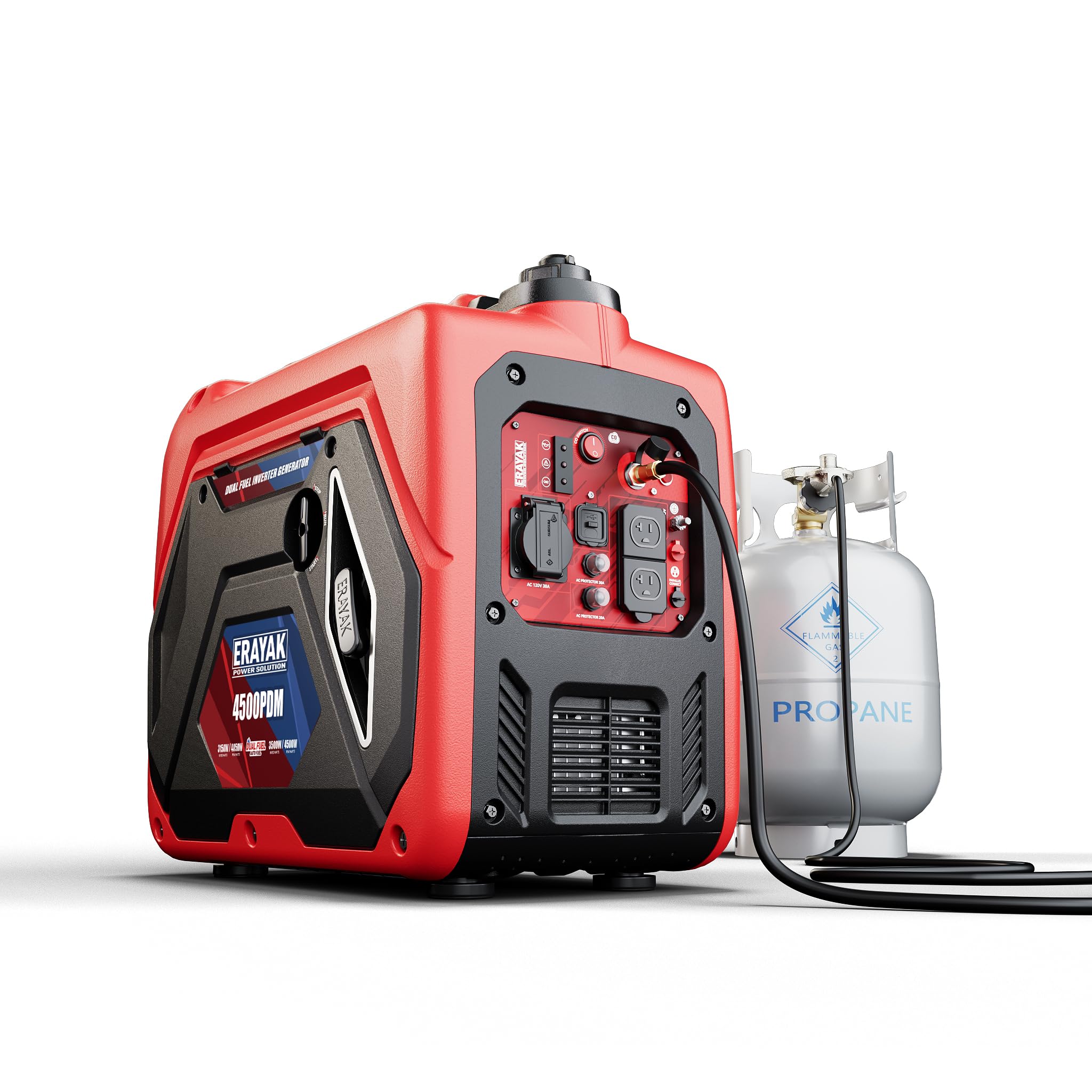
At just 54 pounds and measuring 20 x 11.7 x 19.3 inches, the ERAYAK 4500W is one of the most compact and portable dual-fuel inverter generators available. It packs a 4500W peak (gasoline) and 4050W peak (propane) punch, with pure sine wave output maintaining a THD of only 0.2%–1.2%—cleaner than most competitors. That level of power quality is critical for running sensitive electronics like a CPAP machine or laptop converter directly without an extra conditioner.
The gas-priority auto-switch system automatically transitions to gasoline when propane runs out, which prevents mid-night power loss. At 58 dBA from 23 feet at quarter load, it’s quiet enough for state park quiet hours. The 2.25-gallon gas tank delivers up to 16 hours at 25% load, and adding propane can extend runtime beyond 20 hours. The built-in CO sensor adds a layer of safety that’s increasingly expected.
The primary complaint centers on the instruction manual, which is poorly translated and includes references to features that don’t exist on this model (such as an electric start and off button—this unit is recoil-start only). A small number of users experienced propane regulator issues that caused the generator to run at low idle under load. Support response has been mixed. For the price and weight, however, this is a compelling entry-level dual-fuel choice.
Why it’s great
- Extremely lightweight at 54 pounds
- Exceptionally clean power (THD <1.2%)
- Gas-priority auto-switch to propane
Good to know
- Recoil-start only (no electric start)
- Manual is poorly written and confusing
4. BILT HARD 4500W Dual Fuel Inverter Generator
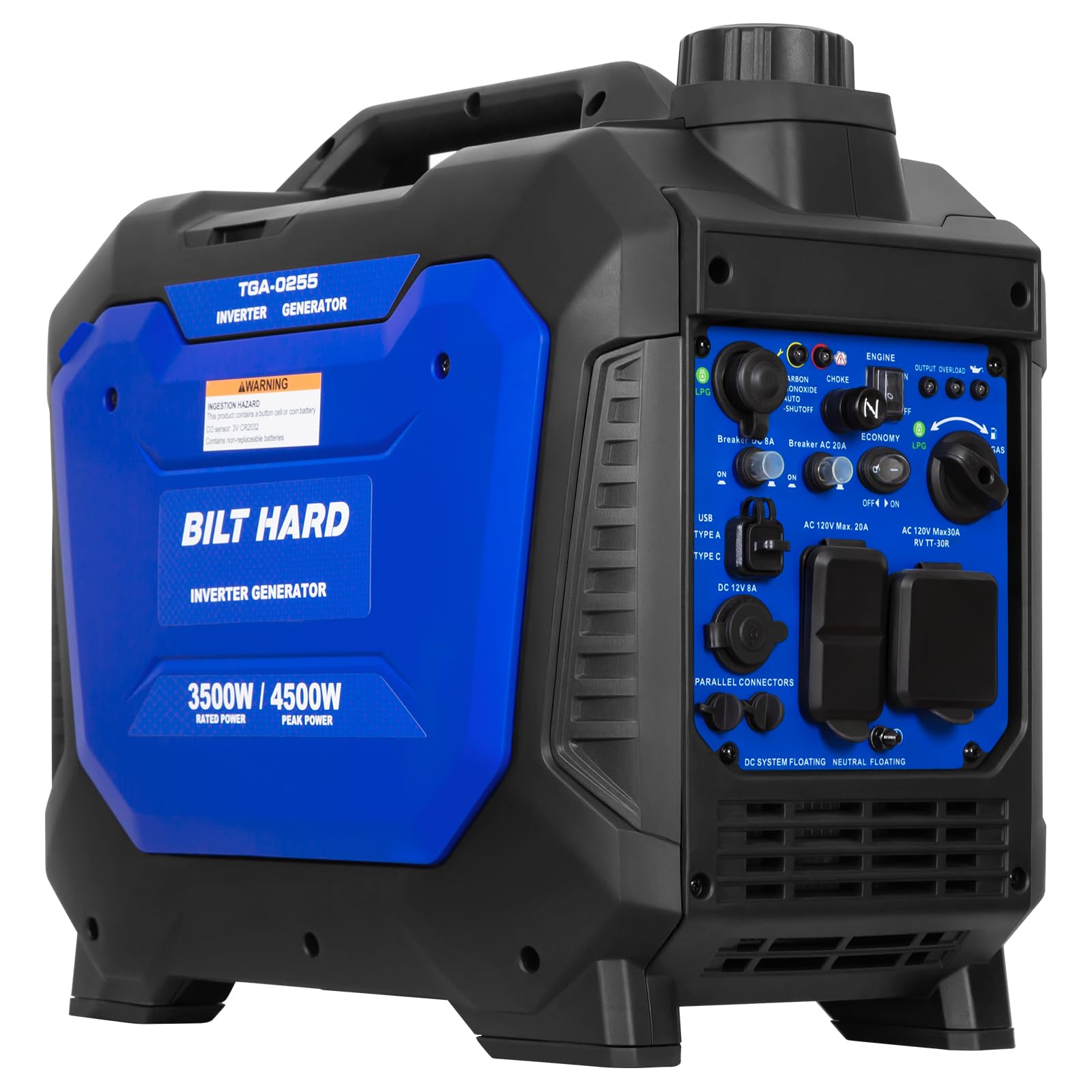
The BILT HARD 4500W is a surprisingly capable dual-fuel inverter generator that punches above its weight class. The 141cc OHV engine produces 4500 peak watts on gasoline and 4150 peak on propane, with a compact 21.4 x 12.7 x 19.3-inch frame that weighs just 57.7 pounds. That makes it one of the lightest dual-fuel options in the 4500-watt range, ideal for RV owners who need to stash the generator in a cargo bay or truck bed.
Noise is rated at 58 dBA from 23 feet at quarter load, which is on par with premium competitors. The fully enclosed design helps keep engine noise down to a level that satisfies national park campground restrictions. The built-in CO sensor automatically shuts down the unit if dangerous levels of carbon monoxide accumulate, adding an important safety layer. Owners consistently report easy starting and quiet operation, with several mentioning they can run their entire 30-amp RV setup without strain.
The main drawback is the cryptic setup process. The manual lacks clarity on certain steps, and some users found the oil fill location difficult to access. The generator also sits at about 100 pounds with fluids, which complicates loading into a truck bed despite the listed dry weight. A few early units had wheel rattle issues, but overall build quality is solid for the price. For a lightweight dual-fuel inverter with good safety features, this is a strong mid-range pick.
Why it’s great
- Very lightweight at 57.7 pounds dry
- Quiet 58 dBA operation
- CO sensor for automatic shutdown
Good to know
- Setup manual is poorly written
- Wheels may rattle on rough terrain
5. Cummins Onan P4500I Inverter Generator
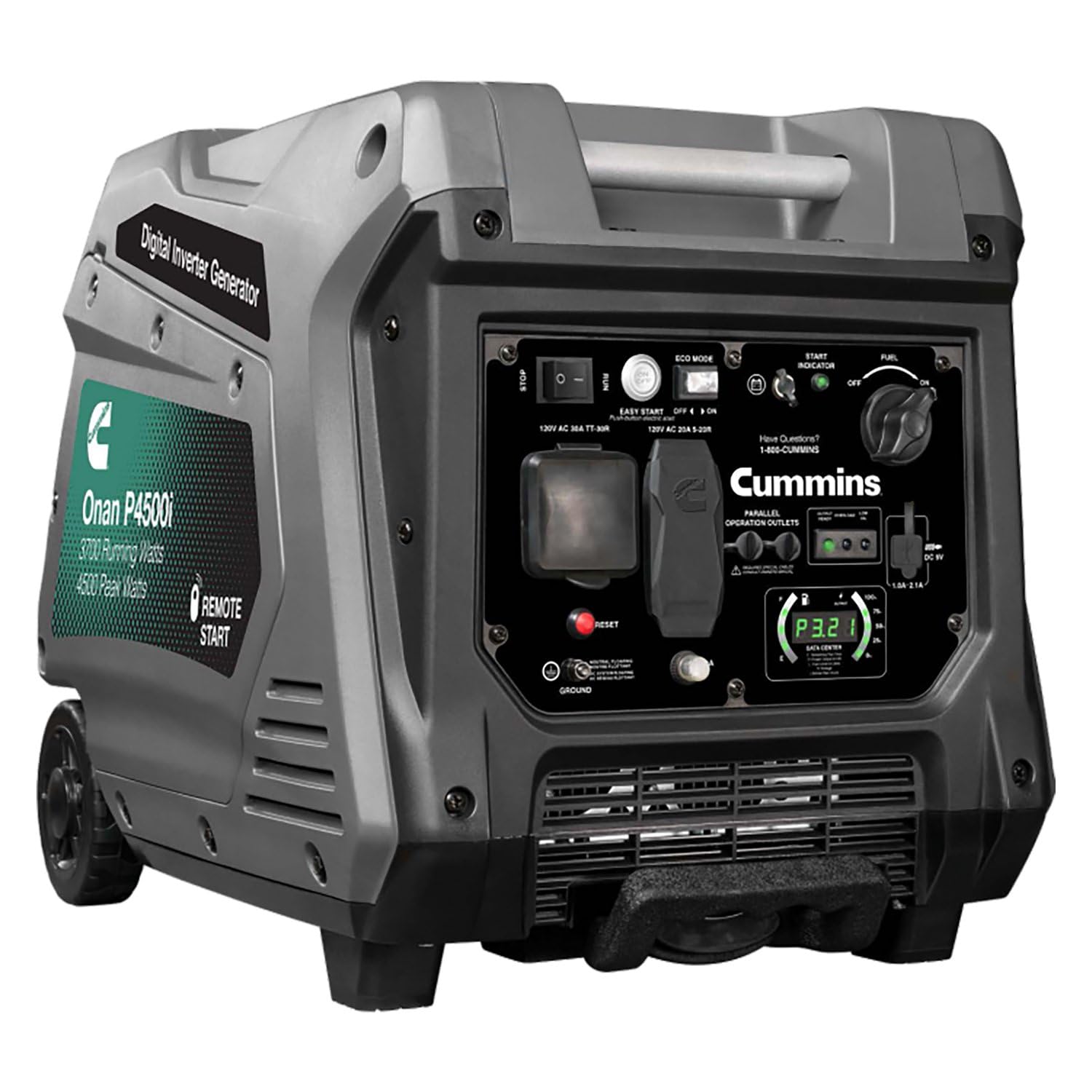
The Cummins Onan P4500I is a premium gasoline inverter generator that prioritizes build quality and long-term reliability. Its 224cc OHV 4-stroke engine delivers 4500 surge watts and 3500 rated watts, with a 30A TT-30R outlet specifically designed for RV hookup. The remote start lets you power up from inside the RV—a genuine luxury when the temperature drops. At 98 pounds, it’s heavy, but the telescoping handle and sturdy wheels make it manageable on paved surfaces.
Noise performance is exceptional: owners consistently report this is one of the quietest generators in its class, easily competing with Honda in terms of sound quality. The generator can run a 50-amp 5th wheel using under 50% load, and the voltage stays rock-steady at 120V under load. Parallel capability with a second P4500I lets you double up to 50 amps for larger rigs.
The biggest trade-off is price—this is a significant investment compared to competitors. The oil change process is more cumbersome than it should be, with the panel misaligned and tight access space. Some users also note that the panel’s layout could be more intuitive. For the RV owner who prioritizes quiet operation, remote convenience, and Cummins’ reputation for durability, the P4500I is a long-term buy that holds its value well.
Why it’s great
- Exceptionally quiet operation
- Remote start key fob
- Parallel capable for double the power
Good to know
- Premium price point
- Oil change access is tight
6. Champion 4000W Dual Fuel Inverter Generator

Champion’s 4000-watt dual-fuel inverter generator is a solid mid-range option backed by a strong 3-year limited warranty and free lifetime technical support. The 149cc engine produces 4000 surge watts and 3000 rated watts on gasoline (2700 on propane), which is slightly lower than the 4500-watt competition but still adequate for a 30-amp RV with a 13,500 BTU AC. The unit weighs just 53 pounds, making it one of the lightest dual-fuel inverters you can buy.
The CO Shield system automatically shuts down the generator if carbon monoxide reaches unsafe levels, a welcome safety feature. At 64 dBA from 23 feet, it’s louder than the quietest inverter models but still far quieter than a conventional open-frame generator. Owners appreciate the easy dual-fuel switching and report that the generator runs both refrigerators and a freezer simultaneously on propane without issue. The cold start technology works well in lower temperatures.
The main concern is quality control: a small but notable portion of buyers received units that failed within the first few weeks or months, with Champion’s customer support described as slow and difficult to navigate. The generator also lacks an electric start, so all starts are via recoil pull cord. For the price and weight, it’s a good entry point into dual-fuel inverter generators, but long-term reliability seems inconsistent based on user feedback.
Why it’s great
- Lightweight at 53 pounds
- CO Shield automatic shutoff
- 3-year warranty with lifetime support
Good to know
- Recoil-start only (no electric start)
- Some quality control issues reported
7. WEN 56477i 4800W Inverter Generator

The WEN 56477i is a gasoline-only inverter generator that focuses on doing one thing really well: providing reliable power for RV and home backup. The 224cc engine generates 4800 surge watts and 4000 rated watts, which is higher than many 4500-watt-class competitors and gives you extra headroom for startup surges. The fuel shutoff feature is a smart addition—it lets you run the carburetor dry before storage, preventing fuel gumming and extending engine life.
The WEN Watchdog CO Shutdown Sensor automatically turns off the generator if carbon monoxide levels become dangerous, a key safety feature for campsite use. At 72.7 pounds with onboard wheels and a telescoping handle, it’s reasonably portable for a 4800-watt machine. Owners consistently praise how quiet it is—much quieter than expected for this power output. The TT-30R RV receptacle means you can plug directly into your RV without an adapter.
The main limitation is that it runs on gasoline only, so you lose the fuel flexibility of dual-fuel models. A few users noted that the recoil start can require several pulls when cold, and the fuel tank capacity could be larger for extended runtime. For the RV owner who prefers simplicity and doesn’t need propane capability, the WEN 56477i offers excellent power density and a strong three-year warranty.
Why it’s great
- 4800 surge watts for AC startup
- Fuel shutoff for easy storage
- CO sensor with automatic shutdown
Good to know
- Gasoline-only (no propane option)
- Recoil start can need multiple pulls when cold
8. Generac iQ5200 Dual Fuel Inverter Generator
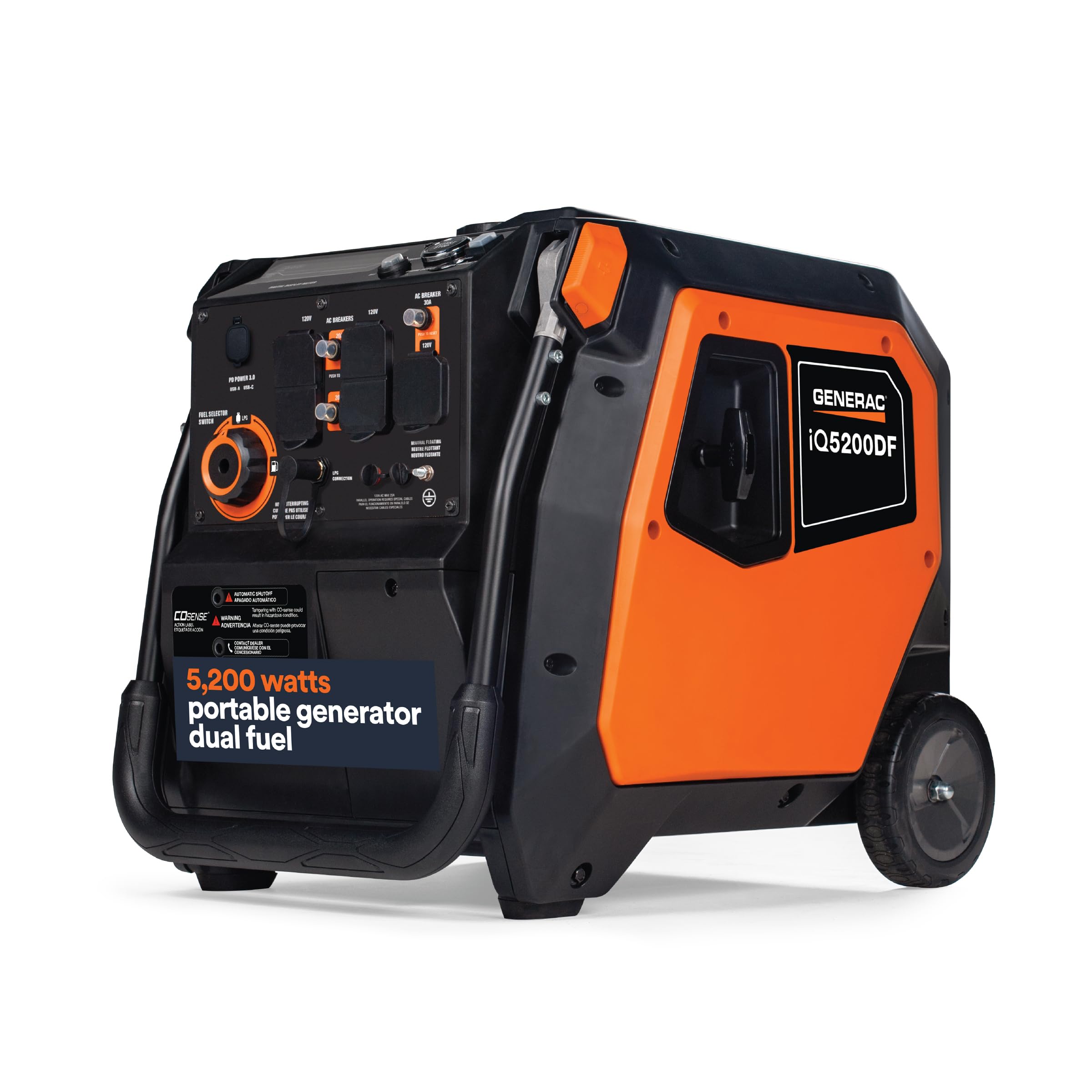
Generac’s iQ5200 brings the brand’s reputation for backup power into a portable dual-fuel inverter generator. It produces 5200 surge watts and a higher rated output than most 4500-watt-class competitors, giving you more breathing room for a large RV AC unit plus additional loads. The electric start makes operation effortless, and the fuel source selector lets you switch seamlessly between gasoline and propane without shutting the unit down.
The COsense Technology not only detects carbon monoxide but also includes automatic shutdown with alert indicators, setting a high safety standard. At 107 pounds, this is one of the heavier portable inverter generators, but the fully enclosed design keeps noise impressively low. Owners report that the generator runs their 40-foot camper without struggling and that it’s noticeably quieter than their previous models. The parallel-ready capability means you can double up with another iQ5200 for larger power needs.
The primary concern is reliability: a significant minority of users report engine issues (smoking) after the break-in period, and Generac’s customer support has been called unhelpful in handling warranty claims. The generator also requires you to add oil before first use—a step some buyers miss, leading to engine damage. For the premium price, you expect higher consistency. If you get a good unit, it’s a powerful and quiet dual-fuel solution.
Why it’s great
- 5200 surge watts for extra headroom
- Seamless fuel switching between gasoline and propane
- Electric start with COsense safety
Good to know
- Heavy at 107 pounds
- Quality control can be inconsistent
9. PowerSmart 4800W Inverter Generator

PowerSmart’s 4800-watt inverter generator is a budget-friendly gasoline option that doesn’t cut corners on core specs. The 223cc 4-stroke engine delivers 4800 starting watts and 3600 running watts, with less than 3% THD for clean power to sensitive electronics. At 89 pounds dry with a built-in wheel and handle kit, it’s one of the heavier units but still manageable for rolling across a campsite or driveway.
Noise is rated at 69 dBA at quarter load from 23 feet—louder than premium inverter generators but still conversation-level and far quieter than a conventional open-frame generator. The runtime of 10 hours at 50% load is competitive for its price point. Owners report using it to power a refrigerator, AC, TV, and small appliances during storms without issues, with many noting it starts on the first pull straight out of the box.
The battery for the electric start (if equipped) has been reported to die after a single use on some units, and the wheels can rattle on uneven terrain. It also lacks propane capability, which limits fuel flexibility for long-term storage. For the RV owner on a tighter budget who primarily needs backup power for weekend trips or home outage coverage, the PowerSmart delivers solid value.
Why it’s great
- Strong 4800 surge watts
- Easy assembly and first-pull start
- Good value for the price
Good to know
- Heavier than competitors at 89 lbs
- Battery life for electric start is inconsistent
10. Westinghouse 13500W Tri-Fuel Generator
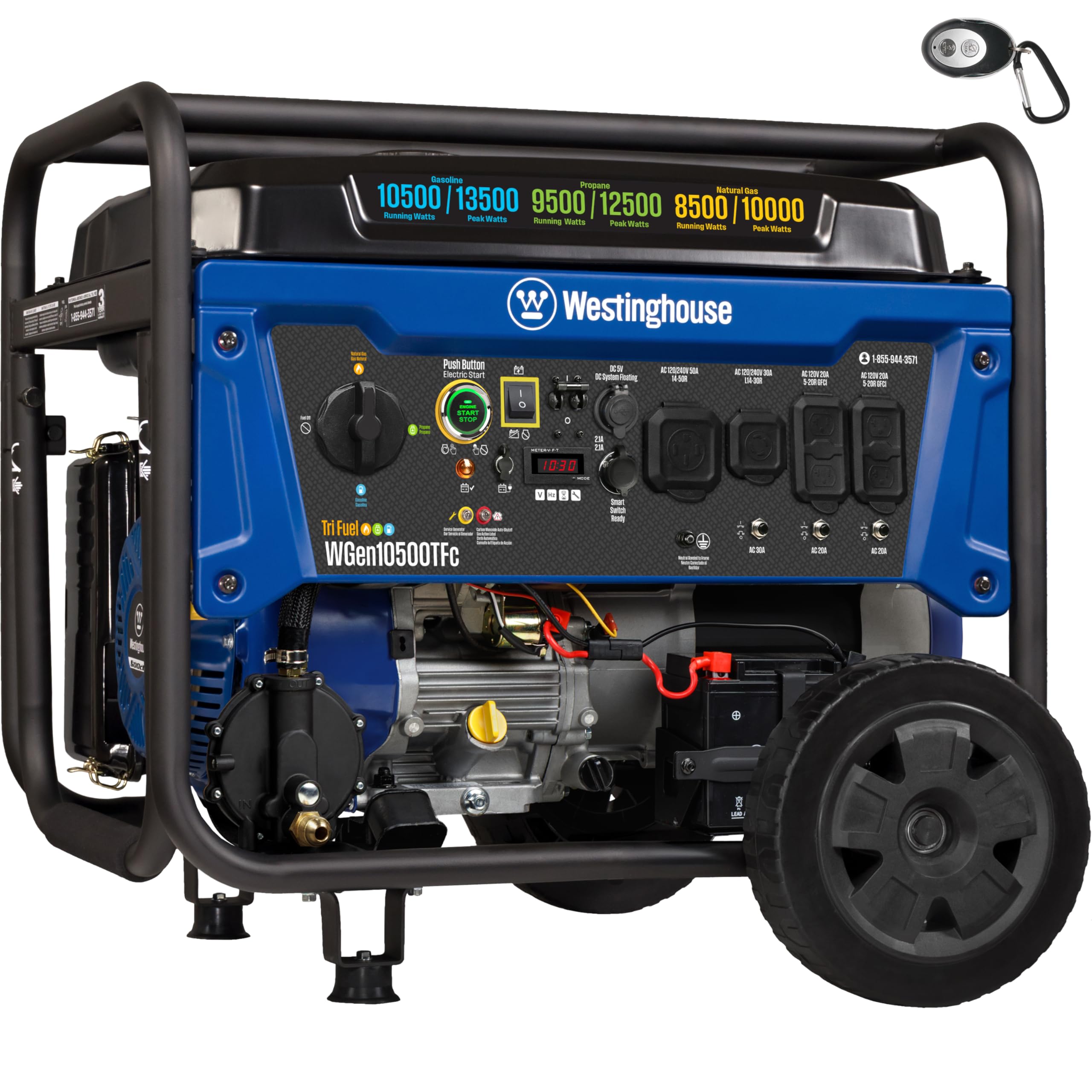
This Westinghouse model is a different beast—it’s an open-frame tri-fuel generator designed for whole-RV backup rather than portable campsite power. With 13500 peak watts on gasoline (12500 on propane, 10000 on natural gas), it can run an entire 50-amp RV plus additional household loads. The 500cc OHV engine features a cast iron sleeve for long life, and the tri-fuel capability (gasoline, propane, natural gas) gives you unprecedented fuel flexibility.
The remote start key fob, electric start, and recoil backup provide multiple starting options. At 230 pounds, this is not a portable unit in the traditional sense—it’s meant to be placed in a generator compartment or storage area and used for extended stays. Owners report running their entire house during multi-day outages with no performance issues. The 9.5-gallon fuel tank delivers up to 19 hours of runtime on gasoline.
The trade-off is that this is an open-frame generator, not an inverter, so THD is higher—around 5-6%—which means it’s not ideal for directly powering sensitive electronics without a separate inverter or surge protector. It’s also much louder than inverter generators. For RV owners who want a single generator that can handle both the RV and home backup during extended outages, the tri-fuel flexibility is unmatched.
Why it’s great
- Tri-fuel operation for maximum fuel flexibility
- Enormous 13500 surge watts
- Remote start with key fob
Good to know
- 230 pounds—not portable
- Open-frame design is louder than inverter models
11. Honda EU3200i Inverter Generator
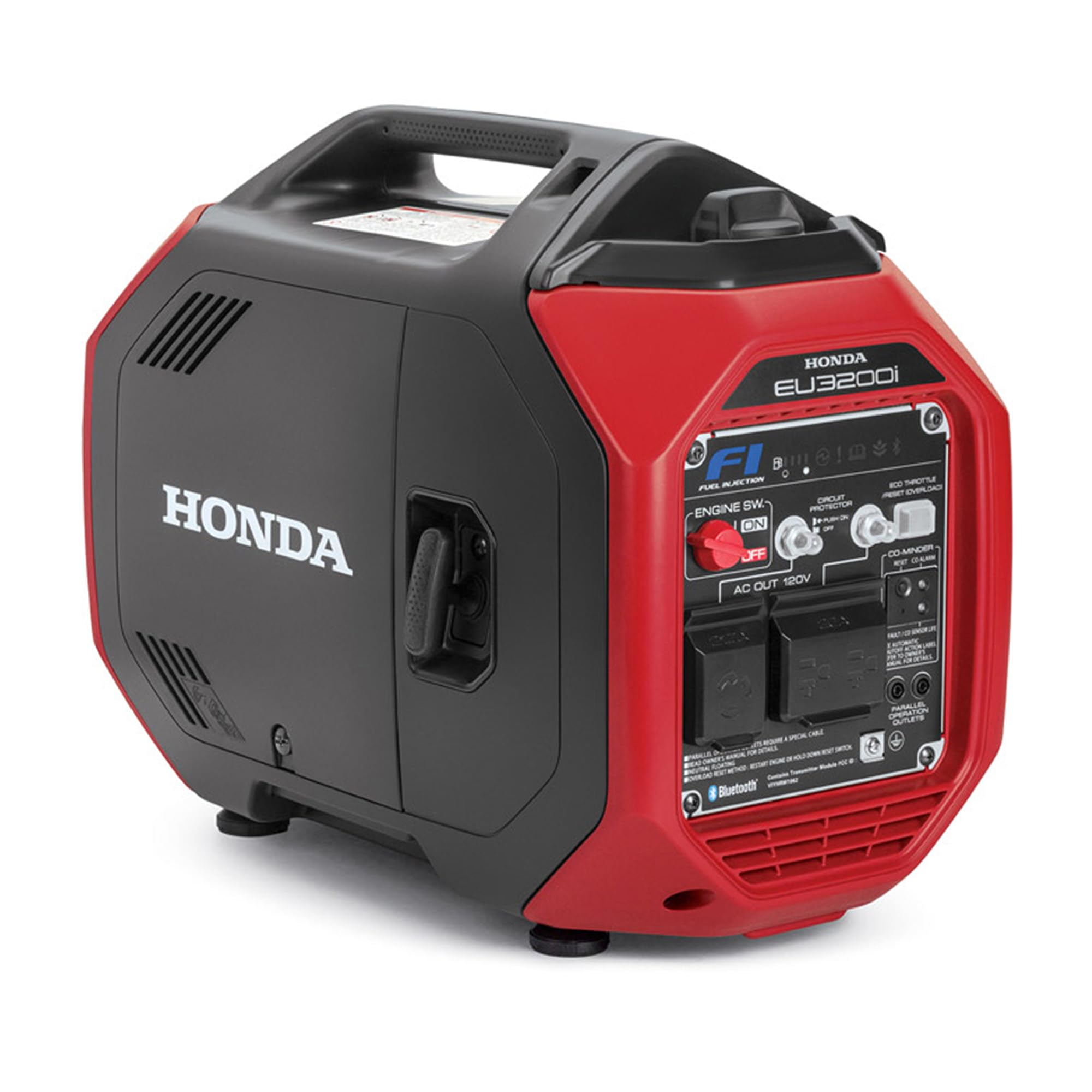
The Honda EU3200i is the gold standard for portability and reliability in the inverter generator category. While its 3200 surge watts and 2600 rated watts are lower than a true 4500-watt generator, Honda’s reputation for build quality and quiet operation is unmatched. The 208cc engine produces the cleanest power in the industry, with THD well below 1%, making it perfectly safe for the most sensitive RV electronics.
At just 65 pounds with a compact 12 x 18 x 22-inch footprint, this is the easiest generator to store and transport. The front panel LED indicators provide quick status checks for fuel level and Eco Throttle operation. The CO-MINDER system automatically shuts the generator down if CO levels become unsafe. Owners consistently report starting on the first or second pull even after months of storage, and the noise output is whisper-quiet at around 48-53 dBA.
The obvious limitation is power output: at 3200 surge watts, it may struggle to start a large 15,000 BTU RV AC unit, especially at higher altitudes or in hot conditions where AC compressors draw more current. It also lacks dual-fuel capability and costs significantly more per watt than any competitor. For smaller RVs or as a supplemental generator for battery charging, the EU3200i is a premium, ultra-reliable choice that holds its resale value.
Why it’s great
- Industry-leading build quality and reliability
- Ultra-quiet and compact at 65 pounds
- Cleanest power output for sensitive electronics
Good to know
- 3200 surge watts may not start larger RV AC units
- Significantly more expensive than competitors
FAQ
Can a 4500-watt inverter generator run a 15,000 BTU RV air conditioner?
What size generator do I need for a 30-amp RV?
Is dual-fuel worth the extra cost for an RV generator?
How often should I change the oil in my inverter generator?
Can I parallel two different brands of inverter generators?
Final Thoughts: The Verdict
For most RV owners, the best 4500-watt inverter generator for rv is the WEN DF451i because it combines dual-fuel flexibility, quiet 58 dBA operation, and reliable electric start in a proven package. If you want the absolute quietest campsite experience, the Westinghouse iGen4000DFc with its 52 dBA rating and remote start is the top choice for noise-sensitive campers. And for those who prioritize ultra-portability and dual-fuel capability on a budget, the ERAYAK 4500W delivers an impressive specs-to-weight ratio at just 54 pounds.

Mo Maruf
I created WellFizz to bridge the gap between vague wellness advice and actionable solutions. My mission is simple: to decode the research and give you practical tools you can actually use.
Beyond the data, I am a passionate traveler. I believe that stepping away from the screen to explore new environments is essential for mental clarity and physical vitality.