Our readers keep the lights on and my smoothie glass nicely filled. As an Amazon Associate, I earn from qualifying purchases.
That subwoofer rumble you crave from your car’s system? Getting it from a portable Bluetooth speaker without rattling plastic or muddy mids has been the holy grail of personal audio. The physics of a small enclosure fight deep low-end extension, which is why so many compact speakers deliver a thud instead of a thump. The best Bluetooth speaker deep bass solutions solve this with passive radiators, tuned enclosures, and smart DSP that pushes air without distortion.
I’m Mohammad Maruf — the founder and writer behind WellFizz. My research process for this guide involved cross-referencing driver size, radiator surface area, frequency response curves, and real-user bass perception across dozens of Amazon verified reviews to separate rumble from marketing.
Whether you need backyard party volume or a personal bass cannon for your desk, this roundup identifies the best bluetooth speaker deep bass options that deliver clean low-end without blowing your budget.
How To Choose The Best Bluetooth Speaker Deep Bass
Not all bass is created equal. A speaker that rattles your table at 60 Hz might disappear at 40 Hz where real sub-bass lives. Understanding driver architecture, radiator deployment, and enclosure tuning helps you buy the rumble, not the hype.
Passive Radiators vs. Bass Ports
Passive radiators move more air than a simple bass port, which translates to lower frequency extension in a smaller box. Look for dual radiators on opposite ends of the speaker — this pushes the air mass symmetrically, reducing cancellation and giving you that chest-thump feel. Single-radiator designs tend to sound one-note boomy rather than deep.
DSP-Based Bass Boost vs. Analog Eq
Digital Signal Processing (DSP) monitors the driver excursion in real time and boosts only the frequencies the driver can handle without clipping. Brands like Anker (BassUp) and DOSS (Active Extra Bass) use this approach. Simple analog bass boost just pumps voltage, often causing distortion at high volume — the exact opposite of clean deep bass.
Enclosure Rigidity and Weight
Heavier speakers with thick ABS or rubber-armored shells resonate less. A flimsy plastic cabinet absorbs energy that should be moving air. Picking up a speaker and feeling its mass is a cheap proxy for build quality — a 1.5-pound speaker almost always out-bass a 0.8-pound one simply because the cabinet doesn’t vibrate against the radiator.
Quick Comparison
On smaller screens, swipe sideways to see the full table.
| Model | Category | Best For | Key Spec | Amazon |
|---|---|---|---|---|
| Bose SoundLink Flex (2nd Gen) | Premium | Hi-fi clarity with deep bass | PositionIQ auto-EQ, 12h battery | Amazon |
| Soundcore Anker Motion Boom | Premium | Outdoor stereo with BassUp | 40kHz titanium drivers, 24h playtime | Amazon |
| JBL Flip 6 | Mid-Range | Rugged IP67 deep bass | Racetrack woofer + dual radiators | Amazon |
| JBL Flip 5 | Mid-Range | Proven JBL bass in small form | Single passive radiator, IPX7 | Amazon |
| TPWIN 80W Outdoor Speaker | Mid-Range | Loud parties with light show | 80W peak, dual subwoofers + tweeters | Amazon |
| Monster S620 Speaker | Budget | Compact 60W with indoor/outdoor EQ | 60W output, IPX8 waterproof | Amazon |
| DOSS SoundBox Pro | Budget | Entry-level deep bass with lights | 20W stereo, dual passive radiators | Amazon |
In‑Depth Reviews
1. Bose SoundLink Flex Bluetooth Speaker (2nd Gen)

The Bose SoundLink Flex (2nd Gen) uses PositionIQ technology to sense its orientation and re-tune the passive radiator and woofer crossover in real time. Whether you lay it flat on a picnic table or hang it vertically from a carabiner, the bass remains consistent and deep — hitting down to roughly 55 Hz without the one-note thump that plagues lesser speakers.
Its IP67 rating means it survives dust, drops, and full submersion, and the silicone-wrapped body adds weight that damps cabinet resonance. Battery life holds at a reliable 12 hours at moderate volume, and Bluetooth 5.3 multipoint lets you switch between a phone and laptop without re-pairing.
The trade-off is volume ceiling — it won’t fill a large backyard like the TPWIN 80W, but for balanced hi-fi bass in a palm-sized package, the Flex 2nd Gen sets the reference standard.
Why it’s great
- PositionIQ auto-tunes bass based on speaker orientation
- Silicone shell damps vibrations for cleaner low end
- Multipoint Bluetooth 5.3 for seamless device switching
Good to know
- 12-hour battery is adequate but not class-leading
- USB-C cable included is short for wall charging
- Premium price positions it above most competitors
2. Soundcore Anker Motion Boom

The Soundcore Motion Boom uses pure titanium diaphragms in its dual drivers to reproduce high frequencies up to 40kHz, but its secret weapon is BassUp — a DSP algorithm that analyzes the audio signal in real time and boosts low-end without exceeding the driver’s mechanical limits. The result is a sub-bass extension that rivals speakers twice its size.
With IPX7 waterproofing and the ability to float, it handles poolside and beach scenarios without worry. The 10,000mAh battery delivers a genuine 24 hours of playback, and the built-in handle makes it easy to tote. Pairing two Motion Booms via TWS creates a true stereo soundstage with noticeable left-right bass separation.
Out of the box, the EQ is slightly scooped in the mids. Use the companion app to adjust the 9-band equalizer — boosting 80 Hz and 120 Hz by a few dB unlocks the full bass potential this speaker is capable of delivering.
Why it’s great
- BassUp DSP delivers clean sub-bass without distortion
- Pure titanium drivers for extended high-frequency clarity
- 24-hour battery life with 10,000mAh capacity
Good to know
- App EQ adjustment is almost required for best sound
- No AUX input for wired connections
- Size is larger than typical portable speakers
3. JBL Flip 6

The JBL Flip 6 replaces the Flip 5’s single-driver approach with a 2-way system: a racetrack-shaped woofer for low and mid frequencies and a separate tweeter for highs. Its dual passive radiators are tuned using Harman’s advanced algorithm to produce bass that feels tight and punchy, not loose or boomy.
IP67 dustproof and waterproof construction means this speaker can be dropped in sand, rinsed off, or used in heavy rain without failure. The 12-hour battery matches the Flip 5, but the sound is noticeably louder and cleaner at max volume — the 30W output fills a medium room without the distortion that plagued earlier Flip models.
One limitation: the Flip 6 does not include an AUX port, so all playback must be wireless. PartyBoost allows linking multiple JBL PartyBoost-compatible speakers, but note that PartyBoost is not backward-compatible with the older Connect+ standard.
Why it’s great
- Separate tweeter and racetrack woofer for cleaner sound separation
- IP67 dustproof + waterproof for extreme outdoor use
- PartyBoost pairs multiple JBL speakers for stereo or party mode
Good to know
- No AUX input for wired audio sources
- PartyBoost not compatible with older JBL Connect+ speakers
- 12-hour battery is average for the price tier
4. JBL Flip 5

The JBL Flip 5 has been a bestseller for years because its single passive radiator and 10cm woofer deliver surprisingly deep bass for a cylinder that fits in a backpack pocket. JBL’s proprietary driver tuning pushes the low-end to around 65 Hz, which is enough to feel kick drums and bass lines in electronic and hip-hop tracks.
IPX7 waterproofing means it can be submerged in one meter of water for 30 minutes, and the 12-hour battery handles a full day of outdoor listening. Pairing multiple Flip 5 speakers via PartyBoost creates a multi-speaker zone that amplifies bass presence across a wider area.
The Flip 5 lacks a built-in microphone and does not support the companion app EQ, so you get JBL’s out-of-box tuning with no adjustments. For bass heads who want to tweak their sound signature, the Flip 6 or Motion Boom offer more flexibility.
Why it’s great
- Proven single-radiator bass design in a compact cylinder
- IPX7 waterproof rating for submersion protection
- PartyBoost links multiple Flip 5s for wider sound
Good to know
- No app EQ to customize bass response
- No built-in microphone for hands-free calls
- Single driver limits stereo imaging
5. TPWIN 80W Outdoor Speaker

The TPWIN 80W speaker employs dual 25W peak subwoofers and dual 15W peak tweeters, creating a four-driver array that moves substantial air. Its BassUp technology — similar in concept to Anker’s — boosts low frequencies without audible clipping, and the 10,000mAh battery allows up to 20 hours of playback, with the USB port doubling as a power bank for charging phones.
IPX6 waterproofing handles heavy rain and splashes, though it won’t survive submersion like the IPX7-rated options. The six light-show modes with ten color options sync to the beat, adding visual energy for backyard gatherings. TWS pairing with a second TPWIN unit creates true left-right separation that pushes bass across a wider stereo field.
The enclosure is large and chunky — this is not a bag-friendly speaker. Some users note that the bass boost can slightly soften midrange clarity at high volumes, making it better suited for bass-heavy genres like EDM and hip-hop than acoustic or vocal-focused tracks.
Why it’s great
- Four-driver design with dedicated subwoofers for deep bass
- Light show syncs to music beat for party atmosphere
- Power bank functionality charges devices on the go
Good to know
- IPX6 can’t handle full submersion like IPX7 speakers
- Bass boost may soften midrange clarity at high volumes
- Large, heavy form factor is not ultra-portable
6. Monster S620 Bluetooth Speaker
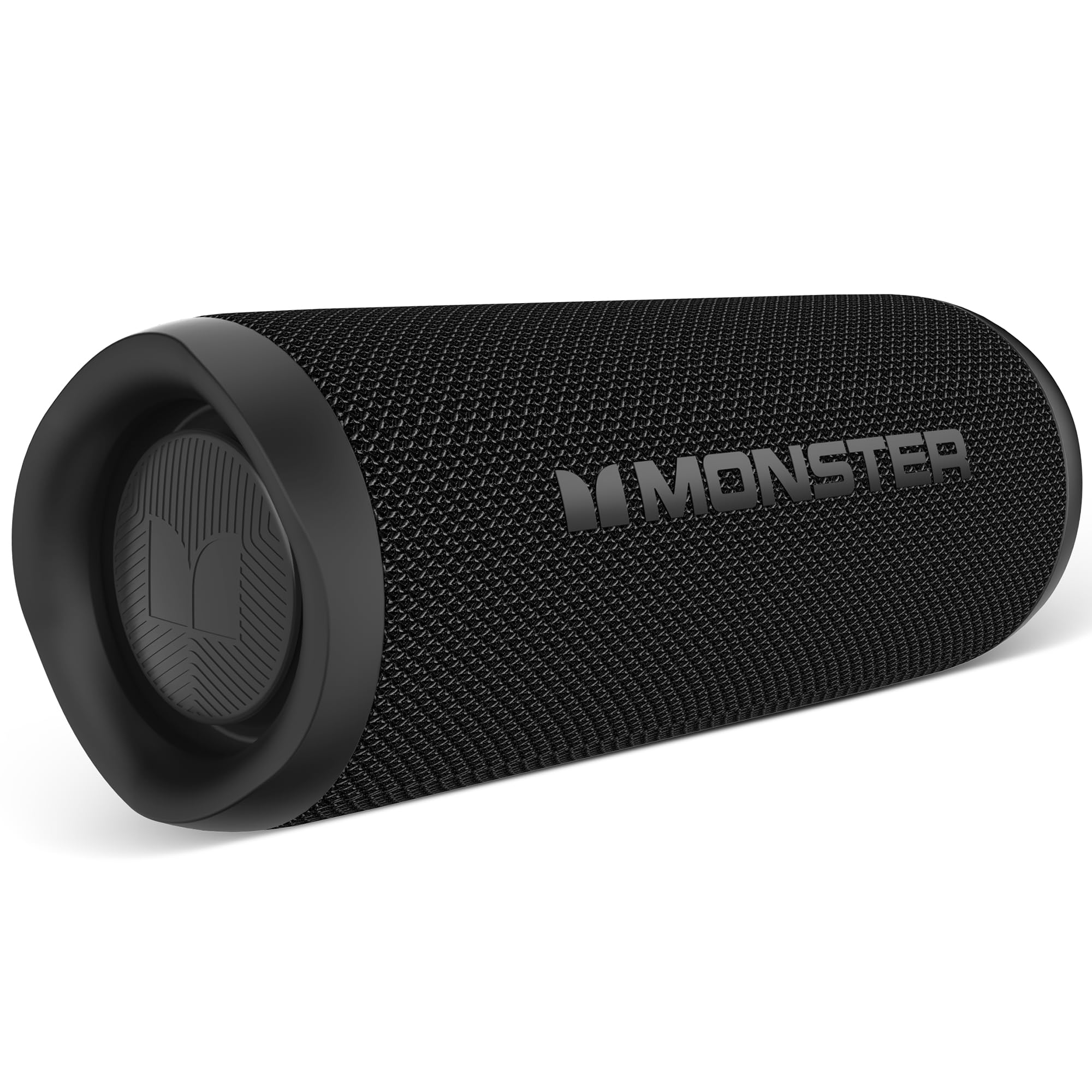
The Monster S620 packs 60W of total audio output into a cylindrical body with an 80 Hz frequency response floor — lower than many speakers in its size bracket. The indoor EQ mode boosts the low frequencies for richer bass, while the outdoor mode favors dynamic treble so the sound cuts through open air without becoming muddy.
IPX8 waterproofing is a standout at this price point — the speaker can be fully submerged in deeper water than IPX7-rated competitors. Bluetooth 5.4 provides a stable connection up to 30 feet, and the built-in lanyard makes it easy to secure to a backpack or bicycle. Pairing two S620 units via True Wireless Stereo delivers 120W of combined output with immersive stereo separation.
Battery life sits at an estimated 6-8 hours at maximum volume, which is shorter than the 12-24 hour claims of competitors. Users who need all-day playback at moderate levels will find enough runtime, but max-volume bass lovers might need to recharge before the day ends.
Why it’s great
- IPX8 waterproof rating for deep submersion
- 60W total output in a compact, lanyard-ready body
- Indoor/outdoor EQ modes for different bass profiles
Good to know
- Battery life drops to 6-8 hours at maximum volume
- 80 Hz response is good but not sub-bass territory
- Single-driver design limits stereo width alone
7. DOSS SoundBox Pro

The DOSS SoundBox Pro uses dual full-range drivers and dual passive radiators to deliver 20W of stereo sound with an Active Extra Bass button that boosts low frequencies on demand. For the price, this speaker punches well above its weight — user reviews consistently compare its bass output favorably against speakers costing significantly more, with clear vocals and tight mids that don’t get swallowed by the low end.
IPX6 waterproofing resists splashes and rain, making it suitable for poolside and camping use. The 20-hour battery life is exceptional for its size, and the TWS pairing allows linking two SoundBox Pro speakers for true stereo separation. The beat-driven light show with six colors and three patterns adds a fun visual element without feeling gimmicky.
The build quality is good but not rugged — the plastic enclosure lacks the rubber armor of the JBL Flip 6 or Monster S620. Bass depth, while impressive for the price, doesn’t reach sub-bass territory below 60 Hz. This speaker is the entry-level champion for deep bass, not the benchmark for audiophile low-end.
Why it’s great
- Active Extra Bass button delivers punchy low-end instantly
- 20-hour battery life leads the entry-level category
- Dual passive radiators provide stereo warmth at this price
Good to know
- Plastic body lacks rubber armor for drop protection
- Bass does not extend into true sub-bass frequencies
- Light show drains battery faster than standard playback
FAQ
Does a higher wattage rating always mean deeper bass?
What is the difference between IPX7 and IP67 for bass speakers?
Can I use a Bluetooth speaker for bass-heavy music without distortion?
Final Thoughts: The Verdict
For most users, the best bluetooth speaker deep bass winner is the Soundcore Anker Motion Boom because it combines titanium-driver clarity with BassUp DSP for sub-bass extension, all with 24-hour battery life and a floating IPX7 design. If you want PositionIQ auto-tuning and the most balanced hi-fi bass in a pocketable form, grab the Bose SoundLink Flex (2nd Gen). And for all-day outdoor parties where volume and light shows matter most, nothing beats the TPWIN 80W Speaker with its dual subwoofers and 20-hour playback.

Mo Maruf
I created WellFizz to bridge the gap between vague wellness advice and actionable solutions. My mission is simple: to decode the research and give you practical tools you can actually use.
Beyond the data, I am a passionate traveler. I believe that stepping away from the screen to explore new environments is essential for mental clarity and physical vitality.