Our readers keep the lights on and my smoothie glass nicely filled. As an Amazon Associate, I earn from qualifying purchases.
The biggest mistake new photographers make is buying a camera that’s too complex to learn on or too limited to grow with. A true beginner photography camera needs a clear balance between guided automation (so you don’t miss the shot) and manual controls (so you can actually learn aperture, shutter speed, and ISO).
I’m Mohammad Maruf — the founder and writer behind WellFizz. I’ve spent years analyzing camera specs, sensor technology, and lens compatibility to separate marketing noise from the specs that genuinely affect image quality and the learning curve for entry-level shooters.
Whether you want to shoot portraits, travel scenes, or family videos, the right body and kit lens combination defines your first year of growth. This guide breaks down the best beginner photography camera options across mirrorless and DSLR platforms to match your budget and creative goals.
How To Choose The Best Beginner Photography Camera
Picking your first interchangeable-lens camera is exciting, but the options can feel overwhelming. Focus on these three factors to narrow the field to models that will teach you photography without slowing you down.
Sensor Size and Megapixels
APS-C sensors (found in most entry-level DSLRs and mirrorless cameras) offer the best balance of image quality, low-light performance, and cost. Full-frame sensors deliver shallower depth of field and better high-ISO noise, but the bodies and lenses cost significantly more. For a first camera, 20–24 megapixels on an APS-C sensor is more than enough for prints up to 20×30 inches and heavy cropping.
Autofocus System and Lens Ecosystem
Phase-detection autofocus points (usually 9 to 51 on DSLRs, more on mirrorless) determine how quickly and accurately the camera locks onto your subject. A higher point count with cross-type sensors helps with moving subjects. Just as important is the lens mount: Canon’s EF/EF-S and RF mounts, Nikon’s F and Z mounts, and Sony’s E-mount all have vast, affordable lens libraries. Buying into a mount with good third-party support (Sigma, Tamron, Viltrox) protects your investment long-term.
Mirrorless vs. DSLR for Beginners
Mirrorless cameras are lighter, quieter, and show you the exact exposure before you press the shutter. DSLRs offer longer battery life, optical viewfinders (no lag), and generally lower entry prices for the same sensor size. Neither is strictly “better” — the right choice depends on whether you prioritize compact size and modern features (mirrorless) or rugged durability and battery stamina (DSLR).
Quick Comparison
On smaller screens, swipe sideways to see the full table.
| Model | Category | Best For | Key Spec | Amazon |
|---|---|---|---|---|
| Canon EOS R100 | Mirrorless | Best overall beginner mirrorless | 24.1MP APS-C, 143 AF points | Amazon |
| Panasonic LUMIX G85 | Mirrorless | Best image stabilization | 16MP MFT, 5-axis IBIS | Amazon |
| Canon EOS Rebel T7 Bundle | DSLR | Best value bundle with accessories | 24.1MP APS-C, 9 AF points | Amazon |
| Nikon D5600 | DSLR | Best vari-angle touchscreen DSLR | 24.2MP APS-C, 39 AF points | Amazon |
| Sony ZV-E10 Bundle | Mirrorless | Best for vlogging and video | 24.2MP APS-C, 425 AF points | Amazon |
| Nikon D7500 | DSLR | Best for action and sports | 20.9MP APS-C, 51 AF points | Amazon |
| Nikon Z50 II | Mirrorless | Best color presets and autofocus | 20.9MP APS-C, 231 AF points | Amazon |
| Canon EOS RP | Mirrorless | Best entry-level full-frame | 26.2MP Full-Frame, 4.779 AF points | Amazon |
| Canon EOS R8 | Mirrorless | Best hybrid stills/video full-frame | 24.2MP Full-Frame, 1,053 AF zones | Amazon |
| Nikon Z5 Bundle | Mirrorless | Best full-frame value bundle | 24.3MP Full-Frame, 273 AF points | Amazon |
| Nikon D3100 | DSLR | Budget-friendly entry DSLR | 14.2MP APS-C, 11 AF points | Amazon |
In‑Depth Reviews
1. Canon EOS R100

The Canon EOS R100 is the lightest and smallest body in the EOS R series, making it exceptionally portable for daily carry. Its 24.1-megapixel APS-C sensor paired with the DIGIC 8 processor delivers sharp stills with natural bokeh, and the Dual Pixel CMOS AF covers 143 zones with human face and eye detection — a massive advantage over older entry-level DSLRs. The camera shoots 4K video at up to 24 fps and Full HD at 60 fps, giving beginners room to experiment with video without needing a second device.
The kit lens, an RF-S 18-45mm F4.5-6.3 IS STM, offers optical image stabilization at up to 4 stops, which helps in low-light handheld shooting. Autofocus performance is snappy in good light, and the beginner-friendly GUI explains shooting modes on-screen, shortening the learning curve considerably. Continuous shooting reaches 6.5 fps with One-Shot AF, enough for capturing pets and kids in motion.
The battery lasts about a day of casual shooting, but no charger is included in the box — you’ll want a spare LP-E17 battery and an external charger. The lack of in-body stabilization means you rely entirely on lens-based IS, and the 8-bit color depth limits extreme grading in video. For a pure beginner who wants modern mirrorless performance in a compact body, the R100 is the most balanced starting point on this list.
Why it’s great
- Smallest and lightest EOS R body for easy portability
- Dual Pixel CMOS AF with face and eye detection is reliable and fast
- Beginner-friendly GUI explains shooting modes clearly
- 4K video and 6.5 fps burst give room to grow
Good to know
- No in-body image stabilization; relies on lens IS only
- 8-bit color depth limits advanced video grading
- Charger not included — budget for a spare battery and charger
2. Panasonic LUMIX G85

The Panasonic LUMIX G85 stands out for its 5-axis in-body image stabilization (IBIS) that works in both stills and video, a feature rarely found at this price tier. The 16-megapixel Micro Four Thirds sensor omits the low-pass filter, boosting fine-detail resolving power by about 10% compared to earlier 16MP MFT sensors. With the 12-60mm Power O.I.S. kit lens (24-120mm full-frame equivalent), you get dual stabilization that makes handheld low-light shooting usable in ways APS-C competitors without IBIS cannot match.
The G85 offers 4K video at 3840×2160, plus exclusive 4K Photo and Post Focus modes that let you pull a still frame from a 30fps burst and refocus after capture. The magnesium alloy body is splashproof and dustproof, a durability advantage for outdoor shooting. The OLED live viewfinder has 2,360K dots, and the 3-inch tilt-and-touch LCD (1,040K dots) provides flexible framing angles. Color temperature adjustment from 2,500 to 10,000K in 100K steps gives you fine creative control over white balance.
The 49-point contrast-detect autofocus is reliable in good light but can hunt in low-light or 4K video situations. Battery life is shorter than DSLR alternatives, and the wireless file transfer app can be finicky. For a beginner prioritizing video stabilization and weather sealing, the G85 delivers professional-level steadiness at an approachable price.
Why it’s great
- 5-axis IBIS works with all lenses for steady handheld video and stills
- Weather-sealed magnesium alloy body for outdoor durability
- 4K Photo and Post Focus allow focus adjustment after capture
- Kit lens covers 24-120mm equivalent, very versatile
Good to know
- Contrast-detect AF can struggle in low light and continuous 4K video
- Battery life is below average for the category
- Wireless transfer app has connectivity issues reported
3. Canon EOS Rebel T7 Bundle
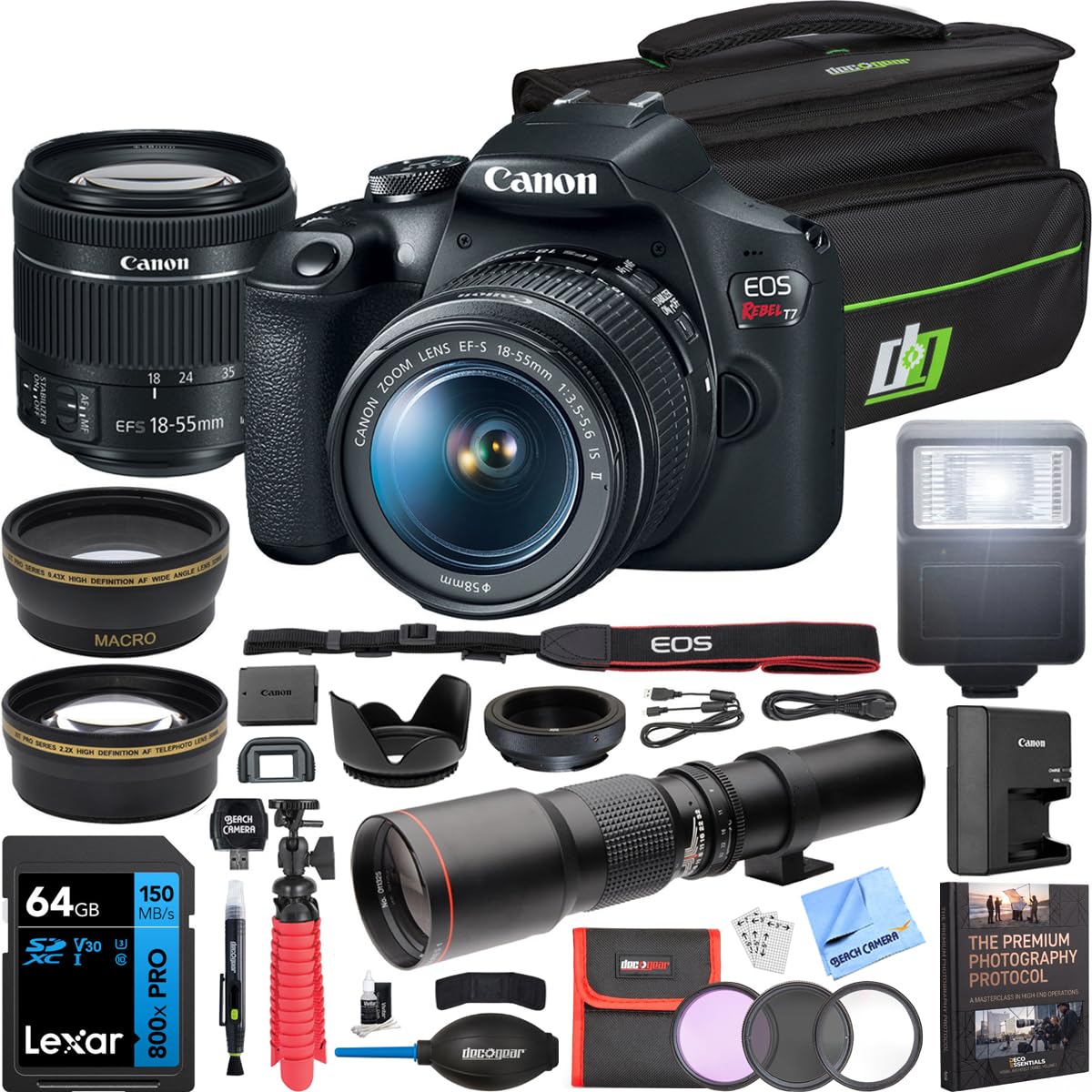
The Canon EOS Rebel T7 bundle packs immense value for budget-conscious beginners. The camera body features a 24.1-megapixel APS-C sensor with DIGIC 4+ processor, offering proven image quality at a price point that leaves room for accessories. The bundle includes a 500mm preset telephoto lens, wide-angle and 2.2x telephoto adapters, a flash, tripod, 64GB Lexar 800x SD card, camera bag, and editing software — covering nearly everything a new photographer needs to start shooting immediately.
The 9-point autofocus system with AI Servo AF is basic by modern standards, but it works well for stationary and slow-moving subjects. Scene Intelligent Auto mode handles exposure decisions for absolute beginners, while Creative Filters (Fisheye, Miniature) add fun without needing post-processing. The optical viewfinder offers 95% frame coverage, and the 3-inch 920K-dot LCD is adequate for composition and review. Built-in Wi-Fi and NFC allow remote shooting and wireless image transfer to a smartphone.
Continuous shooting maxes out at 3 fps, which is slow for action photography. The bundle’s telephoto and wide-angle adapters are accessory-grade glass that will reduce sharpness — consider upgrading the primary lens first. Several users reported the included bag is too small to hold all accessories, and the battery charger is basic. For a new photographer who wants one box with everything to explore different genres, this bundle is the most cost-effective entry point.
Why it’s great
- All-in-one bundle saves significant money on accessories
- 24.1MP sensor delivers proven Canon image quality
- Scene Intelligent Auto mode makes first-time shooting easy
- Built-in Wi-Fi and NFC for easy photo sharing
Good to know
- 9-point AF system is dated; misses moving subjects
- 3 fps burst rate is too slow for sports or action
- Bundled telephoto and wide-angle adapters are entry-level quality
4. Nikon D5600

The Nikon D5600 pairs a 24.2-megapixel DX-format CMOS sensor with the EXPEED 4 processor to produce excellent JPEG and Raw files with wide dynamic range. The standout feature is the 3.2-inch 1,037K-dot vari-angle touchscreen, which rotates and flips for selfies, overhead shots, and low-angle photography — a major advantage for creative composition. The 39-point phase-detection autofocus system covers more of the frame than the Rebel T7’s 9 points, improving tracking for moving subjects.
Full HD 1080p video at 60 fps is smooth for casual video work, and the SnapBridge Bluetooth 4.1 connection allows continuous low-power image transfer to a smartphone. The camera supports all Nikon F-mount DX and FX lenses (with crop factor), giving beginners access to decades of affordable used glass. The touchscreen interface is responsive, and manual mode control is intuitive via the touch-to-focus and touch-to-shoot functions.
There is no in-body image stabilization — you need VR lenses for steady handheld shots. The D5600 also lacks an autofocus motor in the body, meaning older AF-D lenses will not autofocus; you must buy AF-S or AF-P lenses. Battery life is good, but SnapBridge auto-transfer can drain the battery faster than expected. For a beginner who wants a flexible touchscreen and a massive lens ecosystem, the D5600 is a strong DSLR choice.
Why it’s great
- Vari-angle touchscreen enables creative shooting angles and selfies
- 39-point AF system offers good subject tracking for the class
- Huge compatible lens library via Nikon F-mount
- SnapBridge Bluetooth for continuous wireless photo transfer
Good to know
- No in-body image stabilization; VR lenses required for shake reduction
- No body AF motor; older D-type lenses won’t autofocus
- SnapBridge auto-transfer can deplete battery faster
5. Sony ZV-E10 Bundle

The Sony ZV-E10 is built from the ground up for vloggers and content creators. Its 24.2-megapixel APS-C Exmor CMOS sensor with 425-point Fast Hybrid AF (phase-detect + contrast-detect) offers the fastest and most reliable autofocus on this list, with Real-Time Eye AF and Tracking for humans and animals. The 3-inch side flip-out touchscreen faces forward for self-recording, and the directional 3-capsule microphone with included windscreen delivers clean audio without external gear.
This bundle adds a 16-50mm power zoom lens, SanDisk 64GB Extreme PRO UHS-I card (200 MB/s read, 90 MB/s write), Movavi editing software, tripod, extra battery and charger, filter kit, and case. The camera shoots 4K30p and Full HD 120p video, and the Background Defocus button instantly blurs the background for a professional look. The ISO range of 100-32,000 handles indoor and low-light vlogging scenarios well.
The lack of in-body stabilization means you depend on the OSS lens or a gimbal for smooth walking shots. The menu system is Sony’s older interface, which is less beginner-friendly than Canon or Nikon. Some users reported missing software in the bundle — verify contents upon arrival. For a new creator who prioritizes video autofocus and audio quality over still photography, the ZV-E10 bundle is the most purpose-built option.
Why it’s great
- 425-point Fast Hybrid AF with Real-Time Eye Tracking is class-leading
- Side flip-out screen and directional mic are optimized for vlogging
- Background Defocus button gives instant shallow depth of field
- 4K30p and 120p Full HD video provide creative speed options
Good to know
- No IBIS; requires OSS lens or gimbal for smooth walking footage
- Sony menu interface is less intuitive for first-time users
- Bundle accessories vary; verify presence of software and all items
6. Nikon D7500

The Nikon D7500 borrows its class-leading image quality, ISO range, and metering system from the flagship D500, making it the most capable DSLR on this list for action and wildlife. The 20.9-megapixel DX sensor may have lower resolution than the 24MP competitors, but its larger individual pixels deliver superior high-ISO noise performance and dynamic range. The 51-point AF system (15 cross-type sensors) with Group Area AF tracks moving subjects reliably at up to 8 fps continuous shooting.
The included AF-S DX NIKKOR 18-140mm f/3.5-5.6G ED VR lens covers a 27-210mm full-frame equivalent range, making it the most versatile single-lens option in this guide for travel, portraits, and moderate telephoto reach. The 3.2-inch 922K-dot tilting touchscreen LCD and large optical viewfinder provide clear composition. 4K UHD video at 30p with stereo sound, power aperture control, and auto ISO during video recording offer serious video capability for a DSLR.
The D7500 is a 2017 model, so its processor and video features are older than modern mirrorless competitors. It uses a single SD card slot (UHS-I) and lacks a headphone jack for video monitoring. The body is larger and heavier than any mirrorless option here. For a beginner who wants a rugged, fast-shooting DSLR with excellent lens selection and doesn’t need 4K at high frame rates, the D7500 is a premium workhorse.
Why it’s great
- D500-class metering and ISO performance for low-light action
- 51-point AF with Group Area AF tracks moving subjects effectively
- 18-140mm kit lens covers wide to telephoto in one lens
- 8 fps burst rate is best among DSLRs on this list
Good to know
- Single UHS-I SD card slot limits write speed and backup
- No headphone jack for video audio monitoring
- Larger and heavier than mirrorless alternatives
7. Nikon Z50 II

The Nikon Z50 II is a significant upgrade over the original Z50, borrowing menus and autofocus features from the larger Z-series cameras. The 20.9-megapixel DX-format (APS-C) sensor is paired with the same EXPEED processor found in the Z9, enabling 231-point hybrid autofocus with deep-learning subject detection for people, dogs, cats, birds, and vehicles — including dedicated bird and airplane modes. The Picture Control button gives instant access to 31 built-in color presets, and you can create and save custom presets directly from the camera or download bespoke ones from the Nikon Imaging Cloud.
The compact body weighs only 17 ounces, fitting easily into a small bag. It shoots 4K UHD at 60p, 120p slow-motion in Full HD, and features built-in electronic VR and product review mode for vlogging. The built-in flash and Night Portrait mode handle low-light indoor shooting well. The Nikon SnapBridge app transfers photos to a smartphone in seconds, making social media sharing effortless.
The biggest drawback is the single SD card slot, which risks data loss during important shoots. Battery life is shorter than the Z50 and most DSLRs, and there is no auto sensor cleaning, so you’ll need to manually clean the sensor periodically. The body-only kit means you’ll need to purchase a Z-mount lens separately unless you find a bundle. For a beginner who wants the latest mirrorless AF performance and creative presets, the Z50 II is a compelling modern choice.
Why it’s great
- 31 built-in Picture Control presets and Cloud custom presets for instant creative looks
- Hybrid AF with 9 subject types including birds and airplanes
- Lightweight 17-ounce body is highly portable
- 4K60p and 120p slow-motion video in a compact mirrorless body
Good to know
- Single SD card slot with no backup option
- Below-average battery life for the category
- No auto sensor cleaning; manual cleaning required
8. Canon EOS RP

The Canon EOS RP is the most affordable way to enter the full-frame mirrorless world without sacrificing image quality. Its 26.2-megapixel full-frame CMOS sensor with DIGIC 8 processor delivers noticeably better low-light performance, dynamic range, and shallow depth of field compared to any APS-C camera. The 4,779 Dual Pixel CMOS AF points cover nearly the entire frame, providing fast and accurate face and eye detection for both stills and video.
The RF 24-105mm F4-7.1 IS STM kit lens offers optical stabilization up to 5 stops and a versatile zoom range from wide-angle to medium telephoto. The body is compact and lightweight for a full-frame camera — just slightly larger than the R100 — making it an excellent travel companion. The EVF is bright, and the vari-angle touchscreen is responsive. Video is 4K UHD 2160p, though with a crop factor that reduces wide-angle coverage.
The kit lens lacks a physical AF/MF switch, requiring a menu dive to change focus modes. Battery life is average — carrying a spare is recommended. The 4K video is cropped (1.6x) compared to the full sensor, which limits wide-angle video use. For a stills-focused beginner who wants full-frame image quality and depth of field without the typical price premium, the EOS RP delivers outstanding value.
Why it’s great
- Lowest-cost entry to full-frame mirrorless with excellent image quality
- 4,779 Dual Pixel AF points provide fast, accurate subject tracking
- RF 24-105mm kit lens with 5-stop IS covers a broad range
- Compact and lightweight body for a full-frame system
Good to know
- 4K video has a 1.6x crop factor
- Kit lens lacks a physical AF/MF switch
- Average battery life requires a spare for full-day shooting
9. Canon EOS R8

The Canon EOS R8 is the lightest full-frame mirrorless camera Canon has ever made, yet it packs the same 24.2-megapixel sensor and DIGIC X processor found in the R6 Mark II. The Dual Pixel CMOS AF II covers the entire frame with 1,053 zones and uses deep learning for automatic subject detection of people, animals, vehicles, aircraft, trains, and horses. It shoots uncropped 4K60p video oversampled from 6K, giving you incredibly detailed footage with Canon Log 3 and HDR PQ support.
Still photographers benefit from up to 40 fps electronic shutter with full autofocus, making the R8 one of the fastest full-frame cameras for capturing action. The 0.39-inch 2.36-million-dot OLED EVF runs at up to 120 fps for a smooth viewfinder experience. The vari-angle touchscreen LCD has 1.62 million dots, providing excellent clarity for composition and review. UVC/UAC support allows plug-and-play webcam and streaming use without additional software.
The R8 lacks in-body image stabilization, so you need IS lenses for handheld video. The battery is small (rated ~500 shots), and 4K60p recording can cause overheating after about 30 minutes of continuous capture. The single UHS-II SD card slot offers no backup. For a beginner who wants full-frame hybrid performance — excellent stills and serious video — and is willing to manage heat and battery limitations, the R8 punches far above its price class.
Why it’s great
- Uncropped 4K60p oversampled from 6K with Canon Log 3
- 40 fps electronic shutter with full AF is class-leading for action
- R6 Mark II sensor and processor in a smaller, lighter body
- Deep learning AF detects people, animals, vehicles, trains, horses
Good to know
- No IBIS; requires IS lenses for steady handheld video
- Small battery with ~500-shot rating; may overheat in 4K60p
- Single UHS-II SD card slot with no backup option
10. Nikon Z5 Bundle

The Nikon Z5 delivers true full-frame image quality with a 24.3-megapixel FX-format CMOS sensor and an ISO range of 100–51,200, producing exceptional detail, wide dynamic range, and brilliant low-light performance. The 273-point hybrid AF system covers 90% of the frame both horizontally and vertically, with Eye-Detection AF and Animal-Detection AF automatically tracking human subjects and pets. The 3,690K-dot Quad VGA OLED EVF is one of the best in its class — bright, high-resolution, and comfortable for extended shooting.
This bundle includes the NIKKOR Z 24-50mm f/4-6.3 lens, a Deco Gear backpack, photo/video LED light, Lexar 64GB 1667x memory card, filter kit, 12-inch tripod, and a full software suite (Aurora HDR, Photo Noir, Video Suite, and more). Dual UHS-II SD card slots allow simultaneous backup recording or overflow — a feature usually reserved for higher-tier cameras. In-body VR stabilization reduces shake by up to 5 stops, making handheld shooting in low light far more effective.
Video capability is weaker than rivals: 4K UHD has a crop factor and is limited to 30p, and the contrast-detect AF in video mode is less responsive than phase-detect systems. The software bundle is Windows-focused and may not work properly on macOS. For a stills-focused beginner who wants full-frame image quality, dual card slots, and in-body stabilization without paying flagship prices, the Z5 bundle is the best full-frame value proposition on this list.
Why it’s great
- Full-frame 24.3MP sensor with excellent dynamic range and low-light performance
- Dual UHS-II SD card slots for backup or overflow
- In-body VR stabilization reduces shake up to 5 stops
- Comprehensive bundle with backpack, flash, filters, tripod, and software
Good to know
- 4K video has crop factor; limited to 30p with weaker AF in video mode
- Bundled software may not support macOS properly
- Kit lens range (24-50mm) is shorter than typical 24-105mm or 24-70mm
11. Nikon D3100 (Renewed)

The Nikon D3100 is a discontinued entry-level DSLR available as a renewed model, offering the lowest barrier to entry for learning photography on a mirrorless budget. Its 14.2-megapixel CMOS sensor with EXPEED 2 processing delivers good image quality for its age, with standard ISO up to 3200 and expandable to 12,800 equivalent — sufficient for well-lit or modestly lit environments. The 11-point autofocus system with Contrast Detection is basic but functional for stationary subjects and casual shooting.
The camera includes Vibration Reduction technology in the kit lens, 1080p Full HD movie recording, Live View with Auto Scene Selector, and a 3-inch 230,000-dot TFT LCD. The D-Movie feature lets you record and edit full-HD movies with AF-F (full-time servo AF) for continuous focus during video. The pop-up flash offers multiple modes including slow-sync, rear-curtain sync, and red-eye reduction.
The 14.2MP sensor is noticeably lower resolution than modern 24MP sensors, and the 230K-dot LCD is very low-resolution by today’s standards — reviewing images in detail is difficult. The renewed condition means potential cosmetic wear and varying battery health; some units may have technical issues after a few months of use. The lack of a user manual in the box was a common complaint. For someone who wants the absolute lowest cost to learn exposure basics and doesn’t mind older technology, the D3100 works, but the Canon R100 or Rebel T7 offer significantly better value even at slightly higher prices.
Why it’s great
- Lowest-cost entry point to learn photography fundamentals
- EXPEED 2 processor with standard ISO 3200 for decent low-light shots
- Built-in Vibration Reduction in the kit lens
- Full 1080p video recording with continuous AF
Good to know
- 14.2MP sensor and 230K-dot LCD are very outdated
- Renewed condition varies; potential for technical issues
- No memory card or user manual included in the box
FAQ
Is a 14-megapixel camera enough for a beginner in 2025?
Should a beginner buy a DSLR or mirrorless camera?
Do I really need a full-frame camera as a beginner?
What does the autofocus point number actually mean for my photos?
Final Thoughts: The Verdict
For most users, the beginner photography camera winner is the Canon EOS R100 because it combines a 24.1MP APS-C sensor, reliable Dual Pixel AF with 143 zones, and 4K video in the smallest mirrorless body available — offering the best all-around learning platform without overwhelming a new shooter. If you want the best image stabilization and weather sealing for outdoor video work, grab the Panasonic LUMIX G85. And for a beginner who wants full-frame image quality on a budget, nothing beats the Canon EOS RP with its RF 24-105mm kit lens.

Mo Maruf
I created WellFizz to bridge the gap between vague wellness advice and actionable solutions. My mission is simple: to decode the research and give you practical tools you can actually use.
Beyond the data, I am a passionate traveler. I believe that stepping away from the screen to explore new environments is essential for mental clarity and physical vitality.