Our readers keep the lights on and my smoothie glass nicely filled. As an Amazon Associate, I earn from qualifying purchases.
The first microscope is a gateway, not a gadget. Buy a cheap plastic model with a dim light and wobbly focus, and you’ll kill a child’s curiosity before they ever see a cell wall. The right beginner microscope delivers clear images, a sturdy feel, and enough magnification to make the invisible world genuinely thrilling.
I’m Mohammad Maruf — the founder and writer behind WellFizz. Over the past three years, I’ve analyzed over 200 STEM-based educational products, focusing specifically on the build quality, optical resolution, and age-appropriate design of entry-level microscopes.
To help you make a smart choice, this guide breaks down the best options on the market and reveals exactly what separates a real learning tool from a frustrating toy. This is your complete resource for finding the best beginner microscope for your young scientist.
How To Choose The Best Beginner Microscope
A beginner microscope is a purchase defined by trade-offs. You are balancing optical quality, physical durability, ease of use, and the total kit that comes in the box. A cheap digital model might wow a toddler for an afternoon, but a well-built compound scope can nurture a genuine interest in biology for years. Here is what to consider before you add one to your cart.
Build Quality: Metal Frame vs. Plastic Chassis
A metal arm and base provide the weight and stability needed to keep the image steady when you turn the focus knob. Plastic frames are lighter and cheaper, but they transmit vibrations and often suffer from wobbly focus mechanisms that make it hard to get a clear view at higher magnifications. For a child who will be using the microscope regularly, a metal body is worth the extra investment.
Optics: The Lens Matters More Than the Magnification Number
Many beginner microscopes boast numbers like 1200X or 2000X, but the real usable magnification is often much lower. The key spec is the objective lens quality. Look for “achromatic” lenses, which correct for color distortion and provide a sharper, clearer image. A scope with quality 4X, 10X, and 40X objective lenses will outperform a no-name scope that claims a higher maximum magnification.
Illumination: LED Light and Condenser Quality
A bright, adjustable LED light source is non-negotiable. Older models use a mirror to reflect ambient light, which is unreliable indoors. A built-in LED with a condenser system focuses the light beam through the specimen, dramatically improving contrast and detail at higher powers. Dual-light systems that can illuminate both translucent and opaque specimens offer the most versatility.
Ease of Use: Focus Mechanism and Stage Control
Beginners need a smooth, precise focus system. Coarse focus knobs are standard at this price point, but fine focus knobs allow for minute adjustments that bring high-magnification images into crisp clarity. A mechanical stage, which moves the slide with knobs rather than your fingers, is a major usability upgrade for any student who wants to systematically scan a specimen.
Quick Comparison
On smaller screens, swipe sideways to see the full table.
| Model | Category | Best For | Key Spec | Amazon |
|---|---|---|---|---|
| SWIFT SW200DL | Compound | Aspiring Young Biologists | Metal arm & base, 40X-1000X | Amazon |
| AmScope M30-ABS-KT2-W | Compound | Complete STEM Kit Value | 52-piece kit, 120X-1200X | Amazon |
| Herwicm 40X-2000X | Compound | Older Students & Hobbyists | Achromatic lenses, 40X-2000X | Amazon |
| Educational Insights GeoSafari Jr. | Educational Toy | Preschoolers (Ages 3-6) | Talking Bindi Irwin audio | Amazon |
| Odatay 4K 1000X Digital | Digital Handheld | On-the-Go Exploration | 2.4″ screen, 1000X zoom | Amazon |
| Alotwan Handheld Digital | Digital Handheld | Portable Pocket Use | 1080P screen, 0.3 lbs | Amazon |
| Learning Resources Elite | Educational Toy | Introductory Toy (Ages 6+) | 100X-600X, projector mode | Amazon |
In‑Depth Reviews
1. SWIFT Compound Monocular Microscope SW200DL
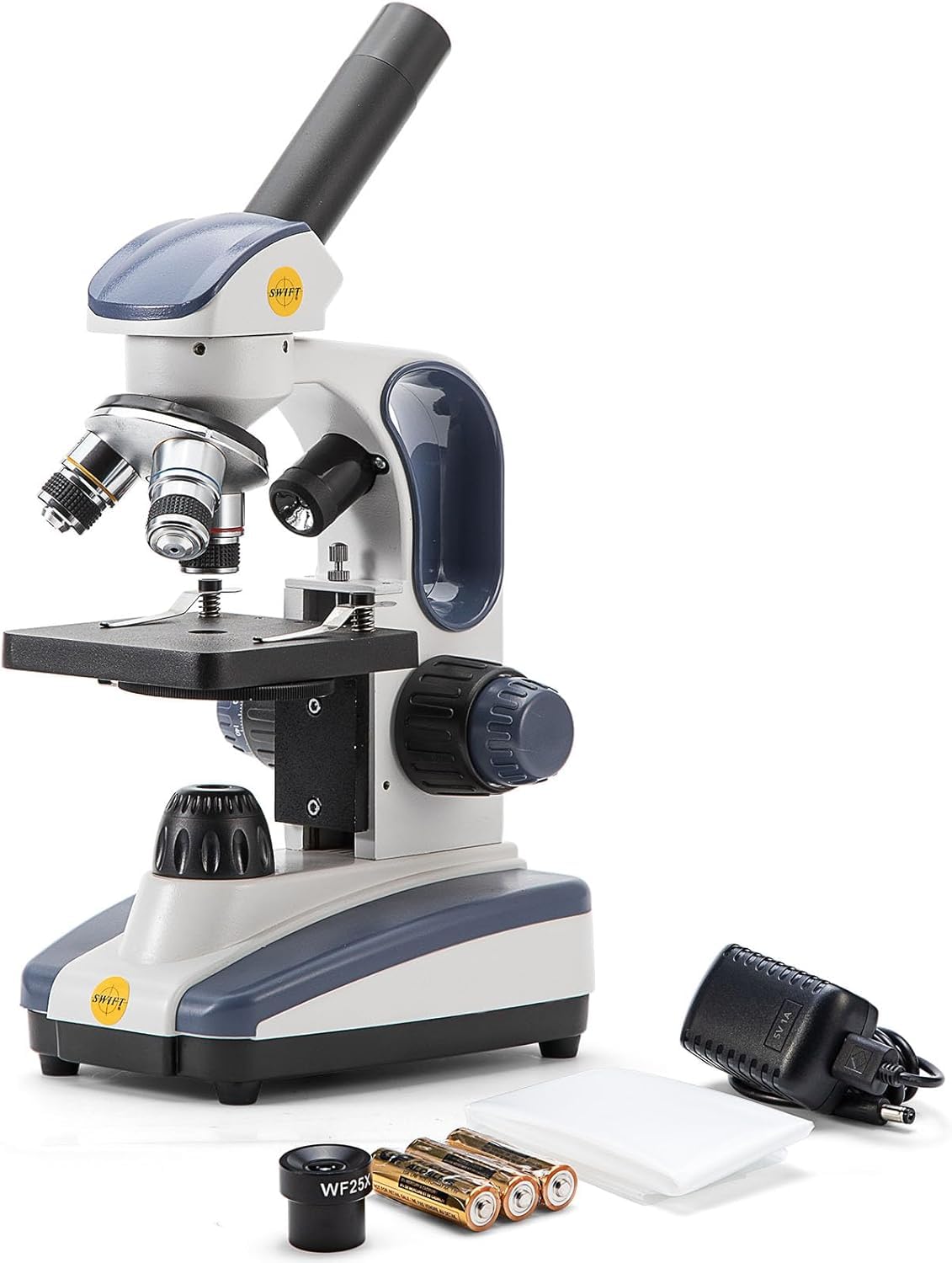
The SWIFT SW200DL sets the benchmark for what a serious beginner microscope should be. Its all-metal arm and base give it a reassuring heft that plastic-bodied competitors lack, and this mass translates directly to image stability when you are turning the focus knob. The double-layer LED illumination system lets you examine both prepared slides on glass and solid objects like coins or fabric, a versatility most entry-level scopes simply do not offer.
Optically, the SWIFT is a class above its peers in this price range. The 4X, 10X, and 40X achromatic objective lenses deliver crisp, color-corrected images at magnifications from 40X up to 1000X. A 25X wide-field eyepiece is included alongside the standard 10X, giving you an extra step in magnification without sacrificing field of view. Users consistently report being able to see cell walls, nematodes, and algae with surprising clarity for a sub-hundred-dollar instrument.
The cordless capability, powered by batteries, makes this scope practical for field work or for a child who wants to set up in the living room rather than next to an outlet. The fully rotatable monocular head is a thoughtful classroom touch, allowing multiple users to share the scope without repositioning the entire unit. Its lightweight 5-pound build and built-in carrying handle make it genuinely portable.
Why it’s great
- Durable all-metal construction resists knocks and provides a stable platform.
- Dual LED illumination system handles transparent and solid specimens with ease.
- Achromatic objective lenses deliver true-to-life color and sharpness at 1000X magnification.
- Cordless operation makes it ideal for outdoor or classroom use.
Good to know
- No carrying case or wooden box included for storage of the scope and accessories.
- Instructions could be more detailed for absolute beginners.
- LED brightness is sufficient but not adjustable.
2. AmScope 120X-1200X 52-pcs Beginner Microscope STEM Kit (M30-ABS-KT2-W)

The AmScope M30 is a complete science starter lab in a box. The kit includes the microscope itself, a hard ABS plastic carrying case, five prepared slides, seven blank slides, slide covers, a brine shrimp hatchery, and a range of dissection tools. For a family wanting everything ready out of the box, this package is hard to beat at its price point.
The microscope body is metal, which provides a stable base and a reassuringly solid feel, though the focus knobs and stage clips are plastic. The magnification ranges from 120X to 1200X across six settings, and the built-in LED light with a rotating color filter wheel helps improve contrast on difficult-to-see specimens. The monocular head is angled for comfortable viewing, and the coarse focus knob is smooth enough for a child to operate.
Where this scope shows its entry-level price tag is in the optics. Clarity is reasonable at the lower magnifications, but image quality degrades noticeably when you push past 600X. The plastic stage clips and single-knob focus system mean you cannot make the fine adjustments needed for professional-level work. For the target audience of curious elementary and middle school students, however, it delivers exactly what is needed to spark a love for biology.
Why it’s great
- Massive 52-piece kit includes slides, tools, and a carrying case for organization.
- Metal body provides a stable, durable platform for young users.
- Rotating color filter wheel is a useful learning tool for adjusting specimen contrast.
- Affordable entry point for a full compound microscope experience.
Good to know
- Image clarity drops significantly at magnifications above 600X.
- Only coarse focus is available; no fine focus knob for precise adjustments.
- Plastic stage clips and dials feel less durable than the metal arm and base.
3. Herwicm 40X-2000X Microscope with Phone Adapter

The Herwicm microscope is aimed at the older student or adult hobbyist who needs genuine optical performance without moving to professional pricing. Its key differentiator is the set of 4X, 10X, and 40X achromatic objective lenses, which provide true color correction and edge-to-edge sharpness. The maximum magnification reaches 2000X, but as with any scope, the usable practical limit is around 1000X with the standard 10X eyepiece.
Build quality is a mix of metal and ABS acrylic, with a sturdy metal arm that can tilt 45 degrees for comfortable viewing. The included phone adapter is a useful addition for digital recording, allowing you to attach a smartphone directly to the eyepiece to capture photos and video of specimens. The dual illumination system uses LED bulbs for both transmitted and reflected light, activated via a switch on the base.
The kit comes with a shock-resistant carrying case and a bag for storage, but the accessory count is lean compared to the AmScope kit — you get only two blank slides and a few basic tools. The instructions are sparse and the setup requires some trial and error, especially for the first-time user. The battery-powered LED has a quirk where it stays dimly lit while charging, which can cause confusion out of the box.
Why it’s great
- Achromatic objective lenses deliver sharp, color-corrected images at the most useful magnifications.
- Included phone adapter makes sharing and recording discoveries easy.
- Tilting metal arm allows for ergonomic viewing angles.
- Compact carrying case protects the scope during transport.
Good to know
- Comes with only two blank slides; you will need to buy more immediately.
- Setup instructions are poorly written and may frustrate beginners.
- The LED light behaves oddly during charging, staying dimly lit until the battery is full.
4. Educational Insights GeoSafari Jr. Talking Microscope

The GeoSafari Jr. Talking Microscope occupies a unique niche as the only interactive audio microscope on this list. It is designed specifically for preschool children aged 3 to 6, using the voice of Bindi Irwin to narrate over 100 facts and questions about the 60 full-color images on the slides. This is not a microscope for examining real specimens; it is a curated learning tool that combines visual exploration with audio education.
The plastic construction is durable and toddler-friendly, with large, easy-to-grip buttons for switching between Fact Mode and Quiz Mode. All 20 prepared slides are stored inside the unit, so there are no loose pieces to lose. The LED light illuminates the slide image, and the viewing lens provides a clear, fixed-magnification view at up to 400X enlargement of the printed images.
Parents consistently report that this toy holds the attention of children who are too young for a compound microscope. The quiz mode gamifies the experience, and kids learn the names and characteristics of animals and plants without realizing they are studying. The main limitation is that it cannot view real physical specimens, so its educational value plateaus once the child outgrows the prepared slide set.
Why it’s great
- Audio narration by Bindi Irwin keeps young children engaged and learning.
- Quiz mode turns exploration into a fun, interactive game.
- All slides are stored internally, preventing loss and clutter.
- Extremely durable build designed to survive drops and rough handling.
Good to know
- Cannot view real specimens or slides you prepare yourself.
- Best suited for children under 6; older kids will find it limiting.
- The slides are printed images, not actual microscopic photographs.
5. Odatay 4K 1000X Digital Microscope for Kids
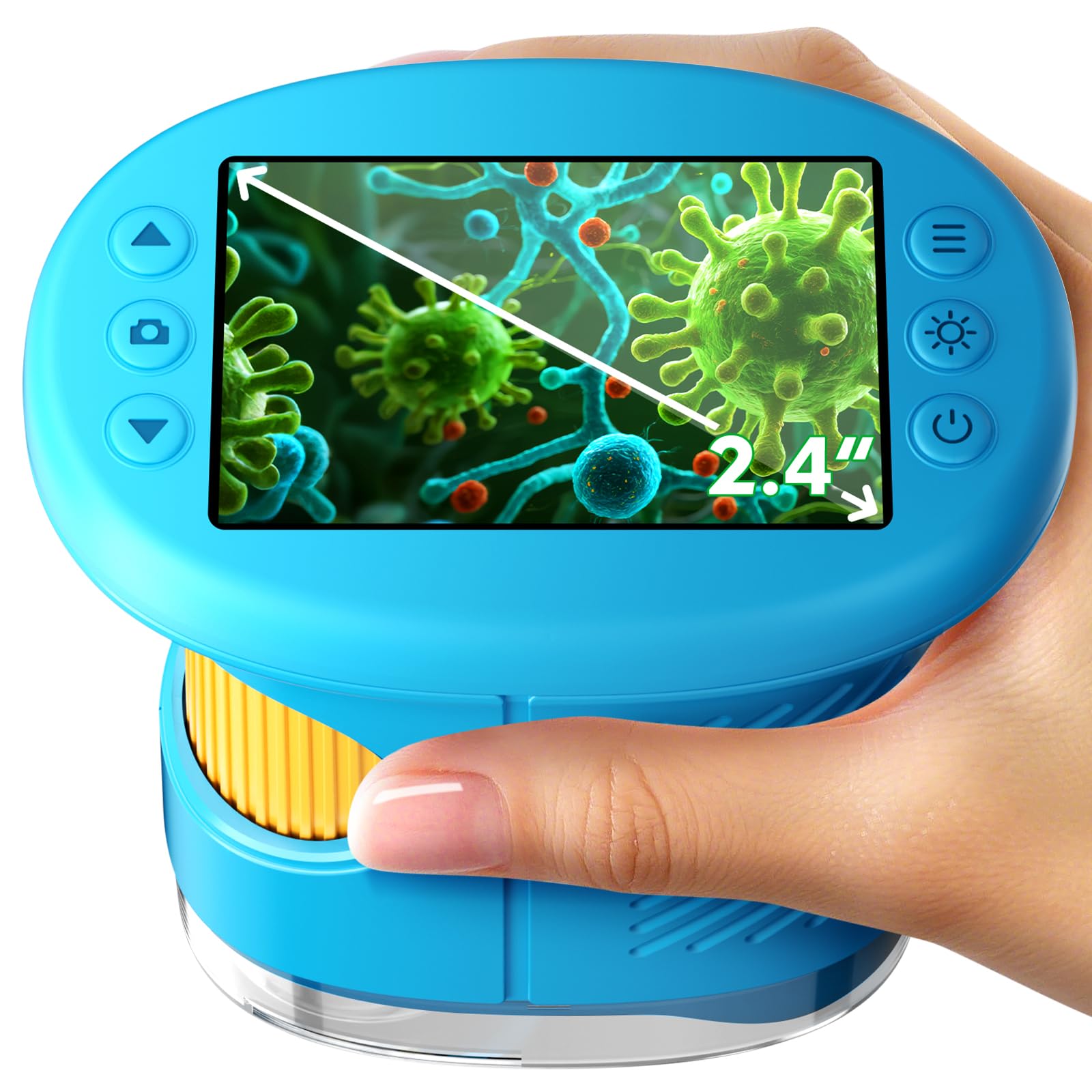
The Odatay digital microscope solves the biggest problem with traditional microscopes for young children: the need to squint through a single eyepiece. Its bright 2.4-inch LCD screen displays the image in full color, allowing kids to look at the screen simultaneously. The 4K HD camera captures detailed images and video, which are stored on the included 32GB TF card.
Magnification ranges from 200X to 1000X across four levels, and the lowest setting doubles as a long-distance viewer for looking at objects like leaves and bugs from a few inches away. The 8 built-in LED lights with three adjustable brightness levels ensure specimens are well-lit, even in dim conditions. Weighing only 0.5 pounds and fitting easily in a pocket, this microscope is designed for outdoor exploration.
The kit is generous, including 12 prepared slides, a slide viewing cover, a lanyard, a tripod hole for steady viewing, and a protective silicone case. The focus wheel is intuitive enough for a 5-year-old to master in minutes. The digital nature of the scope means you cannot view biological samples like cheek cells or onion skin with the same clarity as a compound scope, but for examining coins, fabrics, bugs, and plants, it is genuinely impressive.
Why it’s great
- Bright 2.4-inch 4K screen eliminates the struggle of single-eyepiece viewing.
- Ultra-portable design and neck strap make it perfect for field trips and outdoor play.
- Built-in photo and video recording captures discoveries for sharing.
- Ready to use out of the box with a 32GB card and 12 prepared slides included.
Good to know
- Digital zoom degrades quality; optical zoom would be superior for fine details.
- Not suitable for viewing biological cells or prepared wet-mount slides.
- Battery life is adequate for an afternoon but requires recharging after extended use.
6. Alotwan Kids Microscope Handheld Digital 1000X
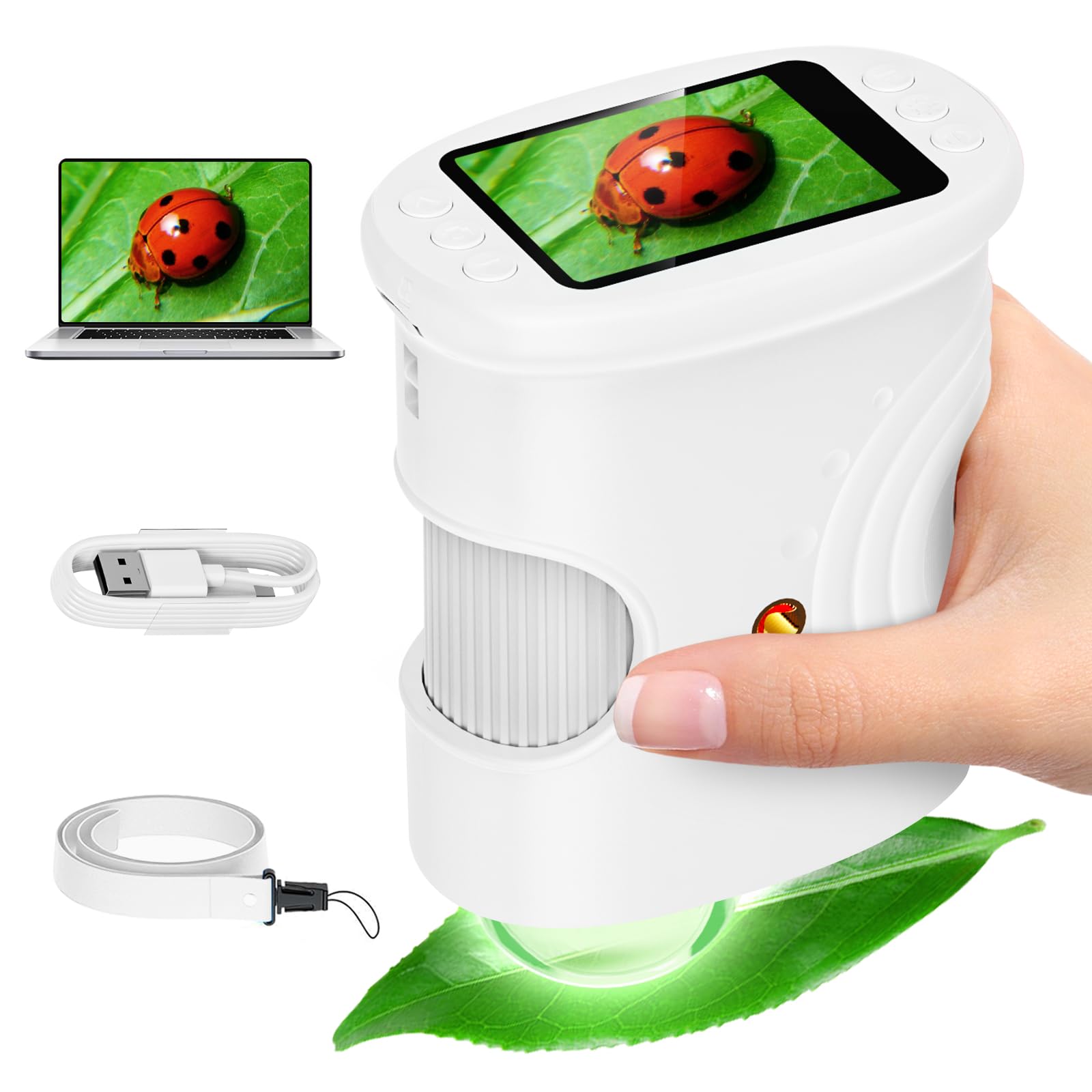
The Alotwan handheld digital microscope prioritizes portability above all else. Weighing just 0.3 pounds, it is the lightest model in this guide, designed to fit into a child’s small hand or pocket. The 1080P HD screen is bright and crisp, and the up to 1000X zoom is controlled by a single smooth focus knob that is easy for little fingers to turn.
This is a 3-in-1 device that functions as a microscope for close-ups, a telescope when you adjust the focus for distant objects, and a video recorder with a TF card (not included). The built-in memory stores approximately 200 photos, so children can capture their findings without any extra hardware. The neck strap enables hands-free carrying during outdoor adventures.
The Alotwan is explicitly designed as a toy for observing everyday objects like leaves, fabrics, coins, and insects. It is not capable of viewing biological cells or blood samples, as the manufacturer clearly states. The plastic enclosure is lightweight but feels less durable than the metal-bodied compound options. For a younger child (ages 3-8) who wants to explore the world without the complexity of glass slides, it is a fantastic entry point.
Why it’s great
- Remarkably light and compact design fits in a pocket or small bag.
- Simple one-knob focus is easy for toddlers and preschoolers to operate.
- 3-in-1 functionality as a microscope, telescope, and video recorder.
- Built-in memory stores about 200 photos without needing a TF card.
Good to know
- Plastic construction feels less robust than metal alternatives.
- TF card required for video recording is not included in the package.
- Not designed for biological slide viewing; limited to opaque objects.
7. Learning Resources Elite Microscope, 21-Piece Set

The Learning Resources Elite Microscope is an introductory toy-microscope hybrid, best suited for children aged 6 and under who are not yet ready for a serious instrument. The set includes 21 pieces: the microscope, two prepared slides, blank slides, cover slips, tweezers, vials, and a hand magnifier. Its standout feature is the projector mode, which lets you remove the eyepiece and tilt the microscope to project images onto a nearby wall.
The body is made entirely of lightweight plastic, which has led to consistent complaints about stability and image quality. The magnification levels of 100X, 300X, and 600X are achieved by rotating the eyepiece turret, but the images at the highest setting are often blurry. There is no on/off switch; the LED light is activated by flipping the mirror, which is an awkward design choice.
Reviews from parents are sharply divided. Some find it a functional and fun starter for toddlers, while others note that the image quality is poor and the plastic feels cheap. The included accessories are safe and engaging for small children, and the projector mode is genuinely novel. For a child who shows a real interest in science, this scope will be outgrown within a few months, making it a stepping stone rather than a long-term tool.
Why it’s great
- Projector mode is a unique feature that lets kids share discoveries with the whole family.
- Included 21-piece set provides plenty of accessories for hands-on exploration.
- Lightweight and safe plastic construction is ideal for very young children.
- Battery-powered LED light works in both sunlight and artificial light.
Good to know
- Image quality at 600X is poor, with significant blur and color distortion.
- Lightweight plastic body lacks the stability needed for clear viewing.
- No on/off switch; the light is controlled by a flip mirror, which is finicky.
FAQ
What is the difference between a compound microscope and a digital handheld microscope?
Why is a metal body better than a plastic one for a beginner microscope?
What does “achromatic” mean and why does it matter for a beginner microscope?
Can a digital handheld microscope view cells on a glass slide?
What is the ideal age range for a first “real” microscope?
Final Thoughts: The Verdict
For most families, the best beginner microscope winner is the SWIFT SW200DL because it combines a durable metal body, dual-LED illumination, and genuine achromatic lenses at a price that undercuts the competition. If you want the most comprehensive kit for a curious middle-school student, grab the AmScope M30-ABS-KT2-W. And for a toddler who is too young for slides and lenses, nothing beats the interactive audio experience of the Educational Insights GeoSafari Jr. Talking Microscope.

Mo Maruf
I created WellFizz to bridge the gap between vague wellness advice and actionable solutions. My mission is simple: to decode the research and give you practical tools you can actually use.
Beyond the data, I am a passionate traveler. I believe that stepping away from the screen to explore new environments is essential for mental clarity and physical vitality.