Our readers keep the lights on and my smoothie glass nicely filled. As an Amazon Associate, I earn from qualifying purchases.
A dull kitchen knife is both a frustration and a safety hazard — it slips more often, requires more force, and tears food instead of slicing it. For anyone new to sharpening, the biggest barrier is the confusing array of stones, angles, and techniques that make the task feel like a professional skill rather than a simple chore.
I’m Mohammad Maruf — the founder and writer behind WellFizz. My research focuses on breaking down kitchen gear into clear, actionable comparisons, analyzing the specific grit ratings, angle adjustability, and safety features that matter most for a confident first sharpening experience.
After sorting through dozens of options, evaluating everything from pull-through simplicity to whetstone versatility, the clearest path forward for a new user is a thoughtfully selected beginner knife sharpener that removes guesswork while still delivering a genuinely sharp edge.
How To Choose The Best Beginner Knife Sharpener
Not every sharpener suits every new user. The wrong choice can damage your blade or leave you frustrated. Focus on three core areas to find the right match for your skill level and kitchen routine.
Sharpening Mechanism: Pull-Through vs. Whetstone
Pull-through sharpeners use preset slots with abrasive rods — you simply draw the blade through them a few times. They are fast, require no technique, and are nearly foolproof for a beginner. Whetstones demand learning a consistent angle and manual motion, but they offer far greater control and can produce a superior edge once mastered. For a first-time buyer, a pull-through design with angle adjustability bridges the gap between convenience and quality.
Angle Adjustability and Grit Selection
Different knives require different sharpening angles — Asian blades often sit at 15 degrees, while Western chef knives typically need 20 degrees. A sharpener that offers multiple angle settings prevents you from ruining an edge. Grit rating determines how aggressive the abrasion is: coarse grit (around 400) repairs damage and reshapes the edge, while fine grit (1000 or higher) refines and polishes. Beginners benefit from a dual-grit setup that handles both tasks in one tool.
Stability and Safety Features
A sharpener that slides around on the counter is dangerous. Look for non-slip silicone pads, rubber bases, or weighted designs that keep the unit firmly planted. Ergonomic handles and magnetic guides further reduce the risk of slipping, giving a new user the confidence to focus on the motion rather than holding the tool steady.
Quick Comparison
On smaller screens, swipe sideways to see the full table.
| Model | Category | Best For | Key Spec | Amazon |
|---|---|---|---|---|
| MAD SHARK | Pull-Through | Quick daily sharpening | 6 adjustable angles (14°–24°) | Amazon |
| Winklez Rolling Sharpener | Rolling Disc | Magnetic-guided precision | #400 diamond / #3000 ceramic discs | Amazon |
| Matsato Wood Sharpener | Ceramic Rod | Compact tabletop elegance | Carbonated beech wood body | Amazon |
| Sharp Pebble Whetstone | Whetstone | Learning free-hand sharpening | 400/1000 dual grit stone | Amazon |
| Lrker 4-Side Whetstone Set | Full Whetstone Kit | Complete sharpening system | 400/1000/3000/8000 grit stones | Amazon |
In‑Depth Reviews
1. MAD SHARK 6-Angle Knife Sharpener

The MAD SHARK sharpener stands out because it offers six precise sharpening angles — 14°, 16°, 18°, 20°, 22°, and 24° — controlled by a simple dial. This adjustability means you can match the angle to your specific knife, whether it’s a thin Japanese santoku or a thick German chef knife, without guessing. The coarse tungsten carbide slot handles edge restoration, while the fine ceramic slot polishes the blade to a clean finish.
Ergonomics are clearly considered here: the handle keeps your fingers well away from the blade path, and two silicone pads on the base anchor the unit firmly to the counter. Users consistently report that a few gentle pull-through passes restore a sharp edge, and the included scissor slot adds real versatility for home cooks who maintain multiple tools. Experienced chefs have noted that this handheld design holds the cutting edge longer than many comparably priced pull-through models.
For a beginner who wants immediate results without studying technique, this is the most forgiving and capable entry point. The clear angle guide printed on the body removes the guesswork, and the compact size stores easily in a drawer. It is the rare sharpener that balances simplicity with genuine precision, making it the top recommendation for first-time buyers.
Why it’s great
- Six angle settings cover nearly every kitchen knife type
- Non-slip silicone base keeps the tool steady during use
- Includes a separate slot for sharpening scissors
Good to know
- Right-hand biased grip may feel less natural for left-handed users
- Plastic body is durable but not as visually premium as wood models
2. Winklez Rolling Knife Sharpener

The Winklez rolling sharpener takes a different approach: instead of pulling the blade through fixed slots, you roll a handle-mounted disc over a magnetically secured knife. This rolling motion naturally follows the blade’s curve, and the #400 diamond disc aggressively restores dull edges while the #3000 ceramic disc refines them to a polished finish. The two magnetic angle guides — 15° and 20° — snap onto the blade and hold it at the correct tilt, eliminating the angle-guessing that trips up most beginners.
Build quality is a step above typical plastic sharpeners: the body is crafted from natural beech wood, and the four N42 super-strong magnets create a reassuring hold on the blade. Users report that even very dull kitchen knives become paper-slicing sharp after about five minutes of rolling. The compact design (under 5 inches tall) stores easily, and the included magnetic holder keeps the knife stable throughout the process.
This is ideal for someone who wants a more controlled, almost meditative sharpening experience without committing to a full whetstone setup. The rolling action is intuitive, and the magnetic angle guides provide the same consistency a fixed-angle jig would. It feels more like a precision tool than a gadget, and the wooden construction makes it a handsome countertop addition.
Why it’s great
- Magnetic angle guides lock the blade at 15° or 20° for perfect consistency
- Diamond disc cuts quickly; ceramic disc delivers a refined edge
- Natural beech wood body looks elegant and feels substantial
Good to know
- The blade can occasionally pop off the magnet if too much side pressure is applied
- Works best with straight-edge knives; not designed for serrated blades
3. Matsato Ceramic Rod Sharpener
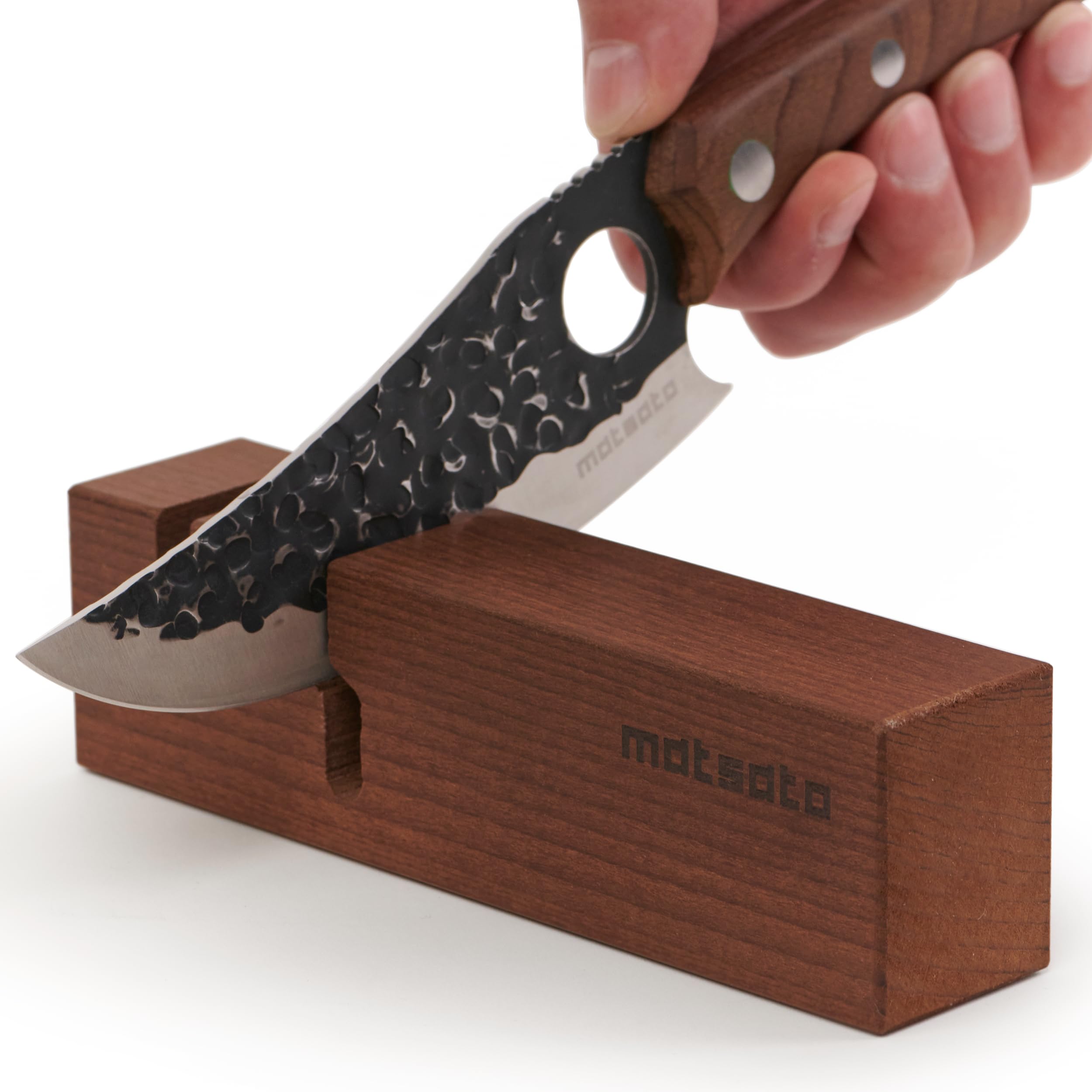
The Matsato sharpener is the most visually distinctive option here, with a body made from natural carbonated beech wood that doubles as kitchen decor rather than an eyesore. Two ceramic rods sit in a V-shaped groove — you simply draw the blade through the slot a few times to restore a workable edge. There are no adjustable angles or interchangeable stones; the fixed geometry is designed for quick maintenance rather than heavy reprofiling.
At just over 7 inches long and weighing 200 grams, it is compact and highly portable, making it a natural choice for campers, outdoor cooks, or anyone who wants a sharpener that can live in a toolbox or travel bag. Users consistently praise how easily it sharpens pocket knives and standard kitchen blades, though serrated steak knives are a notable exception. The non-slip base provides adequate grip on dry countertops, though it lacks the aggressive silicone anchors of the MAD SHARK.
This is best suited for a beginner who values aesthetics and portability over raw versatility. It won’t repair a heavily damaged blade as effectively as a multi-angle or whetstone system, but for maintaining an already decent edge, it is simple, quiet, and elegant. It makes a thoughtful gift for someone who appreciates natural materials in their kitchen tools.
Why it’s great
- Beautiful beech wood construction fits nicely on open kitchen shelving
- Compact and lightweight for travel, camping, or toolboxes
- Ceramic rods produce a clean, consistent edge with minimal effort
Good to know
- Fixed V-angle cannot be adjusted for different blade geometries
- Not effective on serrated knives or badly damaged edges
4. Sharp Pebble Premium Whetstone 400/1000

The Sharp Pebble whetstone represents the most affordable entry into traditional waterstone sharpening. The 400-grit side quickly reprofiles a dull or damaged edge, while the 1000-grit side refines that edge for smooth, clean cuts. The kit includes a non-slip rubber base that holds the stone securely, a flattening stone to correct uneven wear, and a digital angle guide to help beginners learn the correct blade angle without guesswork.
Learning to use a whetstone takes more patience than a pull-through sharpener — you must maintain a consistent angle across the full blade stroke — but the payoff is greater control and a noticeably sharper edge. Users who invested time in practicing on this stone report that they were able to sharpen very dull knives to a level that outperformed their previous electric sharpeners. The included angle guide is especially helpful for the first several sessions, building muscle memory before transitioning to free-hand sharpening.
This is the right choice for a beginner who wants to learn the skill of hand sharpening rather than just getting a quick fix. The bundle includes everything needed to start except water, and the flattening stone ensures the whetstone remains flat over many uses. It is a genuine learning tool that grows with your ability.
Why it’s great
- Dual-sided stone covers both coarse reprofiling and fine honing
- Non-slip rubber base prevents movement during use
- Includes a flattening stone and angle guide for proper technique
Good to know
- Requires practice and patience to learn consistent angle control
- Must be soaked in water before use; not for oil-based sharpening
5. Lrker 4-Side Whetstone Set 400/1000/3000/8000
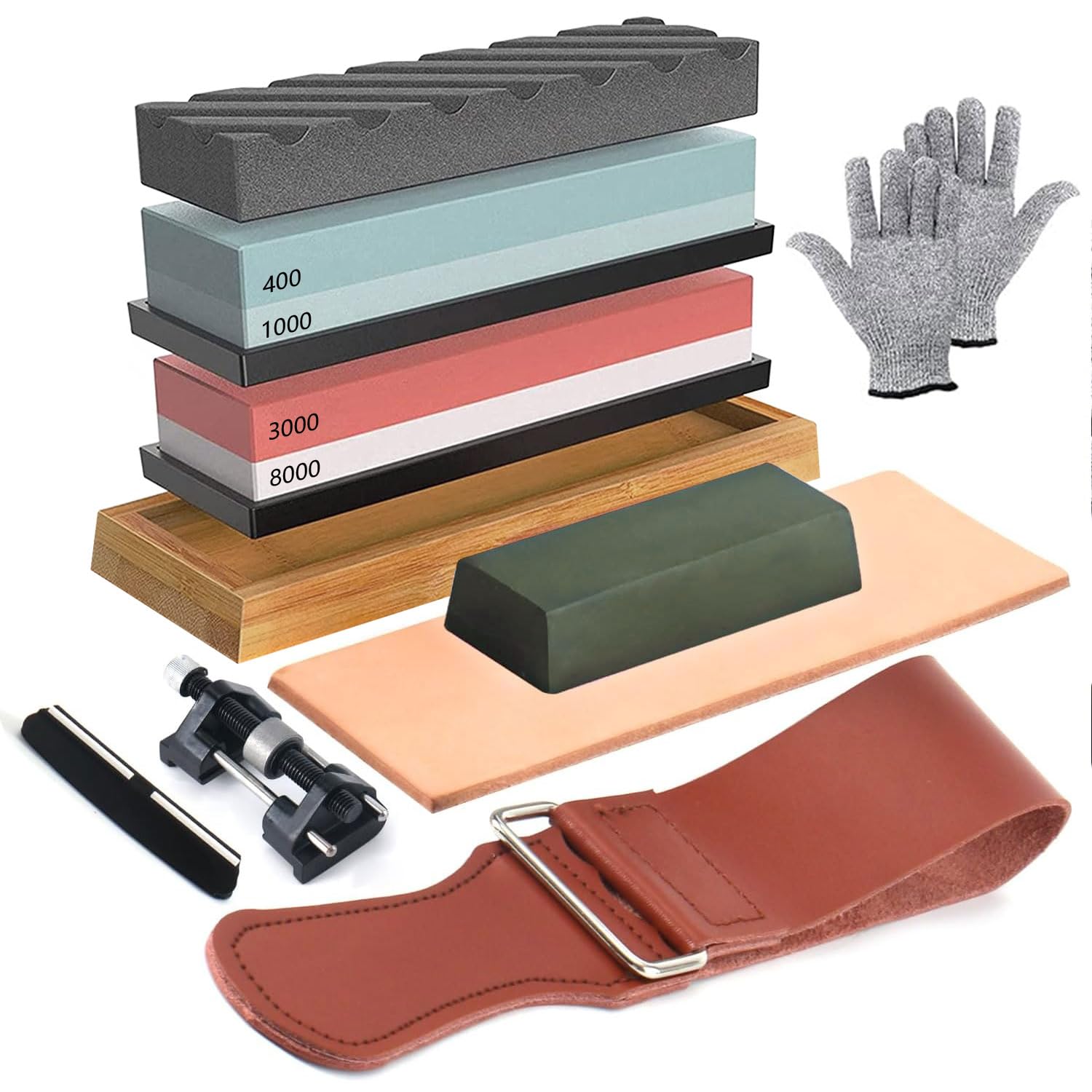
The Lrker set is the most comprehensive whetstone package in this lineup, featuring four grit surfaces — 400, 1000, 3000, and 8000 — across two double-sided stones. The 400/1000 stone handles heavy repair and initial sharpening, while the 3000/8000 stone polishes the edge to a mirror-like finish. The kit goes far beyond stones: it includes a non-slip bamboo base, a leather strop for final burr removal, an angle guide, cut-resistant gloves, and a flattening stone, totaling 16 pieces.
For a beginner who plans to commit to manual sharpening long-term, this set eliminates the need to purchase additional accessories later. The 3000 and 8000 grit stones enable a level of edge refinement that pull-through sharpeners cannot achieve — users who worked through all four grits consistently produced blades sharp enough to shave hair. The bamboo base with silicone strips holds both stones firmly, and the included angle guide provides the same training-wheel benefit as the Sharp Pebble kit.
The main consideration is that with more stones comes more setup time, and maintaining flat stones across four grit surfaces requires periodic flattening. Some users have noted slight bowing in the 3000/8000 stone upon arrival, which can usually be corrected with the included flattening stone. If you want the most capable sharpening system from day one and are willing to invest in learning the process, this kit offers exceptional value per dollar.
Why it’s great
- Four grit levels allow progression from repair to mirror polish
- Includes leather strop, angle guide, and cut-resistant gloves
- Bamboo base with silicone strips provides excellent stability
Good to know
- Learning curve is steeper than pull-through or rolling sharpeners
- Occasional quality control issues with stone flatness on arrival
FAQ
Can a pull-through sharpener damage my knife?
How often should I sharpen a kitchen knife?
Do I need water or oil for a whetstone?
Final Thoughts: The Verdict
For most users, the beginner knife sharpener winner is the MAD SHARK because its six adjustable angles and dual abrasive slots make it genuinely foolproof while still delivering a sharp edge. If you want the precision of magnetic-guided rolling action and a premium wood build, grab the Winklez Rolling Sharpener. And for a beginner ready to learn the craft of hand sharpening, nothing beats the comprehensive Lrker 4-Side Whetstone Set.

Mo Maruf
I created WellFizz to bridge the gap between vague wellness advice and actionable solutions. My mission is simple: to decode the research and give you practical tools you can actually use.
Beyond the data, I am a passionate traveler. I believe that stepping away from the screen to explore new environments is essential for mental clarity and physical vitality.