Our readers keep the lights on and my smoothie glass nicely filled. As an Amazon Associate, I earn from qualifying purchases.
You have a clear vision of the sweeping aerial shots you want to capture, but the fear of losing a brand-new drone in a tree or a pond keeps you from hitting the buy button. The market is flooded with fragile toy-like models that promise the world and deliver nothing but a flyaway disaster. For an adult just starting out, the difference between a confidence-inspiring tool and a frustrating piece of plastic is the presence of reliable GPS stabilization, a decent camera, and brushless motors.
I’m Mohammad Maruf — the founder and writer behind WellFizz. I’ve spent years analyzing the hardware specifications, user flight logs, and failure points of entry-level quadcopters to separate the genuinely user-friendly models from the cardboard box disappointments.
After scrutinizing dozens of models across real-world flight conditions, I’ve identified the nine units that actually deliver on their promise of a stress-free first flight. This guide breaks down the absolute best beginner drone for adults based on GPS reliability, camera stabilization, and battery endurance.
How To Choose The Best Beginner Drone For Adults
An entry-level quadcopter for an adult is fundamentally different from a child’s toy. The buying criteria revolve around flight safety, camera fidelity, and battery endurance — all of which determine whether your first drone purchase sparks a long-term hobby or a one-flight regret.
GPS Reliability & Return to Home
The single most important safety feature you cannot skip is a GPS module paired with an automatic Return to Home (RTH) function. When the battery runs low, the signal drops, or you simply lose orientation, a GPS drone will autonomously fly back to its takeoff point. Without it, a moment of wind or a lost radio connection sends the quadcopter on an unguided trip into the neighbor’s yard. For a first-time pilot, this feature alone transforms a high-anxiety experience into a calm, learning-oriented flight.
Brushless Motors vs. Brushed Motors
Every drone in this guide uses brushless motors, and there’s a reason for that. Brushed motors wear out quickly — they lose power after just a few hours of total run time and offer weak wind resistance. Brushless motors, by contrast, provide consistent thrust, quieter operation, and far greater resistance to level 4 to 5 wind conditions. If the drone listing doesn’t explicitly say “brushless motor,” you are buying a toy with a limited lifespan.
Camera Quality & Stabilization
A 4K label on the box does not guarantee sharp footage because many budget drones produce heavily compressed, jittery video that looks closer to 720p. Look for a mechanical gimbal (even a 2-axis one) or at least electronic image stabilization (EIS) if you care about usable footage. A camera that can tilt via remote control gives you much more compositional freedom than a fixed downward lens. For pure flight practice, a lower-resolution camera is fine, but if you plan to post the footage, prioritize models with a 3-axis gimbal.
Flight Time & Battery Management
Advertised flight times are always measured in ideal, calm, indoor conditions. A realistic expectation is 60–70% of the stated number. If a drone claims 40 minutes with two batteries, you will get roughly 12–15 minutes per battery in real outdoor flying with GPS active. Extra batteries are not a luxury — they are a necessity. A total flight package offering three batteries is significantly more practical than a single-battery unit that leaves you grounded after a single outing.
Weight and FAA Registration
Drones under 250 grams (0.55 pounds) do not require FAA registration or Remote ID compliance for recreational use in the United States. This is a massive convenience for beginners who just want to fly without paperwork. All the models reviewed here are near or under that weight threshold, so you can focus on learning the controls rather than navigating federal regulations.
Quick Comparison
On smaller screens, swipe sideways to see the full table.
| Model | Category | Best For | Key Spec | Amazon |
|---|---|---|---|---|
| WeFone WF30 | Budget GPS | Value-first beginners | 2 batteries / 40 min claimed | Amazon |
| PLEGBLE PL715 | Mid GPS 4K | Easy GPS learning | 2700mAh batteries / 46 min | Amazon |
| Oddire HK11 | Mid GPS 4K | Durable all-around flight | 7.7V 1800mAh / 48 min total | Amazon |
| SIMREX GPS | Mid GPS 4K | Gesture control & FPV | Optical flow / 2296 ft range | Amazon |
| REDRIE HK33 | Mid GPS 4K | Anti-shake camera learning | 45 min total / 110° wide lens | Amazon |
| Potensic ATOM LT | Premium Entry | Long flight practice | 2.5K EIS / 80 min total | Amazon |
| Gleesfun G11PRO | Premium Gimbal | Smooth cinematic footage | 3-axis gimbal / 4K 30fps | Amazon |
| Ruko F13 | Premium 8K | Photo-focused beginners | 48MP sensor / 3-axis gimbal | Amazon |
| Bwine F7MINI | Premium Screen | All-in-one screen convenience | Built-in 5.5″ controller screen | Amazon |
In‑Depth Reviews
1. Potensic ATOM LT

The ATOM LT from Potensic is widely considered the gold standard for entry-level quadcopters precisely because it does not feel like a compromise. Under 249 grams, it requires zero FAA registration, yet it packs a Sony sensor capable of 2.5K footage at 30 fps with ShakeVanish 2.0 electronic image stabilization. The PixSync 2.0 transmission system delivers a clean HD feed up to 4 kilometers — a range that surpasses anything in its mid-range price tier.
Flight time is exceptional: two 3000mAh intelligent batteries yield a claimed 80 minutes total. In realistic outdoor flying with GPS engaged, you can count on around 28 to 32 minutes per battery. The brushless motors handle level 5 wind conditions without drama, and the dual GNSS support (GPS, GLONASS, Galileo, and BeiDou) ensures quick satellite lock and rock-solid position holding.
Where the ATOM LT truly excites beginners is its 3 flight modes that dial the agility from gentle to sporty, plus intelligent features like Follow Me, Waypoint, and Circle Fly. The one downside is that it only flies in GPS mode — no indoor or non-satellite flight — so you must always operate it outdoors away from obstructions. But for a first-time pilot, this constraint actually builds good flying habits from day one.
Why it’s great
- Longest real flight time in its class
- Professional-grade transmission range
- FAA-exempt without sacrificing features
Good to know
- Cannot fly indoors or without GPS lock
- Camera is 2.5K, not true 4K
2. PLEGBLE PL715
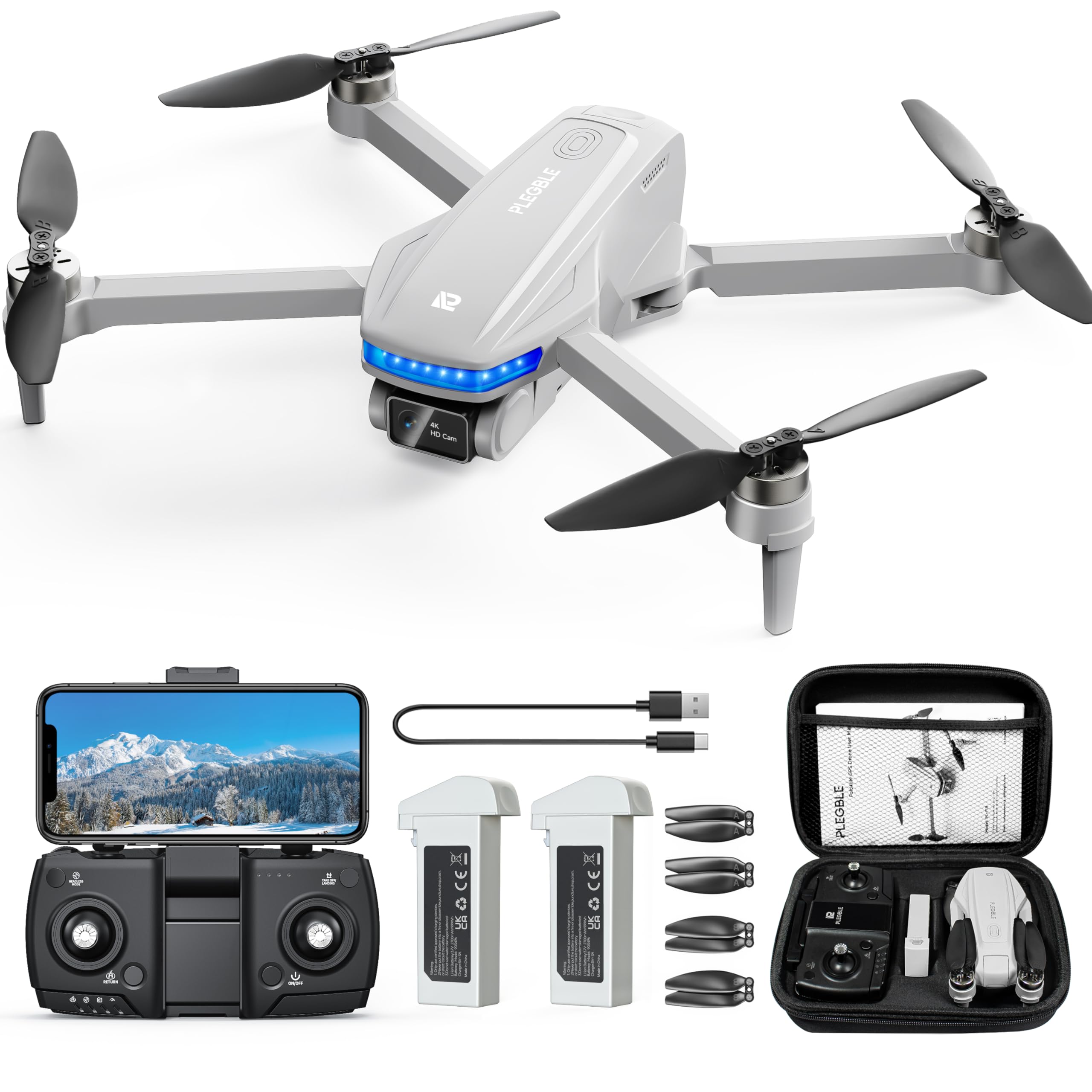
The PLEGBLE PL715 punches well above its price point by offering a true 4K camera with a 120° wide-angle lens and 90° adjustable tilt, all packaged in a sub-250 gram frame. The 5 GHz FPV transmission provides a smooth, low-latency real-time view on your phone, and the claimed transmission range of around 1,968 feet is generous for a beginner model. The included 2700mAh batteries, two of them, deliver a combined 46 minutes of flight — with each battery lasting roughly 18 to 20 minutes in practical use.
GPS features are comprehensive for the price: Auto Return, Follow Me, Waypoint Flight, and Circle Fly are all present and easily accessible through the app. A dedicated Beginner Mode restricts the flight radius to 30 meters, which is perfect for your first few sessions. You can toggle this off as your confidence grows, and the altitude hold system keeps the drone steady even in a light breeze.
Build quality is solid — the foldable arms and carrying case make it genuinely portable, and the remote controller feels substantial in hand. Some users report that the camera stabilization is good but not gimbal-level smooth; you will get clear, shareable footage rather than cinema-grade mastery. For the price, it is an outstanding gateway drone that covers all the essential bases.
Why it’s great
- Strong 4K camera for the price
- Useful Beginner Mode with radius limit
- Light, foldable, and FAA-exempt
Good to know
- Camera lacks mechanical gimbal stabilization
- Requires compass calibration before each flight
3. Bwine F7MINI
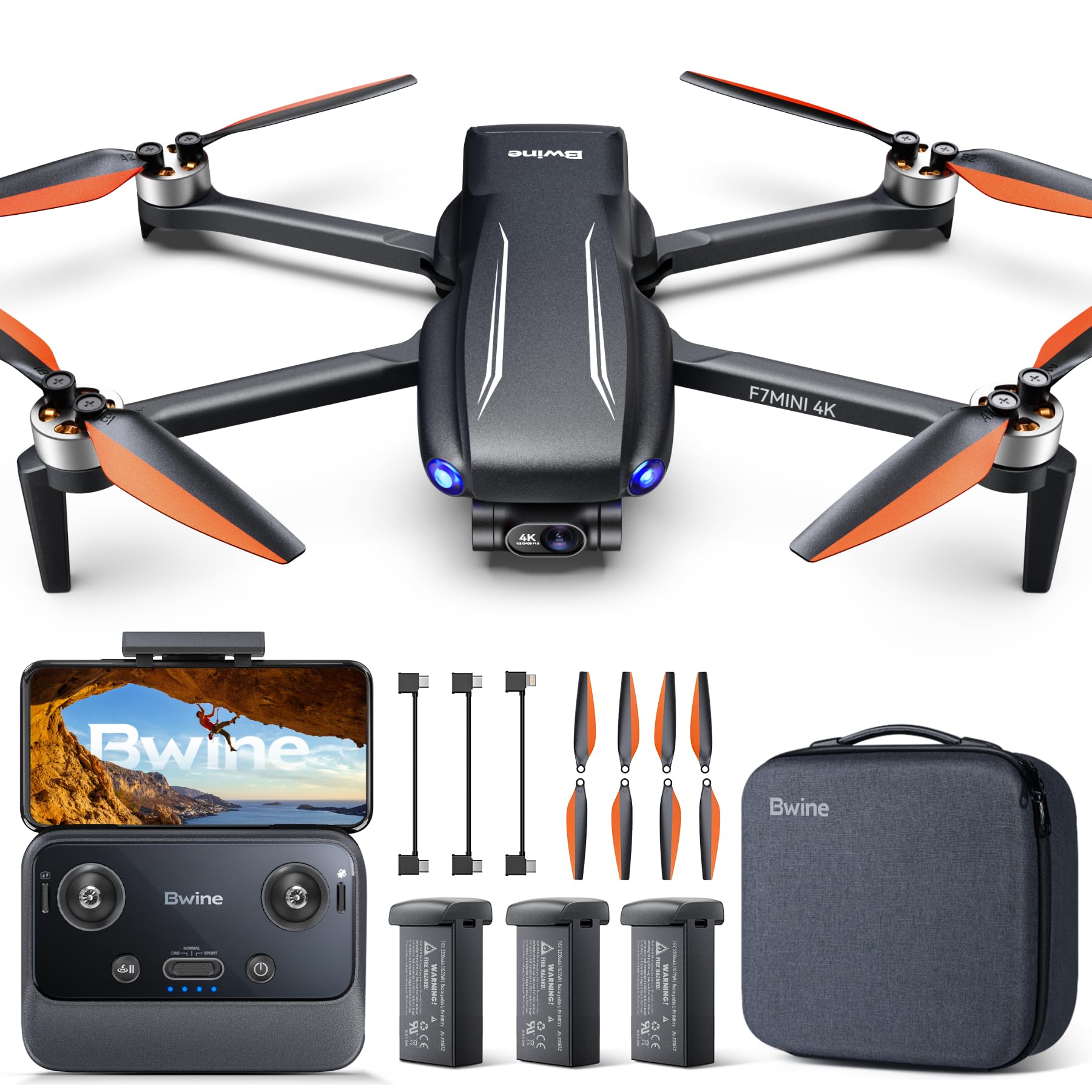
The Bwine F7MINI is the drone that removes the biggest friction point for beginners: fumbling with phone cables and app connectivity. Its remote controller comes with a bright, built-in 5.5-inch touchscreen, so you never have to dock your phone or worry about USB compatibility. This alone makes the pre-flight process faster and far less intimidating. The camera is a 48MP 1/2-inch CMOS sensor with an F1.8 aperture, capturing 8K photos and smooth 4K video at 30 fps through a true 3-axis brushless gimbal.
Three 2200mAh batteries give a total flight time of 96 minutes — roughly 30 minutes per battery in real outdoor flying. The wired digital transmission system reaches up to 20,000 feet (6 km) with zero-latency, more than enough for any beginner scenario. The drone also features a loud 120dB locator buzzer, AI takeoff and landing, and quadruple positioning (GPS, barometric hold, TOF, and optical flow) for stable indoor hovering when GPS is unavailable.
Wind resistance is rated at level 5, and the 1503 brushless motors push the drone to about 31 mph in sport mode. The only concession is the weight — at 248 grams, it still sits under the FAA registration threshold. The drawback is that the built-in screen, while excellent, adds cost. If your budget allows, this is the closest you can get to a premium flight experience without graduating to a + flagship model.
Why it’s great
- No phone needed for live view
- True 3-axis gimbal for smooth footage
- Excellent 96-minute total flight time
Good to know
- Premium price reflects the screen and gimbal
- Photo download to phone is slower than direct SD card transfer
4. Oddire HK11

The Oddire HK11 earns its spot in this guide because it does one thing better than most budget-mid drones: it stays calm under pressure. Brushless motors and a refined altitude hold system mean that when you release both joysticks, the drone simply stops and hovers in place — no drifting, no panic corrections. The 4K camera uses a 110° wide-angle lens that tilts 90° via remote control, and the 5G WiFi transmission holds a stable connection up to 500 meters.
The dual 1800mAh batteries deliver a claimed 48 minutes total. In field testing, each battery yields around 18 minutes of practical flight with GPS and camera recording active. The intelligent GPS modes — Route Planning, Orbit Fly, GPS Follow, and Auto Return — are reliable and do not drop the signal prematurely. The companion app XDRONE GO includes built-in filters and background music for quick social media sharing, which is a thoughtful bonus for new creators.
Durability is a standout theme in user feedback: the HK11 has survived multiple moderate crashes without component failure. The 249g weight keeps it FAA-exempt, and the foldable design fits into the included case without disassembly. The one consistent complaint is that you must calibrate the compass and accelerometer at every power-up, which adds about 45 seconds to the pre-flight routine. For that stability and ease of use, it is a minor trade-off.
Why it’s great
- Exceptionally stable hover for beginners
- Durable build survives learning crashes
- Quiet brushless motor operation
Good to know
- Requires full calibration at each power-on
- Max transmission range is shorter than competitors
5. SIMREX GPS Drone

Shopping for a beginner drone does not mean you have to miss out on fun interactive features. The SIMREX GPS drone brings gesture control to the entry-level table — wave your hand to capture a selfie or start a video without touching the remote. The 90° electrically adjustable camera delivers 4K photos, and the 5 GHz FPV transmission streams directly to your phone at a maximum distance of 2,296 feet.
Flight stability comes from a combination of GPS hold, optical flow positioning, and altitude hold sensors. This triple-lock system keeps the drone planted in the air even when you take your fingers off the sticks — ideal for composing a shot without fighting the controls. The Follow Me, Waypoint Flight, and Circle Around modes are intuitive and activated within the app without complex menu diving.
Battery life is rated at 40 minutes total using two batteries. Real-world performance lands closer to 14–16 minutes per battery, which is average for this price tier. The foldable arms make it truly portable, and the USB-C charging is a welcome modern convenience. The main drawback is that the controller does not have a built-in screen or phone holder that feels very secure — you may want a separate phone mount for rock-solid clamping.
Why it’s great
- Gesture control for hands-free operation
- Optical flow + GPS for ultra-stable hover
- USB-C charging port
Good to know
- Phone holder on remote could be more secure
- Real battery life is about 15 minutes per pack
6. REDRIE HK33
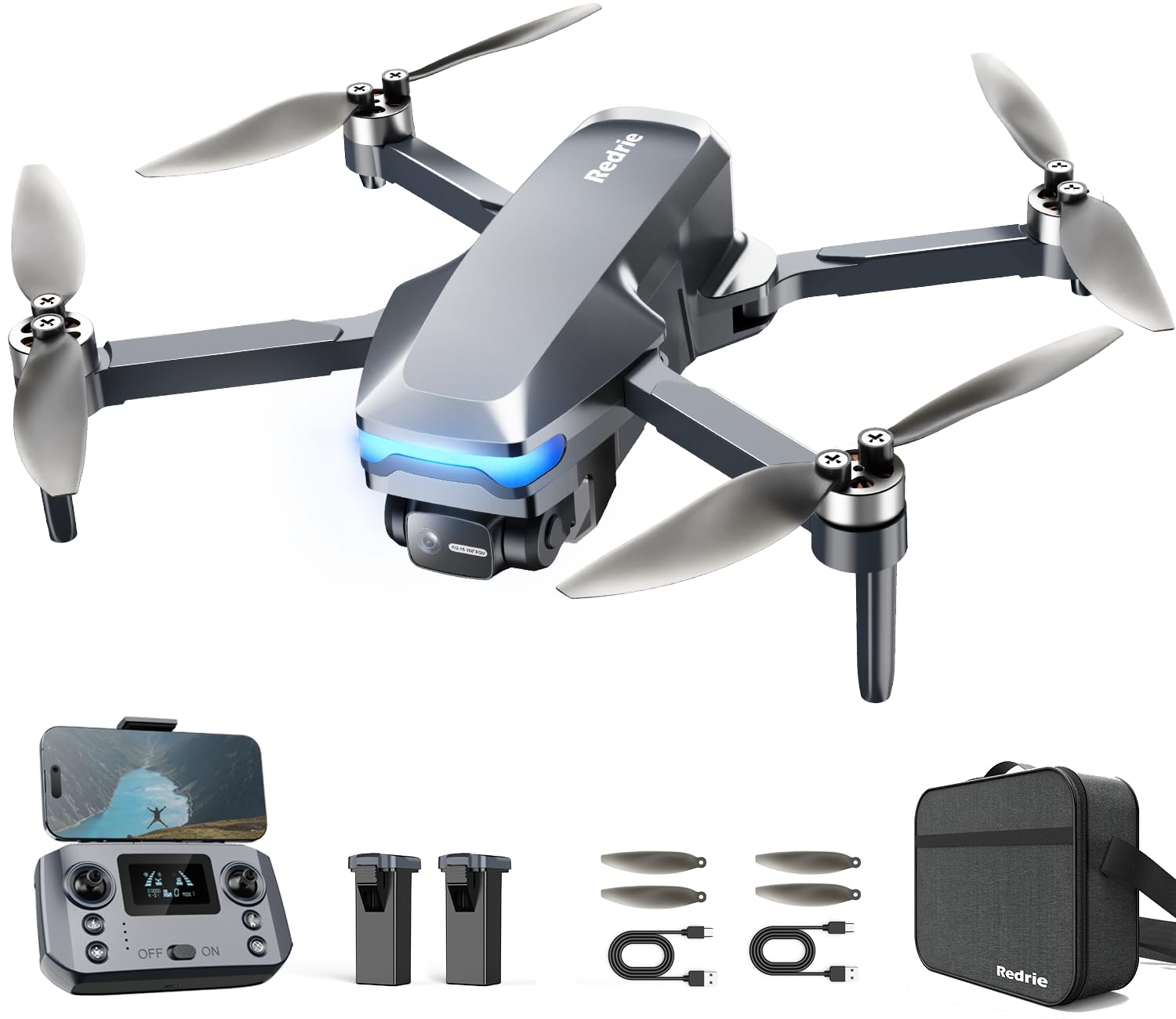
If you are entering the drone world primarily interested in still photography, the REDRIE HK33 deserves a close look. It features an adjustable F2.15 110° wide-angle lens with physical vibration reduction, capturing stills at 4096×3072 pixels. The 90-degree remote tilt adjustment means you can frame the horizon or point straight down without landing and repositioning. Footage records at 2048x1088P, so expect crisp images rather than cinematic video.
The GPS suite includes Auto Return, GPS Follow, Route Planning, and Fly Around — all the staples you need for stress-free navigation. The dual 1800mAh batteries provide 45 minutes of total flight, which correlates to roughly 16 to 18 minutes of real flight per battery. Brushless motors provide level 5 wind resistance, giving you the confidence to fly in breezy coastal parks or open fields without constant correction.
Weighing in at 249 grams, it is FAA-exempt and folds down into a compact carrying case. Customer service from REDRIE is notably responsive, with several users reporting quick resolution for minor defects. The cell phone holder on the controller is a weak point — it works but feels less durable than the rest of the build. For the photography-focused beginner, this is a capable tool that will not break the bank.
Why it’s great
- Physical vibration reduction in camera
- Solid GPS hold with reliable auto return
- Durable and crash-resistant frame
Good to know
- Phone holder on remote is a bit flimsy
- Max transmission range is shorter than premium options
7. Gleesfun G11PRO

The Gleesfun G11PRO is one of the few beginner-class drones that includes a true 3-axis brushless gimbal without crossing into the territory of professional budgets. This gimbal compensates for pitch, roll, and yaw in real time, producing smooth, shake-free 4K video at 30 fps that rivals far more expensive models. The 1/3.2-inch CMOS sensor captures 6K photos, offering more cropping flexibility than standard 4K sensors.
Flight time is 70 minutes total with two 7.7V 3200mAh batteries. Each battery charges in about 2.5 hours thanks to the GL2.0 smart management system, which is fast for a drone in this category. The GQ2.0 digital transmission system uses a dual-antenna design to maintain a stable feed up to 10,000 feet — a range that allows you to explore hillsides and large parks without worrying about disconnection.
FAA compliance is confirmed with built-in Remote ID, so you can fly legally without additional modules. The kit is generous: 40 pieces including a carrying case, camera protector, multiple cables, and spare propellers. User feedback consistently praises the sturdy build and the company’s responsive customer service. The trade-off is the weight — at 357 grams, it exceeds the 249g registration exemption, so you will need to register with the FAA. For the stability you get, that paperwork is a minor step.
Why it’s great
- 3-axis gimbal delivers genuine cinematic stability
- Very fast battery charging (2.5 hours)
- 10,000 ft digital transmission range
Good to know
- Over 249g, requires FAA registration
- No built-in screen on remote control
8. Ruko F13

Ruko has carved a reputation for reliable entry-level quadcopters, and the F13 raises the bar with a 48MP 1/2-inch CMOS sensor that captures 8K photos and 4K video at 30 fps. The 3-axis brushless gimbal combined with electronic image stabilization ensures that even in a moderate breeze, your footage remains steady and professional. The upgraded cruise control maintains a consistent track without requiring constant joystick input.
The most impressive spec is the 96-minute total flight time, delivered by three 2200mAh batteries. With three packs included, you can rotate through them without pausing to recharge mid-adventure — each battery delivers about 30 minutes in real flight. The R2 digital transmission system reaches 20,000 feet, which is double the distance of typical Wi-Fi drones and completely free of the interference that plagues consumer WiFi connections.
AI takeoff and landing handle the most stressful parts of the flight automatically, and the quadruple positioning (GPS, barometric hold, TOF, and optical flow) gives the drone exceptional stability even indoors. The built-in beeper is a welcome safety net — if you crash in tall grass, the 120dB sound leads you straight to it. Customer service is frequently described as “outstanding” in user feedback, with fast replacement of defective units. The joysticks are sensitive out of the box, so a careful first flight is advised.
Why it’s great
- Three batteries provide 96 minutes of airtime
- High-resolution 48MP sensor with 3-axis gimbal
- Loud beeper for easy retrieval after a crash
Good to know
- Joysticks are sensitive for raw beginners
- Requires a microSD card for full-resolution storage
9. WeFone WF30

The WeFone WF30 is the budget-friendly entry point for adults who want to test the hobby without a big financial commitment. It includes GPS with Auto Return, Follow Me, Waypoint Flight, and Point of Interest — features that were once exclusive to much more expensive drones. The 4K camera has a 90° electrically adjustable lens with a 117° wide-angle field of view, and the 5G FPV transmission maintains a real-time view up to about 300 meters.
Two modular batteries provide a claimed 40 minutes of total flight time. In real outdoor use with GPS active, each battery lasts around 14 to 16 minutes, which is reasonable at this price point. The brushless motors are a massive upgrade over the brushed motors found in toy-class drones, giving you quieter and more reliable thrust. The optical flow positioning system provides decent stationary hovering even without a strong GPS signal.
The biggest strength is also its biggest warning: this drone is durable enough to survive learning crashes into trees and walls, but the Return to Home function has been reported to occasionally misbehave in low-battery scenarios, causing an uncontrolled ascent. The WiFi signal is also open — not encrypted — which some users flagged as a potential security concern. For the price, it is a perfectly capable trainer that teaches you the fundamentals, but you should not rely on it as your final drone once your skills grow.
Why it’s great
- Most affordable GPS drone with brushless motors
- Very durable plastic construction survives crashes
- Full GPS suite including Follow Me
Good to know
- Return to Home can behave unpredictably at low battery
- Unencrypted WiFi signal is a privacy concern
FAQ
Do I need FAA registration for a sub-250g drone?
Why does the actual flight time always seem shorter than advertised?
Can a beginner drone fly indoors safely?
What does “Return to Home” actually do in an emergency?
Is a 4K camera on a budget drone actually worth it?
Final Thoughts: The Verdict
For most adults taking their first flight, the best beginner drone for adults winner is the Potensic ATOM LT because it combines FAA-exempt weight, the longest real flight time in its class, and a Sony sensor with electronic stabilization in a package that is easy to control out of the box. If you want a built-in screen that eliminates phone connectivity headaches, grab the Bwine F7MINI. And for the budget-conscious pilot who still wants GPS and brushless motors, nothing beats the value of the PLEGBLE PL715.

Mo Maruf
I created WellFizz to bridge the gap between vague wellness advice and actionable solutions. My mission is simple: to decode the research and give you practical tools you can actually use.
Beyond the data, I am a passionate traveler. I believe that stepping away from the screen to explore new environments is essential for mental clarity and physical vitality.