Our readers keep the lights on and my smoothie glass nicely filled. As an Amazon Associate, I earn from qualifying purchases.
Buying a receiver without listing to it first is a gamble, and most “budget” options strip out the features that actually matter for a real home theater—things like proper room correction, solid HDMI 2.1 support, and enough clean wattage to drive your towers without distortion.
I’m Mohammad Maruf — the founder and writer behind WellFizz. I’ve spent years parsing spec sheets and analyzing market data to separate the receivers that deliver genuine value from those that just look good on paper.
I break down nine receivers across real-world scenarios and measurable specs to help you find the best bargain av receiver that actually makes sense for the gear you already own.
How To Choose A Bargain AV Receiver
Navigating the mid-range and value AV receiver market means looking past marketing peak power numbers and focusing on the features that define long-term usability, including real-world amplifier performance and video format support for both current and upcoming devices.
Prioritize Measured Power per Channel
Most entry-level and mid-range receivers list total wattage that is meaningless on its own. Look for FTC-rated power at the speakers’ impedance (typically 8 ohms) with a reasonable distortion figure, as that number tells you how loud the receiver can actually play without audible strain.
Match HDMI 2.1 Features to Your Sources
If you own a PlayStation 5 or Xbox Series X, a receiver with full HDMI 2.1 bandwidth (48Gbps) and support for 4K/120Hz pass-through is critical for lag-free gaming. Some budget models advertise HDMI 2.1 but lack the processing power to carry the signal properly, so check for specific feature verification in user reviews and third-party tests.
Room Correction and Calibration
Basic auto-setup only sets levels and distances, while advanced room-correction software like Audyssey MultEQ, YPAO-R.S.C., or AccuEQ adjusts frequency response for your specific room’s acoustics. A receiver with capable room correction often sounds drastically better than a more expensive unit lacking it.
Quick Comparison
On smaller screens, swipe sideways to see the full table.
| Model | Category | Best For | Key Spec | Amazon |
|---|---|---|---|---|
| Denon AVR-X1700H | 7.2 Ch | Best Overall Room Correction | Audyssey MultEQ | Amazon |
| YAMAHA RX-V6A | 7.2 Ch | Yamaha Sound & Build | 8K HDMI 2.1 | Amazon |
| Onkyo TX-NR6100 | 7.2 Ch | THX Certification | 210W/Ch Dynamic | Amazon |
| Denon AVR-S670H | 5.2 Ch | Simple 5.1 Setup | Phono Input | Amazon |
| Pioneer VSX-935 | 7.2 Ch | Budget Multi-Channel | HDMI 2.1 Gaming | Amazon |
| JBL MA710 | 7.2 Ch | Modern Design & Power | 110W x 7 | Amazon |
| Sony STRDH590 | 5.2 Ch | Cost-Effective 5.1 | S-Force PRO Front | Amazon |
| YAMAHA RX-V385 | 5.1 Ch | Entry-Level Reliability | YPAO Calibration | Amazon |
| Pyle PT6060CHAE | 6-Ch Amp | Raw Power on a Shoestring | 2000W Peak | Amazon |
In‑Depth Reviews
1. Denon AVR-X1700H (Renewed)

The Denon AVR-X1700H punches above its mid-range price point by offering Audyssey MultEQ room correction, a feature typically reserved for higher-tier models. This system adjusts the frequency response to account for room reflections and furniture placement, giving you noticeably cleaner bass and smoother treble than receivers that only do basic level setting.
With three 8K HDMI 2.1 inputs and support for Dolby Atmos Height Virtualization, this renewed unit can handle both current-gen gaming consoles and the latest streaming formats without a full receiver upgrade. The color-coded speaker terminals and on-screen Quick Setup guide also make installation far less intimidating for first-time home theater builders.
As a certified refurbished model, you get the same hardware and features as the new version at a lower cost, though you should be prepared to use certified 48Gbps HDMI cables for stable 8K pass-through. The 7-channel amplifier puts out enough clean wattage to drive a 5.1.2 Atmos system with solid headroom, making this the most complete package in the group.
Why it’s great
- Audyssey MultEQ is a genuine performance upgrade over basic calibration
- Three 8K HDMI 2.1 inputs provide solid future-proofing
- On-screen setup guide is genuinely helpful for new users
Good to know
- Refurbished units may require certified Ultra High Speed HDMI cables
- Power supply can be sensitive to noise on dirty home electrical circuits
2. YAMAHA RX-V6A 7.2-Channel

The RX-V6A occupies a sweet spot where Yamaha’s signature warm sound signature meets modern HDMI 2.1 requirements. It features three 8K inputs plus a full suite of wireless streaming options including AirPlay 2, Spotify Connect, and MusicCast multi-room, making it equally at home in a dedicated theater room or a whole-home audio system.
YPAO-R.S.C. with Multipoint calibration is a step above the basic YPAO found in lower-end Yamaha models, taking readings from multiple listening positions to better manage room modes and reflections. Owners consistently report clear dialogue and dynamic action scenes after running the calibration, with the receiver driving 4-ohm speakers without issue.
Keep in mind that initial setup requires a firmware update to unlock full HDMI 2.1 bandwidth, and the eARC implementation can be quirky with certain TVs. But once configured properly, the RX-V6A delivers balanced, detailed sound that justifies the premium over entry-level models, making it a strong choice for the user who wants a reliable long-term foundation.
Why it’s great
- YPAO-R.S.C. provides sophisticated room correction for better imaging
- MusicCast multi-room is one of the most reliable implementations available
- Handles 4 ohm speakers comfortably without thermal shutdown
Good to know
- Firmware update required to enable full HDMI 2.1 48Gbps bandwidth
- eARC auto-on may not function correctly with all TV brands
3. Onkyo TX-NR6100 7.2 Channel
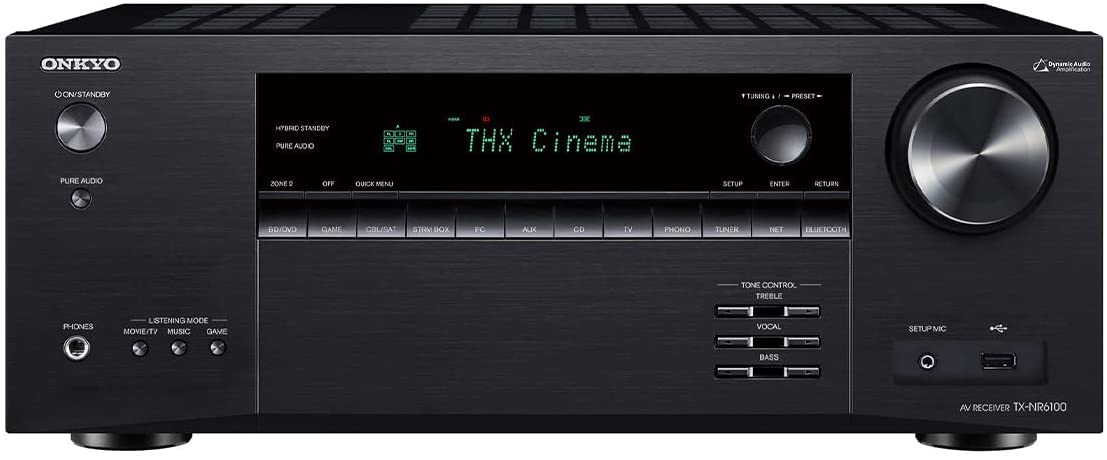
The TX-NR6100 is the only receiver in this roundup holding THX Select certification, meaning it has passed rigorous testing for distortion, crosstalk, and output levels that guarantee reference-quality playback in rooms up to 2,000 cubic feet. Its Dynamic Audio Amplification system delivers 210 watts per channel (dynamic) with enough current to drive a 5.1.2 Atmos setup with authority.
Gamers will appreciate the three HDMI 2.1 inputs that support 4K/120Hz and VRR, making it an ideal match for the Xbox Series X and PS5. Owners of Klipsch speakers frequently report excellent synergy due to the high damping factor, which controls the driver motion tightly for punchy, clean sound. The AccuEQ room calibration is less sophisticated than Audyssey but still a significant step above doing it manually.
Build quality is solid, though the remote is a weak point with its non-backlit buttons and flimsy feel. Input switching can also feel sluggish compared to Denon and Yamaha alternatives. For the user who prioritizes certified performance and gaming features over a polished user interface, the TX-NR6100 delivers exceptional raw value.
Why it’s great
- THX Select certification guarantees a specific level of real-world performance
- Three full-bandwidth HDMI 2.1 inputs for modern consoles
- High damping factor works exceptionally well with Klipsch speakers
Good to know
- Remote feels cheap and is not backlit, making dark-room use frustrating
- Input switching is noticeably slower than Denon or Yamaha
- Some long-term reliability concerns reported with the HDMI board
4. Denon AVR-S670H 5.2 Ch

The AVR-S670H strips down the Denon feature set to the essentials — 5 channels, a built-in phono preamp, and 8K pass-through — making it an ideal upgrade for someone moving from a soundbar or an ancient receiver. The simplified Audyssey calibration still significantly improves dialogue clarity and bass response compared to no calibration at all.
Setup is remarkably straightforward, with a clean on-screen menu that walks you through input configuration and speaker detection. HDMI ARC/eARC integration with modern TVs works reliably, turning the receiver on and off with the TV remote for a nearly invisible home theater experience. The 75 watts per channel (8 ohm, 2ch driven) is sufficient for small to medium rooms with efficient speakers.
The main compromise is the lack of a second zone and only five amplifier channels, which limits you to a 5.1 layout without the ability to add Atmos height speakers. HEOS wireless multi-room streaming is included but can suffer from occasional connection lag. For the buyer who needs a simple, high-quality 5.1 foundation with vinyl playback, this Denon delivers solid value.
Why it’s great
- Phono input is rare at this price point and works well for turntable users
- HDMI ARC/eARC integration is seamless with most modern TVs
- Audyssey calibration provides real improvement in sound staging
Good to know
- 5-channel design limits you to 5.1 without Atmos height support
- HEOS streaming can be unreliable with lag and connection drops
5. Pioneer VSX-935 7.2 Channel
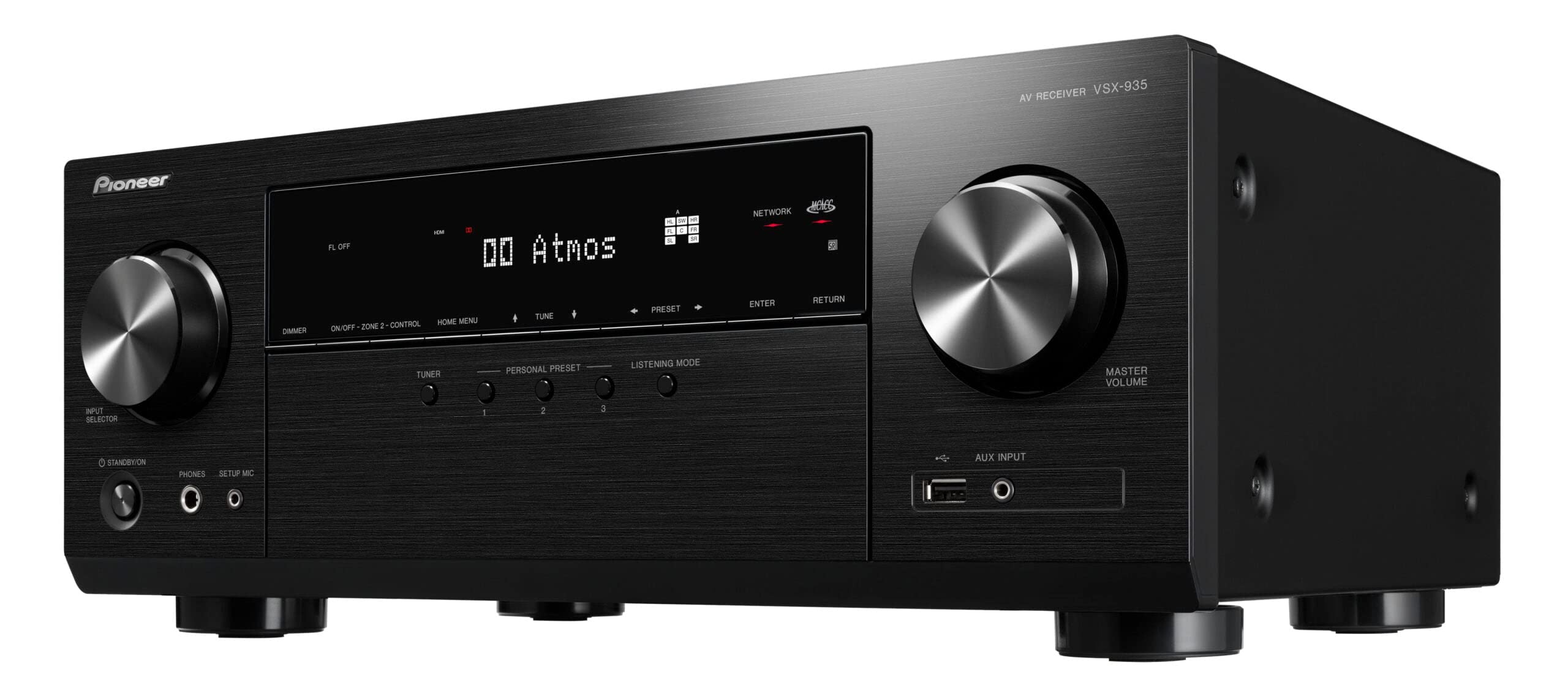
The VSX-935 delivers HDMI 2.1 with 8K pass-through and Dolby Atmos Height Virtualization, allowing you to experience a sense of overhead sound without physically installing ceiling speakers. This makes it a sensible choice for renters or anyone who cannot cut into their ceiling but still wants the immersive audio envelope.
Audio performance is clean and powerful, with users noting excellent detail retrieval and dynamic range when paired with quality speakers. The RF remote is a welcome upgrade over standard IR remotes, providing control without requiring line of sight. Dual-zone output also allows you to play a different source in a second room, a feature usually absent at this price tier.
Reliability is a noticeable concern, as a significant number of customers report units arriving dead or with display failures. The Bluetooth implementation is also widely criticized for being cumbersome to navigate through menus and unreliable in connection. Sound quality is genuinely good when everything works, but the inconsistency is hard to ignore for buyers on a strict budget.
Why it’s great
- Dolby Atmos Height Virtualization works well without ceiling speakers
- RF remote offers reliable non-line-of-sight control
- Dual-zone audio output is unusual at this price point
Good to know
- Reliability issues are not uncommon, with DOA and display failures reported
- Bluetooth pairing is convoluted and frequently unreliable
- Firmware needs further refinement for stable operation
6. JBL MA710 7.2 Channel

JBL’s MA710 brings a refreshingly modern aesthetic to the AV receiver market with a shallow chassis that fits easily into most media consoles. It pushes a genuine 110 watts per channel into 7 speakers, giving it the headroom to fill a large room with clean, dynamic sound without breaking a sweat.
Decoding support includes Dolby Atmos and DTS:X, and the receiver can run a 5.1.2 configuration for true overhead effects. The inclusion of a moving magnet phono input is a smart addition for vinyl enthusiasts, and wireless streaming via Apple AirPlay 2 and Google Chromecast is built right in. Initial setup can be confusing because the on-screen menus only appear after a firmware update, but the process is straightforward once connected to the internet.
The most common complaint is the lack of a backlit remote, making it nearly impossible to navigate the receiver’s settings in a darkened room. Additionally, DTS-HD Master Audio downmixing to 2.1 is not supported, which limits its utility for stereo-only setups. For the home theater builder who values modern design and strong multi-channel power, the MA710 is a compelling mid-range choice.
Why it’s great
- Shallow chassis depth fits into standard media consoles easily
- 110W per channel provides serious real-world power
- Phono input and Chromecast/AirPlay 2 cover both analog and digital sources
Good to know
- Remote lacks backlighting, making dark-room use difficult
- Does not support DTS-HD Master Audio downmix to 2.1
- Firmware update required before on-screen menus appear
7. Sony STRDH590 5.2 Channel
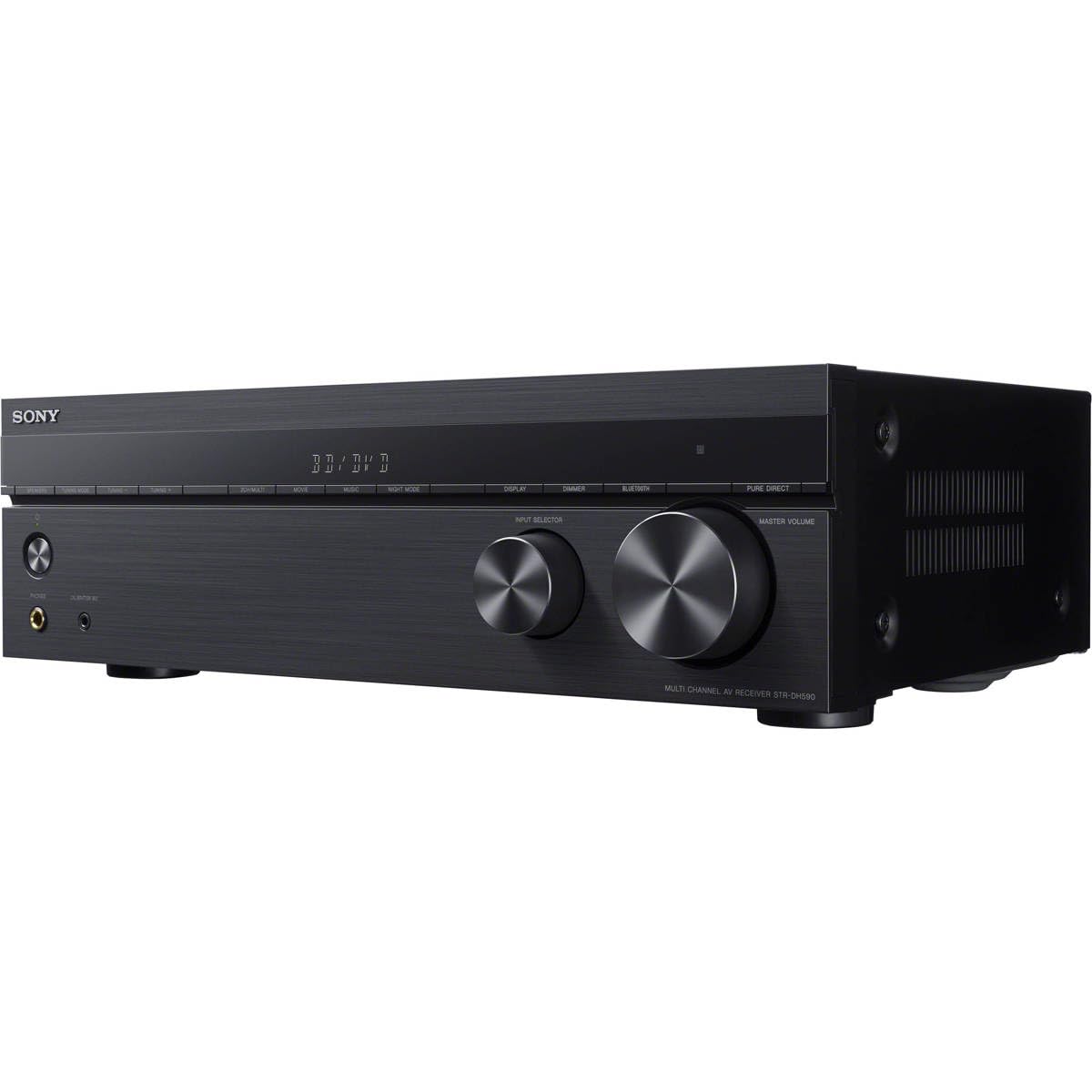
The Sony STRDH590 is a straightforward 5.2-channel receiver that delivers solid surround performance without complex menus or advanced room correction. Its S-Force PRO virtual surround creates a wide soundstage even from a two-channel source, making it a decent option for smaller rooms where a full speaker array isn’t practical.
With four HDMI inputs supporting 4K HDR and HDCP 2.2, it can handle a cable box, game console, and streaming device simultaneously. The slim chassis runs cooler than many competitors, and the included auto-calibration microphone sets speaker levels and distances quickly. Users routinely praise the clear, punchy sound when paired with efficient bookshelf speakers.
The biggest limitation is the lack of any dialogue enhancement or voice clarity technology, relying instead on a basic dynamic compression circuit. There is also no AM tuner or secondary speaker zone. For the shopper who wants a simple, reliable 5.1 foundation without needing HDMI 2.1 or Dolby Atmos, this Sony remains a proven, no-nonsense option.
Why it’s great
- Very simple setup with auto-calibration microphone
- Slim chassis runs cooler and fits in tight spaces
- S-Force PRO virtual surround is effective for 2-channel sources
Good to know
- Lack of HDMI 2.1 means no 4K/120Hz gaming support
- No dedicated dialogue enhancement or voice clarity feature
- Input jack spacing is tight, making thick cables difficult to fit
8. YAMAHA RX-V385 5.1-Channel

This is the receiver that proves you don’t have to spend big to get a genuinely musical sounding amplifier. The RX-V385 delivers Yamaha’s signature warm, detailed presentation with YPAO auto-calibration that filters out the most obvious room-related frequency issues. It supports 4K pass-through with HDR10 and Dolby Vision, covering the basics for modern streaming.
Bluetooth is built in for wireless music streaming, and the 5-channel amplifier provides 70 watts per channel (8 ohms, 2ch driven) — enough to drive a set of quality bookshelf speakers to satisfying levels in an apartment or small room. Customers commonly pair it with Polk TL1600 satellite systems for an impressive entry-level theater experience.
The obvious trade-offs are a lack of HDMI 2.1 for 4K/120Hz gaming and the absence of Dolby Atmos support. With only four HDMI inputs and no eARC, connection flexibility is limited. But for the budget-focused buyer building a first 5.1 system around a 4K TV, the RX-V385’s sound quality and Yamaha reliability make it a safe, long-lasting choice.
Why it’s great
- Yamaha sound signature is warm and detailed even at entry level
- YPAO calibration is effective for basic room correction
- Supports Dolby Vision and HDR10 4K pass-through
Good to know
- No Dolby Atmos or DTS:X support
- Only four HDMI inputs with no eARC
- No HDMI 2.1, limited to 4K/60Hz
9. Pyle PT6060CHAE Hybrid Amplifier
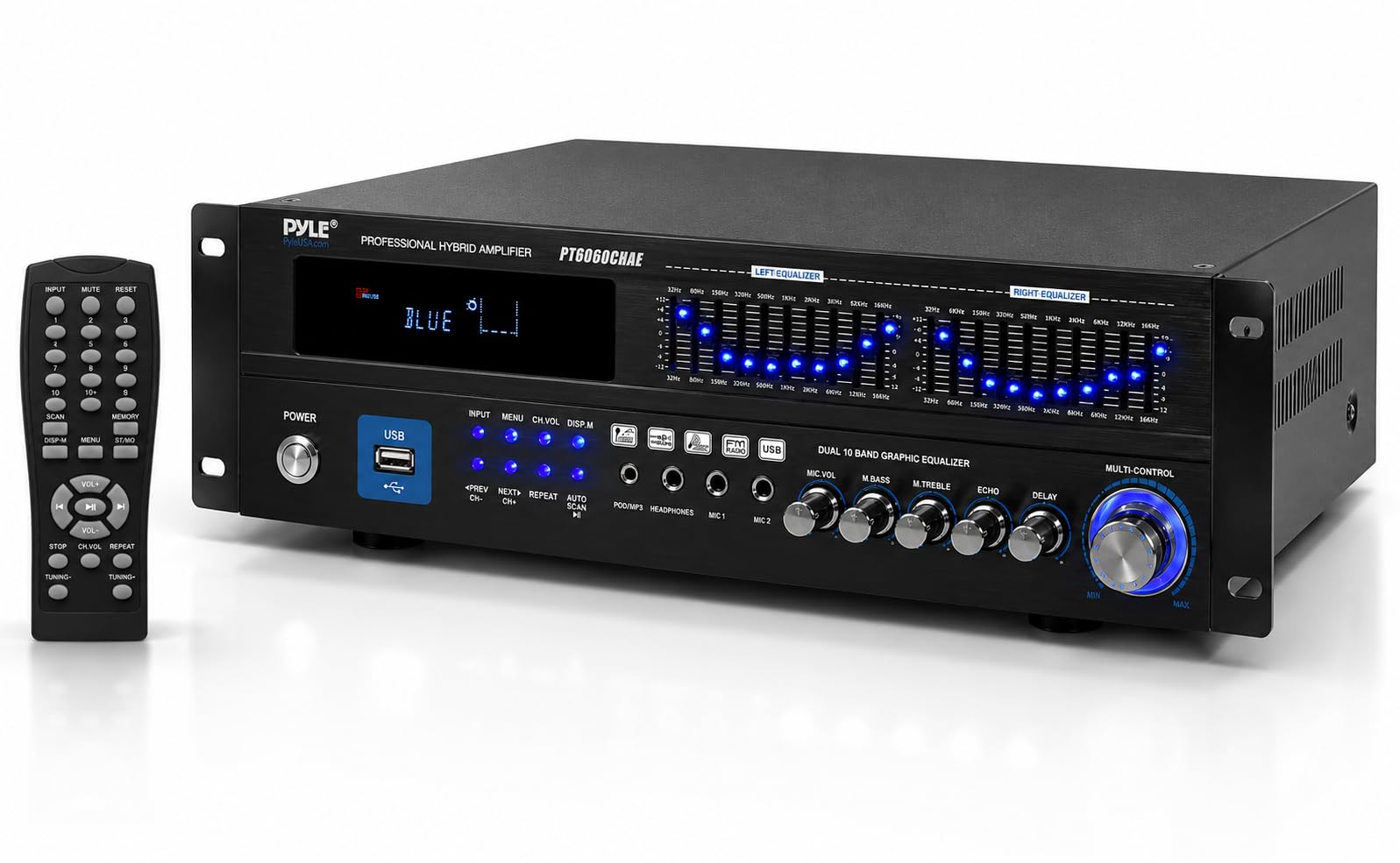
The Pyle PT6060CHAE is not a standard AV receiver — it is a 6-channel hybrid amplifier that puts raw power ahead of refinement. With a claimed 2000 watts peak, it can drive a massive set of speakers for a party or outdoor event, and the dual 10-band equalizer gives you granular tonal control that most home theater receivers completely lack.
It includes two microphone inputs with dedicated mix controls, optical and coaxial digital inputs, and a built-in FM tuner with auto-search scanning. The rack-mountable design with cooling fan makes it suitable for semi-permanent installations in garages, workshops, or DJ setups. Customers report that it shakes windows and drives passive subwoofers hard without breaking a sweat.
The biggest issues are inconsistent quality control — some units arrive with non-functional EQ sliders — and a noticeable noise floor at low volumes. It also lacks modern video switching entirely, so it cannot replace a home theater receiver for a TV or projector setup. This is a specialized tool for anyone who needs massive power on a tight budget and does not need HDMI routing.
Why it’s great
- Huge power output for driving passive subwoofers and large speaker arrays
- Dual 10-band EQ provides extensive sound shaping ability
- Dual microphone inputs with echo and reverb control for karaoke use
Good to know
- Audible noise floor at low listening volumes
- Quality control can be inconsistent, with defective units reported
- No HDMI inputs or video switching of any kind
FAQ
What is the minimum wattage I need for a 5.1 system in a small room?
Can I use a 5.1-channel receiver for a 7.1 speaker setup?
Does a bargain receiver support Dolby Atmos without ceiling speakers?
Final Thoughts: The Verdict
For most users, the best bargain av receiver winner is the Denon AVR-X1700H (Renewed) because it delivers Audyssey MultEQ room correction and three 8K HDMI 2.1 inputs at a price usually associated with entry-level hardware. If you want pure gaming features with THX certification, grab the Onkyo TX-NR6100. And for a simple, reliable 5.1 system to pair with a 4K TV, nothing beats the YAMAHA RX-V385 for long-term value.

Mo Maruf
I created WellFizz to bridge the gap between vague wellness advice and actionable solutions. My mission is simple: to decode the research and give you practical tools you can actually use.
Beyond the data, I am a passionate traveler. I believe that stepping away from the screen to explore new environments is essential for mental clarity and physical vitality.