Our readers keep the lights on and my smoothie glass nicely filled. As an Amazon Associate, I earn from qualifying purchases.
A good night’s sleep inside a tent is about more than just a sleeping bag. The difference between waking up refreshed and waking up sore is literally the surface beneath you — a decision between a raised cot that lifts you off the cold earth or a thick insulating pad that cradles your pressure points. The right choice depends on your tent floor plan, the terrain, and how much you are willing to carry.
I’m Mohammad Maruf — the founder and writer behind WellFizz. I spend hundreds of hours cross-referencing foam densities, load capacities, and R-value test data so you don’t have to guess which gear actually works in the backcountry.
The anatomy of a great camping sleep system is defined by three variables: insulation from the ground, structural support for your body, and portability. That is exactly what this guide to the best bed for tent camping breaks down for every type of camper and every budget tier.
How To Choose The Best Bed For Tent Camping
The wrong bed can turn a weekend trip into a backache. Focus on three pillars: ground insulation, structural support, and setup effort. The following criteria will help you dial in the right balance for your specific camping style.
R-Value and Ground Insulation
R-value measures how well a sleeping pad resists conductive heat loss to the ground. For summer-only tent camping, a rating of 2 to 4 is enough. For three-season or shoulder-season use, target 4.5 to 6. If you camp in freezing temperatures, look for pads with an R-value of 7 or higher. Foam-filled pads and memory foam models naturally score higher than pure air mats because the internal material blocks cold transfer.
Thickness and Body Support
The thickness of a pad or mattress directly determines how well it cushions your hips and shoulders from rocks and roots. A 3-inch pad is the minimum for side sleepers; 4 inches is the sweet spot for tossing and turning. Memory foam models contour to your spine, while air-cell designs use hexagonal or honeycomb chambers to distribute weight evenly. Raised cots bypass the thickness question entirely by suspending you above the ground.
Setup Speed and Packed Size
Time spent inflating a pad is time you could be enjoying the campfire. Self-inflating foam pads open the valve and expand in about 30 seconds, then need a few foot pumps to reach firmness. Built-in foot pumps eliminate the need for separate inflation gadgets. For car campers, packed size matters less; for backpackers, a pad that compresses to the size of a water bottle is non-negotiable. Cots tend to be bulkier but set up in under one minute once you learn the mechanism.
Quick Comparison
On smaller screens, swipe sideways to see the full table.
| Model | Category | Best For | Key Spec | Amazon |
|---|---|---|---|---|
| Wevelel Memory Sleeping Pad | Foam Pad | Cold-weather car campers | 9.5 R-Value, 50D foam | Amazon |
| ONETIGRIS SUPRANUBIS Cot | Raised Cot | Side sleepers & tall campers | 27.5″ wide, 330 lb capacity | Amazon |
| Naturehike ArmyWild Cot | Raised Cot | Backpackers wanting a cot | 7075 aluminum, dual height | Amazon |
| Sportneer Camping Cot | Raised Cot | Budget-friendly tall campers | 78.3″ long, 28.7″ wide | Amazon |
| CYMULA Memory Foam Pad | Foam Pad | Car camping & guest use | 3″ memory foam, washable cover | Amazon |
| HiiPeak Double Sleeping Pad | Air Pad | Couples & family tent sleepers | 76″ x 48″, built-in foot pump | Amazon |
| TEKIK Double Sleeping Pad | Air Pad | Budget two-person comfort | 78″ x 50″, 3″ thick | Amazon |
In‑Depth Reviews
1. Wevelel Memory Sleeping Pad

The Wevelel pad stands out because of its 50D density memory foam — a material rarely found in camping pads under the premium tier. At 3.1 inches thick and 77 inches long, it provides plush support for sleepers up to 800 pounds while keeping you completely insulated from cold ground with a tested R-value of 9.5. The self-inflating design uses three valves: open them, let the pad expand for ten seconds, then stomp the front valve for 20 seconds and you are done. No separate pump needed, no mouth inflation.
The fabric is a 50D stretch knit that breathes, wicks sweat, and stays silent during movement — no crinkling. The pad rolls up to about the size of a compact sleeping bag, but at 6.59 pounds it is firmly in car-camping territory rather than backpacking. The built-in pillow is low-profile; taller users may want to supplement it with their own inflatable pillow. Several reviews confirm it held up well in temperatures below 40°F with zero cold spots.
This is the best choice for anyone who camps in a tent during cooler months or wants a hotel-like sleeping surface without using a cot. The foam resilience after 10,000 compression cycles in ASTM testing means it will not sag after a season of heavy use.
Why it’s great
- Industry-leading R-Value for extreme cold insulation
- Self-inflates in under one minute with no pump required
- Plush memory foam eliminates pressure points for side sleepers
Good to know
- Heavier than air-only pads at 6.6 lbs
- Actual width is 26″ — narrow for broad-shouldered sleepers
2. ONETIGRIS SUPRANUBIS Camping Cot

The ONETIGRIS cot is the widest raised bed on this list at 27.5 inches, giving side sleepers enough room to roll without hitting the edge. The 7075 aluminum frame and 300D Oxford fabric support up to 330 pounds while the cot itself weighs only 9.5 pounds — light for a cot. The leverage locking mechanism snaps together in a few minutes, and the two height settings (5.9 inches for low-tent use and 15.75 inches for sitting height on uneven ground) make it adaptable to almost any site.
A side pocket for gadgets and an under-cot storage net for clothes or a sleeping bag keep gear organized off the tent floor, which is a rare convenience in this category. The fabric is rip-stop and water-resistant, so damp grass is not a disaster. Users at 6 feet tall report no discomfort, and the cot packs into a stuff sack that fits in a trunk corner. It is not designed for backpacking, but for car camping and truck camping it is nearly perfect.
The only trade-off: the cot itself has some fabric stretch, so pairing it with a thin sleeping pad or a memory foam topper dramatically improves comfort for stomach sleepers. Without a pad, the surface is taut but not plush.
Why it’s great
- Widest raised cot on the market at 27.5 inches
- Dual-height legs for tent floor or high-ground positioning
- Includes side pocket and under-cot storage net
Good to know
- Requires a sleeping pad on top for maximum comfort
- Legs attach one at a time; assembly takes a few minutes
3. Naturehike ArmyWild Folding Camping Cot

The Naturehike ArmyWild cot is built around aircraft-grade 7075 aluminum, which makes it significantly lighter than steel-frame cots while still supporting 330 pounds. The split-leg design with three support legs and twelve extending legs gives it a very stable footprint on soft grass, gravel, or uneven tent floors. Setup uses a shock-cord tube system that locks into place quickly; you can assemble it in about two minutes after the first try.
Height adjustability is the standout feature here. The cot sits at 6.7 inches in low mode — perfect for fitting inside a compact tent without touching the walls — and at 15 inches in high mode for easier access or use as a camp bench. The 300D Oxford fabric is breathable and anti-static, which reduces heat loss on cold nights. At 74.8 inches long and 25.6 inches wide, it fits taller campers without feeling cramped.
This cot packs into a storage bag about half the size of a traditional Coleman cot, making it a viable option for canoe trips or truck-bed camping where every cubic inch counts. Several users noted that adding a 3-inch mattress pad transforms it into a sleep system comparable to a home guest bed.
Why it’s great
- Lightweight 7075 aluminum frame packs compact
- Dual height settings for tent and open-air use
- Three-leg geometry prevents wobble on uneven ground
Good to know
- Width is 25.6″ — fine for most but not as roomy as wider cots
- Needs a pad or topper for optimal pressure relief
4. Sportneer Camping Cot
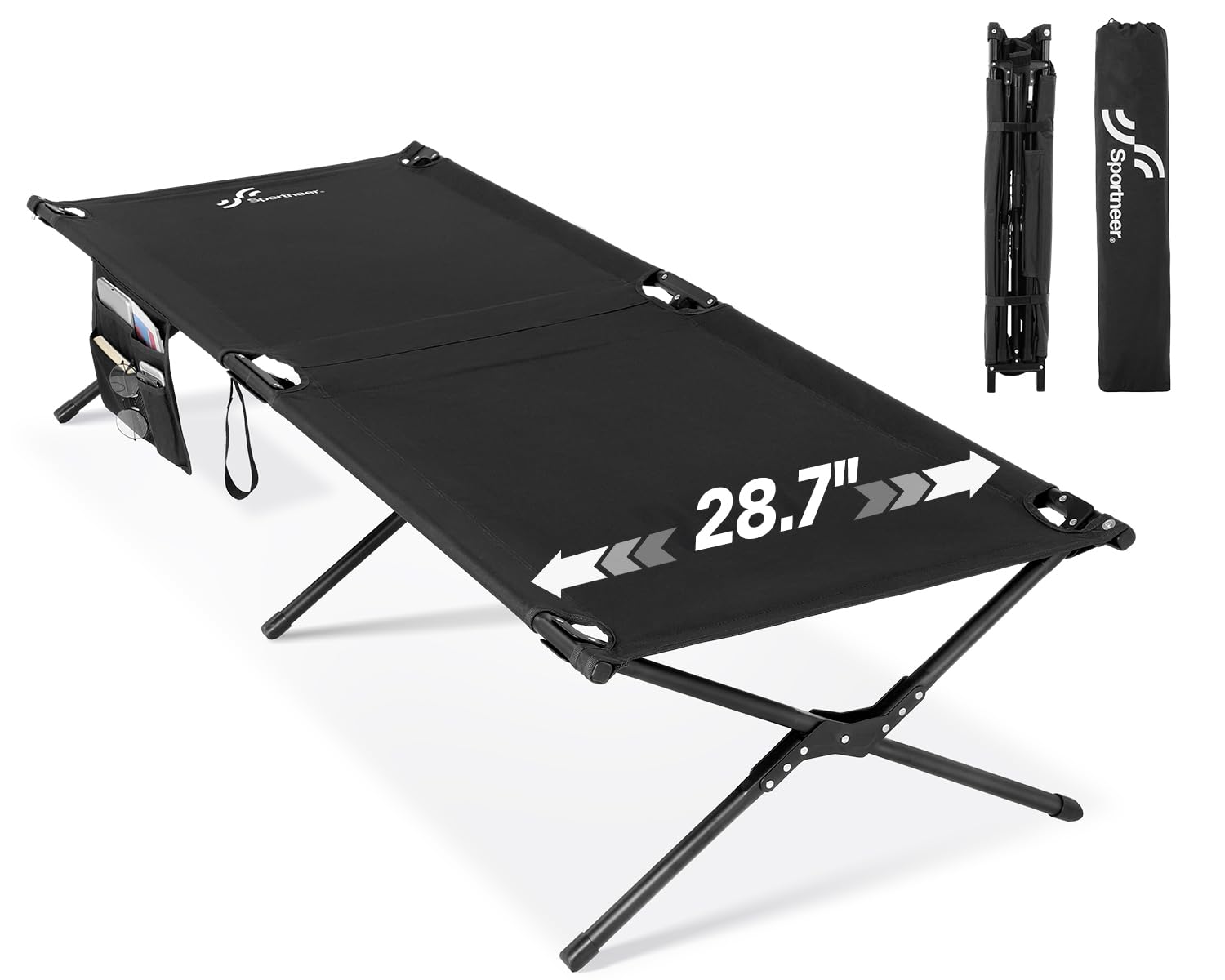
The Sportneer cot delivers the longest bed in this comparison at 78.3 inches — enough for campers over 6 feet to stretch out fully. The frame uses stainless steel brackets and an X-shaped leg brace that supports 330 pounds without sagging. The 600D Oxford cloth surface is taut and durable, and the 28.7-inch width gives you real room to move. Assembly takes about 30 seconds thanks to a leg rotation lock that requires no tools.
At 14.6 inches off the ground, this cot is high enough to sit on like a chair, which is convenient for changing clothes in the tent. The three-in-one storage bag includes compartments for your phone, water bottle, and glasses — a small touch that makes a big difference in the dark. The folded size is 40.2 by 7.9 inches, compact enough for most car trunks. The trade-off is weight: at 13.8 pounds, it is heavier than aluminum cots, but the steel frame justifies its durability for season-after-season use.
Users report that adding a memory foam topper or a 3-inch pad on top eliminates any stiffness from the taut fabric. Without a pad, the cot is firm but supportive. It is not designed for backpacking, but for car camping, guest use at a cabin, or truck camping, it offers the best length for the price.
Why it’s great
- Longest cot on this list at 78.3 inches for tall campers
- X-shaped leg brace provides rock-solid stability
- Integrated storage bag with organization pockets
Good to know
- Heavy at 13.8 pounds due to steel construction
- Fabric surface needs a pad for side-sleeping comfort
5. CYMULA 3 Inch Memory Foam Camping Pad
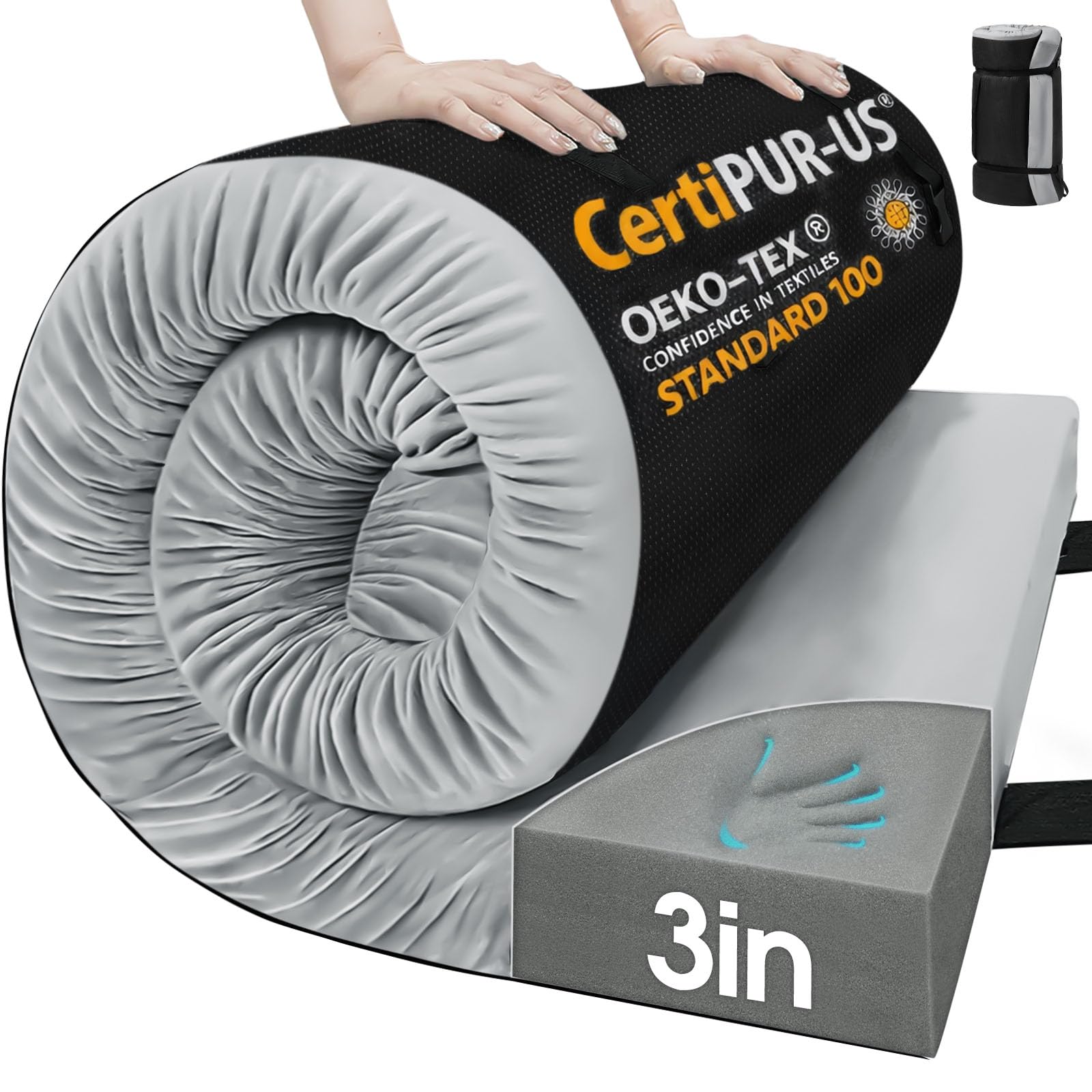
The CYMULA pad uses a two-layer design: carbon-fiber high-elasticity memory foam on top for contouring and a high-density base foam layer for support. At 3 inches thick and 72 inches long, it provides a comfortable sleeping surface for tent floors, cots, or truck beds. The key advantage here is the removable, machine-washable cover — a feature that matters after muddy or sweaty camping trips. The waterproof bottom has rubberized anti-slip dots that keep the pad from shifting on slick tent floors or wooden cot surfaces.
This pad rolls up and secures with straps, compressing to roughly the size of a rolled towel. It is not a self-inflating pad; you just unroll it and let the memory foam expand. The initial smell from the vacuum-sealed packaging dissipates within a few hours. At 6.4 pounds, it is comparable to foam pads but bulkier than air pads when packed. Multiple sizes are available, so you can choose a twin version for solo camping or a wider version for couples.
Campers who used this pad on cots in 30°F conditions reported excellent warmth and comfort. It works best as a topper on a cot or as a standalone pad on a flat tent floor, but it is not thick enough to mask very rocky ground without a cot underneath.
Why it’s great
- Washable zippered cover keeps gear clean
- Non-slip bottom prevents sliding on cots or tent floors
- Memory foam offers excellent pressure relief for side sleepers
Good to know
- Not self-inflating; requires unrolling and waiting for foam expansion
- Strong initial out-of-box smell that needs airing out
6. HiiPeak Double Sleeping Pad
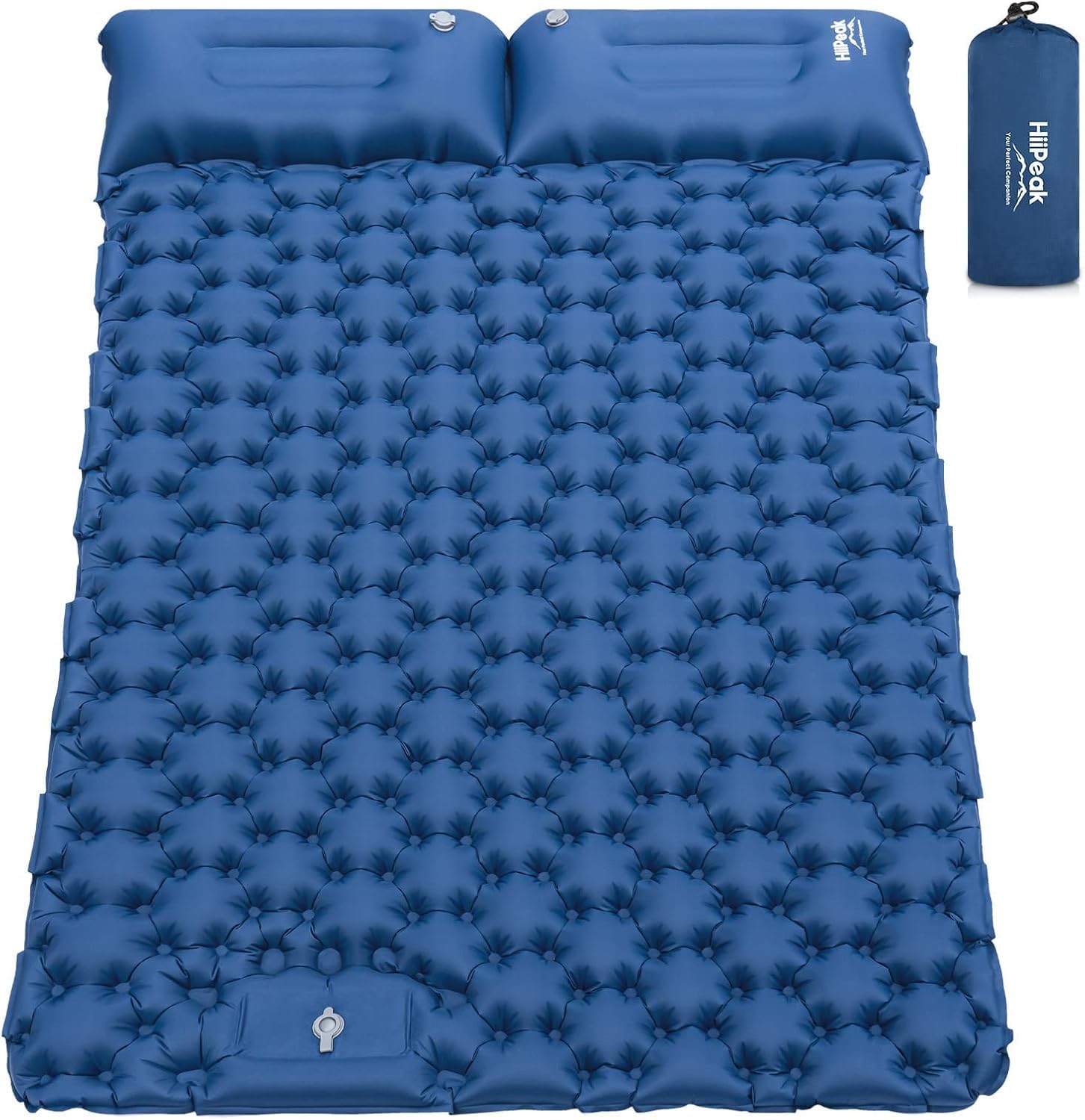
The HiiPeak double pad is 76 inches long and 48 inches wide — enough space for two adults to sleep side by side without feeling each other’s movement. The hexagonal air cell design uses body-mapping technology to support pressure points while the 3-inch thickness keeps your body off the ground. The built-in foot pump inflates the pad in about three minutes with no mouth contact, and the dual-layer valves prevent air leakage during the night.
At 4 pounds, this pad is relatively lightweight for a double-sized model. It packs down to 12.2 by 3.9 by 5.5 inches, fitting into a standard backpack without much hassle. The 50D polyester pongee fabric with multi-layer TPU coating is waterproof and noiseless, so turning over does not produce crinkling sounds that wake a partner. Users report that the pad holds air throughout the night with no noticeable deflation, even after repeated use across a nine-night trip.
The built-in pillows are shaped to cradle your head but are shallow — taller campers or those who prefer a thick pillow may want to bring their own. For couples car camping or tent camping with a larger shelter, this is the most practical two-person air pad available at this price tier.
Why it’s great
- Full double size reduces partner-movement transfer
- Built-in foot pump inflates cleanly in under 3 minutes
- Waterproof TPU coating makes cleaning simple
Good to know
- Built-in pillows are low; supplemental pillow recommended
- Wide pad may not fit in smaller 2-person tents
7. TEKIK Double Sleeping Pad

The TEKIK double pad offers the largest surface area on this list at 78 by 50 inches, comfortably sleeping two people with room to spare. The 3-inch thickness uses a hexagon cell structure to minimize motion transfer — a critical factor when sharing a pad. The built-in foot pump fills the pad in about one minute, which is faster than most competitors in this budget-friendly tier. The nylon fabric is waterproof and weighs only 3.3 pounds, making it one of the lightest double pads for the size.
The hexagon grid pattern is designed to distribute weight evenly, and reviews confirm that users did not feel rocks or bumps through the pad even on uneven tent floors. The pillow built into the design is more of a raised bump than a full pillow; users noted that keeping it under-inflated makes it less obtrusive. The pad comes with a storage bag, six repair patches, and a manual. Some stretching occurs on the first inflation, so a quick top-up after the initial fill is expected.
This is primarily a car-camping pad. At 3 pounds it is light, but the packed size is larger than single backpacking pads. The valve system includes anti-leakage films that held air overnight for multiple reviewers, including one who tested it with a German Shepherd jumping on it. For couples on a tight budget who want a big surface and fast inflation, this pad delivers surprising value.
Why it’s great
- Largest double-pad dimensions on this list at 78″ x 50″
- Foot pump inflates in roughly 60 seconds
- Very lightweight at 3.3 lbs for its size
Good to know
- Pillow design is minimal and may not suit all sleepers
- First inflation requires a top-up due to fabric stretching
FAQ
What R-value do I need for winter tent camping?
Should I use a cot or a sleeping pad inside a tent?
How do I clean a memory foam camping pad after a muddy trip?
Final Thoughts: The Verdict
For most users, the best bed for tent camping winner is the Wevelel Memory Sleeping Pad because it delivers a 9.5 R-value, self-inflating setup, and plush memory foam in a single lightweight package — ideal for cold-weather car campers. If you want the full cot experience with adjustable height and a wide sleeping surface, grab the ONETIGRIS SUPRANUBIS Camping Cot. And for couples sharing a tent, the HiiPeak Double Sleeping Pad offers the best balance of space, portability, and quick inflation.

Mo Maruf
I created WellFizz to bridge the gap between vague wellness advice and actionable solutions. My mission is simple: to decode the research and give you practical tools you can actually use.
Beyond the data, I am a passionate traveler. I believe that stepping away from the screen to explore new environments is essential for mental clarity and physical vitality.