Our readers keep the lights on and my smoothie glass nicely filled. As an Amazon Associate, I earn from qualifying purchases.
A battery-operated sprinkler timer should be a “set it and forget it” device, yet a poorly chosen unit leaves you wrestling with leaky plastic threads, a dead battery at the worst possible moment, or a confusing programming dial that needs a manual every time you travel. The right analog or digital controller does one job flawlessly: it opens and closes a valve on your schedule, reliably, for months on end, without requiring a WiFi password or a nearby outlet. The selection comes down to how many zones you need to water, the quality of the metals sealing the water path, and the battery-drain profile of the solenoid inside.
I’m Mohammad Maruf — the founder and writer behind WellFizz. I spend my research time tearing through user-verified endurance reports, comparing brass-versus-plastic inlet failure rates, and mapping the real-world battery life of solenoid valves, so you don’t have to guess which timer will survive a full growing season.
Choosing the right model is about matching your watering complexity to the hardware’s duty cycle. If you are looking for the true best battery operated sprinkler timer, you want a unit with brass ports for leak resistance, low-power electronics that stretch battery swaps to months, and a programming interface that makes sense without a tutorial.
How To Choose The Best Battery Operated Sprinkler Timer
The market is split between simple single-outlet timers and multi-zone controllers with or without WiFi. The decision path is shorter than you think: count your zones, assess your sunlight exposure, and decide if you want to fiddle with a smartphone app or just twist a dial and walk away.
Zone Count — One Valve or Several?
A single-outlet timer (like the Orbit 62067) works perfectly when you have one soaker hose or a single sprinkler. The moment you need to water a front flower bed separately from a back lawn, you need a 2-zone unit such as the Diivoo Brass Timer. Multi-zone timers let you assign different durations and frequencies to each outlet, which is essential for mixing different plant types. Going beyond two zones — say a 3-zone or 4-zone timer — usually makes sense only for larger properties with distinct watering sections; otherwise, you risk overcomplicating your setup with schedules you’ll never actually fine-tune.
Inlet Material — Brass vs. Plastic
The inlet is the most stressed part of any hose timer. The 2026 RAINPOINT model and the Diivoo two-zone unit both use solid brass threads. Brass resists corrosion and stands up to the 100+ PSI spikes common in municipal water lines. Plastic inlet threads, found on budget and some mid-range timers like the Orbit, save money but are prone to stripping — especially if you use a quick-connect fitting that adds leverage. If the timer lives at the spigot year-round, brass is a surer long-term bet.
Battery Life and Power Source
Standard alkaline AA batteries run most timers. The solenoid — the electromagnetic valve — consumes power every time it opens or closes. A well-designed solenoid (like the one in the Rain Bird SST-400I or the RAINPOINT brass model) opens once per cycle and holds closed with minimal current draw. Some users report three to six months of life from a set of AAs. A solar-charged timer like the AnseTo eliminates battery swaps entirely by using a rechargeable cell inside, but it needs direct sunlight to stay topped up. If your timer is in deep shade, stick with a standard battery model.
Quick Comparison
On smaller screens, swipe sideways to see the full table.
| Model | Category | Best For | Key Spec | Amazon |
|---|---|---|---|---|
| RAINPOINT Brass Inlet Timer | Single Outlet | Reliable daily watering single zone | Brass inlet/outlet, up to 116 PSI | Amazon |
| AnseTo Solar Timer | Solar Dual Outlet | Sunny gardens, no battery changes | Adjustable solar panel, 30-120° angle | Amazon |
| Diivoo Brass 2-Zone Timer | 2-Zone | Separate schedules for two areas | Brass inlet/outlet, IP66 waterproof | Amazon |
| Rvwsx 3-Zone Timer | 3-Zone | Three independent watering zones | 3.3″ large LCD, up to 116 PSI | Amazon |
| Orbit 62067 1-Outlet Timer 2-Pack | Single Outlet 2-Pack | Two simple zones, familiar interface | 2 AA batteries, 2-year life per set | Amazon |
| Rain Bird SST-400I 4-Station Timer | 4-Station | Permanent multi-zone irrigation | 4 stations, one-touch programming | Amazon |
| RainPoint WiFi 2-Zone Timer | Smart 2-Zone | Remote control and smart scheduling | Brass inlet, 2.4 GHz WiFi, Alexa | Amazon |
In‑Depth Reviews
1. RAINPOINT Brass Inlet & Outlet Sprinkler Timer

The RAINPOINT picks up the top recommendation because it nails the two most critical physical specs for any outdoor timer: a pure brass inlet and brass outlet. That metal threading resists cracking from thermal expansion and the constant 100+ PSI cycles that slowly deform plastic fittings. The body shell uses UV-resistant, heavy-duty weatherproof construction, and the built-in metal filter gasket catches sediment before it reaches the solenoid. Battery life runs well past two months even with daily irrigation, and the programming dial uses plain English labels — How Long, How Often, Time, Start — that require zero guesswork.
The LCD screen is generously sized, showing watering time, frequency, and remaining power at a glance. Users report surviving rain, snow, and direct sun without leaking or fogging internally. The rain delay pauses your schedule for 24, 48, or 72 hours and automatically resumes, which is a genuine water-saving feature rather than a checkbox gimmick. For anyone needing a single-zone timer that prioritizes mechanical durability over app connectivity, this is the one to buy.
It lacks smart-home compatibility, which is actually a strength for those who want a set-and-forget unit without app maintenance or firmware updates. The only minor ask from the community is for a Bluetooth-enabled sibling, but as a pure hardware timer, this delivers the most reliable mechanical package in its class.
Why it’s great
- Pure brass inlet and outlet eliminate the stripping and cracking failure mode of plastic threads
- Plain-English dial programming requires no manual to set a weekly schedule
- Rain delay mode automatically pauses and resumes watering without losing your program
Good to know
- Single-zone only — not suitable for areas needing separate schedules
- Not compatible with Bluetooth or WiFi for remote control
2. AnseTo Solar Sprinkler Timer
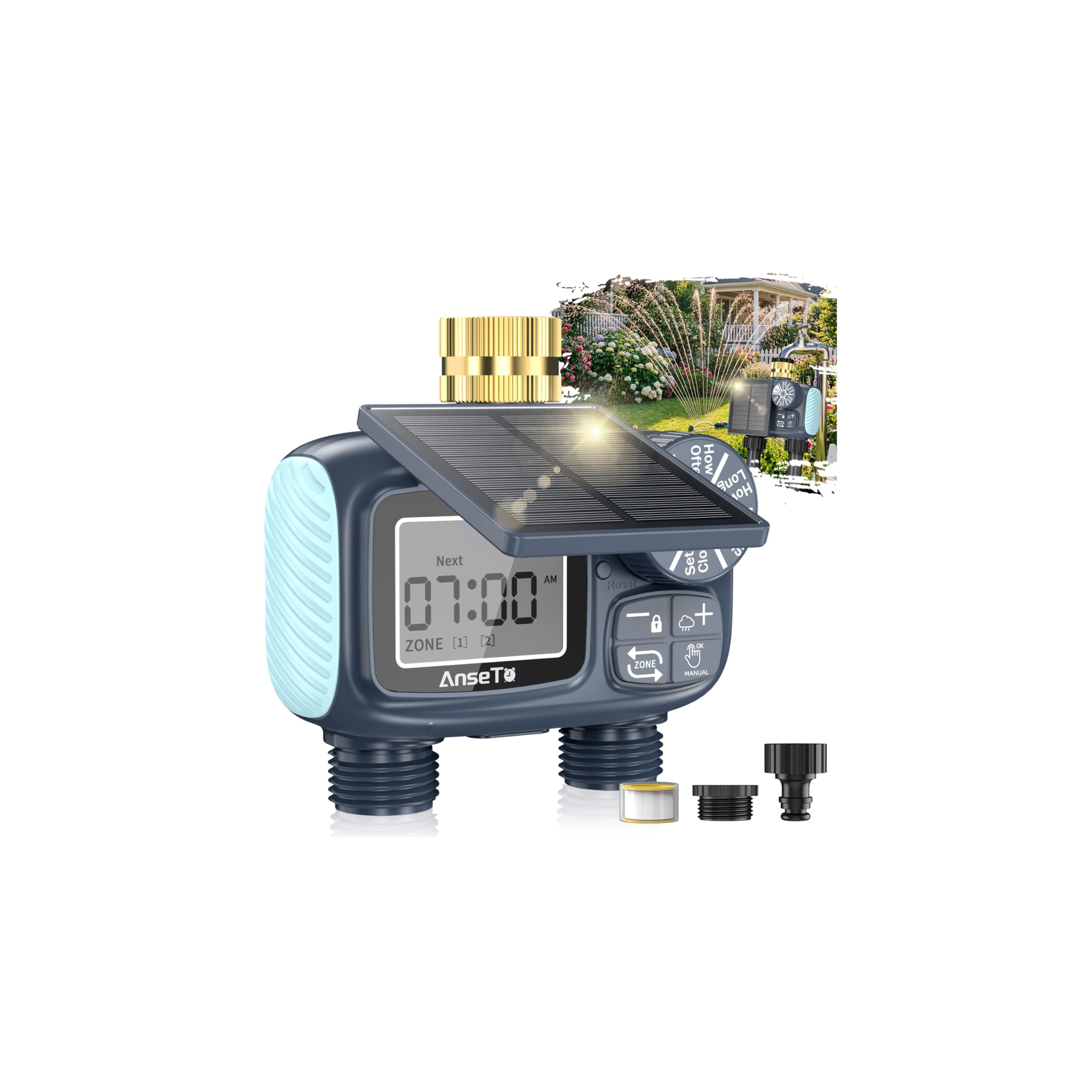
The AnseTo solar timer removes the single most common annoyance of battery-operated timers: mid-season battery death. Its high-efficiency solar panel charges a built-in rechargeable cell via a Type-C port backup, so you never buy a pack of AAs for this device. The panel adjusts to four angles — 30, 60, 90, and 120 degrees — which lets you optimize capture based on the season and your spigot’s orientation relative to the sun. Even in low-light conditions, users report months of continuous operation without dropping a schedule.
The inlet is brass, matching the RAINPOINT’s durability standard, and the IP55 waterproof rating handles typical rain and hose splash without issue. It offers two outlets, each programmable independently, and the large LCD display shows watering time, frequency, and power status. The rain delay function and child lock add practical safety and water conservation layers that matter in homes with curious kids or variable weather.
Because it depends on sunlight, this timer is best suited for spigots that get direct sun for at least a few hours per day. Deep shade under a porch or dense tree canopy may prevent the battery from reaching full charge, in which case the USB-C charging option becomes a workaround. The plastic casing is durable but not as impact-resistant as some all-metal competition; mounting it away from foot traffic is advisable.
Why it’s great
- Eliminates disposable battery waste with solar charging and a rechargeable internal cell
- Adjustable solar panel angles for year-round sunlight optimization
- Brass inlet provides leak resistance comparable to premium standalone timers
Good to know
- Requires direct sunlight for reliable solar-only operation
- USB-C port backup is included, but you must actively use it if solar exposure is inadequate
3. Diivoo Brass 2-Zone Sprinkler Timer
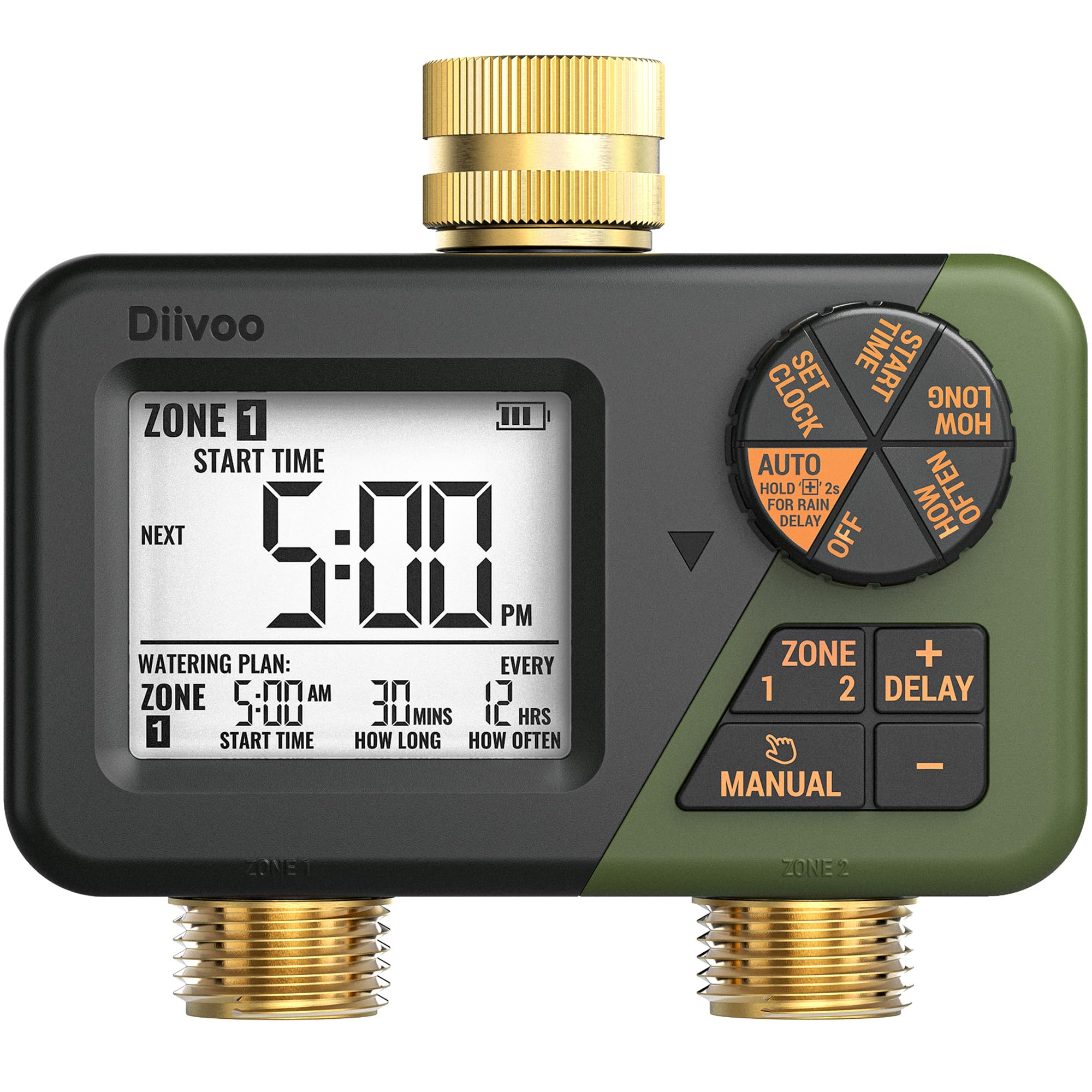
The Diivoo two-zone timer is the best option when you need independent schedules for two separate areas — for example, a lawn sprinkler zone and a soaker hose for a flower bed — without upgrading to a whole-house irrigation controller. Each zone gets its own start time, duration (0–240 minutes), and frequency (every 1, 3, 6, or 12 hours, or up to 7 days). The programming interface uses a simple dial and a clear LCD that shows the active zone and the countdown to the next watering.
The inlet and both outlets are solid brass, avoiding the plastic cracking problem that plagues cheaper two-zone timers when the valve is under load. The IP66 rating means it withstands heavy rain and direct water jets — a meaningful step above the IP55 rating of many competitors. Users in Florida’s heavy summer storms and Arizona’s intense sun both report consistent performance without screen failure or internal moisture.
The unit does not support rechargeable batteries — standard alkaline AA cells only — and the manufacturer explicitly warns against using rechargeable AAs due to voltage differences. Battery life is quoted at 6–8 months, which aligns with real user reports. A few users note the absence of a day-of-week programming option, relying instead on interval (every 1–7 days), which is a minor limitation if you need watering only on specific weekdays.
Why it’s great
- Two fully independent brass-outlet zones for separate watering schedules
- IP66 rating provides better protection against heavy rain and pressure washing than typical IP55 timers
- Next-schedule countdown on the LCD eliminates scheduling guesswork
Good to know
- Rechargeable alkaline AA batteries are not recommended — use standard alkaline only
- Programming uses interval frequency (every 1–7 days) rather than day-of-week selection
4. Rvwsx 3-Zone Programmable Water Timer
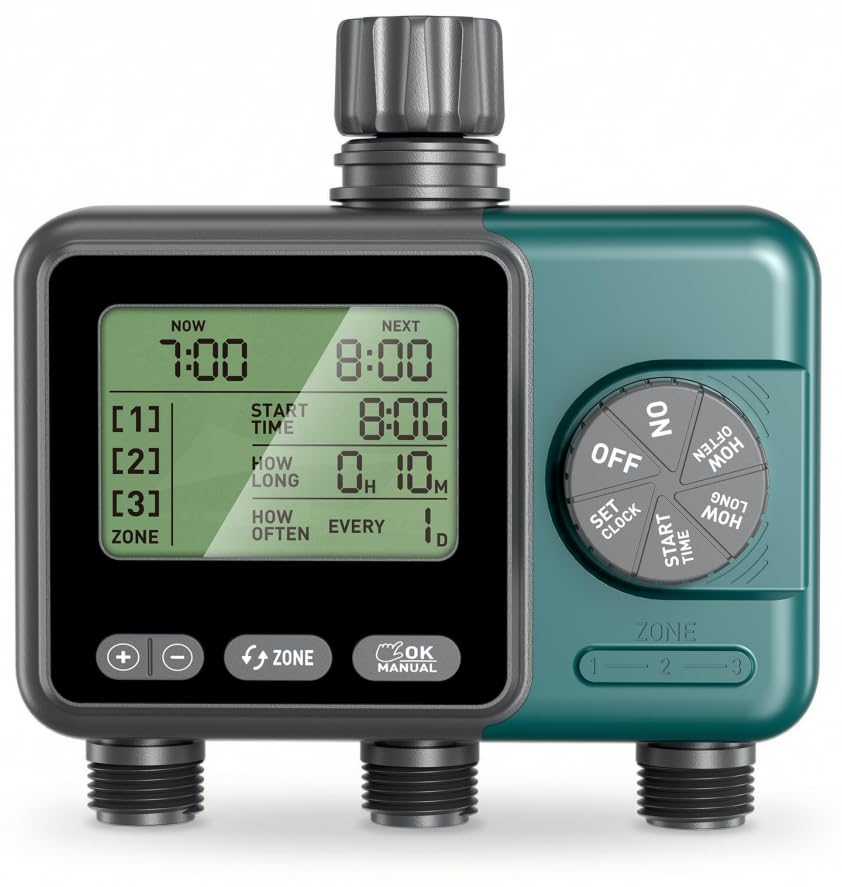
The Rvwsx three-zone timer delivers the highest zone count in this roundup for under fifty dollars, making it a strong choice for properties with three distinct watering areas — a front lawn, a back garden, and a side strip of hedges, for instance. Each zone supports its own start time, duration (1 minute to 3 hours 59 minutes), and frequency (every 1–12 hours or 1–7 days). The 3.3-inch LCD is the largest in this comparison, which makes reading the programming parameters much easier for anyone with less-than-perfect vision.
The reinforced inlet construction handles up to 116 PSI without leaking, and the material is heavy-duty plastic rather than brass. While plastic is generally less durable than brass for the threads, the Rvwsx is designed with a reinforced collar that reduces the stripping risk. The rain delay pauses all zones for 24, 48, or 72 hours, and the manual watering mode lets you run any zone for up to eight hours without interrupting the programmed schedule.
This unit runs on four AA batteries, not two, which increases the overall weight and means you have double the battery purchasing cost per replacement. The low-battery warning flashes on the display and the valves automatically close to prevent flooding, a safety feature absent from many single-zone timers. Users note a slight learning curve with the initial programming, but once the schedule is set, the timer runs reliably.
Why it’s great
- Three fully independent zones allow precise watering for different plant types and layouts
- Large 3.3-inch LCD display is easy to read from a standing position
- Automatic valve closure on low battery prevents accidental flooding
Good to know
- Requires four AA batteries, increasing replacement cost and total unit weight
- Housing is reinforced plastic rather than brass — less durable at the thread connection point
5. Orbit 62067 1-Outlet Programmable Timer 2-Pack

The Orbit 62067 two-pack is the best option if you need to control two separate water sources with simple, non-overlapping schedules. Each timer is a self-contained single-outlet unit with its own large LCD and straightforward programming. The standout feature here is battery life: users consistently report two full seasons — roughly six to eight months of daily use — from a single set of two AA batteries. The timer retains its program even during battery changes, which eliminates the frustration of re-programming after every swap.
The housing is weather-resistant plastic, and the connections are plastic rather than brass, which is the primary cost-saving measure. For light-duty use — one soaker hose or a single sprinkler per timer — plastic threads hold up fine, but users who attach heavy quick-connect fittings or tighten aggressively risk stripping. The rain delay function pauses the schedule for 24, 48, or 72 hours, and the manual mode allows on-demand watering without disrupting the saved program.
The major limitation is that each timer supports only one timed run per day. If you need to water in the morning and again in the evening, this unit cannot do it. For basic daily watering, however, the simplicity and reliability of the Orbit interface is hard to beat, especially given that you get two units in the box.
Why it’s great
- Exceptional battery life — one set of two AAs can last two full growing seasons
- Program retention during battery swaps saves time and frustration
- Two-pack format provides independent control for two zones at a lower total cost
Good to know
- Plastic hose connections are less durable than brass and prone to stripping under high torque
- Only supports one timed watering cycle per day — no dual-start or multiple-run options
6. Rain Bird SST-400I Automatic 4-Station Timer

Rain Bird is the most recognized name in irrigation, and the SST-400I reflects that engineering pedigree. This is not a hose-end timer in the traditional sense; it is a four-station controller designed for permanent outdoor installation, typically mounted on a wall or post near the main spigot. Each of the four stations can be programmed independently with multiple start times per day, and the one-touch manual watering button — default 10 minutes per zone — is a convenience that saves trips back to the controller.
The programming interface uses a color-coded dial and large tactile buttons rather than a touch screen, which is a deliberate design choice for outdoor gloved-hand operation. The rain sensor input port is a significant advantage — it allows you to connect an external rain sensor that automatically shuts off all watering during precipitation, which is a true water conservation feature not available on most battery timers. The seasonal adjustment option lets you shift the watering duration up or down by a percentage across all zones without re-programming each schedule.
The LCD is not backlit, which makes reading it in low evening light or on a shaded wall a bit of a strain. The controller takes four AA batteries, and users report roughly one year of operation per set with normal use. Installation involves mounting the bracket and connecting the valve wires, so it is less portable than a hose-end timer. If you have a permanent setup with multiple drip zones or small sprinkler valves, this is the most capable battery controller available.
Why it’s great
- Four fully independent stations with multiple start times per zone for complex scheduling
- Rain sensor port enables automatic shutoff during rain, saving water without user intervention
- One-touch manual watering button runs a zone for a default 10 minutes
Good to know
- LCD is not backlit, requiring good ambient light to read settings
- Requires wall mounting and valve wire connections — not a simple hose-end timer
7. RainPoint WiFi 2-Zone Smart Sprinkler Timer

The RainPoint WiFi timer brings smart-home integration to the battery-operated category. It connects via the RainPoint Home app over a 2.4 GHz WiFi network (a dedicated hub is required, sold separately) and allows remote schedule changes, manual watering, and real-time status checks from anywhere. Each of the two zones gets six programmable schedules, and the app supports three watering modes — normal, interval, and cycle-and-soak — which covers everything from daily lawn sprinkling to deep-root garden soaking.
The brass inlet ensures a solid mechanical anchor, and the unit includes spare gaskets and a metal filter. Alexa and Google Assistant voice control let you start or stop watering hands-free, which is genuinely useful when you are carrying tools or in the middle of gardening. The smart scenes feature can automatically adjust schedules based on local weather data, so you don’t overwater after rainfall. The seasonal adjustment slider (10%–200%) eliminates the need to manually tweak duration as summer heat intensifies.
The unit is physically larger than most single-zone hose timers, which can make it awkward in tight spigot spaces. Bluetooth range is limited — the app relies on WiFi for reliable remote access, so your spigot location must be within range of a 2.4 GHz network signal. Some early users reported needing to reset the initial Bluetooth pairing; customer support resolved the issue quickly, and firmware updates have stabilized connectivity.
Why it’s great
- Full remote control and schedule management via WiFi app from anywhere
- Voice control with Alexa and Google Assistant adds hands-free convenience
- Weather-based smart scenes and seasonal adjustment automate water conservation
Good to know
- Requires a RainPoint smart hub and stable 2.4 GHz WiFi at the spigot location
- Physically larger than standard hose-end timers — may not fit compact faucet areas
FAQ
How long do the batteries actually last in a battery-operated sprinkler timer?
What does rain delay actually do on a hose timer?
Can I use rechargeable AA batteries in a battery-operated timer?
How many zones do I really need for a residential yard?
Final Thoughts: The Verdict
For most users, the best battery operated sprinkler timer winner is the RAINPOINT Brass Inlet Timer because it combines a brass inlet and outlet with simple dial programming, reliable battery life, and a rain delay feature — all in a weatherproof package that doesn’t require a smartphone or a manual to operate. If you want independent schedules for two separate watering zones without WiFi complexity, grab the Diivoo Brass 2-Zone Timer. And for those who need remote control and weather-smart automation, nothing beats the RainPoint WiFi 2-Zone Timer.

Mo Maruf
I created WellFizz to bridge the gap between vague wellness advice and actionable solutions. My mission is simple: to decode the research and give you practical tools you can actually use.
Beyond the data, I am a passionate traveler. I believe that stepping away from the screen to explore new environments is essential for mental clarity and physical vitality.