Our readers keep the lights on and my smoothie glass nicely filled. As an Amazon Associate, I earn from qualifying purchases.
When the grid goes down, your home’s essential circuits—refrigerator, modem, well pump, furnace fan—shouldn’t have to guess whether you have a plan. A battery generator for home use is a lithium-iron-phosphate (LFP) power station that silently stores energy from wall outlets or solar panels and delivers it as clean, pure-sine-wave AC when an outage strikes. Unlike a gas generator, it has no fuel to store, no carburetor to clean, and no exhaust fumes to route outside. The decision comes down to three locked variables: capacity in watt-hours (Wh), continuous inverter output in watts (W), and the recharge speed that gets you ready for the next blackout in minutes, not hours.
I’m Mohammad Maruf — the founder and writer behind WellFizz. Over the past several years I have analyzed the power electronics, inverter topologies, and battery-management systems of dozens of home backup units, cross-referencing real customer load tests with manufacturer specs to separate marketing wattage from usable power.
A battery generator for home use is not a one-size-fits-all purchase; the right unit depends on whether you need to keep a single fridge alive through a storm or power a 240V well pump for days. there is no single best battery generator for home, but the right choice starts with matching inverter output to your critical loads and capacity to your outage runtime needs.
How To Choose The Best Battery Generator For Home
Home backup stations are not interchangeable with camping power banks. The three critical filters are continuous inverter wattage (what can run at once), total capacity (how long it runs), and how fast the unit can refill its cells from AC or solar. Ignoring any one of these leads to either a generator that trips under load or one that runs out of power before the grid returns.
Watt-Hour Capacity vs. Watt Output
A station listed at 2,048 Wh (watt-hours) can theoretically power a 200W refrigerator for about ten hours, but only if its inverter can deliver the 800W to 1,200W surge the compressor needs when it kicks on. Look at both the rated continuous AC output and the power lifting or surge rating. The inverter’s pure sine wave output also determines whether sensitive electronics like a CPAP or computer will run without hum or flicker.
LFP Battery & Cycle Life
Lithium iron phosphate (LiFePO₄) cells are the standard for home-use generators because they handle 3,000 to 6,000 charge cycles before degrading to 80% capacity—roughly ten to seventeen years of daily use. Cheaper NMC (nickel manganese cobalt) packs degrade faster under high heat and are less common in the mid-to-premium home segment. Always check whether the battery management system (BMS) includes low-temperature charging protection and individual cell monitoring.
Recharge Speed & Multi-Input Options
A unit that takes twelve hours to recharge from a wall outlet is impractical for back-to-back outages. The fastest stations combine a high-wattage AC charger (1,800W to 2,400W) with a separate solar input that can add another 1,000W+ in good sun. Hybrid charging—plugging AC and solar simultaneously—cuts total refill time to under two hours in the top-tier models. Also consider whether the unit supports alternator charging from a vehicle if you need mobile top-ups.
Quick Comparison
On smaller screens, swipe sideways to see the full table.
| Model | Category | Best For | Key Spec | Amazon |
|---|---|---|---|---|
| BLUETTI AC200L | Expandable | Whole-home expansion | 2,048Wh / 2,400W cont / 3,600W lift | Amazon |
| EF ECOFLOW DELTA 3 Max | Fast Recharge | Rapid refill + RV | 2,048Wh / 3,400W X-Boost | Amazon |
| Jackery Explorer 2000 v2 | Lightweight | Portable home backup | 2,042Wh / 2,200W cont / 39.5 lbs | Amazon |
| BLUETTI Elite 200 V2 | Compact Power | High density per footprint | 2,073Wh / 2,600W cont / 3,900W lift | Amazon |
| GROWATT INFINITY 2000 Pro | Cold-Weather | Extreme temps & RV TT-30 | 2,048Wh / 2,400W cont / 4,000W surge | Amazon |
| Anker SOLIX C2000 Gen 2 | Low Standby | Efficient long runtime | 2,048Wh / 2,400W rated / 4,000W peak | Amazon |
| DJI Power 2000 | Ultra-Quiet | Indoor 30dB operation | 2,048Wh / 3,000W cont / 4,000W peak | Amazon |
| PECRON F3000LFP | High Capacity | 3kWh-level backup | 3,072Wh / 3,600W cont | Amazon |
| AFERIY P310 | Budget Capacity | Large Wh per dollar | 3,840Wh / 3,600W cont / 7,200W surge | Amazon |
| Jackery HomePower 3000 | Bundle Ready | Pre-built solar kit | 3,072Wh / 3,600W cont / 7,200W surge | Amazon |
| EF ECOFLOW DELTA Pro 3 | Whole-Home 240V | Full house + 240V loads | 4,096Wh / 4,000W cont / 8,000W surge | Amazon |
In‑Depth Reviews
1. BLUETTI AC200L

The AC200L is an upgraded version of the AC200MAX with a 2,400W continuous inverter that can power-lift up to 3,600W to handle the startup surge of a 15,000 BTU air conditioner or a well pump. Its 2,048Wh LFP battery supports expansion up to 8,192Wh by linking multiple B300 or B210 packs, which gives you multi-day whole-home backup without switching units. The 45-minute 0–80% recharge from a 2,400W AC input is among the fastest in its class, and the 30A RV output makes it a natural fit for both home and road.
Users consistently report that the AC200L runs a refrigerator, a freezer, and home networking gear for roughly ten hours on a single charge, and with two expansion batteries the system can power a household for days while recharging from a gas generator in under two hours. The proprietary AC power cord design is a minor inconvenience—it uses a specialized XT90-aviation connector instead of a standard C13/C14 cable—but the flexibility of mixing different expansion pack sizes offsets this frustration for most buyers.
What pushes the AC200L to the top of this list is its balance of raw power output, modular expandability, and rapid refueling speed. It lacks the sub-30dB silence of newer DJI units, but for a home backup setup that must handle heavy appliances and multi-day outages without compromise, the AC200L’s combination of features is hard to beat at this tier.
Why it’s great
- 3,600W surge handles most residential A/C compressors and well pumps.
- Expands to 8,192Wh across multiple battery packs for multi-day coverage.
- 45-minute 0–80% recharge from wall AC input is class-leading.
- 30A RV port simplifies mobile/home crossover use.
Good to know
- Proprietary AC charging adapter reduces cable flexibility.
- 61.4 lbs is heavy for regular transport; consider a wheel cart.
- Fan noise under heavy load is audible indoors.
2. EF ECOFLOW DELTA Pro 3

The DELTA Pro 3 is the only unit in this roundup that delivers native 120V and 240V output from a single station, making it the right tool for homes with a 240V well pump, central air conditioner, or EV level-1 charging circuit. Its 4,096Wh LFP battery can be expanded to a staggering 48kWh using extra batteries and the Smart Home Panel 2, which effectively turns it into a whole-home battery backup system that integrates with your breaker panel. The 4,000W continuous inverter (8,000W surge using X-Boost) runs the heaviest household loads without hesitation.
Users praise the IP65-rated CTC battery pack that protects the cells from dust and water ingress, plus the 2,600W dual-port solar input that can fully charge the unit in strong sun within a few hours. The built-in neutral-ground bonding (toggleable via the app) makes it code-compliant for sub-panel installations, a rare feature among portable stations. On the downside, the 115-pound weight and large footprint make it more of a stationary home appliance than a portable device, and the app is required for certain control settings like charge-rate adjustment and storage mode.
For homeowners who want to power their entire electrical panel—including 240V loads—without a transfer switch upgrade, the DELTA Pro 3 is the only viable portable option on this list. Its ecosystem expandability, rugged battery enclosure, and 10ms UPS transfer for sensitive electronics make it a genuine whole-home solution, albeit at a weight and cost that reflect its capabilities.
Why it’s great
- Native 120V/240V output powers well pumps and central A/C directly.
- Expandable to 48kWh for multi-day whole-home backup.
- IP65 battery pack resists dust and water ingress.
- 2,600W solar input with dual MPPT ports.
Good to know
- 115 lbs requires a permanent location or wheel kit.
- App registration required for some operational controls.
- No 12V carport output; relies on USB-C and AC for device charging.
3. Anker SOLIX C2000 Gen 2

The SOLIX C2000 Gen 2 delivers a 2,048Wh LFP battery with a 2,400W rated inverter and 4,000W peak surge in a chassis that weighs just 41.7 lbs—25% lighter than typical 2kWh stations. Standby consumption drops to only 9W, which means a dual-door refrigerator can run for up to 32 hours before the battery depletes, and with an optional expansion battery the runtime doubles to 64 hours. The six-way recharge system includes an 800W alternator input that fills the unit from a vehicle in about three hours, plus AC and solar (1,000W max) that together achieve a full charge in 58 minutes.
Customer reviews emphasize the build quality: the metal-and-plastic enclosure feels solid, the cooling fan is quiet even under sustained 1,700W loads, and the Anker app (via Bluetooth and Wi-Fi) provides real-time discharge rates, solar input, and battery temperature monitoring. The unit lacks the native 240V output of the DELTA Pro 3, so it cannot power a well pump or EV charger, but for a conventional home backup—fridge, lights, modem, TV, sump pump—it offers the best throughput efficiency per dollar spent.
What sets the C2000 Gen 2 apart in the mid-range tier is the combination of low self-discharge, ultra-fast recharging, and a weight that most adults can carry short distances without a dolly. It is the smart pick for homeowners who want a single high-capacity station that stays plugged in as a UPS and can be grabbed during an outage without breaking their back.
Why it’s great
- 9W standby consumption extends fridge runtime to 32+ hours.
- 41.7 lbs is the lightest 2kWh station with 2,400W output.
- 58-minute full recharge via AC and solar.
- 800W alternator charging for mobile top-ups.
Good to know
- No 240V output for heavy appliances.
- Expansion battery uses proprietary connector.
- Fan engages during high-output charging; not silent.
4. BLUETTI Elite 200 V2

The Elite 200 V2 packs 2,073Wh of CNAS-certified automotive-grade LFP battery into a footprint barely larger than the 1,000Wh-class AC180, while delivering a 2,600W continuous inverter with a 3,900W power-lifting surge. The standout claim is 6,000 charge cycles to 80% capacity, translating to a 17-year lifespan under daily cycling—longer than any other station in this class. The energy management system cuts standby consumption to just 10W, giving it roughly 13% more runtime per charge than competing 2kWh units under the same load.
Users report that the Elite 200 V2 runs a microwave, coffee maker, and 12,000 BTU air conditioner without clicking over, and the 45dB fan under silent mode is quieter than typical 50dB stations. The triple charging modes—Turbo (0–80% in 50 minutes), Standard (full in 1.6 hours), and Silent (full in 3 hours at 30dB)—give you control over speed vs. noise. The main omission is a dedicated 30A RV port, which the AC200L includes, so RV owners should look upstream in Bluetti’s lineup.
If your priority is squeezing the maximum number of cycles out of a single purchase without expanding capacity, the Elite 200 V2’s 6,000-cycle rating and compact dimensions make it the most future-proof 2kWh station on the market. It charges fast enough to prepare between back-to-back outages and stores enough energy to keep critical loads running for a full day.
Why it’s great
- 6,000-cycle LFP battery rated for 17-year lifespan.
- 10W standby consumption extends usable runtime.
- 3,900W power lifting handles large appliance surges.
- Silent charging mode at 30dB for overnight refill.
Good to know
- No 30A RV port or TT-30 outlet.
- 53.4 lbs is moderate but not ultra-light.
- Proprietary charging cable limits replacement options.
5. DJI Power 2000
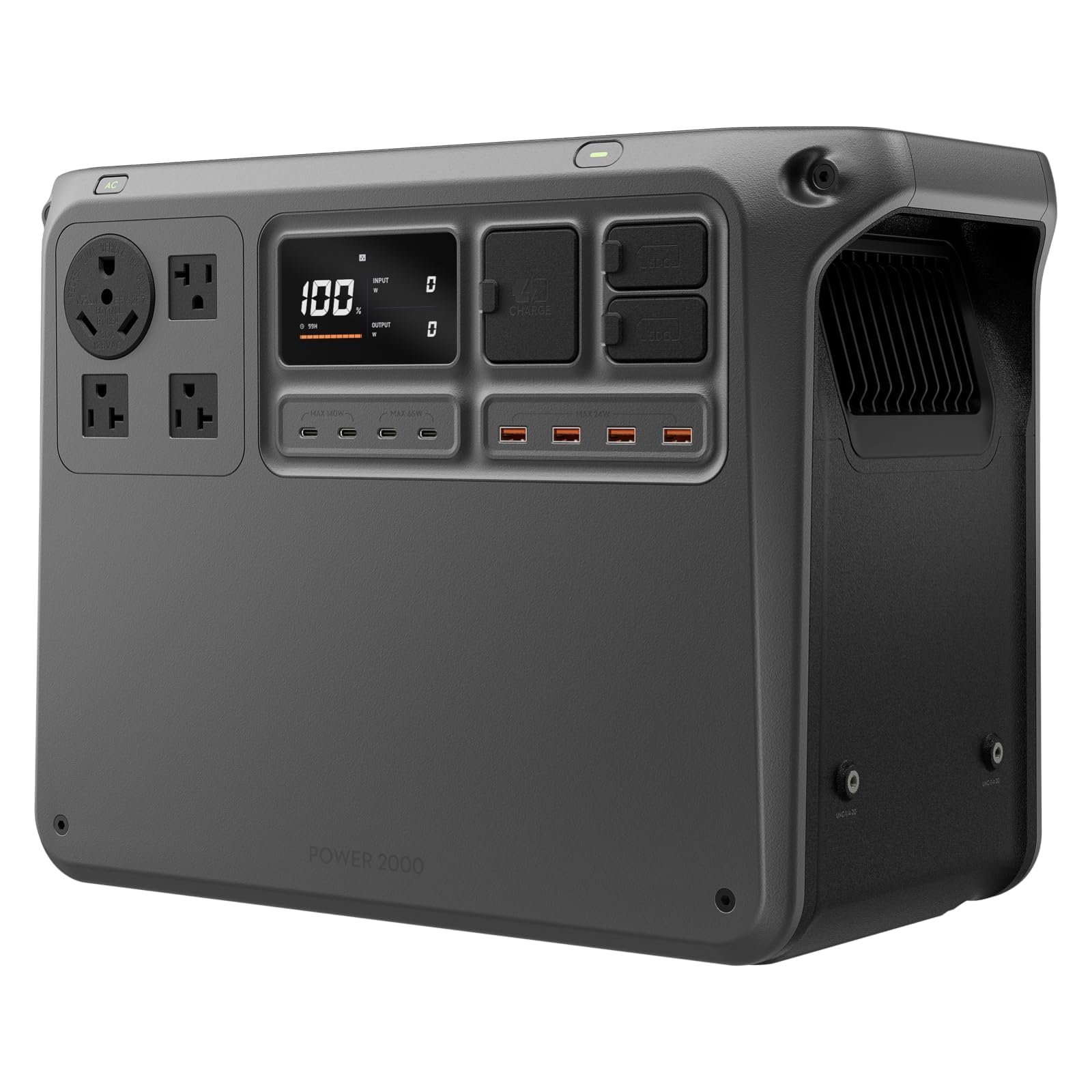
The DJI Power 2000 is the quietest 2kWh station in this comparison, operating at just 30dB—about the level of a library whisper—making it the best option for nighttime RV use or bedside UPS in a bedroom. Its 3,000W continuous inverter (4,000W peak) powers 99% of household appliances, including kettles, cookers, and electric saws, and the 2048Wh LFP battery supports expansion up to 22.5kWh for multi-day backup. The 55-minute 0–80% recharge time is competitive with the fastest Bluetti and EcoFlow units, and the 10ms UPS transfer keeps computers and medical devices safe during grid flickers.
Users note the robust flame-retardant housing and 26 internal temperature sensors that allow the BMS to operate safely even in wet or dusty outdoor conditions. The 15 ports include four USB-C (two at 140W), four USB-A, and dual SDC ports for DJI drone batteries, which is a unique bonus for filmmakers and drone operators. The main frustration is the proprietary connector ecosystem—solar or car charging requires a separate DJI adapter rather than standard XT60 or Anderson plugs—and the app dependency for setting charge limits and monitoring.
For homeowners who need a station that sits in a bedroom, home office, or RV interior without noise complaints, the DJI Power 2000 delivers high output in near-total silence. The proprietary accessories are a trade-off, but the thermal safety engineering and expandability make it a strong long-term investment for noise-sensitive environments.
Why it’s great
- 30dB fan speed is the quietest in the 2kWh class.
- 3,000W continuous output with 4,000W peak surge.
- Flame-retardant housing with 26 temperature sensors.
- 15-port layout includes dual 140W USB-C outputs.
Good to know
- Proprietary connectors for solar and car charging.
- App required for some configuration settings.
- No integrated wheels or handles for easy transport at 48 lbs.
6. EF ECOFLOW DELTA 3 Max
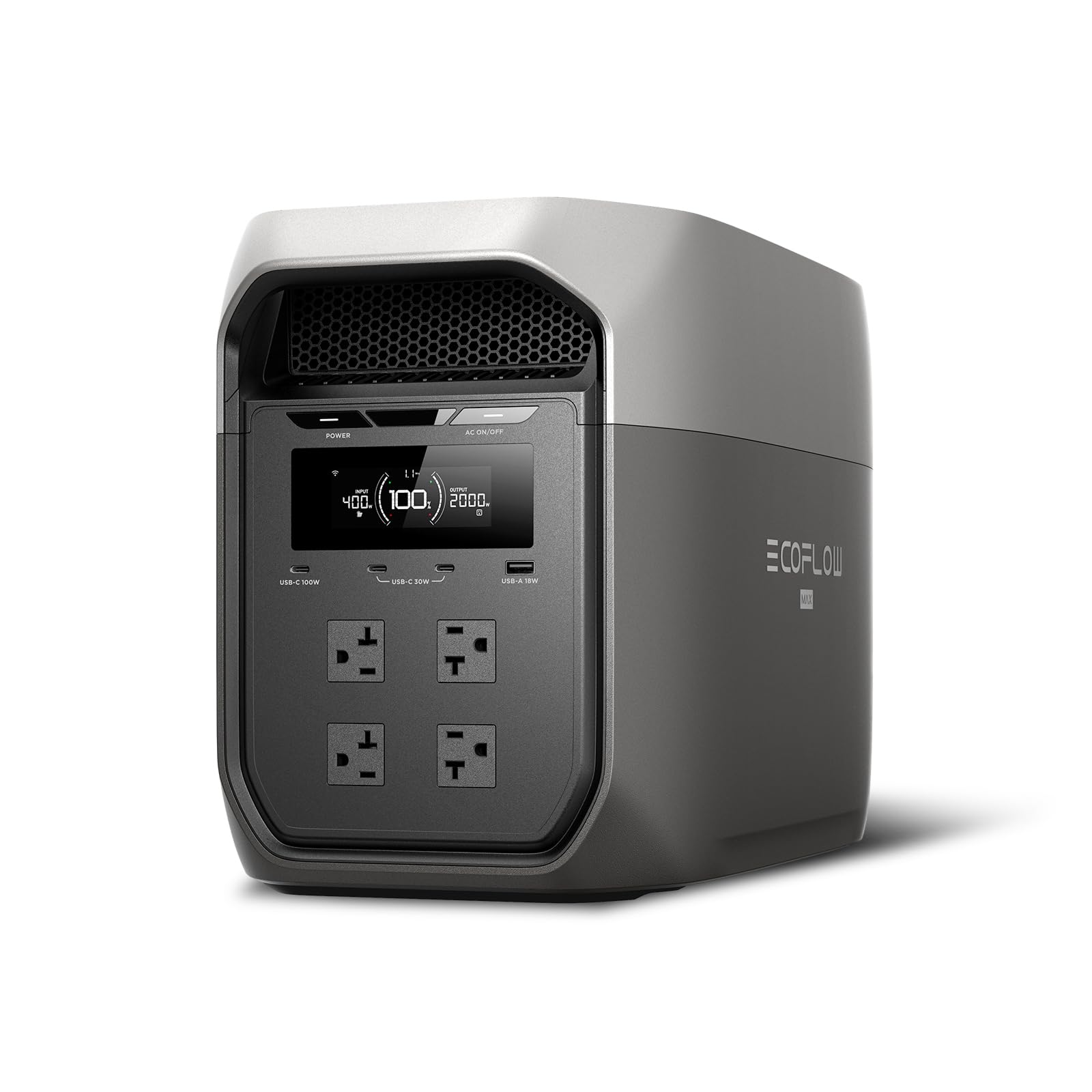
The DELTA 3 Max uses EcoFlow’s X-Stream technology to jump from 0% to 80% in just 1.13 hours, making it the fastest-refilling 2kWh station regardless of price tier. Its 3,400W X-Boost mode runs 99% of standard household appliances, including a 12,000 BTU air conditioner and a 1,500W space heater, without dropping into overload protection. The 2,048Wh LFP battery is housed in a lighter, more portable chassis than the previous DELTA 2, and the 10ms UPS transfer keeps sensitive electronics operational through grid blips.
Users highlight the dual handles for easy carrying and the app’s storm mode, which automatically charges the battery to full when severe weather is forecast. The 1,200W solar input is sufficient for a full solar recharge in roughly 2.5 hours under good sun, and the quiet fan stays below noticeable levels even when sustaining 1,700W of output. The absence of a 240V outlet means it cannot power a well pump or EV charger, and the unit cannot be expanded beyond its internal 2,048Wh without an additional DELTA 3 Max or Smart Extra Battery.
If your top requirement is the fastest possible turnaround between wall-outlet charging sessions—critical for back-to-back storm outages or daily recharging at a base camp—the DELTA 3 Max leads the class. Its lightweight design and robust app integration make it a user-friendly choice for homeowners who want a simple, fast, and reliable backup station.
Why it’s great
- 0–80% charge in 1.13 hours via X-Stream technology.
- 3,400W X-Boost runs most residential appliances.
- App storm mode auto-charges before severe weather.
- Dual handles and lighter build improve portability.
Good to know
- No 240V output for heavy appliances.
- Capacity not expandable beyond internal 2,048Wh.
- Fan may spin up during high solar input on hot days.
7. Jackery Explorer 2000 v2

The Explorer 2000 v2 is the lightest 2kWh station in this comparison at 39.5 lbs, achieved through Jackery’s CTB (Cell-to-Body) technology that integrates the LFP cells directly into the chassis structure, eliminating the heavy external battery case. This makes it 41% lighter and 34% smaller than typical 2kWh units, so a single person can lift it into a car trunk or carry it up a flight of stairs without assistance. The 2,200W pure sine wave inverter handles a standard refrigerator, fan, modem, and lights simultaneously, and the 20ms UPS switchover keeps desktop computers and networking gear online during outages.
Users report that the unit powers a full-size refrigerator for roughly 21 hours on a single charge, and the silent charging mode (30dB) allows overnight refill in the same room without sleep disruption. The app provides basic control over outlets and light (dim/bright/SOS), and the 100W USB-C PD port fast-charges laptops without an extra adapter. The trade-off is a modest 1,200W solar input limit, which means a full solar recharge with two panels takes about six hours—slower than the Bluetti or EcoFlow competition.
For weight-sensitive buyers—those who need to move the generator between home and RV or carry it down stairs—the Explorer 2000 v2’s 39.5-pound package with no sacrifice in capacity makes it the clear mobility champion. It lacks the raw power-lifting capability of the AC200L, but for standard home backup loads it is more than adequate and far easier to handle.
Why it’s great
- 39.5 lbs is the lightest 2kWh station on the market.
- CTB chassis integrates cells into the body for compact size.
- Silent charging mode at 30dB for overnight use.
- 21-hour fridge runtime on a single charge.
Good to know
- 1,200W solar input is slower than competitors.
- No expansion battery option; capacity is fixed.
- 2,200W continuous output may struggle with heavy surges.
8. GROWATT INFINITY 2000 Pro
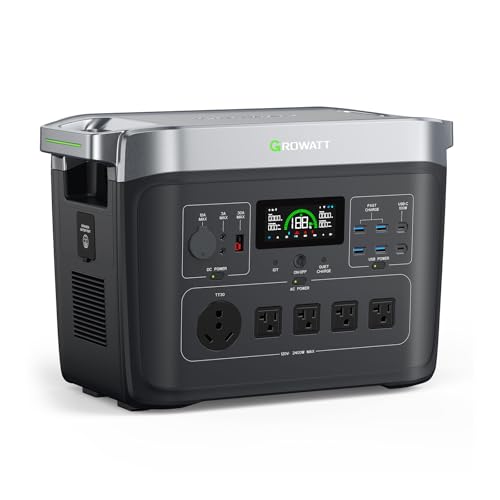
The INFINITY 2000 Pro is engineered for cold climates with its Cold Start technology that allows the LFP battery to operate and charge at temperatures as low as -22°F, a critical feature for northern homeowners or those relying on a generator in an unheated garage. The 2,048Wh capacity pairs with a 2,400W inverter (4,000W surge) and includes both a TT-30 outlet for RVs and an Anderson PowerPole port, giving it exceptional connectivity for camper and overlanding setups. The 1800W AC input recharges the unit from 0–100% in about 90 minutes, and the 1,200W solar input is sufficient for a full sun-powered recharge in about two hours.
Users praise the 5-year warranty backed by Growatt’s industrial inverter heritage, and the app provides solid real-time data on per-port draw and solar input. The 26-pound base weight is deceptively light—expansion batteries are separate modules that plug into the unit but cannot charge independently. A small number of users have reported units that failed to turn on without grid power, a defect that appears to be tied to a specific firmware batch; Growatt has stated that this should not occur on properly configured units.
If you need a home backup generator that lives in an unheated basement, garage, or cabin and must function reliably in freezing weather, the INFINITY 2000 Pro’s Cold Start operation and TT-30+Anderson port combo make it a uniquely capable option. The reported defect risk is worth verifying by testing the unit before a real outage, but for cold-weather reliability it is the clear leader.
Why it’s great
- Operates and charges down to -22°F.
- TT-30 and Anderson ports for RV and camper connectivity.
- 5-year warranty with established inverter manufacturer support.
- Fast 90-minute full AC recharge.
Good to know
- Expansion batteries cannot charge independently from main unit.
- Unit may fail to start without grid power in some batches.
- 26 lbs for base unit, but expansion modules add weight.
9. PECRON F3000LFP
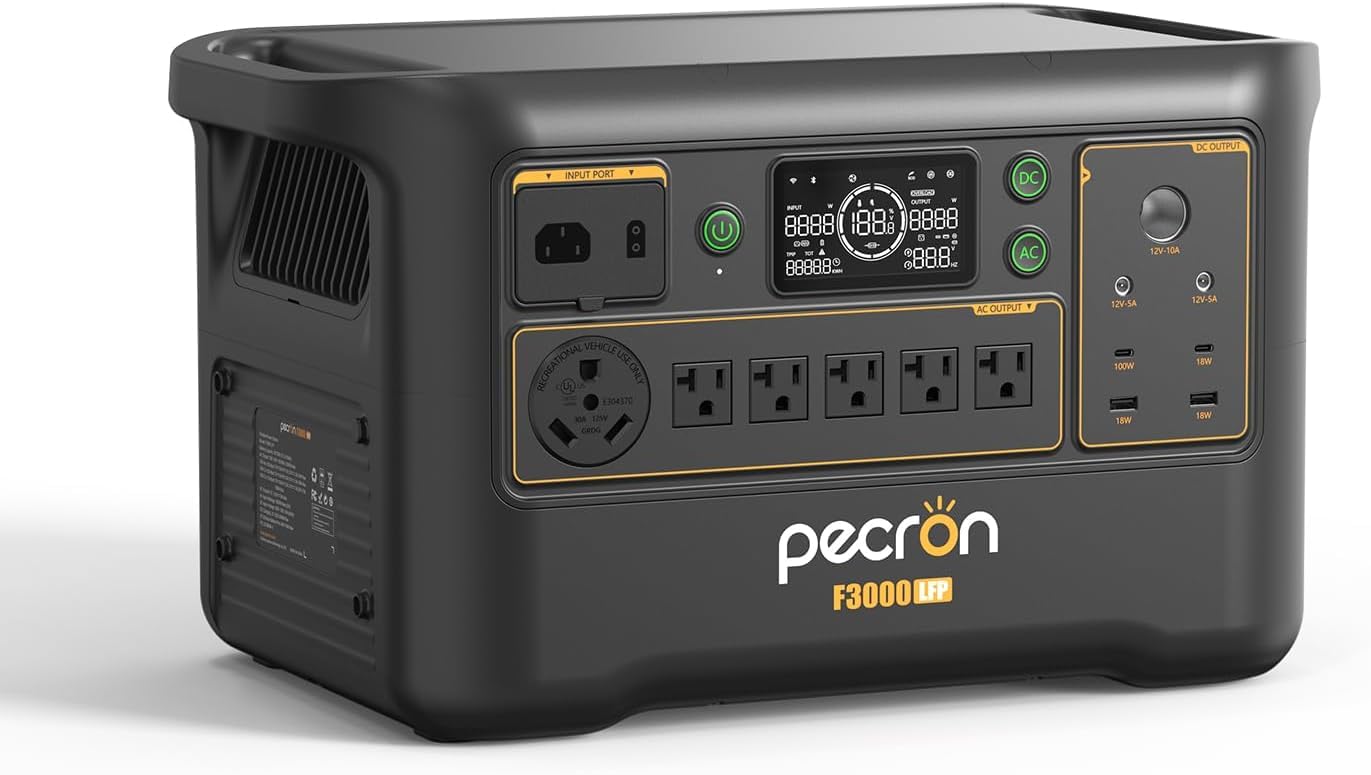
The F3000LFP steps above the 2kWh ceiling with a 3,072Wh LFP battery and a 3,600W continuous pure sine wave inverter, providing enough headroom to run a refrigerator, a well pump, and multiple electronics simultaneously for two to three days. The 1,800W AC input achieves a full charge in about two hours, and the 1,600W solar input (25–120V range) gives flexibility for partial grid-independence. The 13-port layout includes six AC outlets, two USB-C with 100W PD, two USB-A, a carport, and two DC 5525 outputs, covering nearly any device a home user might plug in.
Users note the 8–20ms UPS switch that keeps desktop PCs and medical gear live during power blips, and the app provides real-time consumption data and charging scheduling. The 63.3-pound weight is on par with other 3kWh stations, and the unit includes a storage bag and a protective cover for transport. Some users point out that the fan runs audibly during high-rate charging cycles, and the app requires an account login that some find intrusive. The expansion cable to connect an external battery is sold separately, which adds cost for those who want to reach the advertised 10,752Wh maximum.
For homeowners who want 3kWh of capacity without jumping to the 4kWh price tier, the F3000LFP delivers strong value per watt-hour. Its 3,600W inverter handles heavy residential surges, and the two-hour recharge window means you can refill between storm bands without being offline overnight.
Why it’s great
- 3,072Wh capacity runs essentials for 2–3 days.
- 3,600W continuous inverter handles demanding loads.
- Two-hour full recharge via 1,800W AC input.
- 13-port layout covers all device types.
Good to know
- Fan noise is noticeable during high-rate charging.
- Expansion battery cable sold separately.
- App login required; no offline mode.
10. AFERIY 3840Wh Power Station

The AFERIY P310 delivers the highest raw capacity in this roundup at 3,840Wh (expandable to 11.5kWh) for a significantly lower price per watt-hour than name-brand competitors. Its 3,600W continuous inverter can surge to 7,200W for motor starts, which is enough to handle a ¾-hp sump pump or a window air conditioner alongside a refrigerator. The unit includes five 120V AC outlets, USB-C PD, a TT-30 RV receptacle, and an Anderson-style DC port, plus a pull handle and rugged wheels for rolling the 80-pound station across a driveway or garage floor.
Users frequently cite the 7-year warranty and the responsive customer support team as key differentiators versus smaller brands. The app allows remote monitoring and charging scheduling, and the fast recharge mode hits full in about 1.5 hours from AC. A small number of units have arrived with dead display segments or charging failure—Aferiy has been proactive in offering replacements for those cases, but the quality control variance is higher than with Bluetti or EcoFlow. The fan is also more audible than premium-brand units under load.
If your priority is maximizing watt-hours per dollar for whole-home backup and you can tolerate a slightly rougher user experience and higher defect risk, the AFERIY P310 offers the best capacity-to-cost ratio in this guide. The 7-year support period adds confidence, but budget buyers should verify the unit works immediately upon receipt.
Why it’s great
- 3,840Wh base capacity at lowest cost per Wh in the guide.
- 7,200W surge handles heavy motor starts.
- TT-30 and Anderson ports for RV use.
- Pull handle and wheels for easier transport.
Good to know
- Quality control varies; some units arrive with defects.
- Fan noise is higher than premium-tier competition.
- 80 lbs requires wheels or dolly for any distance.
11. Jackery HomePower 3000
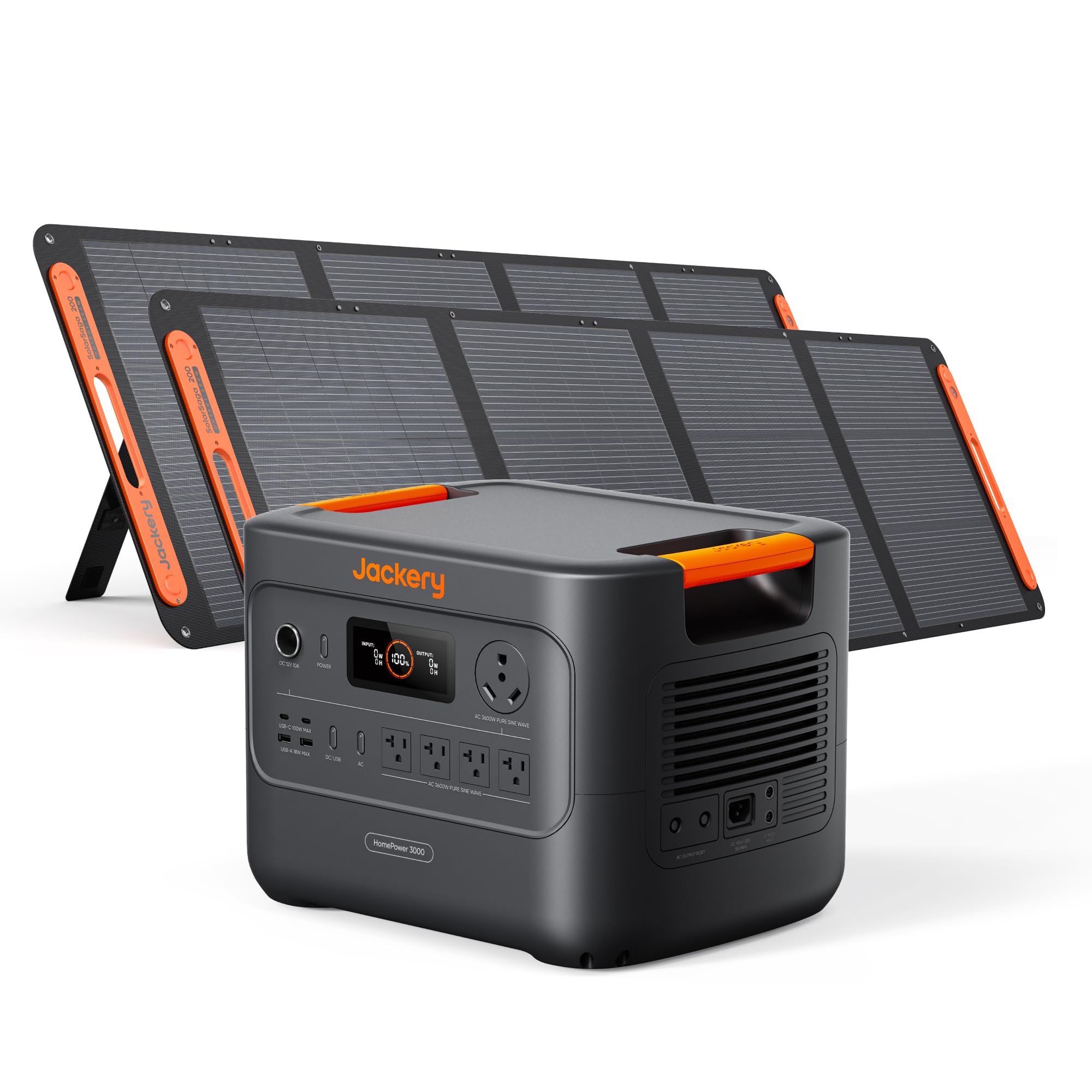
The HomePower 3000 pairs a 3,072Wh LFP battery with two 200W SolarSaga panels in a single bundled package, making it the most complete turnkey solar generator setup for home backup in this list. The 3,600W inverter (7,200W surge) runs a household refrigerator, lights, modem, and TV for about 15 hours, and the UL-certified ≤20ms UPS ensures sensitive electronics stay safe during grid interruptions. The ChargeShield 2.0 AI algorithm adjusts charging rates to extend the 4,000-cycle battery life, and the CTB chassis construction keeps the 60-pound weight lower than most 3kWh competitors.
Users report that in sunny conditions the two 200W panels yield about 80% charge in nine hours, which is sufficient for daily top-ups if the station is partially depleted. The integrated TT-30 RV port lets it plug directly into an RV power inlet, and the dual 100W USB-C PD ports charge laptops and drones at full speed. The main limitation is that the internal battery cannot be expanded; if you need more than 3,072Wh, you must buy a separate HomePower station rather than an add-on battery pack. The bundled panels also use a proprietary connector rather than standard MC4, limiting third-party panel compatibility.
For homeowners who want a solar generator that works out of the box without sourcing separate panels or building a cable harness, the HomePower 3000 bundle is the most convenient option. The all-in-one approach limits expansion flexibility, but for a clean, quiet, and code-compliant home backup system with solar self-recharge, it delivers turnkey simplicity.
Why it’s great
- Includes two 200W solar panels for out-of-box solar capability.
- 3,600W / 7,200W surge handles most home loads.
- ChargeShield 2.0 extends battery cycle life.
- TT-30 RV port for mobile home backup.
Good to know
- Internal battery is not expandable; capacity is fixed.
- Solar panels use proprietary connector, not standard MC4.
- 60 lbs is manageable but heavy for regular transport.
FAQ
Can a battery generator power my 240V well pump or central air conditioner?
How do I calculate how long a station will run my refrigerator?
Do I need to buy solar panels separately, or are they included?
Can I use a battery generator indoors without ventilation?
What does the UPS (uninterruptible power supply) rating mean for home backup?
Final Thoughts: The Verdict
For most homeowners, the best battery generator for home is the BLUETTI AC200L because it combines a class-leading 3,600W power-lifting surge, modular expansion to 8,192Wh, and a 45-minute fast recharge in a package that handles both home backup and RV use without compromise. If you need a native 240V output for a well pump or central air, grab the EF ECOFLOW DELTA Pro 3. And for a lightweight, ultra-portable station that you can carry in one hand, nothing beats the Jackery Explorer 2000 v2 at 39.5 pounds with full 2kWh capacity.

Mo Maruf
I created WellFizz to bridge the gap between vague wellness advice and actionable solutions. My mission is simple: to decode the research and give you practical tools you can actually use.
Beyond the data, I am a passionate traveler. I believe that stepping away from the screen to explore new environments is essential for mental clarity and physical vitality.