Our readers keep the lights on and my smoothie glass nicely filled. As an Amazon Associate, I earn from qualifying purchases.
The single most frustrating thing about carrying gear on a run is the constant up-and-down slap against your lower back. A poorly designed bag turns every stride into a negotiation with momentum, forcing you to choose between hydration and comfort. The right running bag disappears from your awareness entirely, letting you focus on pace, breathing, and form.
I’m Mohammad Maruf — the founder and writer behind WellFizz. I analyze tens of thousands of consumer reviews and hardware specs to find which products actually solve the real problems runners face, from bounce control to chafe-free fabric construction.
Whether you need a barely-there waist pouch for a 5K or a hydration vest for an ultra, this guide breaks down the best options by storage style, fit system, and comfort engineering. You will find your ideal bag for running by matching your distance and gear load to the right design.
How To Choose The Best Bag For Running
The right running bag is defined by how it stays put, how it breathes, and how fast you can access water and your phone. Three criteria separate a useful tool from a nuisance that ends up in a drawer.
Bounce Control and Fit Adjustability
Bounce happens when the bag’s center of mass moves independently from your torso. Waist belts need at least one elastic adjustment and a wide strap that sits on your hips, not your waist. Vests rely on dual chest straps and often a sternum adjustment to lock the pack to your ribcage. The number of independent adjustment points—typically two to four—directly correlates with how stable the load feels at a 7-minute-mile pace.
Storage Layout and Mid-Run Access
Pockets that require you to stop, turn around, or unzip a main compartment while sweating are poorly designed. The best bags put your phone in a stretch mesh pocket on the front strap or belt buckle area. Hydration should be reachable without breaking stride: soft flasks in front vest pockets or squeeze bottles in waist holsters. Gel loops should fit standard energy gels without folding them in half. Look for at least one zippered pocket for keys and ID to prevent mid-run losses.
Fabric Breathability and Chafe Resistance
Mesh-backed shoulder straps and laser-cut holes in the back panel allow sweat to evaporate instead of pooling against your spine. Neoprene waist belts resist moisture but trap heat in summer. The best vests use spacer mesh or dimpled foam panels that create a tiny air gap between the bag and your back. Raw edges or stiff webbing at the arms and collarbone are the most common chafe points; look for soft binding or taped seams in these zones.
Quick Comparison
On smaller screens, swipe sideways to see the full table.
| Model | Category | Best For | Key Spec | Amazon |
|---|---|---|---|---|
| Fitletic Ultimate II | Waist Belt | Minimalist daily runs | Fits iPhone 16 Pro Max | Amazon |
| Fitletic Hydra 16 | Hydration Belt | Mid-distance summer runs | Two 8 oz BPA-free bottles | Amazon |
| INOXTO 3L Vest | Hydration Vest | Budget trail running | 190 g / 3L main compartment | Amazon |
| Nathan TrailMix 7L | Hydration Vest | Half-marathon trail | 7L capacity / 2L bladder | Amazon |
| Nathan QuickStart 4L | Hydration Vest | Road marathons | 352 g / 1.5L bladder | Amazon |
| CamelBak Circuit | Hydration Vest | Endurance training | 50 oz Crux bladder | Amazon |
| Osprey Duro 1.5 | Hydration Vest | Ultra-distance racing | Hydraulics reservoir / 0.93 lb | Amazon |
In‑Depth Reviews
1. Fitletic Ultimate II Running Pouch

The Fitletic Ultimate II is the rare running belt that actually holds a large smartphone without sagging or bouncing. Multiple reviewers confirm it fits an iPhone 16 Pro Max and a Samsung S23 Ultra with ease, a feat that many belt-style pouches simply cannot manage. The neoprene main compartment is sweat-resistant and sits flat against the lower back, while the inner organizer pocket keeps keys, ID, and credit cards from scratching your phone.
The patented bounce-free design comes from a wide elastic belt that hugs the hips and a cinch toggle that locks the fit in place. Integrated bib toggles on the front let you attach race numbers without safety pins, and reflective tabs improve visibility on early-morning runs. The two gel loops on the sides can hold standard energy gels, though some users note they are too small for thick gel packets like SiS or Maurten without folding.
For runners who want the absolute minimum—just phone, keys, a gel or two, and nothing flapping around—this belt is the benchmark. It weighs almost nothing, hides under a shirt easily, and has zero bounce when adjusted correctly. For daily 5K to half-marathon runs without hydration needs, it is unbeatable.
Why it’s great
- Adjustable elastic belt with zero bounce, even with large phones
- Seven compartments including secure key hook and ID slot
- Gel loops and integrated race number toggles
Good to know
- No water bottle holder included
- Gel loops too small for thick energy gel packets
- Neoprene not fully waterproof in heavy rain
2. Fitletic Hydra 16 Hydration Running Belt

The Hydra 16 solves the biggest limitation of the Ultimate II by adding two 8-ounce BPA-free squeeze bottles that nest into quick-draw hip holsters. The bottles are shaped to sit against the curve of your hips and do not bounce—a claim very few hydration belts can honestly make. The quick-flow caps deliver a strong stream without requiring you to stop or tilt your head back, which keeps your breathing rhythm intact during tempo runs.
The main pouch is 8 by 4 inches and contains an inner organizer for ID, credit cards, and keys. It fits most large smartphones including a Samsung S23 Ultra in an OtterBox case, though access mid-run is tight. The front of the belt also features two external gel holders and integrated race bib toggles. Reflective accents run across the front and back for visibility in low light. The belt material is a neoprene-like blend that wicks sweat but can feel warm on 90-degree days.
Some reviewers found that the gel loops are sized for standard Gu gels and do not comfortably hold larger packets or gummy packs. A few users reported the bottle cap membrane folded over after a month of use, causing a slow drip—easily fixed by inserting a rigid plastic tube. For runners who need hydration on 8- to 12-mile runs but dislike the bulk of a vest, the Hydra 16 is the most stable belt solution available.
Why it’s great
- Two 8 oz BPA-free bottles with no bounce in quick-draw holsters
- Main pocket fits large phones with inner organizer for keys and ID
- Adjustable hip-hugging belt with buckle lock
Good to know
- Gel loops too small for oversized gel packets
- Some bottle caps may develop a slow leak over time
- Runs warm in high heat due to neoprene construction
3. IX INOXTO Running Hydration Vest 3L

The IX INOXTO vest weighs only 190 grams, making it one of the lightest hydration packs available at any price point. The 3-liter main compartment is paired with two shoulder pockets that hold 250 ml PET bottles—perfect for short trail runs where you want water access without a bladder. The included 1.5-liter food-grade water bag has a 40-inch tube and works reliably with no leaks, which is rare in budget-tier hydration gear.
The stretch mesh fabric feels cool against the back and the honeycomb padding creates decent airflow for a pack at this price. Adjustable chest and waist straps allow a snug fit, though the phone pocket on the front is tight for large phones and can bounce when fully loaded. The vest also includes a safety whistle and multiple reflective strips for visibility, which is a nice safety bonus for early-morning trail runners.
Reviewers consistently highlight the value proposition: it holds enough water and snacks for a 10-mile hike or a 90-minute trail run at a fraction of the cost of established brands. The main downsides are that the phone pocket is too small for big devices and the front bottle pockets can cause bounce if you fill them with heavy bottles. For entry-level trail runners or anyone who wants a lightweight vest without a premium price tag, this is a smart starting point.
Why it’s great
- Ultralight at 190 g with 3L main capacity
- Includes leak-proof 1.5L bladder and two front bottle pockets
- Breathable honeycomb mesh back panel
Good to know
- Front phone pocket too small for large smartphones
- Front water bottles can cause bounce when full
- Durability is good for the price but not race-ready long-term
4. Nathan TrailMix 7L Hydration Vest

The Nathan TrailMix 7L is a purpose-built trail vest that balances storage capacity with a lightweight, chafe-free design. It weighs just 7 ounces without the included 2-liter bladder and 11 ounces with it—impressively low for a 7-liter pack. The mesh material wicks moisture effectively, and the no-bounce design relies on a snug fit that runners describe as almost forgettable during long runs. Reviewers have taken this vest through 50K trail races and reported zero chafing even in humid conditions.
The storage layout is smart: two zippered rear compartments hold a jacket, snacks, and a first-aid kit, while two front stretch pockets accept soft flasks or standard 500 ml water bottles (bottles not included). An additional front pocket with a key clip keeps valuables secure. The adjustable chest straps allow micro-adjustments mid-run, though some users note the elastic straps tend to loosen gradually on longer outings and require occasional re-tightening.
The sizing runs slightly small, so many runners size up for a comfortable fit. A few reviewers experienced stitching issues after heavy use—one user saw the seam unravel during a 100K race—which suggests the TrailMix is best suited for regular training and mid-distance races rather than year-round ultra abuse. For half-marathon to marathon trail efforts where you need a bladder plus gear storage, this is a strong mid-range choice.
Why it’s great
- Very lightweight at 11 oz with a 2L bladder
- Rear zippered compartments hold jacket, food, and gear
- Front stretch pockets fit soft flasks or standard water bottles
Good to know
- Front elastic straps can loosen gradually during runs
- Runs slightly small—size up for a comfortable fit
- Stitching may not survive heavy ultra-distance training
5. Nathan QuickStart Hydration Pack Vest 4L
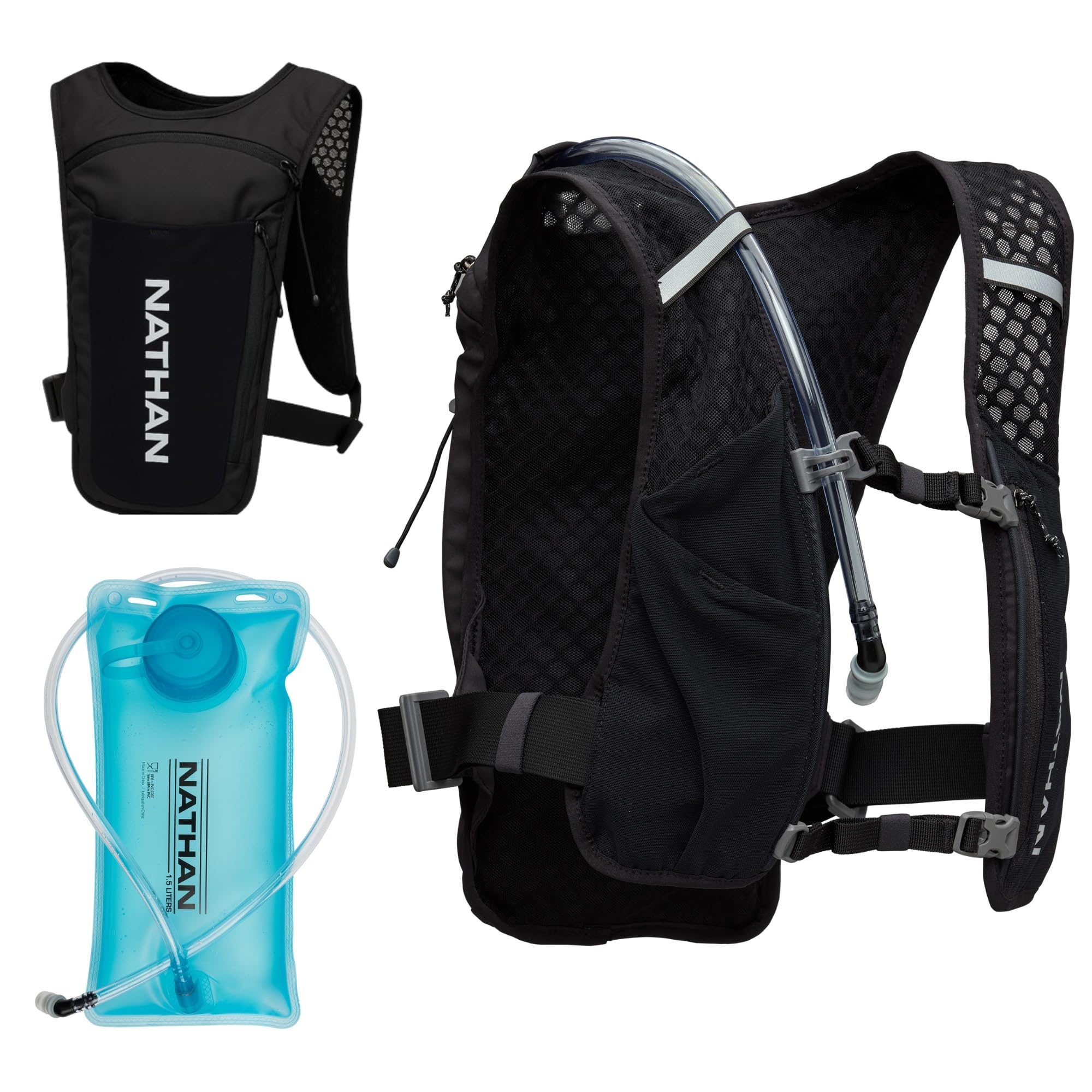
The Nathan QuickStart is designed for runners who want a vest that disappears on the road. At 352 grams with the 1.5-liter bladder, it is lighter than a water bottle and sits so close to the body that reviewers describe it as feeling like a second skin. The moisture-wicking stretch woven fabric and chafe-free binding make it comfortable even when worn directly against bare shoulders on hot days. The front pocket is large enough to hold a Samsung S23 Ultra, which is a major advantage for runners who refuse to run without their big phone.
The included 1.5-liter bladder is leak-proof and has a hands-free drinking tube, though some users find the tube sits too close to the neck and strap it down with a zip tie. The two rear stash pockets offer enough space for a packable jacket, hat, and snacks for a 20K run. Adjustable front and side straps provide a custom fit, but the front straps tend to shift slightly in their channels during runs, requiring the occasional re-center. Reflective elements across the front and back improve visibility for early-morning roads.
For road marathoners and half-marathoners who need just enough hydration and phone storage without the bulk of a trail pack, the QuickStart hits a sweet spot. It is not designed for long unsupported trail runs—the 4-liter capacity is just right for a few hours on pavement. The build quality is solid, with reviewers noting it has held up well through months of weekly use without any seam failures.
Why it’s great
- Extremely lightweight at 352 g with bladder
- Front pocket fits large smartphones like the S23 Ultra
- Breathable, chafe-free woven fabric ideal for shirtless runs
Good to know
- Front chest straps can shift out of position during runs
- Drinking tube may need repositioning away from neck
- 4L capacity is limited to shorter runs and minimal gear
6. CamelBak Circuit Run Vest
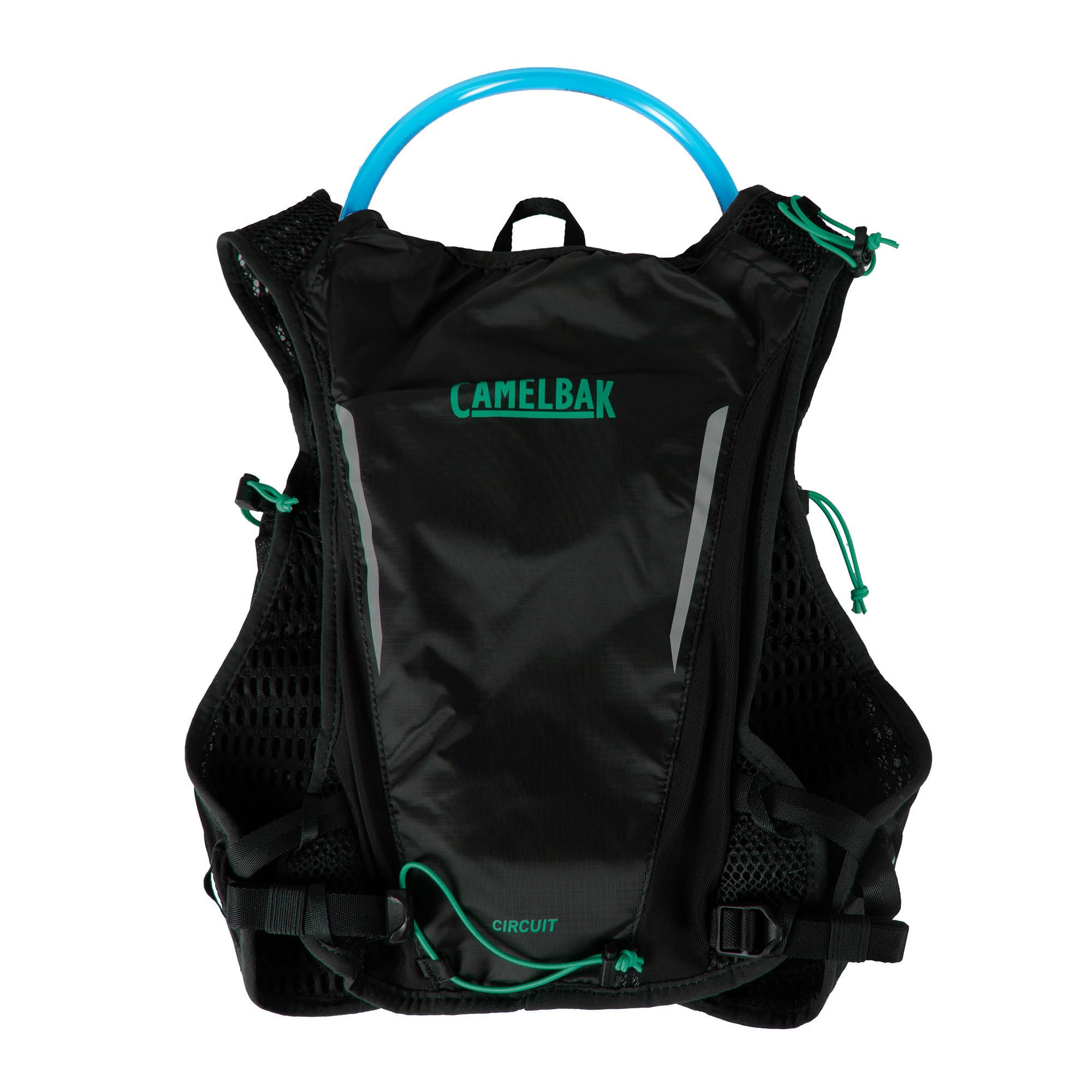
The CamelBak Circuit leverages the brand’s Crux reservoir system, which delivers 20% more water per sip than standard bladders and has a leak-proof valve that shuts off the tube when not drinking. The 50-ounce (1.5-liter) capacity is ideal for 4- to 10-mile runs, and the ultralight nylon construction keeps the whole vest at just 5.9 ounces without the bladder. The breathable mesh shoulder straps keep airflow moving, reducing sweat buildup on long hot runs.
The storage layout includes a zippered phone pocket that fits large phones securely, plus two front cargo pockets for gels, keys, or a small jacket. Dual adjustable chest straps provide a bounce-free fit that reviewers say is noticeably more stable than single-strap designs. The Circuit also includes trekking pole attachments, a built-in safety whistle, and reflective detailing for low-light safety. The 5.5-liter cargo capacity is generous for a vest this slim.
The main durability concern centers around the bladder loop: a few long-term users reported the loop breaking after about 100 runs on previous CamelBak models, and the new loop design is slightly oversized, which can allow the bladder to slip during runs if not secured carefully. The drinking hose is longer than necessary, requiring some loop management. For runners who prioritize a known hydration system and a secure phone pocket, the Circuit is a reliable marathon training companion.
Why it’s great
- Crux bladder delivers high water flow with leak-proof valve
- Ultralight at 5.9 oz without bladder
- Dual chest straps and 5.5L cargo capacity for long training runs
Good to know
- Bladder loop can be oversized, causing bladder to shift
- Drinking hose is longer than needed
- Some users report stitching wear on the bladder loop after heavy use
7. Osprey Duro 1.5L Running Hydration Vest
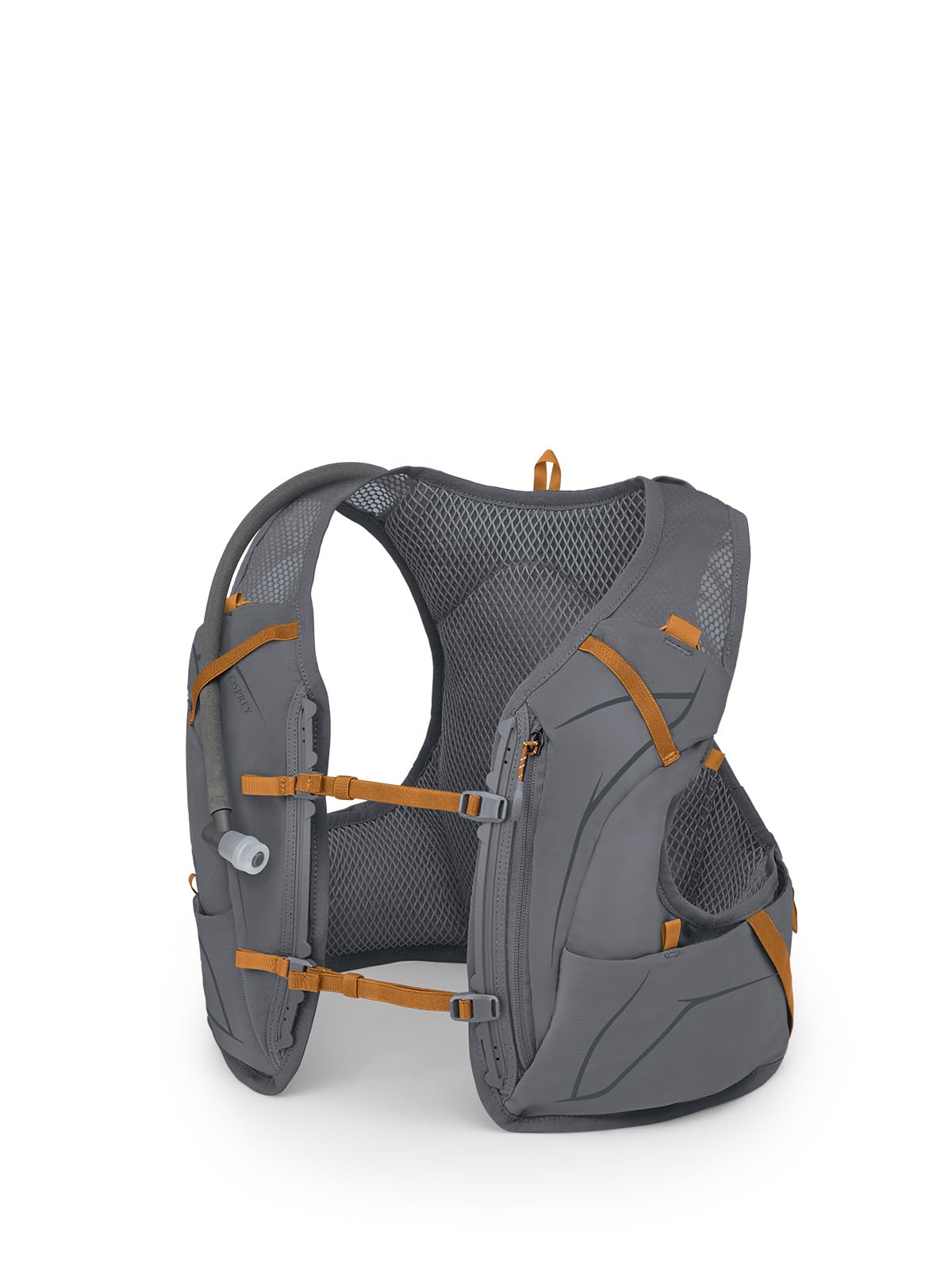
The Osprey Duro 1.5 is a premium vest built for runners who expect race-day reliability and precise pocket engineering. The Hydraulics run-specific reservoir is low-profile and shaped to minimize sloshing, and the included magnetic bite-valve clip keeps the tube secure on your chest strap. The vest fits close to the body with a bounce-free feel that reviewers describe as noticeably more structured than budget alternatives—the fabric does not sag even when the reservoir is full.
The pocket layout is purpose-designed for ultra distances: three front stash pockets hold soft flasks, gels, and your phone, while the back panel has space for a lightweight shell or extra nutrition. Reflective graphics run across the front and back for visibility, and the trekking-pole attachment system works without limiting pocket access. At 14.88 ounces, it is heavier than minimalist vests, but the added structure translates to zero bounce at race pace. The material against the body can feel scratchy if worn shirtless; a thin tank top solves this.
Reviewers who have moved to the Duro from cheaper vests consistently cite the fit and stability as the biggest upgrade—the vest does not shift even during technical trail descents. The 1.5-liter bladder provides enough water for 12 to 15 miles, and the reservoir is easy to fill but slightly harder to dry completely after cleaning. For serious runners training for marathons and ultras who want a vest that lasts multiple seasons, the Osprey Duro is the top-tier investment.
Why it’s great
- Structured, bounce-free fit outperforms budget vests at race pace
- Hydraulics reservoir with magnetic bite-valve clip
- Smart pocket layout for gels, phone, and hydration
Good to know
- Heavier than minimalist vests at 14.88 oz
- Material against skin can feel scratchy without a shirt
- Reservoir is slightly difficult to dry thoroughly after cleaning
FAQ
How tight should a running vest or belt feel?
Do I need a hydration vest for a 5K run?
How do I prevent chafing from a running vest?
Can I use a running bladder pack for hiking?
Final Thoughts: The Verdict
For most runners, the best bag for running is the Fitletic Ultimate II because it combines a truly bounce-free fit, enough phone storage for a large smartphone, and a barely-there profile that works on daily runs from 5K to half-marathon distance. If you need hydration on the move for mid-to-long runs, the Fitletic Hydra 16 delivers stable bottle storage that most hydration belts fail to achieve. And for trail runners training for ultra distances, the Osprey Duro 1.5 offers the most race-ready pocket layout and structural stability you can buy.

Mo Maruf
I created WellFizz to bridge the gap between vague wellness advice and actionable solutions. My mission is simple: to decode the research and give you practical tools you can actually use.
Beyond the data, I am a passionate traveler. I believe that stepping away from the screen to explore new environments is essential for mental clarity and physical vitality.