Our readers keep the lights on and my smoothie glass nicely filled. As an Amazon Associate, I earn from qualifying purchases.
The line between a toy that entertains and a tool that actually teaches a toddler to walk is surprisingly thin — and getting it wrong means weeks of frustration for both parent and child. A well-designed baby push walker shifts the focus from passive riding to active stepping, building the core strength and balance a new walker needs to find their feet on their own terms.
I’m Mohammad Maruf — the founder and writer behind WellFizz. After combing through hundreds of verified reviews and analyzing the wheel geometry, weight distribution, and activity engagement of the top contenders, I’ve narrowed the field to the models that truly deliver on their promises.
Whether you’re buying for a new sitter or a confident cruiser, this guide breaks down the best options to help you choose the right baby push walker for your child’s developmental stage and your home environment.
How To Choose The Best Baby Push Walker
Not all push walkers are created equal. The difference between a model that frustrates your child and one that accelerates their walking confidence comes down to three key factors: stability, progression, and engagement. Here’s what you need to know before clicking “add to cart.”
Wheel Resistance and Base Stability
A push walker that glides too fast is dangerous — a child’s legs can’t keep up, leading to tumbles and tears. Look for models with either a wide, low-slung wheelbase or built-in resistance clickers that create gentle drag on the wheels. This prevents the walker from shooting out from under your child and gives them a stable platform to practice weight shifting. The heaviest walkers often perform best on carpet, while lighter models with smooth wheels handle hardwood and tile better, but may need speed-limiting features.
Activity Complexity and Developmental Fit
The best walkers grow with your child. For a six-month-old just learning to sit, a removable activity panel with high-contrast lights, simple buttons, and chunky shapes is ideal. As they transition to standing and cruising at nine to twelve months, the walker’s handle height and wheel resistance become critical. Advanced features like shape sorters, musical keyboards, and pretend-play accessories (shopping carts, strollers) keep toddlers engaged long after they have mastered walking, extending the toy’s useful life well into the preschool years.
Versatility and Storage
A single-function push walker quickly becomes obsolete. Convertible models that transform from a seated activity station to a push-behind walker, and then to a shopping cart or stroller, offer the best long-term value. Also consider how the walker stores when not in use—fold-flat designs and detachable trays make a significant difference in small homes. Finally, check the surface compatibility: rubber or EVA wheels roll quietly and smoothly on both indoor floors and outdoor pavement, whereas hard plastic wheels can scratch wood and struggle on grass.
Quick Comparison
On smaller screens, swipe sideways to see the full table.
| Model | Category | Best For | Key Spec | Amazon |
|---|---|---|---|---|
| Skip Hop 4-in-1 Explore & More | Sit-to-Stand Convertible | Best Overall for Developmental Growth | 3 height settings; 40+ activities; speed control | Amazon |
| Radio Flyer Scan & Sort Shopping Cart | Push Cart Walker | Pretend Play & Walking Confidence | 3 adjustable handle heights; resistance clickers | Amazon |
| PULA Baby Push Walker Wagon | 2-in-1 Walker/Wagon | Outdoor Stability & Durability | EVA wheels; low-gravity design; 9.9 lbs | Amazon |
| Fisher-Price 4-in-1 Snack Cart Walker | Activity Push Walker | Multilingual Learning & Sensory Play | 135+ songs/phrases; 14 play pieces; 3 Smart Stages | Amazon |
| VTech Sit-to-Stand Learning Walker | Classic Sit-to-Stand | Proven Reliability & Motor Skills | Detachable activity panel; 2-speed control | Amazon |
| Dream On Me Go-Getter Walker | Classic Walker with Push Handle | Parent-Guided First Steps | Rear push handle; 3 height adjustments; fold-flat | Amazon |
| VTech Sort and Discover Activity Wagon | Push/Pull Wagon | Budgets & Multi-Activity Play | 5-sided activity play; folding handle; 3.9 lbs | Amazon |
In‑Depth Reviews
1. Skip Hop Baby Walker 4-in-1 Sit to Stand Convertible
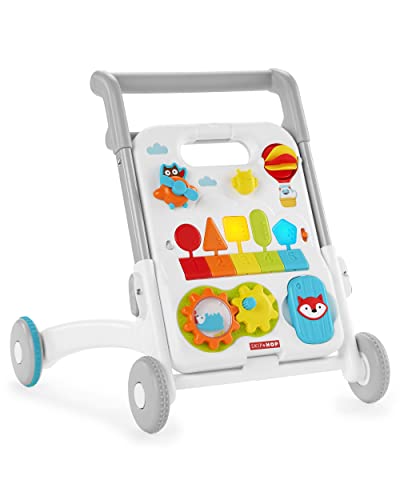
The Skip Hop 4-in-1 is the Swiss Army knife of push walkers. It starts as a seated activity station with a wobble plane, click-clack bee, and rotating gears, then converts to a cruising walker, a shopping cart, and finally a stroller. That four-stage progression means it doesn’t end up in the donation pile after three months — it stays relevant from six months to four years. The light-up musical keyboard offers three modes (song, piano, and sound effects), introducing shapes and numbers without overwhelming a developing brain.
What really sets this walker apart is its adjustable speed control and non-skid rear wheels. The two-speed setting lets you dial in the resistance to match your child’s confidence level, preventing the runaway-walker problem that plagues cheaper models. The three handle height settings (18.3, 20.1, and 21.9 inches) also accommodate rapid growth spurts, so your toddler never has to hunch or reach. The detachable rattle phone and baby mirror add extra sensory engagement during floor play.
Some parents find the music a touch repetitive after the hundredth play of “Row, Row, Row Your Boat,” and the small phone piece can easily be misplaced. But for a walker that actively teaches balance, fine motor skills, and cause-and-effect across multiple developmental stages, the Skip Hop is the most complete package on the market. It’s the one walker that genuinely earns its shelf space through toddlerhood.
Why it’s great
- Four distinct play modes extend useful life to age 4
- Adjustable speed control prevents runaway rolling
- Removable activity panel works for floor play
- Non-skid rear wheels enhance safety on hard floors
Good to know
- Music can become repetitive for parents
- Small rattle phone attachment is easy to lose
- Higher price point than basic walkers
2. Radio Flyer Scan & Sort Shopping Cart
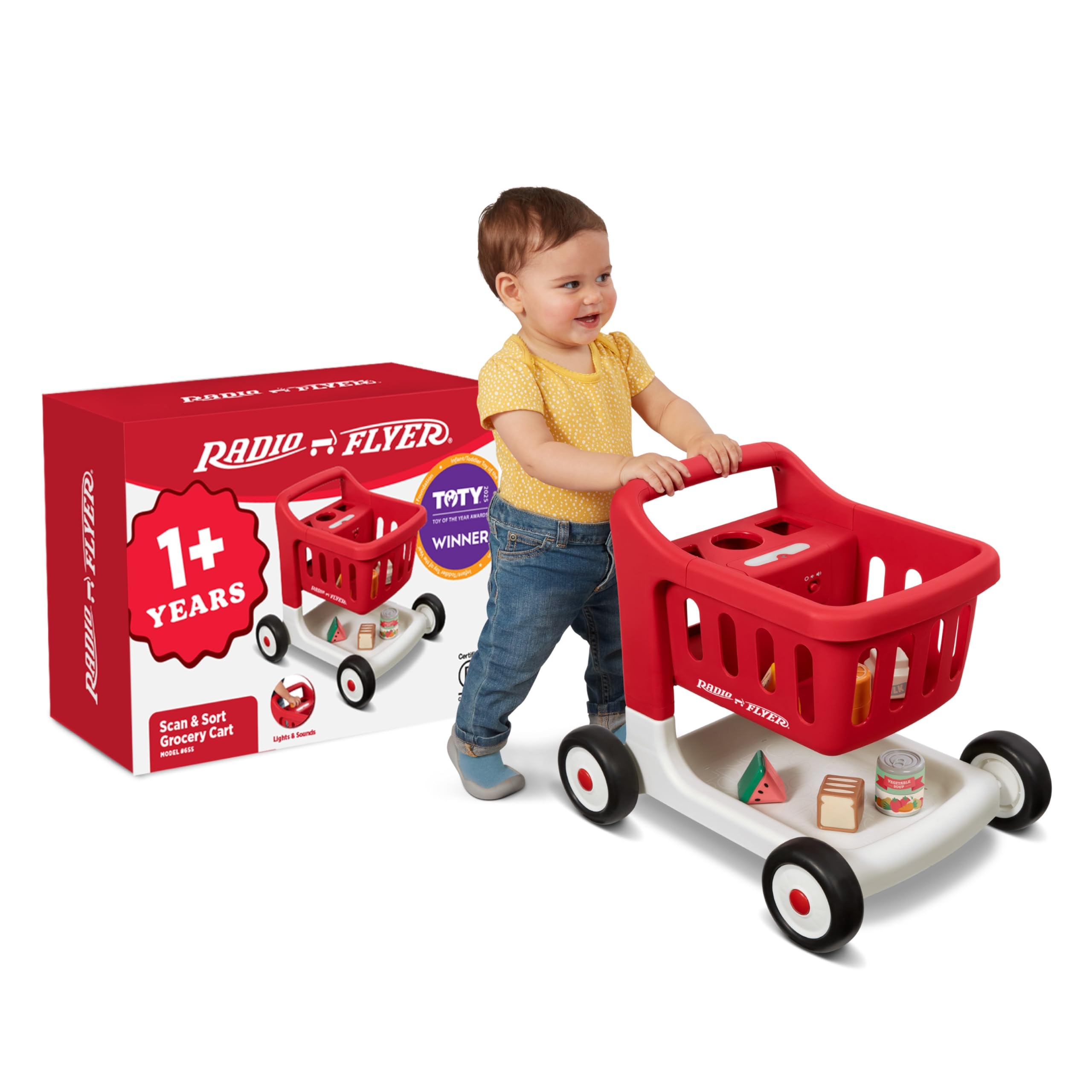
Instead of a generic activity panel, this walker simulates a real grocery-shopping experience: kids scan play food items across a light-up barcode reader that triggers music and sound effects. The six included play food pieces double as shape-sorting blocks that fit into cutouts on the cart’s top, combining pretend play with cognitive problem-solving.
The build quality is noticeably higher than many plastic competitors. The frame uses metal tubing rather than all-plastic construction, giving it a solid heft that resists tipping during enthusiastic pushes. Safety resistance clickers in the rear wheels create gentle friction, so the cart doesn’t race ahead of a new walker. The handle adjusts to three heights (a rare feature at this tier), allowing the cart to grow from a first-step aid to a toddler’s shopping companion well into the preschool years.
The wheels roll smoothly on hardwood and tile but can be slippery on some surfaces — there is no lock mechanism for stationary use. And at 5.8 pounds, it is heavier than many push walkers, which is a trade-off for its durability. Still, for parents who want a walker that doubles as a serious pretend-play toy, the Radio Flyer cart is a standout choice that retains its appeal long after walking is mastered.
Why it’s great
- Metal frame offers exceptional stability and durability
- Interactive scanner with lights and adjustable volume
- Three handle heights accommodate growing toddlers
- Shape-sorting play food adds cognitive challenge
Good to know
- Wheels cannot be locked for stationary play
- Heavier than all-plastic alternatives at 5.8 lbs
- Best suited for hard floors, not deep carpet
3. PULA Baby Push Walker with Wheels Toddler Wagon
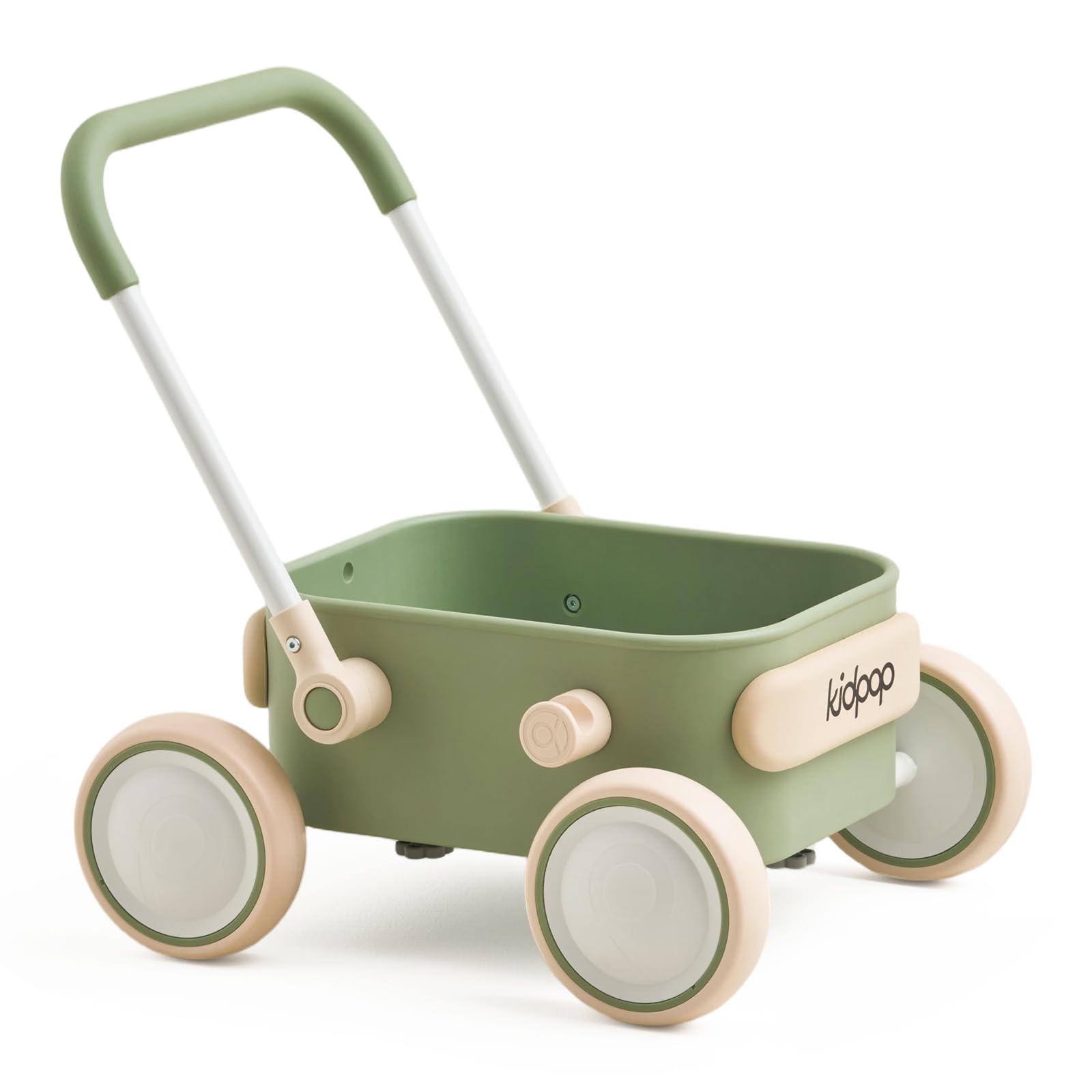
The PULA Baby Push Walker is built differently from the start. Instead of a plastic activity panel on legs, it’s a rugged 2-in-1 wagon that functions as both a push walker and a pull-along cart for toys or even a small child. The low-gravity design places the weight close to the ground, making it exceptionally resistant to tipping — even when a determined toddler leans hard on the handle. The EVA foam wheels are thick, quiet, and shock-absorbing, handling pavement, grass, and indoor tile equally well without scratching wood floors.
Safety is clearly the priority here. The enclosed wheels prevent pinched fingers, and the non-slip handlebar offers a comfortable grip for small hands. The hopper is made from food-grade PP material, so it’s safe for carrying snacks or toys. Assembly takes about three minutes with included tools, and the one-click folding mechanism makes it easy to stash in a car trunk for park trips. The 9.9-pound weight gives it the stability to resist tipping, yet it is light enough for a toddler to push and pull.
The trade-off is that it lacks the electronic activities and musical features of many competitors. There are no lights, sounds, or shape sorters built in — just a beautifully stable rolling wagon. For families who prioritize outdoor exploration and physical development over digital engagement, that simplicity is actually a strength. It’s also one of the few walkers that doubles as a toy storage bin, keeping the playroom tidy.
Why it’s great
- Low-gravity design resists tipping on uneven ground
- Quiet EVA wheels work on pavement, grass, and tile
- One-click folding for easy travel and storage
- Food-grade PP hopper doubles as toy or snack bin
Good to know
- No electronic lights, sounds, or learning activities
- Heavier than basic plastic walkers
- Best for outdoor use rather than confined indoor spaces
4. Fisher-Price Baby Push Toy 4-in-1 Snack Cart Walker
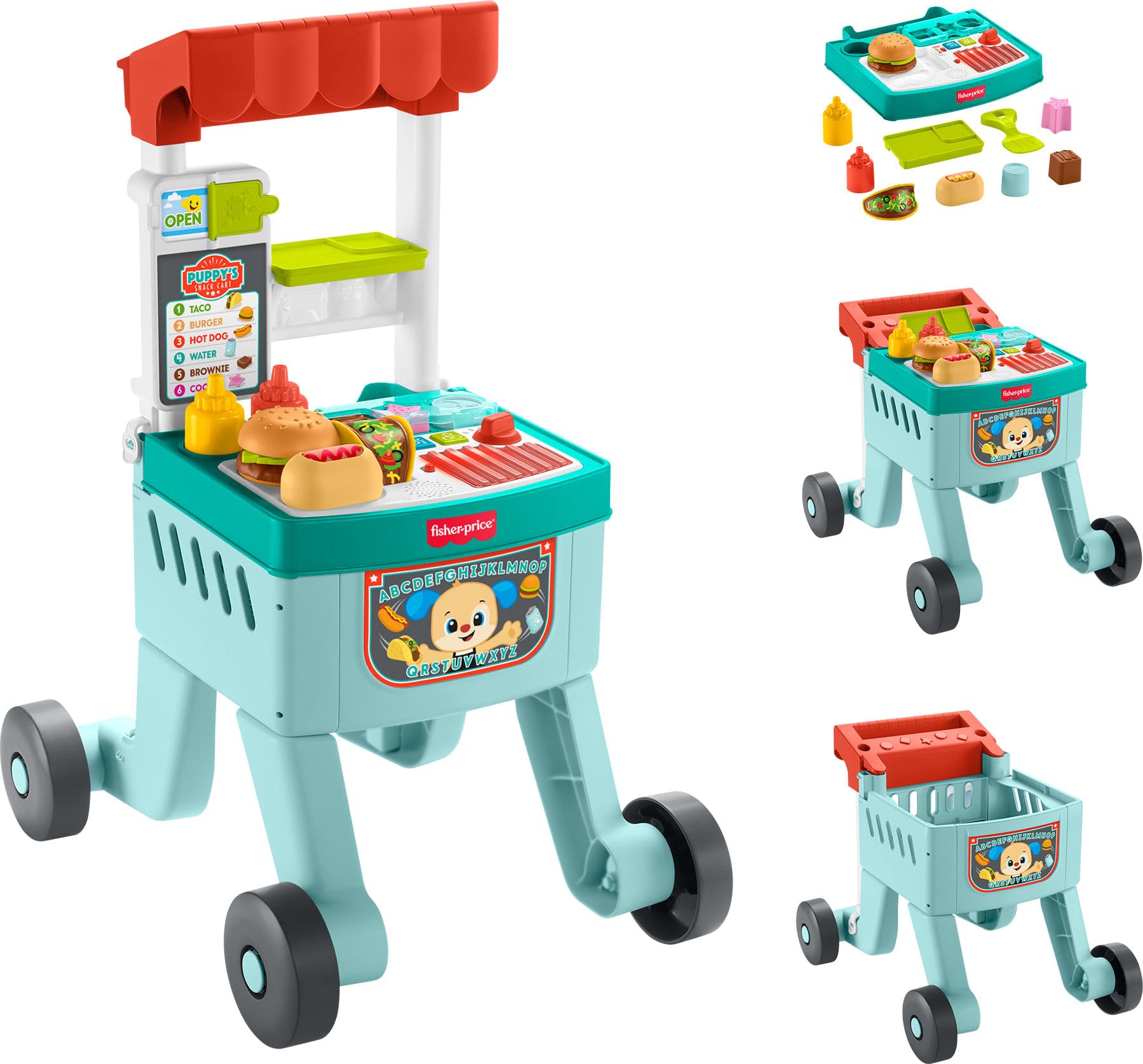
Fisher-Price took the classic snack cart concept and supercharged it with technology. The 4-in-1 Snack Cart Walker offers four play modes — floor play, stationary activity center, push walker, and pretend-play cart — and packs an astonishing 135+ songs, sounds, and phrases into its compact frame. The real headline is the multilingual Smart Stages system, which lets you toggle between English, Spanish, French, and Brazilian Portuguese, teaching opposites, numbers 1-10, shapes, and the alphabet across three learning levels.
The cart comes with 14 play pieces, including play food items that can be “grilled” on the pretend grill or stored in the cooler with a working door. The shape-sorting cutouts on top reinforce cognitive matching, while the push-along mode activates lights and sounds as the cart rolls. The wide wheelbase provides good stability for new walkers, and the lightweight design (3.1 pounds) makes it easy for toddlers to maneuver without struggling against excessive weight.
The sticker decals on the cart have a tendency to peel off quickly, which is frustrating on a toy at this price point. Assembly is required and some pieces snap together tighter than others. But for sheer sensory engagement — lights responding to movement, a full song library, multilingual exposure, and pretend-play props — this Fisher-Price cart offers an unmatched interactive experience that keeps toddlers returning to it long after they have stopped needing the walking support.
Why it’s great
- 135+ songs, sounds, and phrases in four languages
- Smart Stages adapts content to child’s development
- 14 play pieces for extended pretend play
- Lightweight at 3.1 lbs, easy for toddlers to push
Good to know
- Sticker decals tend to peel off with use
- Assembly required with some tight-fitting parts
- Lacks speed control for very fast learners
5. VTech Sit-to-Stand Learning Walker (Blue)
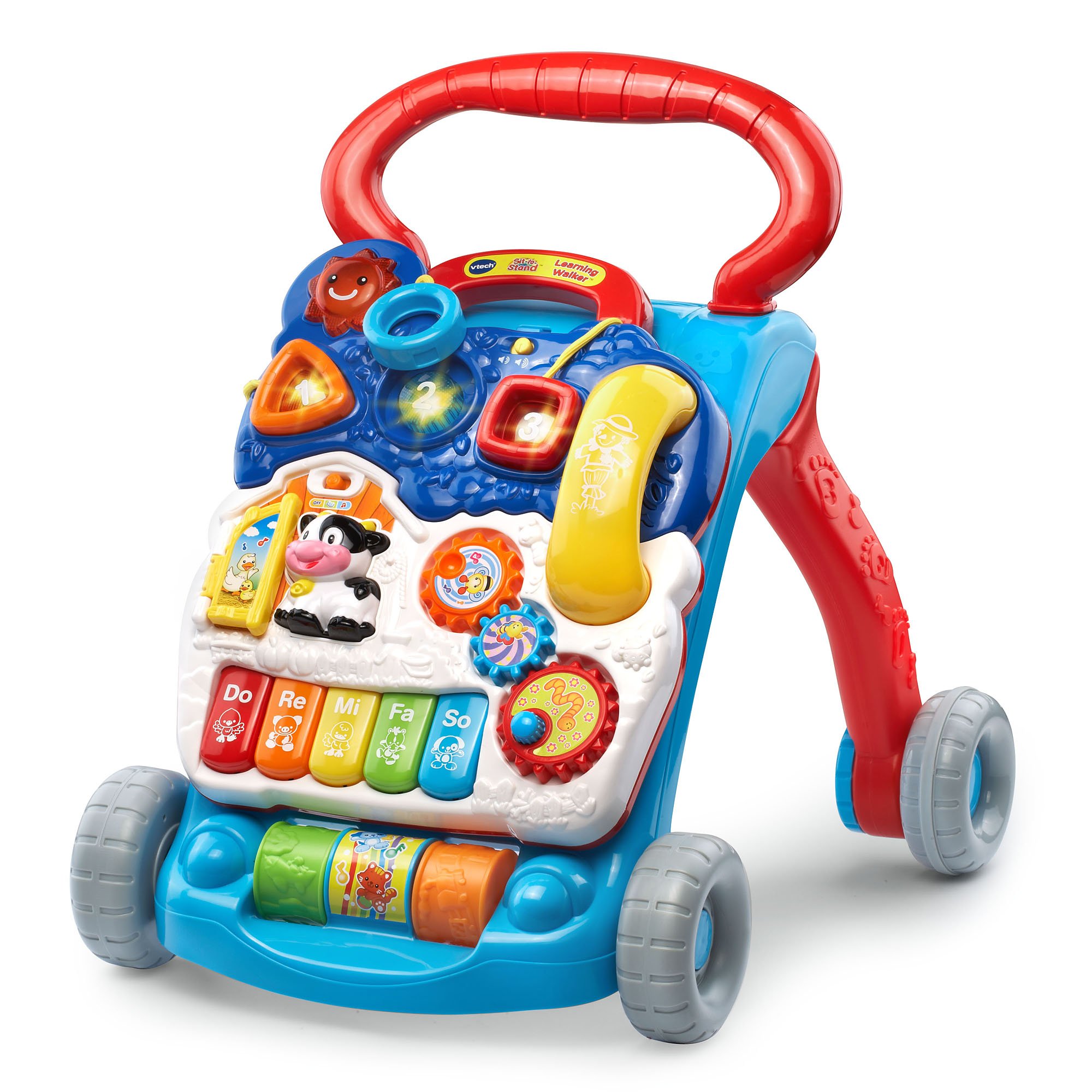
The VTech Sit-to-Stand Learning Walker is the benchmark that other walkers are measured against, and for good reason. Its detachable activity panel works as a floor toy for babies who can sit independently, then reattaches to the walker frame to support standing and cruising. The panel includes five piano keys that play musical notes, a telephone handset for role-play, three shape sorters, light-up buttons, and colorful spinning rollers — enough features to hold a baby’s attention through multiple play sessions.
What makes this walker endure through three kids (as many reviewers attest) is its two-speed control switch. You can slow the wheels for tentative first steps and increase resistance later as your child gains confidence. The wide base prevents tipping even when a toddler leans sideways to grab a toy, and the wheel stoppers on the rear wheels keep the walker from sliding during stationary play. At 4.6 pounds, it is solid without being too heavy for a young child to manage.
The frustration-free packaging is a nice touch, and the 90-day warranty against manufacturer defects offers peace of mind. The plastic construction is durable but can show scratches after heavy use, and the music — while engaging for babies — will likely prompt parents to turn the volume down after the first week. Still, when you need a walker that has been proven across millions of households to actually help babies learn to walk, the VTech Sit-to-Stand is the safest bet.
Why it’s great
- Detachable panel works as an independent floor toy
- Two-speed control prevents runaway rolling
- Five piano keys and phone handset encourage role-play
- Proven durability through multiple children
Good to know
- Plastic shows scratches with heavy use
- Music may be repetitive for adult ears
- Limited to 35 lb maximum weight recommendation
6. Dream On Me Go-Getter Baby Walker with Rear Push Handle

The Dream On Me Go-Getter solves a problem most walkers ignore: how do you guide a child who is not yet confident enough to walk independently? Its unique rear push handle lets parents gently steer and support their baby from behind, giving the child the security of having a caregiver present while they focus on foot placement. This makes it an excellent choice for babies who are hesitant to let go of furniture or who need extra encouragement to shift weight between steps.
The walker offers three height positions to accommodate growth from six to twelve months, and its extra-wide anti-tip base provides reliable stability on hardwood, carpet, and tile. The detachable toy tray doubles as a snack tray for mess-free feeding, and the machine-washable seat pad makes cleanup after inevitable spills simple. The 2-in-1 design converts from a seated activity walker to a walk-behind push mode, and the frame folds flat in seconds for storage or travel.
The toy tray’s music player attachment has some moving pieces that can feel less refined than the corresponding parts on VTech or Fisher-Price models. And at a lighter weight than premium competitors, it may not feel as substantial under an enthusiastic toddler’s weight. But for the parent who wants to be directly involved in the walking process — offering a guiding hand without having to bend over constantly — the Go-Getter’s rear handle is a genuinely useful innovation that no other walker in this lineup provides.
Why it’s great
- Rear push handle allows direct parent guidance
- Three height positions adapt to growing baby
- Folds flat for easy travel and storage
- Machine-washable seat pad for easy cleaning
Good to know
- Music player attachment has loose-feeling pieces
- Lighter frame may feel less sturdy than premium models
- Toy tray lacks the variety of activity-focused walkers
7. VTech Sort and Discover Activity Wagon (Red)
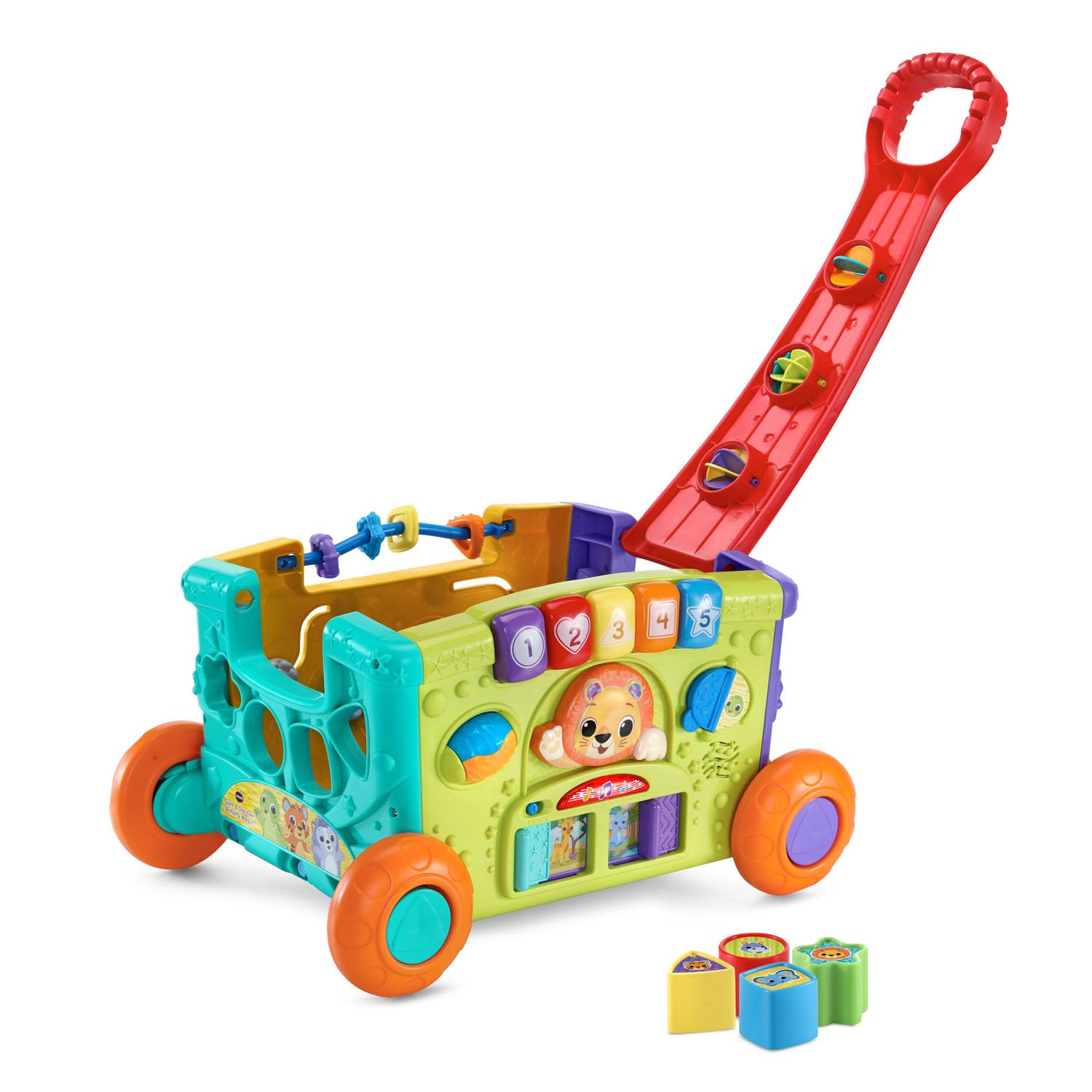
VTech’s Sort and Discover Activity Wagon takes a different approach: instead of being a traditional walker frame, it is a wagon with activities on every side. Each of the four vertical sides contains a different activity — shape sorting, gear spinners, activity keys, mazes, and peek-a-boo doors — and the handle folds over to create a fifth play surface on top. This design encourages children to engage with the toy from all angles rather than just pushing forward, promoting problem-solving and fine motor exploration.
In push/pull mode, the wagon rewards kiddos with cheerful music and sound effects as they roll, adding auditory feedback that reinforces cause-and-effect learning. The interior cargo space is large enough to hold favorite toys, snacks, or blocks, giving toddlers an incentive to pull the wagon along on discovery missions. At just 3.9 pounds, it is the lightest walkable toy on this list, making it ideal for small toddlers who need minimal resistance to get moving.
The plastic construction is solid for the weight class but does not offer the same heft as the premium options. The wagon’s lightweight design can also mean it tips more easily if a toddler leans too far sideways while reaching for a dropped toy. It is best viewed as an activity-packed push/pull toy rather than a primary walking trainer — perfect for children who are already cruising and need motivation to take more steps, rather than for brand-new sitters. For the price, the sheer variety of activities is hard to beat.
Why it’s great
- Five-sided activity design keeps toddlers engaged
- Lightweight at 3.9 lbs, easy for small toddlers to push
- Interior cargo space for toys and snacks
- Folding handle for compact storage
Good to know
- Lightweight construction can tip with sideways leaning
- Best for toddlers who are already cruising
- No speed control or wheel resistance adjustment
FAQ
At what age should my baby start using a push walker?
Are push walkers safer than traditional baby walkers?
How do I clean a baby push walker with electronic components?
Final Thoughts: The Verdict
For most users, the baby push walker winner is the Skip Hop 4-in-1 Explore & More because it combines four distinct play modes, adjustable speed control, and a rich activity panel that stays engaging from six months to four years. If you want a walker that doubles as a serious pretend-play tool and encourages outdoor exploration, grab the Radio Flyer Scan & Sort Shopping Cart. And for families who need a stable, outdoor-capable walker that can also haul toys, nothing beats the PULA Baby Push Walker Wagon for sheer durability and balance.

Mo Maruf
I created WellFizz to bridge the gap between vague wellness advice and actionable solutions. My mission is simple: to decode the research and give you practical tools you can actually use.
Beyond the data, I am a passionate traveler. I believe that stepping away from the screen to explore new environments is essential for mental clarity and physical vitality.