Our readers keep the lights on and my smoothie glass nicely filled. As an Amazon Associate, I earn from qualifying purchases.
The dream of living or traveling in a van hits a wall the moment summer heat turns your metal box into an oven. A standard household window unit is impractical, and a generator-dependent rooftop model defeats the purpose of off-grid freedom. The solution is a 12V or high-efficiency inverter-based AC system designed specifically for the unique power constraints and roof dimensions of a camper van.
I’m Mohammad Maruf — the founder and writer behind WellFizz. For this guide, I’ve analyzed the electrical draw, BTU ratings, decibel levels, and real-world installation feedback for the most relevant rooftop and split-system air conditioners on the market.
After weeks of reviewing specs and user reports, I’ve narrowed the field to the top contenders for the best ac for van life, balancing cooling power with the battery-friendly operation essential for a mobile setup.
How To Choose The Best AC For Van Life
Selecting the right air conditioner for a van is a different process than buying one for a house. You are balancing limited roof space, a finite battery bank, and the need for whisper-quiet operation. Here are the core factors to evaluate before you cut that roof hole.
Power Source and Consumption
The single most important distinction is whether the unit runs on 12V DC directly from your house battery or requires 115V AC via an inverter. A true 12V DC unit eliminates inverter overhead and typically draws 300–600W at the compressor, making it feasible for a 200Ah–400Ah lithium bank. A 115V AC unit, even with a soft start, will pull 1,500W or more on startup, demanding a larger battery and inverter system. Always check the running wattage, not just the startup surge.
Cooling Capacity and Space
BTU ratings for van ACs range from 10,000 to 18,000. A typical short-wheelbase van (80–100 sq ft) can be adequately cooled by a 10,000 BTU unit, especially one with an inverter compressor that runs continuously instead of cycling on and off. Larger vans or those in extreme desert heat may need 13,500–16,000 BTU. Over-sizing can cause short cycling and poor humidity removal, so match the capacity to your insulated space.
Noise Level and Form Factor
In a van, the AC is often feet from your head. A unit rated at 55dB or higher can be disruptive during sleep. Look for a sleep mode that drops to 40–45dB, and pay attention to whether the compressor noise is a smooth hum or a jarring vibration. Rooftop units save interior space but add height and wind resistance. Mini-splits keep the noisy compressor outside but require more complex installation. Your choice depends on whether you prioritize interior quiet or roof clearance.
Quick Comparison
On smaller screens, swipe sideways to see the full table.
| Model | Category | Best For | Key Spec | Amazon |
|---|---|---|---|---|
| Contrymod 10K BTU | 12V Inverter | Ultra-low power consumption | 300W avg / 44dB sleep | Amazon |
| Outequip Summit 2 (w/heater) | 12V Inverter + Heat | Year-round off-grid use | 45 lbs / 4.5K BTU heat pump | Amazon |
| TURBRO 13.5K BTU | 115V Inverter + Heat | Ducted or non-ducted flexibility | 10″ profile / WiFi | Amazon |
| FOGATTI InstaCool Ultra 16K | 115V High Efficiency | Large vans needing fast cooling | 43dB / 418 CFM | Amazon |
| Dometic FreshJet 3 13.5K | 115V Rooftop | Drop-in replacement for Dometic | 21 SEER / 70 lbs | Amazon |
| Gidrox 10K BTU | 12V Inverter | Smart app control | 40dB sleep / 54 lbs | Amazon |
| Outequip 10K BTU (no heat) | 12V Rooftop | Pop-up campers & small vans | 54dB high / 55A draw | Amazon |
| TOSOT 16K BTU | 115V + Heat Pump | Whisper-quiet all-weather | 43dB / 12.5K BTU heat | Amazon |
| Furrion Chill Cube 18K | 115V Variable Speed | Maximum cooling for large RVs | 18K BTU / 850W draw | Amazon |
| VEVOR 15K BTU | 115V Non-Ducted | Budget-friendly rooftop cooling | 65dB / 129 sq ft coverage | Amazon |
| FOGATTI InstaCool 13.5K | 115V Non-Ducted | Easy installation on standard vents | 59dB / HIPS shell | Amazon |
In‑Depth Reviews
1. Contrymod 10000 BTU 12V DC RV Air Conditioner
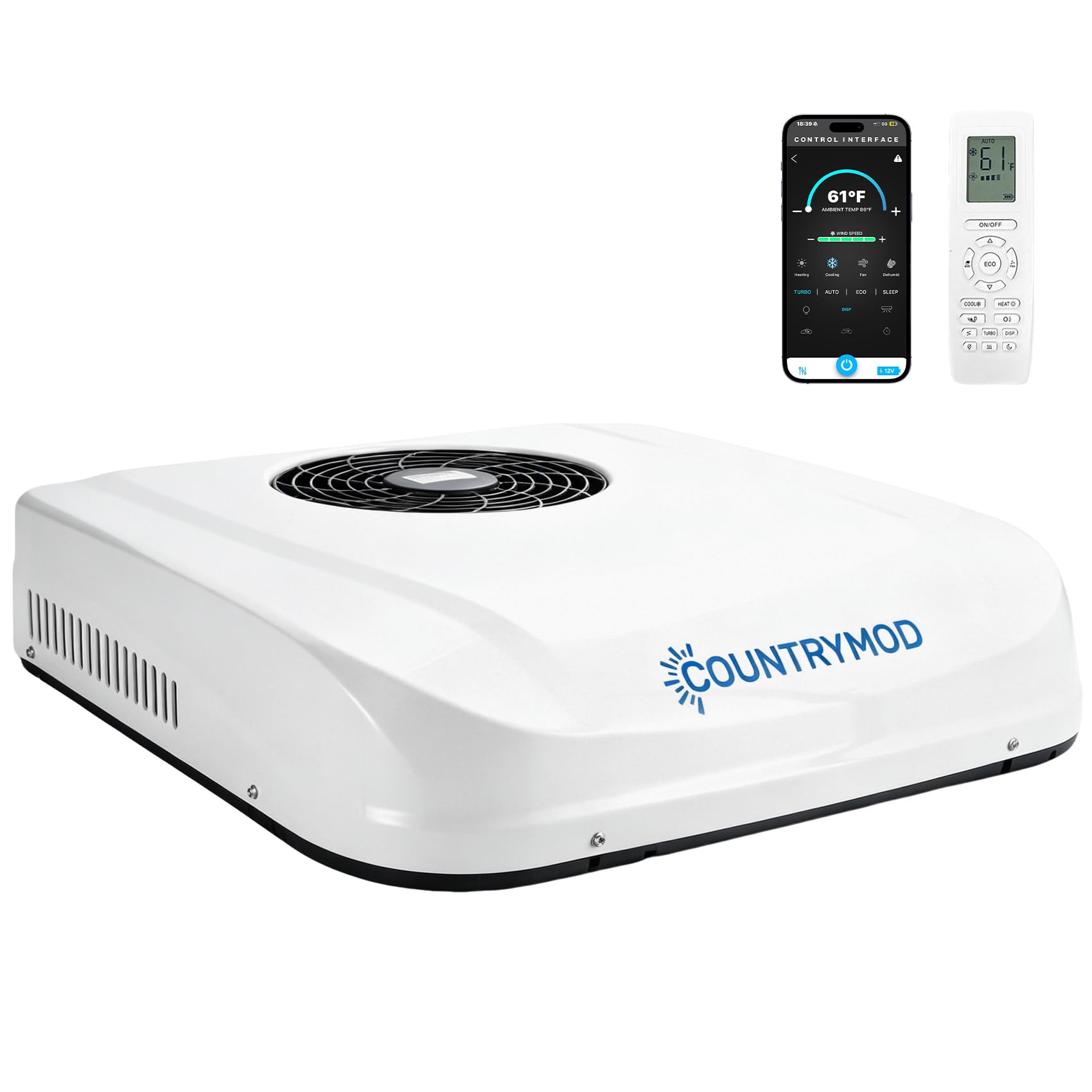
The Contrymod unit is engineered around a horizontal inverter compressor that sips power at a reported 300W on ECO mode and tops out around 900W on Turbo. This power curve is exactly what a van dweller with a 300Ah–400Ah lithium bank needs — real-world users report runtime of up to 10 hours on a single charge. The 10,000 BTU capacity is enough for a standard short-wheelbase van, and the variable-speed design avoids the harsh on/off cycling that kills efficiency and comfort.
Installation fits the standard 14×14-inch roof opening, and at a weight that one installer described as manageable solo, it is a practical DIY project. The noise level is a standout feature: sleep mode registers around 44dB, which is barely louder than a quiet library. Owners who replaced older Dometic units consistently note the dramatic reduction in both decibels and power draw.
The main trade-off is that the included hardware assumes a standard roof thickness. Builders with arched or thicker roofs (over 2.5 inches) will need to source longer M8 all-thread bolts and possibly shim the duct gap. Customer support from a contact named Tony Allen is frequently praised for quick resolution of any issues, which adds peace of mind for a purchase at this price tier.
Why it’s great
- Extremely low power consumption in ECO mode allows all-night use on modest battery banks.
- Near-silent sleep mode at 44dB preserves the quiet atmosphere of a van interior.
- Direct 12V DC operation eliminates inverter losses and simplifies wiring.
Good to know
- Instructions are sparse; installation relies heavily on YouTube guides.
- Roofs thicker than standard may require longer bolts and additional sealing work.
2. Outequip Summit 2 10000 BTU (with Heater)
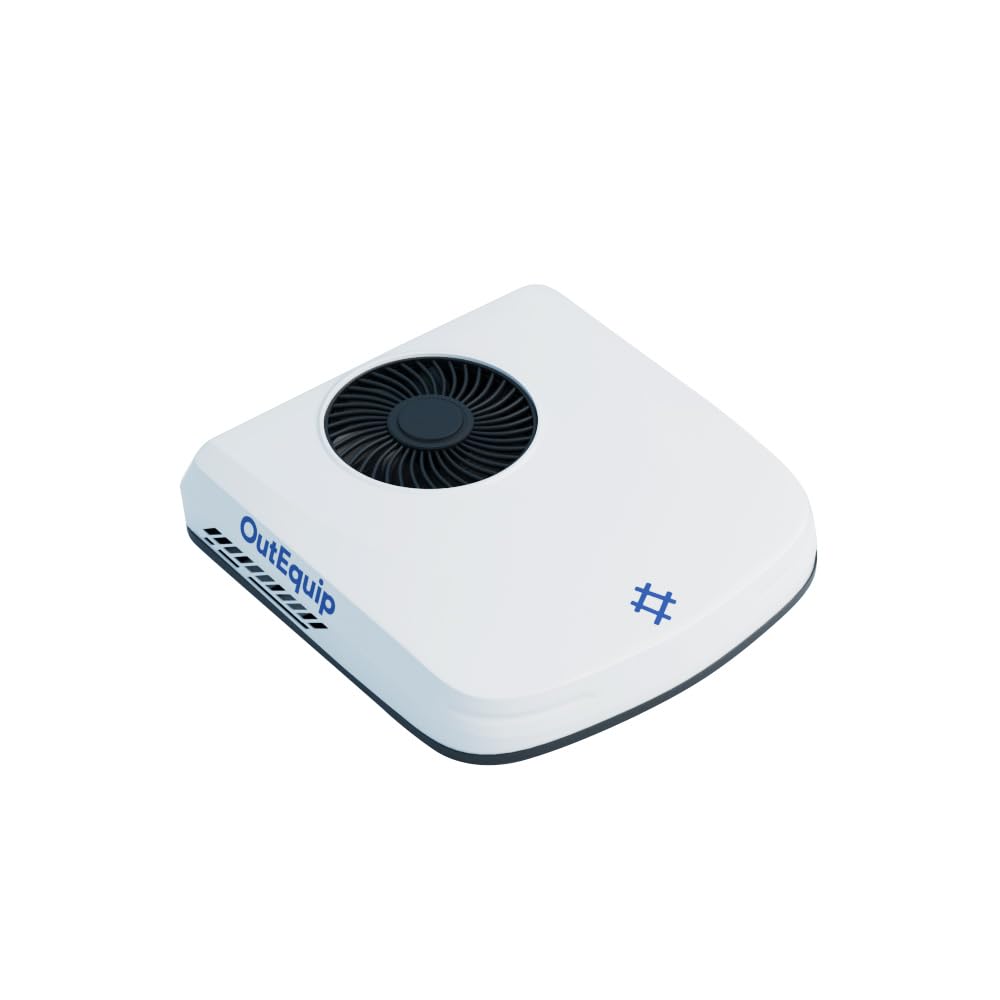
The Summit 2 is one of the most compelling options for the serious off-grid van builder because it accepts 12V, 24V, or 48V DC input without modification. This flexibility is rare and allows it to integrate seamlessly with high-voltage battery banks or existing 12V systems. The inverter-driven compressor draws around 200–300W in eco/idle mode, which is exceptionally frugal, and the 4,500 BTU heat pump provides enough warmth for shoulder-season camping without firing up a propane furnace.
At 45 pounds and only 6 inches of roof protrusion, this is one of the lightest and lowest-profile rooftop units available. The low profile reduces wind drag and center of gravity, which matters for fuel economy and handling. Users report that the unit cools a van from 89°F to 79°F in about 25 minutes, a respectable performance for a 10,000 BTU system. The included remote and multiple modes (ECO, Sleep, Turbo) give full control over power usage.
The heat pump is a supplementary feature — it will take the chill off a cool morning but is not a replacement for a full furnace in freezing conditions. Some buyers noted that the lid connectors are fragile, so careful handling during installation is advised. Overall, the Summit 2 is a premium, intelligent choice for anyone building a solar-powered van that needs both cooling and light heating from a single rooftop unit.
Why it’s great
- Works natively on 12V, 24V, or 48V battery systems without a converter.
- Ultra-low profile and lightweight design minimizes roof load and wind resistance.
- Integrated heat pump adds convenience for mild weather without extra equipment.
Good to know
- Heating output is supplemental only, not sufficient for freezing temperatures.
- Some reports of fragile plastic lid connectors during installation.
3. TURBRO Inverter 13.5K BTU RV Air Conditioner

The TURBRO stands out for its remarkably thin 10-inch rooftop profile — up to 35% slimmer than many competitive units. This is a significant advantage for vans that need to clear low garage doors or bridges. It uses an inverter compressor that draws as little as 9 amps during steady-state cooling and a mere 1.6 amps at startup, meaning it can run on a 1,500W inverter without a soft starter. The heat pump function delivers up to four times the output of a standard electric heater, according to the manufacturer.
Owners report that the unit is a massive upgrade over old Coleman or Dometic units, both in noise reduction and current draw. A buyer using a 600Ah battery bank reported running the unit at 71°F for 13 hours in 95°F weather while consuming only 57% of battery capacity. The WiFi app allows full control of temperature, mode, and timers, plus an integrated LED atmosphere light with three color options adds a custom touch to the van interior.
Critically, some long-term users note that the built-in thermostat can read 10–15°F low because the sensor sits near the cold air outlet, causing the unit to run harder than necessary. This is a design quirk that can be mitigated with a separate external thermostat or smart home automation. The supplied bolts may also be too short for vans with thicker roof builds, so plan for a trip to the hardware store.
Why it’s great
- Exceptional low-profile design at 10 inches tall reduces drag and clearance issues.
- Extremely low startup and running current — works with small inverters and battery systems.
- Inverter heat pump provides efficient heating down to around 19°F ambient.
Good to know
- Built-in thermostat location can cause inaccurate temperature readings.
- Bolts may be too short for non-standard roof thicknesses.
4. FOGATTI InstaCool Ultra 16K BTU
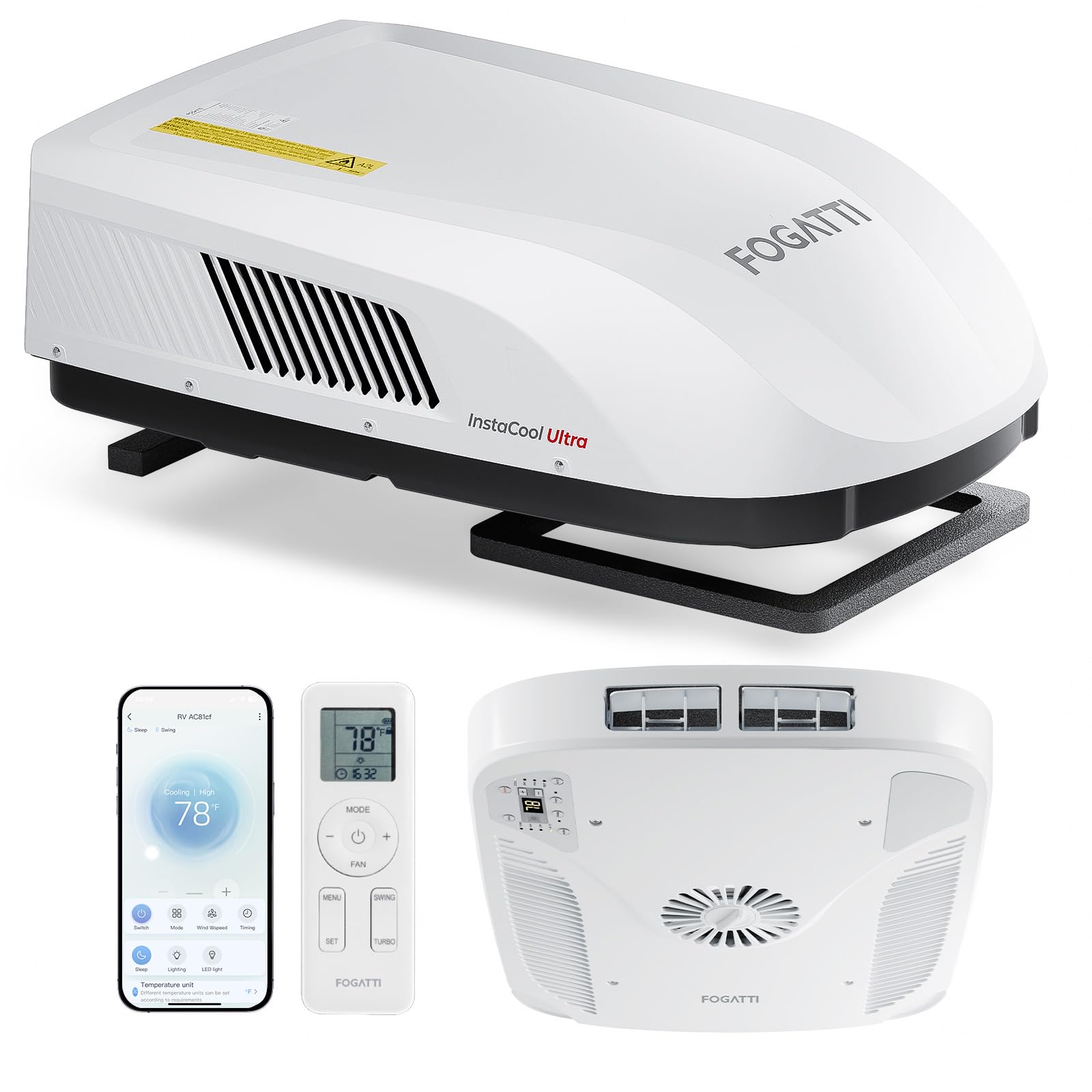
For larger vans or those in extreme heat climates, the Fogatti InstaCool Ultra delivers 16,000 BTU of cooling power through a dual-motor, triple-fan system that pushes 418 CFM. This translates to noticeably faster cooling — owners report a comfortable temperature drop in about 10 minutes. The unit also includes a heat pump, making it a true four-season solution for a van conversion. With an EER of 11.8, it manages to maintain high efficiency despite the output.
At 43dB, this is one of the quieter high-capacity units available. It is designed for a standard 14.25×14.25-inch roof cutout and requires a 15 or 20-amp breaker for the 115V AC input. The control options are comprehensive: a touchscreen ADB panel, a standard remote, and a WiFi app for smartphone control. The dual-layer base absorbs road vibration, which helps protect the compressor from the constant shaking of life on the road.
One detail worth noting: this unit is non-ducted but users report that it can be modified with a ducting kit if needed. Some owners found that removing a center vent piece improved airflow, and one report of a fallen duct foil inside the unit blocking airflow highlights the importance of a thorough inspection upon arrival. The Italian-made design has impressed many buyers who say it outperforms legacy name brands in both cooling speed and feature set.
Why it’s great
- High airflow (418 CFM) and 16K BTU capacity cool large vans quickly.
- Extremely quiet at 43dB for a unit of this power.
- Triple control method (touch, remote, app) offers flexibility.
Good to know
- Requires 115V AC power — needs an inverter or shore power to run.
- Some units have had internal duct foil issues that require user correction.
5. Dometic FreshJet 3 Series 13.5K BTU

Dometic is a legacy name in RV cooling, and the FreshJet 3 Series represents a meaningful step forward from their older Brisk II models. The standout spec here is a 21 SEER rating, which is unusually high for a rooftop RV AC and translates directly to lower power consumption for the same cooling output. It delivers higher airflow than competitive units while being 14% lighter than Dometic’s own Brisk II, at 70 pounds.
Users who upgraded from older Dometic units describe the FreshJet as dramatically quieter — 4dB less noise than some competitive models, which is a perceptible difference in a small van. Installation is a plug-and-play replacement for anyone swapping out an existing Dometic unit, requiring no modification to the roof cutout or control box. One owner cooled an RV from 80°F to 64°F in 30–45 minutes, confirming the 13,500 BTU rating is effective for typical van and small RV spaces.
The primary reliability concern from the data is a report of a compressor wire burning out after only two months, with the seller reportedly unresponsive. While this appears to be an outlier among an otherwise positive set of reviews, it is a risk to consider. Additionally, the packaging during shipping has been criticized — units have arrived with cosmetic damage to the shroud, which, while often refundable, adds hassle to an already expensive purchase.
Why it’s great
- Industry-leading 21 SEER efficiency reduces battery drain.
- Direct drop-in replacement for older Dometic rooftop units.
- Noticeably quieter than previous-generation Dometic models.
Good to know
- Shipping packaging can be inadequate, leading to damage in transit.
- Some early failures reported with compressor wiring; seller support inconsistent.
6. Gidrox 10000 BTU 12V DC RV Air Conditioner
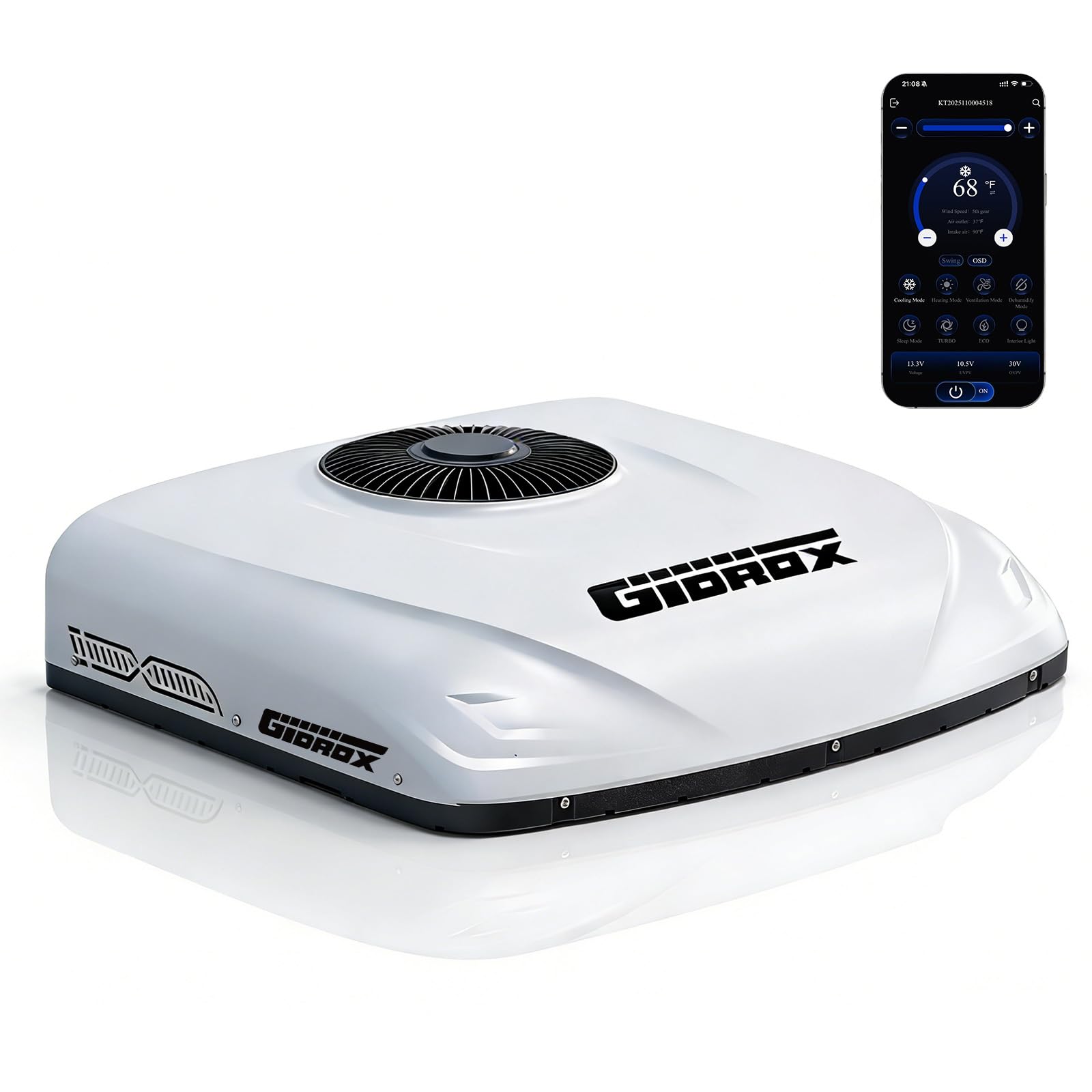
The Gidrox unit is another strong contender in the 12V DC inverter space, offering 10,000 BTU of cooling with a claimed 350W average power consumption during nighttime operation. It promises fast cooling within three minutes, thanks to its inverter compressor. The unit includes a HEPA filter, a dehumidifier mode, and three operating modes (Turbo, ECO, Sleep) that allow fine control over power draw and noise. Sleep mode operates at a library-quiet 40dB.
Control is handled through a smartphone app via Bluetooth, an infrared remote, or the physical panel on the unit. The ability to set timers and switch between Celsius and Fahrenheit from your phone is convenient, especially when the unit is mounted out of easy reach. Installation fits the standard 14×14-inch roof opening and includes a 19.7-foot power cable. At 54 pounds, it is manageable for two people to lift onto the roof.
A detailed power consumption breakdown from one owner shows the dehumidifier mode draws about 250W, ECO mode 350W, Cool mode 420W, and Turbo peaks at 650–700W. This granularity is useful for planning battery usage. Some buyers note that the manual is vague on wiring details and that a full lithium battery bank is a prerequisite — you cannot run this unit on a small AGM battery. Minor plenum trimming may also be needed for a perfect fit.
Why it’s great
- Very quiet sleep mode at 40dB is one of the lowest in this category.
- App control adds convenience for adjusting settings from your bed or driver seat.
- Precise power draw data available across all modes helps with battery planning.
Good to know
- Requires a substantial lithium battery bank (400Ah recommended) for extended use.
- Installation instructions lack clarity; experienced DIYers will fare better.
7. Outequip 10000 BTU 12V RV Air Conditioner (No Heat)
This is the cooling-only version of the Outequip platform, aimed at builders who do not need a heat pump and want to save some cost. It offers the same 10,000 BTU inverter-driven cooling, direct 12V DC power, and a lightweight build at 45 pounds. The unit uses a brushless copper motor fan and spring-supported mounts to keep noise and vibration down, though it operates at about 54dB on high speed — slightly louder than the premium models in this list.
A real-world test in a van showed the unit dropped the interior from 89°F to 79°F in 25 minutes, drawing a peak of 55 amps on Turbo and dropping to around 20 amps on ECO mode. This makes it compatible with a 360Ah battery bank for about 6–7 hours of runtime. The construction uses UV-stabilized ABS materials and a zinc-coated condenser, which should hold up well to years of road exposure.
The installation requires attention to sealing the condenser area to prevent water ingress — a step that some owners felt was not clearly explained in the manual. It fits the standard 14×14-inch opening and includes a remote control with ECO, Sleep, and Turbo modes. For small vans and pop-up campers where weight and roof load are primary concerns, this unit delivers reliable battery-powered cooling at a lower entry price.
Why it’s great
- Lightest option in the roundup at 45 pounds, ideal for low-roof campers.
- Variable-speed compressor draws only 20A on ECO for excellent battery conservation.
- Rugged outdoor construction with UV-stabilized ABS and zinc-coated condenser.
Good to know
- Lacks a heat pump — cooling only, no supplementary warmth.
- Condenser area must be carefully sealed during install to prevent water leaks.
8. TOSOT 16000 BTU RV Air Conditioner

The TOSOT is a powerhouse that operates in ambient temperatures from 23°F to 115°F, making it one of the most versatile units for van life that spans multiple seasons and climates. With 16,000 BTU of cooling and a 12,500 BTU heat pump, it can handle both summer heat waves and chilly spring mornings without needing a separate furnace. The 43dB noise level is almost unbelievable for a unit of this capacity — it is 32% quieter than standard RV ACs, according to the manufacturer.
Installation is straightforward for a non-ducted design, fitting the standard 14.25×14.25-inch roof opening. The WiFi connectivity is powered by the Gree+ app, which allows full control of temperature, fan speed, mode, and timers from anywhere inside the van. A buyer with a 23-foot trailer reported the unit kept the interior at 70°F even when temperatures hit 105°F outside, running on a 5,000W generator.
The main drawback is a recurring concern about post-purchase customer support. One long-term owner reported a rooftop seal leak after a year and found the company unresponsive to repair requests. This is a substantial risk for a unit that requires integration into your van’s roof. The unit also ships in two separate packages, which can be confusing, and you must ensure both arrive before starting installation. For those willing to accept the support risk, the performance per dollar is impressive.
Why it’s great
- Massive 16K BTU cooling and 12.5K BTU heat pump cover extreme temperatures.
- Remarkably quiet at 43dB for a high-capacity rooftop unit.
- WiFi control via the Gree+ app simplifies operation from anywhere.
Good to know
- Customer support and warranty service have received negative feedback from owners.
- Ships in two separate boxes — both must arrive before installation.
9. Furrion Chill Cube 18K BTU Variable Speed

The Furrion Chill Cube is the high-output specialist of this group, delivering 18,000 BTU from a variable-speed compressor that draws approximately 850W while running — roughly half the energy of a traditional 18K unit. This efficiency means it can be run on a Honda EU2000i generator or a substantial solar and battery system, despite its high cooling capacity. The variable-speed design eliminates the abrupt starts and stops that cause power spikes and noise.
Owners report that this unit dramatically outperforms their old 13.5K and 15K units, often cooling a fifth wheel or large RV quickly on a single unit. The ducted design works with standard RV ducting systems, and the aerodynamic rooftop profile reduces drag. The unit is bolt-on and includes a preinstalled gasket, though the ADB (air distribution box) must be purchased separately — a point that has caused confusion for some buyers.
Noise is a mixed bag here: some users find it exceptionally quiet, describing the low fan setting as quieter than a tower fan. Others report a loud compressor vibration that resonates through the entire RV during startup. The unit also lacks a heat strip, so heating must be handled by a separate system. For van builders with very large spaces (over 200 sq ft) or extreme cooling needs, the Chill Cube delivers raw capacity with surprisingly low energy consumption.
Why it’s great
- Highest cooling capacity at 18K BTU with lower-than-expected power draw.
- Variable-speed compressor eliminates harsh cycling and reduces amp draw.
- Aerodynamic low-profile design improves fuel efficiency during travel.
Good to know
- Air distribution box (ADB) is sold separately, adding to the total cost.
- Compressor vibration can be an issue in some installations; no heat function.
10. VEVOR 15000 BTU Non-Ducted Rooftop AC
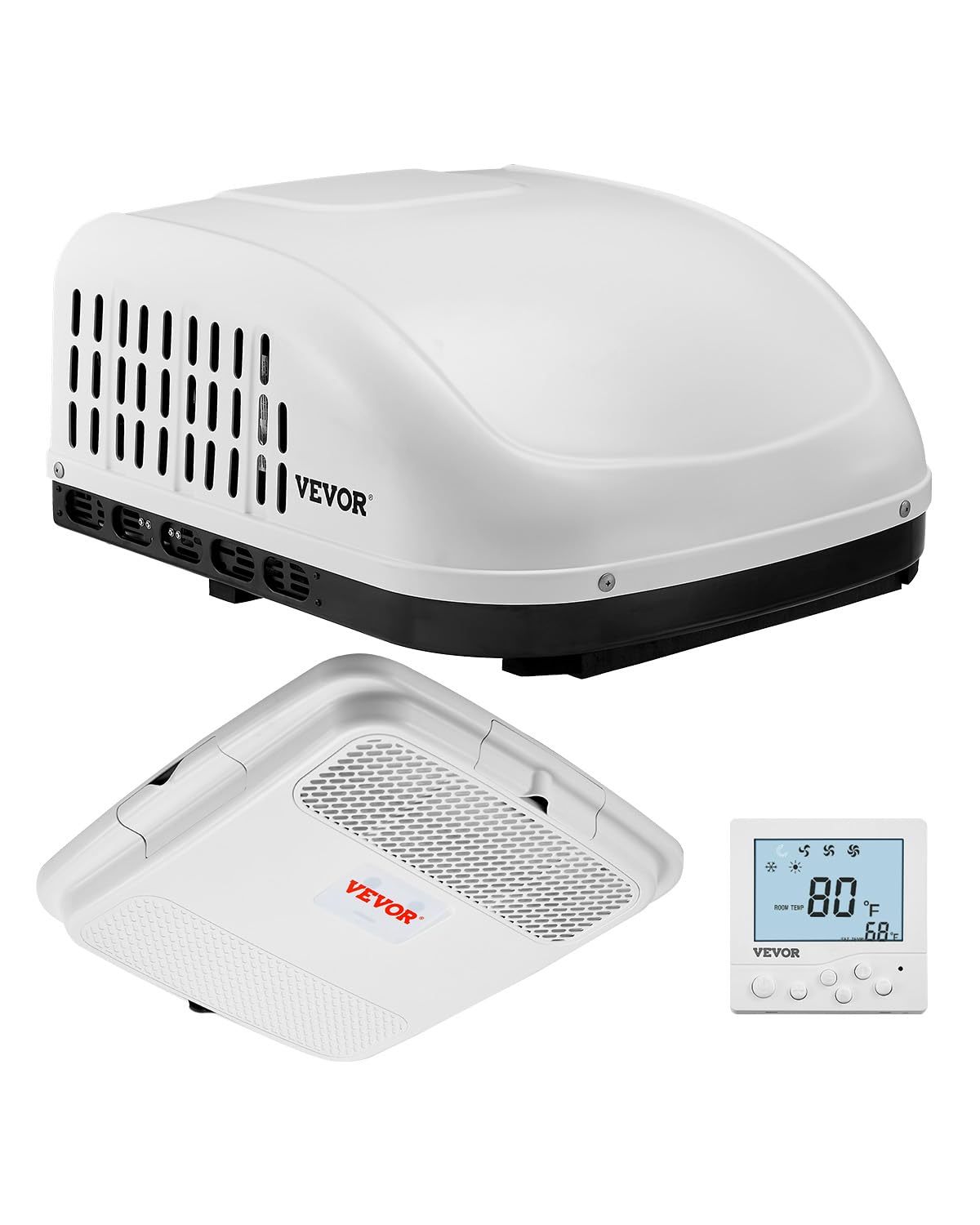
If you need high cooling capacity and are operating on a tighter budget, the VEVOR unit provides 15,000 BTU of cooling power for RVs up to about 129 square feet. It uses R32 refrigerant and a non-inverter compressor, meaning it runs at full power until the set temperature is reached and then cycles on and off. The EPP material shell provides good insulation and is resistant to deformation, which is important for a rooftop unit exposed to sun and rain.
The installation is ductless and fits a standard 14.25×14.25-inch roof vent. It offers three modes (Auto, Cooling, and 3-Speed Fan) along with a timer function. The control panel is straightforward, though some users report the manual incorrectly describes how to switch from Celsius to Fahrenheit. Most buyers found the unit easy to install and effective at cooling, with one user noting it kept their RV several degrees below the thermostat setting.
The biggest concern is the noise level at 65dB — this is notably louder than the inverter-based units in this guide. More critically, one reviewer reported that the unit cycles on and off every 2–3 minutes once it reaches temperature, which is disruptive and inefficient. Another owner had a positive experience, but the build quality appears inconsistent. This unit is best suited for van builders who prioritize budget and cooling power over whisper-quiet sleep and precise temperature control.
Why it’s great
- High 15,000 BTU capacity at a lower price point than inverter models.
- Insulated EPP shell resists heat and physical damage on the roof.
- Fits standard 14.25×14.25-inch roof openings with no ducting needed.
Good to know
- No inverter — compressor cycles on/off, which can be noticeable and inefficient.
- Operation at 65dB is loud compared to quiet inverter competitors.
11. FOGATTI InstaCool 13500 BTU Non-Ducted
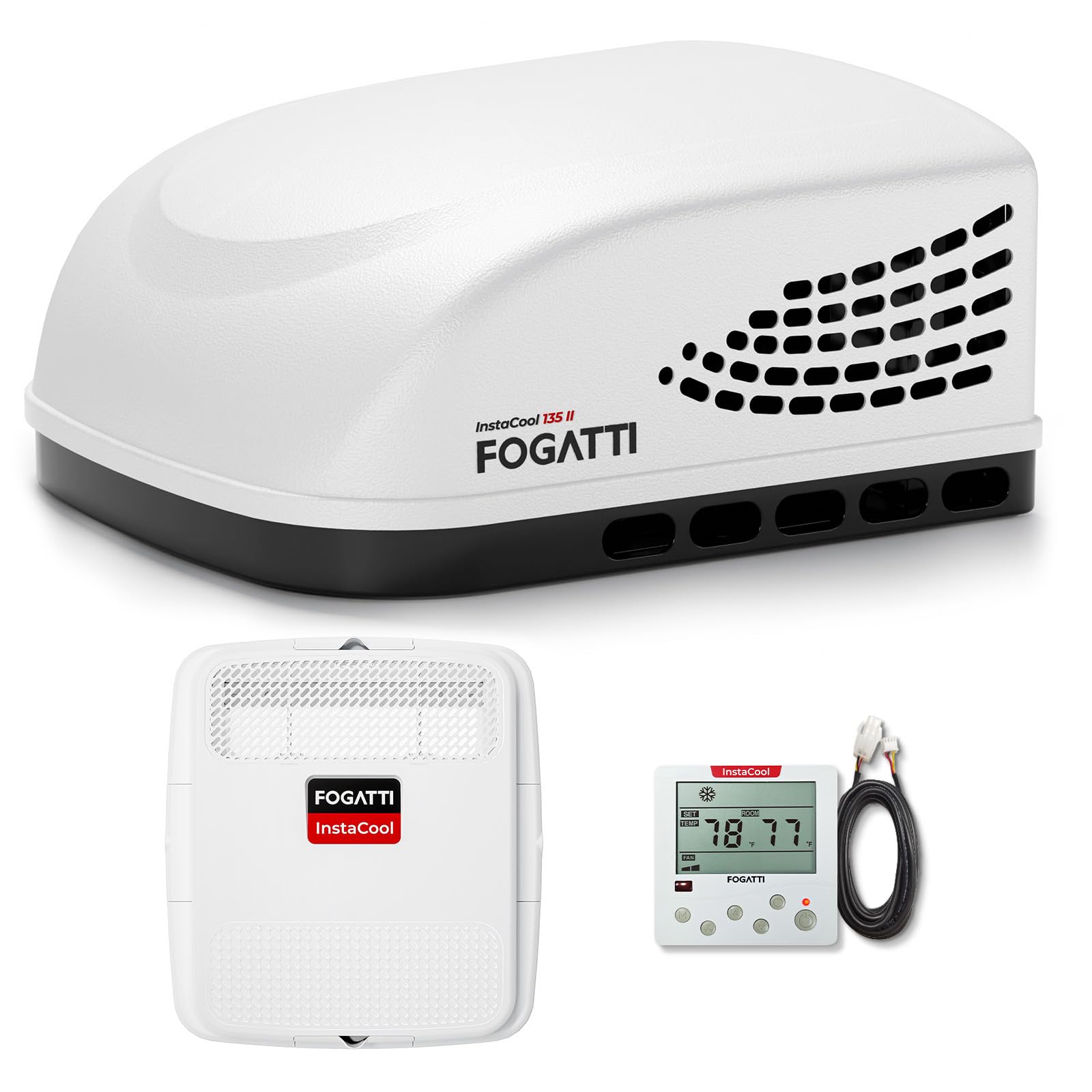
The standard Fogatti InstaCool is a solid mid-range option for van builders who want a straightforward rooftop AC without the complexity of an inverter system. It packs 13,500 BTU of cooling power into a robust HIPS shell that resists impact and UV damage. The dual high-efficiency compressors use R32 refrigerant and are designed to cool a vehicle quickly. It requires both 115V AC and 12V DC connections, meaning you need shore power or a generator to run it.
Installation is described as easy by most users, especially those with prior RV experience. It fits the common 14.25×14.25-inch roof opening and includes detailed guides and a video. The unit is compatible with roof thicknesses from 1.2 to 5.0 inches. Users running food trucks and large campers report that it handles heat well, and the noise level at 59dB is acceptable, though not library-quiet.
The main drawbacks are the size and the power requirements. Several owners note that the unit is physically large (29.5 x 27.6 x 14.2 inches) and may look oversized on smaller vans. More importantly, it cannot run directly off batteries — it needs a generator or campsite hookup. For van lifers who prioritize simplicity and low upfront cost over off-grid capability, this is a reliable, easy-to-install workhorse.
Why it’s great
- Simple installation with clear guide — suitable for DIY builders.
- Durable HIPS shell withstands UV and physical impact well.
- Strong cooling performance reported in food trucks and large campers.
Good to know
- Requires both 115V AC and 12V DC power — not suitable for battery-only off-grid.
- Bulky dimensions (14.2 inches tall) may look oversized on compact vans.
FAQ
Can I run a 12V DC rooftop AC on a 200Ah lithium battery?
What is the difference between a ducted and non-ducted RV AC?
Do I need a soft starter for a 115V RV AC in my van?
How do I seal a rooftop AC to prevent leaks in my van?
Final Thoughts: The Verdict
For most van dwellers prioritizing off-grid battery life and quiet sleep, the overall winner for the best ac for van life is the Contrymod 10000 BTU 12V DC unit because it offers the best balance of low power draw, whisper-quiet 44dB sleep mode, and proven real-world performance on a standard 14-inch roof cutout. If you need a heat pump and multi-voltage flexibility, grab the Outequip Summit 2. And for large vans or extreme climates where raw cooling power matters most, nothing beats the TOSOT 16000 BTU — just be prepared for potential support headaches down the road.

Mo Maruf
I created WellFizz to bridge the gap between vague wellness advice and actionable solutions. My mission is simple: to decode the research and give you practical tools you can actually use.
Beyond the data, I am a passionate traveler. I believe that stepping away from the screen to explore new environments is essential for mental clarity and physical vitality.