Our readers keep the lights on and my smoothie glass nicely filled. As an Amazon Associate, I earn from qualifying purchases.
Digitizing a shoebox of loose photographs used to mean hours hunched over a flatbed, placing each 4×6 print one by one. An auto feed photo scanner eliminates that bottleneck by pulling stacks of photos through an automatic feeder, capturing both sides in a single pass at speeds that turn a weekend project into a lunch-break task. The difference between a scanner that handles delicate glossy paper cleanly and one that jams every third photo often comes down to roller material, paper-path geometry, and the software’s ability to crop without clipping edges.
I’m Mohammad Maruf — the founder and writer behind WellFizz. I spend my time dissecting scanner hardware specifications, comparing feeder mechanisms, and analyzing real-world user workflows to separate the machines that truly stack-feed photos from those that are really better suited for loose-leaf documents.
Whether you are archiving family albums or clearing out decades of client files, the best auto feed photo scanner cuts your digitization time from days to hours by combining a gentle paper path, reliable duplex sensors, and intelligent crop software that treats a photo like a photo, not a receipt.
How To Choose The Best Auto Feed Photo Scanner
Not every document scanner handles photos well. Glossy prints stick to rollers, thin paper can buckle, and auto-crop algorithms often treat a white-border photo as a full-page document, chopping off heads. The three factors that separate a good photo scanner from a great one are feeder design, resolution flexibility, and software intelligence.
Feeder Path and Roller Material
A straight paper path reduces the chance of curling photos, especially for thicker prints like Polaroids or 5x7s. Rollers with a soft, non-stick compound (often silicone-based) grip glossy paper without leaving scuff marks or pulling the emulsion layer. Look for models that advertise a flexible scan path or a direct-feed slot alongside the main tray — this lets you hand-feed fragile or damaged prints when the stack feed is too risky.
Resolution vs. File Speed
Most photo scanners operate comfortably at 300-600 dpi for general archiving. Higher resolutions (1200 dpi interpolated) produce larger files that slow batch processing and fill hard drives quickly. The best approach is to scan at 300 dpi for bulk work and reserve 600 dpi for individual heirloom prints. Some software allows per-document resolution presets, which saves hours when mixing old polaroids with standard 4x6s.
Auto Crop and Image Enhancement
Auto-crop algorithms vary widely. The best models detect the physical edge of each photo, even if the border is white, and crop precisely without stretching. Look for scanners that include edge detection with manual override, dust streak removal (common with photo-feeding mechanisms), and automatic color/contrast adjustments that don’t wash out dark detail. Software that can distinguish between a photo and a receipt is a strong indicator of mature image processing.
Quick Comparison
On smaller screens, swipe sideways to see the full table.
| Model | Category | Best For | Key Spec | Amazon |
|---|---|---|---|---|
| Canon RS40 | Photo Specialist | Photo-first batch scanning | 40 ipm at 300 dpi | Amazon |
| ScanSnap iX2400 | Document Primary | Mixed document/photo scanning | 45 ppm duplex, 100-ADF | Amazon |
| Epson ES-590W | Wireless Workhorse | Office and cloud scanning | 45 ppm duplex, WiFi | Amazon |
| ScanSnap iX2500 | Premium Touchscreen | High-volume mixed environments | 45 ppm, 5″ touchscreen | Amazon |
| Fujitsu fi-8170 | Enterprise Grade | Maximum daily volume | 10k sheets daily duty | Amazon |
| Doxie Pro | Compact Duplex | Home office and receipts | 20-page ADF, duplex | Amazon |
| Canon R30 | High Capacity | Large document batches | 60-sheet ADF, 25 ppm | Amazon |
| Epson ES-C220 | Ultra Compact | Portable desk scanning | 30 ppm, 20-page ADF | Amazon |
| HP PS200 | Lightweight Portable | Travel-friendly scanning | 25 ppm, 25-page ADF | Amazon |
In‑Depth Reviews
1. Canon imageFORMULA RS40

The Canon RS40 is one of the few mid-range scanners designed specifically to handle both photos and documents through a single ADF at a meaningful speed. Its 40-ipm duplex rate matches or exceeds most photo-first competitors, and the bundled software includes red-eye correction and face smoothing that genuinely improve scanned snapshots without manual editing.
Users report reliable batch feeding of 20-30 4×6 photos with few jams over thousands of scans, though dust streaks appear frequently — about every ten photos — and require a quick cleaning swipe. The CaptureOnTouch software auto-crops well and discards blank reverse sides, but its temporary file handling can fill the system drive after several hundred scans, requiring manual cleanup.
At 600 dpi optical resolution with 1200 dpi interpolated, the RS40 delivers sufficient detail for 4×6 and 5×7 prints. The RGB LED light source produces even illumination across the scan bed. For a photo-centric workflow at this price tier, the combination of speed, feeding reliability, and specialized software makes the RS40 the top all-rounder.
Why it’s great
- Dedicated photo enhancement software (red-eye, face smoothing)
- 40 ipm duplex handles mixed photo/document stacks well
- Adjustable per-document quality presets save time
Good to know
- Frequent dust streaks require cleaning every ~10 photos
- Software bug fills C: drive with temp files after ~800 scans
- Photo correction is less natural than Epson FastFoto series
2. ScanSnap iX2400
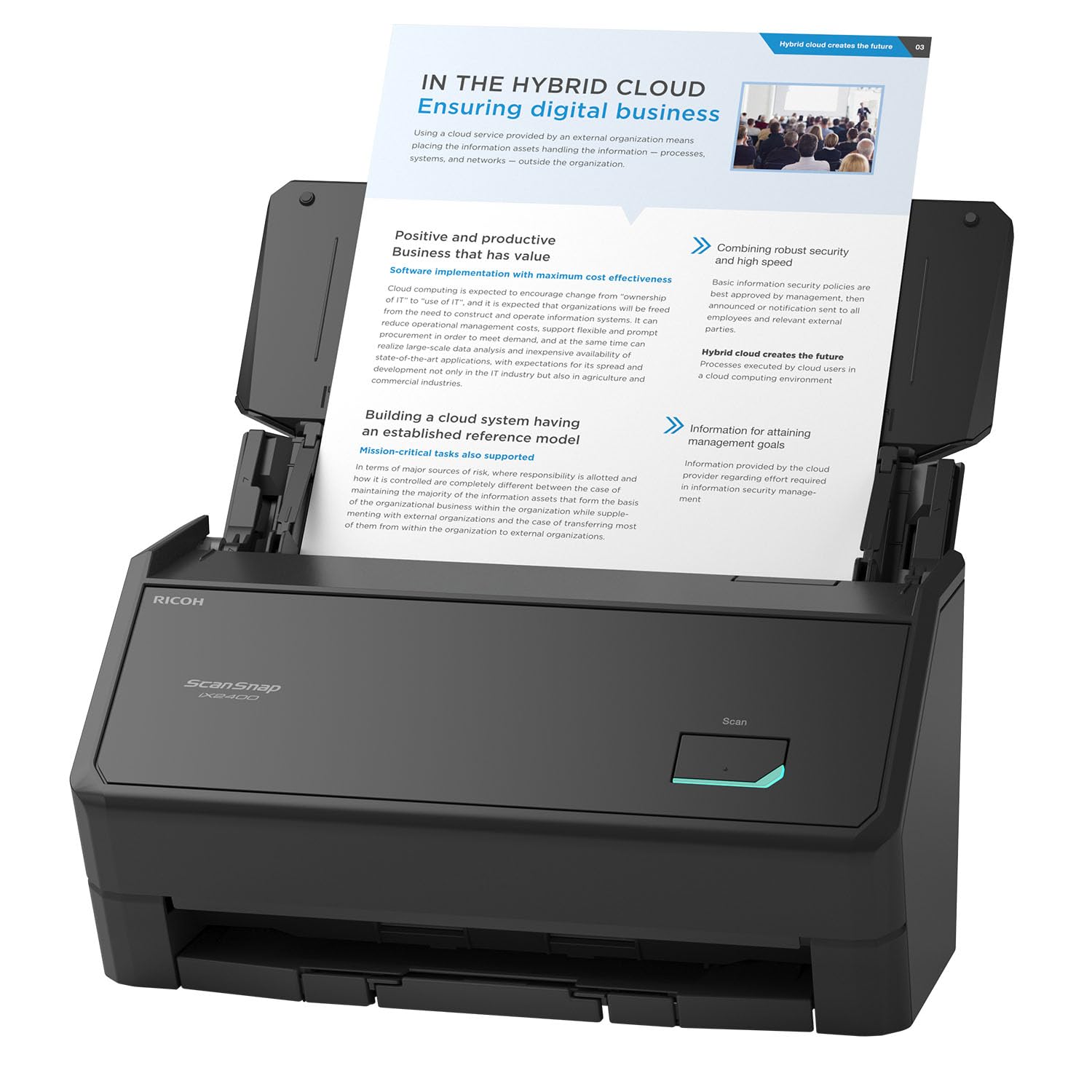
The ScanSnap iX2400 delivers 45 pages per minute duplex scanning at 600 dpi with a 100-sheet automatic document feeder, making it one of the fastest USB-powered scanners in its class. It automatically detects document size, removes blank pages, deskews, and rotates — handling mixed batches of receipts, business cards, and standard photos without manual intervention.
Users uniformly praise the one-touch operation and the near-instant setup. The iX2400 processes a 500-page stack in roughly an hour, though misfeeds occasionally pause and resume without losing the scan order. Some note that the Quick Menu software introduces extra clicks for folder destinations, but the ability to scan directly to searchable PDF offsets the friction.
While primarily a document scanner, the iX2400 handles photos competently in mixed batches. The straight paper path reduces curling, and the auto-crop is accurate for bordered prints. The lack of TWAIN/WIA support limits integration with some third-party apps, but for standalone ScanSnap Home software users, it is a reliable speed demon.
Why it’s great
- 45 ppm duplex is genuinely fast for the price
- 100-sheet ADF reduces reload frequency
- Auto deskew and blank page removal work flawlessly
Good to know
- No TWAIN/WIA support limits third-party app integration
- USB-only connection (no wireless option)
- Occasional upside-down scans require manual re-check
3. Epson Workforce ES-590W
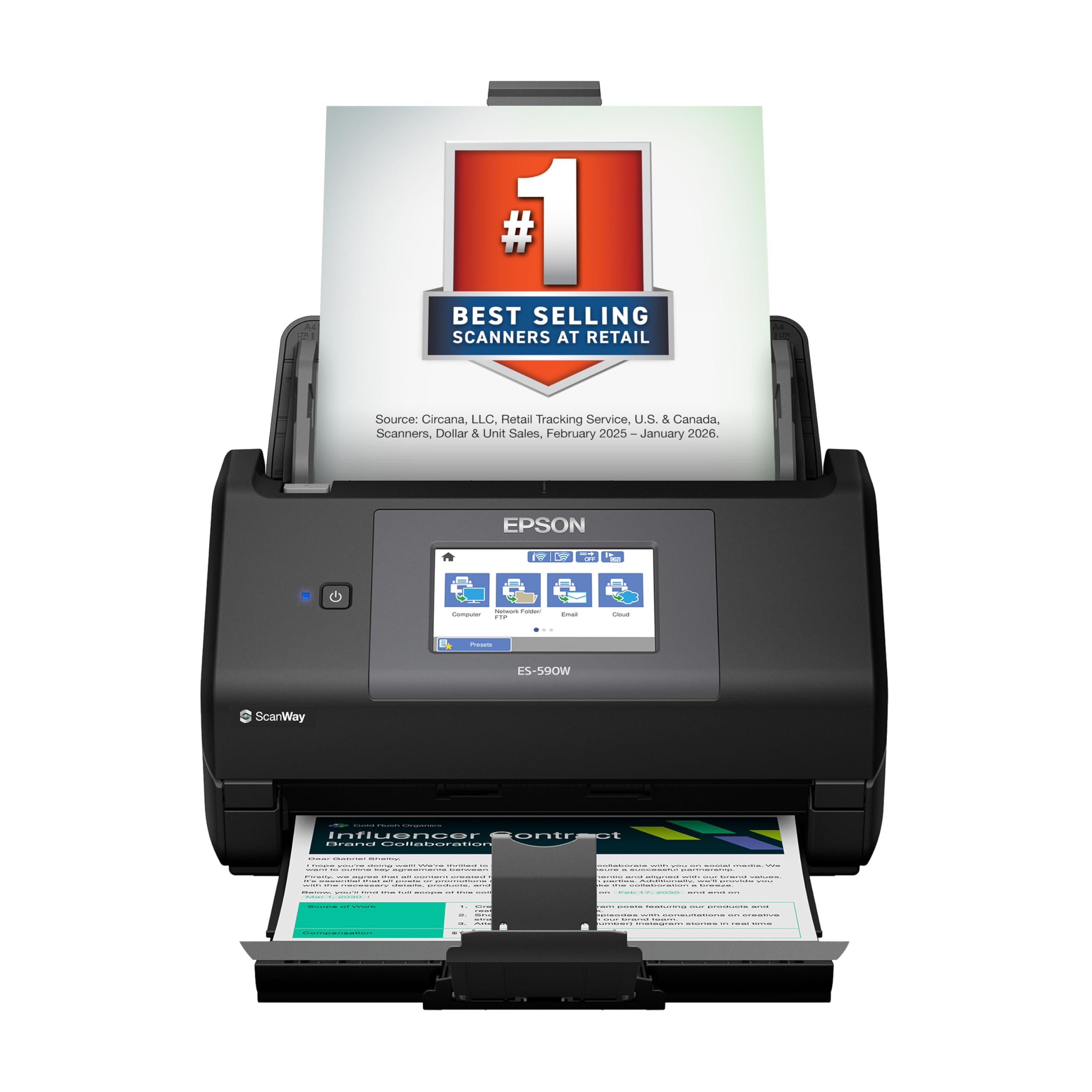
The Epson ES-590W brings Wi-Fi scanning to the desktop without sacrificing speed. Its 45-ppm duplex rate matches the fastest USB-only models, and the built-in wireless allows direct scanning to cloud storage, email, or a connected USB flash drive via the 4.3-inch color touchscreen — no computer required for routing.
Users running high-volume notary and legal workflows report reliable operation with the 100-sheet ADF, and the AI-ready ScanSmart software adds blank page skip, staple detection, and automatic file name suggestion. The scanner handles jam recovery well, pausing mid-batch without losing the page order, which is critical for unattended runs.
The optical resolution is 600 dpi with 30-bit color depth, delivering sharp document scans. Photo quality is decent but not as refined as dedicated photo scanners; the auto-crop can occasionally misjudge bordered prints. The lack of Ethernet connectivity is a minor limitation for office networks, but the WiFi and USB dual-mode covers most use cases.
Why it’s great
- WiFi scanning to cloud/email without a host PC
- Fast 45 ppm duplex with reliable jam recovery
- Large 4.3″ color touchscreen for standalone operation
Good to know
- No Ethernet port for wired office networks
- Photo auto-crop is less precise than photo-specific models
- Setup requires some initial WiFi configuration
4. ScanSnap iX2500
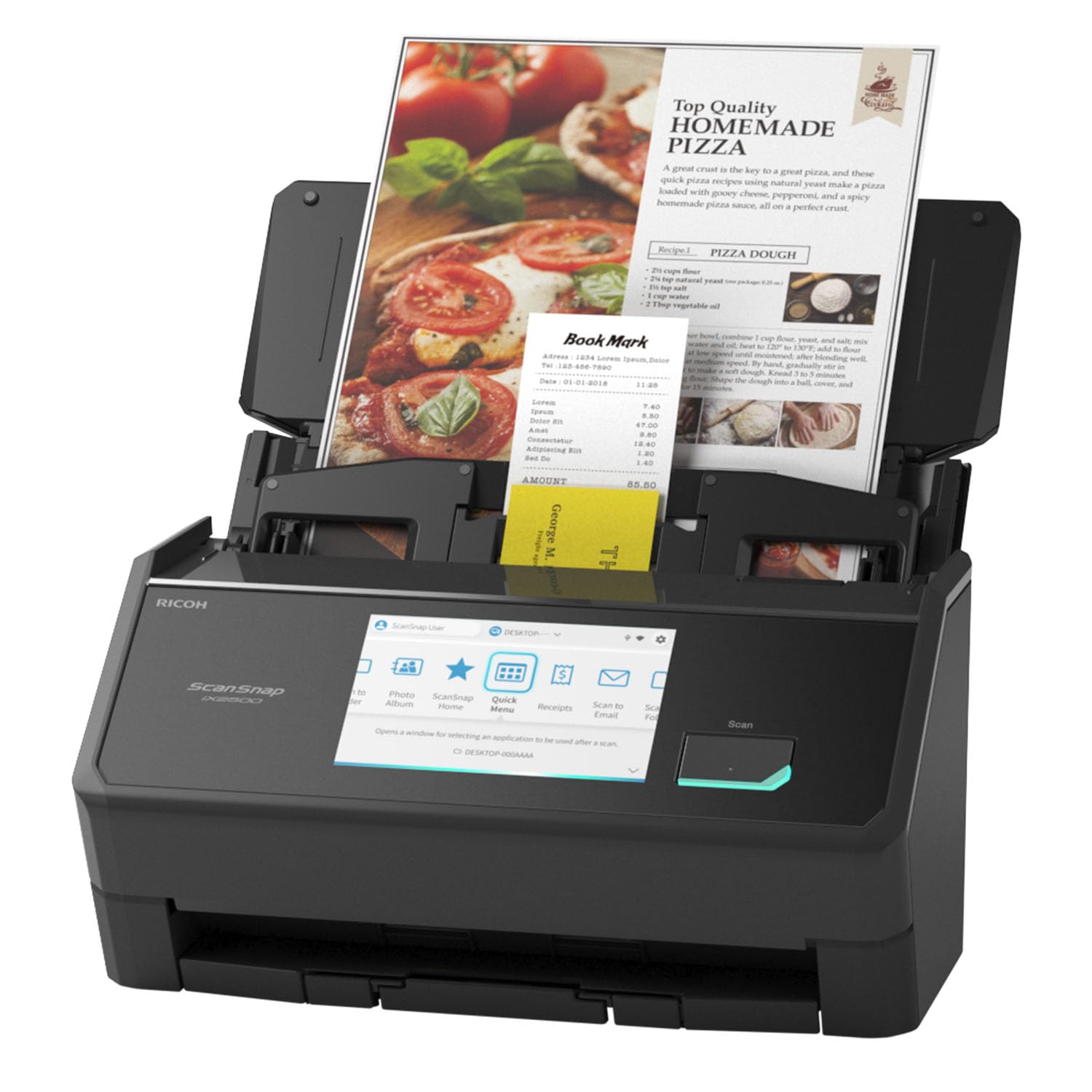
The ScanSnap iX2500 is the most advanced USB and Wi-Fi scanner in the lineup, featuring a 5-inch color touchscreen, 45-ppm duplex scanning, and a 100-sheet ADF. The brake roller system and multi-feed sensor actively prevent paper jams and damage — a critical feature when feeding mixed document batches that include glossy photos and paper receipts.
Users running non-profit organizations scanning over 25,000 pages per year report that the iX2500 handles mixed-size documents and occasional photos without jams. The touchscreen allows personalized profile selection for different scan destinations (PC, Mac, cloud, mobile). Some note that the build feels lighter than the older IX500, and the PDF compression is not very aggressive — a 4-page color scan can reach 1.2-1.5 MB.
However, several users explicitly warn against using the iX2500 for photos. At 600 dpi (or 1200 interpolated), color accuracy is poor, and the auto-crop can damage the image. This scanner is best considered a document-first device with occasional photo tolerance, not a dedicated photo digitizer.
Why it’s great
- Brake roller system minimizes jams with mixed media
- 5″ touchscreen with customizable scan profiles
- WiFi 6 and USB-C for flexible connectivity
Good to know
- Photo color accuracy is poor; not a dedicated photo scanner
- Build feels lighter/cheaper than older ScanSnap models
- PDF compression produces larger file sizes
5. Fujitsu fi-8170

The Fujitsu fi-8170 is built for institutional volumes, with a stated daily duty cycle of 10,000 sheets and connectivity options that include Ethernet and USB. It is a rare portable form factor (only 2 inches deep) that still manages to pack a robust ADF, making it suitable for both desktop and mobile scanning operations in legal, medical, or archival settings.
Users coming from older Fujitsu units (fi-6130) report that the fi-8170 is equally durable and significantly faster. One user scanned 15,000 family photos with excellent clarity and no hardware issues. The software, while powerful, has a steeper learning curve than consumer-grade alternatives, and internal configuration for advanced features can be cumbersome.
The 600 dpi optical resolution is standard for this class, but the fi-8170’s paper handling is what sets it apart. It feeds continuously without overheating and handles varying paper weights reliably. However, users scanning trading cards or sleeved items report damage — the rollers can pull sleeved cards apart and leave wheel marks on bare cards.
Why it’s great
- Built for 10,000 scans per day with no thermal throttling
- Ethernet and USB connectivity for network deployment
- Proven reliability from Fujitsu’s professional line
Good to know
- Software configuration is complex for non-IT users
- Can damage sleeved trading cards or unprotected glossy items
- Large physical footprint despite “portable” branding
6. Doxie Pro

The Doxie Pro is a compact duplex scanner with a 20-page ADF and direct-feed slot for thick or delicate paper, including single photo sheets. Its software handles automatic cropping, rotation, and contrast boost, and scans can be sent directly to Dropbox, Evernote, OneNote, and iCloud without complicated driver setup.
Users love the 5-minute setup and the fast duplex scanning for good-quality paper. The scanner handles wrinkled documents well, though glossy map photos may require contrast/gamma adjustments via the real-time software controls. The 600 dpi maximum resolution is sufficient for receipts, invoices, and standard photos, but not archival-grade prints.
The Doxie Pro lacks an SD card slot, external battery, and Chromebook support, which limits its standalone use. It is best paired with a laptop where the intuitive software can manage the workflow. For a budget-friendly entry into duplex photo scanning, the Doxie Pro delivers strong value without the premium price tag.
Why it’s great
- Compact footprint saves desk space
- Direct feed slot for delicate single photos
- Excellent software integration with cloud apps
Good to know
- No SD card, battery, or Chromebook support
- 20-page ADF is small for big batches
- Priced higher than some similarly specced scanners
7. Canon imageFORMULA R30

The Canon imageFORMULA R30 prioritizes capacity and simplicity, featuring a 60-sheet automatic document feeder and plug-and-scan operation via USB. The built-in software requires no installation and updates automatically — just connect and scan. Its 25-ppm duplex speed is adequate for large document batches, and the auto-detection of mixed paper sizes works smoothly.
Users report scanning over 1,000 double-sided pages in about 3 hours with no driver setup issues. The auto-duplex function, blank page skip, and continuous operation make it ideal for digitizing large archives of printed materials. The R30 is not designed for delicate photo feeding; it is strictly a document-first scanner best suited for invoices, contracts, and reports.
Some users experienced driver reliability issues on specific Windows configurations, requiring reinstallation on every restart. The scanner also cannot handle bound books or items thicker than standard paper. For straightforward paper document digitization, the R30 offers exceptional per-page capacity at a mid-range price.
Why it’s great
- 60-sheet ADF reduces reloads for big projects
- True plug-and-scan with no software installation
- Auto-duplex and blank page skip work reliably
Good to know
- Not designed for photo feeding (document only)
- Driver instability reported on some Windows systems
- Cannot scan bound materials or thick items
8. Epson Workforce ES-C220

The Epson ES-C220 is designed for desk-space conservation, claiming a 60% reduction in footprint compared to traditional ADF scanners. Despite its size, it delivers 30 ppm duplex scanning (60 ipm) with a 20-page ADF, and the flexible scan path handles document types from standard paper to cards and passports.
Users appreciate the fast setup and the single-step duplex capture, which makes it easy to scan stacks of double-sided documents quickly into a laptop. The included Epson ScanSmart software provides auto-crop, blank page deletion, background removal, and skew correction — all features that improve document quality without manual tweaking.
However, some users report that the scanner only scans one page at a time in certain modes, and there are compatibility concerns with Surface Pro devices running Windows 11, where drivers fail to enable full functionality. The small 20-page ADF means more frequent reloading for larger batches, but for a portable, space-saving scanner, the ES-C220 is a strong performer.
Why it’s great
- Extremely compact desk footprint (saves 60% space)
- Fast 30 ppm duplex for its size class
- Flexible scan path handles cards and passports
Good to know
- Incompatibility issues with Surface Pro Windows 11
- 20-page ADF requires frequent reloads
- Driver limits advanced features on some setups
9. HP Compact Desktop Duplex USB Mobile Scanner (PS200)

The HP PS200 is a lightweight, portable duplex scanner (3.14 lbs, approx 3 inches thin) that fits into a laptop bag. It boasts 1200 dpi resolution (interpolated) with a 25-page ADF and a slim rear tray that folds away when not in use. The integrated HP WorkScan software offers auto-scan, size detection, and basic editing tools.
Users returning from travel report that the scanner fits easily into a briefcase and produces vibrant color scans quickly. The duplex feature works for double-sided documents, and the setup process — unbox, connect USB, install software, scan — takes under 15 minutes. The build feels solid for its weight.
Critical reviews highlight major flaws: the 1200 dpi figure is interpolated; actual scan resolution tops out at 200 dpi in color, which is insufficient for photo detail. Auto-crop randomly cuts photos, and the ADF bulb rear error appears after just days of use. Duplex scanning works only about 5% of the time for some users, and the “Save As” function can freeze and cause data loss. HP does not list this scanner on its main website, complicating support.
Why it’s great
- Extremely portable at 3.14 lbs and thin profile
- Folds flat for storage and travel
- Quick setup and intuitive software for basic scans
Good to know
- 1200 dpi is interpolated; real color limit is 200 dpi
- Auto-crop can randomly cut photos and cause data loss
- Duplex scanning unreliable; frequent error messages
FAQ
Can I use a regular document scanner for photos?
What dpi should I scan photos at for archiving?
How do I prevent dust streaks when scanning photos in a batch?
Final Thoughts: The Verdict
For most users, the auto feed photo scanner winner is the Canon imageFORMULA RS40 because it specifically handles photos in the ADF, includes targeted image enhancement software, and delivers 40 ipm duplex speed at a price that balances capability and value. If you prioritize pure speed and document capacity above photo quality, grab the ScanSnap iX2400. And for wireless convenience with the ability to scan directly to cloud or USB without a computer, nothing beats the Epson WorkForce ES-590W.

Mo Maruf
I created WellFizz to bridge the gap between vague wellness advice and actionable solutions. My mission is simple: to decode the research and give you practical tools you can actually use.
Beyond the data, I am a passionate traveler. I believe that stepping away from the screen to explore new environments is essential for mental clarity and physical vitality.