Our readers keep the lights on and my smoothie glass nicely filled. As an Amazon Associate, I earn from qualifying purchases.
Nothing derails a study session or business meeting transcript faster than a recording filled with chair creaks, hallway chatter, and muffled speech from across the room. The right lecture recorder isolates the speaker’s voice, stores hours of content, and lets you transfer files without hunting for a cable — turning raw audio into a usable reference tool rather than a frustrating chore.
I’m Mohammad Maruf — the founder and writer behind WellFizz. I’ve spent hundreds of hours analyzing audio recorder specs like microphone directionality, DSP noise reduction generations, storage capacities, and battery endurance to separate the devices that genuinely capture clear lectures from those that capture more background hum than substance.
Whether you need AI-powered transcription or a reliable mono workhorse, this guide breaks down the top options for the best audio recorder for lectures to match your specific classroom or conference room reality.
How To Choose The Best Audio Recorder For Lectures
Lecture capture demands a specific balance: enough microphone sensitivity to pick up a professor from the tenth row, intelligent noise processing to filter out HVAC systems and rustling papers, and enough storage so you never miss a 90-minute session mid-semester. Ignoring any of these three pillars leads to recordings you can barely decipher on playback.
Microphone Configuration and Noise Reduction
Mono recorders with a single omnidirectional mic work fine for compact rooms where the speaker sits within a few feet. For large lecture halls, look for dual-microphone or three-microphone (TRESMIC) systems combined with a DSP noise reduction chip — the DSP generation (like DSP 6.0) determines how aggressively the device filters out non-speech frequencies without distorting the vocal range.
Storage Capacity and File Management
A single lecture at high-quality WAV format can consume 200–400 MB. Over a full semester or a series of multi-day conferences, built-in storage of 64 GB or more eliminates the need to offload files weekly. Devices with time-stamped file naming and segment-saving features (splitting a three-hour lecture into 30-minute chunks automatically) make later searching dramatically easier.
Battery Endurance and Power Safety
Continuous recording time matters — 30 hours minimum means you can record multiple full days without recharging. More important is a low-battery auto-save function; losing 90 minutes of a final lecture because the recorder died silently is a risk no student or professional should take. AAA battery models offer instant power replacement, while built-in lithium options require advance planning.
Transcription and AI Features
If you need searchable text, consider whether you want offline transcription (files never leave the device — slower but private) or app-based cloud transcription (faster, higher accuracy, but often requires a monthly subscription after a free tier). Some mid-range recorders now include free offline speech-to-text, removing the subscription cost entirely.
Quick Comparison
On smaller screens, swipe sideways to see the full table.
| Model | Category | Best For | Key Spec | Amazon |
|---|---|---|---|---|
| Sony ICD-UX570 | Premium | Stereo lecture capture with noise cancellation | Stereo recording, microSD slot | Amazon |
| Olympus DM-720 | Premium | Multi-mic fidelity for noisy lecture halls | TRESMIC 3-microphone system | Amazon |
| Yorlu B3 AI Recorder | Mid-Range | AI transcription with cloud backup | 64 GB, 30 hr battery | Amazon |
| TIMMKOO SR1 | Mid-Range | Free offline transcription & mind-mapping | 128 GB, offline AI | Amazon |
| NekSide TY-09V3 | Mid-Range | Compact keychain storage with huge capacity | 140 GB, 1400+ hr record | Amazon |
| Yegolito 128GB Recorder | Budget | Pen-style recording with Type-C direct transfer | 128 GB, 360° mic | Amazon |
| Sony ICD-PX370 | Budget | Simple mono recording with long AAA battery life | 4 GB, 57 hr battery | Amazon |
In‑Depth Reviews
1. Sony ICD-UX570

The Sony ICD-UX570 delivers true stereo recording through dual built-in microphones, capturing the spatial separation of a lecture hall — professor on the left, student questions on the right — with impressive clarity. Its advanced noise cancellation filters out low-frequency room hum, and the Scene Select function lets you quickly switch between settings optimized for lectures, meetings, or dictation.
Storage expands via microSD beyond the included 4 GB, and the built-in USB connector slides out for direct file transfers without a cable. The OLED display makes menu navigation straightforward, and voice-activated recording saves storage by pausing during silences. Battery life reaches around 40 hours, more than enough for a full week of daily lectures.
Reviewers consistently praise the UX570 for field reliability — one buyer mentioned dropping it multiple times inside its included case without missing a beat. The slim, portable form factor slips into a pen pocket, making it the most polished premium choice for students and professionals who demand both stereo fidelity and ruggedness.
Why it’s great
- Crystal-clear stereo recording with active noise cancellation
- Expandable via microSD for unlimited capacity
- Built-in USB for cable-free file transfer
Good to know
- Folders lack independent settings — reconfiguring required when switching between music and lecture recording
- Hold button does not prevent auto-on during charging
2. OM SYSTEM Olympus DM-720
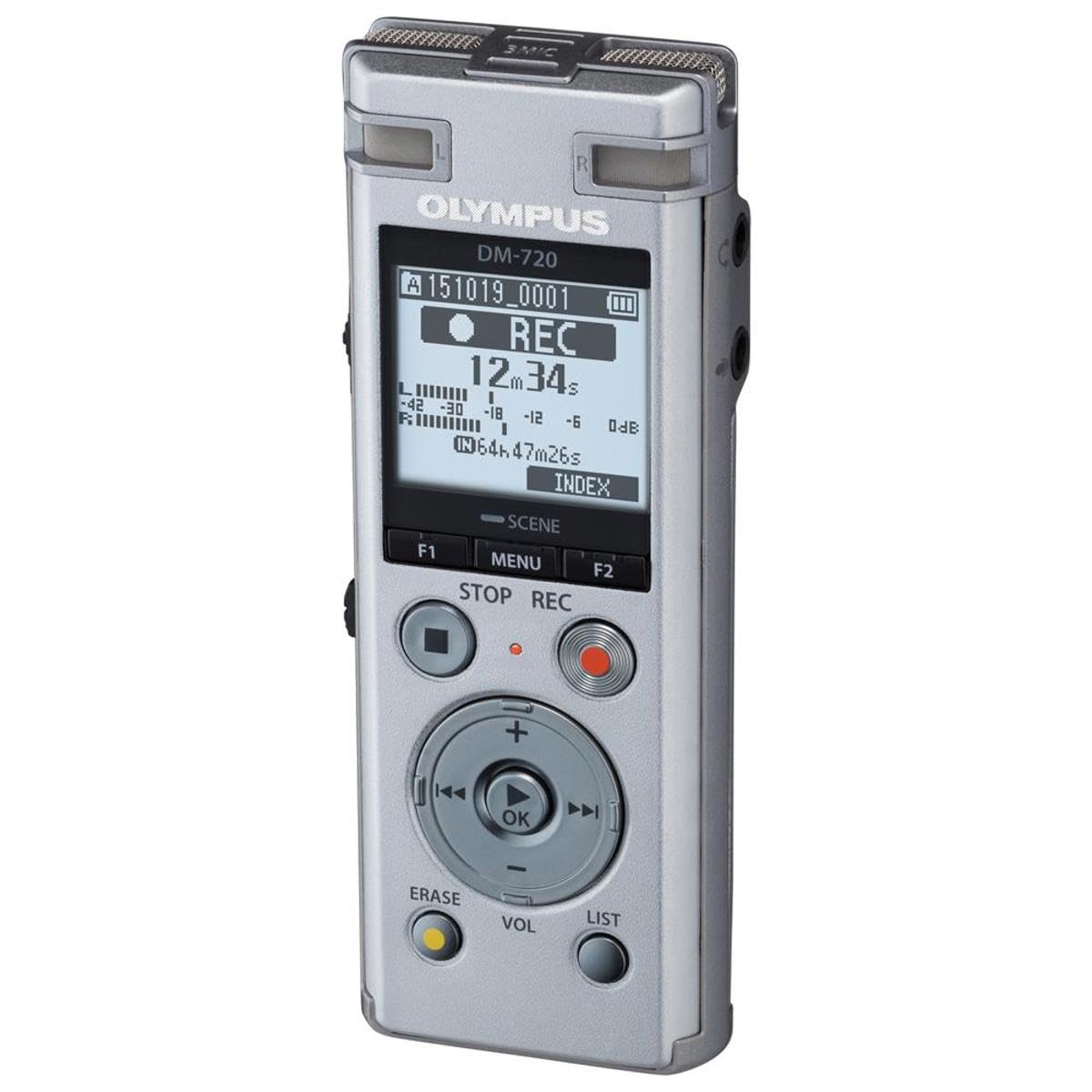
The OM SYSTEM (formerly Olympus) DM-720 uses the TRESMIC three-microphone system — two stereo mics plus a central directional mic — to capture a wide, true-to-life soundscape in 48 kHz/16-bit linear PCM format. Intelligent Auto Mode adjusts sensitivity based on input level, so a soft-spoken lecturer is amplified properly while a booming presenter doesn’t distort.
A low-cut filter eliminates frequencies below 300 Hz, removing HVAC rumble and projector fan noise during recording. With a single AAA battery lasting up to 985 hours (in LP mode), this is the longest-running device in its class. The built-in USB arm folds out for direct PC connection, and the microSD slot supports up to 32 GB of additional storage.
Users upgrading from cheaper recorders report dramatically superior audio clarity in noisy environments — one buyer noted the noise reduction makes it worth the price jump over entry-level Sony models. The thin profile and lightweight design (2.56 ounces) make it a natural fit for travel journals and lecture bags alike.
Why it’s great
- TRESMIC system delivers unmatched spatial audio for large halls
- Low-cut filter removes mechanical background noise at capture
- Exceptional 985-hour battery on a single AAA
Good to know
- Slow startup time between pressing power and being ready to record
- No SDXC support — maximum 32 GB via microSD
3. Yorlu B3 AI Recorder
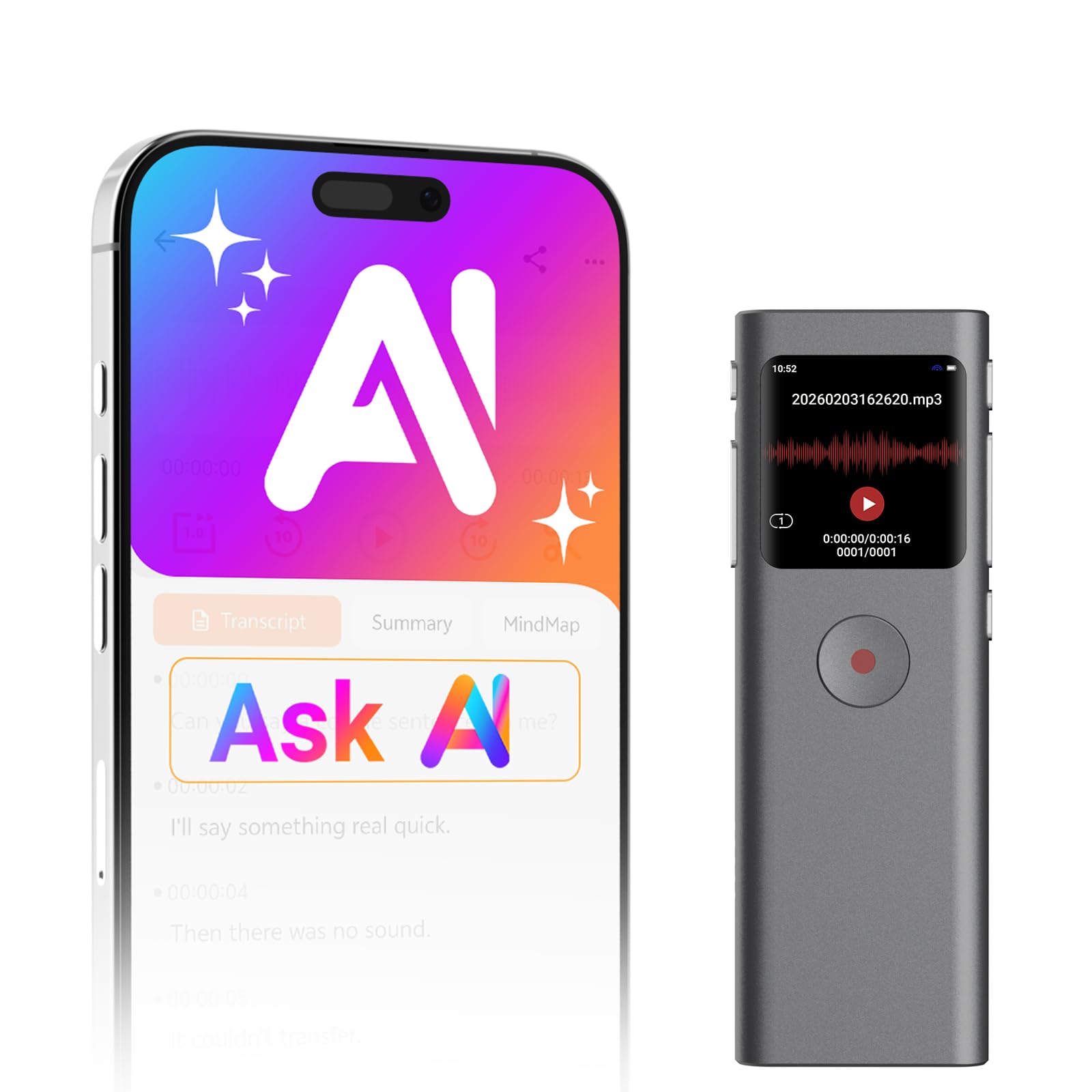
The Yorlu B3 bridges the gap between a standard voice recorder and a smart assistant. Paired with the Boean app, it offers AI-powered transcription, summarization, and mind mapping in over 90 languages, along with an “Ask AI” feature that lets you query specific moments from your recording. Each month starts with 200 free transcription minutes, with upgrade paths for higher-volume users.
The dual high-sensitivity microphones capture 360-degree sound with AI noise reduction, and voice-activated recording pauses during silence to save space. With 64 GB of internal storage holding up to 4700 hours and a 30-hour battery, it handles full-day conferences without recharging. Password protection and optional cloud backup ensure sensitive lecture content stays secure.
User feedback emphasizes the clarity at short distances and the convenience of app-based file management. The compact size fits in a shirt pocket, and reviewers mention it works well for both structured lectures and informal interviews. The subscription model for higher transcription volumes is the main trade-off for those wanting unlimited text conversion.
Why it’s great
- AI transcription and summarization in 90+ languages via Boean app
- Dual-mic 360-degree capture with voice-activated mode
- Password lock protects files if device is lost
Good to know
- Free transcription limited to 200 minutes/month — upgrades cost extra
- Bluetooth file transfer only; no Wi-Fi direct
4. TIMMKOO SR1

The TIMMKOO SR1 stands out for offering full offline AI transcription with no subscription — a rarity at this price point. It converts speech to text in up to 92 languages on the device itself, then applies post-processing tools like proofreading, structured organization, summarization, and even mind-mapping without ever uploading your audio files. This makes it a strong choice for privacy-conscious students and researchers.
With 128 GB of internal storage, the SR1 offers plenty of room for dozens of semester’s worth of lectures. Its multiple recording modes — STT Boost (optimized for speech-to-text), Vocal Boost (voice isolation), and Hi-Fi (full dynamic range) — let you tailor capture to the room size. Scheduled and voice-activated auto recording provide hands-free operation, and the exclusive backup feature creates a duplicate of each recording to prevent data loss.
Some reviewers note that the on-device transcription accuracy isn’t perfect, particularly with heavy accents, and the touchscreen UI has a learning curve. But the core recording quality in noisy rooms is solid, and the lack of ongoing subscription cost makes it a compelling mid-range device for long-term use.
Why it’s great
- Free offline AI transcription in 92 languages, no subscription
- 128 GB storage with automatic backup feature
- Multiple recording modes (STT Boost, Vocal Boost, Hi-Fi)
Good to know
- Transcription accuracy drops with strong accents or rapid speech
- Android-based OS requires reconnection for folder access occasionally
5. NekSide TY-09V3
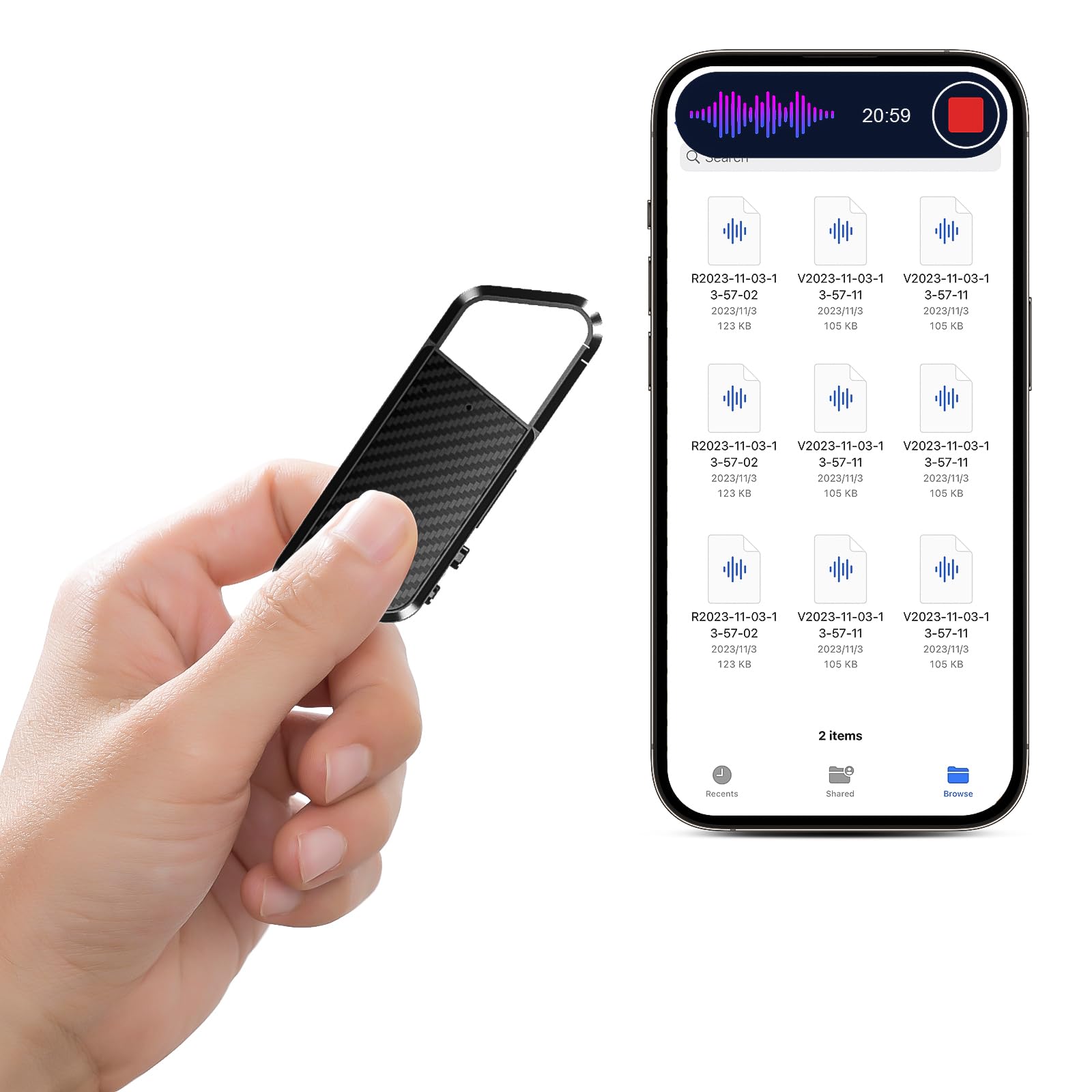
The NekSide TY-09V3 is the storage champion of this lineup, packing 140 GB of built-in memory for up to 21,880 hours of audio. Its keychain-style design is genuinely practical — you can hang it on your keys and never worry about forgetting your recorder at home. DSP 6.0 noise reduction filters out ambient background while preserving dialogue detail, making it a solid choice for busy lecture halls and open-plan meeting rooms.
The integrated OTG feature connects directly to smartphones and tablets for instant file transfer without a laptop. One-touch recording starts instantly from power-off, and the back-labeled buttons make control layout easy to memorize by touch. The compact cylindrical body (0.58 by 6 inches) slides into any bag pocket with no bulk.
Users appreciate the large capacity for long-term storage — one reviewer noted they could record around 800 hours on the device without deleting anything. The battery life supports extended continuous recording, though the Mono microphone means you lose the spatial separation that stereo recorders provide. For pure storage-to-size ratio, this is hard to beat.
Why it’s great
- Massive 140 GB storage for semester-long recording without offloading
- Keychain form factor — impossible to forget or lose
- OTG direct transfer to phone or tablet
Good to know
- Mono recording only — no stereo separation
- Small screen labels are hard to read in low light
6. Yegolito 128GB Voice Recorder
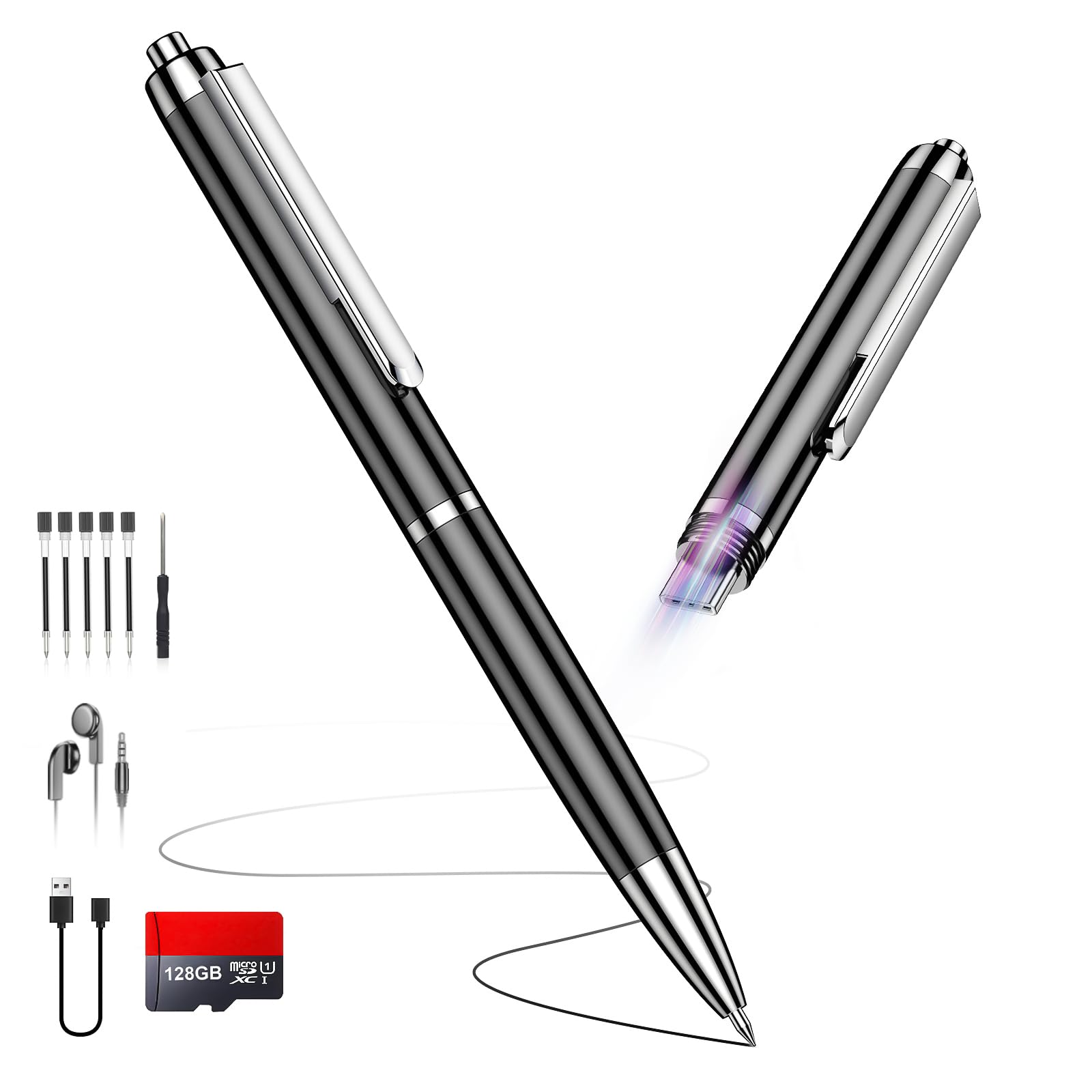
The Yegolito 128GB recorder combines a discreet pen form factor with surprisingly capable internals: a 360-degree omnidirectional microphone paired with a DSP noise reduction chip, 128 GB of built-in storage, and a 35-hour battery. Its one-touch recording mechanism operates like a ballpoint pen click — press to start, press again to save. This makes it a natural choice for students who need to take written notes and record simultaneously.
Voice-operated recording (VOR) pauses when the room goes silent and resumes when speech is detected, automatically condensing pauses out of your final file. The Type-C port built into the device body connects directly to Android phones, iPhones, or PCs for file transfer without any cable. Time-synchronized file naming saves recordings with the exact start time down to the second, and segment-saving splits long recordings into adjustable 10–240 minute chunks.
Buyers highlight the practical design and clear everyday recording quality — one reviewer called it “handy” for fitting into a daily routine without hassle. The included headphones and Type-C adapter expand usability, but the pen-clip feel and small control buttons take a brief adjustment period. For a sub‑mid-range device, the storage and feature set are exceptional.
Why it’s great
- Pen form factor is discreet and doubles as a writing tool
- 360-degree mic with DSP noise reduction for clear capture
- Time-stamped file naming and segment-saving for easy retrieval
Good to know
- Buttons are small — takes practice to operate by feel
- Not professional-grade audio; best suited for everyday lecture use
7. Sony ICD-PX370

The Sony ICD-PX370 is the entry-level standard against which many budget recorders are measured. It records MP3 audio in mono format, offers a built-in USB connector for drag-and-drop file transfer to any PC, and runs on two AAA batteries for up to 57 hours of continuous recording. At 4 GB of internal storage, it holds roughly 60 hours of MP3 audio — enough for a short semester or a week-long conference.
While it lacks advanced noise reduction or AI features, the microphone picks up voices clearly from several feet away, and the simple interface is accessible to anyone. The mono recording format keeps file sizes small, and the 2.5 mm headphone jack (adapter required for standard 3.5 mm headphones) works fine for quick playback review.
Users describe it as a “nice little recorder” — easy to use, portable, and reliable for basic track-your-own-progress or front-row lecture capture. Critics note the instructions are sparse and the build feels plasticky for its price tier. For a straightforward, battery-sipping recorder that just works, this Sony remains a solid fallback.
Why it’s great
- Excellent 57-hour battery on standard AAA cells
- Simple, foolproof interface — no menu diving required
- Built-in USB for quick file transfer without cables
Good to know
- Mono recording only — no spatial audio separation
- 4 GB storage fills quickly with long lectures at high bitrate
FAQ
What is the difference between stereo and mono recording for lectures?
Does more built-in storage guarantee better recording quality?
Can I use a lecture recorder for live transcription without internet access?
Final Thoughts: The Verdict
For most users, the best audio recorder for lectures winner is the Sony ICD-UX570 because it combines true stereo recording, advanced noise cancellation, and expandable microSD storage in a rugged, pocket-friendly design that works out of the box without a subscription. If you need AI transcription without monthly fees, grab the TIMMKOO SR1 for its offline speech-to-text and 128 GB of storage. And for the longest battery life and best multi-microphone spatial capture in noisy halls, nothing beats the Olympus DM-720 with its TRESMIC system and 985-hour endurance.

Mo Maruf
I created WellFizz to bridge the gap between vague wellness advice and actionable solutions. My mission is simple: to decode the research and give you practical tools you can actually use.
Beyond the data, I am a passionate traveler. I believe that stepping away from the screen to explore new environments is essential for mental clarity and physical vitality.