Our readers keep the lights on and my smoothie glass nicely filled. As an Amazon Associate, I earn from qualifying purchases.
Every attic access point is a compromise between a seamless ceiling line and a functional entryway. An attic door that flexes under load, leaks conditioned air, or fights you on the way down undermines the storage or living space it serves. Finding the right balance of structural rigidity, thermal efficiency, and smooth operation transforms a utility feature into a daily convenience.
I’m Mohammad Maruf — the founder and writer behind WellFizz. Over years analyzing home improvement hardware specifications, I’ve focused on the measurable benchmarks that separate a reliable attic access from a constant source of drafts and frustration.
This guide evaluates nine models on hinge strength, step width, insulation value, and real-world stability to help you identify the best attic door for your home’s specific ceiling profile and usage frequency.
How To Choose The Best Attic Door
Selecting an attic door involves more than just measuring the opening. The unit must handle the ceiling height, bear the weight of a person plus cargo, seal against drafts, and operate without binding. These four criteria cover the essential ground.
Opening Dimensions and Ceiling Fit
Rough opening width and length are fixed values set during framing. The attic door you choose must match those dimensions exactly — a gap larger than half an inch on any side requires shimming or frame modification. Ceiling height determines whether the ladder sections are long enough to reach the floor while maintaining a safe angle. Most models list a range such as 7’8″ to 10’3″, and some offer removable sections for fine tuning.
Load Capacity and Step Surface
Weight ratings range from 350 pounds to over 880 pounds. A higher rating typically indicates thicker aluminum stringers and stronger hinges. Step width also matters — narrow steps force an awkward foot angle when carrying boxes. Look for steps at least three inches wide with a textured or embossed surface. A handrail on one or both sides adds a critical third point of contact during descent.
Door Insulation and Sealing
The door panel itself is a thermal weak point. Standard uninsulated doors reduce the ceiling assembly’s effective R-value. Models with a foam core or weather stripping around the perimeter cut air leakage. If the attic is above a conditioned living space, an R-10 insulated door can make a measurable difference in heating and cooling costs. Magnetic or compression latches also help the door sit flush when closed.
Operating Mechanism and Smoothness
Manual ladders rely on springs to counterbalance weight during folding and unfolding. Gas springs or hydraulic dampers provide more controlled motion, letting the ladder descend slowly without a sudden drop. The same system reduces effort when pushing the ladder back into the ceiling. Pull rods and rings located low on the door allow operation without a stool or step ladder.
Quick Comparison
On smaller screens, swipe sideways to see the full table.
| Model | Category | Best For | Key Spec | Amazon |
|---|---|---|---|---|
| Louisville Ladder AL3040MG-R10 | Premium | Energy efficiency & wide access | R-10 insulation, 30″x54″ opening | Amazon |
| VEVOR 63″ Foldable Ladder | Premium | High ceilings (9.5’–12′) | 12 steps, hydraulic rods | Amazon |
| Takpylia Wall-Mounted Stairs | Premium | Wall mount, high capacity | 600 lbs, 12 steps, 5.1″ tread | Amazon |
| VEVOR Adjustable Ladder | Mid-Range | Smooth hydraulic descent | 375 lbs, dual hydraulic rods | Amazon |
| ELTFROH 10-Foot with Cover | Mid-Range | Quiet operation with cover | 375 lbs, 22.5″x54″ opening | Amazon |
| WTRAVEL Pull Down Loft Stairs | Mid-Range | Budget-friendly all-around | 375 lbs, 25″x54″ opening | Amazon |
| WIILAYOK Aluminum Ladder | Mid-Range | Lightweight, easy pull-down | 375 lbs, telescopic design | Amazon |
| Thctvous 10FT Ladder | Mid-Range | Sturdy build, wide rungs | 350 lbs, 3″ non-slip steps | Amazon |
| KWCWB Wall-Mounted Ladder | Budget | Vertical wall mount, high load | 881 lbs, 12 steps, handrails | Amazon |
In‑Depth Reviews
1. Louisville Ladder AL3040MG-R10

The Louisville Ladder AL3040MG-R10 stands apart because it combines an R-10 insulated door with a 30-by-54-inch rough opening — a full six inches wider than many standard units. That larger opening makes a real difference when you are moving storage bins or seasonal equipment. The weather stripping around the perimeter and the foam core door keep attic air from leaking into the room below.
The Type IAA load rating of 375 pounds supports confident climbing even when you are carrying weight. The aluminum frame keeps the overall unit light enough for one person to install, and the pre-drilled holes line up cleanly with standard framing. Users consistently note zero flex under load, which is rare for a ladder in this weight class.
Some users mention that the top five rungs sit close to the door panel, leaving limited toe clearance for larger feet or bulky boots. The handrail is included and the slip-resistant steps provide reliable traction. If minimizing energy loss through the attic opening is your priority, this model delivers the best thermal performance in the group.
Why it’s great
- R-10 insulated door reduces heat transfer
- Wide 30″ x 54″ opening for easy bin access
- Zero flex under full 375-pound load
Good to know
- Top rungs offer limited toe room
- Requires precise 30″x54″ rough opening for flush fit
2. VEVOR Foldable Attic Ladder (63″)

Homes with ceiling heights above ten feet often struggle to find pull-down ladders that extend fully without requiring custom fabrication. The VEVOR 63-inch foldable model handles ceilings from 9.5 to 12 feet, putting it in a unique segment. The 12-step aluminum design with adjustable support legs lets you fine-tune the floor contact height.
The hydraulic rods provide a cushioned descent that prevents the ladder from slamming down. The pull rod and ring system means you do not need a step stool to reach the latch. The insulated door panel also folds flush against the ceiling for a clean appearance. Users with high garage ceilings or loft spaces find this model fits where shorter ladders cannot reach.
A small number of reviewers note that the mounting holes do not always align with standard 16-inch stud spacing, which may require cross-bracing. The unit weighs about 50 pounds, so a second person is strongly recommended during installation. For the ceiling height range alone, this is the most capable option available.
Why it’s great
- Extended range covers 9.5′ to 12′ ceilings
- Hydraulic cushion prevents sudden drops
- Pull rod system allows operation from floor
Good to know
- May need cross-bracing for stud alignment
- Heavy enough to require two-person install
3. Takpylia Wall-Mounted 12-Step Stairs

When the attic doubles as a workshop or heavy storage area, the load rating becomes the primary spec. The Takpylia wall-mounted stairs support up to 600 pounds, which is almost double the typical aluminum pull-down ladder rating. The treads measure 5.1 inches wide — significantly larger than the three-inch steps common on folding models — giving each foot a stable platform during climbs.
The S-shaped folding mechanism uses high-manganese steel springs and carbon steel pedals. The design mounts vertically against a wall instead of folding into the ceiling, which means no rough opening cutout is needed. The included armrests adjust in length and provide a secure handhold on both sides. This is a strong option for basements, garages, or commercial lofts where daily access is required.
Some buyers report that the mounting hole positions do not match standard US framing and require building a cross-brace for a secure anchor. A small number of units have shown distortion after extended use. The pull rod and ring allow easy one-person operation even without a tall ladder nearby.
Why it’s great
- 600-pound capacity handles heavy loads
- 5.1″ treads provide stable footing
- Wall-mount design avoids ceiling cutout
Good to know
- Mounting holes may not align with 16″ studs
- Some reports of shape distortion after months of use
4. VEVOR Adjustable Attic Ladder
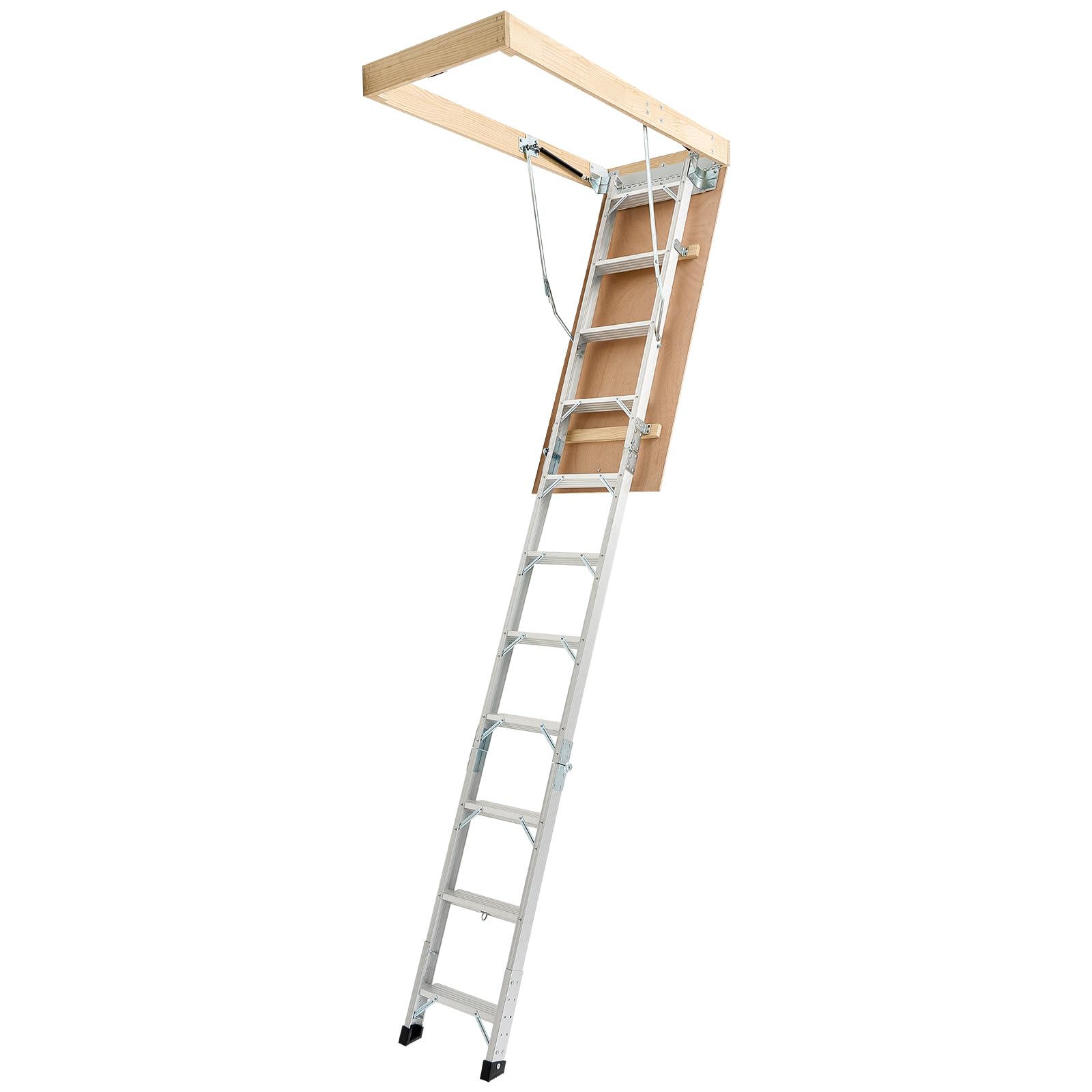
The VEVOR adjustable ladder addresses a common pain point: uncontrolled lowering. The dual-side hydraulic rods let the ladder descend in a slow, steady motion rather than dropping under its own weight. This feature is particularly helpful for elderly users or anyone who finds a traditional spring-loaded ladder difficult to manage.
The ladder fits ceiling heights from 7.66 to 10.3 feet and includes two detachable steps for precise height adjustment. The rough opening is 54 by 22.5 inches with a minimum depth of 4.3 inches. The anti-slip adjustable feet work on various floor surfaces, and the magnetic door panel ensures a tight seal when closed. Users note that the frame remains rigid during the climb with minimal side-to-side sway.
Installers have observed that the packaging could be better and that the instruction sheet is sparse. The ladder requires a load-bearing mounting area, and the fasteners must be anchored into solid framing. The overall build quality is high for the price tier, and the hydraulic mechanism alone justifies the upgrade over a standard spring model.
Why it’s great
- Hydraulic rods provide controlled, slow descent
- Detachable steps allow height fine-tuning
- Magnetic door latches securely
Good to know
- Instruction manual lacks detail
- Must be mounted on a load-bearing area
5. ELTFROH 10-Foot Attic Ladder with Cover
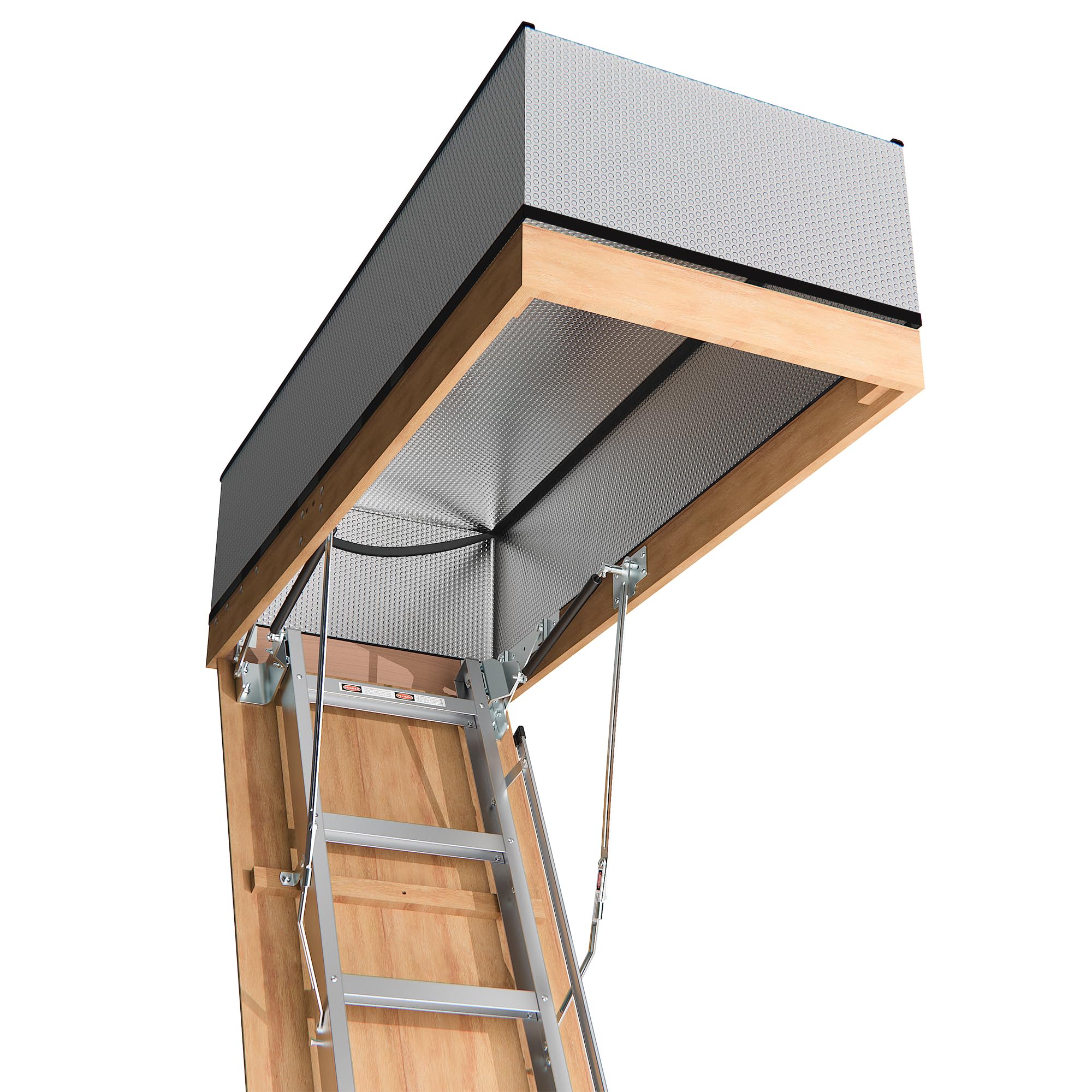
Noise is a real consideration when the attic door sits above a bedroom or living area. The ELTFROH model uses an advanced closing mechanism that operates with minimal rattling. The included cover panel hides the folded ladder and blends with the ceiling texture, so the opening does not look like an afterthought.
The aluminum frame supports a 375-pound capacity with 3-inch non-slip rungs. The integrated handrail and heavy-duty hinges keep the ladder stable during use. The rough opening is 22.5 by 54 inches, which fits standard residential framing. Users replacing old wooden ladders note that this unit feels more rigid and does not creak or groan under load.
The ladder requires trimming the bottom of each leg for ceiling heights between 7’8″ and 10’3″. The 10-foot sections may be slightly long for lower ceilings, but the trimming process is straightforward. A two-person team is recommended for the initial placement, after which one person can complete the installation.
Why it’s great
- Quiet mechanism reduces disturbance
- Cover panel hides ladder when folded
- Rigid frame with no creaking under load
Good to know
- Legs may need trimming for lower ceilings
- Two-person lift recommended for initial placement
6. WTRAVEL Pull Down Loft Stairs

The WTRAVEL pull-down stairs offer a straightforward solution for standard attic openings without overcomplicating the design. The 25-by-54-inch rough opening fits the most common residential cutout, and the adjustable height range from 7’8″ to 10’3″ covers the majority of home ceiling heights. The aluminum alloy frame keeps the unit light enough for a solo installer to handle.
The heavy-duty hinges and widened steps add stability during the climb. The handrail on one side provides an extra grip point, and the non-slip foot mats at the base prevent the ladder from shifting on the floor. Users consistently describe the installation as simple and the operation as smooth, with no binding or sticking when folding.
The ladder does not include an insulated door panel or advanced dampers. It relies on a manual spring mechanism for operation. If your priority is a reliable, no-frills pull-down ladder that installs cleanly and works every time, this model delivers solid value without extra features you may not need.
Why it’s great
- Fits standard 25″ x 54″ rough openings
- Lightweight aluminum frame for easy handling
- Non-slip foot mats improve floor contact
Good to know
- No insulated door panel included
- Manual spring mechanism lacks hydraulic dampening
7. WIILAYOK Aluminum Attic Ladder
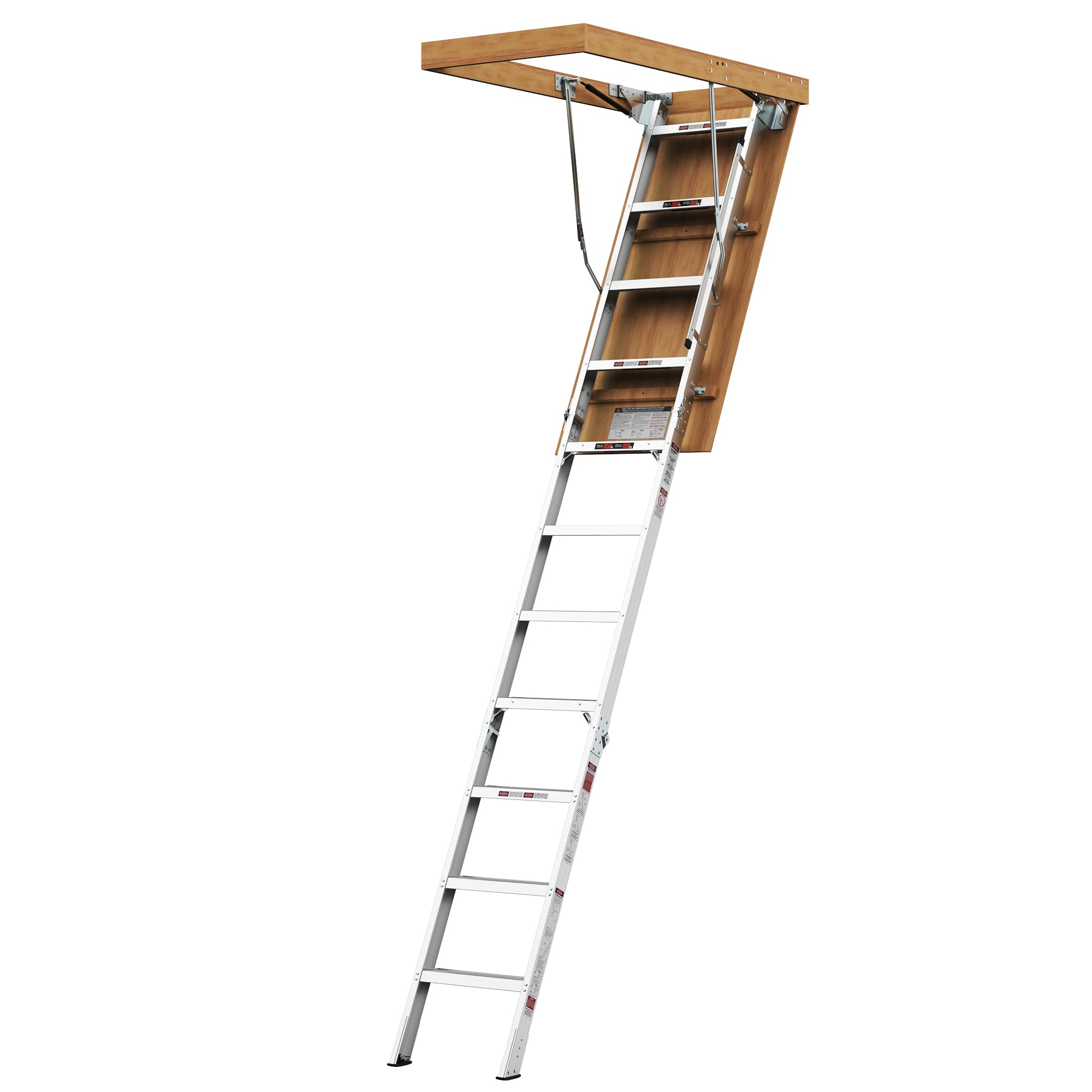
The WIILAYOK aluminum ladder weighs about 50 pounds, making it one of the lighter full-size pull-down units on the market. The telescopic sections extend and lock without needing external springs, which simplifies the setup. The 375-pound capacity is adequate for one person plus standard attic loads, and the anti-slip tread surface provides grip even when the ladder is angled steeply.
The rough opening is 25 by 54 inches, and the height adjusts from 7’8″ to 10’3″. The heavy-duty hinge system uses reinforced rivets rather than pressed pins, which improves long-term durability. A contractor reviewer noted that the build quality exceeds what he sees in newly constructed homes, particularly regarding the hinge plate thickness.
A few users have reported a small gap at one corner of the door panel after installation. Some have solved this by adding door magnets to pull the panel flush. The ladder itself remains stable during use, and the pull-down effort is low enough that lighter users can operate it without struggling.
Why it’s great
- Lightweight at 50 pounds for easier install
- Reinforced hinge rivets improve durability
- Low pull-down effort suitable for all users
Good to know
- Small door gap may need magnets for flush closure
- Not designed for very high ceilings above 10’3″
8. Thctvous 10FT Aluminium Attic Ladder

The Thctvous ladder uses high-strength aluminum and carbon steel construction with a metallic grey finish. The 3-inch non-slip rungs provide a confident foot surface, and the integrated handrails add stability during the climb. The 350-pound load capacity meets the needs of most residential users, and the pneumatic springs reduce the effort needed to fold the ladder back.
The rough opening dimensions are 25 by 54 inches, and the ladder adjusts for ceiling heights from 7’8″ to 10’3″. The ANSI 14.9 compliance means it has passed independent safety testing for structural integrity. Users repeatedly mention the clear instructions and the straightforward assembly process, with most installations completed in under two hours.
The carbon steel components add weight — the unit is 50 pounds — but the trade-off is reduced flex compared to lighter all-aluminum models. The ladder folds compactly into the ceiling opening without protruding into the room. If you want a solid, well-reviewed ladder from a newer brand that follows established safety standards, this is a strong contender.
Why it’s great
- ANSI 14.9 safety certified
- Pneumatic springs assist folding
- Clear instructions simplify installation
Good to know
- Carbon steel components add weight
- Limited to 350-pound maximum load
9. KWCWB Wall-Mounted Attic Ladder

The KWCWB wall-mounted ladder takes a different approach by attaching directly to a vertical wall rather than folding into a ceiling cutout. This design eliminates the need for a large ceiling hole and makes it suitable for attics with limited overhead clearance. The Al-Mg alloy and aluminum frame supports a massive 881-pound load capacity, making it the strongest unit in this lineup by a wide margin.
The 12-step ladder reaches a maximum height of 10.17 feet with step spacing between 8.66 and 9.84 inches. The S-bent skeletons and reinforcement rivets create a triangular support structure that reduces vibration during climbing. Both sides come with handrails, and the retractable design folds against the wall when not in use. The vertical mount also frees up floor space compared to A-frame alternatives.
Some users report a slight side-to-side sway when the ladder is fully extended, though it remains stable under normal use. Installers note that the pre-drilled holes may not align with 16-inch stud spacing, requiring horizontal 2×6 cross pieces. This is not a project for a solo installer, but the extreme load capacity and wall-mount versatility make it a unique option for heavy-duty commercial or residential scenarios.
Why it’s great
- 881-pound capacity for heavy commercial use
- Wall-mount design avoids ceiling cutout
- Dual handrails improve climbing safety
Good to know
- Side-to-side sway present at full extension
- Mounting holes may not align with standard stud spacing
FAQ
Can I install an attic ladder that is larger than my rough opening?
How much weight can a standard residential pull-down ladder hold?
Do attic ladders come with an insulated door panel?
How do I know if my ceiling height is within the ladder’s range?
Final Thoughts: The Verdict
For most users, the best attic door winner is the Louisville Ladder AL3040MG-R10 because it combines a wide 30-by-54-inch opening with an R-10 insulated door that actually saves energy. If you have a ceiling height above ten feet, grab the VEVOR Foldable 63-Inch Ladder for its hydraulic descent and extended reach. And for heavy-duty storage where load capacity tops everything, nothing beats the Takpylia Wall-Mounted 600-Pound Stairs.

Mo Maruf
I created WellFizz to bridge the gap between vague wellness advice and actionable solutions. My mission is simple: to decode the research and give you practical tools you can actually use.
Beyond the data, I am a passionate traveler. I believe that stepping away from the screen to explore new environments is essential for mental clarity and physical vitality.