Our readers keep the lights on and my smoothie glass nicely filled. As an Amazon Associate, I earn from qualifying purchases.
Most tap water arrives full of chlorine, heavy metals, and microplastics, yet the average pitcher filter struggles to remove the smallest particles, leaving you with water that tastes marginally better but still carries contaminants. The difference between a basic carbon pitcher and a serious multi-stage filtration system comes down to micron rating, filter longevity, and whether the system targets TDS, lead, or bacteria specifically. Understanding those specs before buying saves both money and health risk.
I’m Mohammad Maruf — the founder and writer behind WellFizz. I have spent thousands of hours analyzing lab-certified filtration specs, comparing micron ratings, NSF certifications, and gallon capacities across models ranging from countertop dispensers to under-sink RO systems to determine which designs actually deliver on their claims.
Whether you need a countertop filter for a rental, a gravity-fed system for emergency preparedness, or an under-sink RO for the purest drinking water, choosing the right at home water purifier depends on matching your specific water quality concerns to the right filtration technology.
How To Choose The Best At Home Water Purifier
Your tap water chemistry determines which filtration technology will work. Homes on municipal supplies typically deal with chlorine, lead, and VOCs, while well water often contains bacteria, sediment, and minerals. Identifying the dominant contaminants in your water is the first step — a simple water quality report from your local utility or an at-home test kit gives you the data you need before considering any specific system.
Filtration Technology: Carbon, UF, or RO
Activated carbon blocks (0.5 micron) handle chlorine, taste, odor, and some heavy metals, but they cannot remove dissolved solids, bacteria, or viruses. Ultrafiltration (UF) membranes at 0.01 micron block bacteria and most viruses without removing minerals, making them ideal for well water or gravity-fed systems. Reverse osmosis (RO) at 0.0001 micron removes virtually everything, including dissolved solids, fluoride, and PFAS, but requires electricity or water pressure and typically wastes some water during the filtration process.
Certifications: NSF/ANSI Standards
Look for NSF/ANSI 42 (chlorine, taste, odor), NSF/ANSI 53 (lead, VOCs, cysts), and NSF/ANSI 372 (lead-free materials). A system certified to these standards has been third-party tested, not just marketing claims. Third-party lab verification matters more than the number of filter stages — a 3-stage certified system outperforms an uncertified 8-stage unit every time.
Filter Lifespan and Flow Rate
Filter life is measured in gallons, not months, because water usage varies wildly between households. A 200-gallon filter lasts roughly three months for a family of four, while an 8,000-gallon system can go a full year. Flow rate affects daily convenience — 0.5 GPM is fine for filling a glass, but 1.6 GPM or higher is needed to fill a pot or pitcher quickly. Gravity-fed systems run at 0.06 GPM and require patience, while countertop direct-connect models deliver instant flow.
Quick Comparison
On smaller screens, swipe sideways to see the full table.
| Model | Category | Best For | Key Spec | Amazon |
|---|---|---|---|---|
| Waterdrop ED01W | Electric Pitcher | Instant filtered water | 0.5 µm carbon block filter | Amazon |
| LifeStraw Personal Filter | Portable Straw | Hiking & emergency | 0.2 µm microfiltration membrane | Amazon |
| OEMIRY Countertop | Countertop | Sink-mount direct flow | 1.6 GPM fast flow rate | Amazon |
| SimPure V7 | Under Sink | Space-saving permanent install | 304 stainless steel housing | Amazon |
| Frizzlife DS99 | Countertop | Premium build & flow | 2 GPM @ 60 psi flow rate | Amazon |
| Purewell 2.25G | Gravity Fed | No-power household use | 0.01 µm UF membrane | Amazon |
| Waterdrop T3-T RO | Under Sink RO | Highest purity water | 0.0001 µm RO membrane | Amazon |
In‑Depth Reviews
1. Waterdrop ED01W Electric Water Filter Pitcher
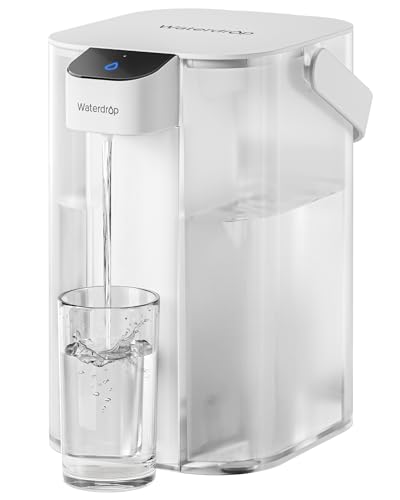
The Waterdrop ED01W bridges the gap between a traditional pour-through pitcher and an electric dispenser with its one-touch operation that delivers clean water in roughly one second. The 0.5 micron carbon block filter achieves 10X the filtration efficiency of standard pitcher filters, and NSF/ANSI certifications for standards 42, 53, and 401 confirm reduction of lead, chlorine, microplastics, and over 45 contaminants.
Countertop footprint is modest at 12.5 x 12.2 inches, and the rechargeable battery lasts up to 30 days on a single full charge, eliminating the need to keep it tethered to an outlet. The 200-gallon filter life means roughly three months between replacements, and the USB Type-C charging adds modern convenience. This system does not lower TDS, so if you prefer demineralized water, the TDS reduction model is the better choice.
Customer feedback consistently highlights the ease of use across all ages and the noticeable improvement in taste, though a few users noted that filling above the max line can cause minor leaks. Replacement filters (model WD-EDF) are readily available, and the company’s customer service earns high marks for responsive replacements when issues arise.
Why it’s great
- Instant one-second dispensing eliminates pitcher waiting time
- NSF/ANSI 42, 53, and 401 certified for broad contaminant reduction
- 30-day battery life with USB-C charging for flexible placement
Good to know
- Does not reduce TDS — not suitable for those seeking demineralized water
- Must fill to max line only to avoid potential leaks
- Plastic housing may not match stainless steel aesthetic preference
2. LifeStraw Personal Water Filter

LifeStraw is the category gold standard for portable filtration, using a hollow-fiber microfiltration membrane that removes 99.999999% of waterborne bacteria and 99.999% of parasites, verified by EPA, NSF, and ASTM testing protocols. The 0.2 micron pore size also captures the smallest microplastics found in natural water sources, making it a legitimate survival-grade tool rather than a convenience item.
The 4-pack of filters provides 4,000 liters total with each unit lasting up to 1,000 gallons, and the entire straw weighs only 0.1 pounds, fitting easily into a backpack or emergency kit. This is not a system for home countertop use — there is no container, no electric pump, and no improvement to taste — but it excels in scenarios where tap water is unreliable or absent, such as hiking, camping, or international travel.
User reviews confirm the simple sip-to-filter design works exactly as promised, with many citing it as essential gear for outdoor adventures and emergency preparedness. The slight plastic taste reported by some users is a minor trade-off for the level of microbial protection provided, and the five-year shelf life when stored dry makes it a low-maintenance backup.
Why it’s great
- Proven removal of bacteria, parasites, and microplastics verified by third-party labs
- Ultra-lightweight at 0.1 pounds and compact for any pack
- Each purchase supports clean water access for a school child for a full year
Good to know
- Does not improve taste or remove chemical contaminants like chlorine
- Not designed for high-volume household water storage or large-quantity use
- Requires direct sucking — no container or gravity feed integration included
3. OEMIRY Countertop Water Filter

OEMIRY packs an impressive 8,000-gallon filter life into a compact 5.5 x 5.5 x 12.4-inch countertop housing, with a maximum flow rate of 1.6 GPM that fills an 8-ounce cup in under three seconds. The multi-stage alkaline filtration reduces up to 99% of chlorine, heavy metals, and fluoride while retaining beneficial minerals, making it a strong choice for those who want purified water without the flat taste of distilled or RO water.
Installation is genuinely tool-free — the system screws directly onto standard faucet threads using one of the six included adapters, switching between tap and filtered water via a twist mechanism. It produces zero wastewater and requires no electricity, making it suitable for RVs, offices, and rental kitchens where permanent modifications are not allowed. The single filter lasts a full 12 months under municipal water, drastically reducing annual replacement costs.
Reviewers on catchment and well water systems report dramatic improvements in taste and clarity, with bacteria tests showing negative results after filtration. The main drawback is the slow shut-off after dispensing, which causes a few drips, and the lack of a drip tray means you may want to keep a small towel nearby. This system does not reduce TDS, so it is not a solution for those needing demineralized water.
Why it’s great
- 8,000-gallon filter lifespan means one replacement per year on municipal water
- Fast 1.6 GPM flow rate eliminates waiting for a full glass or pot
- No drilling, no electricity, no wastewater — ideal for renters and RVs
Good to know
- Does not lower TDS — retains minerals, not for demineralization purposes
- Slow shut-off causes minor dripping after each use
- Diverter wand lacks a secure holder, may need tape to stay in place
4. SimPure V7 Under Sink Water Filter System

The SimPure V7 shifts the filtration point out of sight, tucking a 3.6-inch diameter stainless steel canister under the sink and connecting directly to the cold water line with no drilling required. The 5-stage composite filter uses double sediment membranes, KDF-55, and dual activated carbon blocks with 0.5 micron accuracy to reduce lead, chlorine, and bad taste while preserving natural minerals — a design that avoids the high installation cost of full RO systems while delivering better filtration than countertop pitchers.
The 20,000-gallon filter capacity is exceptional for the category, providing up to 12 months of continuous filtration for an average household. Flow rate matches the OEMIRY at 1.6 GPM, filling an 8-ounce glass in about three seconds, and the food-grade 304 stainless steel housing resists the cracking or chemical degradation common with plastic under-sink filters. Installation takes roughly five minutes with the included 3/8-inch to 1/2-inch converter fittings.
Customer reviews consistently praise the solid build quality and dramatic taste improvement, with several noting that even their pets refused unfiltered water after the switch. Some debate exists about the actual micron rating — a few users suspect the filter is closer to 5 microns than the advertised 0.5 — and one reviewer experienced chlorine taste returning after four months, though customer service addressed the issue promptly.
Why it’s great
- 20,000-gallon capacity provides the longest filter life in this comparison
- 304 stainless steel housing is durable, BPA-free, and space-saving
- Tool-free installation connects directly to existing cold water line
Good to know
- Does not lower TDS — retains minerals, not for full demineralization
- Some users report actual micron accuracy may be closer to 5 microns
- Filter life may shorten significantly with poor source water quality
5. Frizzlife DS99 Countertop Water Filter System
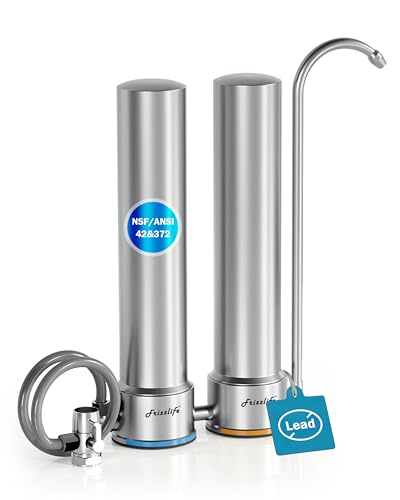
Frizzlife DS99 takes countertop filtration up a notch with its dual-stage stainless steel design, using thickened 1-millimeter 304 stainless steel housings that have passed 100,000 water hammer tests and 10,000 pulse tests. The 8-stage filtration combines a high-grade PP membrane, activated coconut shell carbon block, KDF media, and a 0.5 micron carbon block that targets lead, chlorine, fluoride, heavy metals, and VOCs while preserving essential minerals.
Flow rate hits 2 gallons per minute at 60 psi, making it the fastest direct-connect model in this lineup, and the included six adapters cover the most common American faucet thread sizes. The first-stage filter lasts up to 8 months and the second stage up to 12 months or 8,000 gallons, with replacement inner cores saving plastic waste compared to replacing entire housings. Zero wastewater and no electricity requirement keep operational costs low.
Verified buyers consistently note the immediate taste improvement and the absence of leaks thanks to the reinforced construction. A small percentage experienced initial black carbon dust during the break-in period, which clears quickly by running the system for several minutes, and the slight post-shut-off drip is common among countertop diverters in this class.
Why it’s great
- Fastest flow rate at 2 GPM among countertop models reviewed here
- Reinforced 1mm stainless steel housing tested to 100,000 cycles
- 8-stage filtration with KDF media targets lead, fluoride, and VOCs
Good to know
- Initial break-in may release black carbon dust — flush before first use
- Minor dripping after shut-off is typical for diverter-style systems
- Not compatible with pull-out, hand-held, or sensor faucets
6. Purewell 2.25G Gravity Water Filter System

The Purewell 2.25G operates entirely without electricity or water pressure, relying on gravity to pull water through a 3-stage filtration process built around a 0.01 micron hollow-fiber UF membrane. This pore size is 20 times smaller than typical countertop carbon blocks, allowing it to intercept 99.99% of bacteria, cysts, and sediment while retaining natural minerals — a critical distinction for those on well water or in emergency scenarios where power is unavailable.
The dual-chamber design holds 2.25 gallons total, with a transparent water-level window on the lower chamber so you can see exactly how much filtered water remains without opening the lid. Flow rate is 4 gallons per hour, meaning a full tank takes about 34 minutes to filter — slower than direct-connect systems but acceptable for gravity-fed designs. The stainless steel lower chamber and polypropylene construction are BPA-free and durable, and the included stand elevates the unit for easy spigot access.
Users on municipal and well water alike report complete removal of chlorine smell and taste, with several families finding that the 2.25-gallon capacity covers daily drinking and cooking needs with two to three refills per day. The filters last up to 6 months each, and the pair provides 6,000 gallons before needing replacement. The water-level window is a genuine convenience upgrade over traditional countertop gravity filters without this feature.
Why it’s great
- 0.01 micron UF membrane blocks bacteria and cysts without electricity
- Transparent water-level window eliminates guesswork on remaining capacity
- Gravity-fed operation works for off-grid, camping, and emergency use
Good to know
- Slow 4 GPH flow rate requires patience for full tank refills
- Actual usable capacity is slightly less than 2.25 gallons due to filter displacement
- Not suitable for those who need instant flow for filling pots or pitchers
7. Waterdrop T3-T Reverse Osmosis System
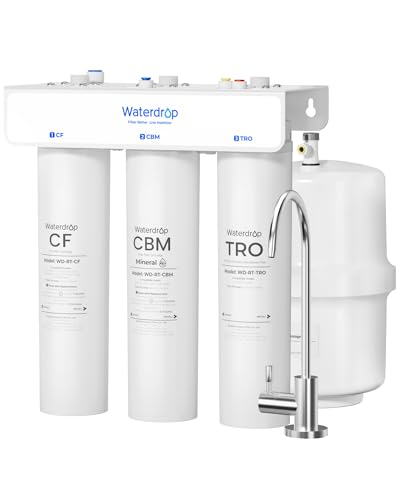
The Waterdrop T3-T delivers the highest level of filtration in this roundup, using a 0.0001 micron RO membrane that reduces up to 90% of TDS along with chlorine, heavy metals, PFAS, PFOA, and PFOS. What sets it apart from standard RO systems is the 7-stage remineralization process that adds essential minerals back to the purified water, avoiding the flat-tasting demineralized water typical of traditional RO units.
Production capacity reaches 220 gallons per day with a 7.5-minute tank refill time, ensuring ready availability even during peak household demand. The 2:1 pure-to-drain ratio is notably efficient for an RO system — most budget models waste 3 to 4 gallons for every gallon of purified water. The system is power-free (no electric booster pump required) and includes NFC smart tag technology for tracking filter life and accessing installation guides from your phone.
While the filtration capability is undeniable, installation requires drilling a hole in the countertop for the dedicated faucet, making it less suitable for renters or those who avoid permanent modifications. The 12.6 x 6.1 x 14.7-inch footprint under the sink is compact for an RO system with a tank, though you will need to free up some cabinet space. Customer reviews highlight the straightforward DIY installation, the excellent taste of the remineralized water, and responsive support from the manufacturer when issues arise.
Why it’s great
- RO membrane removes 90% of TDS plus PFAS, heavy metals, and fluoride
- Remineralization stage restores essential minerals for better taste
- 2:1 pure-to-drain ratio minimizes water waste compared to standard RO
Good to know
- Faucet installation requires drilling a hole in the countertop
- Slow dispensing speed — about 12 seconds per 8-ounce glass
- Requires dedicated under-sink space; not suitable for cramped cabinets
FAQ
Do I need a system that lowers TDS?
Can I install a countertop filter on a pull-out or spray faucet?
How often should I replace the filter in a countertop water purifier?
Final Thoughts: The Verdict
For most users, the at home water purifier winner is the Waterdrop ED01W because it combines instant electric dispensing, NSF-certified 0.5 micron filtration, and a 200-gallon filter life in a compact countertop footprint that works for apartments and families alike. If you need the highest purity water with TDS reduction and mineral restoration for the best possible taste, grab the Waterdrop T3-T RO. And for a budget-friendly, long-lasting under-sink option that clears up cabinet space, nothing beats the SimPure V7 with its 20,000-gallon capacity and stainless steel build.

Mo Maruf
I created WellFizz to bridge the gap between vague wellness advice and actionable solutions. My mission is simple: to decode the research and give you practical tools you can actually use.
Beyond the data, I am a passionate traveler. I believe that stepping away from the screen to explore new environments is essential for mental clarity and physical vitality.