Our readers keep the lights on and my smoothie glass nicely filled. As an Amazon Associate, I earn from qualifying purchases.
The challenge of finding over-ear headphones that deliver genuine clarity, deep bass, and lasting comfort without crossing the two-hundred-dollar mark is a specific kind of audio hunt. The market is saturated with flashy models promising high-res sound but delivering thin, plastic-y audio and ear cups that start to pinch after an hour. You need a pair that cuts through the noise—both the ambient kind and the marketing kind—by prioritizing measurable performance in driver response, impedance matching, and passive noise isolation.
I’m Mohammad Maruf — the founder and writer behind WellFizz. I’ve spent thousands of hours cross-referencing consumer reviews, third-party frequency response graphs, and long-term durability reports for headphones in this exact price bracket to separate the true studio contenders from the lifestyle pretenders.
After rigorous analysis of material quality, driver architecture, and real-world battery life for wireless models, I’ve assembled the definitive guide to the best around ear headphones under 200.
How To Choose The Best Around Ear Headphones Under 200
Gravity, foam density, and diaphragm thickness matter far more than brand logos. Here’s what to focus on before clicking add to cart.
Driver Size & Type
The 40mm dynamic driver is the category standard, offering a reliable balance of bass slam and treble extension. Planar magnetic drivers, like the one found in the HIFIMAN Sundara, use a thin, electrically charged diaphragm suspended between magnets for faster transient response and lower distortion but require more power to drive properly.
Impedance & Sensitivity
Impedance (measured in Ohms) dictates how much power the headphones need from your source. Models rated 32 Ohm are easily driven by smartphones and laptops. At 80 Ohm—the sweet spot for studio monitoring—you gain better control over the driver but may need a portable DAC for optimal volume. The 250 Ohm variants demand a dedicated headphone amplifier.
Noise Isolation vs. Active Noise Cancellation
Closed-back, circumaural designs physically block ambient sound through dense padding and sealed ear cups. Active Noise Cancellation (ANC) uses microphones and phase-cancelling algorithms to neutralize low-frequency drone. Hybrid ANC, found on the Soundcore Q30, adds external mics for adaptive filtering but adds weight and battery dependency.
Quick Comparison
On smaller screens, swipe sideways to see the full table.
| Model | Category | Best For | Key Spec | Amazon |
|---|---|---|---|---|
| beyerdynamic DT 770 PRO (80 Ohm) | Studio | Critical listening & mixing | 80 Ohm / 5 Hz–35 kHz | Amazon |
| Audio-Technica ATH-M50X | Studio | Monitoring & production | 45 mm driver / 15–28 kHz | Amazon |
| HIFIMAN Sundara Closed-Back | Hi-Fi | Audiophile listening | Planar magnetic / 6 Hz–50 kHz | Amazon |
| Sennheiser HD 280 Pro | Studio | Tracking & isolation | 32 dB isolation / 64 Ohm | Amazon |
| Audio-Technica ATH-M40x | Studio | Neutral monitoring | 40 mm driver / 15–24 kHz | Amazon |
| Sony WH-CH720N | Wireless ANC | Travel & daily commute | 192 g / 35 h battery | Amazon |
| Soundcore Q30 by Anker | Wireless ANC | Budget-friendly travel | 40 mm / 50 h ANC on | Amazon |
In‑Depth Reviews
1. beyerdynamic DT 770 PRO (80 Ohm)

The DT 770 PRO has been a studio standard for decades, and the 80 Ohm version delivers the most versatile performance for the under-200 bracket. The closed-back, circumaural design physically blocks around 32 dB of ambient noise without any electronics, making it a reliable choice for tracking vocals or mixing in noisy environments. The 45 mm dynamic driver produces punchy, articulate bass with a controlled low-end that doesn’t bleed into the mids.
Comfort is exceptional thanks to the iconic black velour ear pads that resist sweat and remain breathable during extended sessions. The metal-reinforced headband and fully replaceable parts (pads, cable, headband) mean this is a headphone built to last a decade, not a season. The 3-meter straight cable gives you freedom on a desk but is less portable for commuting.
The sound signature is slightly V-shaped with a treble emphasis that adds air and detail but can become fatiguing at high volumes. Equalization through software like Equalizer APO smooths out that peak nicely. The 80 Ohm impedance requires more power than a typical phone can provide, so pairing it with a dedicated DAC or audio interface is strongly recommended for best performance.
Why it’s great
- Exceptional build quality with serviceable parts
- Class-leading passive isolation for a closed-back
- Punchy, detailed bass that translates well to mixes
Good to know
- Requires an amplifier or interface for optimal volume
- Treble can become harsh at high output levels
- Non-detachable fixed cable limits portability
2. Audio-Technica ATH-M50X

The M50X is one of the most critically acclaimed closed-back monitors in pro audio. Its proprietary 45 mm large-aperture driver, using rare earth magnets and copper-clad aluminum wire voice coils, delivers an extended frequency response from 15 Hz to 28 kHz. The bass is deep and accurate without being boomy, and the mids are forward enough to make vocal mixing decisions clear.
Build quality is robust with a metal headband and 90-degree swiveling ear cups for single-ear monitoring. The three included detachable cables (1.2 m coiled, 3 m straight, and 1.2 m straight) offer flexibility across different use cases. Comfort is good for medium-sized ears, but the clamp force is slightly higher than the DT 770, and the stock ear pads can become warm over long sessions.
The sound signature has a slight treble emphasis that reveals sibilance in poorly mastered tracks. It’s not strictly neutral, but the clarity and detail retrieval are excellent for the price point. The M50X works well directly from laptops and interfaces without an external amp, making it more plug-and-play than the DT 770.
Why it’s great
- Excellent bass accuracy and transient response
- Three detachable cables for versatile connectivity
- Folding design and carrying case included
Good to know
- Treble peak can emphasize sibilance
- Ear pads may cause heat buildup
- Soundstage is narrower than open-back alternatives
3. HIFIMAN Sundara Closed-Back

The Sundara Closed-Back brings planar magnetic technology into a sub-200 price range, and the difference is immediately audible. The NEO “supernano” diaphragm is 80% thinner than conventional polyester diaphragms, resulting in a transient response that captures micro-details in cymbal hits, bass guitar slides, and room ambience. The Stealth Magnet design reduces internal reflections, so the sound stage feels more open than typical closed-back headphones.
Build quality leans into luxury with hand-assembled beechwood ear cups that also serve an acoustic purpose by reducing resonance. The lightweight headband has a matte finish and provides adequate, though not plush, padding. The detachable dual-sided 3.5 mm cable is on the shorter side—around 1.5 meters—so desk placement matters. A 6.35 mm adapter is included for interface use.
Comfort is mixed: the ear pads are soft and have generous foam, but the clamp force is firm and the overall weight is higher than many dynamic driver competitors. This headphone strongly benefits from a dedicated DAC/amp combo to reach its full potential. Without sufficient power, the bass can sound anemic and the highs can become slightly brittle.
Why it’s great
- Planar magnetic driver offers exceptional clarity and speed
- Beautiful beechwood ear cups reduce cabinet resonance
- Wide, open soundstage for a closed-back design
Good to know
- Requires a quality DAC/amp for proper performance
- Heavier and clamps tighter than some competitors
- Stock cable is short and somewhat stiff
4. Sennheiser HD 280 Pro

The HD 280 Pro is purpose-built for high-ambient-noise environments like live sound reinforcement and broadcast. The closed-back circumaural design attenuates sound by up to 32 dB, which is among the highest passive isolation figures in this price range. This makes it a top-tier option for drum tracking or recording vocals in untreated rooms.
The sound signature is honest and linear, with tight lows and accurate mids. The high frequencies are slightly exaggerated at the upper end, giving them a crispness that helps identify sibilance and noise floor issues during editing—but that same emphasis can feel fatiguing for casual music listening. An EQ cut around 8 kHz tames the brightness effectively.
Comfort is functional with soft ear pads, though the clamping force is notably strong straight out of the box. The headband and yokes are made from durable plastic that can withstand drops but may develop joint wire failures if the folding mechanism is used repeatedly. The single-sided cable is tough and thick, and replacement parts are widely available.
Why it’s great
- Industry-leading passive noise isolation for the price
- Honest, linear frequency response for critical monitoring
- Very affordable and easy to source replacement pads
Good to know
- Clamp force is tight—requires break-in period
- Folding mechanism is a known failure point
- Treble can be shrill without EQ
5. Audio-Technica ATH-M40x

The ATH-M40x is often overshadowed by its more expensive sibling, the M50X, but it actually delivers a more neutral frequency response. The 40 mm driver with rare earth magnets and CCAW voice coils produces a flatter midrange that makes it a better choice for critical mixing decisions. Instrument separation is surprisingly good for the driver size, and the bass is present without being lifted.
Build quality is solid with a foldable design and a protective case included. The ear pads are professional-grade material but have a thinner foam that can cause pressure points on larger ears—many users swap them for Brainwavz velour pads to improve comfort without altering the sound signature too much. The detachable cable uses a twist-lock connector that stays secure during movement.
The soundstage is on the intimate side, which is typical for closed-back studio monitors in this class. The high frequencies are smooth and non-fatiguing, though they lack the air and sparkle of the M50X. This headphone does not require an amp for most listening but benefits from a clean DAC source for best clarity.
Why it’s great
- More neutral tuning than the M50X for mixing
- Comes with carrying case and two detachable cables
- Smooth, non-fatiguing treble response
Good to know
- Stock ear pads are uncomfortable for larger ears
- Soundstage is narrow
- Build is plastic-heavy compared to metal-frame competitors
6. Sony WH-CH720N

The WH-CH720N is Sony’s lightest wireless noise-canceling headband ever, weighing just 192 grams. This makes a tangible difference during long commutes or office days where heavier headphones cause neck strain. The Dual Noise Sensor technology, powered by the Integrated Processor V1, provides adaptive ANC that filters out drone without introducing excessive cabin pressure.
Battery life reaches 35 hours with ANC enabled, and a 3-minute quick charge yields one hour of playback. The DSEE engine upscales compressed audio files, adding some air and detail to Spotify streams. Multipoint connection allows seamless switching between a phone and laptop, which is a practical feature for multitaskers.
The sound signature is consumer-friendly with a bass boost and slightly recessed mids, making it less suitable for critical listening but very engaging for pop, EDM, and podcasts. The touch controls on the ear cup are responsive but the volume and track skip buttons are placed too close together, causing accidental presses. No carrying case is included, which is a notable omission at this price tier.
Why it’s great
- Extremely lightweight—192 grams for fatigue-free wear
- Good adaptive ANC with minimal pressure sensation
- Multipoint Bluetooth for dual-device workflows
Good to know
- Bass-heavy tuning masks midrange detail
- No carrying case or hard shell included
- Button layout leads to accidental track skips
7. Soundcore Q30 by Anker
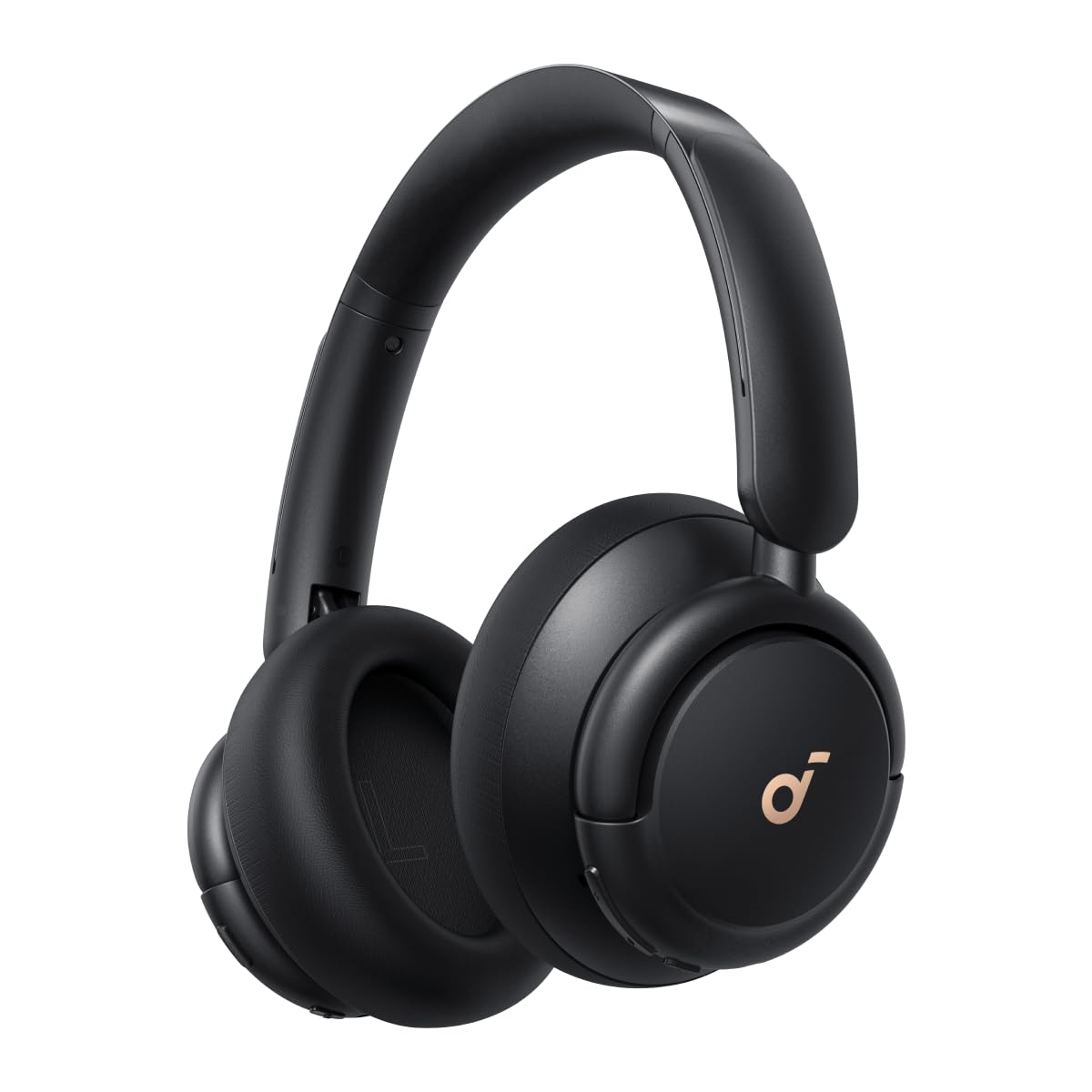
The Q30 punches far above its class by offering hybrid active noise cancellation with three distinct modes: Transport (for airplane engine drone), Outdoor (for traffic and wind), and Indoor (for office chatter). Dual noise-detecting microphones filter out up to 95% of low-frequency ambient sound. The clarity is impressive—speech sounds clear, but white noise from the ANC circuit remains audible when no music is playing.
The 40 mm silk diaphragm drivers deliver a frequency response that extends to 40 kHz, supporting Hi-Res Audio certification. Bass is present but controlled, and the 8-band EQ in the companion app lets you dial in a flatter signature if the default V-shape is too aggressive. Battery life reaches 50 hours with ANC on and 70 hours in standard mode, which outlasts every other wireless model on this list.
Comfort is a strong point thanks to ultra-soft protein leather ear cups with memory foam padding. The lightweight plastic build feels less premium than the Beyerdynamic or Audio-Technica models, but it stays comfortable for extended wear. The headband adjustment is smooth, and the overall clamp force is gentle. A soft carrying pouch is included, though a hard case would be preferable for travel durability.
Why it’s great
- Outstanding battery life—50 hours with ANC active
- Effective multi-mode hybrid ANC for various environments
- Comfortable memory foam padding for long sessions
Good to know
- ANC is audible as faint white noise in quiet rooms
- Build feels less robust than studio-focused wired models
- Soft pouch offers less protection than a hard case
FAQ
What is the ideal impedance for use with a smartphone?
How does passive noise isolation differ from active noise cancellation?
Do planar magnetic headphones require a special amplifier?
Final Thoughts: The Verdict
For most users, the best around ear headphones under 200 winner is the beyerdynamic DT 770 PRO (80 Ohm) because it combines bulletproof build, exceptional passive isolation, and a sound signature that translates perfectly into studio work and serious listening. If you need wireless freedom and lightweight comfort for travel, grab the Sony WH-CH720N. And for pure audiophile detail retrieval with a planar magnetic driver, nothing beats the HIFIMAN Sundara Closed-Back.

Mo Maruf
I created WellFizz to bridge the gap between vague wellness advice and actionable solutions. My mission is simple: to decode the research and give you practical tools you can actually use.
Beyond the data, I am a passionate traveler. I believe that stepping away from the screen to explore new environments is essential for mental clarity and physical vitality.