Our readers keep the lights on and my smoothie glass nicely filled. As an Amazon Associate, I earn from qualifying purchases.
When your arch collapses, every step sends a shockwave from your heel through your knees and up your spine. That dull ache in the bottom of your foot isn’t just tiredness — it’s your foot’s natural shock absorber failing under load. For anyone with flat feet, a standard insole is a cosmetic bandage; you need a rigid, biomechanically-designed insert that rebuilds the arch’s structural integrity from the ground up.
I’m Mohammad Maruf — the founder and writer behind WellFizz. I’ve spent 15 years analyzing product specifications, combing through thousands of verified customer reports, and consulting biomechanical research to determine which orthotic materials and geometries actually stabilize overpronation without causing new pressure points.
This guide breaks down the five most effective rigid and semi-rigid inserts on the market, ranked by material quality, arch height consistency, and real-world durability. Whether you stand on concrete all day or log miles on pavement, you’ll find the exact arch inserts for flat feet that match your foot shape and activity level.
How To Choose The Best Arch Inserts For Flat Feet
Flat feet aren’t just about missing an arch curve — the foot’s entire kinetic chain is compromised. Buying an insert designed for general fatigue is a waste of money. You need a support system that mechanically repositions the talus and calcaneus.
Rigidity: Soft Foam Will Collapse, Semi-Rigid Won’t
A flat foot needs a firm shelf to push against. Soft gel or memory foam insoles compress instantly under body weight, offering zero structural correction. Look for semi-rigid shells made from TPU (thermoplastic polyurethane) or reinforced nylon. These materials hold their shape for 12–18 months, even under 230+ lbs of load.
Heel Cup Depth: The Anchor That Prevents Splay
If the heel cup is shallow, your foot slides outward with each step, undoing any arch support. A deep, 12–15 mm heel cup wraps the calcaneus snugly, controlling rearfoot motion and preventing the foot from rolling inward (overpronation). Measure your current insole’s heel depth — anything under 10 mm is insufficient for flat feet.
Arch Height & Length: 3/4 vs. Full-Length Fit
Many flat-footed people have short toe boxes or narrow shoes. A 3/4-length insert stops before the toes, leaving room for natural splay and avoiding crowding. Full-length inserts give more surface-area cushioning but require at least 10 mm of vertical clearance under the toes. If your work boots or dress shoes are already snug, a 3/4-length is the safer bet.
Quick Comparison
On smaller screens, swipe sideways to see the full table.
| Model | Category | Best For | Key Spec | Amazon |
|---|---|---|---|---|
| Psveb Professional Heavy Duty | Full-Length | All-day standing & heavy load | Dual PORON cushioning + Golden Triangle shell | Amazon |
| BestHalo Plantar Fasciitis Insoles | Full-Length | Rigid high-arch correction for heavy users | Premium EVA + gel cushioning, deep heel cup | Amazon |
| VALSOLE Heavy Duty Support | Full-Length | Warehouse & construction work boots | High arch rigidity for 220+ lbs | Amazon |
| OUOKK Plantar Fasciitis Low Arch | 3/4 Length | Low or fallen arches in tight shoes | 26mm TPU arch, 3 arch height options | Amazon |
| Welnove Semi-Rigid Arch Support | 3/4 Length | Metatarsal pain + flat feet | Semi-rigid shell, metatarsal pad | Amazon |
In‑Depth Reviews
1. Psveb Professional Heavy Duty Support Orthotics
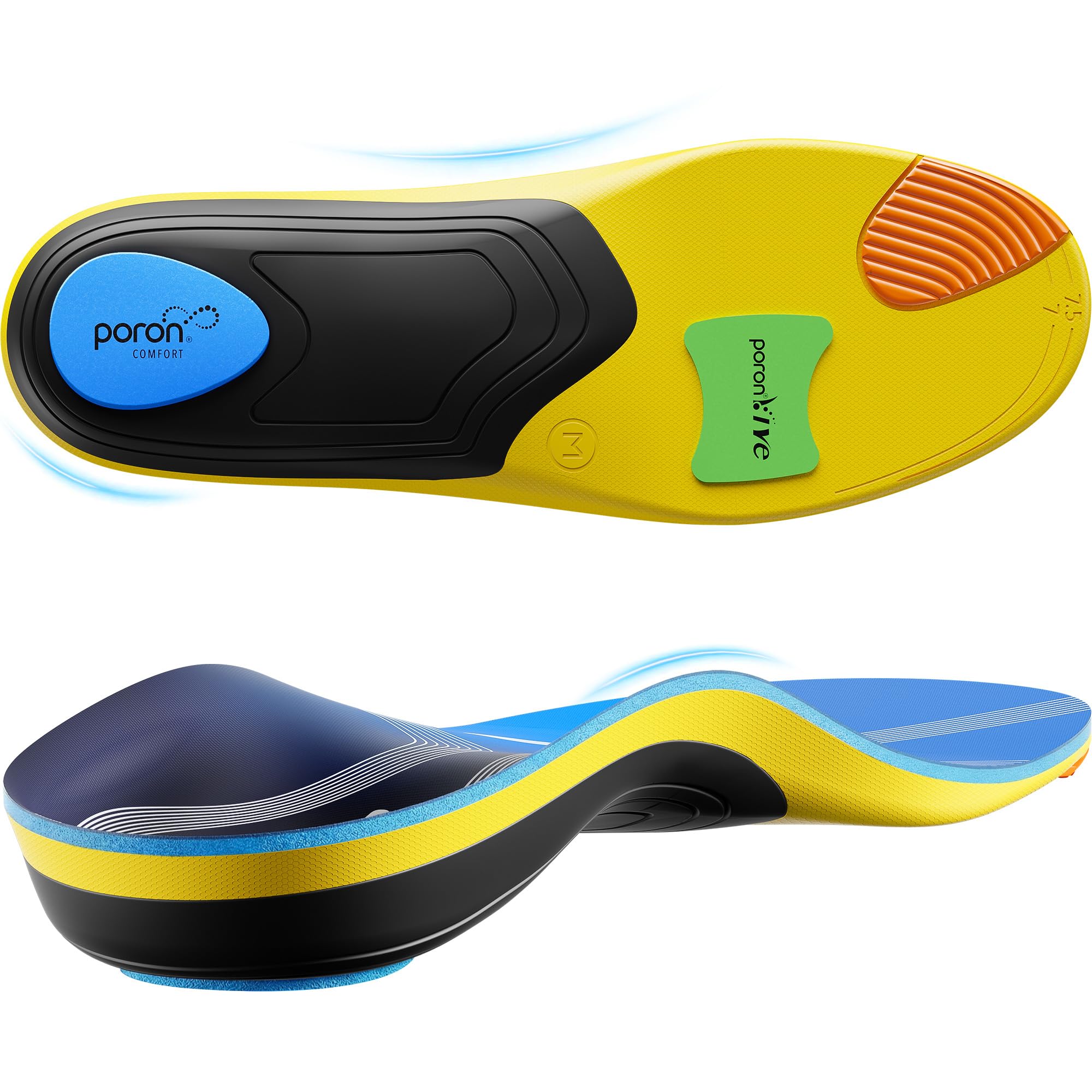
This is the Goldilocks insert for flat feet that need daily structural correction without feeling like a wooden plank. The “Golden Triangle” ergonomic design delivers three-point support across the forefoot, arch, and heel — a geometry that mathematically resists the collapse pattern of overpronation. The dual PORON layers absorb shock better than single-density EVA while maintaining a medium firmness that most users adapt to within a week.
Customer feedback from heavy users (230+ lbs) confirms zero flattening after three weeks of 9-to-10-hour shifts on hard flooring. The skin-friendly, sweatproof fabric keeps moisture away, which matters for all-day wear in work boots or gym shoes. A minor toe trim is needed for size 10 and above, but the material cuts cleanly without delaminating.
Where this insert truly separates itself is the balance between rigidity and cushion. It gives enough support to realign the arch but doesn’t cause the “bowling ball under the foot” sensation that some semi-rigid designs produce. For most flat-footed individuals walking or standing all day, this is the safest first recommendation.
Why it’s great
- Proven 9+ hour standing durability without compression
- Three-zone support prevents heel drift and forefoot collapse
- Sweat-wicking top layer reduces odor and irritation
Good to know
- May require toe trim for sizes 10 and above
- Too thick for low-back sneakers or slip-ons
2. BestHalo Heavy Duty Plantar Fasciitis Insoles
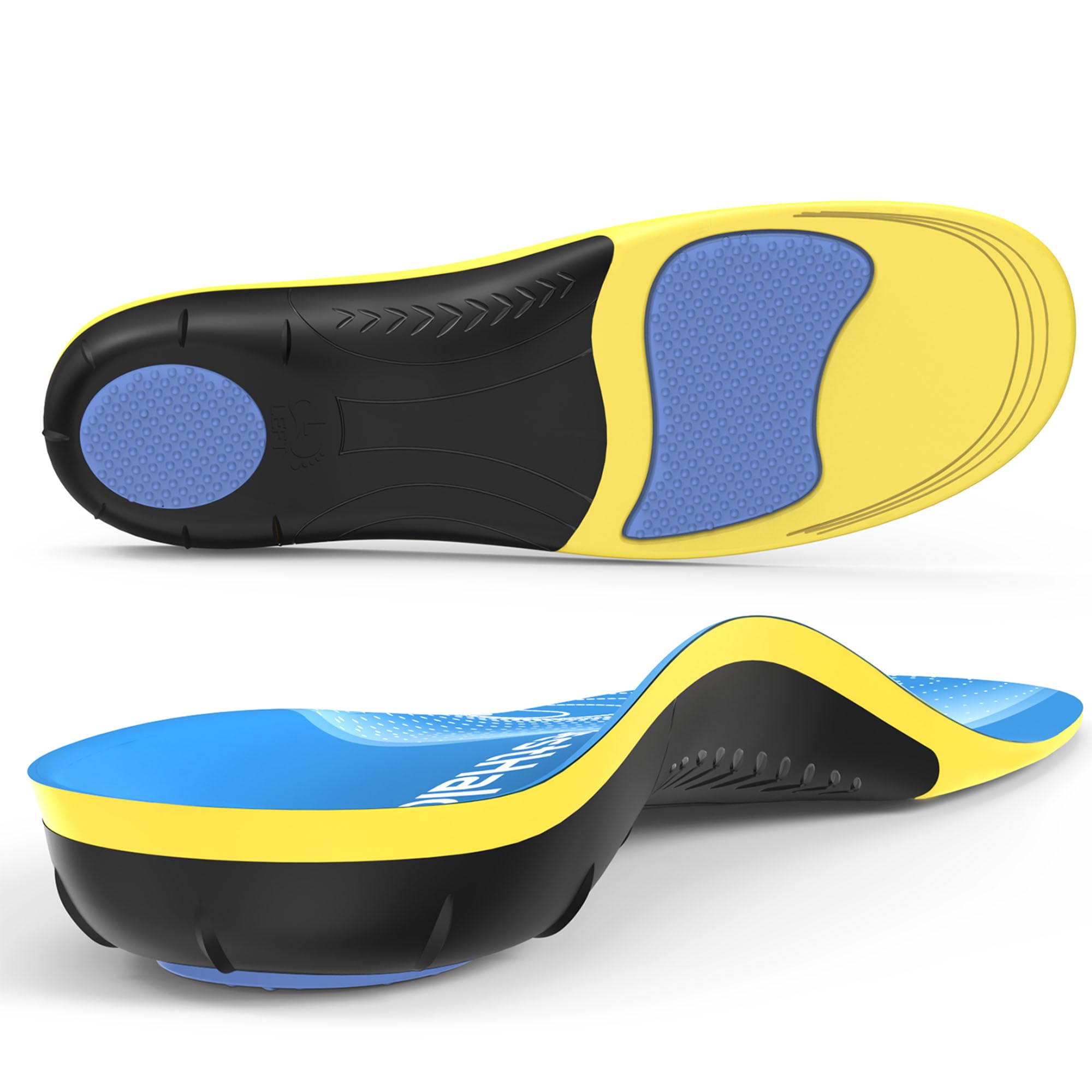
BestHalo targets the heavy-load demographic directly — users over 220 pounds who need arch rigidity beyond what standard drugstore inserts provide. The biomechanical design lifts the arch aggressively, which is excellent for flat feet that have been compensating with ankle and knee rotation. The deep heel cup is noticeably higher than competitors, locking the calcaneus in neutral alignment and resisting the medial roll of overpronation.
Real-world testers in the warehouse and construction sectors reported back pain relief after the first shift — a strong signal that the insert is correcting the kinetic chain, not just padding the foot. The premium EVA foam with gel cushioning offers a two-stage feel: firm on the arch, forgiving under the heel. Multiple users noted a 3-to-7-day adaptation period where the arch feels intense; this is normal for a rigid orthotic waking up dormant muscles.
The trim-to-fit design works well in athletic shoes and work boots, but some users with naturally high arches found the elevation too aggressive. This insert is purpose-built for fallen arches — if your foot still has some natural arch height, choose a medium-support option instead.
Why it’s great
- Highest arch rigidity in this lineup for 220+ lb users
- Heel cup depth effectively controls rearfoot pronation
- Back pain relief reported after first shift by heavy users
Good to know
- Arch may feel too aggressive during 5-day break-in period
- Not suitable for medium or high natural arches
3. VALSOLE Heavy Duty Support Pain Relief Orthotics

VALSOLE earns its reputation from the warehouse floor. A 6-foot-5, 235-pound former athlete reported zero knee or foot pain after the first day — a testimonial that matches the mechanical specs: high arch rigidity paired with a stiff heel cradle that distributes ground reaction forces evenly across the midfoot. The orthopedic design focuses on even pressure distribution rather than just lifting the arch, which reduces the hot-spot pain that flat-footed walkers often develop under the ball of the foot.
Multiple reviews from concrete-floor workers confirm that the insert “turned uncomfortable sneakers into the most comfortable pair” after a single day. The shock absorption layer uses a multi-density foam rather than a single gel pad, giving more progressive deceleration on heel strike. The fit is accurate to size with no trimming needed for most standard widths.
While the cushioning is rated “alright to good” by users who have tried premium + inserts, the VALSOLE holds its own at a mid-range point. The trade-off is slightly less forefoot padding compared to a full PORON design — something to note if you have metatarsalgia alongside your flat feet.
Why it’s great
- Instant pain relief for heavy warehouse and construction workers
- Even pressure distribution reduces ball-of-foot hot spots
- Accurate sizing with no trimming required for standard widths
Good to know
- Forefoot cushioning is less forgiving than PORON-based inserts
- May feel firm for those transitioning from soft gel insoles
4. OUOKK Low Arch Support Inserts (3/4 Length)
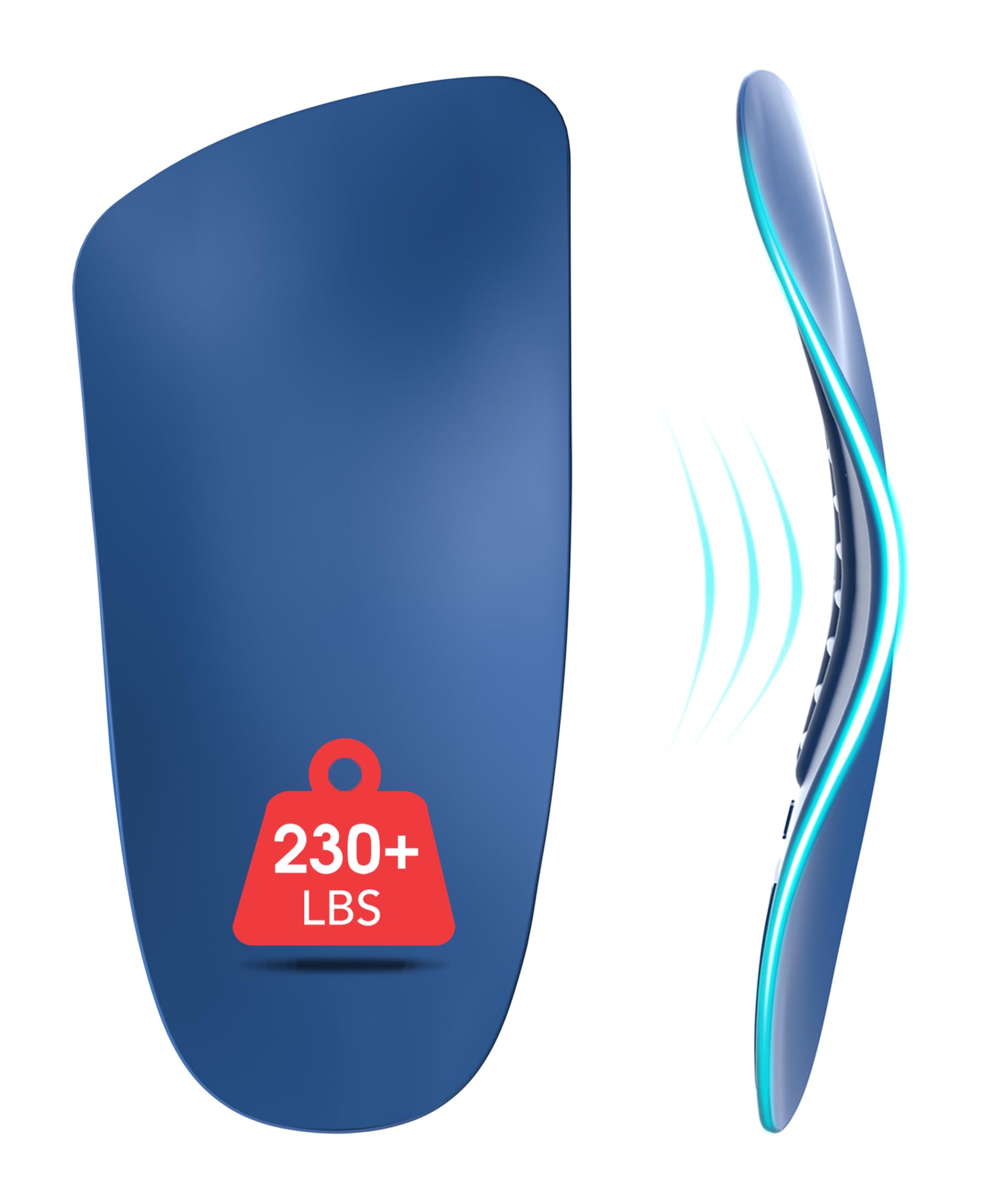
OUOKK solves the biggest fit challenge for flat feet: shoes that are too tight for a full-length orthotic. The 3/4-length design stops before the toes, leaving the toe box free for natural splay while providing 26mm of TPU arch elevation underneath. This is a premium TPU material rated for two years of daily use, which outlasts most EVA inserts by a large margin. The manufacturer offers three arch heights, so you can match the exact curve your foot needs rather than accepting a one-size-fits-all dome.
Customers with pronounced flat feet and plantar fasciitis reported zero foot pain at the end of multi-job days, with several noting that these inserts fit easily in flats, hiking shoes, and even some heels. The thin edges save critical vertical space, making them viable in footwear that previously rejected any aftermarket insole. The “foot massage” texture on the surface distributes plantar fascia pressure more evenly than a smooth top sheet.
The main drawback is the rigidity-to-cushion ratio — some users with leg length discrepancies found the inserts too stiff for their gait, and the placement inside the shoe can shift slightly if the heel cup isn’t snug against the shoe’s counter. A dab of adhesive solves this, but it’s worth noting for picky fitters.
Why it’s great
- 3/4 design fits tight shoes that reject full-length orthotics
- 26mm TPU arch lasts 2+ years without compression
- Three arch height options allow personalized correction
Good to know
- May shift in shoes with smooth heel counters; adhesive recommended
- Stiff feel not ideal for users who prefer cushioned landings
5. Welnove Semi-Rigid Arch Support Inserts (3/4 Length)

Welnove distinguishes itself with a built-in metatarsal pad — a raised bump behind the ball of the foot that specifically targets the pain underneath the metatarsal heads, a common secondary issue for flat-footed walkers. The semi-rigid shell is stiffer than a standard gel insert but more forgiving than a full carbon-fiber orthotic, making it a good bridge option for people who need structural correction without the boot-like feel of a custom device. The 3/4 length body leaves toes uncramped, and multiple users report moving the same insert between sneakers and Crocs without issue.
Doctor recommendations appear in the feedback: podiatrists have specifically advised this model for patients with weak ankles and post-sprain recovery, citing the semi-rigid shell as superior to foam for maintaining joint alignment. Users with flat feet and metatarsal pain saw immediate improvement per multiple accounts. The heel cup wraps deeply enough to correct moderate pronation without cutting into the Achilles.
Be aware that these inserts take up substantial internal shoe volume. They will not fit snugly into low-profile shoes or narrow dress shoes; they are best used in sneakers, work boots, and casual lace-ups. The initial 3-to-5 day break-in period involves a noticeable “foreign object” sensation under the arch — this is normal for semi-rigid designs.
Why it’s great
- Built-in metatarsal pad addresses ball-of-foot pain common in flat feet
- Semi-rigid shell is podiatrist-recommended for ankle instability
- 3/4 length fits multiple shoe types without toe crowding
Good to know
- Takes up significant shoe volume; not for low-profile footwear
- Initial break-in period can feel uncomfortable for 3–5 days
FAQ
Will semi-rigid arch inserts fit in my dress shoes?
How long does it take to adapt to a rigid arch insert?
Can I use the same arch insert in multiple shoes?
Final Thoughts: The Verdict
For most users, the arch inserts for flat feet winner is the Psveb Professional Heavy Duty Support because its dual PORON cushioning and Golden Triangle geometry provide the best balance of firm correction and all-day comfort. If you want aggressive arch rigidity for 220+ pound loads, grab the BestHalo Heavy Duty Insoles. And for tight shoes where a 3/4-length is mandatory, nothing beats the OUOKK Low Arch Support Inserts for custom height selection and TPU durability.

Mo Maruf
I created WellFizz to bridge the gap between vague wellness advice and actionable solutions. My mission is simple: to decode the research and give you practical tools you can actually use.
Beyond the data, I am a passionate traveler. I believe that stepping away from the screen to explore new environments is essential for mental clarity and physical vitality.